Semester 4, 2011
                      By Fitri


Compounding
Definition
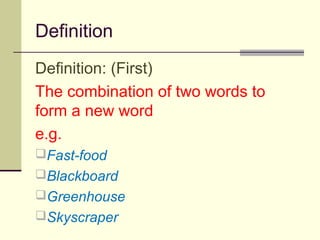
Definition: (First)
The combination of two words to
form a new word
e.g.
Fast-food
Blackboard
Greenhouse
Skyscraper
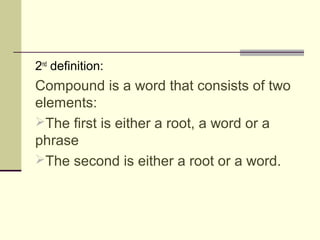
2nd definition:
Compound is a word that consists of two
elements:
The first is either a root, a word or a
phrase
The second is either a root or a word.
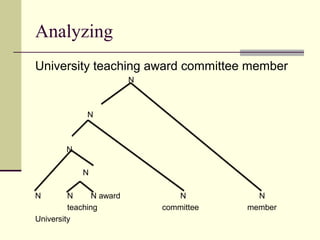
Analyzing
University teaching award committee member
                          N


              N


        N

            N

N        N      N award          N          N
         teaching             committee   member
University
The assumption that compound are binary
structures:
Innermost constituent
  [teaching award]         an award for teaching
Next larger constituent
  [university teaching award]      the teaching
 award of the university.
Next constituent
  [university teaching award committee]
Recognizing compounds
Three ways in recognizing compounds:
1. The formulation of binary structures
2. The notion of head
3. The stress
The notion of head
Compounds have a very important
systematic property:
Their head usually occurs on the right-
hand head
It’s called right-hand head rule
Type of right-hand head:
If the head is a verb, the compound will be a
verb.
  e.g. deep-fry
If the head is a count noun, the compound will
a noun.
   e.g. beer bottle
If the head has feminine gender, the
compound will have feminine gender
   e.g. head waitress
The stress
Compounds tend to have a stress pattern
that is different from phrases.
Phrases tend to be stressed at the final
word (it’s called as nuclear stress rule)
Compounds tend to be stressed on the
first element (it’s called compound stress
rule)
Example:
Noun phrases:
 [the green cárpet]
 [this new hóuse]
 [such a good jób]
Nominal compounds
 [páyment problems]
 [installátion]
 [spáce requirement]
Exception
A systematic exception of the compound stress
rule:
The compound stress rule hold for all
compounds (leftward stress).
However, there is an exception of it as the
example below:
   Geologist astrónomer
   Summer níght
   Silk tíe, aluminum foíl
   A Mahler sýmpony
 Such compounds are called copulative
  compounds
 The meaning relationships typically
  accompanied by rightward stress are:
   Temporal or locative (a summer níght, the
    boston márathon)
   Causative (aluminum fóil)
   Created by (a Shakespeare Sónnet)
Type of compounds
 Nominal compounds
 Adjectival compounds
 Verbal compounds
 Neoclassical compounds
Nominal compounds
 Compound with nouns as head (though
  involve verbs and adjectives as non-heads)
 Noun-noun compounds are the most
  common type of compound in English
 Two types of nominal compounds:
    Endocentric compounds

     the semantic head of these compounds is
     inside the compound.
    Exocentric compounds

     The semantic head is outside the
     compound
Example
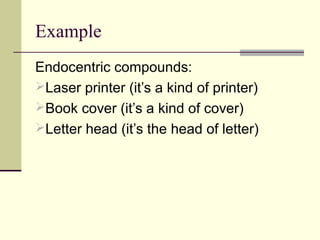
Endocentric compounds:
Laser printer (it’s a kind of printer)
Book cover (it’s a kind of cover)
Letter head (it’s the head of letter)
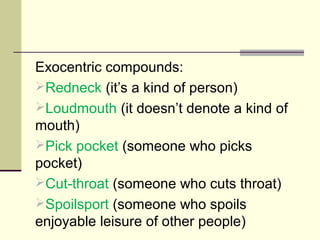
Exocentric compounds:
Redneck (it’s a kind of person)
Loudmouth (it doesn’t denote a kind of
mouth)
Pick pocket (someone who picks
pocket)
Cut-throat (someone who cuts throat)
Spoilsport (someone who spoils
enjoyable leisure of other people)
Adjectival compounds
 Compound with adjectives as head
 It can have nouns or adjectives, but as non-
 heads
 e.g.
   Capital-intensive
   Knee-deep
   Girl-crazy
   Class-conscious
   Sugar-free
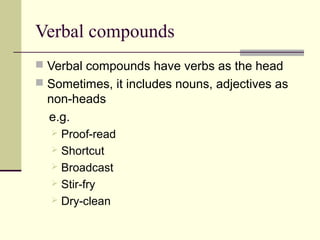
Verbal compounds
 Verbal compounds have verbs as the head
 Sometimes, it includes nouns, adjectives as
  non-heads
  e.g.
   Proof-read
   Shortcut
   Broadcast
   Stir-fry
   Dry-clean
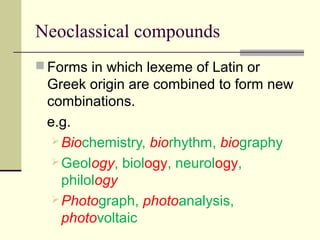
Neoclassical compounds
 Forms in which lexeme of Latin or
 Greek origin are combined to form new
 combinations.
 e.g.
   Biochemistry, biorhythm, biography
   Geology, biology, neurology,
    philology
   Photograph, photoanalysis,
    photovoltaic

Compounding

  • 1.
    Semester 4, 2011 By Fitri Compounding
  • 2.
    Definition Definition: (First) The combinationof two words to form a new word e.g. Fast-food Blackboard Greenhouse Skyscraper
  • 3.
    2nd definition: Compound isa word that consists of two elements: The first is either a root, a word or a phrase The second is either a root or a word.
  • 4.
    Analyzing University teaching awardcommittee member N N N N N N N award N N teaching committee member University
  • 5.
    The assumption thatcompound are binary structures: Innermost constituent [teaching award] an award for teaching Next larger constituent [university teaching award] the teaching award of the university. Next constituent [university teaching award committee]
  • 6.
    Recognizing compounds Three waysin recognizing compounds: 1. The formulation of binary structures 2. The notion of head 3. The stress
  • 7.
    The notion ofhead Compounds have a very important systematic property: Their head usually occurs on the right- hand head It’s called right-hand head rule
  • 8.
    Type of right-handhead: If the head is a verb, the compound will be a verb. e.g. deep-fry If the head is a count noun, the compound will a noun. e.g. beer bottle If the head has feminine gender, the compound will have feminine gender e.g. head waitress
  • 9.
    The stress Compounds tendto have a stress pattern that is different from phrases. Phrases tend to be stressed at the final word (it’s called as nuclear stress rule) Compounds tend to be stressed on the first element (it’s called compound stress rule)
  • 10.
    Example: Noun phrases: [thegreen cárpet] [this new hóuse] [such a good jób] Nominal compounds [páyment problems] [installátion] [spáce requirement]
  • 11.
    Exception A systematic exceptionof the compound stress rule: The compound stress rule hold for all compounds (leftward stress). However, there is an exception of it as the example below:  Geologist astrónomer  Summer níght  Silk tíe, aluminum foíl  A Mahler sýmpony
  • 12.
     Such compoundsare called copulative compounds  The meaning relationships typically accompanied by rightward stress are:  Temporal or locative (a summer níght, the boston márathon)  Causative (aluminum fóil)  Created by (a Shakespeare Sónnet)
  • 13.
    Type of compounds Nominal compounds  Adjectival compounds  Verbal compounds  Neoclassical compounds
  • 14.
    Nominal compounds  Compoundwith nouns as head (though involve verbs and adjectives as non-heads)  Noun-noun compounds are the most common type of compound in English  Two types of nominal compounds:  Endocentric compounds the semantic head of these compounds is inside the compound.  Exocentric compounds The semantic head is outside the compound
  • 15.
    Example Endocentric compounds: Laser printer(it’s a kind of printer) Book cover (it’s a kind of cover) Letter head (it’s the head of letter)
  • 16.
    Exocentric compounds: Redneck (it’sa kind of person) Loudmouth (it doesn’t denote a kind of mouth) Pick pocket (someone who picks pocket) Cut-throat (someone who cuts throat) Spoilsport (someone who spoils enjoyable leisure of other people)
  • 17.
    Adjectival compounds  Compoundwith adjectives as head  It can have nouns or adjectives, but as non- heads e.g.  Capital-intensive  Knee-deep  Girl-crazy  Class-conscious  Sugar-free
  • 18.
    Verbal compounds  Verbalcompounds have verbs as the head  Sometimes, it includes nouns, adjectives as non-heads e.g.  Proof-read  Shortcut  Broadcast  Stir-fry  Dry-clean
  • 19.
    Neoclassical compounds  Formsin which lexeme of Latin or Greek origin are combined to form new combinations. e.g.  Biochemistry, biorhythm, biography  Geology, biology, neurology, philology  Photograph, photoanalysis, photovoltaic