Assimilation
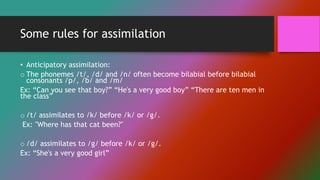
Some rules for assimilation
• Anticipatory assimilation:
o The phonemes /t/, /d/ and /n/ often become bilabial before bilabial
consonants /p/, /b/ and /m/
Ex: “Can you see that boy?” “He's a very good boy” “There are ten men in
the class”
o /t/ assimilates to /k/ before /k/ or /g/.
Ex: "Where has that cat been?"
o /d/ assimilates to /g/ before /k/ or /g/.
Ex: “She's a very good girl”
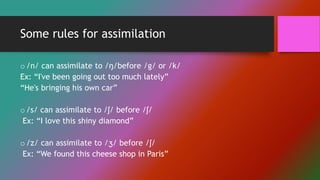
Some rules for assimilation
o/n/ can assimilate to /ŋ/before /g/ or /k/
Ex: “I've been going out too much lately”
“He's bringing his own car”
o/s/ can assimilate to /ʃ/ before /ʃ/
Ex: “I love this shiny diamond”
o/z/ can assimilate to /ʒ/ before /ʃ/
Ex: “We found this cheese shop in Paris”
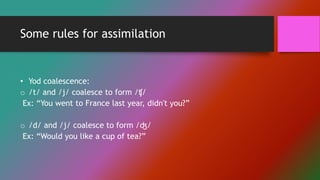
Some rules for assimilation
• Yod coalescence:
o /t/ and /j/ coalesce to form /ʧ/
Ex: “You went to France last year, didn't you?”
o /d/ and /j/ coalesce to form /ʤ/
Ex: “Would you like a cup of tea?”
Elision
Omission of a sound to reduce the effort while speaking.
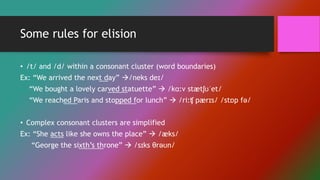
Some rules for elision
• /t/ and /d/ within a consonant cluster (word boundaries)
Ex: “We arrived the next day” /neks deɪ/
“We bought a lovely carved statuette”  /kɑ:v stætʃʊˈet/
“We reached Paris and stopped for lunch”  /ri:ʧ pærɪs/ /stɒp fə/
• Complex consonant clusters are simplified
Ex: “She acts like she owns the place”  /æks/
“George the sixth’s throne”  /sɪks θrəʊn/
Some rules for elision
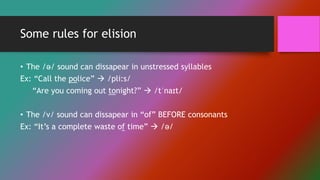
• The /ə/ sound can dissapear in unstressed syllables
Ex: “Call the police”  /pli:s/
“Are you coming out tonight?”  /tˈnaɪt/
• The /v/ sound can dissapear in “of” BEFORE consonants
Ex: “It’s a complete waste of time”  /ə/
Linking and intrusion
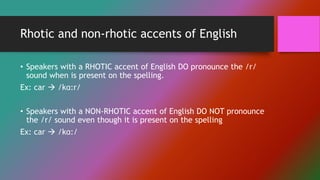
Rhotic and non-rhotic accents of English
• Speakers with a RHOTIC accent of English DO pronounce the /r/
sound when is present on the spelling.
Ex: car  /kɑ:r/
• Speakers with a NON-RHOTIC accent of English DO NOT pronounce
the /r/ sound even though it is present on the spelling
Ex: car  /kɑ:/
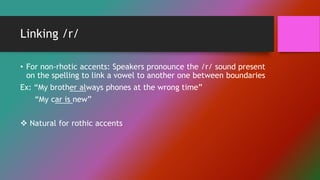
Linking /r/
• For non-rhotic accents: Speakers pronounce the /r/ sound present
on the spelling to link a vowel to another one between boundaries
Ex: “My brother always phones at the wrong time”
“My car is new”
 Natural for rothic accents
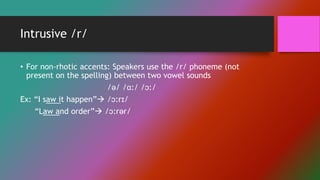
Intrusive /r/
• For non-rhotic accents: Speakers use the /r/ phoneme (not
present on the spelling) between two vowel sounds
/ə/ /ɑ:/ /ɔ:/
Ex: “I saw it happen” /ɔ:rɪ/
“Law and order” /ɔ:rər/
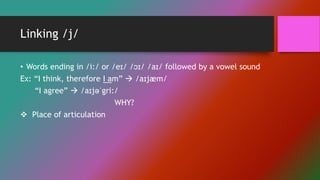
Linking /j/
• Words ending in /i:/ or /eɪ/ /ɔɪ/ /aɪ/ followed by a vowel sound
Ex: “I think, therefore I am”  /aɪjæm/
“I agree”  /aɪjəˈgri:/
WHY?
 Place of articulation
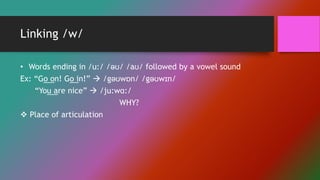
Linking /w/
• Words ending in /u:/ /əʊ/ /aʊ/ followed by a vowel sound
Ex: “Go on! Go in!”  /gəʊwɒn/ /gəʊwɪn/
“You are nice”  /ju:wɑ:/
WHY?
 Place of articulation
How to teach elision
Tips for teaching
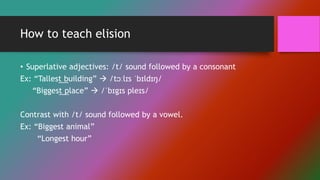
How to teach elision
• Superlative adjectives: /t/ sound followed by a consonant
Ex: “Tallest building”  /tɔːlɪs ˈbɪldɪŋ/
“Biggest place”  /ˈbɪgɪs pleɪs/
Contrast with /t/ sound followed by a vowel.
Ex: “Biggest animal”
“Longest hour”
How to teach linking
Tips for teaching
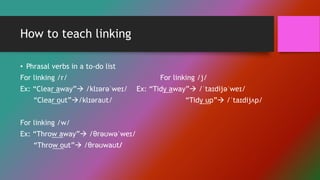
How to teach linking
• Phrasal verbs in a to-do list
For linking /r/ For linking /j/
Ex: “Clear away” /klɪərəˈweɪ/ Ex: “Tidy away” /ˈtaɪdijəˈweɪ/
“Clear out”/klɪəraʊt/ “Tidy up” /ˈtaɪdijʌp/
For linking /w/
Ex: “Throw away” /θrəʊwəˈweɪ/
“Throw out” /θrəʊwaʊt/
Juncture
Juncture
• “I scream,you scream,we all scream for ice-cream”
• “The clock keeps ticking” /ki:ps tikin/
• “The kids keep sticking things on the wall” /ki:p stikin/
• “That's my train”
• “It might rain”
Juncture
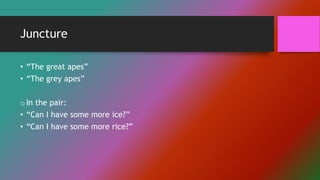
• “The great apes”
• “The grey apes”
oIn the pair:
• “Can I have some more ice?”
• “Can I have some more rice?”
Juncture
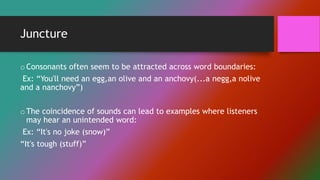
oConsonants often seem to be attracted across word boundaries:
Ex: “You'll need an egg,an olive and an anchovy(...a negg,a nolive
and a nanchovy”)
oThe coincidence of sounds can lead to examples where listeners
may hear an unintended word:
Ex: “It's no joke (snow)”
“It's tough (stuff)”
Contractions
Contractions
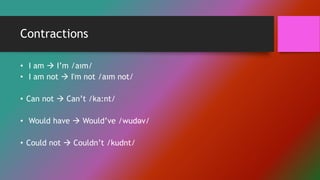
• I am  I’m /aım/
• I am not  I'm not /aım not/
• Can not  Can’t /ka:nt/
• Would have  Would’ve /wudəv/
• Could not  Couldn’t /kudnt/
Should we teach these aspects of
connected speech?
Should we teach these aspects of connected
speech?
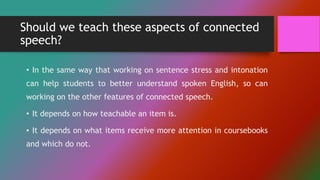
• In the same way that working on sentence stress and intonation
can help students to better understand spoken English, so can
working on the other features of connected speech.
• It depends on how teachable an item is.
• It depends on what items receive more attention in coursebooks
and which do not.
Should we teach these aspects of connected
speech?
• It depends on how they contribute to the intelligibility of the speech.
• It depends on how teachable an item is.
• It depends on how relevant an item is for the student.
• Every teacher has to make their own judgment based on the above
criteria, of how much attention to give to the different features of
connected speech.

Connected_speech_PW_presentation.pptx

  • 1.
  • 2.
    Some rules forassimilation • Anticipatory assimilation: o The phonemes /t/, /d/ and /n/ often become bilabial before bilabial consonants /p/, /b/ and /m/ Ex: “Can you see that boy?” “He's a very good boy” “There are ten men in the class” o /t/ assimilates to /k/ before /k/ or /g/. Ex: "Where has that cat been?" o /d/ assimilates to /g/ before /k/ or /g/. Ex: “She's a very good girl”
  • 3.
    Some rules forassimilation o/n/ can assimilate to /ŋ/before /g/ or /k/ Ex: “I've been going out too much lately” “He's bringing his own car” o/s/ can assimilate to /ʃ/ before /ʃ/ Ex: “I love this shiny diamond” o/z/ can assimilate to /ʒ/ before /ʃ/ Ex: “We found this cheese shop in Paris”
  • 4.
    Some rules forassimilation • Yod coalescence: o /t/ and /j/ coalesce to form /ʧ/ Ex: “You went to France last year, didn't you?” o /d/ and /j/ coalesce to form /ʤ/ Ex: “Would you like a cup of tea?”
  • 5.
    Elision Omission of asound to reduce the effort while speaking.
  • 6.
    Some rules forelision • /t/ and /d/ within a consonant cluster (word boundaries) Ex: “We arrived the next day” /neks deɪ/ “We bought a lovely carved statuette”  /kɑ:v stætʃʊˈet/ “We reached Paris and stopped for lunch”  /ri:ʧ pærɪs/ /stɒp fə/ • Complex consonant clusters are simplified Ex: “She acts like she owns the place”  /æks/ “George the sixth’s throne”  /sɪks θrəʊn/
  • 7.
    Some rules forelision • The /ə/ sound can dissapear in unstressed syllables Ex: “Call the police”  /pli:s/ “Are you coming out tonight?”  /tˈnaɪt/ • The /v/ sound can dissapear in “of” BEFORE consonants Ex: “It’s a complete waste of time”  /ə/
  • 8.
  • 9.
    Rhotic and non-rhoticaccents of English • Speakers with a RHOTIC accent of English DO pronounce the /r/ sound when is present on the spelling. Ex: car  /kɑ:r/ • Speakers with a NON-RHOTIC accent of English DO NOT pronounce the /r/ sound even though it is present on the spelling Ex: car  /kɑ:/
  • 10.
    Linking /r/ • Fornon-rhotic accents: Speakers pronounce the /r/ sound present on the spelling to link a vowel to another one between boundaries Ex: “My brother always phones at the wrong time” “My car is new”  Natural for rothic accents
  • 11.
    Intrusive /r/ • Fornon-rhotic accents: Speakers use the /r/ phoneme (not present on the spelling) between two vowel sounds /ə/ /ɑ:/ /ɔ:/ Ex: “I saw it happen” /ɔ:rɪ/ “Law and order” /ɔ:rər/
  • 12.
    Linking /j/ • Wordsending in /i:/ or /eɪ/ /ɔɪ/ /aɪ/ followed by a vowel sound Ex: “I think, therefore I am”  /aɪjæm/ “I agree”  /aɪjəˈgri:/ WHY?  Place of articulation
  • 13.
    Linking /w/ • Wordsending in /u:/ /əʊ/ /aʊ/ followed by a vowel sound Ex: “Go on! Go in!”  /gəʊwɒn/ /gəʊwɪn/ “You are nice”  /ju:wɑ:/ WHY?  Place of articulation
  • 14.
    How to teachelision Tips for teaching
  • 15.
    How to teachelision • Superlative adjectives: /t/ sound followed by a consonant Ex: “Tallest building”  /tɔːlɪs ˈbɪldɪŋ/ “Biggest place”  /ˈbɪgɪs pleɪs/ Contrast with /t/ sound followed by a vowel. Ex: “Biggest animal” “Longest hour”
  • 16.
    How to teachlinking Tips for teaching
  • 17.
    How to teachlinking • Phrasal verbs in a to-do list For linking /r/ For linking /j/ Ex: “Clear away” /klɪərəˈweɪ/ Ex: “Tidy away” /ˈtaɪdijəˈweɪ/ “Clear out”/klɪəraʊt/ “Tidy up” /ˈtaɪdijʌp/ For linking /w/ Ex: “Throw away” /θrəʊwəˈweɪ/ “Throw out” /θrəʊwaʊt/
  • 18.
  • 19.
    Juncture • “I scream,youscream,we all scream for ice-cream” • “The clock keeps ticking” /ki:ps tikin/ • “The kids keep sticking things on the wall” /ki:p stikin/ • “That's my train” • “It might rain”
  • 20.
    Juncture • “The greatapes” • “The grey apes” oIn the pair: • “Can I have some more ice?” • “Can I have some more rice?”
  • 21.
    Juncture oConsonants often seemto be attracted across word boundaries: Ex: “You'll need an egg,an olive and an anchovy(...a negg,a nolive and a nanchovy”) oThe coincidence of sounds can lead to examples where listeners may hear an unintended word: Ex: “It's no joke (snow)” “It's tough (stuff)”
  • 22.
  • 23.
    Contractions • I am I’m /aım/ • I am not  I'm not /aım not/ • Can not  Can’t /ka:nt/ • Would have  Would’ve /wudəv/ • Could not  Couldn’t /kudnt/
  • 24.
    Should we teachthese aspects of connected speech?
  • 25.
    Should we teachthese aspects of connected speech? • In the same way that working on sentence stress and intonation can help students to better understand spoken English, so can working on the other features of connected speech. • It depends on how teachable an item is. • It depends on what items receive more attention in coursebooks and which do not.
  • 26.
    Should we teachthese aspects of connected speech? • It depends on how they contribute to the intelligibility of the speech. • It depends on how teachable an item is. • It depends on how relevant an item is for the student. • Every teacher has to make their own judgment based on the above criteria, of how much attention to give to the different features of connected speech.