The Sounds of Languages: Phonetics
Consonant
Sounds
MANNER OF ARTICULATION
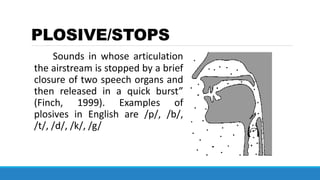
PLOSIVE/STOPS
Sounds in whose articulation
the airstream is stopped by a brief
closure of two speech organs and
then released in a quick burst”
(Finch, 1999). Examples of
plosives in English are /p/, /b/,
/t/, /d/, /k/, /g/
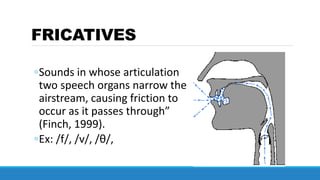
FRICATIVES
◦Sounds in whose articulation
two speech organs narrow the
airstream, causing friction to
occur as it passes through”
(Finch, 1999).
◦Ex: /f/, /v/, /θ/,
AFFRICATIVES
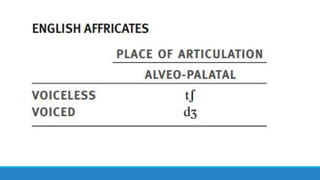
These are the sounds that occur
initially in chin and gin and finally in batch
and badge. If you pronounce these sounds
slowly enough, you can recognize that
they are stop-fricatives, which we’ll refer
to as affricates.
APPROXIMANTS
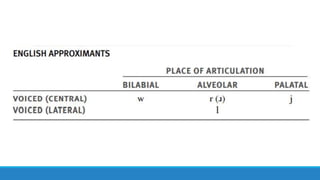
oThey are produced by two articulators
approaching one another almost like fricatives
but not coming close enough to produce
friction.
oThe English approximants are [j], [r] (IPA [ɹ]), [l],
and [w]
◦Because [r] is pronounced by channeling air
through the central part of the mouth, it is
called a central approximant. To pronounce
[l], air is channeled on one or both sides of the
tongue to make a lateral approximant. To
distinguish them from the other approximants,
[r] and [l] are sometimes called liquids.
NASALS
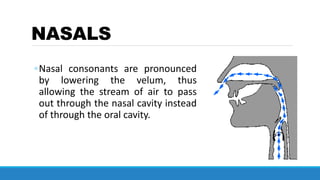
◦Nasal consonants are pronounced
by lowering the velum, thus
allowing the stream of air to pass
out through the nasal cavity instead
of through the oral cavity.
NASALS
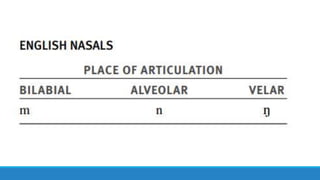
◦English has three nasal stops:
[m] as in mad, drummer, cram;
[n] as in new, sinner, ten; and a
third, symbolized by [ŋ].
English speakers may think of [ŋ] as a
combination of [n] and [g], but it is actually a
single sound
singer vs. finger
CLICK, FLAP, TRILLS
◦One example is the lateral click made on
the side of the tongue; it occurs in English
when we urge a horse to move on, for
example, but it is not part of the inventory
of English speech sounds.
Consonant
Sounds
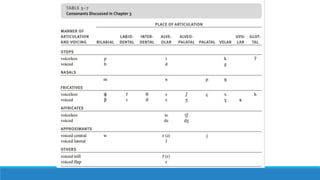
PLACE OF ARTICULATION
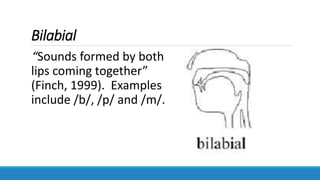
Bilabial
“Sounds formed by both
lips coming together”
(Finch, 1999). Examples
include /b/, /p/ and /m/.
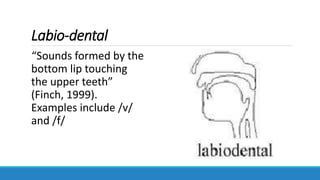
Labio-dental
“Sounds formed by the
bottom lip touching
the upper teeth”
(Finch, 1999).
Examples include /v/
and /f/
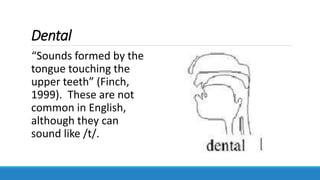
Dental
“Sounds formed by the
tongue touching the
upper teeth” (Finch,
1999). These are not
common in English,
although they can
sound like /t/.
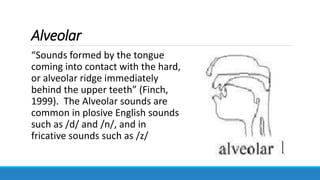
Alveolar
“Sounds formed by the tongue
coming into contact with the hard,
or alveolar ridge immediately
behind the upper teeth” (Finch,
1999). The Alveolar sounds are
common in plosive English sounds
such as /d/ and /n/, and in
fricative sounds such as /z/
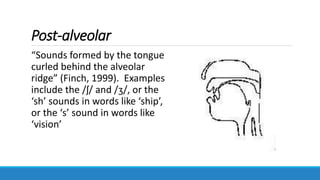
Post-alveolar
“Sounds formed by the tongue
curled behind the alveolar
ridge” (Finch, 1999). Examples
include the /ʃ/ and /ʒ/, or the
‘sh’ sounds in words like ‘ship’,
or the ‘s’ sound in words like
‘vision’
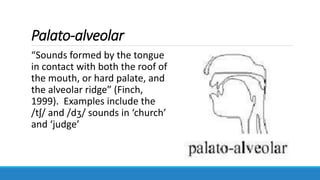
Palato-alveolar
“Sounds formed by the tongue
in contact with both the roof of
the mouth, or hard palate, and
the alveolar ridge” (Finch,
1999). Examples include the
/tʃ/ and /dʒ/ sounds in ‘church’
and ‘judge’
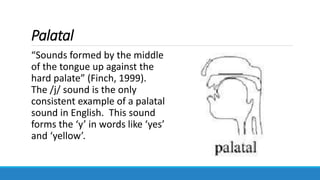
Palatal
“Sounds formed by the middle
of the tongue up against the
hard palate” (Finch, 1999).
The /j/ sound is the only
consistent example of a palatal
sound in English. This sound
forms the ‘y’ in words like ‘yes’
and ‘yellow’.
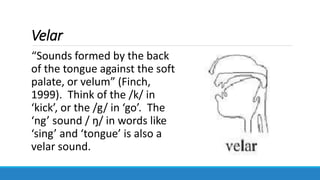
Velar
“Sounds formed by the back
of the tongue against the soft
palate, or velum” (Finch,
1999). Think of the /k/ in
‘kick’, or the /g/ in ‘go’. The
‘ng’ sound / ŋ/ in words like
‘sing’ and ‘tongue’ is also a
velar sound.
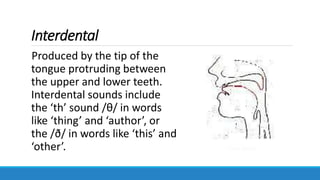
Interdental
Produced by the tip of the
tongue protruding between
the upper and lower teeth.
Interdental sounds include
the ‘th’ sound /θ/ in words
like ‘thing’ and ‘author’, or
the /ð/ in words like ‘this’ and
‘other’.
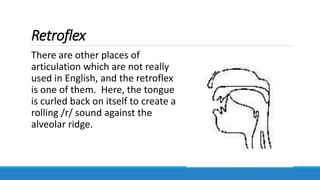
Retroflex
There are other places of
articulation which are not really
used in English, and the retroflex
is one of them. Here, the tongue
is curled back on itself to create a
rolling /r/ sound against the
alveolar ridge.
Glottal
“Sounds formed from the space between the
vocal folds, or glottis” (Finch, 1999). The glottal
sound /ʔ/ can be heard in the affirmative
expression ‘uh-huh’, and in certain estuary or
cockney accents it is used to replace the /t/
sound in words like ‘better’.
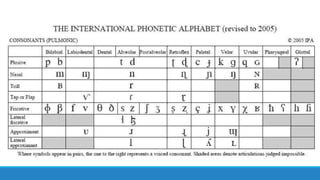
Interactive IPA chart
https://www.internationalphoneticalphabet.org/ipa-sounds/ipa-chart-with-sounds/
https://web.uvic.ca/ling/resources/ipa/charts/IPAlab/IPAlab.htm
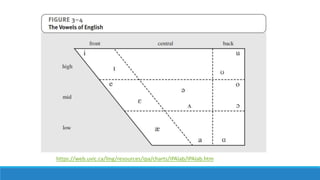
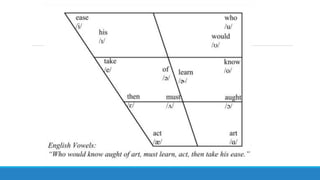
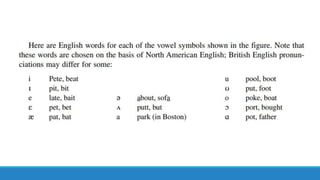
Vowel Sounds
https://web.uvic.ca/ling/resources/ipa/charts/IPAlab/IPAlab.htm
Vowel sounds are produced by passing
air through different shapes of the mouth,
with different positions of the tongue and
of the lips, and with the air stream
relatively unobstructed by narrow passages
except at the glottis.
DIPTHONGS
English also has diphthongs, represented by pairs
of symbols to capture the fact that a diphthong is a
vowel sound for which the tongue starts in one place
and glides to another.
[aj] (as in ride)
[aw] (as in loud)
[ɔj] (as in boy, toy)
Tenseness
◦Languages can make a distinction between
vowels that is characterized as tense versus
lax. These labels represent a set of
characteristics that distinguish one set of
vowels from another.
contrast between [i] of peat and of pit is
in part a tense/lax contrast; likewise for the
vowels in bait/bet and in cooed/could
Length
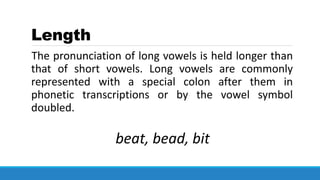
The pronunciation of long vowels is held longer than
that of short vowels. Long vowels are commonly
represented with a special colon after them in
phonetic transcriptions or by the vowel symbol
doubled.
beat, bead, bit
Nasalization
All vowel types can be nasalized by
pronouncing the vowel while passing air
through the nose (as for nasal stops) and
through the mouth.
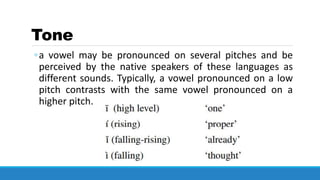
Tone
◦a vowel may be pronounced on several pitches and be
perceived by the native speakers of these languages as
different sounds. Typically, a vowel pronounced on a low
pitch contrasts with the same vowel pronounced on a
higher pitch.
The Sounds of Languages: Phonetics

phonetics-1.pptx

  • 1.
    The Sounds ofLanguages: Phonetics
  • 2.
  • 3.
    PLOSIVE/STOPS Sounds in whosearticulation the airstream is stopped by a brief closure of two speech organs and then released in a quick burst” (Finch, 1999). Examples of plosives in English are /p/, /b/, /t/, /d/, /k/, /g/
  • 4.
    FRICATIVES ◦Sounds in whosearticulation two speech organs narrow the airstream, causing friction to occur as it passes through” (Finch, 1999). ◦Ex: /f/, /v/, /θ/,
  • 5.
    AFFRICATIVES These are thesounds that occur initially in chin and gin and finally in batch and badge. If you pronounce these sounds slowly enough, you can recognize that they are stop-fricatives, which we’ll refer to as affricates.
  • 7.
    APPROXIMANTS oThey are producedby two articulators approaching one another almost like fricatives but not coming close enough to produce friction. oThe English approximants are [j], [r] (IPA [ɹ]), [l], and [w]
  • 8.
    ◦Because [r] ispronounced by channeling air through the central part of the mouth, it is called a central approximant. To pronounce [l], air is channeled on one or both sides of the tongue to make a lateral approximant. To distinguish them from the other approximants, [r] and [l] are sometimes called liquids.
  • 10.
    NASALS ◦Nasal consonants arepronounced by lowering the velum, thus allowing the stream of air to pass out through the nasal cavity instead of through the oral cavity.
  • 11.
    NASALS ◦English has threenasal stops: [m] as in mad, drummer, cram; [n] as in new, sinner, ten; and a third, symbolized by [ŋ].
  • 13.
    English speakers maythink of [ŋ] as a combination of [n] and [g], but it is actually a single sound singer vs. finger
  • 14.
    CLICK, FLAP, TRILLS ◦Oneexample is the lateral click made on the side of the tongue; it occurs in English when we urge a horse to move on, for example, but it is not part of the inventory of English speech sounds.
  • 15.
  • 16.
    Bilabial “Sounds formed byboth lips coming together” (Finch, 1999). Examples include /b/, /p/ and /m/.
  • 17.
    Labio-dental “Sounds formed bythe bottom lip touching the upper teeth” (Finch, 1999). Examples include /v/ and /f/
  • 18.
    Dental “Sounds formed bythe tongue touching the upper teeth” (Finch, 1999). These are not common in English, although they can sound like /t/.
  • 19.
    Alveolar “Sounds formed bythe tongue coming into contact with the hard, or alveolar ridge immediately behind the upper teeth” (Finch, 1999). The Alveolar sounds are common in plosive English sounds such as /d/ and /n/, and in fricative sounds such as /z/
  • 20.
    Post-alveolar “Sounds formed bythe tongue curled behind the alveolar ridge” (Finch, 1999). Examples include the /ʃ/ and /ʒ/, or the ‘sh’ sounds in words like ‘ship’, or the ‘s’ sound in words like ‘vision’
  • 21.
    Palato-alveolar “Sounds formed bythe tongue in contact with both the roof of the mouth, or hard palate, and the alveolar ridge” (Finch, 1999). Examples include the /tʃ/ and /dʒ/ sounds in ‘church’ and ‘judge’
  • 22.
    Palatal “Sounds formed bythe middle of the tongue up against the hard palate” (Finch, 1999). The /j/ sound is the only consistent example of a palatal sound in English. This sound forms the ‘y’ in words like ‘yes’ and ‘yellow’.
  • 23.
    Velar “Sounds formed bythe back of the tongue against the soft palate, or velum” (Finch, 1999). Think of the /k/ in ‘kick’, or the /g/ in ‘go’. The ‘ng’ sound / ŋ/ in words like ‘sing’ and ‘tongue’ is also a velar sound.
  • 24.
    Interdental Produced by thetip of the tongue protruding between the upper and lower teeth. Interdental sounds include the ‘th’ sound /θ/ in words like ‘thing’ and ‘author’, or the /ð/ in words like ‘this’ and ‘other’.
  • 25.
    Retroflex There are otherplaces of articulation which are not really used in English, and the retroflex is one of them. Here, the tongue is curled back on itself to create a rolling /r/ sound against the alveolar ridge.
  • 26.
    Glottal “Sounds formed fromthe space between the vocal folds, or glottis” (Finch, 1999). The glottal sound /ʔ/ can be heard in the affirmative expression ‘uh-huh’, and in certain estuary or cockney accents it is used to replace the /t/ sound in words like ‘better’.
  • 29.
  • 30.
  • 31.
  • 33.
    Vowel sounds areproduced by passing air through different shapes of the mouth, with different positions of the tongue and of the lips, and with the air stream relatively unobstructed by narrow passages except at the glottis.
  • 35.
    DIPTHONGS English also hasdiphthongs, represented by pairs of symbols to capture the fact that a diphthong is a vowel sound for which the tongue starts in one place and glides to another. [aj] (as in ride) [aw] (as in loud) [ɔj] (as in boy, toy)
  • 36.
    Tenseness ◦Languages can makea distinction between vowels that is characterized as tense versus lax. These labels represent a set of characteristics that distinguish one set of vowels from another.
  • 37.
    contrast between [i]of peat and of pit is in part a tense/lax contrast; likewise for the vowels in bait/bet and in cooed/could
  • 38.
    Length The pronunciation oflong vowels is held longer than that of short vowels. Long vowels are commonly represented with a special colon after them in phonetic transcriptions or by the vowel symbol doubled. beat, bead, bit
  • 39.
    Nasalization All vowel typescan be nasalized by pronouncing the vowel while passing air through the nose (as for nasal stops) and through the mouth.
  • 40.
    Tone ◦a vowel maybe pronounced on several pitches and be perceived by the native speakers of these languages as different sounds. Typically, a vowel pronounced on a low pitch contrasts with the same vowel pronounced on a higher pitch.
  • 41.
    The Sounds ofLanguages: Phonetics

Editor's Notes

  • #4 The sound is produce through closure of two articulatory organs and then released in a quick manner. In the p and b the two articulatory organs are the upper and lower lip. While the t and d are alveolar and tongue; k and g are velar and soft palate
  • #5 Sound is produced when air is passed through a small gap in the mouth
  • #6 Affricative starts at plosive and ends as fricatives. In the pronunciation of an affricate, air is built up by a complete closure of the oral tract at some place of articulation, then released (something like a stop) and continued (like a fricative)
  • #9 The sound is produced by two articulators approaching each other but not close enough to produce friction like in fricatives.
  • #12 Velum/ lower palate
  • #38 Lax vowels do not occur at the end of a stressed syllable, and they tend to be shorter; they also tend to be more centralized than the nearest tense vowel.