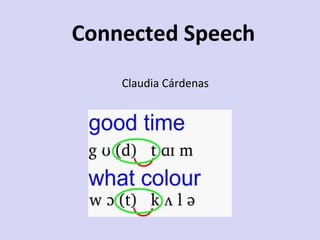
Connected Speech
Claudia Cárdenas
http://davidbrett.uniss.it/phonology/aspects_of_connecte
http://www.youtube.com/watch?v=RekeWP2W0P4
CONNECTED SPEECH

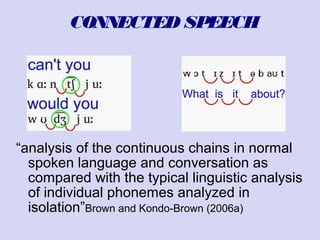
“analysis of the continuous chains in normal
spoken language and conversation as
compared with the typical linguistic analysis
of individual phonemes analyzed in
isolation”Brown and Kondo-Brown (2006a)
Aspect of connected speech
• Weak forms are pronounced more quickly and at lower
volume in comparison to the stressed syllables.
went         hotel        booked   room       two nights          
father          best   friend.
I went to the hotel and booked a room for two nights for my
father and his best friend.
Aspect of connected speech
•

Weak forms are pronounced more quickly and at lower volume in comparison to
the stressed syllables.

went         hotel        booked   room       two nights          father          best   friend.

I went to the hotel and booked a room for two nights 
for my father and his best friend.
/aɪ ˈwent tə ðə həʊ ˈtel ən ˈbʊkt ə ˈru:m fə ˈtu: ˈnaɪts fə
maɪ ˈfɑ:ðər ən hɪz ˈbest ˈfrend/
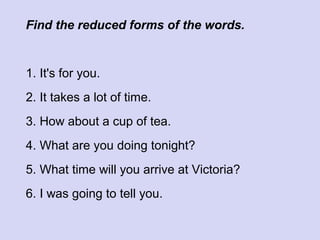
Find the reduced forms of the words.

1. It's for you.
2. It takes a lot of time.
3. How about a cup of tea.
4. What are you doing tonight?
5. What time will you arrive at Victoria?
6. I was going to tell you.
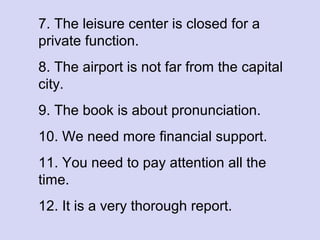
7. The leisure center is closed for a
private function.
8. The airport is not far from the capital
city.
9. The book is about pronunciation.
10. We need more financial support.
11. You need to pay attention all the
time.
12. It is a very thorough report.
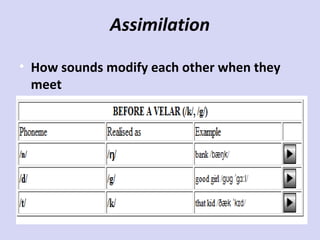
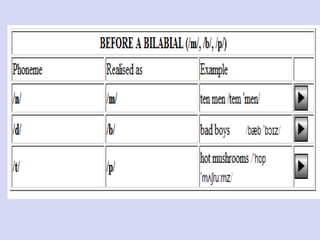
Assimilation
• How sounds modify each other when they
meet
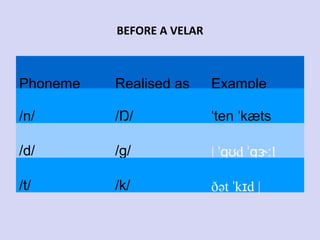
BEFORE A VELAR

Phoneme

Realised as

Example

/n/

/Ŋ/

ˈten ˈkæts

/d/

/g/

| ˈɡʊd ˈɡɝːl

/t/

/k/

ðət ˈkɪd |
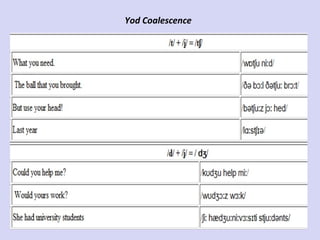
Yod Coalescence
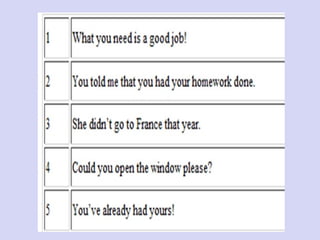
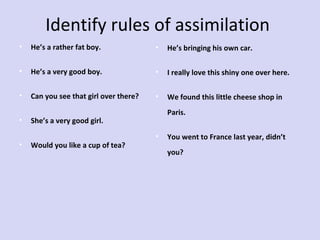
Identify rules of assimilation
•

He’s a rather fat boy.

•

He’s bringing his own car.

•

He’s a very good boy.

•

I really love this shiny one over here.

•

Can you see that girl over there?

•

We found this little cheese shop in

•
•

Paris.

She’s a very good girl.
Would you like a cup of tea?

•

You went to France last year, didn’t
you?
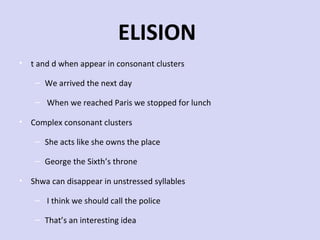
ELISION
• t and d when appear in consonant clusters
– We arrived the next day
– When we reached Paris we stopped for lunch
• Complex consonant clusters
– She acts like she owns the place
– George the Sixth’s throne
• Shwa can disappear in unstressed syllables
– I think we should call the police
– That’s an interesting idea
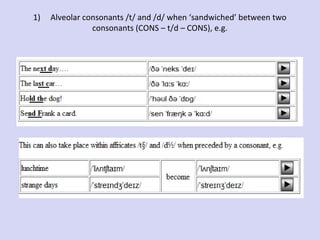
1)

Alveolar consonants /t/ and /d/ when ‘sandwiched’ between two
consonants (CONS – t/d – CONS), e.g.
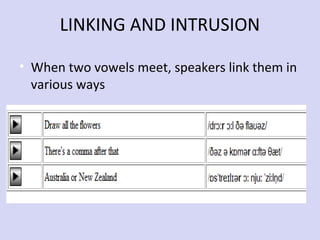
LINKING AND INTRUSION
• When two vowels meet, speakers link them in
various ways
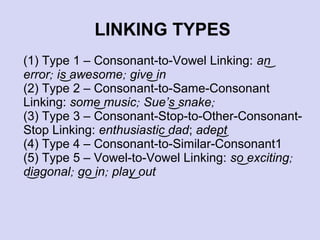
LINKING TYPES
(1) Type 1 – Consonant-to-Vowel Linking: an͜
error; is͜ awesome; give͜ in
(2) Type 2 – Consonant-to-Same-Consonant
Linking: some͜ music; Sue’s͜ snake;
(3) Type 3 – Consonant-Stop-to-Other-ConsonantStop Linking: enthusiastic͜ dad; adept
͜
(4) Type 4 – Consonant-to-Similar-Consonant1
(5) Type 5 – Vowel-to-Vowel Linking: so͜ exciting;
diagonal; go͜ in; play͜ out
͜
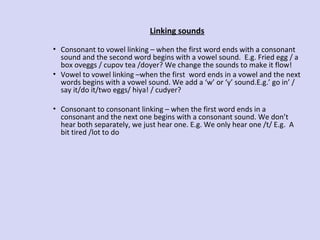
Linking sounds
• Consonant to vowel linking – when the first word ends with a consonant
sound and the second word begins with a vowel sound. E.g. Fried egg / a
box oveggs / cupov tea /doyer? We change the sounds to make it flow!
• Vowel to vowel linking –when the first word ends in a vowel and the next
words begins with a vowel sound. We add a ‘w’ or ‘y’ sound.E.g.’ go in’ /
say it/do it/two eggs/ hiya! / cudyer?
• Consonant to consonant linking – when the first word ends in a
consonant and the next one begins with a consonant sound. We don’t
hear both separately, we just hear one. E.g. We only hear one /t/ E.g. A
bit tired /lot to do
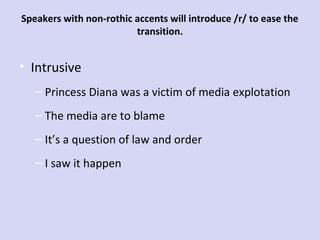
Speakers with non-rothic accents will introduce /r/ to ease the
transition.

• Intrusive
– Princess Diana was a victim of media explotation
– The media are to blame
– It’s a question of law and order
– I saw it happen
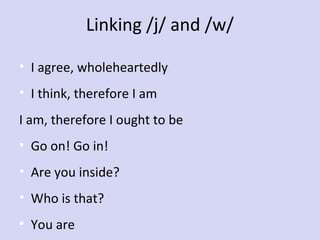
Linking /j/ and /w/
• I agree, wholeheartedly
• I think, therefore I am
I am, therefore I ought to be
• Go on! Go in!
• Are you inside?
• Who is that?
• You are
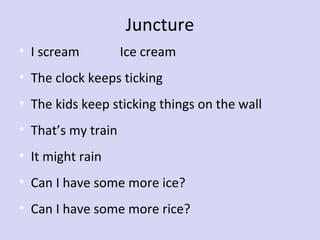
Juncture
• I scream

Ice cream

• The clock keeps ticking
• The kids keep sticking things on the wall
• That’s my train
• It might rain
• Can I have some more ice?
• Can I have some more rice?
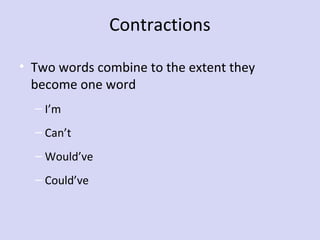
Contractions
• Two words combine to the extent they
become one word
– I’m
– Can’t
– Would’ve
– Could’ve
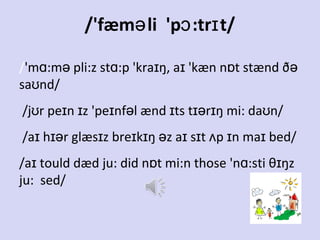
/'fæmə li 'pɔ :trɪ t/
/'mɑ:mə pli:z stɑ:p 'kraɪŋ, aɪ 'kæn nɒt stænd ðə
saʊnd/
/jʊr peɪn ɪz 'peɪnfəl ænd ɪts tɪərɪŋ mi: daʊn/
/aɪ hɪər glæsɪz breɪkɪŋ əz aɪ sɪt ʌp ɪn maɪ bed/
/aɪ tould dæd ju: did nɒt mi:n those 'nɑ:sti θɪŋz
ju: sed/
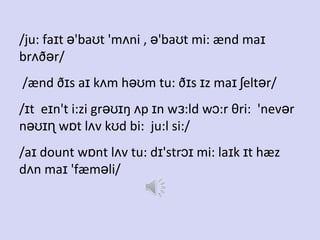
/ju: faɪt ə'baʊt 'mʌni , ə'baʊt mi: ænd maɪ
brʌðər/
/ænd ðɪs aɪ kʌm həʊm tu: ðɪs ɪz maɪ ʃeltər/
/ɪt eɪn't i:zi grəʊɪŋ ʌp ɪn wɜ:ld wɔ:r θri: 'nevər
nəʊɪɳ wɒt lʌv kʊd bi: ju:l si:/
/aɪ dount wɒnt lʌv tu: dɪ'strɔɪ mi: laɪk ɪt hæz
dʌn maɪ 'fæməli/
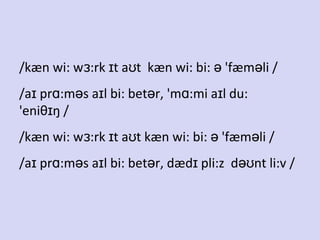
/kæn wi: wɜ:rk ɪt aʊt kæn wi: bi: ə 'fæməli /
/aɪ prɑ:məs aɪl bi: betər, 'mɑ:mi aɪl du:
'eniθɪŋ /
/kæn wi: wɜ:rk ɪt aʊt kæn wi: bi: ə 'fæməli /
/aɪ prɑ:məs aɪl bi: betər, dædɪ pli:z dəʊnt li:v /

CONNECTED SPEECH

  • 1.
  • 2.
  • 3.
    CONNECTED SPEECH “analysis ofthe continuous chains in normal spoken language and conversation as compared with the typical linguistic analysis of individual phonemes analyzed in isolation”Brown and Kondo-Brown (2006a)
  • 4.
    Aspect of connectedspeech • Weak forms are pronounced more quickly and at lower volume in comparison to the stressed syllables. went         hotel        booked   room       two nights           father          best   friend. I went to the hotel and booked a room for two nights for my father and his best friend.
  • 5.
    Aspect of connectedspeech • Weak forms are pronounced more quickly and at lower volume in comparison to the stressed syllables. went         hotel        booked   room       two nights          father          best   friend. I went to the hotel and booked a room for two nights  for my father and his best friend. /aɪ ˈwent tə ðə həʊ ˈtel ən ˈbʊkt ə ˈru:m fə ˈtu: ˈnaɪts fə maɪ ˈfɑ:ðər ən hɪz ˈbest ˈfrend/
  • 6.
    Find the reducedforms of the words. 1. It's for you. 2. It takes a lot of time. 3. How about a cup of tea. 4. What are you doing tonight? 5. What time will you arrive at Victoria? 6. I was going to tell you.
  • 7.
    7. The leisurecenter is closed for a private function. 8. The airport is not far from the capital city. 9. The book is about pronunciation. 10. We need more financial support. 11. You need to pay attention all the time. 12. It is a very thorough report.
  • 8.
    Assimilation • How soundsmodify each other when they meet
  • 9.
    BEFORE A VELAR Phoneme Realisedas Example /n/ /Ŋ/ ˈten ˈkæts /d/ /g/ | ˈɡʊd ˈɡɝːl /t/ /k/ ðət ˈkɪd |
  • 11.
  • 14.
    Identify rules ofassimilation • He’s a rather fat boy. • He’s bringing his own car. • He’s a very good boy. • I really love this shiny one over here. • Can you see that girl over there? • We found this little cheese shop in • • Paris. She’s a very good girl. Would you like a cup of tea? • You went to France last year, didn’t you?
  • 15.
    ELISION • t andd when appear in consonant clusters – We arrived the next day – When we reached Paris we stopped for lunch • Complex consonant clusters – She acts like she owns the place – George the Sixth’s throne • Shwa can disappear in unstressed syllables – I think we should call the police – That’s an interesting idea
  • 16.
    1) Alveolar consonants /t/and /d/ when ‘sandwiched’ between two consonants (CONS – t/d – CONS), e.g.
  • 17.
    LINKING AND INTRUSION •When two vowels meet, speakers link them in various ways
  • 18.
    LINKING TYPES (1) Type1 – Consonant-to-Vowel Linking: an͜ error; is͜ awesome; give͜ in (2) Type 2 – Consonant-to-Same-Consonant Linking: some͜ music; Sue’s͜ snake; (3) Type 3 – Consonant-Stop-to-Other-ConsonantStop Linking: enthusiastic͜ dad; adept ͜ (4) Type 4 – Consonant-to-Similar-Consonant1 (5) Type 5 – Vowel-to-Vowel Linking: so͜ exciting; diagonal; go͜ in; play͜ out ͜
  • 19.
    Linking sounds • Consonantto vowel linking – when the first word ends with a consonant sound and the second word begins with a vowel sound. E.g. Fried egg / a box oveggs / cupov tea /doyer? We change the sounds to make it flow! • Vowel to vowel linking –when the first word ends in a vowel and the next words begins with a vowel sound. We add a ‘w’ or ‘y’ sound.E.g.’ go in’ / say it/do it/two eggs/ hiya! / cudyer? • Consonant to consonant linking – when the first word ends in a consonant and the next one begins with a consonant sound. We don’t hear both separately, we just hear one. E.g. We only hear one /t/ E.g. A bit tired /lot to do
  • 20.
    Speakers with non-rothicaccents will introduce /r/ to ease the transition. • Intrusive – Princess Diana was a victim of media explotation – The media are to blame – It’s a question of law and order – I saw it happen
  • 21.
    Linking /j/ and/w/ • I agree, wholeheartedly • I think, therefore I am I am, therefore I ought to be • Go on! Go in! • Are you inside? • Who is that? • You are
  • 22.
    Juncture • I scream Icecream • The clock keeps ticking • The kids keep sticking things on the wall • That’s my train • It might rain • Can I have some more ice? • Can I have some more rice?
  • 23.
    Contractions • Two wordscombine to the extent they become one word – I’m – Can’t – Would’ve – Could’ve
  • 24.
    /'fæmə li 'pɔ:trɪ t/ /'mɑ:mə pli:z stɑ:p 'kraɪŋ, aɪ 'kæn nɒt stænd ðə saʊnd/ /jʊr peɪn ɪz 'peɪnfəl ænd ɪts tɪərɪŋ mi: daʊn/ /aɪ hɪər glæsɪz breɪkɪŋ əz aɪ sɪt ʌp ɪn maɪ bed/ /aɪ tould dæd ju: did nɒt mi:n those 'nɑ:sti θɪŋz ju: sed/
  • 25.
    /ju: faɪt ə'baʊt'mʌni , ə'baʊt mi: ænd maɪ brʌðər/ /ænd ðɪs aɪ kʌm həʊm tu: ðɪs ɪz maɪ ʃeltər/ /ɪt eɪn't i:zi grəʊɪŋ ʌp ɪn wɜ:ld wɔ:r θri: 'nevər nəʊɪɳ wɒt lʌv kʊd bi: ju:l si:/ /aɪ dount wɒnt lʌv tu: dɪ'strɔɪ mi: laɪk ɪt hæz dʌn maɪ 'fæməli/
  • 26.
    /kæn wi: wɜ:rkɪt aʊt kæn wi: bi: ə 'fæməli / /aɪ prɑ:məs aɪl bi: betər, 'mɑ:mi aɪl du: 'eniθɪŋ / /kæn wi: wɜ:rk ɪt aʊt kæn wi: bi: ə 'fæməli / /aɪ prɑ:məs aɪl bi: betər, dædɪ pli:z dəʊnt li:v /