International Research Journal of Engineering and Technology (IRJET) e-ISSN: 2395-0056
Volume: 04 Issue: 07 | July -2017 www.irjet.net p-ISSN: 2395-0072
© 2017, IRJET | Impact Factor value: 5.181 | ISO 9001:2008 Certified Journal | Page 1165
Effect of Soil Structure Interaction on Buildings with Stiffness
Irregularity under Seismic Load
Mr. Kotkar R.K.1, Prof. Patankar J. P.2
1Student, Department of Applied Mechanics, WCE, Sangli, Maharashtra, India
2professor Department of Applied Mechanics, WCE, Sangli, Maharashtra, India
---------------------------------------------------------------------***---------------------------------------------------------------------
Abstract - The main objective of the study is to investigate
the significance of effect of soil structure interaction on
building with stiffness irregularity. In the present study the
behavior of building with stiffness irregularity is considered.
To address this problem, a Finite Element Method is used to
model soil structure interaction analysis of foundation and
supported framed structures by SAP 2000 V18 software. An
attempt has been made to evaluate the effect of soil structure
interaction on building with stiffness irregularity by
considering the systematic parameters like time period, base
shear, lateral displacement, storey drift. Response spectrum
analysis has been carried out and the parameters like time
period, base shear, roof top displacement and storey drift of
the building frames resting overfoundationandsoilmedia has
been studied.
Key Words: soil structure interaction, vertical irregularity,
stiffness irregularity, response spectrum.
1. INTRODUCTION
An earthquake cause, failure of structure which starts at
points of weakness. Discontinuity in mass, stiffness and
geometry of structure cause weaknesses in structure. The
structures which having such type of discontinuity are
termed as Irregular structures. Building with vertical
irregularities are one of the major reasons of failures of
structures during earthquakes. Structures with soft storey
were the most notable structures which collapsed. Such
effect of vertical irregularities in the seismic performance of
structures becomes very important. Changesin height-wise
stiffness and mass cause the dynamic characteristics of
these buildings different from the regular‘ building. IS 1893
definition of Vertically Irregular structures: The irregularity
in the building structures may be due to irregular
distributions in their mass, strength and stiffness along the
height of building. When such buildings are constructed in
high seismic zones, the analysis and design becomes more
complicated. So the effect of soil structure interaction effect
cosideration is most important parameter.
1.1 Soil-Structure Interaction (SSI)
Soil-Structure Interaction (SSI) is phenomena in the
response of structures caused by the flexibility of the
foundation soils, as well as in the response of soils caused by
the presence of structures. Analytic and numerical models
for dynamic analysis typically ignore SSI effects of the
coupled in nature structure foundation-soil system. It has
been recognized that SSI effects may have a significant
impact especially in cases involving heavier structures rest
on soft soil conditions.
1.2 Stiffness Irregular Building
According to IS 1893-2002, A soft storey is one in which the
lateral stiffness is less than 70 percent of that in the storey
above or less than 80 percent of the average lateral stiffness
of the three storeys above
2. OBJECTIVE OF STUDY
Study of soil structure interaction due to seismic load
having vertical irregularity with different types of soils viz.
soft, medium and hard, using software consists of
1. Modeling and analysis of regular building and building
with stiffness irregularity without and with considering
soil structure interaction with different types of soils.
2. Comparison of above responses ofregularbuildingsand
irregular buildings on different types of soils like base
shear, time period, top storey displacement and storey
drift.
3. PROBLEM FORMULATION
For this study, an 11-storey with 5 bays frame (Each bay
span 6 m) and floor height 3.0m, regular in plan is
considered. This building is considered to be situated in
seismic zone ‘iv’ and designed in compliance to the Indian
Code of Practice for Earthquake Resistant Design of
Structures. The buildingismodeledusingsoftwareSAP2000
and analyzed by response spectrum method.. Model is
studied for comparing, base shear, time period, top storey
displacement and storey drift as follow:
Following models are considered for this study.
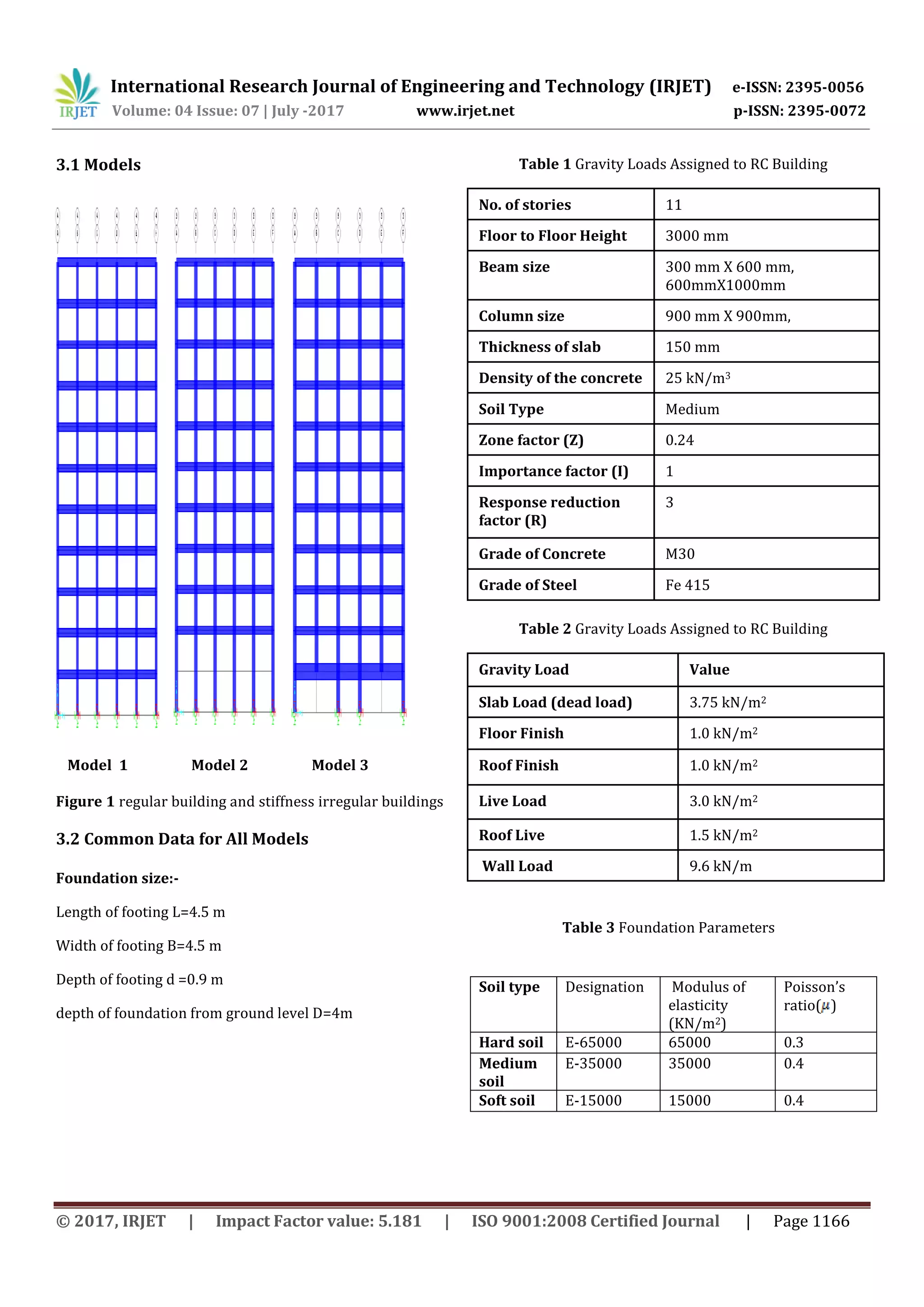
1) Regular building and
2) Two models with stiffness irregularity having same total
seismic weight, are considered.
International Research Journal of Engineering and Technology (IRJET) e-ISSN: 2395-0056
Volume: 04 Issue: 07 | July -2017 www.irjet.net p-ISSN: 2395-0072
© 2017, IRJET | Impact Factor value: 5.181 | ISO 9001:2008 Certified Journal | Page 1166
3.1 Models
Model 1 Model 2 Model 3
Figure 1 regular building and stiffness irregular buildings
3.2 Common Data for All Models
Foundation size:-
Length of footing L=4.5 m
Width of footing B=4.5 m
Depth of footing d =0.9 m
depth of foundation from ground level D=4m
Table 1 Gravity Loads Assigned to RC Building
No. of stories 11
Floor to Floor Height 3000 mm
Beam size 300 mm X 600 mm,
600mmX1000mm
Column size 900 mm X 900mm,
Thickness of slab 150 mm
Density of the concrete 25 kN/m3
Soil Type Medium
Zone factor (Z) 0.24
Importance factor (I) 1
Response reduction
factor (R)
3
Grade of Concrete M30
Grade of Steel Fe 415
Table 2 Gravity Loads Assigned to RC Building
Gravity Load Value
Slab Load (dead load) 3.75 kN/m2
Floor Finish 1.0 kN/m2
Roof Finish 1.0 kN/m2
Live Load 3.0 kN/m2
Roof Live 1.5 kN/m2
Wall Load 9.6 kN/m
Table 3 Foundation Parameters
Soil type Designation Modulus of
elasticity
(KN/m2)
Poisson’s
ratio( )
Hard soil E-65000 65000 0.3
Medium
soil
E-35000 35000 0.4
Soft soil E-15000 15000 0.4
International Research Journal of Engineering and Technology (IRJET) e-ISSN: 2395-0056
Volume: 04 Issue: 07 | July -2017 www.irjet.net p-ISSN: 2395-0072
© 2017, IRJET | Impact Factor value: 5.181 | ISO 9001:2008 Certified Journal | Page 1167
Table 4 Stiffness of Equivalent Soil Spring(KN/m)(ref.
FEMA 356)
4. RESULT AND DISCUSSION
Response Spectrum Analysis is carried out for Bare frame.
The models are checked for time period, base shear, and
maximum top displacement.
Chart 1 Comparison of Time Period for Regular and
Stiffness Irregular Building
Chart 2 Comparison of Base Shear for Regular and
Stiffness Irregular Building
Chart 3 Comparison of Top Storey Displacement for
Regular and Stiffness Irregular Building
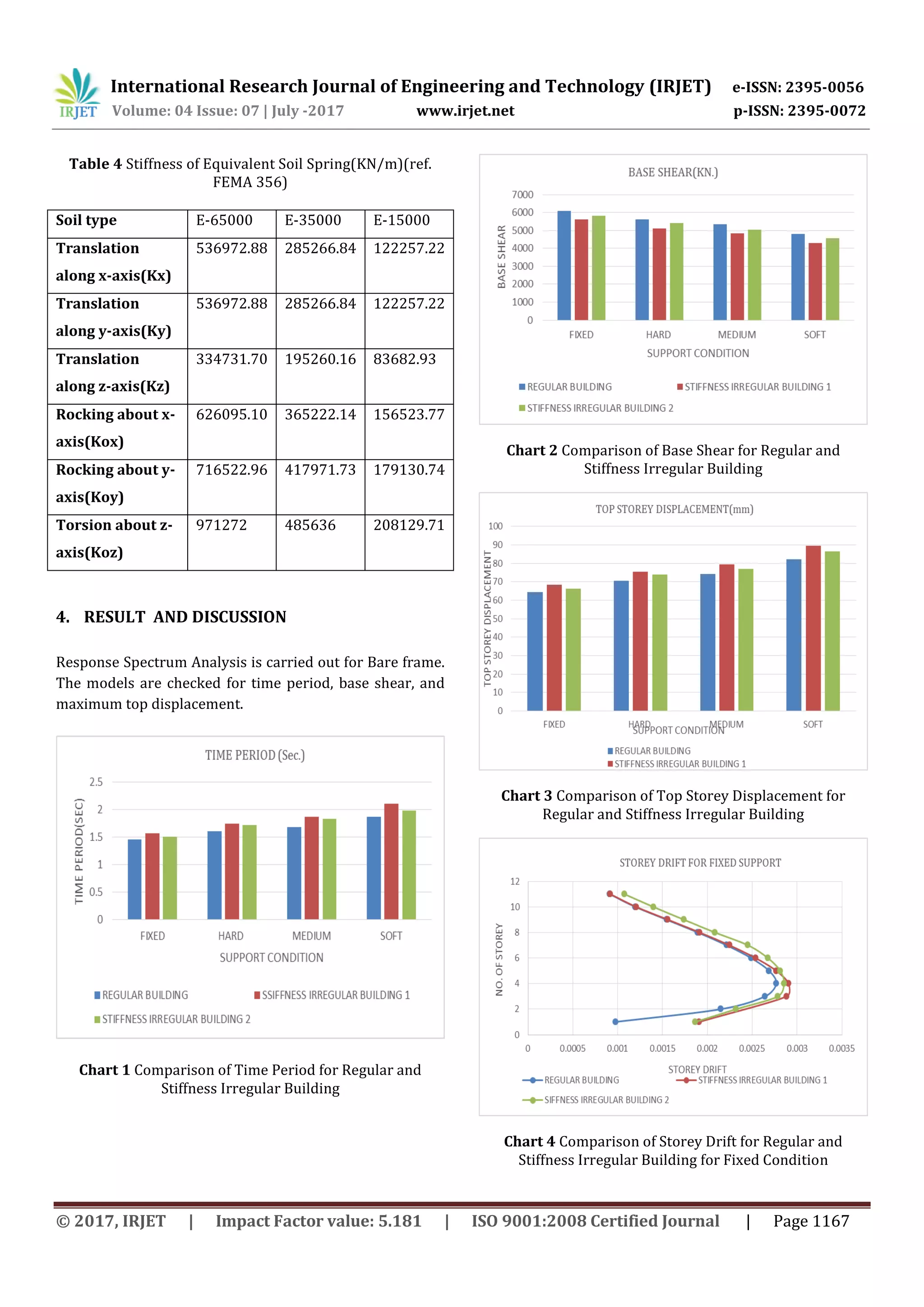
Chart 4 Comparison of Storey Drift for Regular and
Stiffness Irregular Building for Fixed Condition
Soil type E-65000 E-35000 E-15000
Translation
along x-axis(Kx)
536972.88 285266.84 122257.22
Translation
along y-axis(Ky)
536972.88 285266.84 122257.22
Translation
along z-axis(Kz)
334731.70 195260.16 83682.93
Rocking about x-
axis(Kox)
626095.10 365222.14 156523.77
Rocking about y-
axis(Koy)
716522.96 417971.73 179130.74
Torsion about z-
axis(Koz)
971272 485636 208129.71
International Research Journal of Engineering and Technology (IRJET) e-ISSN: 2395-0056
Volume: 04 Issue: 07 | July -2017 www.irjet.net p-ISSN: 2395-0072
© 2017, IRJET | Impact Factor value: 5.181 | ISO 9001:2008 Certified Journal | Page 1168
Chart 5 Comparison of Storey Drift for Regular and
Stiffness Irregular Building for Hard Soil Condition
Chart 6 Comparison of Storey Drift for Regular and
Stiffness Irregular Building for Medium Soil Condition
Chart 7 Comparison of Storey Drift for Regular and
Stiffness Irregular Building for Medium Soil Condition
1. Fron chart 1, found that natural period of structure
increases for building with stiffness irregularity. Rate
is higher for model (2) with soft soil, it is increase
43.93% w.r.t regular building with fixed support
condition.
2. From chart 2, found that increase in soil flexibility
causes decrease in base shear. For soft soil base shear
decreases with higher rate. From It is more for model
(2); it decreases 29.05% w.r.t regular building with
fixed support.
3. From chart 3, found that roof displacement is also
observed to be increases for building with stiffness
irregularity. For soft soil roof displacement is higher
than fixed support condition. It is critical for model
(2). It increases up to 38.90 % w. r. t. regular building
with fixed support.
4. From chart 4 to 7 it is found that storey drift is
maximum for model (2). It is increases from fixed
support condition to soft soil condition.Itiscritical for
model (2) with soft soil.
5. CONCLUSION
1. Base shear decreasesfor“stiffnessirregularity”type
building.
2. Time period, top storey displacement and storey
drift increase for building of “stiffness irregularity”
type. This effects are more prominent in soft soil
condition.
REFERENCES
[1] Sekhar Chandra Dutta, Koushik Bhattacharya and Rana
Roy (2004), “Response of low-rise buildings under
seismic ground excitation incorporating soil–structure
interaction” Soil Dynamics and Earthquake Engineering
24, pp 893–914.
[2] Jinu Mary Mathew, Cinitha A, Umesha P K, NageshR Iyer
and Eapen Sakaria (2014), “Seismic response of RC
building by considering soil structure interaction”
International Journal of Structural & Civil Engineering,
Res. ISSN 2319 – 6009 Vol. 3, pp 160-172
[3] S. A. Halkude, Mr. M. G. Kalyanshetti, Mr. S. H. Kalyani
(2014), “Soil Structure Interaction Effect on Seismic
Response of R.C. Frames with Isolated Footing”,
International Journal of Engineering Research and
Technology, Vol. 3 Issue 1, pp 2767-2775
[4] Shehata E. Abdel Raheem, Mohamed M. Ahmed and
Tarek M. A. Alazrak (2015), “Evaluation of soil–
foundation–structure interaction effects on seismic
response demands of multi-story MRF buildings on raft
foundations”, Advance Structural Engineering., pp 11-
30
International Research Journal of Engineering and Technology (IRJET) e-ISSN: 2395-0056
Volume: 04 Issue: 07 | July -2017 www.irjet.net p-ISSN: 2395-0072
© 2017, IRJET | Impact Factor value: 5.181 | ISO 9001:2008 Certified Journal | Page 1169
[5] Cinitha.A, Umesha P. K and Nagesh R. Iyer (2015), “Soil
structure interaction analysis for seismic responseofan
asymmetric RC building”, International Conference on
Computer Modeling and Simulation., pp 1-6
[6] Pandey A.D, Prabhat Kumar and Sharad Sharma (2011),
“Seismic soil-structure interaction of buildings on hill
slopes”, International Journal of Civil and Structural
Engineering Research, Volume 2, No 2, 2011, pp 544-
555
[7] Jiang Xinliang and Zhang Yanan (2013), “Influence of
Structure Plane Size on Seismic Response of Soil-
Structure Interaction”, World Earthquake Engineering,
Vol.19 No.5. pp 345-350
[8] Mr. Rahul Sawant and. M. N. Bajad (2016),“EffectofSoil-
Structure Interaction on High Rise RC Building”. IOSR
Journal of Mechanical and Civil Engineering (IOSR-
JMCE), Volume 13, Issue 1, pp 85-91
[9] IS 1893(Part 1):2002, Criteria for Earthquake Resistant
Design of Structures-General provisions and Buildings,
Bureau of Indian Standards, New Delhi.

Effect of Soil Structure Interaction on Buildings with Stiffness Irregularity under Seismic Load

  • 1.
    International Research Journalof Engineering and Technology (IRJET) e-ISSN: 2395-0056 Volume: 04 Issue: 07 | July -2017 www.irjet.net p-ISSN: 2395-0072 © 2017, IRJET | Impact Factor value: 5.181 | ISO 9001:2008 Certified Journal | Page 1165 Effect of Soil Structure Interaction on Buildings with Stiffness Irregularity under Seismic Load Mr. Kotkar R.K.1, Prof. Patankar J. P.2 1Student, Department of Applied Mechanics, WCE, Sangli, Maharashtra, India 2professor Department of Applied Mechanics, WCE, Sangli, Maharashtra, India ---------------------------------------------------------------------***--------------------------------------------------------------------- Abstract - The main objective of the study is to investigate the significance of effect of soil structure interaction on building with stiffness irregularity. In the present study the behavior of building with stiffness irregularity is considered. To address this problem, a Finite Element Method is used to model soil structure interaction analysis of foundation and supported framed structures by SAP 2000 V18 software. An attempt has been made to evaluate the effect of soil structure interaction on building with stiffness irregularity by considering the systematic parameters like time period, base shear, lateral displacement, storey drift. Response spectrum analysis has been carried out and the parameters like time period, base shear, roof top displacement and storey drift of the building frames resting overfoundationandsoilmedia has been studied. Key Words: soil structure interaction, vertical irregularity, stiffness irregularity, response spectrum. 1. INTRODUCTION An earthquake cause, failure of structure which starts at points of weakness. Discontinuity in mass, stiffness and geometry of structure cause weaknesses in structure. The structures which having such type of discontinuity are termed as Irregular structures. Building with vertical irregularities are one of the major reasons of failures of structures during earthquakes. Structures with soft storey were the most notable structures which collapsed. Such effect of vertical irregularities in the seismic performance of structures becomes very important. Changesin height-wise stiffness and mass cause the dynamic characteristics of these buildings different from the regular‘ building. IS 1893 definition of Vertically Irregular structures: The irregularity in the building structures may be due to irregular distributions in their mass, strength and stiffness along the height of building. When such buildings are constructed in high seismic zones, the analysis and design becomes more complicated. So the effect of soil structure interaction effect cosideration is most important parameter. 1.1 Soil-Structure Interaction (SSI) Soil-Structure Interaction (SSI) is phenomena in the response of structures caused by the flexibility of the foundation soils, as well as in the response of soils caused by the presence of structures. Analytic and numerical models for dynamic analysis typically ignore SSI effects of the coupled in nature structure foundation-soil system. It has been recognized that SSI effects may have a significant impact especially in cases involving heavier structures rest on soft soil conditions. 1.2 Stiffness Irregular Building According to IS 1893-2002, A soft storey is one in which the lateral stiffness is less than 70 percent of that in the storey above or less than 80 percent of the average lateral stiffness of the three storeys above 2. OBJECTIVE OF STUDY Study of soil structure interaction due to seismic load having vertical irregularity with different types of soils viz. soft, medium and hard, using software consists of 1. Modeling and analysis of regular building and building with stiffness irregularity without and with considering soil structure interaction with different types of soils. 2. Comparison of above responses ofregularbuildingsand irregular buildings on different types of soils like base shear, time period, top storey displacement and storey drift. 3. PROBLEM FORMULATION For this study, an 11-storey with 5 bays frame (Each bay span 6 m) and floor height 3.0m, regular in plan is considered. This building is considered to be situated in seismic zone ‘iv’ and designed in compliance to the Indian Code of Practice for Earthquake Resistant Design of Structures. The buildingismodeledusingsoftwareSAP2000 and analyzed by response spectrum method.. Model is studied for comparing, base shear, time period, top storey displacement and storey drift as follow: Following models are considered for this study. 1) Regular building and 2) Two models with stiffness irregularity having same total seismic weight, are considered.
  • 2.
    International Research Journalof Engineering and Technology (IRJET) e-ISSN: 2395-0056 Volume: 04 Issue: 07 | July -2017 www.irjet.net p-ISSN: 2395-0072 © 2017, IRJET | Impact Factor value: 5.181 | ISO 9001:2008 Certified Journal | Page 1166 3.1 Models Model 1 Model 2 Model 3 Figure 1 regular building and stiffness irregular buildings 3.2 Common Data for All Models Foundation size:- Length of footing L=4.5 m Width of footing B=4.5 m Depth of footing d =0.9 m depth of foundation from ground level D=4m Table 1 Gravity Loads Assigned to RC Building No. of stories 11 Floor to Floor Height 3000 mm Beam size 300 mm X 600 mm, 600mmX1000mm Column size 900 mm X 900mm, Thickness of slab 150 mm Density of the concrete 25 kN/m3 Soil Type Medium Zone factor (Z) 0.24 Importance factor (I) 1 Response reduction factor (R) 3 Grade of Concrete M30 Grade of Steel Fe 415 Table 2 Gravity Loads Assigned to RC Building Gravity Load Value Slab Load (dead load) 3.75 kN/m2 Floor Finish 1.0 kN/m2 Roof Finish 1.0 kN/m2 Live Load 3.0 kN/m2 Roof Live 1.5 kN/m2 Wall Load 9.6 kN/m Table 3 Foundation Parameters Soil type Designation Modulus of elasticity (KN/m2) Poisson’s ratio( ) Hard soil E-65000 65000 0.3 Medium soil E-35000 35000 0.4 Soft soil E-15000 15000 0.4
  • 3.
    International Research Journalof Engineering and Technology (IRJET) e-ISSN: 2395-0056 Volume: 04 Issue: 07 | July -2017 www.irjet.net p-ISSN: 2395-0072 © 2017, IRJET | Impact Factor value: 5.181 | ISO 9001:2008 Certified Journal | Page 1167 Table 4 Stiffness of Equivalent Soil Spring(KN/m)(ref. FEMA 356) 4. RESULT AND DISCUSSION Response Spectrum Analysis is carried out for Bare frame. The models are checked for time period, base shear, and maximum top displacement. Chart 1 Comparison of Time Period for Regular and Stiffness Irregular Building Chart 2 Comparison of Base Shear for Regular and Stiffness Irregular Building Chart 3 Comparison of Top Storey Displacement for Regular and Stiffness Irregular Building Chart 4 Comparison of Storey Drift for Regular and Stiffness Irregular Building for Fixed Condition Soil type E-65000 E-35000 E-15000 Translation along x-axis(Kx) 536972.88 285266.84 122257.22 Translation along y-axis(Ky) 536972.88 285266.84 122257.22 Translation along z-axis(Kz) 334731.70 195260.16 83682.93 Rocking about x- axis(Kox) 626095.10 365222.14 156523.77 Rocking about y- axis(Koy) 716522.96 417971.73 179130.74 Torsion about z- axis(Koz) 971272 485636 208129.71
  • 4.
    International Research Journalof Engineering and Technology (IRJET) e-ISSN: 2395-0056 Volume: 04 Issue: 07 | July -2017 www.irjet.net p-ISSN: 2395-0072 © 2017, IRJET | Impact Factor value: 5.181 | ISO 9001:2008 Certified Journal | Page 1168 Chart 5 Comparison of Storey Drift for Regular and Stiffness Irregular Building for Hard Soil Condition Chart 6 Comparison of Storey Drift for Regular and Stiffness Irregular Building for Medium Soil Condition Chart 7 Comparison of Storey Drift for Regular and Stiffness Irregular Building for Medium Soil Condition 1. Fron chart 1, found that natural period of structure increases for building with stiffness irregularity. Rate is higher for model (2) with soft soil, it is increase 43.93% w.r.t regular building with fixed support condition. 2. From chart 2, found that increase in soil flexibility causes decrease in base shear. For soft soil base shear decreases with higher rate. From It is more for model (2); it decreases 29.05% w.r.t regular building with fixed support. 3. From chart 3, found that roof displacement is also observed to be increases for building with stiffness irregularity. For soft soil roof displacement is higher than fixed support condition. It is critical for model (2). It increases up to 38.90 % w. r. t. regular building with fixed support. 4. From chart 4 to 7 it is found that storey drift is maximum for model (2). It is increases from fixed support condition to soft soil condition.Itiscritical for model (2) with soft soil. 5. CONCLUSION 1. Base shear decreasesfor“stiffnessirregularity”type building. 2. Time period, top storey displacement and storey drift increase for building of “stiffness irregularity” type. This effects are more prominent in soft soil condition. REFERENCES [1] Sekhar Chandra Dutta, Koushik Bhattacharya and Rana Roy (2004), “Response of low-rise buildings under seismic ground excitation incorporating soil–structure interaction” Soil Dynamics and Earthquake Engineering 24, pp 893–914. [2] Jinu Mary Mathew, Cinitha A, Umesha P K, NageshR Iyer and Eapen Sakaria (2014), “Seismic response of RC building by considering soil structure interaction” International Journal of Structural & Civil Engineering, Res. ISSN 2319 – 6009 Vol. 3, pp 160-172 [3] S. A. Halkude, Mr. M. G. Kalyanshetti, Mr. S. H. Kalyani (2014), “Soil Structure Interaction Effect on Seismic Response of R.C. Frames with Isolated Footing”, International Journal of Engineering Research and Technology, Vol. 3 Issue 1, pp 2767-2775 [4] Shehata E. Abdel Raheem, Mohamed M. Ahmed and Tarek M. A. Alazrak (2015), “Evaluation of soil– foundation–structure interaction effects on seismic response demands of multi-story MRF buildings on raft foundations”, Advance Structural Engineering., pp 11- 30
  • 5.
    International Research Journalof Engineering and Technology (IRJET) e-ISSN: 2395-0056 Volume: 04 Issue: 07 | July -2017 www.irjet.net p-ISSN: 2395-0072 © 2017, IRJET | Impact Factor value: 5.181 | ISO 9001:2008 Certified Journal | Page 1169 [5] Cinitha.A, Umesha P. K and Nagesh R. Iyer (2015), “Soil structure interaction analysis for seismic responseofan asymmetric RC building”, International Conference on Computer Modeling and Simulation., pp 1-6 [6] Pandey A.D, Prabhat Kumar and Sharad Sharma (2011), “Seismic soil-structure interaction of buildings on hill slopes”, International Journal of Civil and Structural Engineering Research, Volume 2, No 2, 2011, pp 544- 555 [7] Jiang Xinliang and Zhang Yanan (2013), “Influence of Structure Plane Size on Seismic Response of Soil- Structure Interaction”, World Earthquake Engineering, Vol.19 No.5. pp 345-350 [8] Mr. Rahul Sawant and. M. N. Bajad (2016),“EffectofSoil- Structure Interaction on High Rise RC Building”. IOSR Journal of Mechanical and Civil Engineering (IOSR- JMCE), Volume 13, Issue 1, pp 85-91 [9] IS 1893(Part 1):2002, Criteria for Earthquake Resistant Design of Structures-General provisions and Buildings, Bureau of Indian Standards, New Delhi.