IJRET: International Journal of Research in Engineering and Technology eISSN: 2319-1163 | pISSN: 2321-7308
_______________________________________________________________________________________
Volume: 05 Issue: 02 | Feb-2016, Available @ http://www.ijret.org 267
BEHAVIOUR OF 3D RC FRAMES WITH MASONRY INFILL UNDER
EARTHQUAKE LOADS- AN ANALYTICAL STUDY USING E-TABS
Arulmozhi. N1
, Srinivasan. R2
, Suresh Babu. S3
, Jegidha.K.J4
1
PG Scholor, Department of Civil Engineering, Adhiyamaan College of Engineering, Hosur
2
Assistant Professor, Department of Civil Engineering, Adhiyamaan College of Engineering, Hosur
3
HOD, Department of Civil Engineering, Adhiyamaan College of Engineering, Hosur
4
Assistant Professor, Department of Civil Engineering, Adhiyamaan College of Engineering, Hosur
Abstract
Moderate and astringent earthquakes have struck different places in the world, causing rigorous damage to reinforced concrete
structures. The bond between the structural elements and masonry in-fills of the building is habitually effected by Earthquake. The
voids between horizontal and vertical resisting elements of the building frame is filled by Masonry in-fills. An infill wall enhances
considerably the strength and rigidity of the structure. It has apperceived that frames with in-fills have more vigor and rigidity
compared to the bare frames Hence this study is about the demeanor of 3D-RC frames with and without masonry in-fills utilizing
E-TABS. parameters were studied like displacement, lateral load distribution, stiffness and overturning moment of the frames and
it is concluded that, the in-fill walls are needed to be considered while designing phase of the structures.
Keywords: Earthquake load, 3D RC Frame, Masonry In-Fill
--------------------------------------------------------------------***----------------------------------------------------------------------
1. INTRODUCTION
The earthquake is a phenomenon that releases high amount
of energy in a short time through the earth. Structures
designed to resist moderate and frequently occurring
earthquakes must have ample stiffness and strength, to
control deflection and avert any possible collapse. In other
words, a structure not only should dissipate a considerable
amount of imported energy by ductile demeanor, but
additionally it should be able to control the deformations
and transfer the force to substratum through enough lateral
stiffness in ground kineticism From the observations of
damages of the past earthquakes, it is hard to digest the loss
of greater number of human lives and to the properties. So
this is due to the lack of proper design and understanding
construction technique among both public and engineering
domain. The buildings, which had already been constructed
is susceptible to face more seismic risk, due to the increased
seismic vulnerability, hence proper evaluation of the
building against seismic hazards is absolutely necessary.
The rapid industrialization and increase in population have
called for optimum use of scarce land due to which multi-
storey building have become inevitable. Apart from dead
and live loads, the structures have to withstand lateral
forces. Under the action of natural wind and earthquake a
tall building will be continually buffeted by gusts and other
dynamic forces. Masonry infill walls are frequently utilized
as interior partitions and exterior walls in low or middle
elevate RC buildings. The infill walls are conventionally
treated as non-structural elements and they are ignored in
analytical models In the design and assessment of buildings
because they are surmised to be propitious to the structural
replications. Ergo their influences on the structural
replication are generally ignored. When the boundary frame
of the structure when it is subjected to ground forms of
kineticism their stiffness and strength are not tiny .This
interaction may or may not be salutary to the performance of
the structure.
In developing countries ,Most of the reinforced concrete
(RC) frame buildings are in-filled with masonry walls.
Experience during the past earthquakes has demonstrated
the benign effects as well as the ill-effects of the presence of
infill masonry walls. In least two moderate earth quake
(enormity 6.0 to 6.5 and maximum intensity 7 on MM
scale). In India, RC frame building with brick masonry in-
fills have shown excellent performance even though most
such buildings were not designed and detailed for seismic
replication. From the extensive review of literature carried
out, it has been found that no analytical study on three-bay,
multi-storey R.C.C frame subjected to lateral loading has
been done so far. In this research analytical study was
carried out on a three bay, multi storey R.C frame with
different locations and percentage of masonry in-fills. The
load points were located at first storey level.
1.2 Analytical Model:
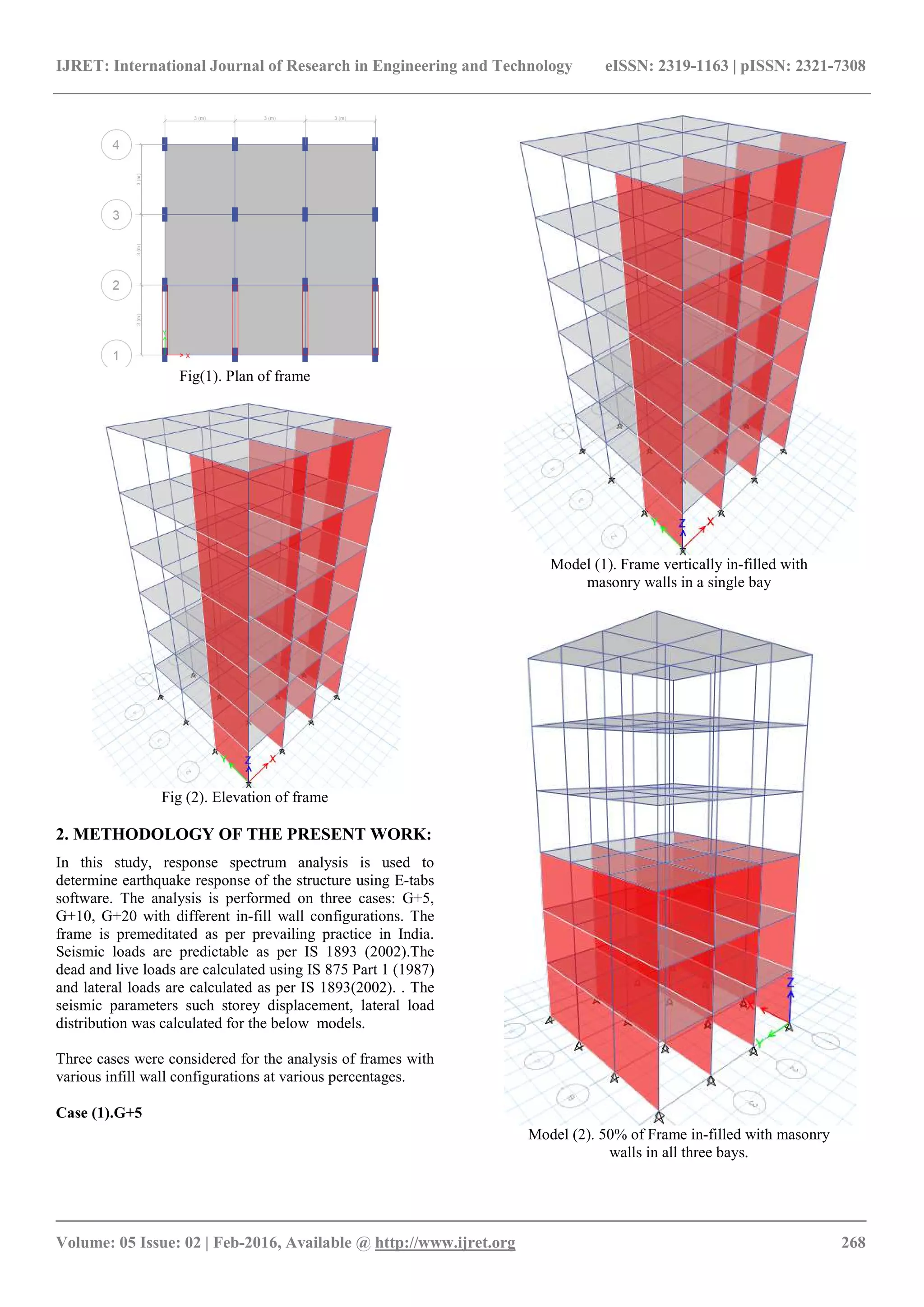
A typical multi-storey residential building, with three bays
in longitudinal as well as in transverse direction is
considered for study as shown in fig 1. The grade of
concrete used is M20 and steel is fe415. As per IS 456:200,.
The thickness of slab and masonry in-fill is 150mm and
230mm respectively. The live load on roof and floor finish
are taken to be 3kN/m2
and 1kN/m2
. The size of beam is
230x450mm and size of column is 230x600mm. The
building is considered to be sited in IV zone with medium
soil setting.
IJRET: International Journal of Research in Engineering and Technology
__________________________________________________________
Volume: 05 Issue: 02 | Feb-2016, Available @
Fig(1). Plan of frame
Fig (2). Elevation of frame
2. METHODOLOGY OF THE PRESENT WORK:
In this study, response spectrum analysis is used to
determine earthquake response of the structure using E
software. The analysis is performed on three cases: G+5,
G+10, G+20 with different in-fill wall configurations.
frame is premeditated as per prevailing practice in India.
Seismic loads are predictable as per IS 1893 (2002).
dead and live loads are calculated using IS 875 Part 1 (1987)
and lateral loads are calculated as per IS 1893(2002). . The
seismic parameters such storey displacement,
distribution was calculated for the below models.
Three cases were considered for the analysis of frames with
various infill wall configurations at various percentages.
Case (1).G+5
IJRET: International Journal of Research in Engineering and Technology eISSN: 2319
_______________________________________________________________________________________
, Available @ http://www.ijret.org
2. METHODOLOGY OF THE PRESENT WORK:
In this study, response spectrum analysis is used to
determine earthquake response of the structure using E-tabs
software. The analysis is performed on three cases: G+5,
fill wall configurations. The
r prevailing practice in India.
Seismic loads are predictable as per IS 1893 (2002).The
dead and live loads are calculated using IS 875 Part 1 (1987)
and lateral loads are calculated as per IS 1893(2002). . The
seismic parameters such storey displacement, lateral load
distribution was calculated for the below models.
Three cases were considered for the analysis of frames with
various infill wall configurations at various percentages.
Model (1). Frame vertically in
masonry walls
Model (2). 50% of Frame in
walls in all three bays.
eISSN: 2319-1163 | pISSN: 2321-7308
_____________________________
268
Frame vertically in-filled with
masonry walls in a single bay
Model (2). 50% of Frame in-filled with masonry
walls in all three bays.
IJRET: International Journal of Research in Engineering and Technology eISSN: 2319-1163 | pISSN: 2321-7308
_______________________________________________________________________________________
Volume: 05 Issue: 02 | Feb-2016, Available @ http://www.ijret.org 269
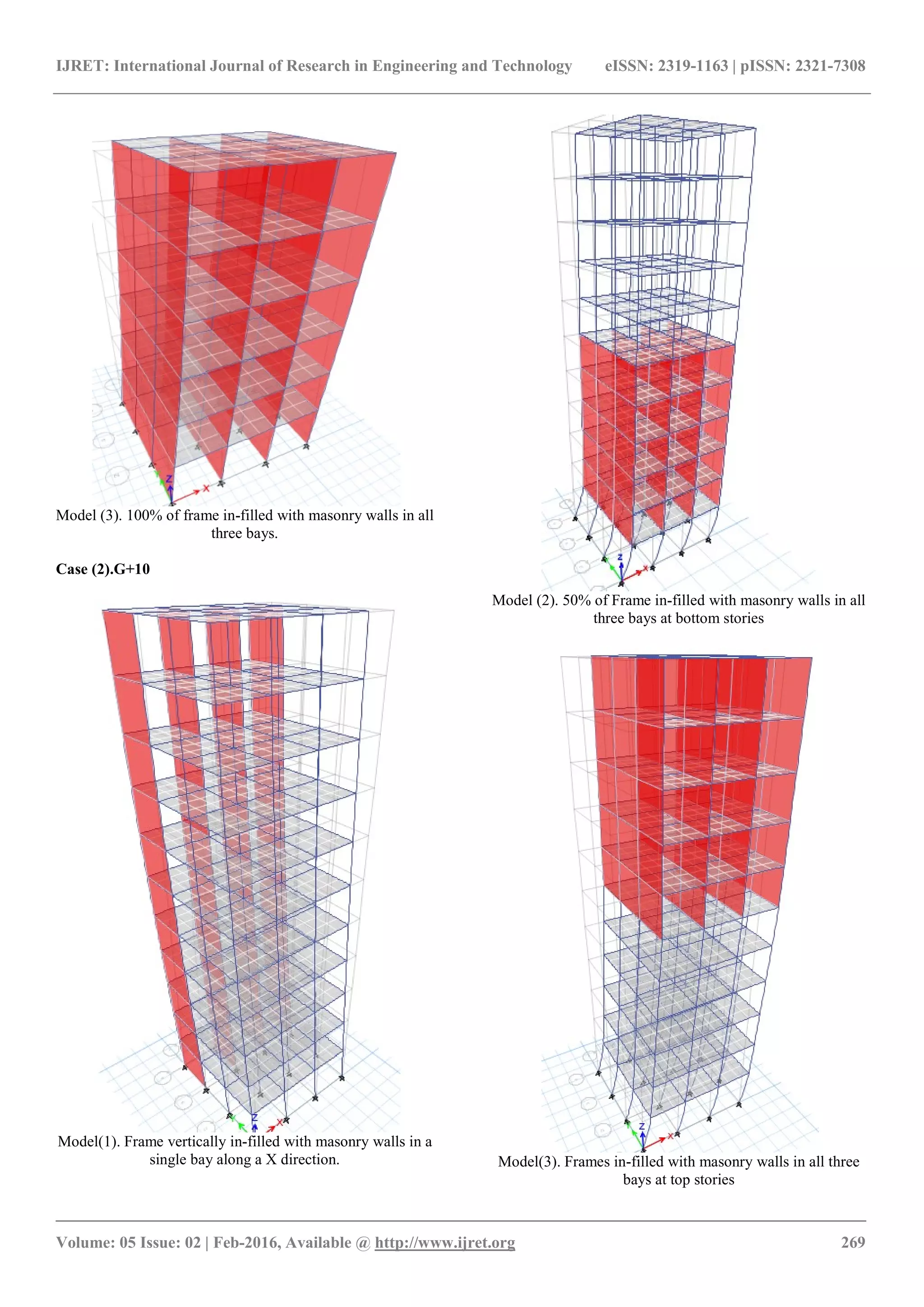
Model (3). 100% of frame in-filled with masonry walls in all
three bays.
Case (2).G+10
Model(1). Frame vertically in-filled with masonry walls in a
single bay along a X direction.
Model (2). 50% of Frame in-filled with masonry walls in all
three bays at bottom stories
Model(3). Frames in-filled with masonry walls in all three
bays at top stories
IJRET: International Journal of Research in Engineering and Technology eISSN: 2319-1163 | pISSN: 2321-7308
_______________________________________________________________________________________
Volume: 05 Issue: 02 | Feb-2016, Available @ http://www.ijret.org 270
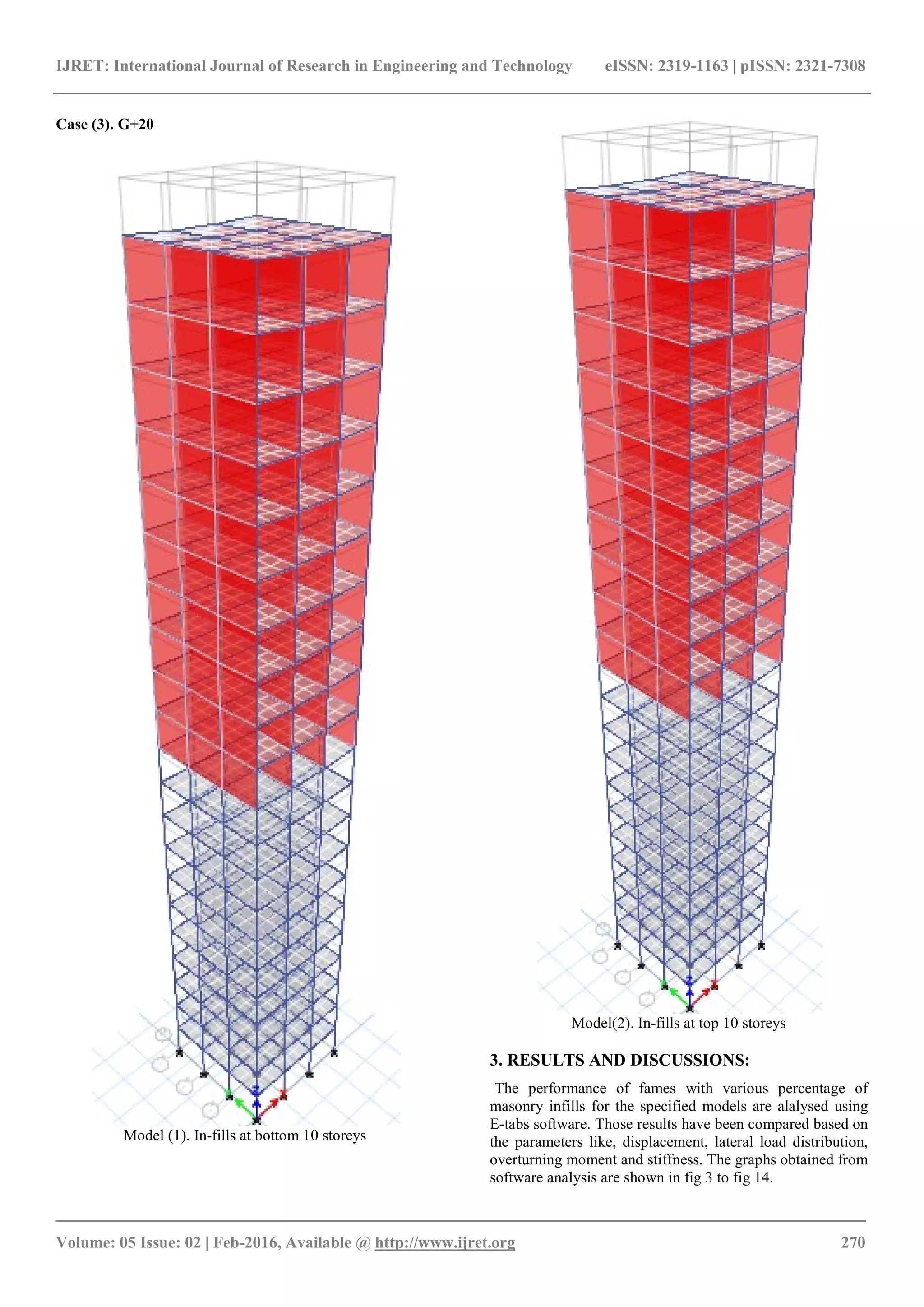
Case (3). G+20
Model (1). In-fills at bottom 10 storeys
Model(2). In-fills at top 10 storeys
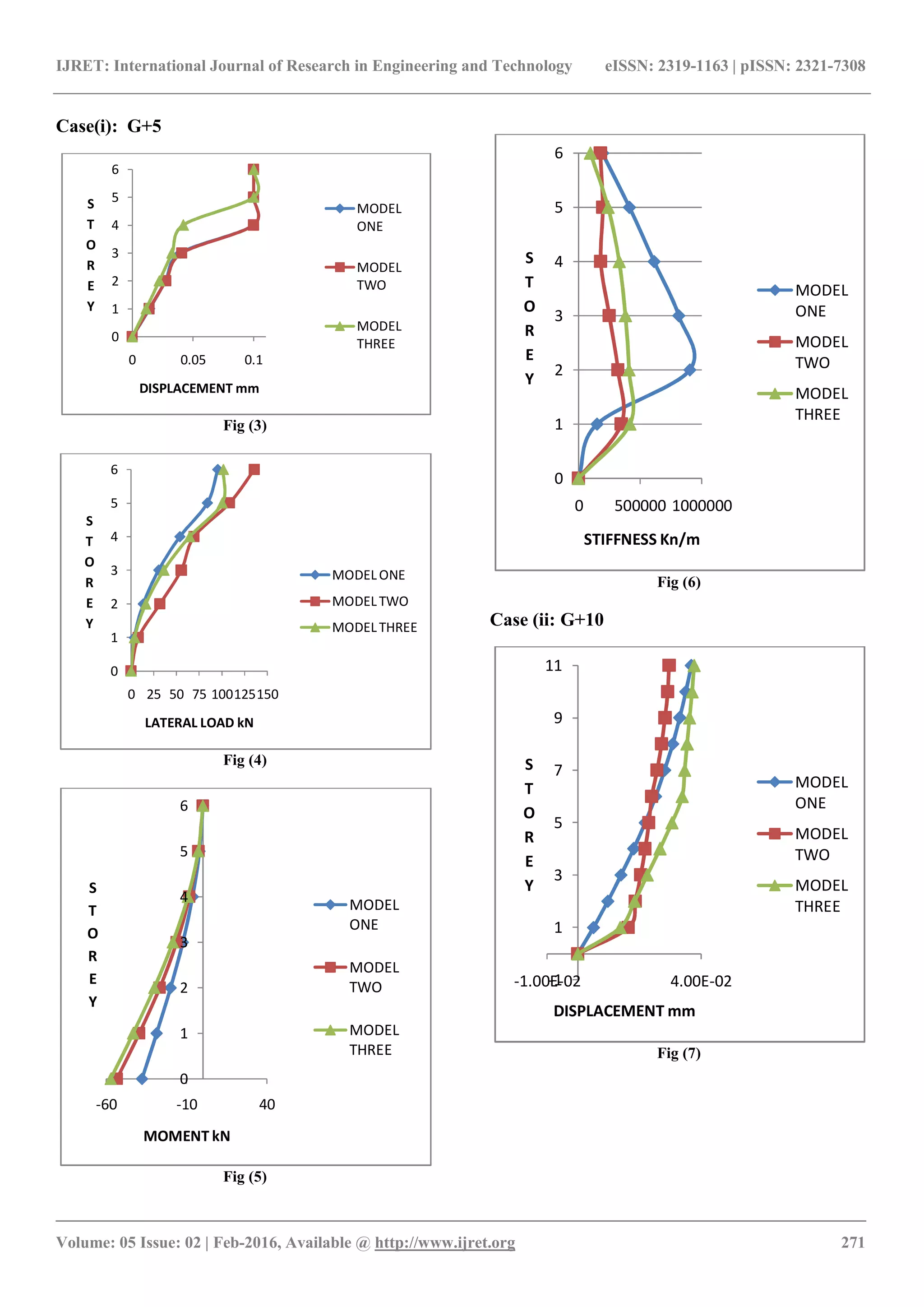
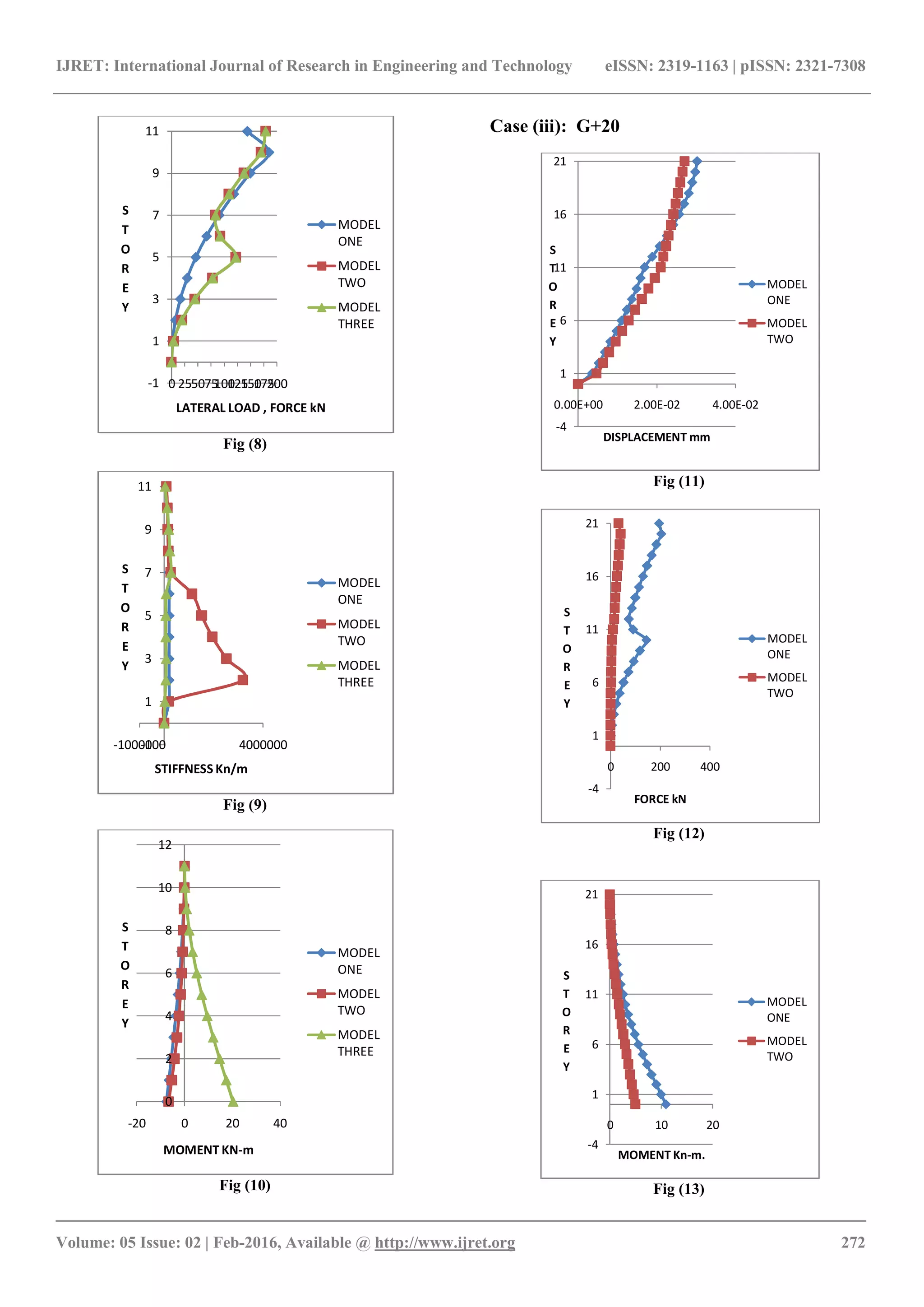
3. RESULTS AND DISCUSSIONS:
The performance of fames with various percentage of
masonry infills for the specified models are alalysed using
E-tabs software. Those results have been compared based on
the parameters like, displacement, lateral load distribution,
overturning moment and stiffness. The graphs obtained from
software analysis are shown in fig 3 to fig 14.
IJRET: International Journal of Research in Engineering and Technology eISSN: 2319-1163 | pISSN: 2321-7308
_______________________________________________________________________________________
Volume: 05 Issue: 02 | Feb-2016, Available @ http://www.ijret.org 271
Case(i): G+5
Fig (3)
Fig (4)
Fig (5)
Fig (6)
Case (ii: G+10
Fig (7)
0
1
2
3
4
5
6
0 0.05 0.1
S
T
O
R
E
Y
DISPLACEMENT mm
MODEL
ONE
MODEL
TWO
MODEL
THREE
0
1
2
3
4
5
6
0 25 50 75 100125150
S
T
O
R
E
Y
LATERAL LOAD kN
MODEL ONE
MODEL TWO
MODEL THREE
0
1
2
3
4
5
6
-60 -10 40
S
T
O
R
E
Y
MOMENT kN
MODEL
ONE
MODEL
TWO
MODEL
THREE
0
1
2
3
4
5
6
0 500000 1000000
S
T
O
R
E
Y
STIFFNESS Kn/m
MODEL
ONE
MODEL
TWO
MODEL
THREE
-1
1
3
5
7
9
11
-1.00E-02 4.00E-02
S
T
O
R
E
Y
DISPLACEMENT mm
MODEL
ONE
MODEL
TWO
MODEL
THREE
IJRET: International Journal of Research in Engineering and Technology eISSN: 2319-1163 | pISSN: 2321-7308
_______________________________________________________________________________________
Volume: 05 Issue: 02 | Feb-2016, Available @ http://www.ijret.org 272
Fig (8)
Fig (9)
Fig (10)
Case (iii): G+20
Fig (11)
Fig (12)
Fig (13)
-1
1
3
5
7
9
11
0 255075100125150175200
S
T
O
R
E
Y
LATERAL LOAD , FORCE kN
MODEL
ONE
MODEL
TWO
MODEL
THREE
-1
1
3
5
7
9
11
-1000000 4000000
S
T
O
R
E
Y
STIFFNESS Kn/m
MODEL
ONE
MODEL
TWO
MODEL
THREE
0
2
4
6
8
10
12
-20 0 20 40
S
T
O
R
E
Y
MOMENT KN-m
MODEL
ONE
MODEL
TWO
MODEL
THREE
-4
1
6
11
16
21
0.00E+00 2.00E-02 4.00E-02
S
T
O
R
E
Y
DISPLACEMENT mm
MODEL
ONE
MODEL
TWO
-4
1
6
11
16
21
0 200 400
S
T
O
R
E
Y
FORCE kN
MODEL
ONE
MODEL
TWO
-4
1
6
11
16
21
0 10 20
S
T
O
R
E
Y
MOMENT Kn-m.
MODEL
ONE
MODEL
TWO
IJRET: International Journal of Research in Engineering and Technology eISSN: 2319-1163 | pISSN: 2321-7308
_______________________________________________________________________________________
Volume: 05 Issue: 02 | Feb-2016, Available @ http://www.ijret.org 273
Fig (14)
Fig (3 to 14). shows the displacement, lateral load, stiffness
and overturning moment of the frame
Table (1) and (2). Comparative analysis of all 3 cases
Cases Model Displac
ement
mm
Over
turning
moment
kN-m
Storey
shear,
kN
Case (i)
G+5
Model one 70 18.5 0.30
Model two 73 41 0.81
Model three 48 32 0.58
Case (ii)
G+10
Model one 37 20.2 0.96
Model two 16 6.40 4.40
Model three 13 7.20 3.40
Case (iii)
G+20
Model one 30 11 3.20
Model two 27 5 1.20
Table (2)
Cases Model Lateral
load,
kN
Eigen
value,
Rad2
/sec2
Case (i)
G+5
Model one 340 83720.21
Model two 162 166957.11
Model three 225 337617.12
Case (ii)
G+10
Model one 182 53868.93
Model two 180 2096.237
Model three 120 4884.3185
Case (iii)
G+20
Model one 200 540.1131
Model two 45 1030.7868
4. CONCLUSIONS
 The lateral stiffness of the framed structures is enhanced
by the infill wall , conversely the presence of apertures
within the infill wall would reduce the lateral stiffness
 When considering the infill wall the root displacement of
the structure reduces and stiffness of the structure
increases. The masonry infill wall is more significant in
small structures, but, when the height of the structure
increases, the effect of masonry infill wall reduces.
 The displacement is found to be more in the structure
where the in-fills are not present. The maximum
displacement is found to be 73mm.
 The lateral load displacement of the framed structures is
found to be not regular, it varies because of absence of
infill.
REFERENCES
[1] Alessandra Fiore, Andriana Netti, Pietro Monaco “The
Influence of Masonry Infill on the Seismic Behavior of
RC Frame Buildings” Engineering structures(2012),
volume 44, pp:133-145.
[2] C.V.R Murty, Sudhir.K.Jain “Beneficial Influence of
Masonry Infill Walls on Seismic Performance of RC
Framed Buildings”12WCEE (2000), pp:1790-1796.
[3] G,C.Monos, V.J.Soulis,J .Thauampteh “The Behavior
Of Masonry Assemblages And Masonry In-Filled RC
Frames Subjected To Combined Vertical And
Horizontal Seismic Type Loading” Advances in
engineering software(2012), pp:35-41.
[4] Haroon Rasheed Tamboli, Umesh.N.Karadi “Seismic
Analysis Of RC Frame Structure With And Without
Masonry Infill Walls” Indian Journal Of Natural
Sciences(October 2014) Volume 3, Issue 14, pp:1137-
1148.
[5] Hemant B. Kausik, Durgesh C Rai, Sudhir K Jain
(2009) “Effectiveness of Some Strengthening Options
for Masonry Infill RC Frames with Open First Storey”
Journal Of Structural Engineering (2009) volume 135,
issue 8, pp: 212-220.
[6] Jaya Prakash Kadali, M.K.M.V.Rathnam Static
Analysis of Multistoreyed RC Buildings By Using
Pushover Methodology International Journal for
Innovative Research in Science & Technology
Volume1,Issue 8, January 2015 pp113-124.1989.
[7] Kashif Mahmud, Md.Rashadul Islam, Md.Al-Amin
“Study The Reinforced Concrete Frame With Brick
Masonry Infill Due To Lateral Loads” International
Journal Of Civil And Environmental Engineering
(2010), Volume 10, Issue 4.
[8] Md. Rashedul Kabir, Debasish Sen, Md. Mashfiqul
Islam “Response of multi-storey regular and irregular
buildings of identical weight under static and dynamic
loading in context of Bangladesh,” International journal
of Civil and Structural Engineering, Volume 5, No 3,
February 2015, pp 252-260.
[9] Md.Irfanullah, Vishwanath.B.Patil “Seismic Evaluation
Of RC Framed Buildings With Influence Of Masonry
Infill Panel” International Journal Of Recent
0
1
2
3
4
5
6
0 500000 1000000
S
T
O
R
E
Y
STIFFNESS Kn/m
MODEL
ONE
MODEL
TWO
IJRET: International Journal of Research in Engineering and Technology eISSN: 2319-1163 | pISSN: 2321-7308
_______________________________________________________________________________________
Volume: 05 Issue: 02 | Feb-2016, Available @ http://www.ijret.org 274
Technology And Engineering (September 2013),
Volume2, Issue 4, pp 117-120
[10]Mohammad H. Jinya “Seismic Behavior Of RC Frame
Building Is Analyzed By Performing Multi-Model Static
And Dynamic Analysis”, International Journal Of
Research In Engineering And Technology(2014),
volume 4, issue 5, pp 411-414.
[11]Mulgund.G, Kulkarni.A.B “Seismic Assessment Of RC
Frame Buildings With Brick Masonry In-fills”
International Of Advanced Engineering, Science And
Technology (2011), Volume 2, Issue 2, pp 140-147.
[12]Niruba, K.V.Boobalakrishnan, K.M.Gopalakrishna
“Analysis Of Masonry Infill In A Multi-Storied
Building” International Refereed Journal Of
Engineering And Science (March 2014), Volume 3,
Issue3, pp26-31.
[13]P.B. Kulkarni, Pooja Raut, Nikhil Agarwal “Linear
Static Analysis Of Masonry In-Filled RC Frame With
And Without Opening Including Open Ground Storey”
International Journal Of Innovative Research In
Science, Engineering And Technology(2013), Volume
2, Issue 6, pp2215-2223
[14]Shaharbon P.S, Manju P.M “Study On Behavior Of RC
Frame With Infill Walls Under Seismic Loads Using E-
TABS”, International Journal Of Civil Engineering And
Technology (December 2014), Volume 5, Issue
12,pp:181-187.
[15]Wackchaure M.R, Ped S.P “Earthquake Analysis Of
High Rise Buildings With And Without In-Filled Walls”
International Journal Of Engineering And Innovative
Technology (August 2012) , Volume 2, Issue 2, pp 89-
94.
BIOGRAPHIES
Arulmozhi.N, PG scholar, Deptartment of
Civil Engineering, Adhiyamaan College of
Engineering, Hosur.
arul.theshark4@gmail.com
+91 9003965069
Srinivasan.R , Assistant Professor,
Dept. Of Civil Engineering
Adhiyamaan college of Engineering,
Hosur. bksrinivasan8@gmail.com
+91 9952664755
Dr. Suresh Babu .S Dean (Research and
development), Head of the Department
(Civil Engineering) Adhiyamaan college of
Engineering, Hosur. Sunisurp@gmail.com
Jegidha .K.J, Assistant professor
Department of Civil Engineering
Adhiyamaan College of Engineering,
Hosur. jegirkj@gmail.com
+ 91 9444714847

Behaviour of 3 d rc frames with masonry infill under earthquake loads an analytical study using e-tabs

  • 1.
    IJRET: International Journalof Research in Engineering and Technology eISSN: 2319-1163 | pISSN: 2321-7308 _______________________________________________________________________________________ Volume: 05 Issue: 02 | Feb-2016, Available @ http://www.ijret.org 267 BEHAVIOUR OF 3D RC FRAMES WITH MASONRY INFILL UNDER EARTHQUAKE LOADS- AN ANALYTICAL STUDY USING E-TABS Arulmozhi. N1 , Srinivasan. R2 , Suresh Babu. S3 , Jegidha.K.J4 1 PG Scholor, Department of Civil Engineering, Adhiyamaan College of Engineering, Hosur 2 Assistant Professor, Department of Civil Engineering, Adhiyamaan College of Engineering, Hosur 3 HOD, Department of Civil Engineering, Adhiyamaan College of Engineering, Hosur 4 Assistant Professor, Department of Civil Engineering, Adhiyamaan College of Engineering, Hosur Abstract Moderate and astringent earthquakes have struck different places in the world, causing rigorous damage to reinforced concrete structures. The bond between the structural elements and masonry in-fills of the building is habitually effected by Earthquake. The voids between horizontal and vertical resisting elements of the building frame is filled by Masonry in-fills. An infill wall enhances considerably the strength and rigidity of the structure. It has apperceived that frames with in-fills have more vigor and rigidity compared to the bare frames Hence this study is about the demeanor of 3D-RC frames with and without masonry in-fills utilizing E-TABS. parameters were studied like displacement, lateral load distribution, stiffness and overturning moment of the frames and it is concluded that, the in-fill walls are needed to be considered while designing phase of the structures. Keywords: Earthquake load, 3D RC Frame, Masonry In-Fill --------------------------------------------------------------------***---------------------------------------------------------------------- 1. INTRODUCTION The earthquake is a phenomenon that releases high amount of energy in a short time through the earth. Structures designed to resist moderate and frequently occurring earthquakes must have ample stiffness and strength, to control deflection and avert any possible collapse. In other words, a structure not only should dissipate a considerable amount of imported energy by ductile demeanor, but additionally it should be able to control the deformations and transfer the force to substratum through enough lateral stiffness in ground kineticism From the observations of damages of the past earthquakes, it is hard to digest the loss of greater number of human lives and to the properties. So this is due to the lack of proper design and understanding construction technique among both public and engineering domain. The buildings, which had already been constructed is susceptible to face more seismic risk, due to the increased seismic vulnerability, hence proper evaluation of the building against seismic hazards is absolutely necessary. The rapid industrialization and increase in population have called for optimum use of scarce land due to which multi- storey building have become inevitable. Apart from dead and live loads, the structures have to withstand lateral forces. Under the action of natural wind and earthquake a tall building will be continually buffeted by gusts and other dynamic forces. Masonry infill walls are frequently utilized as interior partitions and exterior walls in low or middle elevate RC buildings. The infill walls are conventionally treated as non-structural elements and they are ignored in analytical models In the design and assessment of buildings because they are surmised to be propitious to the structural replications. Ergo their influences on the structural replication are generally ignored. When the boundary frame of the structure when it is subjected to ground forms of kineticism their stiffness and strength are not tiny .This interaction may or may not be salutary to the performance of the structure. In developing countries ,Most of the reinforced concrete (RC) frame buildings are in-filled with masonry walls. Experience during the past earthquakes has demonstrated the benign effects as well as the ill-effects of the presence of infill masonry walls. In least two moderate earth quake (enormity 6.0 to 6.5 and maximum intensity 7 on MM scale). In India, RC frame building with brick masonry in- fills have shown excellent performance even though most such buildings were not designed and detailed for seismic replication. From the extensive review of literature carried out, it has been found that no analytical study on three-bay, multi-storey R.C.C frame subjected to lateral loading has been done so far. In this research analytical study was carried out on a three bay, multi storey R.C frame with different locations and percentage of masonry in-fills. The load points were located at first storey level. 1.2 Analytical Model: A typical multi-storey residential building, with three bays in longitudinal as well as in transverse direction is considered for study as shown in fig 1. The grade of concrete used is M20 and steel is fe415. As per IS 456:200,. The thickness of slab and masonry in-fill is 150mm and 230mm respectively. The live load on roof and floor finish are taken to be 3kN/m2 and 1kN/m2 . The size of beam is 230x450mm and size of column is 230x600mm. The building is considered to be sited in IV zone with medium soil setting.
  • 2.
    IJRET: International Journalof Research in Engineering and Technology __________________________________________________________ Volume: 05 Issue: 02 | Feb-2016, Available @ Fig(1). Plan of frame Fig (2). Elevation of frame 2. METHODOLOGY OF THE PRESENT WORK: In this study, response spectrum analysis is used to determine earthquake response of the structure using E software. The analysis is performed on three cases: G+5, G+10, G+20 with different in-fill wall configurations. frame is premeditated as per prevailing practice in India. Seismic loads are predictable as per IS 1893 (2002). dead and live loads are calculated using IS 875 Part 1 (1987) and lateral loads are calculated as per IS 1893(2002). . The seismic parameters such storey displacement, distribution was calculated for the below models. Three cases were considered for the analysis of frames with various infill wall configurations at various percentages. Case (1).G+5 IJRET: International Journal of Research in Engineering and Technology eISSN: 2319 _______________________________________________________________________________________ , Available @ http://www.ijret.org 2. METHODOLOGY OF THE PRESENT WORK: In this study, response spectrum analysis is used to determine earthquake response of the structure using E-tabs software. The analysis is performed on three cases: G+5, fill wall configurations. The r prevailing practice in India. Seismic loads are predictable as per IS 1893 (2002).The dead and live loads are calculated using IS 875 Part 1 (1987) and lateral loads are calculated as per IS 1893(2002). . The seismic parameters such storey displacement, lateral load distribution was calculated for the below models. Three cases were considered for the analysis of frames with various infill wall configurations at various percentages. Model (1). Frame vertically in masonry walls Model (2). 50% of Frame in walls in all three bays. eISSN: 2319-1163 | pISSN: 2321-7308 _____________________________ 268 Frame vertically in-filled with masonry walls in a single bay Model (2). 50% of Frame in-filled with masonry walls in all three bays.
  • 3.
    IJRET: International Journalof Research in Engineering and Technology eISSN: 2319-1163 | pISSN: 2321-7308 _______________________________________________________________________________________ Volume: 05 Issue: 02 | Feb-2016, Available @ http://www.ijret.org 269 Model (3). 100% of frame in-filled with masonry walls in all three bays. Case (2).G+10 Model(1). Frame vertically in-filled with masonry walls in a single bay along a X direction. Model (2). 50% of Frame in-filled with masonry walls in all three bays at bottom stories Model(3). Frames in-filled with masonry walls in all three bays at top stories
  • 4.
    IJRET: International Journalof Research in Engineering and Technology eISSN: 2319-1163 | pISSN: 2321-7308 _______________________________________________________________________________________ Volume: 05 Issue: 02 | Feb-2016, Available @ http://www.ijret.org 270 Case (3). G+20 Model (1). In-fills at bottom 10 storeys Model(2). In-fills at top 10 storeys 3. RESULTS AND DISCUSSIONS: The performance of fames with various percentage of masonry infills for the specified models are alalysed using E-tabs software. Those results have been compared based on the parameters like, displacement, lateral load distribution, overturning moment and stiffness. The graphs obtained from software analysis are shown in fig 3 to fig 14.
  • 5.
    IJRET: International Journalof Research in Engineering and Technology eISSN: 2319-1163 | pISSN: 2321-7308 _______________________________________________________________________________________ Volume: 05 Issue: 02 | Feb-2016, Available @ http://www.ijret.org 271 Case(i): G+5 Fig (3) Fig (4) Fig (5) Fig (6) Case (ii: G+10 Fig (7) 0 1 2 3 4 5 6 0 0.05 0.1 S T O R E Y DISPLACEMENT mm MODEL ONE MODEL TWO MODEL THREE 0 1 2 3 4 5 6 0 25 50 75 100125150 S T O R E Y LATERAL LOAD kN MODEL ONE MODEL TWO MODEL THREE 0 1 2 3 4 5 6 -60 -10 40 S T O R E Y MOMENT kN MODEL ONE MODEL TWO MODEL THREE 0 1 2 3 4 5 6 0 500000 1000000 S T O R E Y STIFFNESS Kn/m MODEL ONE MODEL TWO MODEL THREE -1 1 3 5 7 9 11 -1.00E-02 4.00E-02 S T O R E Y DISPLACEMENT mm MODEL ONE MODEL TWO MODEL THREE
  • 6.
    IJRET: International Journalof Research in Engineering and Technology eISSN: 2319-1163 | pISSN: 2321-7308 _______________________________________________________________________________________ Volume: 05 Issue: 02 | Feb-2016, Available @ http://www.ijret.org 272 Fig (8) Fig (9) Fig (10) Case (iii): G+20 Fig (11) Fig (12) Fig (13) -1 1 3 5 7 9 11 0 255075100125150175200 S T O R E Y LATERAL LOAD , FORCE kN MODEL ONE MODEL TWO MODEL THREE -1 1 3 5 7 9 11 -1000000 4000000 S T O R E Y STIFFNESS Kn/m MODEL ONE MODEL TWO MODEL THREE 0 2 4 6 8 10 12 -20 0 20 40 S T O R E Y MOMENT KN-m MODEL ONE MODEL TWO MODEL THREE -4 1 6 11 16 21 0.00E+00 2.00E-02 4.00E-02 S T O R E Y DISPLACEMENT mm MODEL ONE MODEL TWO -4 1 6 11 16 21 0 200 400 S T O R E Y FORCE kN MODEL ONE MODEL TWO -4 1 6 11 16 21 0 10 20 S T O R E Y MOMENT Kn-m. MODEL ONE MODEL TWO
  • 7.
    IJRET: International Journalof Research in Engineering and Technology eISSN: 2319-1163 | pISSN: 2321-7308 _______________________________________________________________________________________ Volume: 05 Issue: 02 | Feb-2016, Available @ http://www.ijret.org 273 Fig (14) Fig (3 to 14). shows the displacement, lateral load, stiffness and overturning moment of the frame Table (1) and (2). Comparative analysis of all 3 cases Cases Model Displac ement mm Over turning moment kN-m Storey shear, kN Case (i) G+5 Model one 70 18.5 0.30 Model two 73 41 0.81 Model three 48 32 0.58 Case (ii) G+10 Model one 37 20.2 0.96 Model two 16 6.40 4.40 Model three 13 7.20 3.40 Case (iii) G+20 Model one 30 11 3.20 Model two 27 5 1.20 Table (2) Cases Model Lateral load, kN Eigen value, Rad2 /sec2 Case (i) G+5 Model one 340 83720.21 Model two 162 166957.11 Model three 225 337617.12 Case (ii) G+10 Model one 182 53868.93 Model two 180 2096.237 Model three 120 4884.3185 Case (iii) G+20 Model one 200 540.1131 Model two 45 1030.7868 4. CONCLUSIONS  The lateral stiffness of the framed structures is enhanced by the infill wall , conversely the presence of apertures within the infill wall would reduce the lateral stiffness  When considering the infill wall the root displacement of the structure reduces and stiffness of the structure increases. The masonry infill wall is more significant in small structures, but, when the height of the structure increases, the effect of masonry infill wall reduces.  The displacement is found to be more in the structure where the in-fills are not present. The maximum displacement is found to be 73mm.  The lateral load displacement of the framed structures is found to be not regular, it varies because of absence of infill. REFERENCES [1] Alessandra Fiore, Andriana Netti, Pietro Monaco “The Influence of Masonry Infill on the Seismic Behavior of RC Frame Buildings” Engineering structures(2012), volume 44, pp:133-145. [2] C.V.R Murty, Sudhir.K.Jain “Beneficial Influence of Masonry Infill Walls on Seismic Performance of RC Framed Buildings”12WCEE (2000), pp:1790-1796. [3] G,C.Monos, V.J.Soulis,J .Thauampteh “The Behavior Of Masonry Assemblages And Masonry In-Filled RC Frames Subjected To Combined Vertical And Horizontal Seismic Type Loading” Advances in engineering software(2012), pp:35-41. [4] Haroon Rasheed Tamboli, Umesh.N.Karadi “Seismic Analysis Of RC Frame Structure With And Without Masonry Infill Walls” Indian Journal Of Natural Sciences(October 2014) Volume 3, Issue 14, pp:1137- 1148. [5] Hemant B. Kausik, Durgesh C Rai, Sudhir K Jain (2009) “Effectiveness of Some Strengthening Options for Masonry Infill RC Frames with Open First Storey” Journal Of Structural Engineering (2009) volume 135, issue 8, pp: 212-220. [6] Jaya Prakash Kadali, M.K.M.V.Rathnam Static Analysis of Multistoreyed RC Buildings By Using Pushover Methodology International Journal for Innovative Research in Science & Technology Volume1,Issue 8, January 2015 pp113-124.1989. [7] Kashif Mahmud, Md.Rashadul Islam, Md.Al-Amin “Study The Reinforced Concrete Frame With Brick Masonry Infill Due To Lateral Loads” International Journal Of Civil And Environmental Engineering (2010), Volume 10, Issue 4. [8] Md. Rashedul Kabir, Debasish Sen, Md. Mashfiqul Islam “Response of multi-storey regular and irregular buildings of identical weight under static and dynamic loading in context of Bangladesh,” International journal of Civil and Structural Engineering, Volume 5, No 3, February 2015, pp 252-260. [9] Md.Irfanullah, Vishwanath.B.Patil “Seismic Evaluation Of RC Framed Buildings With Influence Of Masonry Infill Panel” International Journal Of Recent 0 1 2 3 4 5 6 0 500000 1000000 S T O R E Y STIFFNESS Kn/m MODEL ONE MODEL TWO
  • 8.
    IJRET: International Journalof Research in Engineering and Technology eISSN: 2319-1163 | pISSN: 2321-7308 _______________________________________________________________________________________ Volume: 05 Issue: 02 | Feb-2016, Available @ http://www.ijret.org 274 Technology And Engineering (September 2013), Volume2, Issue 4, pp 117-120 [10]Mohammad H. Jinya “Seismic Behavior Of RC Frame Building Is Analyzed By Performing Multi-Model Static And Dynamic Analysis”, International Journal Of Research In Engineering And Technology(2014), volume 4, issue 5, pp 411-414. [11]Mulgund.G, Kulkarni.A.B “Seismic Assessment Of RC Frame Buildings With Brick Masonry In-fills” International Of Advanced Engineering, Science And Technology (2011), Volume 2, Issue 2, pp 140-147. [12]Niruba, K.V.Boobalakrishnan, K.M.Gopalakrishna “Analysis Of Masonry Infill In A Multi-Storied Building” International Refereed Journal Of Engineering And Science (March 2014), Volume 3, Issue3, pp26-31. [13]P.B. Kulkarni, Pooja Raut, Nikhil Agarwal “Linear Static Analysis Of Masonry In-Filled RC Frame With And Without Opening Including Open Ground Storey” International Journal Of Innovative Research In Science, Engineering And Technology(2013), Volume 2, Issue 6, pp2215-2223 [14]Shaharbon P.S, Manju P.M “Study On Behavior Of RC Frame With Infill Walls Under Seismic Loads Using E- TABS”, International Journal Of Civil Engineering And Technology (December 2014), Volume 5, Issue 12,pp:181-187. [15]Wackchaure M.R, Ped S.P “Earthquake Analysis Of High Rise Buildings With And Without In-Filled Walls” International Journal Of Engineering And Innovative Technology (August 2012) , Volume 2, Issue 2, pp 89- 94. BIOGRAPHIES Arulmozhi.N, PG scholar, Deptartment of Civil Engineering, Adhiyamaan College of Engineering, Hosur. arul.theshark4@gmail.com +91 9003965069 Srinivasan.R , Assistant Professor, Dept. Of Civil Engineering Adhiyamaan college of Engineering, Hosur. bksrinivasan8@gmail.com +91 9952664755 Dr. Suresh Babu .S Dean (Research and development), Head of the Department (Civil Engineering) Adhiyamaan college of Engineering, Hosur. Sunisurp@gmail.com Jegidha .K.J, Assistant professor Department of Civil Engineering Adhiyamaan College of Engineering, Hosur. jegirkj@gmail.com + 91 9444714847