IJRET: International Journal of Research in Engineering and Technology eISSN: 2319-1163 | pISSN: 2321-7308
_______________________________________________________________________________________
Volume: 04 Issue: 04 | Apr-2015, Available @ http://www.ijret.org 447
OPTIMIZATION AND IMPROVEMENT IN STABILITY OF
COUNTERFORT RETAINING WALL WITH RELIEF SHELF
Tonne V. R1
, Mohite P. M2
1
M. Tech Scholar, Civil Engineering Department, R. I. T., Sangli, Maharashtra, India
2
Associate Professor of Civil Engineering Department, R. I. T., Sangli, Maharashtra, India
Abstract
Reinforced concrete retaining walls are meant to support more height of earth mass. Cantilever retaining wall is constructed up
to height of 6 m and above that it becomes uneconomical. To support more height of earth mass advancement is done in cantilever
retaining wall by adding relief shelf in it. Due to provision of relief shelf the soil pressure on the retaining wall is reduced
resulting in improvement in stability of retaining wall. Cantilever retaining wall with one relief shelf is economical up to height of
10 m above that counterfort retaining wall with relief shelf is useful. In this paper analysis and design of counterfort retaining
wall with one relief shelf is done for various positions of relief shelf. These results are studied to get minimum earth pressure,
more stability and minimum moment in each component of retaining wall. The optimization of counterfort retaining wall is done
to get minimum size of retaining wall. Due to this optimization extra formation width is available in hilly areas and excessive
cutting is avoided thereby construction cost reduces.
Keywords: Counterfort Retaining wall, relief shelf, earth pressure, Factor of safety, overturning, sliding, optimization
--------------------------------------------------------------------***----------------------------------------------------------------------
1. INTRODUCTION
Retaining structures are the walls meant to support earth or
other materials. In order to design retaining wall it is
necessary to determine active and passive earth pressures on
wall. In hills it is not possible to construct roads without
retaining structures. Retaining structures are encountered
and constructed in various fields of engineering such as
roads, harbors, dams, subways, railroads, tunnels mines and
military fortification.
According to Khural R. [2]
to achieve required formation
width and to stabilize disturbed hill slopes number of
retaining structures are constructed in hilly terrain, its
construction cost is near about 20% to 30 %of hill roads
project cost. Gravity retaining walls are designed by
considering its shape and size. Its stability is depending on
its dimensions. Design of gravity retaining wall is not based
on type of material used for construction. Ray Choudhari [1]
had concluded that when height of earth mass to be retained
is less than 6 m cantilever retaining wall is generally
preferred. Above 6 m height counterfort retaining wall is
used to achieve economy in construction. Cantilever
retaining wall with relief shelf is alternative to counterfort
retaining wall which is found out easy to construct and more
economic. As total active earth pressure on retaining wall
with relief shelf is lower in magnitude than that of
conventional type, keying at the base may not be necessary
to prevent sliding in certain cases. Patil S. [4]
says that by
providing relief shelf in cantilever retaining wall it is found
that factor of safety against overturning and sliding is
improved. Due to provision of relief shelf earth pressure
reduces which results in reduction in section. As section of
retaining wall is less, requirement of construction material is
also less which results reduction in cost. He had found that
reduction in volume of concrete and steel is 35 % and 18%
respectively. For height in the vicinity of 10 m cantilever
retaining wall with single relief shelf is economical than
conventional counterfort retaining wall but further economy
is achieved by providing relief shelf in counterfort.
2. COULOMB THEORY
The Coulomb‟s theory is conveniently adopted when the
plane of failure extending diagonally upward and backward
through the backfill. The sliding wedge is a triangular mass
of soil between this plane of failure and the back face of
retaining wall. The soil within the sliding wedge would
slump down when the retaining wall is suddenly removed. If
a plane of failure makes an angle ᴓ with the horizontal, the
forces acting on the sliding wedge are as shown in figure 1.
Forces acting on failure plane these forces consist of weight
of the soil within the wedge W which acts through the
centroid of the triangle, a thrust normal to the plane of
failure N which exerted by the soil to the right of the failure
plane. N = N tan ᴓ will be at the limit of equilibrium. These
forces must be balanced by the thrust P which is assumed to
act horizontally and to be concurrent with W, N and S. The
equal and opposite reaction to P is the lateral force to
withstand which the wall is to be designed. The forces N
and S may be replaced by the resultant R to derive the value
of P. S acts along a line making the angle ᴓ with the normal
to the failure plane. Since W, P and R are three concurrent
forces which are in equilibrium, when the failure is about to
take place along the failure plane, they may be represented
by the triangle of forces in figure 1. In this triangle P=W
tanρ-ᴓ=1/2*Ka*γ*H2
IJRET: International Journal of Research in Engineering and Technology eISSN: 2319-1163 | pISSN: 2321-7308
_______________________________________________________________________________________
Volume: 04 Issue: 04 | Apr-2015, Available @ http://www.ijret.org 448
Fig.1 Forces acting on failure plane
Fig. 2 shows the active and passive state of plastic
equilibrium in a non-cohesive soil with the horizontal
ground surface. In an active state the major principal stress
σ1 is vertical and minor principal stress σ2 is horizontal.
Circle I represents such a state in which the pole P1
corresponds to minor principal stress while point A
corresponds to major principal stress The circle touches the
failure envelopes at F1 and F2‟ hence P1F1 and P1F1‟show
the directions of failure planes or slip lines these slip lines
also shown in fig. 2. Similarly direction of the major
principal stress and minor principal stresses are vice versa.
Fig.2 Active and Passive states of plastic equilibrium
3. LOFT THEORY
For non-cohesive soils the active earth pressure on a
retaining wall can be computed by considering the stabilities
of different wedges of soil mass. It attains a maximum value
when the rupture plane makes an angle of 45o
+ ᴓ/2 with the
horizontal, where ᴓ is the angle of internal friction of the
non-cohesive soil. Fig 3 shows cross section of retaining
wall with one horizontal shelf of width „b‟ and thickness „t‟
at a height „H-h‟ from the base. When b= H-T-h tan [45o
+
ᴓ/2], the rupture plane originating at the intersection of base
and stem on the backfill side meets the horizontal shelf.
According to Jumikies the earth pressure distribution
diagram below the shelf would be as shown in the fig.3, as if
a free surface existed at the shelf level. If b is greater than
H-T-h tan [45o
+ ᴓ/2], the rupture plane which gives the
maximum value of lateral earth pressure, i.e. the plane
inclined at 45o
+ ᴓ/2 with the horizontal, cannot develop, as
it has to go through the shelf. The total active earth pressure
at any level can be obtained by stability analysis of wedge,
assuming that by providing a horizontal shelf, the weight of
the earth over the shelf is born by the shelf and the weight of
this soil mass is not effective to cause sliding.
Fig.3 Cross section of retaining wall with one relief shelf
and soil pressure on wall
4. ANALYSIS OF COUNTERFORT RETAINING
WALL WITH ONE RELIEF SHELF
From literature it is clear that cantilever retaining wall with
one relief shelf is economical up to 10 m height, above that
height counterfort retaining wall with relief shelf is
economical. Analysis of counterfort retaining wall is done to
find best suited position considering different heights of
walls too. Properties taken for analysis are, Cohesiveness of
soil (c) = 0 N/mm2
, Angle of internal friction (ᴓ) = 300
,
Inclination of soil = 00
, Unit Weight of soil (s) = 19 kN/m3
,
Unit Weight of concrete (c) = 25 kN/m3
, Bearing capacity
of soil (sbc) = 270 N/mm2
, Concrete M20, Steel Fe 415.
IJRET: International Journal of Research in Engineering and Technology eISSN: 2319-1163 | pISSN: 2321-7308
_______________________________________________________________________________________
Volume: 04 Issue: 04 | Apr-2015, Available @ http://www.ijret.org 449
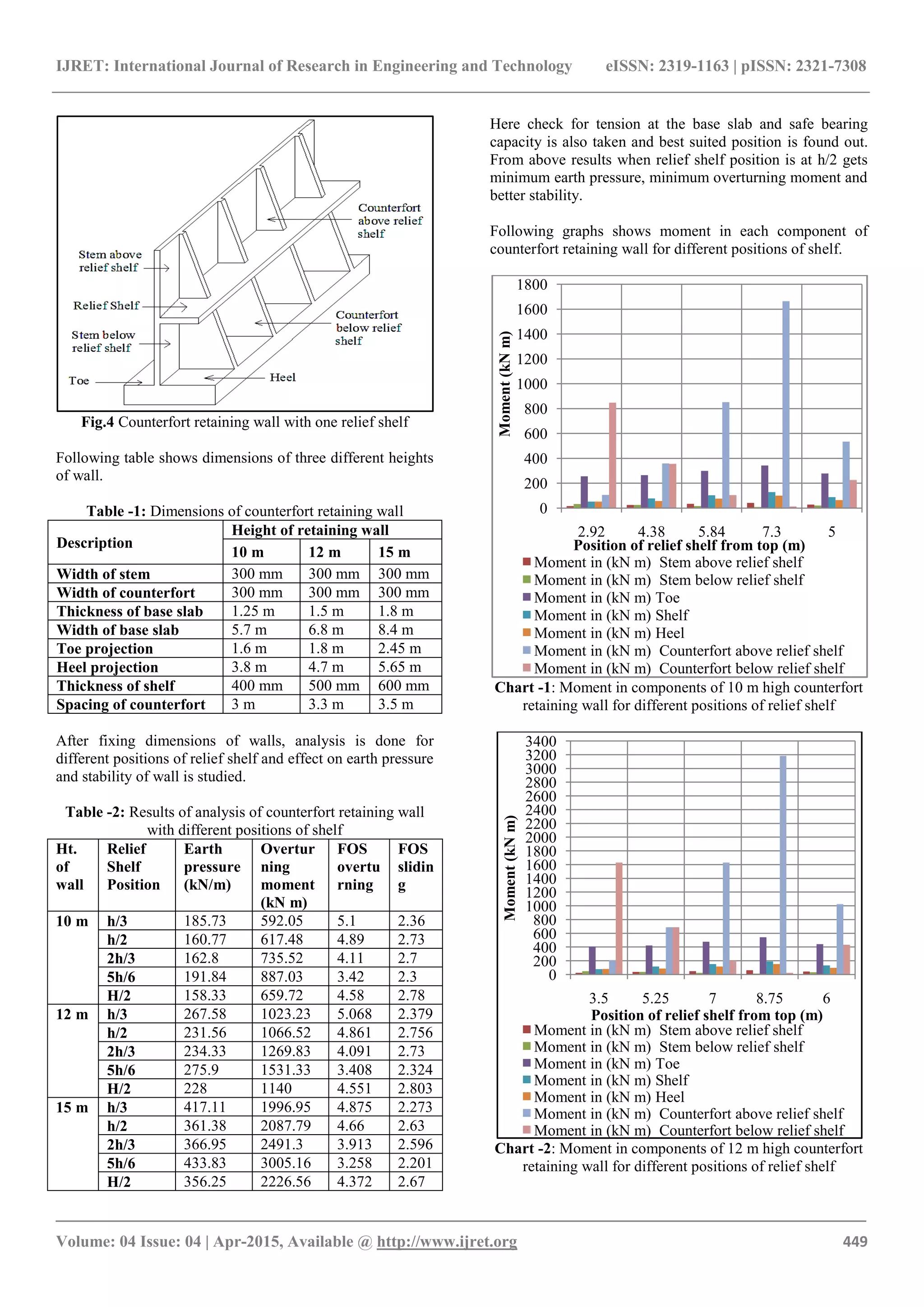
Fig.4 Counterfort retaining wall with one relief shelf
Following table shows dimensions of three different heights
of wall.
Table -1: Dimensions of counterfort retaining wall
Description
Height of retaining wall
10 m 12 m 15 m
Width of stem 300 mm 300 mm 300 mm
Width of counterfort 300 mm 300 mm 300 mm
Thickness of base slab 1.25 m 1.5 m 1.8 m
Width of base slab 5.7 m 6.8 m 8.4 m
Toe projection 1.6 m 1.8 m 2.45 m
Heel projection 3.8 m 4.7 m 5.65 m
Thickness of shelf 400 mm 500 mm 600 mm
Spacing of counterfort 3 m 3.3 m 3.5 m
After fixing dimensions of walls, analysis is done for
different positions of relief shelf and effect on earth pressure
and stability of wall is studied.
Table -2: Results of analysis of counterfort retaining wall
with different positions of shelf
Ht.
of
wall
Relief
Shelf
Position
Earth
pressure
(kN/m)
Overtur
ning
moment
(kN m)
FOS
overtu
rning
FOS
slidin
g
10 m h/3 185.73 592.05 5.1 2.36
h/2 160.77 617.48 4.89 2.73
2h/3 162.8 735.52 4.11 2.7
5h/6 191.84 887.03 3.42 2.3
H/2 158.33 659.72 4.58 2.78
12 m h/3 267.58 1023.23 5.068 2.379
h/2 231.56 1066.52 4.861 2.756
2h/3 234.33 1269.83 4.091 2.73
5h/6 275.9 1531.33 3.408 2.324
H/2 228 1140 4.551 2.803
15 m h/3 417.11 1996.95 4.875 2.273
h/2 361.38 2087.79 4.66 2.63
2h/3 366.95 2491.3 3.913 2.596
5h/6 433.83 3005.16 3.258 2.201
H/2 356.25 2226.56 4.372 2.67
Here check for tension at the base slab and safe bearing
capacity is also taken and best suited position is found out.
From above results when relief shelf position is at h/2 gets
minimum earth pressure, minimum overturning moment and
better stability.
Following graphs shows moment in each component of
counterfort retaining wall for different positions of shelf.
Chart -1: Moment in components of 10 m high counterfort
retaining wall for different positions of relief shelf
Chart -2: Moment in components of 12 m high counterfort
retaining wall for different positions of relief shelf
0
200
400
600
800
1000
1200
1400
1600
1800
2.92 4.38 5.84 7.3 5
Moment(kNm)
Position of relief shelf from top (m)
Moment in (kN m) Stem above relief shelf
Moment in (kN m) Stem below relief shelf
Moment in (kN m) Toe
Moment in (kN m) Shelf
Moment in (kN m) Heel
Moment in (kN m) Counterfort above relief shelf
Moment in (kN m) Counterfort below relief shelf
0
200
400
600
800
1000
1200
1400
1600
1800
2000
2200
2400
2600
2800
3000
3200
3400
3.5 5.25 7 8.75 6
Moment(kNm)
Position of relief shelf from top (m)
Moment in (kN m) Stem above relief shelf
Moment in (kN m) Stem below relief shelf
Moment in (kN m) Toe
Moment in (kN m) Shelf
Moment in (kN m) Heel
Moment in (kN m) Counterfort above relief shelf
Moment in (kN m) Counterfort below relief shelf
IJRET: International Journal of Research in Engineering and Technology eISSN: 2319-1163 | pISSN: 2321-7308
_______________________________________________________________________________________
Volume: 04 Issue: 04 | Apr-2015, Available @ http://www.ijret.org 450
Chart -3: Moment in components of 15 m high counterfort
retaining wall for different positions of relief shelf
From above graphs it is concluded that there is minimum
moment in the components of retaining walls when shelf
position is at h/2 height. (h = height of stem.)
5. OPTIMIZATION OF RETAINING WALL
After fixing position of relief shelf, optimization of retaining
wall is done to minimize the size. Following table shows
optimized dimensions of retaining wall.
Table -3: Optimized dimensions of counterfort retaining
wall
Description Height of retaining wall
10 m 12 m 15 m
Width of stem 200 mm 200 mm 220 mm
Width of counterfort 300 mm 300 mm 300 mm
Thickness of base slab 0.6 m 0.8 m 1 m
Width of base slab 5 m 5.8 m 7.8 m
Toe projection 1.2 m 1.8 m 2.5 m
Heel projection 3.6 m 3.8 m 5.08 m
Thickness of shelf 250 mm 280 mm 320 mm
Spacing of counterfort 3 m 3.3 m 3.5 m
In following table stability checks are given
Table -4: Stability checks for counterfort retaining wall
Ht.
of
wall
FOS against
Overturning
FOS
against
Sliding
P max
(kN/m2
)
P min
(kN/m2
)
10 m 3.612 2.411 213.37 93.15
12 m 3.274 2.143 231.77 106.72
15 m 3.761 2.271 249.74 167.00
In the following table moment in each components of
retaining wall and required steel for respective component
are given
Table -5: Critical mmt in each component of counterfort
retaining wall and their respective steel requirement
Compone
nt of wall
Height of
wall
10 m 12 m 15 m
Stem
Mu
(kN m)
27.12 39.90 56.75
Reqd
. Steel
(mm2)
588.17 913.42 1156.16
Toe
Mu
(kN m)
203.85 483.17 1012.03
Reqd
. Steel
(mm2)
478.51 1911.8 3211.04
Shelf
Mu
(kN m)
82.74 121.59 172.70
Reqd
. Steel
(mm2)
1430.12 1856.7 2241.65
Heel
Mu
(kN m)
91.53 141.84 158.72
Reqd
. Steel
(mm2)
478.51 539.31 472.85
Counterf
ort
Mu
(kN m)
443.84 834.17 1737.86
Reqd
. Steel
(mm2)
719.53 1242.7 1947.39
6. CONCLUSION
Counterfort retaining wall of heights 10 m, 12 m, and 15 m
with relief shelf at h/2 gets minimum earth pressure,
minimum overturning moment and better stability.(where h=
height of stem.)
Optimization of counterfort retaining wall is possible due to
provision of relief shelf. Because of relief shelf moment in
each component of retaining wall is reduced. It results in
reduction in cross-section of retaining wall by 49.86% in 10
m, 49.84% in 12 m and 43.75% in 15 m height of wall. Due
to reduction in cross-sectional area excessive cutting of
earth mass is avoided and requirement of construction
material is reduced, which results in reduction in
construction cost.
REFERENCES
[1] Brig Rajesh Tyagi, “Construction of Retaining
Structures in Bhutan” Journal of the Indian National
Group of the International Association for Bridge &
Structural Engineering, March-April 2009.
[2] Bentler J.G., Labuz, J. F., “Performance of a
cantilever retaining wall.” Journal of geotechnical
and geo environmental engineering, Page: 1062-
1070, 2006.
[3] Chaudhuri P Ray, Garg A. K. “Design of retaining
walls with relieving shelves” IRC Journal, Vol-35,
page:289 – 325,1973.
0
500
1000
1500
2000
2500
3000
3500
4000
4500
5000
5500
6000
6500
7000
7500
4.4 6.6 8.8 11 7.5
Moment(kNm)
Position of relief shelf from top (m)
Moment in (kN m) Stem above relief shelf
Moment in (kN m) Stem below relief shelf
Moment in (kN m) Toe
Moment in (kN m) Shelf
Moment in (kN m) Heel
Moment in (kN m) Counterfort above relief shelf
Moment in (kN m) Counterfort below relief shelf
IJRET: International Journal of Research in Engineering and Technology eISSN: 2319-1163 | pISSN: 2321-7308
_______________________________________________________________________________________
Volume: 04 Issue: 04 | Apr-2015, Available @ http://www.ijret.org 451
[4] DonkadaShravya, MenonDevdas“Optimal design of
reinforced concrete retaining walls” The Indian
Concrete Journal,April 2012.
[5] Dr. Punmia B. C. “Earth Pressure”, Soil Mechanics
and Foundations, Thirteenth Edition, Page- 535 –
581.
[6] I.S. 456:2000 Plain and Reinforced Concrete Code of
Practice (Fourth Revision)
[7] Jumikis A.R., Mechanics of Soils, D Van Nostrand,
1964.
[8] Khural R. A“Design of modified retaining structures”
The Bridge and Structural Engineering, Vol-43,
Page: 31- 47,Mar2013.
[9] Natraja M. C. “Design and Detailing of Retaining
Wall” April 2007.
[10] Padhye R. D, Ullagaddi P. B“Analysis of retaining
wall with pressure relief shelf by coulomb‟s method”
Proceedings of Indian Geotechnical Conference,
Paper No. K-106, Page:671 – 673, 15-17 Dec2011.
[11] Patil S. M, Wagh K. S “Reduction in construction
material: Effect of the provision of the loft behind the
cantilever retaining wall” Indian Geotechnical
Conference, Page:227-230,16-18Dec2010
[12] Ramamrutham S. And Narayan R. “Retaining
Walls”, Design of Reinforced Concrete Structures
(Conforming To IS 456), Fifteenth Revised and
Enlarged Edition, Page: 1236 - 1437.
[13] Sharma Chetan, Baradiya Vijay, “Evaluation of the
effect of lateral soil pressure on cantilever retaining
wall with soil type variation” IOSR Journal of
Mechanical and Civil Engineering, Volume 11, Issue
2, Ver. III, Page: 36-42, Mar- Apr 2014.
BIOGRAPHIES
Tonne V. R, P.G (civil structure)
Scholar, R. I. T. Sakharale, Sangli,
Maharashtra, India
Email:gururaj.tonne@gmail.com
Mohite P. M, Associate Professor of
Civil Engineering Department, R. I. T.
Sakharale, Sangli, Maharashtra, India
Email:prakash.mohite@ritindia.edu

Optimization and improvement in stability of counterfort retaining wall with relief shelf

  • 1.
    IJRET: International Journalof Research in Engineering and Technology eISSN: 2319-1163 | pISSN: 2321-7308 _______________________________________________________________________________________ Volume: 04 Issue: 04 | Apr-2015, Available @ http://www.ijret.org 447 OPTIMIZATION AND IMPROVEMENT IN STABILITY OF COUNTERFORT RETAINING WALL WITH RELIEF SHELF Tonne V. R1 , Mohite P. M2 1 M. Tech Scholar, Civil Engineering Department, R. I. T., Sangli, Maharashtra, India 2 Associate Professor of Civil Engineering Department, R. I. T., Sangli, Maharashtra, India Abstract Reinforced concrete retaining walls are meant to support more height of earth mass. Cantilever retaining wall is constructed up to height of 6 m and above that it becomes uneconomical. To support more height of earth mass advancement is done in cantilever retaining wall by adding relief shelf in it. Due to provision of relief shelf the soil pressure on the retaining wall is reduced resulting in improvement in stability of retaining wall. Cantilever retaining wall with one relief shelf is economical up to height of 10 m above that counterfort retaining wall with relief shelf is useful. In this paper analysis and design of counterfort retaining wall with one relief shelf is done for various positions of relief shelf. These results are studied to get minimum earth pressure, more stability and minimum moment in each component of retaining wall. The optimization of counterfort retaining wall is done to get minimum size of retaining wall. Due to this optimization extra formation width is available in hilly areas and excessive cutting is avoided thereby construction cost reduces. Keywords: Counterfort Retaining wall, relief shelf, earth pressure, Factor of safety, overturning, sliding, optimization --------------------------------------------------------------------***---------------------------------------------------------------------- 1. INTRODUCTION Retaining structures are the walls meant to support earth or other materials. In order to design retaining wall it is necessary to determine active and passive earth pressures on wall. In hills it is not possible to construct roads without retaining structures. Retaining structures are encountered and constructed in various fields of engineering such as roads, harbors, dams, subways, railroads, tunnels mines and military fortification. According to Khural R. [2] to achieve required formation width and to stabilize disturbed hill slopes number of retaining structures are constructed in hilly terrain, its construction cost is near about 20% to 30 %of hill roads project cost. Gravity retaining walls are designed by considering its shape and size. Its stability is depending on its dimensions. Design of gravity retaining wall is not based on type of material used for construction. Ray Choudhari [1] had concluded that when height of earth mass to be retained is less than 6 m cantilever retaining wall is generally preferred. Above 6 m height counterfort retaining wall is used to achieve economy in construction. Cantilever retaining wall with relief shelf is alternative to counterfort retaining wall which is found out easy to construct and more economic. As total active earth pressure on retaining wall with relief shelf is lower in magnitude than that of conventional type, keying at the base may not be necessary to prevent sliding in certain cases. Patil S. [4] says that by providing relief shelf in cantilever retaining wall it is found that factor of safety against overturning and sliding is improved. Due to provision of relief shelf earth pressure reduces which results in reduction in section. As section of retaining wall is less, requirement of construction material is also less which results reduction in cost. He had found that reduction in volume of concrete and steel is 35 % and 18% respectively. For height in the vicinity of 10 m cantilever retaining wall with single relief shelf is economical than conventional counterfort retaining wall but further economy is achieved by providing relief shelf in counterfort. 2. COULOMB THEORY The Coulomb‟s theory is conveniently adopted when the plane of failure extending diagonally upward and backward through the backfill. The sliding wedge is a triangular mass of soil between this plane of failure and the back face of retaining wall. The soil within the sliding wedge would slump down when the retaining wall is suddenly removed. If a plane of failure makes an angle ᴓ with the horizontal, the forces acting on the sliding wedge are as shown in figure 1. Forces acting on failure plane these forces consist of weight of the soil within the wedge W which acts through the centroid of the triangle, a thrust normal to the plane of failure N which exerted by the soil to the right of the failure plane. N = N tan ᴓ will be at the limit of equilibrium. These forces must be balanced by the thrust P which is assumed to act horizontally and to be concurrent with W, N and S. The equal and opposite reaction to P is the lateral force to withstand which the wall is to be designed. The forces N and S may be replaced by the resultant R to derive the value of P. S acts along a line making the angle ᴓ with the normal to the failure plane. Since W, P and R are three concurrent forces which are in equilibrium, when the failure is about to take place along the failure plane, they may be represented by the triangle of forces in figure 1. In this triangle P=W tanρ-ᴓ=1/2*Ka*γ*H2
  • 2.
    IJRET: International Journalof Research in Engineering and Technology eISSN: 2319-1163 | pISSN: 2321-7308 _______________________________________________________________________________________ Volume: 04 Issue: 04 | Apr-2015, Available @ http://www.ijret.org 448 Fig.1 Forces acting on failure plane Fig. 2 shows the active and passive state of plastic equilibrium in a non-cohesive soil with the horizontal ground surface. In an active state the major principal stress σ1 is vertical and minor principal stress σ2 is horizontal. Circle I represents such a state in which the pole P1 corresponds to minor principal stress while point A corresponds to major principal stress The circle touches the failure envelopes at F1 and F2‟ hence P1F1 and P1F1‟show the directions of failure planes or slip lines these slip lines also shown in fig. 2. Similarly direction of the major principal stress and minor principal stresses are vice versa. Fig.2 Active and Passive states of plastic equilibrium 3. LOFT THEORY For non-cohesive soils the active earth pressure on a retaining wall can be computed by considering the stabilities of different wedges of soil mass. It attains a maximum value when the rupture plane makes an angle of 45o + ᴓ/2 with the horizontal, where ᴓ is the angle of internal friction of the non-cohesive soil. Fig 3 shows cross section of retaining wall with one horizontal shelf of width „b‟ and thickness „t‟ at a height „H-h‟ from the base. When b= H-T-h tan [45o + ᴓ/2], the rupture plane originating at the intersection of base and stem on the backfill side meets the horizontal shelf. According to Jumikies the earth pressure distribution diagram below the shelf would be as shown in the fig.3, as if a free surface existed at the shelf level. If b is greater than H-T-h tan [45o + ᴓ/2], the rupture plane which gives the maximum value of lateral earth pressure, i.e. the plane inclined at 45o + ᴓ/2 with the horizontal, cannot develop, as it has to go through the shelf. The total active earth pressure at any level can be obtained by stability analysis of wedge, assuming that by providing a horizontal shelf, the weight of the earth over the shelf is born by the shelf and the weight of this soil mass is not effective to cause sliding. Fig.3 Cross section of retaining wall with one relief shelf and soil pressure on wall 4. ANALYSIS OF COUNTERFORT RETAINING WALL WITH ONE RELIEF SHELF From literature it is clear that cantilever retaining wall with one relief shelf is economical up to 10 m height, above that height counterfort retaining wall with relief shelf is economical. Analysis of counterfort retaining wall is done to find best suited position considering different heights of walls too. Properties taken for analysis are, Cohesiveness of soil (c) = 0 N/mm2 , Angle of internal friction (ᴓ) = 300 , Inclination of soil = 00 , Unit Weight of soil (s) = 19 kN/m3 , Unit Weight of concrete (c) = 25 kN/m3 , Bearing capacity of soil (sbc) = 270 N/mm2 , Concrete M20, Steel Fe 415.
  • 3.
    IJRET: International Journalof Research in Engineering and Technology eISSN: 2319-1163 | pISSN: 2321-7308 _______________________________________________________________________________________ Volume: 04 Issue: 04 | Apr-2015, Available @ http://www.ijret.org 449 Fig.4 Counterfort retaining wall with one relief shelf Following table shows dimensions of three different heights of wall. Table -1: Dimensions of counterfort retaining wall Description Height of retaining wall 10 m 12 m 15 m Width of stem 300 mm 300 mm 300 mm Width of counterfort 300 mm 300 mm 300 mm Thickness of base slab 1.25 m 1.5 m 1.8 m Width of base slab 5.7 m 6.8 m 8.4 m Toe projection 1.6 m 1.8 m 2.45 m Heel projection 3.8 m 4.7 m 5.65 m Thickness of shelf 400 mm 500 mm 600 mm Spacing of counterfort 3 m 3.3 m 3.5 m After fixing dimensions of walls, analysis is done for different positions of relief shelf and effect on earth pressure and stability of wall is studied. Table -2: Results of analysis of counterfort retaining wall with different positions of shelf Ht. of wall Relief Shelf Position Earth pressure (kN/m) Overtur ning moment (kN m) FOS overtu rning FOS slidin g 10 m h/3 185.73 592.05 5.1 2.36 h/2 160.77 617.48 4.89 2.73 2h/3 162.8 735.52 4.11 2.7 5h/6 191.84 887.03 3.42 2.3 H/2 158.33 659.72 4.58 2.78 12 m h/3 267.58 1023.23 5.068 2.379 h/2 231.56 1066.52 4.861 2.756 2h/3 234.33 1269.83 4.091 2.73 5h/6 275.9 1531.33 3.408 2.324 H/2 228 1140 4.551 2.803 15 m h/3 417.11 1996.95 4.875 2.273 h/2 361.38 2087.79 4.66 2.63 2h/3 366.95 2491.3 3.913 2.596 5h/6 433.83 3005.16 3.258 2.201 H/2 356.25 2226.56 4.372 2.67 Here check for tension at the base slab and safe bearing capacity is also taken and best suited position is found out. From above results when relief shelf position is at h/2 gets minimum earth pressure, minimum overturning moment and better stability. Following graphs shows moment in each component of counterfort retaining wall for different positions of shelf. Chart -1: Moment in components of 10 m high counterfort retaining wall for different positions of relief shelf Chart -2: Moment in components of 12 m high counterfort retaining wall for different positions of relief shelf 0 200 400 600 800 1000 1200 1400 1600 1800 2.92 4.38 5.84 7.3 5 Moment(kNm) Position of relief shelf from top (m) Moment in (kN m) Stem above relief shelf Moment in (kN m) Stem below relief shelf Moment in (kN m) Toe Moment in (kN m) Shelf Moment in (kN m) Heel Moment in (kN m) Counterfort above relief shelf Moment in (kN m) Counterfort below relief shelf 0 200 400 600 800 1000 1200 1400 1600 1800 2000 2200 2400 2600 2800 3000 3200 3400 3.5 5.25 7 8.75 6 Moment(kNm) Position of relief shelf from top (m) Moment in (kN m) Stem above relief shelf Moment in (kN m) Stem below relief shelf Moment in (kN m) Toe Moment in (kN m) Shelf Moment in (kN m) Heel Moment in (kN m) Counterfort above relief shelf Moment in (kN m) Counterfort below relief shelf
  • 4.
    IJRET: International Journalof Research in Engineering and Technology eISSN: 2319-1163 | pISSN: 2321-7308 _______________________________________________________________________________________ Volume: 04 Issue: 04 | Apr-2015, Available @ http://www.ijret.org 450 Chart -3: Moment in components of 15 m high counterfort retaining wall for different positions of relief shelf From above graphs it is concluded that there is minimum moment in the components of retaining walls when shelf position is at h/2 height. (h = height of stem.) 5. OPTIMIZATION OF RETAINING WALL After fixing position of relief shelf, optimization of retaining wall is done to minimize the size. Following table shows optimized dimensions of retaining wall. Table -3: Optimized dimensions of counterfort retaining wall Description Height of retaining wall 10 m 12 m 15 m Width of stem 200 mm 200 mm 220 mm Width of counterfort 300 mm 300 mm 300 mm Thickness of base slab 0.6 m 0.8 m 1 m Width of base slab 5 m 5.8 m 7.8 m Toe projection 1.2 m 1.8 m 2.5 m Heel projection 3.6 m 3.8 m 5.08 m Thickness of shelf 250 mm 280 mm 320 mm Spacing of counterfort 3 m 3.3 m 3.5 m In following table stability checks are given Table -4: Stability checks for counterfort retaining wall Ht. of wall FOS against Overturning FOS against Sliding P max (kN/m2 ) P min (kN/m2 ) 10 m 3.612 2.411 213.37 93.15 12 m 3.274 2.143 231.77 106.72 15 m 3.761 2.271 249.74 167.00 In the following table moment in each components of retaining wall and required steel for respective component are given Table -5: Critical mmt in each component of counterfort retaining wall and their respective steel requirement Compone nt of wall Height of wall 10 m 12 m 15 m Stem Mu (kN m) 27.12 39.90 56.75 Reqd . Steel (mm2) 588.17 913.42 1156.16 Toe Mu (kN m) 203.85 483.17 1012.03 Reqd . Steel (mm2) 478.51 1911.8 3211.04 Shelf Mu (kN m) 82.74 121.59 172.70 Reqd . Steel (mm2) 1430.12 1856.7 2241.65 Heel Mu (kN m) 91.53 141.84 158.72 Reqd . Steel (mm2) 478.51 539.31 472.85 Counterf ort Mu (kN m) 443.84 834.17 1737.86 Reqd . Steel (mm2) 719.53 1242.7 1947.39 6. CONCLUSION Counterfort retaining wall of heights 10 m, 12 m, and 15 m with relief shelf at h/2 gets minimum earth pressure, minimum overturning moment and better stability.(where h= height of stem.) Optimization of counterfort retaining wall is possible due to provision of relief shelf. Because of relief shelf moment in each component of retaining wall is reduced. It results in reduction in cross-section of retaining wall by 49.86% in 10 m, 49.84% in 12 m and 43.75% in 15 m height of wall. Due to reduction in cross-sectional area excessive cutting of earth mass is avoided and requirement of construction material is reduced, which results in reduction in construction cost. REFERENCES [1] Brig Rajesh Tyagi, “Construction of Retaining Structures in Bhutan” Journal of the Indian National Group of the International Association for Bridge & Structural Engineering, March-April 2009. [2] Bentler J.G., Labuz, J. F., “Performance of a cantilever retaining wall.” Journal of geotechnical and geo environmental engineering, Page: 1062- 1070, 2006. [3] Chaudhuri P Ray, Garg A. K. “Design of retaining walls with relieving shelves” IRC Journal, Vol-35, page:289 – 325,1973. 0 500 1000 1500 2000 2500 3000 3500 4000 4500 5000 5500 6000 6500 7000 7500 4.4 6.6 8.8 11 7.5 Moment(kNm) Position of relief shelf from top (m) Moment in (kN m) Stem above relief shelf Moment in (kN m) Stem below relief shelf Moment in (kN m) Toe Moment in (kN m) Shelf Moment in (kN m) Heel Moment in (kN m) Counterfort above relief shelf Moment in (kN m) Counterfort below relief shelf
  • 5.
    IJRET: International Journalof Research in Engineering and Technology eISSN: 2319-1163 | pISSN: 2321-7308 _______________________________________________________________________________________ Volume: 04 Issue: 04 | Apr-2015, Available @ http://www.ijret.org 451 [4] DonkadaShravya, MenonDevdas“Optimal design of reinforced concrete retaining walls” The Indian Concrete Journal,April 2012. [5] Dr. Punmia B. C. “Earth Pressure”, Soil Mechanics and Foundations, Thirteenth Edition, Page- 535 – 581. [6] I.S. 456:2000 Plain and Reinforced Concrete Code of Practice (Fourth Revision) [7] Jumikis A.R., Mechanics of Soils, D Van Nostrand, 1964. [8] Khural R. A“Design of modified retaining structures” The Bridge and Structural Engineering, Vol-43, Page: 31- 47,Mar2013. [9] Natraja M. C. “Design and Detailing of Retaining Wall” April 2007. [10] Padhye R. D, Ullagaddi P. B“Analysis of retaining wall with pressure relief shelf by coulomb‟s method” Proceedings of Indian Geotechnical Conference, Paper No. K-106, Page:671 – 673, 15-17 Dec2011. [11] Patil S. M, Wagh K. S “Reduction in construction material: Effect of the provision of the loft behind the cantilever retaining wall” Indian Geotechnical Conference, Page:227-230,16-18Dec2010 [12] Ramamrutham S. And Narayan R. “Retaining Walls”, Design of Reinforced Concrete Structures (Conforming To IS 456), Fifteenth Revised and Enlarged Edition, Page: 1236 - 1437. [13] Sharma Chetan, Baradiya Vijay, “Evaluation of the effect of lateral soil pressure on cantilever retaining wall with soil type variation” IOSR Journal of Mechanical and Civil Engineering, Volume 11, Issue 2, Ver. III, Page: 36-42, Mar- Apr 2014. BIOGRAPHIES Tonne V. R, P.G (civil structure) Scholar, R. I. T. Sakharale, Sangli, Maharashtra, India Email:gururaj.tonne@gmail.com Mohite P. M, Associate Professor of Civil Engineering Department, R. I. T. Sakharale, Sangli, Maharashtra, India Email:prakash.mohite@ritindia.edu