IOSR Journal of Mechanical and Civil Engineering (IOSR-JMCE)
e-ISSN: 2278-1684,p-ISSN: 2320-334X, Volume 12, Issue 2 Ver. V (Mar - Apr. 2015), PP 68-74
www.iosrjournals.org
DOI: 10.9790/1684-12256874 www.iosrjournals.org 68 | Page
Behavior of Piles under Lateral Loading Soil Structure
Interaction
Kalavathi G N1
, Muralidhar2
1
(Asst Prof, Department of Civil Engg, MVJCE/VTU, India)
2
(Prof, Department of Civil Engg, MVJCE/VTU, India)
Abstract: This paper focuses on the application of sub grade reaction method for the analysis of laterally
loaded piles embedded in cohesion less soils. The sub grade reaction method considers the pile as a flexible
beam on the elastic foundation and replaces soil as a series of elastic, closely spaced but independent springs.
This method has the advantage of being relatively simple, and single layer foundation in cohesion less soil is
considered in the present study. The pile deflection, Slope, bending moment and shear force is calculated using
this method and the same has been validated with finite element based ANSYS software. The code IS 1911 has
been used for values of Constant subgrade reaction.
Keywords: Lateral loads. Deflection, Slope, Bending moment, Shear force.
I. Introduction
Piles are usually slender, having high length to width ratio mainly designed to resist axial loads. Pile
foundation is often used in bridges and other structures to support the applied axial loads and lateral loads.
A pile may be subjected to lateral force for a number of causes, such as, wind, earthquake, water
current, earth pressure, effect of moving vehicles or ships, plant and equipment, etc. The lateral load capacity of
a single pile depends not only on the horizontal sub grade modulus of the surrounding soil but also on the
structural strength of the pile shaft against bending, consequent upon application of a lateral load.
Because of the complexity of the problem and limited information on horizontal sub grade modulus of
soil, and pending refinements in the theoretical analysis only a procedure for an approximate solution, that is
presented in IS codes. And also there is no exact solution for the analysis of laterally loaded piles as in case of
vertically loaded piles. Situations that need a rigorous analysis shall be dealt with accordingly.
II. Objectives
The main aim of this study is to understand the interaction between ground and piles when subjected to
lateral loading, that is Deflection, Slope, Bending moment, Shear force is calculated along the length of pile and
the same is validated with finite element based ANSYS software.
III. Theoretical Analysis
a. Soil Structure Interaction:
Generally structures are assumed to be fixed at their bases in most of the civil engineering analysis. But
in reality, the response of a structure varies according to the supporting soil stiffness. Conventional structural
design methods neglect the SSI effects. Neglecting SSI is reasonable for light structures in relatively stiff soil
such as low rise buildings and simple rigid retaining walls. The effect of SSI however becomes prominent for
Structures subjected to lateral loads and massive structures resting on relatively soft soils. The soil-structure
interaction SSI affects the distribution of pressure between the foundation and the soil.
In the present study, the effect of supporting soil flexibility, on lateral load response of concrete pile is
investigated. The long flexible pile response is observed, Compressibility of surrounding soil is modeled with
Winkler springs. Free head piles are considered in this method. The pile deflection, Slope, bending moment and
Shear force can be calculated using this method. The proposed study has been validated by comparison of the
results with those calculated using finite element based ANSYS Software.
Theoretical Example To Show Behavior Of Laterally Loaded Piles:
Particulars Corresponding values
Pile size 0.5mx0.5m
Length of pile (L) 8m
Factored Lateral load 240KN
Moment 48KN-m
Young’s modulus of pile (Ec) 22.4Gpa
Type of soil Cohesion less soil
Constant of Sub grade reaction (nh) 52400KN/m³
Behavior of Piles under Lateral Loading Soil structure interaction
DOI: 10.9790/1684-12256874 www.iosrjournals.org 69 | Page
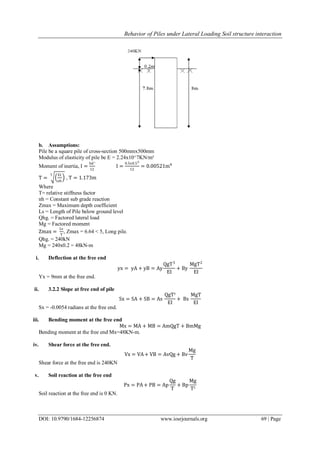
b. Assumptions:
Pile be a square pile of cross-section 500mmx500mm
Modulus of elasticity of pile be E = 2.24x10^7KN/m²
Moment of inertia, I =
bd³
12
I =
0.5x0.53
12
= 0.00521m⁴
T =
EI
nh
5
, T = 1.173m
Where
T= relative stiffness factor
nh = Constant sub grade reaction
Zmax = Maximum depth coefficient
Ls = Length of Pile below ground level
Qhg. = Factored lateral load
Mg = Factored moment
Zmax =
Ls
T
, Zmax = 6.64 < 5, Long pile.
Qhg. = 240kN
Mg = 240x0.2 = 48kN-m
i. Deflection at the free end
yx = yA + yB = Ay
QgT3
EI
+ By
MgT2
EI
Yx = 9mm at the free end.
ii. 3.2.2 Slope at free end of pile
Sx = SA + SB = As
QgT²
EI
+ Bs
MgT
EI
Sx = -0.0054 radians at the free end.
iii. Bending moment at the free end
Mx = MA + MB = AmQgT + BmMg
Bending moment at the free end Mx=48KN-m.
iv. Shear force at the free end.
Vx = VA+ VB = AvQg + Bv
Mg
T
Shear force at the free end is 240KN
v. Soil reaction at the free end
Px = PA+ PB = Ap
Qg
T
+ Bp
Mg
T²
Soil reaction at the free end is 0 KN.
Behavior of Piles under Lateral Loading Soil structure interaction
DOI: 10.9790/1684-12256874 www.iosrjournals.org 70 | Page
IV. Finite Element Modelling
Based on the platform of ANSYS, reasonable and practical 2D-FE models were published. The
bending moment and shear force plots can only be obtained in case of 2D or 1D models because of that reason
the 2D models selected. In the present study the pile is created as 2D elastic beam element, and the soil created
as linear springs are modeled using COMBIN14 element.
The pile foundation has been modeled using 2D elastic Beam 3 element, which is a uniaxial element
with tension, compression, and bending capabilities. The element has three degrees of freedom at each node:
translations in the nodal x and y directions and rotation about the nodal z-axis. The behaviors are assumed to be
elastic. The concrete pile of M20 grade is considered having density of 24kN/m3. The modulus of elasticity of
pile foundation E and poison’s ratio μ of pile foundation are 22.4Gpa, 0.15.
In the Winkler model soil is modeled as linear springs. In the present study the linear springs are
modeled using COMBIN14 element. No bending or torsion is considered, the spring damper element has no
mass. The spring stiffness is calculated depending on the type and the contributing area for that spring.
The springs are provided only in the opposite phase to the application of load, because there won’t be
any contact between the soil and pile in the load application phase.
4.1 Problem Solving Using Ansys:
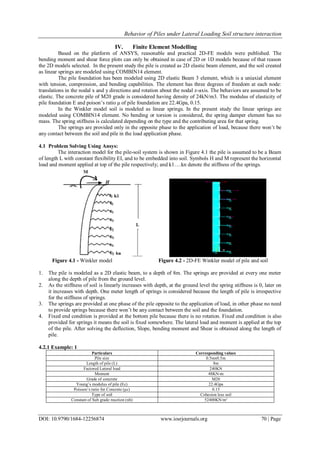
The interaction model for the pile-soil system is shown in Figure 4.1 the pile is assumed to be a Beam
of length L with constant flexibility EI, and to be embedded into soil. Symbols H and M represent the horizontal
load and moment applied at top of the pile respectively; and k1….kn denote the stiffness of the springs.
Figure 4.1 - Winkler model Figure 4.2 - 2D-FE Winkler model of pile and soil
1. The pile is modeled as a 2D elastic beam, to a depth of 8m. The springs are provided at every one meter
along the depth of pile from the ground level.
2. As the stiffness of soil is linearly increases with depth, at the ground level the spring stiffness is 0, later on
it increases with depth. One meter length of springs is considered because the length of pile is irrespective
for the stiffness of springs.
3. The springs are provided at one phase of the pile opposite to the application of load, in other phase no need
to provide springs because there won’t be any contact between the soil and the foundation.
4. Fixed end condition is provided at the bottom pile because there is no rotation. Fixed end condition is also
provided for springs it means the soil is fixed somewhere. The lateral load and moment is applied at the top
of the pile. After solving the deflection, Slope, bending moment and Shear is obtained along the length of
pile.
4.2.1 Example: 1
Particulars Corresponding values
Pile size 0.5mx0.5m
Length of pile (L) 8m
Factored Lateral load 240KN
Moment 48KN-m
Grade of concrete M20
Young’s modulus of pile (Ec) 22.4Gpa
Poisson’s ratio for Concrete (μc) 0.15
Type of soil Cohesion less soil
Constant of Sub grade reaction (nh) 52400KN/m³
Behavior of Piles under Lateral Loading Soil structure interaction
DOI: 10.9790/1684-12256874 www.iosrjournals.org 71 | Page
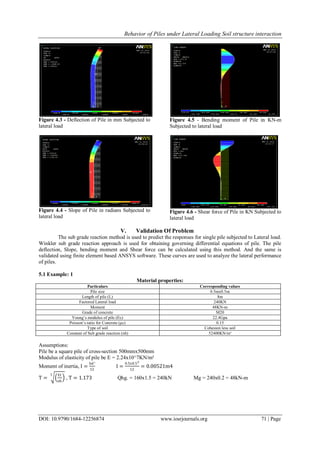
Figure 4.3 - Deflection of Pile in mm Subjected to
lateral load
Figure 4.4 - Slope of Pile in radians Subjected to
lateral load
Figure 4.5 - Bending moment of Pile in KN-m
Subjected to lateral load
Figure 4.6 - Shear force of Pile in KN Subjected to
lateral load
V. Validation Of Problem
The sub grade reaction method is used to predict the responses for single pile subjected to Lateral load.
Winkler sub grade reaction approach is used for obtaining governing differential equations of pile. The pile
deflection, Slope, bending moment and Shear force can be calculated using this method. And the same is
validated using finite element based ANSYS software. These curves are used to analyze the lateral performance
of piles.
5.1 Example: 1
Material properties:
Particulars Corresponding values
Pile size 0.5mx0.5m
Length of pile (L) 8m
Factored Lateral load 240KN
Moment 48KN-m
Grade of concrete M20
Young’s modulus of pile (Ec) 22.4Gpa
Poisson’s ratio for Concrete (μc) 0.15
Type of soil Cohesion less soil
Constant of Sub grade reaction (nh) 52400KN/m³
Assumptions:
Pile be a square pile of cross-section 500mmx500mm
Modulus of elasticity of pile be E = 2.24x10^7KN/m²
Moment of inertia, I =
bd³
12
I =
0.5x0.53
12
= 0.00521m4
T =
EI
nh
5
, T = 1.173 Qhg. = 160x1.5 = 240kN Mg = 240x0.2 = 48kN-m
Behavior of Piles under Lateral Loading Soil structure interaction
DOI: 10.9790/1684-12256874 www.iosrjournals.org 72 | Page
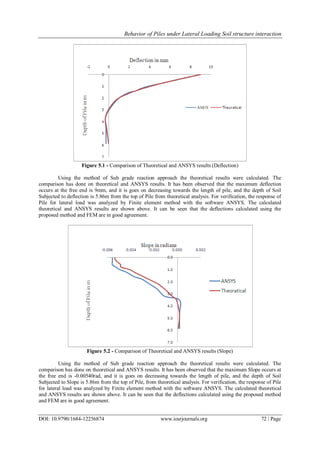
Figure 5.1 - Comparison of Theoretical and ANSYS results (Deflection)
Using the method of Sub grade reaction approach the theoretical results were calculated. The
comparison has done on theoretical and ANSYS results. It has been observed that the maximum deflection
occurs at the free end is 9mm, and it is goes on decreasing towards the length of pile, and the depth of Soil
Subjected to deflection is 5.86m from the top of Pile from theoretical analysis. For verification, the response of
Pile for lateral load was analyzed by Finite element method with the software ANSYS. The calculated
theoretical and ANSYS results are shown above. It can be seen that the deflections calculated using the
proposed method and FEM are in good agreement.
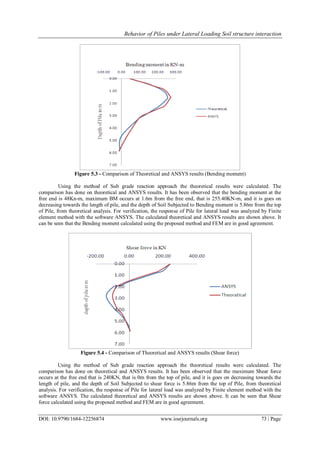
Figure 5.2 - Comparison of Theoretical and ANSYS results (Slope)
Using the method of Sub grade reaction approach the theoretical results were calculated. The
comparison has done on theoretical and ANSYS results. It has been observed that the maximum Slope occurs at
the free end is -0.00540rad, and it is goes on decreasing towards the length of pile, and the depth of Soil
Subjected to Slope is 5.86m from the top of Pile, from theoretical analysis. For verification, the response of Pile
for lateral load was analyzed by Finite element method with the software ANSYS. The calculated theoretical
and ANSYS results are shown above. It can be seen that the deflections calculated using the proposed method
and FEM are in good agreement.
Behavior of Piles under Lateral Loading Soil structure interaction
DOI: 10.9790/1684-12256874 www.iosrjournals.org 73 | Page
Figure 5.3 - Comparison of Theoretical and ANSYS results (Bending moment)
Using the method of Sub grade reaction approach the theoretical results were calculated. The
comparison has done on theoretical and ANSYS results. It has been observed that the bending moment at the
free end is 48Kn-m, maximum BM occurs at 1.6m from the free end, that is 255.40KN-m, and it is goes on
decreasing towards the length of pile, and the depth of Soil Subjected to Bending moment is 5.86m from the top
of Pile, from theoretical analysis. For verification, the response of Pile for lateral load was analyzed by Finite
element method with the software ANSYS. The calculated theoretical and ANSYS results are shown above. It
can be seen that the Bending moment calculated using the proposed method and FEM are in good agreement.
Figure 5.4 - Comparison of Theoretical and ANSYS results (Shear force)
Using the method of Sub grade reaction approach the theoretical results were calculated. The
comparison has done on theoretical and ANSYS results. It has been observed that the maximum Shear force
occurs at the free end that is 240KN, that is 0m from the top of pile, and it is goes on decreasing towards the
length of pile, and the depth of Soil Subjected to shear force is 5.86m from the top of Pile, from theoretical
analysis. For verification, the response of Pile for lateral load was analyzed by Finite element method with the
software ANSYS. The calculated theoretical and ANSYS results are shown above. It can be seen that Shear
force calculated using the proposed method and FEM are in good agreement.
Behavior of Piles under Lateral Loading Soil structure interaction
DOI: 10.9790/1684-12256874 www.iosrjournals.org 74 | Page
VI. Conclusions
The analysis of laterally loaded piles is done with both theoretical and FEM based ANSYS software. It
has been observed that the analysis of laterally loaded piles can be effectively carried out using ANSYS
software. A Winkler method is adopted for the analysis of laterally loaded piles. The analysis of laterally loaded
pile embedded in a single layer soil profile is carried out. The results show that the calculated deflections, Slope,
Bending moment, Shear force using proposed method agree well with those obtained from FEM with software
ANSYS. This method has the advantage over other procedures in that it is easy to understand and is adaptable to
simple computer programs by engineers.
References
[1]. Shamsher prakash and Hari D. Sharma, “Pile foundations in engineering practice”. John wiley and sons New York - 1990.
[2]. Poulos, H.G. and Davis, E. H, Pile Foundation Analysis and Design. John Wiley & Sons, New York.-1980
[3]. Murugan M, Natarajan C, Muthukkumaran K. “Behavior of laterally loaded piles in cohesionless soils” (2011). International journal
of earth science and engineering
[4]. Rongqing Li and Jinxin Gong. “Analysis of laterally loaded pile in layered soils” (2008). EJGE
[5]. V S Phanikanth, Deepankar choudhury, G Rami reddy. “Response of single pile under lateral loads in cohesionless soils” (2010)
EJGE
[6]. Matlock, H. and Reese, L. C. (1962).” Generalized Solutions for Laterally Loaded Piles. Transactions of the American Society of
Civil Engineers” 12, 1220-1247.
[7]. Hetenyi, M. (1946) “Beams on elastic foundations,” University of Michigan Press, Ann Arbor, Mich., United States.
[8]. Ashour, M., and G. Norris (2000) “Modeling lateral soil–pile response based on soil–pile interaction,” Journal of Geotechnical and
Geoenvironmental Engineering, ASCE, 126(5), pp 420–428.

K012256874

  • 1.
    IOSR Journal ofMechanical and Civil Engineering (IOSR-JMCE) e-ISSN: 2278-1684,p-ISSN: 2320-334X, Volume 12, Issue 2 Ver. V (Mar - Apr. 2015), PP 68-74 www.iosrjournals.org DOI: 10.9790/1684-12256874 www.iosrjournals.org 68 | Page Behavior of Piles under Lateral Loading Soil Structure Interaction Kalavathi G N1 , Muralidhar2 1 (Asst Prof, Department of Civil Engg, MVJCE/VTU, India) 2 (Prof, Department of Civil Engg, MVJCE/VTU, India) Abstract: This paper focuses on the application of sub grade reaction method for the analysis of laterally loaded piles embedded in cohesion less soils. The sub grade reaction method considers the pile as a flexible beam on the elastic foundation and replaces soil as a series of elastic, closely spaced but independent springs. This method has the advantage of being relatively simple, and single layer foundation in cohesion less soil is considered in the present study. The pile deflection, Slope, bending moment and shear force is calculated using this method and the same has been validated with finite element based ANSYS software. The code IS 1911 has been used for values of Constant subgrade reaction. Keywords: Lateral loads. Deflection, Slope, Bending moment, Shear force. I. Introduction Piles are usually slender, having high length to width ratio mainly designed to resist axial loads. Pile foundation is often used in bridges and other structures to support the applied axial loads and lateral loads. A pile may be subjected to lateral force for a number of causes, such as, wind, earthquake, water current, earth pressure, effect of moving vehicles or ships, plant and equipment, etc. The lateral load capacity of a single pile depends not only on the horizontal sub grade modulus of the surrounding soil but also on the structural strength of the pile shaft against bending, consequent upon application of a lateral load. Because of the complexity of the problem and limited information on horizontal sub grade modulus of soil, and pending refinements in the theoretical analysis only a procedure for an approximate solution, that is presented in IS codes. And also there is no exact solution for the analysis of laterally loaded piles as in case of vertically loaded piles. Situations that need a rigorous analysis shall be dealt with accordingly. II. Objectives The main aim of this study is to understand the interaction between ground and piles when subjected to lateral loading, that is Deflection, Slope, Bending moment, Shear force is calculated along the length of pile and the same is validated with finite element based ANSYS software. III. Theoretical Analysis a. Soil Structure Interaction: Generally structures are assumed to be fixed at their bases in most of the civil engineering analysis. But in reality, the response of a structure varies according to the supporting soil stiffness. Conventional structural design methods neglect the SSI effects. Neglecting SSI is reasonable for light structures in relatively stiff soil such as low rise buildings and simple rigid retaining walls. The effect of SSI however becomes prominent for Structures subjected to lateral loads and massive structures resting on relatively soft soils. The soil-structure interaction SSI affects the distribution of pressure between the foundation and the soil. In the present study, the effect of supporting soil flexibility, on lateral load response of concrete pile is investigated. The long flexible pile response is observed, Compressibility of surrounding soil is modeled with Winkler springs. Free head piles are considered in this method. The pile deflection, Slope, bending moment and Shear force can be calculated using this method. The proposed study has been validated by comparison of the results with those calculated using finite element based ANSYS Software. Theoretical Example To Show Behavior Of Laterally Loaded Piles: Particulars Corresponding values Pile size 0.5mx0.5m Length of pile (L) 8m Factored Lateral load 240KN Moment 48KN-m Young’s modulus of pile (Ec) 22.4Gpa Type of soil Cohesion less soil Constant of Sub grade reaction (nh) 52400KN/m³
  • 2.
    Behavior of Pilesunder Lateral Loading Soil structure interaction DOI: 10.9790/1684-12256874 www.iosrjournals.org 69 | Page b. Assumptions: Pile be a square pile of cross-section 500mmx500mm Modulus of elasticity of pile be E = 2.24x10^7KN/m² Moment of inertia, I = bd³ 12 I = 0.5x0.53 12 = 0.00521m⁴ T = EI nh 5 , T = 1.173m Where T= relative stiffness factor nh = Constant sub grade reaction Zmax = Maximum depth coefficient Ls = Length of Pile below ground level Qhg. = Factored lateral load Mg = Factored moment Zmax = Ls T , Zmax = 6.64 < 5, Long pile. Qhg. = 240kN Mg = 240x0.2 = 48kN-m i. Deflection at the free end yx = yA + yB = Ay QgT3 EI + By MgT2 EI Yx = 9mm at the free end. ii. 3.2.2 Slope at free end of pile Sx = SA + SB = As QgT² EI + Bs MgT EI Sx = -0.0054 radians at the free end. iii. Bending moment at the free end Mx = MA + MB = AmQgT + BmMg Bending moment at the free end Mx=48KN-m. iv. Shear force at the free end. Vx = VA+ VB = AvQg + Bv Mg T Shear force at the free end is 240KN v. Soil reaction at the free end Px = PA+ PB = Ap Qg T + Bp Mg T² Soil reaction at the free end is 0 KN.
  • 3.
    Behavior of Pilesunder Lateral Loading Soil structure interaction DOI: 10.9790/1684-12256874 www.iosrjournals.org 70 | Page IV. Finite Element Modelling Based on the platform of ANSYS, reasonable and practical 2D-FE models were published. The bending moment and shear force plots can only be obtained in case of 2D or 1D models because of that reason the 2D models selected. In the present study the pile is created as 2D elastic beam element, and the soil created as linear springs are modeled using COMBIN14 element. The pile foundation has been modeled using 2D elastic Beam 3 element, which is a uniaxial element with tension, compression, and bending capabilities. The element has three degrees of freedom at each node: translations in the nodal x and y directions and rotation about the nodal z-axis. The behaviors are assumed to be elastic. The concrete pile of M20 grade is considered having density of 24kN/m3. The modulus of elasticity of pile foundation E and poison’s ratio μ of pile foundation are 22.4Gpa, 0.15. In the Winkler model soil is modeled as linear springs. In the present study the linear springs are modeled using COMBIN14 element. No bending or torsion is considered, the spring damper element has no mass. The spring stiffness is calculated depending on the type and the contributing area for that spring. The springs are provided only in the opposite phase to the application of load, because there won’t be any contact between the soil and pile in the load application phase. 4.1 Problem Solving Using Ansys: The interaction model for the pile-soil system is shown in Figure 4.1 the pile is assumed to be a Beam of length L with constant flexibility EI, and to be embedded into soil. Symbols H and M represent the horizontal load and moment applied at top of the pile respectively; and k1….kn denote the stiffness of the springs. Figure 4.1 - Winkler model Figure 4.2 - 2D-FE Winkler model of pile and soil 1. The pile is modeled as a 2D elastic beam, to a depth of 8m. The springs are provided at every one meter along the depth of pile from the ground level. 2. As the stiffness of soil is linearly increases with depth, at the ground level the spring stiffness is 0, later on it increases with depth. One meter length of springs is considered because the length of pile is irrespective for the stiffness of springs. 3. The springs are provided at one phase of the pile opposite to the application of load, in other phase no need to provide springs because there won’t be any contact between the soil and the foundation. 4. Fixed end condition is provided at the bottom pile because there is no rotation. Fixed end condition is also provided for springs it means the soil is fixed somewhere. The lateral load and moment is applied at the top of the pile. After solving the deflection, Slope, bending moment and Shear is obtained along the length of pile. 4.2.1 Example: 1 Particulars Corresponding values Pile size 0.5mx0.5m Length of pile (L) 8m Factored Lateral load 240KN Moment 48KN-m Grade of concrete M20 Young’s modulus of pile (Ec) 22.4Gpa Poisson’s ratio for Concrete (μc) 0.15 Type of soil Cohesion less soil Constant of Sub grade reaction (nh) 52400KN/m³
  • 4.
    Behavior of Pilesunder Lateral Loading Soil structure interaction DOI: 10.9790/1684-12256874 www.iosrjournals.org 71 | Page Figure 4.3 - Deflection of Pile in mm Subjected to lateral load Figure 4.4 - Slope of Pile in radians Subjected to lateral load Figure 4.5 - Bending moment of Pile in KN-m Subjected to lateral load Figure 4.6 - Shear force of Pile in KN Subjected to lateral load V. Validation Of Problem The sub grade reaction method is used to predict the responses for single pile subjected to Lateral load. Winkler sub grade reaction approach is used for obtaining governing differential equations of pile. The pile deflection, Slope, bending moment and Shear force can be calculated using this method. And the same is validated using finite element based ANSYS software. These curves are used to analyze the lateral performance of piles. 5.1 Example: 1 Material properties: Particulars Corresponding values Pile size 0.5mx0.5m Length of pile (L) 8m Factored Lateral load 240KN Moment 48KN-m Grade of concrete M20 Young’s modulus of pile (Ec) 22.4Gpa Poisson’s ratio for Concrete (μc) 0.15 Type of soil Cohesion less soil Constant of Sub grade reaction (nh) 52400KN/m³ Assumptions: Pile be a square pile of cross-section 500mmx500mm Modulus of elasticity of pile be E = 2.24x10^7KN/m² Moment of inertia, I = bd³ 12 I = 0.5x0.53 12 = 0.00521m4 T = EI nh 5 , T = 1.173 Qhg. = 160x1.5 = 240kN Mg = 240x0.2 = 48kN-m
  • 5.
    Behavior of Pilesunder Lateral Loading Soil structure interaction DOI: 10.9790/1684-12256874 www.iosrjournals.org 72 | Page Figure 5.1 - Comparison of Theoretical and ANSYS results (Deflection) Using the method of Sub grade reaction approach the theoretical results were calculated. The comparison has done on theoretical and ANSYS results. It has been observed that the maximum deflection occurs at the free end is 9mm, and it is goes on decreasing towards the length of pile, and the depth of Soil Subjected to deflection is 5.86m from the top of Pile from theoretical analysis. For verification, the response of Pile for lateral load was analyzed by Finite element method with the software ANSYS. The calculated theoretical and ANSYS results are shown above. It can be seen that the deflections calculated using the proposed method and FEM are in good agreement. Figure 5.2 - Comparison of Theoretical and ANSYS results (Slope) Using the method of Sub grade reaction approach the theoretical results were calculated. The comparison has done on theoretical and ANSYS results. It has been observed that the maximum Slope occurs at the free end is -0.00540rad, and it is goes on decreasing towards the length of pile, and the depth of Soil Subjected to Slope is 5.86m from the top of Pile, from theoretical analysis. For verification, the response of Pile for lateral load was analyzed by Finite element method with the software ANSYS. The calculated theoretical and ANSYS results are shown above. It can be seen that the deflections calculated using the proposed method and FEM are in good agreement.
  • 6.
    Behavior of Pilesunder Lateral Loading Soil structure interaction DOI: 10.9790/1684-12256874 www.iosrjournals.org 73 | Page Figure 5.3 - Comparison of Theoretical and ANSYS results (Bending moment) Using the method of Sub grade reaction approach the theoretical results were calculated. The comparison has done on theoretical and ANSYS results. It has been observed that the bending moment at the free end is 48Kn-m, maximum BM occurs at 1.6m from the free end, that is 255.40KN-m, and it is goes on decreasing towards the length of pile, and the depth of Soil Subjected to Bending moment is 5.86m from the top of Pile, from theoretical analysis. For verification, the response of Pile for lateral load was analyzed by Finite element method with the software ANSYS. The calculated theoretical and ANSYS results are shown above. It can be seen that the Bending moment calculated using the proposed method and FEM are in good agreement. Figure 5.4 - Comparison of Theoretical and ANSYS results (Shear force) Using the method of Sub grade reaction approach the theoretical results were calculated. The comparison has done on theoretical and ANSYS results. It has been observed that the maximum Shear force occurs at the free end that is 240KN, that is 0m from the top of pile, and it is goes on decreasing towards the length of pile, and the depth of Soil Subjected to shear force is 5.86m from the top of Pile, from theoretical analysis. For verification, the response of Pile for lateral load was analyzed by Finite element method with the software ANSYS. The calculated theoretical and ANSYS results are shown above. It can be seen that Shear force calculated using the proposed method and FEM are in good agreement.
  • 7.
    Behavior of Pilesunder Lateral Loading Soil structure interaction DOI: 10.9790/1684-12256874 www.iosrjournals.org 74 | Page VI. Conclusions The analysis of laterally loaded piles is done with both theoretical and FEM based ANSYS software. It has been observed that the analysis of laterally loaded piles can be effectively carried out using ANSYS software. A Winkler method is adopted for the analysis of laterally loaded piles. The analysis of laterally loaded pile embedded in a single layer soil profile is carried out. The results show that the calculated deflections, Slope, Bending moment, Shear force using proposed method agree well with those obtained from FEM with software ANSYS. This method has the advantage over other procedures in that it is easy to understand and is adaptable to simple computer programs by engineers. References [1]. Shamsher prakash and Hari D. Sharma, “Pile foundations in engineering practice”. John wiley and sons New York - 1990. [2]. Poulos, H.G. and Davis, E. H, Pile Foundation Analysis and Design. John Wiley & Sons, New York.-1980 [3]. Murugan M, Natarajan C, Muthukkumaran K. “Behavior of laterally loaded piles in cohesionless soils” (2011). International journal of earth science and engineering [4]. Rongqing Li and Jinxin Gong. “Analysis of laterally loaded pile in layered soils” (2008). EJGE [5]. V S Phanikanth, Deepankar choudhury, G Rami reddy. “Response of single pile under lateral loads in cohesionless soils” (2010) EJGE [6]. Matlock, H. and Reese, L. C. (1962).” Generalized Solutions for Laterally Loaded Piles. Transactions of the American Society of Civil Engineers” 12, 1220-1247. [7]. Hetenyi, M. (1946) “Beams on elastic foundations,” University of Michigan Press, Ann Arbor, Mich., United States. [8]. Ashour, M., and G. Norris (2000) “Modeling lateral soil–pile response based on soil–pile interaction,” Journal of Geotechnical and Geoenvironmental Engineering, ASCE, 126(5), pp 420–428.