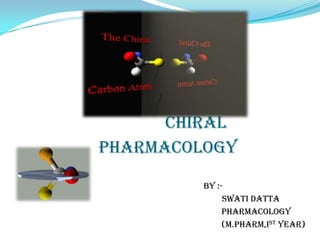
CHIRAL
pharmacology
By :-
Swati datta
Pharmacology
(M.Pharm,Ist year)
RECOGNITION OF CHIRALITY
 Chirality is the fundamental property of
3 –dimensional object.
 Chiral chemistry was identified by Lowis pasteur
when in1948,for the first time seperated the 2-
isomers of sodium potassium tartarate.
• He found that the two isomers were identical in
physiochemical properties but different in their
ability to rotate plane polarized light.
WHY STUDYING STERIO CHEMICAL
FEATURES IS IMPORTANT
 Biological Activity may reside in only one of the stereoisomer.
 Stereoisomer's may show essentially similar qualitative And
quantitative activity.
 Isomer may exhibit similar qualitatively but different quantitatively
activities.
 Isomer may show distinct pharmacological activity.
CHIRALITY
• Property of a compound whose molecules are not super imposable
on their mirror images.
• Chirality = Handedness.
• Necessary condition for existence of enantiomers.
• Same molecular formula, same functional groups.
• Differ in the way atoms are oriented in 3 dimensions.
STEREOISOMERS
ASYMMETRIC CARBON ATOM
• Carbon atom to which 4 different atoms
or groups are attached.
Cl
F
Br
H
The Two Types of Stereoisomers
 Geometric isomers
 Optical isomers
Geometric Isomers
Cis (on the same side) Trans (across/opposite sides)
 Cis-2-butene
 Molecular Formula- C4H8
 Structural Formula-
CH3CHCHCH3
 Trans-2-butene
 Molecular Formula- C4H8
 Structural Formula-
CH3CHCHCH3
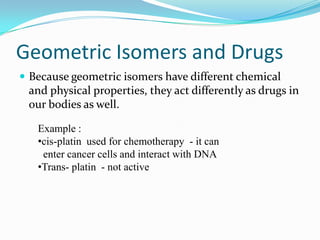
Geometric Isomers and Drugs
 Because geometric isomers have different chemical
and physical properties, they act differently as drugs in
our bodies as well.
Example :
•cis-platin used for chemotherapy - it can
enter cancer cells and interact with DNA
•Trans- platin - not active
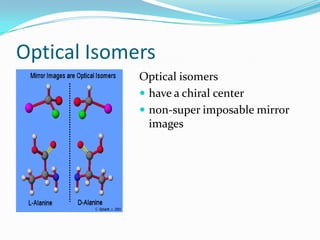
Optical Isomers
Optical isomers
 have a chiral center
 non-super imposable mirror
images
Optical Isomers Terminology
Chiral: if a molecule is chiral ( or displays chirality) this
means the molecule has two optical isomers
Chiral centre: the central carbon in an optical isomer with
four bonds each attached to a different group.
Enantiomer: another name for a molecule that is found in
optical isomers. For example, ibuprofen has a two
enantiomers, a left rotating enantiomer and a right
rotating enantiomer.
Racemic mixture: A mixture of 50% left rotating and 50%
right rotating optical isomers
ENANTIOMERS
• Stereoisomers that are mirror images of each other.
• Molecule and mirror image cannot be superimposed into each
other even after twisting and turning them.
• Identical physical and chemical properties
• Dextrorotatory ("+" / “d” form) - clockwise direction.
• Levorotatory ("-“ / “l” form) - anti-clockwise direction.
DIASTEREOMERS
• Stereoisomers that are not mirror images of each other.
• Similar chemical properties but different physical
properties.
• Is an equimolar solution of the two enantiomers.
• Shows no optical rotation.
RACEMATE
R/S SYSTEM
a = 1; b = 2 ; c = 3 ; d = 4
• Priority of an atom is determined
by its atomic number
• Order of substituents going from
highest to lowest priority.
• Clockwise – R (rectus).
• Anticlockwise – S (sinister).
• Unless established experimentally no idea whether (+) or (-)
rotation is associated with R or S configuration.
Arthur r. Cushny & “ChirAl”
Pharmacology
1866 - 1926
• (-)-Hyoscyamine almost exactly twice as
active as atropine [( )- hysocyamine]
(1904).
• (-)-Adrenaline twice the potency of ( )-adrenaline as a
vasoconstrictor (1908). (-)-enantiomer 12-15 fold more potent
than (+)-adrenaline on sympathetic vessels (1909).
• Biological Relations of Optically Isomeric Substances (1926).
Cushny & “ChirAl” phArmACology
 Believed that the “receptor” was chiral and combined with the
enantiomers of the drug to produce diastereoisomeric drug –
receptor complexes.
 “---- difference in action lies not in the facility with which the
chemical combination is formed, but in the physical
characteristics of the resultant compound” (Cushny, 1926).
STEREOPHARMACOLOGY
• Affinity of a drug for a specific receptor and its intrinsic
activity are related to its chemical structure.
• Drug – receptor interactions are stereo selective.
• Minor changes in drug molecule structure.
• Major changes in pharmacological properties.
Why do we care about this subtle form of
stereoisomerism?
 Biomolecules (sugars, amino acids, DNA,
proteins, steroids) are chiral
– Proteins are built from L-amino acids, which implies
that enzymes – the catalysts of nature - are chiral
– Also, receptors (drug, taste, biopharmaceuticals,
agrochemicals) are chiral and the natural ligand to a
receptor is often only one specific enantiomer
– This is why mirror image molecules can have radically
different activities (effectivity, toxicity, taste) in the
body.
Right-handed and left-handed molecules
interact with living systems in very different
ways and results for example in:
olfactory sensors are chiral
(R)
CH3
O
H
(S)
CH3
HH2C
CH3
CH2
H3C
O
Mirror plane
(R) Spearmint oil (S) caraway oil
− Different
smell
CHIRAL DRUGS IN BIOLOGICAL SYSTEMS
Biological
Discrimination
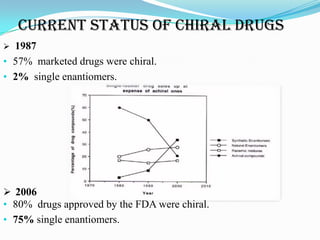
 1987
• 57% marketed drugs were chiral.
• 2% single enantiomers.
 2006
• 80% drugs approved by the FDA were chiral.
• 75% single enantiomers.
CURRENT STATUS OF CHIRAL DRUGS
− In 2000, 40% of drugs on sale in the US were
single enantiomer-based.
− In 2004, about 80% of drugs entering market
are single enantiomer variants
− FDA now requires information about the
structure and activity of each isomer present
in a racemic mixture of a new medication.
What sparked the change????
• 1987 – change in FDA regulations.
• Inclusion of information on the enantiomer composition of
chiral compounds in new-drug applications.
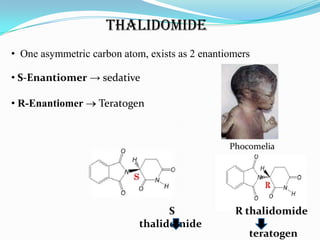
THALIDOMIDE
• One asymmetric carbon atom, exists as 2 enantiomers
• S-Enantiomer → sedative
• R-Enantiomer Teratogen
Phocomelia
S
thalidomide
R thalidomide
teratogen
CHIRAL INVERSION
• Unique metabolic pathway.
• Enzymatic or non-enzymatic.
• Involves unidirectional conversion of one enantiomeric
form to another.
R → S
CHIRAL SWITCH
• Development of a single enantiomer from a previously
marketed racemate.
• Resulted in a number of agents being re-marketed as
chiral drugs.
• Same or similar therapeutic indications.
• Novel indications for old compounds.
β2 ADreNErgic recePTOR AGONIST
 Salbutamol
• Salbutamol →Mixture of (R)-salbutamol and (S)-salbutamol
• Levosalbutamol is the (R)-enantiomer → active
bronchodilator.
Racemic and (S)-Salbutamol
• Induce airway hyper responsiveness.
• Increase sensitivity to allergen
challenge.
• Inhalation of levosalbutamol→ greater bronchodilatation than the
equivalent dose of the racemate.
R SR
S
CALCIUM CHANNEL BLOCKER
 Verapamil
• (S)-verapamil : vasodilating , cardiac antidepressant properties.
• (R)-verapamil : a vasodilating drug.
• Verapamil blocks the P170 glycoprotein.
• Interaction is non stereoselective.
• Partially reverse multiple drug resistance of cancer cells.
• R-verapamil might be expected to be more beneficial.
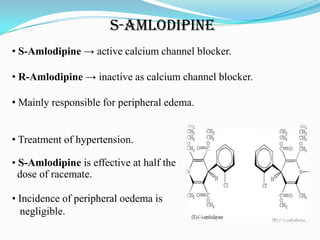
S-AMLODIPINE
• S-Amlodipine → active calcium channel blocker.
• R-Amlodipine → inactive as calcium channel blocker.
• Mainly responsible for peripheral edema.
• Treatment of hypertension.
• S-Amlodipine is effective at half the
dose of racemate.
• Incidence of peripheral oedema is
negligible.
• Treatment of normotensive angina patients.
• S-Amlodipine is effective at half the dose of racemate.
Cont..
LOCAL ANAESTHETIC
Levobupivacaine
• Cardiotoxicity of the drug : R-enantiomer.
• Levobupivacaine - „S‟ enantiomer of Bupivacaine.
• Moderately more potent.
• Significantly reduced negative inotropic effect .
Levobupivacaine is less cardiotoxic.
SELECTIVE SEROTONIN REUPTAKE
INHIBITOR
Escitalopram
• S-enantiomer of Citalopram.
• Doses that show improvement in depressed
patients.
10 mg / day – „S‟ enantiomer
40 mg / day – racemate
• Other advantages of Escitalopram.
• Faster onset of action.
• Reduction in side effects.
• Improved tolerability profile.
S R
ANORECTIC AGENT
 Sibutramine
• Activity of racemic sibutramine – active metabolites.
• R-sibutramine metabolite are
More potent in the inhibition
of monoamine uptake.
Greater anorexic potency.
Under evaluation for treatment of depression.
Single enantiomer of metabolite - treatment of both obesity
& depression.
NON-STEROIDAL ANTI-INFLAMMATORY
DRUG
 Dexibuprofen
• Inhibition of cyclooxygenase activity – „S’ enantiomer.
• 60% of R enantiomer undergoes chiral inversion to the
active S-enantiomer.
• chiral Dexibuprofen (1200 mg daily) was better than
racemate (2400 mg daily).
• Highly effective NSAID.
• Low adverse effect profile .
**
ADVANTAGES OF CHIRAL DRUGS
• Chiral drug is a single agent instead of a mixture of
two distinct drugs.
• Simplifies the interpretation of the Basic Pharmacology.
• Greater selectivity for their biological targets improved
therapeutic indices and reduced adverse effects.
• Longer or shorter duration of action - more appropriate
dosing frequency.
• Decreased inter individual variability.
SOME DRUGS ARE BETTER AS
RACEMATES
 BLOCKERS
• blockers currently used contain at
least one chiral center.
• Most are marketed as racemates.
-
 Labetalol
• Two chiral centres ; four stereoisomeric forms.
• R, R-isomer : b -blocking property
• S, R-isomer : a -blocking property
• Remaining isomers : inactive
• Dilevalol ( R,R-isomer ) – elevated liver function tests.
• Chiral dilevalol was withdrawn.
Chiral drugs

Chiral drugs

  • 1.
  • 2.
    RECOGNITION OF CHIRALITY Chirality is the fundamental property of 3 –dimensional object.  Chiral chemistry was identified by Lowis pasteur when in1948,for the first time seperated the 2- isomers of sodium potassium tartarate. • He found that the two isomers were identical in physiochemical properties but different in their ability to rotate plane polarized light.
  • 3.
    WHY STUDYING STERIOCHEMICAL FEATURES IS IMPORTANT  Biological Activity may reside in only one of the stereoisomer.  Stereoisomer's may show essentially similar qualitative And quantitative activity.  Isomer may exhibit similar qualitatively but different quantitatively activities.  Isomer may show distinct pharmacological activity.
  • 4.
    CHIRALITY • Property ofa compound whose molecules are not super imposable on their mirror images. • Chirality = Handedness. • Necessary condition for existence of enantiomers.
  • 5.
    • Same molecularformula, same functional groups. • Differ in the way atoms are oriented in 3 dimensions. STEREOISOMERS ASYMMETRIC CARBON ATOM • Carbon atom to which 4 different atoms or groups are attached. Cl F Br H
  • 6.
    The Two Typesof Stereoisomers  Geometric isomers  Optical isomers
  • 7.
    Geometric Isomers Cis (onthe same side) Trans (across/opposite sides)  Cis-2-butene  Molecular Formula- C4H8  Structural Formula- CH3CHCHCH3  Trans-2-butene  Molecular Formula- C4H8  Structural Formula- CH3CHCHCH3
  • 8.
    Geometric Isomers andDrugs  Because geometric isomers have different chemical and physical properties, they act differently as drugs in our bodies as well. Example : •cis-platin used for chemotherapy - it can enter cancer cells and interact with DNA •Trans- platin - not active
  • 9.
    Optical Isomers Optical isomers have a chiral center  non-super imposable mirror images
  • 10.
    Optical Isomers Terminology Chiral:if a molecule is chiral ( or displays chirality) this means the molecule has two optical isomers Chiral centre: the central carbon in an optical isomer with four bonds each attached to a different group. Enantiomer: another name for a molecule that is found in optical isomers. For example, ibuprofen has a two enantiomers, a left rotating enantiomer and a right rotating enantiomer. Racemic mixture: A mixture of 50% left rotating and 50% right rotating optical isomers
  • 11.
    ENANTIOMERS • Stereoisomers thatare mirror images of each other. • Molecule and mirror image cannot be superimposed into each other even after twisting and turning them. • Identical physical and chemical properties • Dextrorotatory ("+" / “d” form) - clockwise direction. • Levorotatory ("-“ / “l” form) - anti-clockwise direction.
  • 12.
    DIASTEREOMERS • Stereoisomers thatare not mirror images of each other. • Similar chemical properties but different physical properties. • Is an equimolar solution of the two enantiomers. • Shows no optical rotation. RACEMATE
  • 13.
    R/S SYSTEM a =1; b = 2 ; c = 3 ; d = 4 • Priority of an atom is determined by its atomic number • Order of substituents going from highest to lowest priority. • Clockwise – R (rectus). • Anticlockwise – S (sinister). • Unless established experimentally no idea whether (+) or (-) rotation is associated with R or S configuration.
  • 14.
    Arthur r. Cushny& “ChirAl” Pharmacology 1866 - 1926 • (-)-Hyoscyamine almost exactly twice as active as atropine [( )- hysocyamine] (1904). • (-)-Adrenaline twice the potency of ( )-adrenaline as a vasoconstrictor (1908). (-)-enantiomer 12-15 fold more potent than (+)-adrenaline on sympathetic vessels (1909). • Biological Relations of Optically Isomeric Substances (1926).
  • 15.
    Cushny & “ChirAl”phArmACology  Believed that the “receptor” was chiral and combined with the enantiomers of the drug to produce diastereoisomeric drug – receptor complexes.  “---- difference in action lies not in the facility with which the chemical combination is formed, but in the physical characteristics of the resultant compound” (Cushny, 1926).
  • 16.
    STEREOPHARMACOLOGY • Affinity ofa drug for a specific receptor and its intrinsic activity are related to its chemical structure. • Drug – receptor interactions are stereo selective. • Minor changes in drug molecule structure. • Major changes in pharmacological properties.
  • 17.
    Why do wecare about this subtle form of stereoisomerism?  Biomolecules (sugars, amino acids, DNA, proteins, steroids) are chiral – Proteins are built from L-amino acids, which implies that enzymes – the catalysts of nature - are chiral – Also, receptors (drug, taste, biopharmaceuticals, agrochemicals) are chiral and the natural ligand to a receptor is often only one specific enantiomer – This is why mirror image molecules can have radically different activities (effectivity, toxicity, taste) in the body.
  • 18.
    Right-handed and left-handedmolecules interact with living systems in very different ways and results for example in: olfactory sensors are chiral (R) CH3 O H (S) CH3 HH2C CH3 CH2 H3C O Mirror plane (R) Spearmint oil (S) caraway oil − Different smell
  • 19.
    CHIRAL DRUGS INBIOLOGICAL SYSTEMS
  • 20.
  • 21.
     1987 • 57%marketed drugs were chiral. • 2% single enantiomers.  2006 • 80% drugs approved by the FDA were chiral. • 75% single enantiomers. CURRENT STATUS OF CHIRAL DRUGS
  • 22.
    − In 2000,40% of drugs on sale in the US were single enantiomer-based. − In 2004, about 80% of drugs entering market are single enantiomer variants − FDA now requires information about the structure and activity of each isomer present in a racemic mixture of a new medication.
  • 23.
    What sparked thechange???? • 1987 – change in FDA regulations. • Inclusion of information on the enantiomer composition of chiral compounds in new-drug applications.
  • 24.
    THALIDOMIDE • One asymmetriccarbon atom, exists as 2 enantiomers • S-Enantiomer → sedative • R-Enantiomer Teratogen Phocomelia S thalidomide R thalidomide teratogen
  • 25.
    CHIRAL INVERSION • Uniquemetabolic pathway. • Enzymatic or non-enzymatic. • Involves unidirectional conversion of one enantiomeric form to another. R → S
  • 26.
    CHIRAL SWITCH • Developmentof a single enantiomer from a previously marketed racemate. • Resulted in a number of agents being re-marketed as chiral drugs. • Same or similar therapeutic indications. • Novel indications for old compounds.
  • 27.
    β2 ADreNErgic recePTORAGONIST  Salbutamol • Salbutamol →Mixture of (R)-salbutamol and (S)-salbutamol • Levosalbutamol is the (R)-enantiomer → active bronchodilator. Racemic and (S)-Salbutamol • Induce airway hyper responsiveness. • Increase sensitivity to allergen challenge. • Inhalation of levosalbutamol→ greater bronchodilatation than the equivalent dose of the racemate. R SR S
  • 28.
    CALCIUM CHANNEL BLOCKER Verapamil • (S)-verapamil : vasodilating , cardiac antidepressant properties. • (R)-verapamil : a vasodilating drug. • Verapamil blocks the P170 glycoprotein. • Interaction is non stereoselective. • Partially reverse multiple drug resistance of cancer cells. • R-verapamil might be expected to be more beneficial.
  • 29.
    S-AMLODIPINE • S-Amlodipine →active calcium channel blocker. • R-Amlodipine → inactive as calcium channel blocker. • Mainly responsible for peripheral edema. • Treatment of hypertension. • S-Amlodipine is effective at half the dose of racemate. • Incidence of peripheral oedema is negligible.
  • 30.
    • Treatment ofnormotensive angina patients. • S-Amlodipine is effective at half the dose of racemate. Cont..
  • 31.
    LOCAL ANAESTHETIC Levobupivacaine • Cardiotoxicityof the drug : R-enantiomer. • Levobupivacaine - „S‟ enantiomer of Bupivacaine. • Moderately more potent. • Significantly reduced negative inotropic effect . Levobupivacaine is less cardiotoxic.
  • 32.
    SELECTIVE SEROTONIN REUPTAKE INHIBITOR Escitalopram •S-enantiomer of Citalopram. • Doses that show improvement in depressed patients. 10 mg / day – „S‟ enantiomer 40 mg / day – racemate • Other advantages of Escitalopram. • Faster onset of action. • Reduction in side effects. • Improved tolerability profile. S R
  • 33.
    ANORECTIC AGENT  Sibutramine •Activity of racemic sibutramine – active metabolites. • R-sibutramine metabolite are More potent in the inhibition of monoamine uptake. Greater anorexic potency. Under evaluation for treatment of depression. Single enantiomer of metabolite - treatment of both obesity & depression.
  • 34.
    NON-STEROIDAL ANTI-INFLAMMATORY DRUG  Dexibuprofen •Inhibition of cyclooxygenase activity – „S’ enantiomer. • 60% of R enantiomer undergoes chiral inversion to the active S-enantiomer. • chiral Dexibuprofen (1200 mg daily) was better than racemate (2400 mg daily). • Highly effective NSAID. • Low adverse effect profile . **
  • 35.
    ADVANTAGES OF CHIRALDRUGS • Chiral drug is a single agent instead of a mixture of two distinct drugs. • Simplifies the interpretation of the Basic Pharmacology. • Greater selectivity for their biological targets improved therapeutic indices and reduced adverse effects. • Longer or shorter duration of action - more appropriate dosing frequency. • Decreased inter individual variability.
  • 36.
    SOME DRUGS AREBETTER AS RACEMATES  BLOCKERS • blockers currently used contain at least one chiral center. • Most are marketed as racemates. -
  • 37.
     Labetalol • Twochiral centres ; four stereoisomeric forms. • R, R-isomer : b -blocking property • S, R-isomer : a -blocking property • Remaining isomers : inactive • Dilevalol ( R,R-isomer ) – elevated liver function tests. • Chiral dilevalol was withdrawn.