THE CITRIC ACID
CYCLE

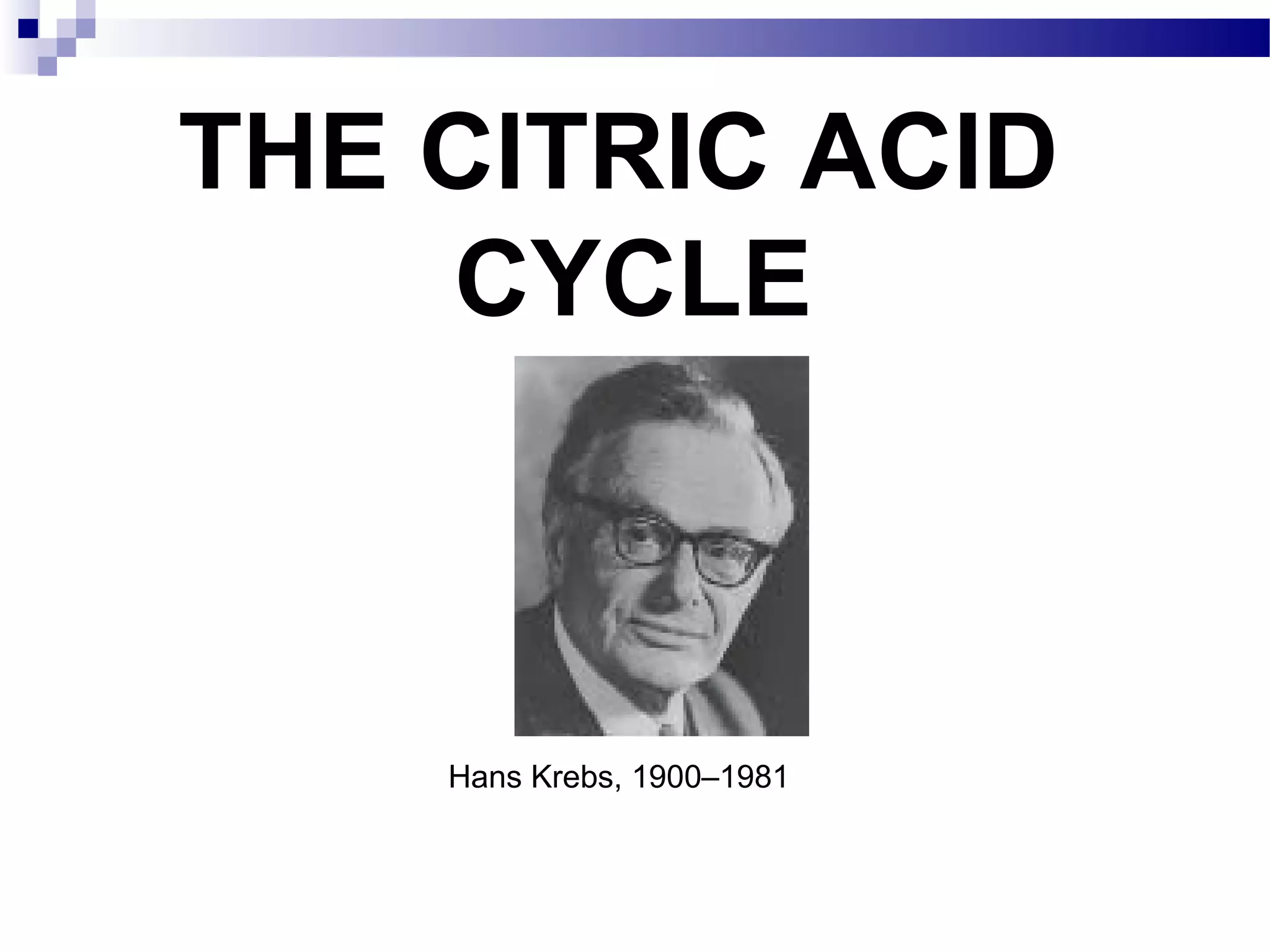
Hans Krebs, 1900–1981
OXIDATIVE DECARBOXYLATION OF PYRUVATE
Only about 7 % of the total potential energy present in
glucose is released in glycolysis.
Glycolysis is preliminary phase, preparing glucose for
entry into aerobic metabolism.
Pyruvate formed in the aerobic conditions undergoes
conversion to acetyl CoA by pyruvate dehydrogenase
complex.
Pyruvate dehydrogenase complex is a bridge between
glycolysis and aerobic metabolism – citric acid cycle.
Pyruvate dehydrogenase complex and enzymes of
cytric acid cycle are located in the matrix of
mitochondria.
Entry of Pyruvate into the Mitochondrion

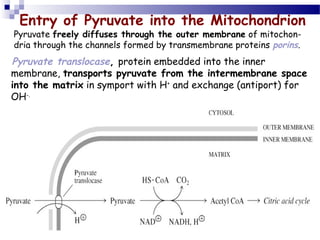
Pyruvate freely diffuses through the outer membrane of mitochondria through the channels formed by transmembrane proteins porins.

Pyruvate translocase, protein embedded into the inner
membrane, transports pyruvate from the intermembrane space
into the matrix in symport with H+ and exchange (antiport) for
OH-.
Conversion of Pyruvate to Acetyl CoA

•

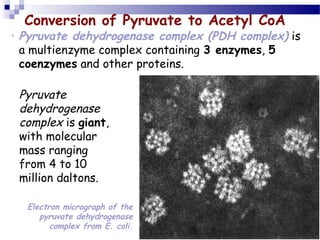
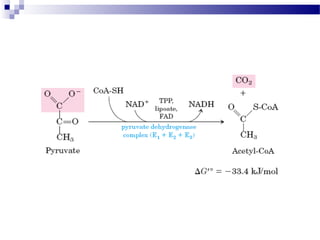
Pyruvate dehydrogenase complex (PDH complex) is
a multienzyme complex containing 3 enzymes, 5
coenzymes and other proteins.
Pyruvate
dehydrogenase
complex is giant,
with molecular
mass ranging
from 4 to 10
million daltons.
Electron micrograph of the
pyruvate dehydrogenase
complex from E. coli.
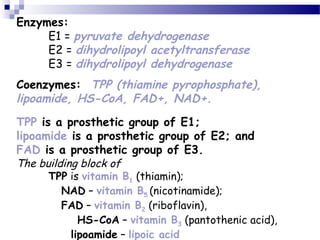
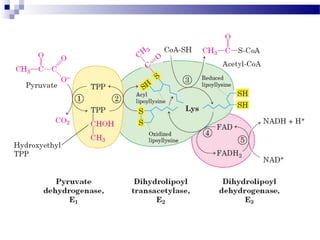
Enzymes:
E1 = pyruvate dehydrogenase
E2 = dihydrolipoyl acetyltransferase
E3 = dihydrolipoyl dehydrogenase
Coenzymes: TPP (thiamine pyrophosphate),
lipoamide, HS-CoA, FAD+, NAD+.
TPP is a prosthetic group of E1;
lipoamide is a prosthetic group of E2; and
FAD is a prosthetic group of E3.
The building block of

TPP is vitamin B1 (thiamin);
NAD – vitamin B5 (nicotinamide);
FAD – vitamin B2 (riboflavin),
HS-CoA – vitamin B3 (pantothenic acid),
lipoamide – lipoic acid
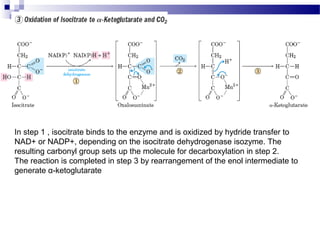
In step 1 , isocitrate binds to the enzyme and is oxidized by hydride transfer to
NAD+ or NADP+, depending on the isocitrate dehydrogenase isozyme. The
resulting carbonyl group sets up the molecule for decarboxylation in step 2.
The reaction is completed in step 3 by rearrangement of the enol intermediate to
generate α-ketoglutarate
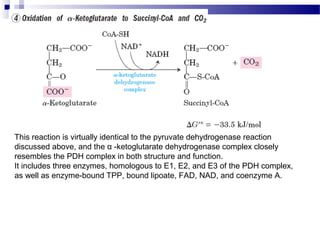
This reaction is virtually identical to the pyruvate dehydrogenase reaction
discussed above, and the α -ketoglutarate dehydrogenase complex closely
resembles the PDH complex in both structure and function.
It includes three enzymes, homologous to E1, E2, and E3 of the PDH complex,
as well as enzyme-bound TPP, bound lipoate, FAD, NAD, and coenzyme A.
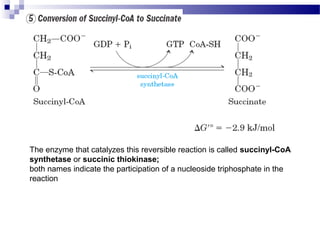
The enzyme that catalyzes this reversible reaction is called succinyl-CoA
synthetase or succinic thiokinase;
both names indicate the participation of a nucleoside triphosphate in the
reaction
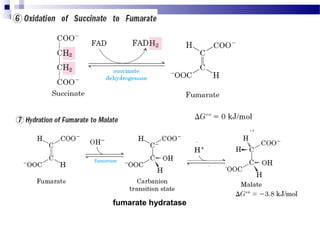
fumarate hydratase
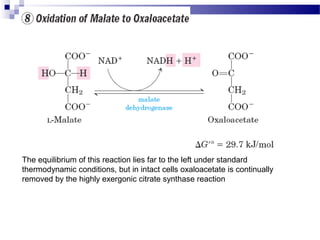
The equilibrium of this reaction lies far to the left under standard
thermodynamic conditions, but in intact cells oxaloacetate is continually
removed by the highly exergonic citrate synthase reaction
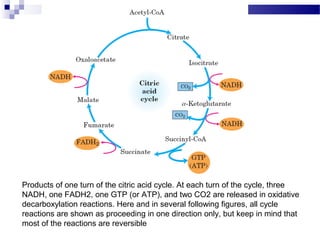
Products of one turn of the citric acid cycle. At each turn of the cycle, three
NADH, one FADH2, one GTP (or ATP), and two CO2 are released in oxidative
decarboxylation reactions. Here and in several following figures, all cycle
reactions are shown as proceeding in one direction only, but keep in mind that
most of the reactions are reversible
Recall that the conversion of one glucose molecule
to CO2 via the glycolytic pathway and citric acid
cycle yields 10 NADH and 2 FADH2 molecules.
Oxidation of these reduced coenzymes has a total
ΔG°′ of −613 kcal/mol [10(−52.6) + 2(−43.4)].
Thus, of the potential free energy present in the
chemical bonds of glucose (−680 kcal/mol), about
90 percent is conserved in the reduced coenzymes.
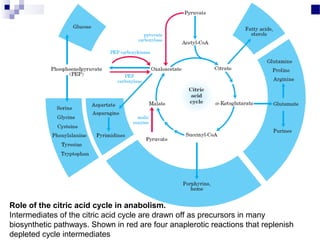
Role of the citric acid cycle in anabolism.
Intermediates of the citric acid cycle are drawn off as precursors in many
biosynthetic pathways. Shown in red are four anaplerotic reactions that replenish
depleted cycle intermediates
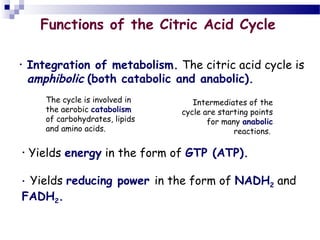
Functions of the Citric Acid Cycle
•

Integration of metabolism. The citric acid cycle is
amphibolic (both catabolic and anabolic).
The cycle is involved in
the aerobic catabolism
of carbohydrates, lipids
and amino acids.

•

Intermediates of the
cycle are starting points
for many anabolic
reactions.

Yields energy in the form of GTP (ATP).

Yields reducing power in the form of NADH2 and
FADH2.
•
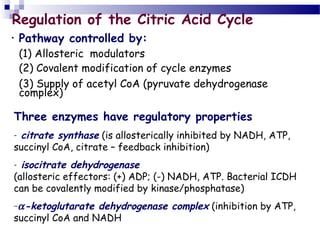
Regulation of the Citric Acid Cycle
•

Pathway controlled by:

(1) Allosteric modulators
(2) Covalent modification of cycle enzymes
(3) Supply of acetyl CoA (pyruvate dehydrogenase
complex)

Three enzymes have regulatory properties
citrate synthase (is allosterically inhibited by NADH, ATP,
succinyl CoA, citrate – feedback inhibition)
-

isocitrate dehydrogenase
(allosteric effectors: (+) ADP; (-) NADH, ATP. Bacterial ICDH
can be covalently modified by kinase/phosphatase)
-

dehydrogenase complex (inhibition by ATP,
succinyl CoA and NADH
−α-ketoglutarate
Regulation of metabolite flow from the
PDH complex through the citric acid
cycle.
The PDH complex is allosterically inhibited
when [ATP]/[ADP], [NADH]/[NAD], and
[acetyl-CoA]/[CoA] ratios are high,
indicating an energy-sufficient metabolic
state. When these ratios decrease,
allosteric activation of pyruvate oxidation
results. The rate of flow through the citric
acid cycle can be limited by the availability
of the citrate synthase substrates,
oxaloacetate and acetyl-CoA, or of NAD,
which is depleted by its conversion to
NADH, slowing the three NAD-dependent
oxidation steps. Feedback inhibition by
succinyl-CoA, citrate, and ATP also slows
the cycle by inhibiting early steps. In
muscle tissue, Ca2 signals contraction and,
as shown here, stimulates energy-yielding
metabolism to replace the ATP consumed
by contraction.
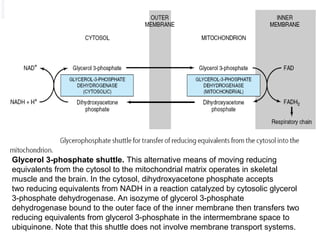
Glycerol 3-phosphate shuttle. This alternative means of moving reducing
equivalents from the cytosol to the mitochondrial matrix operates in skeletal
muscle and the brain. In the cytosol, dihydroxyacetone phosphate accepts
two reducing equivalents from NADH in a reaction catalyzed by cytosolic glycerol
3-phosphate dehydrogenase. An isozyme of glycerol 3-phosphate
dehydrogenase bound to the outer face of the inner membrane then transfers two
reducing equivalents from glycerol 3-phosphate in the intermembrane space to
ubiquinone. Note that this shuttle does not involve membrane transport systems.

Crebs cycle 2013

  • 1.
    THE CITRIC ACID CYCLE HansKrebs, 1900–1981
  • 3.
    OXIDATIVE DECARBOXYLATION OFPYRUVATE Only about 7 % of the total potential energy present in glucose is released in glycolysis. Glycolysis is preliminary phase, preparing glucose for entry into aerobic metabolism. Pyruvate formed in the aerobic conditions undergoes conversion to acetyl CoA by pyruvate dehydrogenase complex. Pyruvate dehydrogenase complex is a bridge between glycolysis and aerobic metabolism – citric acid cycle. Pyruvate dehydrogenase complex and enzymes of cytric acid cycle are located in the matrix of mitochondria.
  • 4.
    Entry of Pyruvateinto the Mitochondrion Pyruvate freely diffuses through the outer membrane of mitochondria through the channels formed by transmembrane proteins porins. Pyruvate translocase, protein embedded into the inner membrane, transports pyruvate from the intermembrane space into the matrix in symport with H+ and exchange (antiport) for OH-.
  • 5.
    Conversion of Pyruvateto Acetyl CoA • Pyruvate dehydrogenase complex (PDH complex) is a multienzyme complex containing 3 enzymes, 5 coenzymes and other proteins. Pyruvate dehydrogenase complex is giant, with molecular mass ranging from 4 to 10 million daltons. Electron micrograph of the pyruvate dehydrogenase complex from E. coli.
  • 6.
    Enzymes: E1 = pyruvatedehydrogenase E2 = dihydrolipoyl acetyltransferase E3 = dihydrolipoyl dehydrogenase Coenzymes: TPP (thiamine pyrophosphate), lipoamide, HS-CoA, FAD+, NAD+. TPP is a prosthetic group of E1; lipoamide is a prosthetic group of E2; and FAD is a prosthetic group of E3. The building block of TPP is vitamin B1 (thiamin); NAD – vitamin B5 (nicotinamide); FAD – vitamin B2 (riboflavin), HS-CoA – vitamin B3 (pantothenic acid), lipoamide – lipoic acid
  • 10.
    In step 1, isocitrate binds to the enzyme and is oxidized by hydride transfer to NAD+ or NADP+, depending on the isocitrate dehydrogenase isozyme. The resulting carbonyl group sets up the molecule for decarboxylation in step 2. The reaction is completed in step 3 by rearrangement of the enol intermediate to generate α-ketoglutarate
  • 11.
    This reaction isvirtually identical to the pyruvate dehydrogenase reaction discussed above, and the α -ketoglutarate dehydrogenase complex closely resembles the PDH complex in both structure and function. It includes three enzymes, homologous to E1, E2, and E3 of the PDH complex, as well as enzyme-bound TPP, bound lipoate, FAD, NAD, and coenzyme A.
  • 12.
    The enzyme thatcatalyzes this reversible reaction is called succinyl-CoA synthetase or succinic thiokinase; both names indicate the participation of a nucleoside triphosphate in the reaction
  • 13.
  • 14.
    The equilibrium ofthis reaction lies far to the left under standard thermodynamic conditions, but in intact cells oxaloacetate is continually removed by the highly exergonic citrate synthase reaction
  • 15.
    Products of oneturn of the citric acid cycle. At each turn of the cycle, three NADH, one FADH2, one GTP (or ATP), and two CO2 are released in oxidative decarboxylation reactions. Here and in several following figures, all cycle reactions are shown as proceeding in one direction only, but keep in mind that most of the reactions are reversible
  • 16.
    Recall that theconversion of one glucose molecule to CO2 via the glycolytic pathway and citric acid cycle yields 10 NADH and 2 FADH2 molecules. Oxidation of these reduced coenzymes has a total ΔG°′ of −613 kcal/mol [10(−52.6) + 2(−43.4)]. Thus, of the potential free energy present in the chemical bonds of glucose (−680 kcal/mol), about 90 percent is conserved in the reduced coenzymes.
  • 17.
    Role of thecitric acid cycle in anabolism. Intermediates of the citric acid cycle are drawn off as precursors in many biosynthetic pathways. Shown in red are four anaplerotic reactions that replenish depleted cycle intermediates
  • 18.
    Functions of theCitric Acid Cycle • Integration of metabolism. The citric acid cycle is amphibolic (both catabolic and anabolic). The cycle is involved in the aerobic catabolism of carbohydrates, lipids and amino acids. • Intermediates of the cycle are starting points for many anabolic reactions. Yields energy in the form of GTP (ATP). Yields reducing power in the form of NADH2 and FADH2. •
  • 19.
    Regulation of theCitric Acid Cycle • Pathway controlled by: (1) Allosteric modulators (2) Covalent modification of cycle enzymes (3) Supply of acetyl CoA (pyruvate dehydrogenase complex) Three enzymes have regulatory properties citrate synthase (is allosterically inhibited by NADH, ATP, succinyl CoA, citrate – feedback inhibition) - isocitrate dehydrogenase (allosteric effectors: (+) ADP; (-) NADH, ATP. Bacterial ICDH can be covalently modified by kinase/phosphatase) - dehydrogenase complex (inhibition by ATP, succinyl CoA and NADH −α-ketoglutarate
  • 20.
    Regulation of metaboliteflow from the PDH complex through the citric acid cycle. The PDH complex is allosterically inhibited when [ATP]/[ADP], [NADH]/[NAD], and [acetyl-CoA]/[CoA] ratios are high, indicating an energy-sufficient metabolic state. When these ratios decrease, allosteric activation of pyruvate oxidation results. The rate of flow through the citric acid cycle can be limited by the availability of the citrate synthase substrates, oxaloacetate and acetyl-CoA, or of NAD, which is depleted by its conversion to NADH, slowing the three NAD-dependent oxidation steps. Feedback inhibition by succinyl-CoA, citrate, and ATP also slows the cycle by inhibiting early steps. In muscle tissue, Ca2 signals contraction and, as shown here, stimulates energy-yielding metabolism to replace the ATP consumed by contraction.
  • 22.
    Glycerol 3-phosphate shuttle.This alternative means of moving reducing equivalents from the cytosol to the mitochondrial matrix operates in skeletal muscle and the brain. In the cytosol, dihydroxyacetone phosphate accepts two reducing equivalents from NADH in a reaction catalyzed by cytosolic glycerol 3-phosphate dehydrogenase. An isozyme of glycerol 3-phosphate dehydrogenase bound to the outer face of the inner membrane then transfers two reducing equivalents from glycerol 3-phosphate in the intermembrane space to ubiquinone. Note that this shuttle does not involve membrane transport systems.