Stereochemistry of Organic Compounds
Sem III
“the study of the different spatial arrangements of atoms in
molecules”
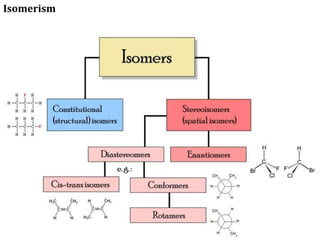
Isomerism
Stereoisomerism
 Isomerism where the connectivity of atoms in molecules remains
the same but they differ in spatial arrangement
 Stereoisomers have same chemical formulaand bonds
 differs in spatial arrangement of atoms
Optical Isomers
isomers display identical characteristics in terms of molecular
weight as well as chemical and physical properties.
 they cannot be superimposed on each other- they are mirror
images of each other.
Found in substances that have an asymmetric carbon atom.
 Shown by stereoisomers which rotate the plane of polarized light
 all properties like boiling points, melting points, and solubilities
are same
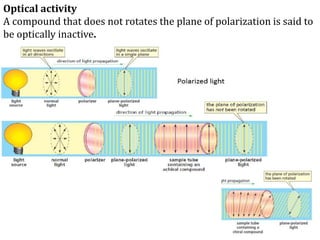
Optical activity
A compound that does not rotates the plane of polarization is said to
be optically inactive.
Chiral Molecule:
 Rotate the plane of the polarized light
 A compound that rotates the plane of polarization is said to be
optically active.
 Such molecules show optical isomerism
 If an optically active compound rotates the plane of polarization
clockwise, it is called dextrorotatory, indicated by (+)or Dextro or d
If an optically active compound rotates the plane of polarization
counterclockwise, it is called levorotatory, indicated by (-)or Levo or
l
chiral compounds are optically active and achiral compounds
are optically inactive.
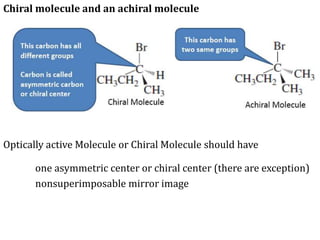
Chiral molecule and an achiral molecule
Optically active Molecule or Chiral Molecule should have
one asymmetric center or chiral center (there are exception)
nonsuperimposable mirror image
Specific rotation
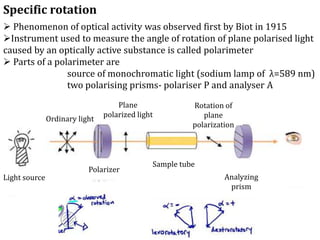
 Phenomenon of optical activity was observed first by Biot in 1915
Instrument used to measure the angle of rotation of plane polarised light
caused by an optically active substance is called polarimeter
 Parts of a polarimeter are
source of monochromatic light (sodium lamp of λ=589 nm)
two polarising prisms- polariser P and analyser A
Plane
polarized light
Rotation of
plane
polarization
Analyzing
prism
Light source
Ordinary light
Polarizer
Sample tube
Unpolarized light from the light source is first polarized
This polarized light passes through a sample cell
If an optically active substance is present in the sample tube, the
plane polarized light is rotated
The observed rotation is a result of the different components of the
plane polarized light interacting differently with the chiral center. In
order to observe the maximum brightness, the observer (person or
instrument) will have to rotate the axis of the analyzer back, either
clockwise or counterclockwise direction depending on the nature of
the compound. (the light reaching the analyzer will be maximum
when the polarizer and analyzer are parallel)
 The actual rotation α as observed by the polarimeter depends on
concentration, c of the solution
length,l, of the light path through the solution
temperature of measurement
wavelength of light used
solvent used for dissolving the substance
The specific rotation αD is given by
Where α is the observed rotation, l is the length of the polarimeter in
dm and c is the concentration of the substance in grams per ml
Thus specific rotation can be defined as the observed angle of
optical rotation α when plane polarized light is passed through a
sample of pathlength one decimeter and concentration of 1gm per
ml.
Molecular rotation is the product of molecular mass and specific
rotation.
The specific rotation of sucrose solution at 20oC using sodium light is
[α]D
20= +66.5o
The sign + denotes that sucrose is dextrorotatory or it rotates plane
polarized light in clockwise direction
Enantiomers
 Enantiomers are a pair of molecules that exist in two forms that
are mirror images of one another but cannot be superimposed one
upon the other.
 A pair of enantiomers is distinguished by the direction in which
when dissolved in solution they rotate polarized light, either dextro
(d or +) or levo (l or -) rotatory
 the physical properties and chemical properties that are typically
used to separate molecular species are identical in the case of
enantiomers, hence it is difficult to separate the two species.
When two enantiomers are present in equal proportions they are
collectively referred to as a racemic mixture that does not rotate
polarized light because the optical activity of each enantiomer is
cancelled by the other.
Any molecule that is not superimposable on its mirror image and
so exists as a pair of enantiomers is said to be chiral and to exhibit
chirality
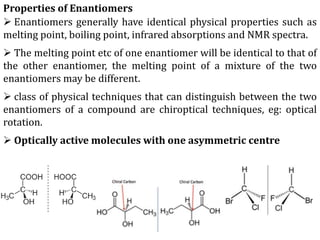
Properties of Enantiomers
 Enantiomers generally have identical physical properties such as
melting point, boiling point, infrared absorptions and NMR spectra.
 The melting point etc of one enantiomer will be identical to that of
the other enantiomer, the melting point of a mixture of the two
enantiomers may be different.
 class of physical techniques that can distinguish between the two
enantiomers of a compound are chiroptical techniques, eg: optical
rotation.
 Optically active molecules with one asymmetric centre
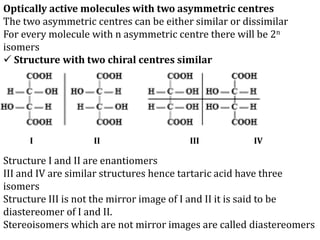
Optically active molecules with two asymmetric centres
The two asymmetric centres can be either similar or dissimilar
For every molecule with n asymmetric centre there will be 2n
isomers
 Structure with two chiral centres similar
Structure I and II are enantiomers
III and IV are similar structures hence tartaric acid have three
isomers
Structure III is not the mirror image of I and II it is said to be
diastereomer of I and II.
Stereoisomers which are not mirror images are called diastereomers
I II III IV
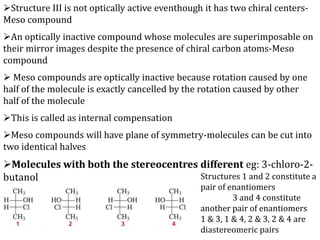
Structure III is not optically active eventhough it has two chiral centers-
Meso compound
An optically inactive compound whose molecules are superimposable on
their mirror images despite the presence of chiral carbon atoms-Meso
compound
 Meso compounds are optically inactive because rotation caused by one
half of the molecule is exactly cancelled by the rotation caused by other
half of the molecule
This is called as internal compensation
Meso compounds will have plane of symmetry-molecules can be cut into
two identical halves
Molecules with both the stereocentres different eg: 3-chloro-2-
butanol Structures 1 and 2 constitute a
pair of enantiomers
3 and 4 constitute
another pair of enantiomers
1 & 3, 1 & 4, 2 & 3, 2 & 4 are
diastereomeric pairs
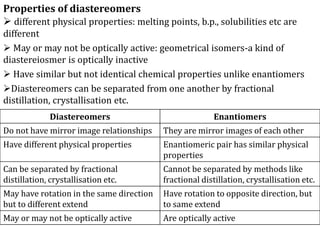
Properties of diastereomers
 different physical properties: melting points, b.p., solubilities etc are
different
 May or may not be optically active: geometrical isomers-a kind of
diastereiosmer is optically inactive
 Have similar but not identical chemical properties unlike enantiomers
Diastereomers can be separated from one another by fractional
distillation, crystallisation etc.
Diastereomers Enantiomers
Do not have mirror image relationships They are mirror images of each other
Have different physical properties Enantiomeric pair has similar physical
properties
Can be separated by fractional
distillation, crystallisation etc.
Cannot be separated by methods like
fractional distillation, crystallisation etc.
May have rotation in the same direction
but to different extend
Have rotation to opposite direction, but
to same extend
May or may not be optically active Are optically active
Configuration
Arrangement of atoms or groups in space for each enantiomer define their
configuration
Relative configuration
absolute configuration
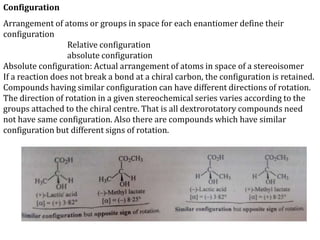
Absolute configuration: Actual arrangement of atoms in space of a stereoisomer
If a reaction does not break a bond at a chiral carbon, the configuration is retained.
Compounds having similar configuration can have different directions of rotation.
The direction of rotation in a given stereochemical series varies according to the
groups attached to the chiral centre. That is all dextrorotatory compounds need
not have same configuration. Also there are compounds which have similar
configuration but different signs of rotation.
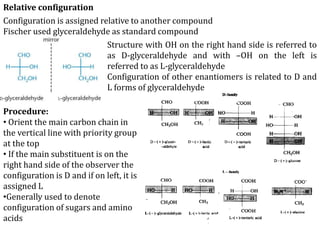
Relative configuration
Configuration is assigned relative to another compound
Fischer used glyceraldehyde as standard compound
Structure with OH on the right hand side is referred to
as D-glyceraldehyde and with –OH on the left is
referred to as L-glyceraldehyde
Configuration of other enantiomers is related to D and
L forms of glyceraldehyde
Procedure:
• Orient the main carbon chain in
the vertical line with priority group
at the top
• If the main substituent is on the
right hand side of the observer the
configuration is D and if on left, it is
assigned L
•Generally used to denote
configuration of sugars and amino
acids
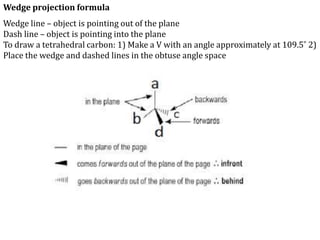
Wedge projection formula
Wedge line – object is pointing out of the plane
Dash line – object is pointing into the plane
To draw a tetrahedral carbon: 1) Make a V with an angle approximately at 109.5˚ 2)
Place the wedge and dashed lines in the obtuse angle space
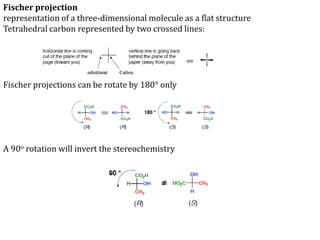
Fischer projection
representation of a three-dimensional molecule as a flat structure
Tetrahedral carbon represented by two crossed lines:
Fischer projections can be rotate by 180° only
A 90o rotation will invert the stereochemistry
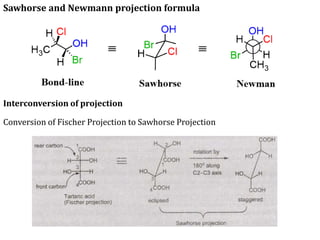
Sawhorse and Newmann projection formula
Interconversion of projection
Conversion of Fischer Projection to Sawhorse Projection
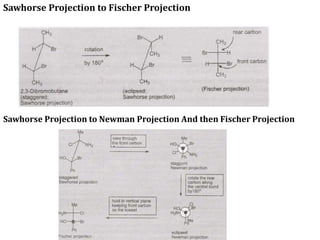
Sawhorse Projection to Fischer Projection
Sawhorse Projection to Newman Projection And then Fischer Projection
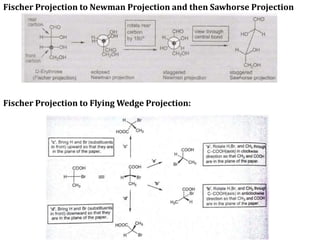
Fischer Projection to Newman Projection and then Sawhorse Projection
Fischer Projection to Flying Wedge Projection:
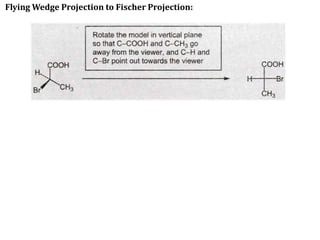
Flying Wedge Projection to Fischer Projection:

Stereochemistry

  • 1.
    Stereochemistry of OrganicCompounds Sem III “the study of the different spatial arrangements of atoms in molecules”
  • 2.
  • 3.
    Stereoisomerism  Isomerism wherethe connectivity of atoms in molecules remains the same but they differ in spatial arrangement  Stereoisomers have same chemical formulaand bonds  differs in spatial arrangement of atoms Optical Isomers isomers display identical characteristics in terms of molecular weight as well as chemical and physical properties.  they cannot be superimposed on each other- they are mirror images of each other. Found in substances that have an asymmetric carbon atom.  Shown by stereoisomers which rotate the plane of polarized light  all properties like boiling points, melting points, and solubilities are same
  • 4.
    Optical activity A compoundthat does not rotates the plane of polarization is said to be optically inactive.
  • 5.
    Chiral Molecule:  Rotatethe plane of the polarized light  A compound that rotates the plane of polarization is said to be optically active.  Such molecules show optical isomerism  If an optically active compound rotates the plane of polarization clockwise, it is called dextrorotatory, indicated by (+)or Dextro or d If an optically active compound rotates the plane of polarization counterclockwise, it is called levorotatory, indicated by (-)or Levo or l chiral compounds are optically active and achiral compounds are optically inactive.
  • 6.
    Chiral molecule andan achiral molecule Optically active Molecule or Chiral Molecule should have one asymmetric center or chiral center (there are exception) nonsuperimposable mirror image
  • 7.
    Specific rotation  Phenomenonof optical activity was observed first by Biot in 1915 Instrument used to measure the angle of rotation of plane polarised light caused by an optically active substance is called polarimeter  Parts of a polarimeter are source of monochromatic light (sodium lamp of λ=589 nm) two polarising prisms- polariser P and analyser A Plane polarized light Rotation of plane polarization Analyzing prism Light source Ordinary light Polarizer Sample tube
  • 8.
    Unpolarized light fromthe light source is first polarized This polarized light passes through a sample cell If an optically active substance is present in the sample tube, the plane polarized light is rotated The observed rotation is a result of the different components of the plane polarized light interacting differently with the chiral center. In order to observe the maximum brightness, the observer (person or instrument) will have to rotate the axis of the analyzer back, either clockwise or counterclockwise direction depending on the nature of the compound. (the light reaching the analyzer will be maximum when the polarizer and analyzer are parallel)  The actual rotation α as observed by the polarimeter depends on concentration, c of the solution length,l, of the light path through the solution temperature of measurement wavelength of light used solvent used for dissolving the substance
  • 9.
    The specific rotationαD is given by Where α is the observed rotation, l is the length of the polarimeter in dm and c is the concentration of the substance in grams per ml Thus specific rotation can be defined as the observed angle of optical rotation α when plane polarized light is passed through a sample of pathlength one decimeter and concentration of 1gm per ml. Molecular rotation is the product of molecular mass and specific rotation. The specific rotation of sucrose solution at 20oC using sodium light is [α]D 20= +66.5o The sign + denotes that sucrose is dextrorotatory or it rotates plane polarized light in clockwise direction
  • 10.
    Enantiomers  Enantiomers area pair of molecules that exist in two forms that are mirror images of one another but cannot be superimposed one upon the other.  A pair of enantiomers is distinguished by the direction in which when dissolved in solution they rotate polarized light, either dextro (d or +) or levo (l or -) rotatory  the physical properties and chemical properties that are typically used to separate molecular species are identical in the case of enantiomers, hence it is difficult to separate the two species. When two enantiomers are present in equal proportions they are collectively referred to as a racemic mixture that does not rotate polarized light because the optical activity of each enantiomer is cancelled by the other. Any molecule that is not superimposable on its mirror image and so exists as a pair of enantiomers is said to be chiral and to exhibit chirality
  • 11.
    Properties of Enantiomers Enantiomers generally have identical physical properties such as melting point, boiling point, infrared absorptions and NMR spectra.  The melting point etc of one enantiomer will be identical to that of the other enantiomer, the melting point of a mixture of the two enantiomers may be different.  class of physical techniques that can distinguish between the two enantiomers of a compound are chiroptical techniques, eg: optical rotation.  Optically active molecules with one asymmetric centre
  • 12.
    Optically active moleculeswith two asymmetric centres The two asymmetric centres can be either similar or dissimilar For every molecule with n asymmetric centre there will be 2n isomers  Structure with two chiral centres similar Structure I and II are enantiomers III and IV are similar structures hence tartaric acid have three isomers Structure III is not the mirror image of I and II it is said to be diastereomer of I and II. Stereoisomers which are not mirror images are called diastereomers I II III IV
  • 13.
    Structure III isnot optically active eventhough it has two chiral centers- Meso compound An optically inactive compound whose molecules are superimposable on their mirror images despite the presence of chiral carbon atoms-Meso compound  Meso compounds are optically inactive because rotation caused by one half of the molecule is exactly cancelled by the rotation caused by other half of the molecule This is called as internal compensation Meso compounds will have plane of symmetry-molecules can be cut into two identical halves Molecules with both the stereocentres different eg: 3-chloro-2- butanol Structures 1 and 2 constitute a pair of enantiomers 3 and 4 constitute another pair of enantiomers 1 & 3, 1 & 4, 2 & 3, 2 & 4 are diastereomeric pairs
  • 14.
    Properties of diastereomers different physical properties: melting points, b.p., solubilities etc are different  May or may not be optically active: geometrical isomers-a kind of diastereiosmer is optically inactive  Have similar but not identical chemical properties unlike enantiomers Diastereomers can be separated from one another by fractional distillation, crystallisation etc. Diastereomers Enantiomers Do not have mirror image relationships They are mirror images of each other Have different physical properties Enantiomeric pair has similar physical properties Can be separated by fractional distillation, crystallisation etc. Cannot be separated by methods like fractional distillation, crystallisation etc. May have rotation in the same direction but to different extend Have rotation to opposite direction, but to same extend May or may not be optically active Are optically active
  • 15.
    Configuration Arrangement of atomsor groups in space for each enantiomer define their configuration Relative configuration absolute configuration Absolute configuration: Actual arrangement of atoms in space of a stereoisomer If a reaction does not break a bond at a chiral carbon, the configuration is retained. Compounds having similar configuration can have different directions of rotation. The direction of rotation in a given stereochemical series varies according to the groups attached to the chiral centre. That is all dextrorotatory compounds need not have same configuration. Also there are compounds which have similar configuration but different signs of rotation.
  • 16.
    Relative configuration Configuration isassigned relative to another compound Fischer used glyceraldehyde as standard compound Structure with OH on the right hand side is referred to as D-glyceraldehyde and with –OH on the left is referred to as L-glyceraldehyde Configuration of other enantiomers is related to D and L forms of glyceraldehyde Procedure: • Orient the main carbon chain in the vertical line with priority group at the top • If the main substituent is on the right hand side of the observer the configuration is D and if on left, it is assigned L •Generally used to denote configuration of sugars and amino acids
  • 17.
    Wedge projection formula Wedgeline – object is pointing out of the plane Dash line – object is pointing into the plane To draw a tetrahedral carbon: 1) Make a V with an angle approximately at 109.5˚ 2) Place the wedge and dashed lines in the obtuse angle space
  • 18.
    Fischer projection representation ofa three-dimensional molecule as a flat structure Tetrahedral carbon represented by two crossed lines: Fischer projections can be rotate by 180° only A 90o rotation will invert the stereochemistry
  • 19.
    Sawhorse and Newmannprojection formula Interconversion of projection Conversion of Fischer Projection to Sawhorse Projection
  • 20.
    Sawhorse Projection toFischer Projection Sawhorse Projection to Newman Projection And then Fischer Projection
  • 21.
    Fischer Projection toNewman Projection and then Sawhorse Projection Fischer Projection to Flying Wedge Projection:
  • 22.
    Flying Wedge Projectionto Fischer Projection: