REPORT
 Optical Fibers in
 Communications


                                    [2011]

            SUBMITTED BY
            GURU VASHIST
              0830531011
               E.C. VII SEM
ARYABHATT COLLEGE OF ENGINEERING AND TECHNOLOGY
ABSTRACT

Communication is an important part of our daily life. The
communication process involves information generation,
transmission, reception and interpretation. As needs for
various types of communication such as voice, images, video
and data communications increase demands for large
transmission capacity also increase. This need for large
capacity has driven the rapid development of light wave
technology; a worldwide industry has developed. An optical
or light wave communication system is a system that uses
light waves as the carrier for transmission. An optical
communication      system    mainly    involves    three   parts.
Transmitter, receiver and channel. In optical communication
transmitters are light sources, receivers are light detectors and
the channels are optical fibers. In optical communication the
channel i.e., optical fibers play an important role because it
carries the data from transmitter to the receiver. Hence, here
we shall discuss mainly about optical fibers.
INDEX
S.NO.                  CONTENT
1.      History
2.      Introduction
3.      Fundamental of Optical Fiber
4.      Construction of Fibers
5.      Classification of Optical Fibers
           5.1 Based on the materials used
           5.2 Based on number of modes
           5.3 Based on refractive index
6.      Modes And Propagation Of Light In Fibers
7.      Optical Fiber Cables
8.      Joint of Fiber
9.      Fiber Splices
10.     Fusion Splices
11.     Equipment Required for OFC Joint
12.     Electric Field With In Fiber Cladding
13.     Repeaters And Regenerators
14.     Light Sources
15.     Detecting the Signal
16.     Advantages Over Conventional Cables
17.     Application of the Optical Fiber Communication
18.     Features
19.     Essential Features of an Optical Fiber
20.     Drawbacks of Optical Fiber Communication
21.     Conclusions
22.     Bibliography
Optical Fibers in Communication

1. HISTORY:-
The use of visible optical carrier waves or light for
communication has been common for many years. Simple
systems such as signal fires, reflecting mirrors and, more
recently signaling lamps have provided successful, if limited,
information transfer. Moreover as early as 1880 Alexander
Graham Bell reported the transmission of speech using a light
Beam. The photo phone proposed by Bell just for years after
the invention of the telephone modulated sunlight with a
diaphragm giving speech transmission over a distance of
200m. However, although some investigation of the optical
communication continued in the early part of the 20th century
its use was limited to mobile, low capacity communication
Links. This was due to both the lack of suitable light sources
and the problem that light transmission in the atmosphere is
restricted to line of sight and severely affected by
disturbances such as rain, snow, fog dust and atmospheric
turbulence. A renewed interest in optical communication was
stimulated in the early 1960s with the invention of the laser.
This device provided a coherent light source, together with
the possibility of the modulation at high frequency. The
proposals for optical communication via optical fibers
fabricated from glass to avoid degradation of the optical
signal by the atmosphere were made almost simultaneously in
1966 by Kao and Hock ham and Werts. Such systems were
viewed as a replacement for coaxial cable system; initially the
optical fibers exhibited very high attenuation and were
therefore not comparable with the coaxial cable they were to
replace. There were also problems involved in jointing the
fiber cables in a satisfactory manner to achieve low loss and
to enable the process to be performed relatively easily and
repeatedly in the field.
In coaxial system the channel capacity is 300 to 10800 and
the disadvantages of the coaxial system are digging, electrical
disturbance, in winter cable contracts and breaks mutual
induction. The coaxial cable loss is 0.3db per every km.

• In microwave system if we double the distance the loss will
be increased by 6db.
• For the shorter distance the loss is higher.
• In o.f.c. system Optical wire is small size, light weight, high
strength and flexibility. Its Transmission benefits include
wide band width, low loss and low cost.
• They are suitable for both analog and digital transmission.
• It is not suffered by digging, electrical interference etc.
problems.


2. Introduction:-
Optical fibers are arguably one of the world’s most influential
scientific developments from the latter half of the 20th
century. Normally we are unaware that we are using them,
although many of us do frequently. The majority of telephone
calls and internet traffic at some stage in their journey will be
transmitted along an optical fiber. Why has the development
of fibers been given so much attention by the scientific
community when we have alternatives? The main reason is
bandwidth – fibers can carry an extremely large amount of
information. More indirectly, many of the systems that we
either rely on or enjoy in everyday life such as banks,
television and newspapers as (to name only a very limited
selection) are themselves dependent on communication
systems that are dependent on optical fibers.


3. Fundamentals of Fibers:-
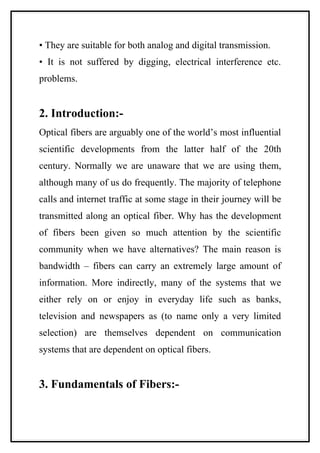
The fundamental principle that makes optical fibers
possible is total internal reflection. This is described using
the ray model of light as shown in figure 1.


Figure 1 - Total Internal Reflection

From Snell’s Law we find that refraction (as shown by the
dashed line) can only occur when the angle theta1 is large
enough. This implies that as the angle is reduced, there must
be a point when the light ray is reflected, where theta1 =
theta2. The angle where this happens is known as the critical
angle and is:


4. CONSTRUCTION OF FIBERS:-

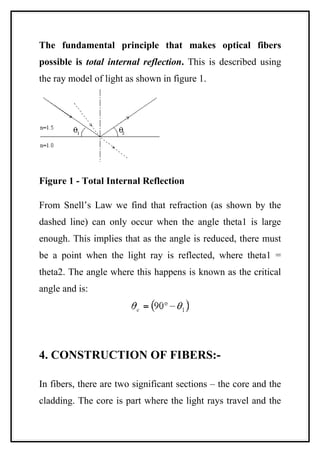
In fibers, there are two significant sections – the core and the
cladding. The core is part where the light rays travel and the
cladding is a similar material of slightly lower refractive
index to cause total internal reflection. Usually both sections
are fabricated from silica (glass). The light within the fiber is
then continuously totally internally reflected along the
waveguide.


                       Figure 2: Structure of Fiber

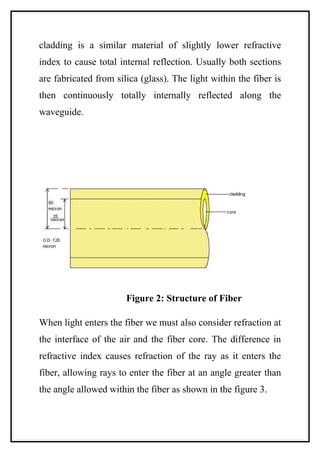
When light enters the fiber we must also consider refraction at
the interface of the air and the fiber core. The difference in
refractive index causes refraction of the ray as it enters the
fiber, allowing rays to enter the fiber at an angle greater than
the angle allowed within the fiber as shown in the figure 3.
Figure 3 - Acceptance Angle

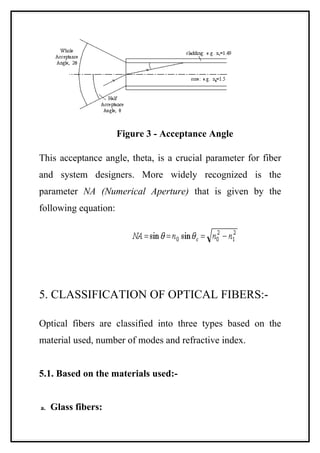
This acceptance angle, theta, is a crucial parameter for fiber
and system designers. More widely recognized is the
parameter NA (Numerical Aperture) that is given by the
following equation:


5. CLASSIFICATION OF OPTICAL FIBERS:-

Optical fibers are classified into three types based on the
material used, number of modes and refractive index.


5.1. Based on the materials used:-


a.   Glass fibers:
They have a glass core and glass cladding. The glass used in
the fiber is ultra pure, ultra transparent silicon dioxide (SiO2)
or fused quartz. Impurities are purposely added to pure glass
to achieve the desired refractive index
.
b. Plastic clad silica:
This fiber has a glass core and plastic cladding. This
performance though not as good as all glass fibers, is quite
respectable.


c.   Plastic fibers:
They have a plastic core and plastic cladding. These fibers are
attractive in applications where high bandwidth and low loss
are not a concern.


5.2. Based on the number of modes:-

a. Single Mode fiber:
When a fiber wave-guide can support only the HE11 mode, it
is referred to as a single mode wave-guide. In a step index
structure this occurs w3hen the wave-guide is operating at
v<2.4 where v is dimensionless number which relates the
propagating in the cladding. These single mode fibers have
small size and low dopant level (typically 0.3% to 0.4% index
elevation over the lading index.)

In high silica fibers the wave-guide and the material
dispersion are often of opposite signs. This fact can be used
conveniently to achieve a single mode fiber of extremely
large bandwidth. Reduced dopant level results in lower
attenuation than in multimode fibres. A single mode wave
guide with its large and fully definable bandwidth
characteristics is an obvious candidate for long distance, high
capacity transmission applications.


b.   Multimode fiber:
It is a fiber in which more than one mode is propagating at the
system operating wavelength. Multimode fiber system does
not have the information carrying capacity of single mode
fibers. However they offer several advantages for specific
systems.

The larger core diameters result in easier splicing of fibers.
Given the larger cores, higher numerical apertures, and
typically shorter link distances, multimode systems can use
less expensive light sources such as LED s . Multimode fibers
have numerical apertures that typically range from 0.2 to 0.29
and have core size that range from 35 to100 micro-meters.


5.3. Based on refractive index:-

a. Step index fiber:
The step index (SI) fiber consists of a central core whose
refractive index is n1, surrounded by a lading whose
refractive index is n2, lower than that of core.

 Because of an abrupt index change at the core cladding
interface such fibers are called step index fibers.
b. Graded index fibers:
The refractive index of the core in graded index fiber is not
constant, but decreases gradually from its maximum value n1
to its minimum value n2 at the core-cladding interface. The
ray velocity changes along the path because of variations in
the refractive index.

The ray propagating along the fiber axis takes the shortest
path but travels most slowly, as the index is largest along this
path in medium of lower refractive index where they travel
faster. It is therefore possible for all rays to arrive together at
the fiber output by a suitable choice of refractive index
profile.


6. MODES AND PROPAGATION OF LIGHT
IN FIBERS:-
Also crucial to understanding fibers is the principle of modes.
A more in-depth analysis of the propagation of light along an
optical fiber requires the light to be treated as an
electromagnetic wave (rather that as a ray).


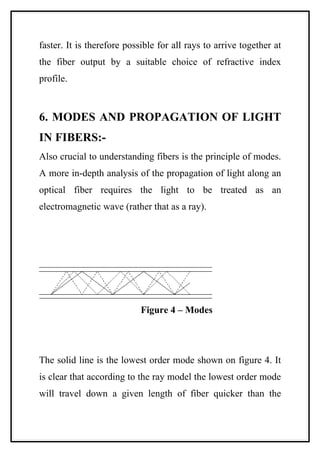
                            Figure 4 – Modes


The solid line is the lowest order mode shown on figure 4. It
is clear that according to the ray model the lowest order mode
will travel down a given length of fiber quicker than the
others. The electromagnetic field model predicts the opposite
– that the highest order mode will travel quicker.
             However, the overall effect is still the same – if a
signal is sent down the fiber as several modes then as it
travels along the fibre the pulse will spread out, this can lead
to the pulses merging and becoming indistinguishable.


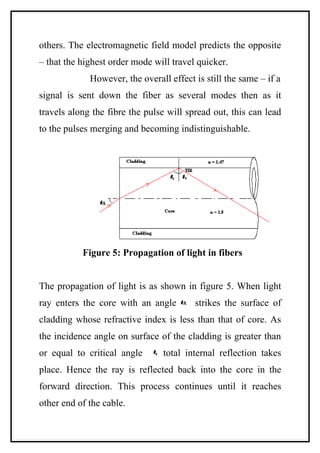
           Figure 5: Propagation of light in fibers


The propagation of light is as shown in figure 5. When light
ray enters the core with an angle        strikes the surface of
cladding whose refractive index is less than that of core. As
the incidence angle on surface of the cladding is greater than
or equal to critical angle       total internal reflection takes
place. Hence the ray is reflected back into the core in the
forward direction. This process continues until it reaches
other end of the cable.
7. OPTICAL FIBER CABLES:-
When optical fibers are to be installed in a working
environment their mechanical properties are of prime
importance. In this respect the unprotected optical fiber has
several disadvantages with regard to its strength and
durability.
Bare glass fibers are little and have small cross sectional areas
which make them very susceptible to damage when
employing normal transmission line handling procedures. It is
therefore necessary to cover the fibers to improve their tensile
strength and to protect them against external influences.


The functions of the optical cable may be summarized into
four main areas.
These are as follows:-

1. Fiber protection. The major function of the optical cable is
to protect against fiber damage and breakage both during
installation and throughout the life of the fiber.
2. Stability of the fiber transmission characteristics. The
cabled    fiber   must   have    good     stable   transmission
characteristics which are comparable with the uncabled fiber.
Increases in optical attenuation due to cabling are quite usual
and must be minimized within the cable design.

3. Cable strength. Optical cables must have similar
mechanical properties to electrical transmission cables in
order that they may be handled in the same manner. These
mechanical properties include tension, torsion, compression,
bending, squeezing and vibration. Hence the cable strength
may be improved by incorporating a suitable strength member
and by giving the cable a properly designed thick outer
sheath.
.
4. Identification and jointing of the fibers within the cable.
This is especially important for cables including a large
number of optical fibers. If the fibers are arranged in a
suitable geometry it may be possible to use multiple jointing
techniques rather than jointing each fiber individually.
8. JOINT OF FIBER:-
Optical fiber links, in common with any line communication
system, have a requirement for both jointing and termination
of the transmission medium. The number of intermediate fiber
connections or joints is dependent upon the link length, the
continuous length of the fiber cable that may be produced by
the preparation methods and the length of the fiber cable that
may be practically installed as a continuous section on the
link. It is therefore apparent that fiber to fiber connection with
low loss and minimum distortion (i.e. modal noise) remains
an important aspect of optical fiber communication system.

Before optical fibers splicing and joining are done certain
preparations are made with fiber or fiber cables as case may
be to achieve best results at the end surface. First of all the
protective plastic that covers the glass cladding is stripped
from each fiber end, which is then cleaved with a special tool,
producing a smooth and flat end.

1. Fiber splices: these are semi permanent or permanent joints
which find major use in most optical fiber telecommunication
system (analogous to electrical soldered joints).


2. Demountable fiber connectors or simple connectors: these
are removable joints which allow easy, fast, manual coupling
and uncoupling of fibers (analogous to electrical plugs and
sockets).

The above fiber to fiber joints are designed ideally to couple
all the light propagating in one fiber into the adjoining fiber.
By contrast fiber couplers are branching devices that split all
the light from main fiber into two or more fibers or,
alternatively, couple a proportion of the light propagating in
the main fiber into main fiber.


9. FIBER SPLICES:-
A permanent joint formed between two individual optical
fibers in the field or factory is known as a fiber splice. Fiber
splicing is frequently used to establish long haul optical fiber
links where smaller fiber lengths need to be joined, and there
is no requirement for repeated connection and disconnection.
Splices may be divided into two broad categories depending
upon the splicing technique utilized. These are fusion splicing
or welding and mechanical splicing.

Fusion splicing is accomplished by applying localized heating
(e.g. by a flame or an electric are) at the interface between
two butted, prealigned fiber ends causing them to soften and
fuse. Mechanical splicing, in which the fibers are held in
alignment by some mechanical means, may be achieved by
various methods including the use of tubes around the fiber
ends (groove splices).

A requirement with fibers intended for splicing is that they
have smooth and square end faces. In general this end
preparation may be achieved using a suitable tool which
cleaves the fiber as illustrated.


10. FUSION SPLICES:-
The fusion splicing – of single fibers involves the heating of
the two prepared fiber ends to their fusing point with the
application of sufficient axial pressure between the two
optical fibers. It is therefore essential that the stripped (of
cabling and buffer coating) fiber ends are adequately
positioned and aligned in order to achieve good continuity of
the transmission medium at the junction point. Hence the fiber
are usually positioned and clamped with the aid of an
inspection microscope.
Flame heating sources such as micro plasma torches (argon
and hydrogen) and oxhydric micro burners (oxygen, hydrogen
and alcohol vapour) have been utilized with some success.
However, the most widely used heating source is an electric
arc. This technique offers advantages of consistent, easily
controlled heat with adaptability for use under field
conditions. A schematic diagram of the basic two fibers is
welded together. Shows a development of the basic are fusion
process which involves the rounding of the fiber ends with a
low energy discharge before pressing the fibers together and
fusing with a stronger arc. This technique, known as
perfusion, removes the requirement for fiber end preparation
which has a distinct advantage in the field environment.


A possible drawback with fusion splicing is that the heat
necessary to fuse the fibers may weaken the fiber in the
vicinity of the splice. It has been found that even with careful
handling; the tensile strength of the fused fiber may be as low
as 30 % of that of the uncoated fiber before fusion.


11. EQUIPMENT REQUIRED FOR OFC
JOINT:
1) Optical fiber fusion splicer specification ( spicer machine )
• AC input – 100 to 240v, frequency – 50/60Hz
• DC input 12v/A

2) Fiber cutter
• It converts irregular shaped fiber end into smooth & flat end.

3) Chemicals used in OFC joint
• HAXENE: To remove jelly from the fiber
• ACETONE: For cleaning the OFC
• ISO PROPENOT: For smoothness of optical glass.

4) Sleeve: - To enclose fiber joint.

5) Tool Kit

6) Joint kit.
• Joint encloser
• Buffer
• Adhesive tape.

7) Generator /12V Battery

8) Cotton clothes for fiber cleaning.
12. ELECTRIC-FIELD WITH IN FIBER
CLADDING:-

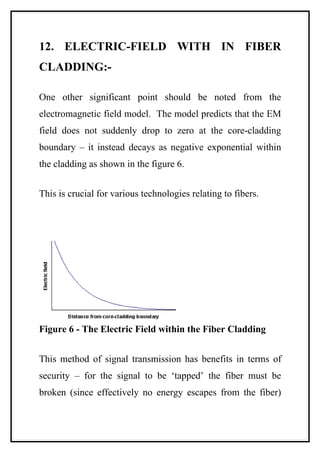
One other significant point should be noted from the
electromagnetic field model. The model predicts that the EM
field does not suddenly drop to zero at the core-cladding
boundary – it instead decays as negative exponential within
the cladding as shown in the figure 6.


This is crucial for various technologies relating to fibers.


Figure 6 - The Electric Field within the Fiber Cladding


This method of signal transmission has benefits in terms of
security – for the signal to be ‘tapped’ the fiber must be
broken (since effectively no energy escapes from the fiber)
and this can easily be detected (when no signal reaches the
other end of the fiber!).


This is one of the many advantages of the medium. But
mainly two factors, attenuation and dispersion of light, have
to be considered while transmitting the light over large
distances.

         We use repeaters and regenerators to reduce the
attenuation and dispersion.


13. REPEATERS AND REGENERATORS:-
Optical repeaters are purely optical devices that are used
simply to combat attenuation in the fiber; typically spans of
80km upwards are now possible. The recent introduction of
soliton transmission methods has increased the allowed
distance between repeaters and systems spanning 130km
without a repeater are now possible.

                                                    Regener
ators are devices consisting of both electronic and optical
components to provide ‘3R’ regeneration – Retiming,
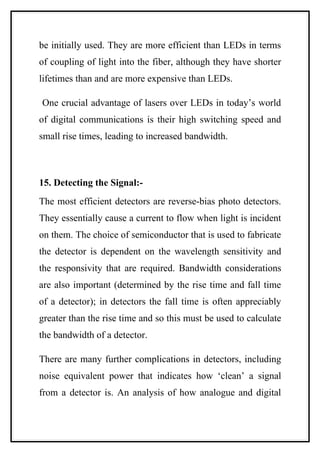
Reshaping, Regeneration. Retiming and reshaping detect the
digital signal that will be distorted and noisy (partly due to the
optical repeaters), and recreate it as a clean signal as shown in
figure 6 This clean signal is then regenerated (optically
amplified) to be sent on. It should be noted that repeaters are
purely optical devices whereas regenerators require optical-to-
electrical (O/E) conversion and electrical-to-optical (E/O)
conversion.

                        The ultimate aim of many fiber system
researchers is to create a purely optical network without
electronics,   which    would     maximize      efficiency    and
performance. Many aspects of such a system are in place, but
some still require the O/E and E/O conversion.


Figure7 - A digital signal before (noisy and attenuated)
and after regeneration
The most common optical amplifier currently in use is the
EDFA (Erbium Doped Fiber Amplifier). These consist of a
coil of fiber doped with the rare earth metal erbium. A laser
diode pumps the erbium atoms to a high-energy state; when
the signal reaches the doped fiber the energy of the erbium
atoms is transferred to the signal, thus amplifying it.

14. Light Sources:-

Two types of light source are used with fibers, LEDs and
Laser Diodes. LEDs can operate in the near infrared (the main
wavelengths used in fibers are 1300nm and 1550nm, along
with 850nm for some applications); they can emit light at
850nm and 1300nm. They also have the advantages of long
lifetimes and being cheap. Unfortunately they are large
compared to the cross-section of a fiber and so a large amount
of light is lost in the coupling of an LED with a fiber. This
also reduces the amount of modal control designers have over
incident light. Laser diodes can be made to emit light at either
1300nm or 1550 nm, and also over a small spectral width
(unlike LEDs), which reduces chromatic dispersion. Their
emitting areas are extremely small and so the angle of
incidence of light on a fiber can be accurately controlled such
that <5% of the possible modes within a multimode fiber will
be initially used. They are more efficient than LEDs in terms
of coupling of light into the fiber, although they have shorter
lifetimes than and are more expensive than LEDs.

One crucial advantage of lasers over LEDs in today’s world
of digital communications is their high switching speed and
small rise times, leading to increased bandwidth.


15. Detecting the Signal:-
The most efficient detectors are reverse-bias photo detectors.
They essentially cause a current to flow when light is incident
on them. The choice of semiconductor that is used to fabricate
the detector is dependent on the wavelength sensitivity and
the responsivity that are required. Bandwidth considerations
are also important (determined by the rise time and fall time
of a detector); in detectors the fall time is often appreciably
greater than the rise time and so this must be used to calculate
the bandwidth of a detector.

There are many further complications in detectors, including
noise equivalent power that indicates how ‘clean’ a signal
from a detector is. An analysis of how analogue and digital
signals are processed after the initial detector is also
interesting.


16.  ADVANTAGES               OVER        CONVENTIONAL
CABLES:-
a. Wide Bandwidth:
Optical fibers offer greater bandwidth due to the use of light
as carrier. The frequency range used for glass fiber
communication extends from 2*e14Hz to 4*e14Hz. Hence
optical fibers are suitable for high speed, large capacity
telecommunication lines.

b. Low Loss:
In a coaxial cable attenuation increases with frequency. The
higher the frequency of information signals the greater the
loss, whereas in an optical fiber the attenuation is independent
of frequency. They offer a loss of0.2 dBm/km, allowing
repeater separation upto 50Km or more.

c. Freedom from electromagnetic interference:
Optical fibers are not affected by interference originating
from power cables, railways and radio waves. They do not
limit unwanted radiation and no cross talk between fibers
exists. These fibers make an ideal transmission medium when
EMI (Electro Magnetic Immunity) is increased.

d. Non conductivity:
Optical fibers are non-conductive and are not effective by
strong electromagnetic interference such as lighting. These
are usable in explosive environment.

e. Small diameters and less weight:
Even multi fiber optical cables have a small diameter and are
light weight, and flexible optical fiber cables permit effective
utilization of speech and can also be applicable to long
distance use are easier to handle and install than conventional
cables.

f. Security:
Fiber optic is a highly source transmission medium. It does
not radiate energy that can be received by a nearby antenna,
and it is extremely difficult to tap a fiber and virtually
impossible to make the tap undetected.
g. Safety:
Fibre is a dielectric and does not carry electricity. It presents
no sparks or fire hazards. It does not cause explosions, which
occur due to faulty copper cable.

17. APPLICATION OF THE OPTICAL FIBER
COMMUNICATION:-

TRUNK NETWORK

The trunk or toll network is used for carrying telephone traffic
between major
conurbations. Hence there is generally a requirement for the
use of transmission systems
which have a high capacity in order to minimize costs per
circuit. The transmission
distance for trunk systems can very enormously from under
20 km to over 300 km, and
occasionally to as much as 1000 km. Therefore transmission
systems which exhibit low
attenuation and hence give a maximum distance of
unrepeatered operation are the most
economically viable. In this context optical fiber systems with
their increased bandwidth
and repeater spacing offer a distinct advantage.


JUNCTION NETWORK:
The junction or interoffice network usually consists of routes
within major conurbations
over distances of typically 5 to 20 km. However, the
distribution of distances between
switching centers (telephone exchanges ) or offices in the
junction network of large urban
areas varies considerably for various countries.


MILITARY APPLICATION:
In these applications, although economics are important, there
are usually other, possibly
overriding, considerations such as size, weight, deployability,
survivability (in both
conventional and nuclear attack and security. The special
attributes of optical fiber
communication system therefore often lend themselves to
military use.


MOBILES:
One of the most promising areas of milita5ry application for
optical fiber communication
is within military mobiles such as aircraft, ships and tanks.
The small size and weight of
optical fibers provide and attractive solution to space
problems in these mobiles which
are increasingly equipped with sophisticated electronics. Also
the wideband nature of
optical fiber transmission will allow the multiplexing of a
number of signals on to a
common bus.


                            Furthermore, the immunity of optical
transmission to electromagnetic
interference (EMI) in the often noisy environment of military
mobiles is a tremendous
advantage. This also applies to the immunity of optical fiber
to lighting and
electromagnetic pulses (EMP) especially within avionics. The
electrical isolation, and
therefore safety, aspect of optical fiber communication also
proves invaluable in these
applications, allowing routing through both fuel tanks and
magazines.


COMMUNICATION LINKS:
     The other major area for the application of optical fiber
communication in the military
sphere includes both short and long distance communication
links. Short distance optical
fiber systems may be utilized to connect closely spaced items
of electronics equipment in
such areas as operations rooms and computer installations. A
large number of this system
have already been installed in military installations in the
united kingdom. These operate
over distances from several centimeters to a few hundred
meters at transmission rates
between 50 bauds and 4.8 kbits-1. In addition a small number
of 7 MHz video links
operating over distances of up to 10 m are in operation. There
is also a requirement for
long distance communication between military installations
which could benefit from the
use of optical fibers. In both these advantages may be gained
in terms of bandwidth,
security and immunity to electrical interference and earth loop
problems over
conventional copper systems.


CIVIL APPLICATION:
The introduction of optical fiber communication systems into
the public network has
stimulated investigation and application of these transmission
techniques by public utility
organizations which provide their own communication
facilities over moderately long
distances. For example these transmission techniques may be
utilized on the railways and
along pipe and electrical power lines.
In these applications, although high capacity transmission is
not usually required, optical fibers may provide a relatively
low cost solution, also giving enhanced protection in harsh
environment, especially in relation to EMI and EMP.
Experimental optical fiber communication systems have been
investigated within a number of organizations in Europe,
North America and Japan. For instance, British Rail has
successfully demonstrated a 2 Mbits-1 system suspended
between the electrical power line gantries over a 6 km route in
Cheshire.
Also, the major electric power companies have shown a great
deal of interest with regard    to the incorporation of optical
fibers within the metallic earth of overhead electric power
lines. fibers are now the standard.


TELECOMMUNICATION:
Optical point to point cable link between telephone
substations.

LOCAL AREA NETWORKS (LAN's):
Multimode fiber is commonly used as the "backbone" to carry
signals between the hubs of LAN's from where copper coaxial
cable takes the data to the desktop. Fiber links to the desktop,
however, are also common.

CABLE TV:

As mentioned before domestic cable TV networks use optical
fiber because of its very low power consumption.
CCTV:

Closed circuit television security systems use optical fiber
because of its inherent security, as well as the other
advantages mentioned above.
18. FEATURE:-

The fiber optics has become a preferred medium due to its
some important features like:

• The bandwidth of the fiber and light beam is extremely
wide. It is possible to handle
signals which turn on and off at gigabit per second rates (1
gigabit, gbit =1000
Mbitts).
• The fiber itself is very thin and not expensive. The thinness
means that it is easy to
handle, and many fibers can be put in the trenches or narrow
conduits.

• The light signa-l is absolutely immune to electrical noise
from any sources. Even if
there are sources of electrical noise directly touching the
cable, the electric fields of
the noise source cannot affect the light beam in the fiber.

• The signal in the cable is secure from unauthorized listeners.
It is relatively hard to
tap into the cable without being noticed, and the entire light
signal is confined within
the fiber. No light escapes to the outside where someone else
could see it.

• Since there is no electricity or electrical energy in the fiber,
it can be run in hazardous
atmospheres where the danger of explosion from spark may
exist. Also, the fiber
itself is immune to many types of poisonous gases, chemicals,
and water.


19. ESSENTIAL FEATURES OF AN OPTICAL FIBER:-

1. Optical fibers may be produced with good stable
transmission characteristics in long
lengths    at   a    minimum     cost   and    with    maximum
reproducibility.
2. A range of optical fiber types with regard to size, refractive
indices and index
profiles, operating wavelengths, materials etc. be available in
order to fulfill many
different system applications.


3. The fibers may be converted into practical cables which
can be handled in a similar
manner to conventional electrical transmission cables without
problems associated
with the degradation of their characteristics or damage.


4. The fibers and fiber cables may be terminated and
connected together without
excessive practical difficulties and in ways which limit the
effect of this process on
the fiber transmission characteristics to keep them within
acceptable operating levels.

                                 It is important that these jointing
techniques may be
applied with ease in the field location where cable connection
takes place.
20.     DRAWBACKS               OF    OPTICAL         FIBER
COMMUNICATION:-
The use of fibers for optical communication does have some
drawbacks in practice.
Hence to provide a balance picture these disadvantages must
be considered. They are

• The fragility of the bare fibers;

• The small size of fibers and cables which creates some
difficulties with splicing and
forming connectors;

• Some problems involved with forming low loss T- couplers;

• Some doubts in relations to the long term reliability of
optical fibers in the presence
of moisture;

• An independent electrical power feed is required for any
electronic repeaters;

• New equipment and field practice are required;
• Testing procedures tend to be more complex.
21. Conclusions:-
We are currently in the middle of a rapid increase in the
demand for data bandwidth across the Earth. For most
applications optical fibers are the primary solution to this
problem. They have potentially a very high bandwidth, with
many of the bandwidth limitations now being at the
transceivers rather than being an intrinsic property of the fiber
allowing easy upgrading of systems without relaying cable.

                                  This is creating a surge in the
deployment of fiber both in backbones of networks and in
topologically horizontal cabling, which inturn is supporting
and propelling the industry into further research. With the
adoption of new techniques such as DWDM, soliton
transmission, and ultimately the purely optical network, we
have a medium that will satisfy our communication needs for
the foreseeable future.


22. Bibliography:-
  •   Optical Fibers And Sources For Communications
---Adams
and Henning,
  •    Principles Of Modern Optical Systems
                                               --- Andonovic
  and Uttamchandani
  •    An Introduction to Optical Waveguides
                                               ---Adams, M.
  J.

Guru vashist report

  • 1.
    REPORT Optical Fibersin Communications [2011] SUBMITTED BY GURU VASHIST 0830531011 E.C. VII SEM ARYABHATT COLLEGE OF ENGINEERING AND TECHNOLOGY
  • 2.
    ABSTRACT Communication is animportant part of our daily life. The communication process involves information generation, transmission, reception and interpretation. As needs for various types of communication such as voice, images, video and data communications increase demands for large transmission capacity also increase. This need for large capacity has driven the rapid development of light wave technology; a worldwide industry has developed. An optical or light wave communication system is a system that uses light waves as the carrier for transmission. An optical communication system mainly involves three parts. Transmitter, receiver and channel. In optical communication transmitters are light sources, receivers are light detectors and the channels are optical fibers. In optical communication the channel i.e., optical fibers play an important role because it carries the data from transmitter to the receiver. Hence, here we shall discuss mainly about optical fibers.
  • 3.
    INDEX S.NO. CONTENT 1. History 2. Introduction 3. Fundamental of Optical Fiber 4. Construction of Fibers 5. Classification of Optical Fibers 5.1 Based on the materials used 5.2 Based on number of modes 5.3 Based on refractive index 6. Modes And Propagation Of Light In Fibers 7. Optical Fiber Cables 8. Joint of Fiber 9. Fiber Splices 10. Fusion Splices 11. Equipment Required for OFC Joint 12. Electric Field With In Fiber Cladding 13. Repeaters And Regenerators 14. Light Sources 15. Detecting the Signal 16. Advantages Over Conventional Cables 17. Application of the Optical Fiber Communication 18. Features 19. Essential Features of an Optical Fiber 20. Drawbacks of Optical Fiber Communication 21. Conclusions 22. Bibliography
  • 4.
    Optical Fibers inCommunication 1. HISTORY:- The use of visible optical carrier waves or light for communication has been common for many years. Simple systems such as signal fires, reflecting mirrors and, more recently signaling lamps have provided successful, if limited, information transfer. Moreover as early as 1880 Alexander Graham Bell reported the transmission of speech using a light Beam. The photo phone proposed by Bell just for years after the invention of the telephone modulated sunlight with a diaphragm giving speech transmission over a distance of 200m. However, although some investigation of the optical communication continued in the early part of the 20th century its use was limited to mobile, low capacity communication Links. This was due to both the lack of suitable light sources and the problem that light transmission in the atmosphere is restricted to line of sight and severely affected by disturbances such as rain, snow, fog dust and atmospheric turbulence. A renewed interest in optical communication was stimulated in the early 1960s with the invention of the laser. This device provided a coherent light source, together with
  • 5.
    the possibility ofthe modulation at high frequency. The proposals for optical communication via optical fibers fabricated from glass to avoid degradation of the optical signal by the atmosphere were made almost simultaneously in 1966 by Kao and Hock ham and Werts. Such systems were viewed as a replacement for coaxial cable system; initially the optical fibers exhibited very high attenuation and were therefore not comparable with the coaxial cable they were to replace. There were also problems involved in jointing the fiber cables in a satisfactory manner to achieve low loss and to enable the process to be performed relatively easily and repeatedly in the field. In coaxial system the channel capacity is 300 to 10800 and the disadvantages of the coaxial system are digging, electrical disturbance, in winter cable contracts and breaks mutual induction. The coaxial cable loss is 0.3db per every km. • In microwave system if we double the distance the loss will be increased by 6db. • For the shorter distance the loss is higher. • In o.f.c. system Optical wire is small size, light weight, high strength and flexibility. Its Transmission benefits include wide band width, low loss and low cost.
  • 6.
    • They aresuitable for both analog and digital transmission. • It is not suffered by digging, electrical interference etc. problems. 2. Introduction:- Optical fibers are arguably one of the world’s most influential scientific developments from the latter half of the 20th century. Normally we are unaware that we are using them, although many of us do frequently. The majority of telephone calls and internet traffic at some stage in their journey will be transmitted along an optical fiber. Why has the development of fibers been given so much attention by the scientific community when we have alternatives? The main reason is bandwidth – fibers can carry an extremely large amount of information. More indirectly, many of the systems that we either rely on or enjoy in everyday life such as banks, television and newspapers as (to name only a very limited selection) are themselves dependent on communication systems that are dependent on optical fibers. 3. Fundamentals of Fibers:-
  • 7.
    The fundamental principlethat makes optical fibers possible is total internal reflection. This is described using the ray model of light as shown in figure 1. Figure 1 - Total Internal Reflection From Snell’s Law we find that refraction (as shown by the dashed line) can only occur when the angle theta1 is large enough. This implies that as the angle is reduced, there must be a point when the light ray is reflected, where theta1 = theta2. The angle where this happens is known as the critical angle and is: 4. CONSTRUCTION OF FIBERS:- In fibers, there are two significant sections – the core and the cladding. The core is part where the light rays travel and the
  • 8.
    cladding is asimilar material of slightly lower refractive index to cause total internal reflection. Usually both sections are fabricated from silica (glass). The light within the fiber is then continuously totally internally reflected along the waveguide. Figure 2: Structure of Fiber When light enters the fiber we must also consider refraction at the interface of the air and the fiber core. The difference in refractive index causes refraction of the ray as it enters the fiber, allowing rays to enter the fiber at an angle greater than the angle allowed within the fiber as shown in the figure 3.
  • 9.
    Figure 3 -Acceptance Angle This acceptance angle, theta, is a crucial parameter for fiber and system designers. More widely recognized is the parameter NA (Numerical Aperture) that is given by the following equation: 5. CLASSIFICATION OF OPTICAL FIBERS:- Optical fibers are classified into three types based on the material used, number of modes and refractive index. 5.1. Based on the materials used:- a. Glass fibers:
  • 10.
    They have aglass core and glass cladding. The glass used in the fiber is ultra pure, ultra transparent silicon dioxide (SiO2) or fused quartz. Impurities are purposely added to pure glass to achieve the desired refractive index . b. Plastic clad silica: This fiber has a glass core and plastic cladding. This performance though not as good as all glass fibers, is quite respectable. c. Plastic fibers: They have a plastic core and plastic cladding. These fibers are attractive in applications where high bandwidth and low loss are not a concern. 5.2. Based on the number of modes:- a. Single Mode fiber: When a fiber wave-guide can support only the HE11 mode, it is referred to as a single mode wave-guide. In a step index structure this occurs w3hen the wave-guide is operating at v<2.4 where v is dimensionless number which relates the propagating in the cladding. These single mode fibers have
  • 11.
    small size andlow dopant level (typically 0.3% to 0.4% index elevation over the lading index.) In high silica fibers the wave-guide and the material dispersion are often of opposite signs. This fact can be used conveniently to achieve a single mode fiber of extremely large bandwidth. Reduced dopant level results in lower attenuation than in multimode fibres. A single mode wave guide with its large and fully definable bandwidth characteristics is an obvious candidate for long distance, high capacity transmission applications. b. Multimode fiber: It is a fiber in which more than one mode is propagating at the system operating wavelength. Multimode fiber system does not have the information carrying capacity of single mode fibers. However they offer several advantages for specific systems. The larger core diameters result in easier splicing of fibers. Given the larger cores, higher numerical apertures, and typically shorter link distances, multimode systems can use less expensive light sources such as LED s . Multimode fibers
  • 12.
    have numerical aperturesthat typically range from 0.2 to 0.29 and have core size that range from 35 to100 micro-meters. 5.3. Based on refractive index:- a. Step index fiber: The step index (SI) fiber consists of a central core whose refractive index is n1, surrounded by a lading whose refractive index is n2, lower than that of core. Because of an abrupt index change at the core cladding interface such fibers are called step index fibers. b. Graded index fibers: The refractive index of the core in graded index fiber is not constant, but decreases gradually from its maximum value n1 to its minimum value n2 at the core-cladding interface. The ray velocity changes along the path because of variations in the refractive index. The ray propagating along the fiber axis takes the shortest path but travels most slowly, as the index is largest along this path in medium of lower refractive index where they travel
  • 13.
    faster. It istherefore possible for all rays to arrive together at the fiber output by a suitable choice of refractive index profile. 6. MODES AND PROPAGATION OF LIGHT IN FIBERS:- Also crucial to understanding fibers is the principle of modes. A more in-depth analysis of the propagation of light along an optical fiber requires the light to be treated as an electromagnetic wave (rather that as a ray). Figure 4 – Modes The solid line is the lowest order mode shown on figure 4. It is clear that according to the ray model the lowest order mode will travel down a given length of fiber quicker than the
  • 14.
    others. The electromagneticfield model predicts the opposite – that the highest order mode will travel quicker. However, the overall effect is still the same – if a signal is sent down the fiber as several modes then as it travels along the fibre the pulse will spread out, this can lead to the pulses merging and becoming indistinguishable. Figure 5: Propagation of light in fibers The propagation of light is as shown in figure 5. When light ray enters the core with an angle strikes the surface of cladding whose refractive index is less than that of core. As the incidence angle on surface of the cladding is greater than or equal to critical angle total internal reflection takes place. Hence the ray is reflected back into the core in the forward direction. This process continues until it reaches other end of the cable.
  • 15.
    7. OPTICAL FIBERCABLES:- When optical fibers are to be installed in a working environment their mechanical properties are of prime importance. In this respect the unprotected optical fiber has several disadvantages with regard to its strength and durability. Bare glass fibers are little and have small cross sectional areas which make them very susceptible to damage when employing normal transmission line handling procedures. It is therefore necessary to cover the fibers to improve their tensile strength and to protect them against external influences. The functions of the optical cable may be summarized into four main areas. These are as follows:- 1. Fiber protection. The major function of the optical cable is to protect against fiber damage and breakage both during installation and throughout the life of the fiber.
  • 16.
    2. Stability ofthe fiber transmission characteristics. The cabled fiber must have good stable transmission characteristics which are comparable with the uncabled fiber. Increases in optical attenuation due to cabling are quite usual and must be minimized within the cable design. 3. Cable strength. Optical cables must have similar mechanical properties to electrical transmission cables in order that they may be handled in the same manner. These mechanical properties include tension, torsion, compression, bending, squeezing and vibration. Hence the cable strength may be improved by incorporating a suitable strength member and by giving the cable a properly designed thick outer sheath. . 4. Identification and jointing of the fibers within the cable. This is especially important for cables including a large number of optical fibers. If the fibers are arranged in a suitable geometry it may be possible to use multiple jointing techniques rather than jointing each fiber individually. 8. JOINT OF FIBER:- Optical fiber links, in common with any line communication system, have a requirement for both jointing and termination
  • 17.
    of the transmissionmedium. The number of intermediate fiber connections or joints is dependent upon the link length, the continuous length of the fiber cable that may be produced by the preparation methods and the length of the fiber cable that may be practically installed as a continuous section on the link. It is therefore apparent that fiber to fiber connection with low loss and minimum distortion (i.e. modal noise) remains an important aspect of optical fiber communication system. Before optical fibers splicing and joining are done certain preparations are made with fiber or fiber cables as case may be to achieve best results at the end surface. First of all the protective plastic that covers the glass cladding is stripped from each fiber end, which is then cleaved with a special tool, producing a smooth and flat end. 1. Fiber splices: these are semi permanent or permanent joints which find major use in most optical fiber telecommunication system (analogous to electrical soldered joints). 2. Demountable fiber connectors or simple connectors: these are removable joints which allow easy, fast, manual coupling
  • 18.
    and uncoupling offibers (analogous to electrical plugs and sockets). The above fiber to fiber joints are designed ideally to couple all the light propagating in one fiber into the adjoining fiber. By contrast fiber couplers are branching devices that split all the light from main fiber into two or more fibers or, alternatively, couple a proportion of the light propagating in the main fiber into main fiber. 9. FIBER SPLICES:- A permanent joint formed between two individual optical fibers in the field or factory is known as a fiber splice. Fiber splicing is frequently used to establish long haul optical fiber links where smaller fiber lengths need to be joined, and there is no requirement for repeated connection and disconnection. Splices may be divided into two broad categories depending upon the splicing technique utilized. These are fusion splicing or welding and mechanical splicing. Fusion splicing is accomplished by applying localized heating (e.g. by a flame or an electric are) at the interface between two butted, prealigned fiber ends causing them to soften and
  • 19.
    fuse. Mechanical splicing,in which the fibers are held in alignment by some mechanical means, may be achieved by various methods including the use of tubes around the fiber ends (groove splices). A requirement with fibers intended for splicing is that they have smooth and square end faces. In general this end preparation may be achieved using a suitable tool which cleaves the fiber as illustrated. 10. FUSION SPLICES:- The fusion splicing – of single fibers involves the heating of the two prepared fiber ends to their fusing point with the application of sufficient axial pressure between the two optical fibers. It is therefore essential that the stripped (of cabling and buffer coating) fiber ends are adequately positioned and aligned in order to achieve good continuity of the transmission medium at the junction point. Hence the fiber are usually positioned and clamped with the aid of an inspection microscope. Flame heating sources such as micro plasma torches (argon and hydrogen) and oxhydric micro burners (oxygen, hydrogen
  • 20.
    and alcohol vapour)have been utilized with some success. However, the most widely used heating source is an electric arc. This technique offers advantages of consistent, easily controlled heat with adaptability for use under field conditions. A schematic diagram of the basic two fibers is welded together. Shows a development of the basic are fusion process which involves the rounding of the fiber ends with a low energy discharge before pressing the fibers together and fusing with a stronger arc. This technique, known as perfusion, removes the requirement for fiber end preparation which has a distinct advantage in the field environment. A possible drawback with fusion splicing is that the heat necessary to fuse the fibers may weaken the fiber in the vicinity of the splice. It has been found that even with careful handling; the tensile strength of the fused fiber may be as low as 30 % of that of the uncoated fiber before fusion. 11. EQUIPMENT REQUIRED FOR OFC JOINT: 1) Optical fiber fusion splicer specification ( spicer machine ) • AC input – 100 to 240v, frequency – 50/60Hz
  • 21.
    • DC input12v/A 2) Fiber cutter • It converts irregular shaped fiber end into smooth & flat end. 3) Chemicals used in OFC joint • HAXENE: To remove jelly from the fiber • ACETONE: For cleaning the OFC • ISO PROPENOT: For smoothness of optical glass. 4) Sleeve: - To enclose fiber joint. 5) Tool Kit 6) Joint kit. • Joint encloser • Buffer • Adhesive tape. 7) Generator /12V Battery 8) Cotton clothes for fiber cleaning.
  • 22.
    12. ELECTRIC-FIELD WITHIN FIBER CLADDING:- One other significant point should be noted from the electromagnetic field model. The model predicts that the EM field does not suddenly drop to zero at the core-cladding boundary – it instead decays as negative exponential within the cladding as shown in the figure 6. This is crucial for various technologies relating to fibers. Figure 6 - The Electric Field within the Fiber Cladding This method of signal transmission has benefits in terms of security – for the signal to be ‘tapped’ the fiber must be broken (since effectively no energy escapes from the fiber)
  • 23.
    and this caneasily be detected (when no signal reaches the other end of the fiber!). This is one of the many advantages of the medium. But mainly two factors, attenuation and dispersion of light, have to be considered while transmitting the light over large distances. We use repeaters and regenerators to reduce the attenuation and dispersion. 13. REPEATERS AND REGENERATORS:- Optical repeaters are purely optical devices that are used simply to combat attenuation in the fiber; typically spans of 80km upwards are now possible. The recent introduction of soliton transmission methods has increased the allowed distance between repeaters and systems spanning 130km without a repeater are now possible. Regener ators are devices consisting of both electronic and optical components to provide ‘3R’ regeneration – Retiming, Reshaping, Regeneration. Retiming and reshaping detect the
  • 24.
    digital signal thatwill be distorted and noisy (partly due to the optical repeaters), and recreate it as a clean signal as shown in figure 6 This clean signal is then regenerated (optically amplified) to be sent on. It should be noted that repeaters are purely optical devices whereas regenerators require optical-to- electrical (O/E) conversion and electrical-to-optical (E/O) conversion. The ultimate aim of many fiber system researchers is to create a purely optical network without electronics, which would maximize efficiency and performance. Many aspects of such a system are in place, but some still require the O/E and E/O conversion. Figure7 - A digital signal before (noisy and attenuated) and after regeneration
  • 25.
    The most commonoptical amplifier currently in use is the EDFA (Erbium Doped Fiber Amplifier). These consist of a coil of fiber doped with the rare earth metal erbium. A laser diode pumps the erbium atoms to a high-energy state; when the signal reaches the doped fiber the energy of the erbium atoms is transferred to the signal, thus amplifying it. 14. Light Sources:- Two types of light source are used with fibers, LEDs and Laser Diodes. LEDs can operate in the near infrared (the main wavelengths used in fibers are 1300nm and 1550nm, along with 850nm for some applications); they can emit light at 850nm and 1300nm. They also have the advantages of long lifetimes and being cheap. Unfortunately they are large compared to the cross-section of a fiber and so a large amount of light is lost in the coupling of an LED with a fiber. This also reduces the amount of modal control designers have over incident light. Laser diodes can be made to emit light at either 1300nm or 1550 nm, and also over a small spectral width (unlike LEDs), which reduces chromatic dispersion. Their emitting areas are extremely small and so the angle of incidence of light on a fiber can be accurately controlled such that <5% of the possible modes within a multimode fiber will
  • 26.
    be initially used.They are more efficient than LEDs in terms of coupling of light into the fiber, although they have shorter lifetimes than and are more expensive than LEDs. One crucial advantage of lasers over LEDs in today’s world of digital communications is their high switching speed and small rise times, leading to increased bandwidth. 15. Detecting the Signal:- The most efficient detectors are reverse-bias photo detectors. They essentially cause a current to flow when light is incident on them. The choice of semiconductor that is used to fabricate the detector is dependent on the wavelength sensitivity and the responsivity that are required. Bandwidth considerations are also important (determined by the rise time and fall time of a detector); in detectors the fall time is often appreciably greater than the rise time and so this must be used to calculate the bandwidth of a detector. There are many further complications in detectors, including noise equivalent power that indicates how ‘clean’ a signal from a detector is. An analysis of how analogue and digital
  • 27.
    signals are processedafter the initial detector is also interesting. 16. ADVANTAGES OVER CONVENTIONAL CABLES:- a. Wide Bandwidth: Optical fibers offer greater bandwidth due to the use of light as carrier. The frequency range used for glass fiber communication extends from 2*e14Hz to 4*e14Hz. Hence optical fibers are suitable for high speed, large capacity telecommunication lines. b. Low Loss: In a coaxial cable attenuation increases with frequency. The higher the frequency of information signals the greater the loss, whereas in an optical fiber the attenuation is independent of frequency. They offer a loss of0.2 dBm/km, allowing repeater separation upto 50Km or more. c. Freedom from electromagnetic interference:
  • 28.
    Optical fibers arenot affected by interference originating from power cables, railways and radio waves. They do not limit unwanted radiation and no cross talk between fibers exists. These fibers make an ideal transmission medium when EMI (Electro Magnetic Immunity) is increased. d. Non conductivity: Optical fibers are non-conductive and are not effective by strong electromagnetic interference such as lighting. These are usable in explosive environment. e. Small diameters and less weight: Even multi fiber optical cables have a small diameter and are light weight, and flexible optical fiber cables permit effective utilization of speech and can also be applicable to long distance use are easier to handle and install than conventional cables. f. Security: Fiber optic is a highly source transmission medium. It does not radiate energy that can be received by a nearby antenna, and it is extremely difficult to tap a fiber and virtually impossible to make the tap undetected.
  • 29.
    g. Safety: Fibre isa dielectric and does not carry electricity. It presents no sparks or fire hazards. It does not cause explosions, which occur due to faulty copper cable. 17. APPLICATION OF THE OPTICAL FIBER COMMUNICATION:- TRUNK NETWORK The trunk or toll network is used for carrying telephone traffic between major conurbations. Hence there is generally a requirement for the use of transmission systems which have a high capacity in order to minimize costs per circuit. The transmission distance for trunk systems can very enormously from under 20 km to over 300 km, and occasionally to as much as 1000 km. Therefore transmission systems which exhibit low attenuation and hence give a maximum distance of unrepeatered operation are the most economically viable. In this context optical fiber systems with their increased bandwidth
  • 30.
    and repeater spacingoffer a distinct advantage. JUNCTION NETWORK: The junction or interoffice network usually consists of routes within major conurbations over distances of typically 5 to 20 km. However, the distribution of distances between switching centers (telephone exchanges ) or offices in the junction network of large urban areas varies considerably for various countries. MILITARY APPLICATION: In these applications, although economics are important, there are usually other, possibly overriding, considerations such as size, weight, deployability, survivability (in both conventional and nuclear attack and security. The special attributes of optical fiber communication system therefore often lend themselves to military use. MOBILES:
  • 31.
    One of themost promising areas of milita5ry application for optical fiber communication is within military mobiles such as aircraft, ships and tanks. The small size and weight of optical fibers provide and attractive solution to space problems in these mobiles which are increasingly equipped with sophisticated electronics. Also the wideband nature of optical fiber transmission will allow the multiplexing of a number of signals on to a common bus. Furthermore, the immunity of optical transmission to electromagnetic interference (EMI) in the often noisy environment of military mobiles is a tremendous advantage. This also applies to the immunity of optical fiber to lighting and electromagnetic pulses (EMP) especially within avionics. The electrical isolation, and therefore safety, aspect of optical fiber communication also proves invaluable in these
  • 32.
    applications, allowing routingthrough both fuel tanks and magazines. COMMUNICATION LINKS: The other major area for the application of optical fiber communication in the military sphere includes both short and long distance communication links. Short distance optical fiber systems may be utilized to connect closely spaced items of electronics equipment in such areas as operations rooms and computer installations. A large number of this system have already been installed in military installations in the united kingdom. These operate over distances from several centimeters to a few hundred meters at transmission rates between 50 bauds and 4.8 kbits-1. In addition a small number of 7 MHz video links operating over distances of up to 10 m are in operation. There is also a requirement for long distance communication between military installations which could benefit from the
  • 33.
    use of opticalfibers. In both these advantages may be gained in terms of bandwidth, security and immunity to electrical interference and earth loop problems over conventional copper systems. CIVIL APPLICATION: The introduction of optical fiber communication systems into the public network has stimulated investigation and application of these transmission techniques by public utility organizations which provide their own communication facilities over moderately long distances. For example these transmission techniques may be utilized on the railways and along pipe and electrical power lines. In these applications, although high capacity transmission is not usually required, optical fibers may provide a relatively low cost solution, also giving enhanced protection in harsh environment, especially in relation to EMI and EMP. Experimental optical fiber communication systems have been
  • 34.
    investigated within anumber of organizations in Europe, North America and Japan. For instance, British Rail has successfully demonstrated a 2 Mbits-1 system suspended between the electrical power line gantries over a 6 km route in Cheshire. Also, the major electric power companies have shown a great deal of interest with regard to the incorporation of optical fibers within the metallic earth of overhead electric power lines. fibers are now the standard. TELECOMMUNICATION: Optical point to point cable link between telephone substations. LOCAL AREA NETWORKS (LAN's): Multimode fiber is commonly used as the "backbone" to carry signals between the hubs of LAN's from where copper coaxial cable takes the data to the desktop. Fiber links to the desktop, however, are also common. CABLE TV: As mentioned before domestic cable TV networks use optical fiber because of its very low power consumption.
  • 35.
    CCTV: Closed circuit televisionsecurity systems use optical fiber because of its inherent security, as well as the other advantages mentioned above. 18. FEATURE:- The fiber optics has become a preferred medium due to its some important features like: • The bandwidth of the fiber and light beam is extremely wide. It is possible to handle signals which turn on and off at gigabit per second rates (1 gigabit, gbit =1000 Mbitts). • The fiber itself is very thin and not expensive. The thinness means that it is easy to handle, and many fibers can be put in the trenches or narrow conduits. • The light signa-l is absolutely immune to electrical noise from any sources. Even if
  • 36.
    there are sourcesof electrical noise directly touching the cable, the electric fields of the noise source cannot affect the light beam in the fiber. • The signal in the cable is secure from unauthorized listeners. It is relatively hard to tap into the cable without being noticed, and the entire light signal is confined within the fiber. No light escapes to the outside where someone else could see it. • Since there is no electricity or electrical energy in the fiber, it can be run in hazardous atmospheres where the danger of explosion from spark may exist. Also, the fiber itself is immune to many types of poisonous gases, chemicals, and water. 19. ESSENTIAL FEATURES OF AN OPTICAL FIBER:- 1. Optical fibers may be produced with good stable transmission characteristics in long lengths at a minimum cost and with maximum reproducibility.
  • 37.
    2. A rangeof optical fiber types with regard to size, refractive indices and index profiles, operating wavelengths, materials etc. be available in order to fulfill many different system applications. 3. The fibers may be converted into practical cables which can be handled in a similar manner to conventional electrical transmission cables without problems associated with the degradation of their characteristics or damage. 4. The fibers and fiber cables may be terminated and connected together without excessive practical difficulties and in ways which limit the effect of this process on the fiber transmission characteristics to keep them within acceptable operating levels. It is important that these jointing techniques may be
  • 38.
    applied with easein the field location where cable connection takes place. 20. DRAWBACKS OF OPTICAL FIBER COMMUNICATION:- The use of fibers for optical communication does have some drawbacks in practice. Hence to provide a balance picture these disadvantages must be considered. They are • The fragility of the bare fibers; • The small size of fibers and cables which creates some difficulties with splicing and forming connectors; • Some problems involved with forming low loss T- couplers; • Some doubts in relations to the long term reliability of optical fibers in the presence of moisture; • An independent electrical power feed is required for any electronic repeaters; • New equipment and field practice are required; • Testing procedures tend to be more complex.
  • 39.
    21. Conclusions:- We arecurrently in the middle of a rapid increase in the demand for data bandwidth across the Earth. For most applications optical fibers are the primary solution to this problem. They have potentially a very high bandwidth, with many of the bandwidth limitations now being at the transceivers rather than being an intrinsic property of the fiber allowing easy upgrading of systems without relaying cable. This is creating a surge in the deployment of fiber both in backbones of networks and in topologically horizontal cabling, which inturn is supporting and propelling the industry into further research. With the adoption of new techniques such as DWDM, soliton transmission, and ultimately the purely optical network, we have a medium that will satisfy our communication needs for the foreseeable future. 22. Bibliography:- • Optical Fibers And Sources For Communications
  • 40.
    ---Adams and Henning, • Principles Of Modern Optical Systems --- Andonovic and Uttamchandani • An Introduction to Optical Waveguides ---Adams, M. J.