


Ophthalmology Eponyms IV !
By
Ahmed Alsherbeny
MD, CABOphth, MRCSEd Ophth, FRCS Ophth (Glasg), FICO
For The Great Ophthalmologists
Whom Paved The Way For Us , I
Dedicate This Presentation :)
Scheie
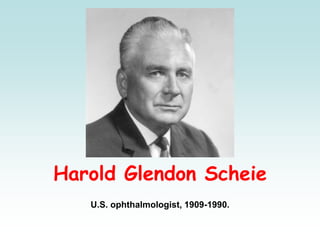
Harold Glendon Scheie
U.S. ophthalmologist, 1909-1990.
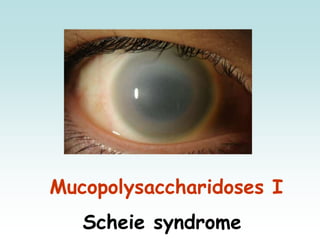
Mucopolysaccharidoses I
Scheie syndrome
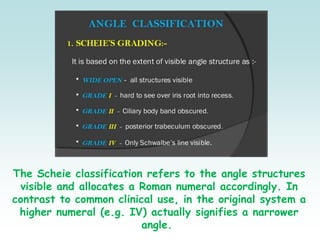
The Scheie classification refers to the angle structures
visible and allocates a Roman numeral accordingly. In
contrast to common clinical use, in the original system a
higher numeral (e.g. IV) actually signifies a narrower
angle.
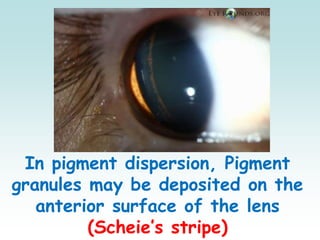
In pigment dispersion, Pigment
granules may be deposited on the
anterior surface of the lens
(Scheie’s stripe)
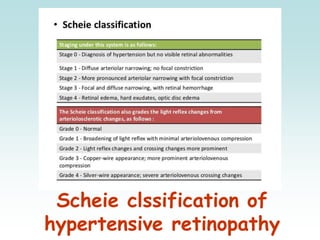
Scheie clssification of
hypertensive retinopathy
Scheie method of cataract
extraction
Schwalbe
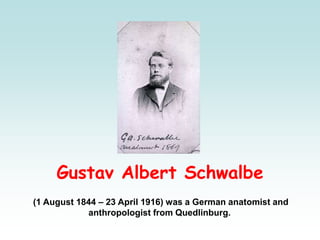
Gustav Albert Schwalbe
(1 August 1844 – 23 April 1916) was a German anatomist and
anthropologist from Quedlinburg.
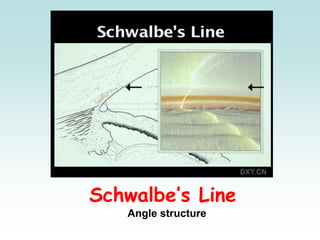
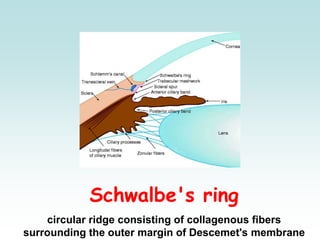
Schwalbe’s Line
Angle structure
Schwalbe's ring
circular ridge consisting of collagenous fibers
surrounding the outer margin of Descemet's membrane
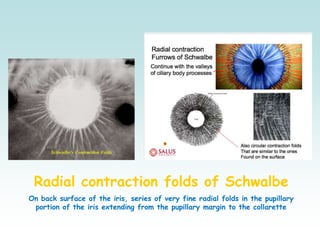
Radial contraction folds of Schwalbe
On back surface of the iris, series of very fine radial folds in the pupillary
portion of the iris extending from the pupillary margin to the collarette
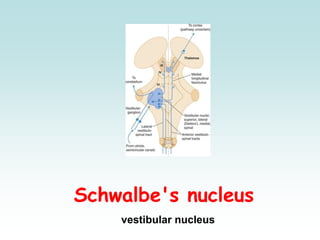
Schwalbe's nucleus
vestibular nucleus
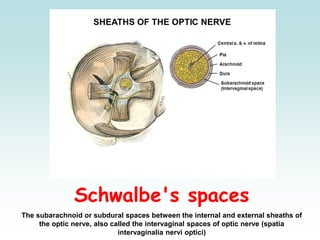
Schwalbe's spaces
The subarachnoid or subdural spaces between the internal and external sheaths of
the optic nerve, also called the intervaginal spaces of optic nerve (spatia
intervaginalia nervi optici)
Shaffer
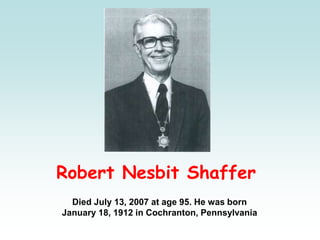
Robert Nesbit Shaffer
Died July 13, 2007 at age 95. He was born
January 18, 1912 in Cochranton, Pennsylvania
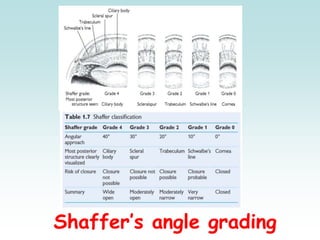
Shaffer’s angle grading
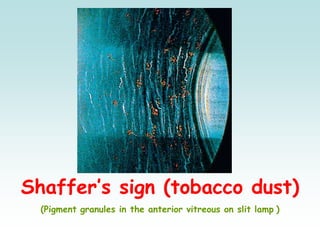
Shaffer’s sign (tobacco dust)
(Pigment granules in the anterior vitreous on slit lamp )
Posner
Adolph Posner
Posner, Adolph was born on March 19, 1906 in Poland. Came to United
States, 1920 . Died March 12, 2002
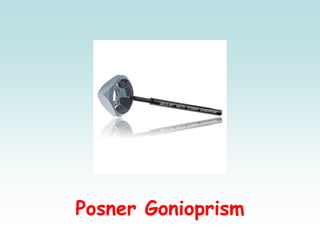
Posner Gonioprism
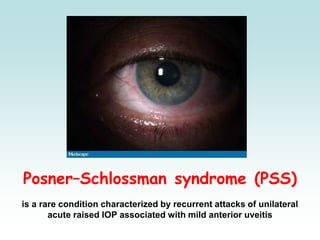
Posner–Schlossman syndrome (PSS)
is a rare condition characterized by recurrent attacks of unilateral
acute raised IOP associated with mild anterior uveitis
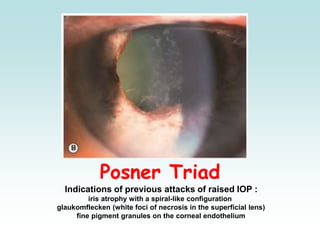
Posner Triad
Indications of previous attacks of raised IOP :
iris atrophy with a spiral-like configuration
glaukomflecken (white foci of necrosis in the superficial lens)
fine pigment granules on the corneal endothelium
Brown
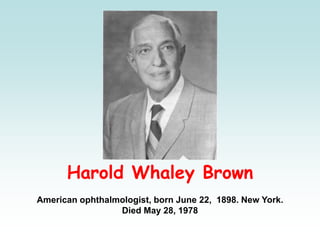
Harold Whaley Brown
American ophthalmologist, born June 22, 1898. New York.
Died May 28, 1978
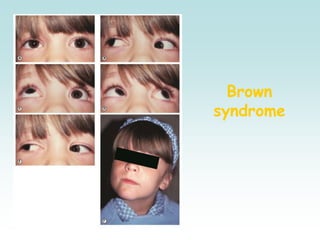
Brown
syndrome
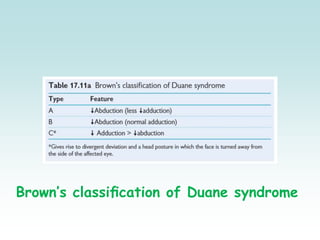
Brown’s classification of Duane syndrome
Kestenbaum
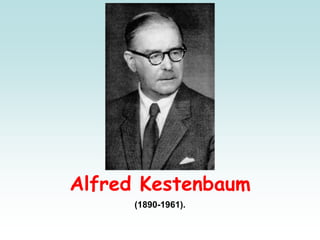
Alfred Kestenbaum
(1890-1961).
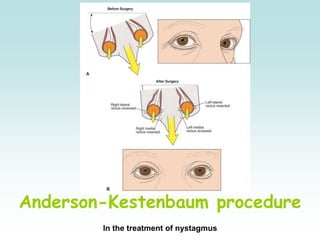
Anderson-Kestenbaum procedure
In the treatment of nystagmus
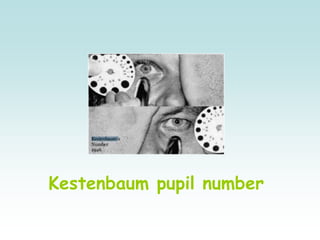
Kestenbaum pupil number
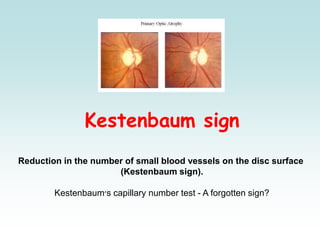
Kestenbaum sign
Reduction in the number of small blood vessels on the disc surface
(Kestenbaum sign).
Kestenbaum‫׳‬s capillary number test - A forgotten sign?
Arden
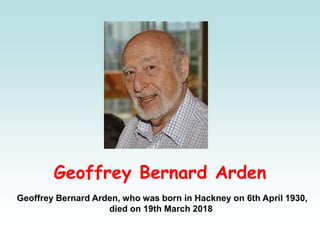
Geoffrey Bernard Arden
Geoffrey Bernard Arden, who was born in Hackney on 6th April 1930,
died on 19th March 2018
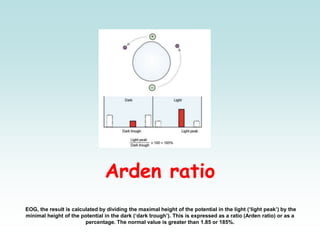
Arden ratio
EOG, the result is calculated by dividing the maximal height of the potential in the light (‘light peak’) by the
minimal height of the potential in the dark (‘dark trough’). This is expressed as a ratio (Arden ratio) or as a
percentage. The normal value is greater than 1.85 or 185%.
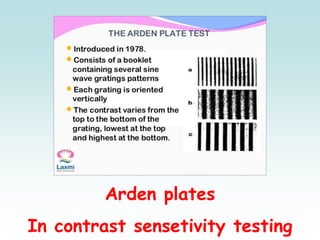
Arden plates
In contrast sensetivity testing
Hughes
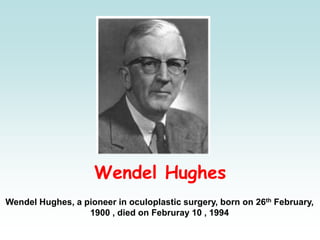
Wendel Hughes
Wendel Hughes, a pioneer in oculoplastic surgery, born on 26th February,
1900 , died on Februray 10 , 1994
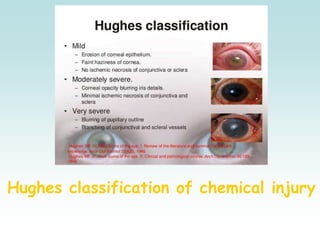
Hughes classification of chemical injury
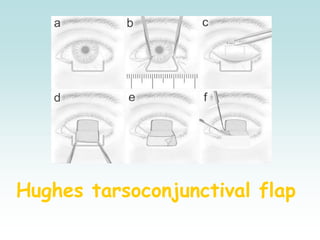
Hughes tarsoconjunctival flap
Bowman
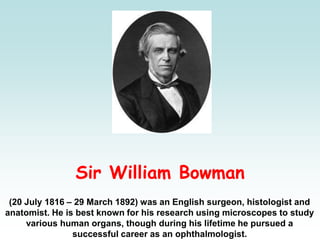
Sir William Bowman
(20 July 1816 – 29 March 1892) was an English surgeon, histologist and
anatomist. He is best known for his research using microscopes to study
various human organs, though during his lifetime he pursued a
successful career as an ophthalmologist.
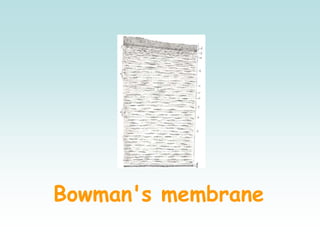
Bowman's membrane
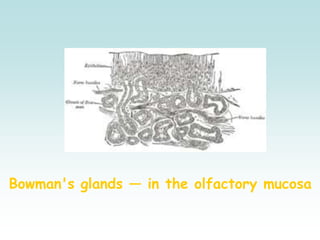
Bowman's glands — in the olfactory mucosa
Bruch
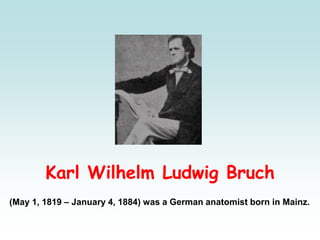
Karl Wilhelm Ludwig Bruch
(May 1, 1819 – January 4, 1884) was a German anatomist born in Mainz.
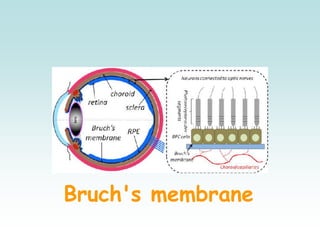
Bruch's membrane
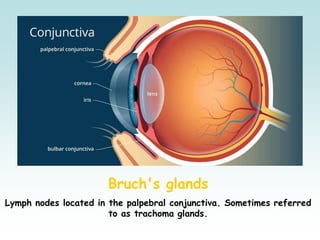
Bruch's glands
Lymph nodes located in the palpebral conjunctiva. Sometimes referred
to as trachoma glands.
Javal
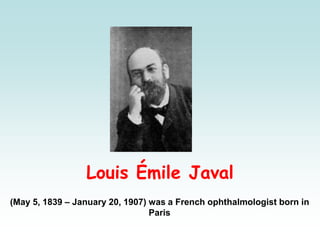
Louis Émile Javal
(May 5, 1839 – January 20, 1907) was a French ophthalmologist born in
Paris
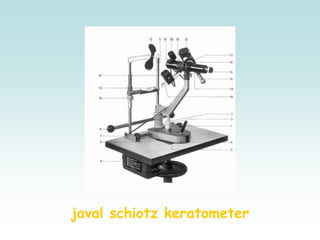
javal schiotz keratometer
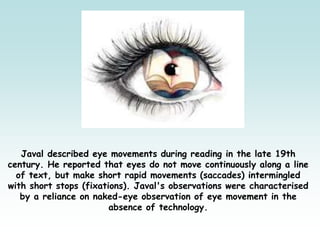
Javal described eye movements during reading in the late 19th
century. He reported that eyes do not move continuously along a line
of text, but make short rapid movements (saccades) intermingled
with short stops (fixations). Javal's observations were characterised
by a reliance on naked-eye observation of eye movement in the
absence of technology.
Javal's interest in strabismus was due to the disorder
affecting his father and sister. Javal himself had
heterochromia. At middle-age Javal developed glaucoma,
and by 1900 was totally blind after suffering repeated
attacks of acute angle-closure. Javal died of stomach
cancer and donated his left eye to histopathological
research in England where, however, it got lost without a
report being published.
Thank You

Ophthalmology Eponyms IV !