DIPLOPIA:
CLINICAL APPROACH AND
MANAGEMENT
BY
Dr. YUGANDHAR. TUMMALA
1ST YEAR PG
DEFINITION OF DIPLOPIA
O The term diplopia is derived from Greek
O Diplous  Double
O Ops  Eye
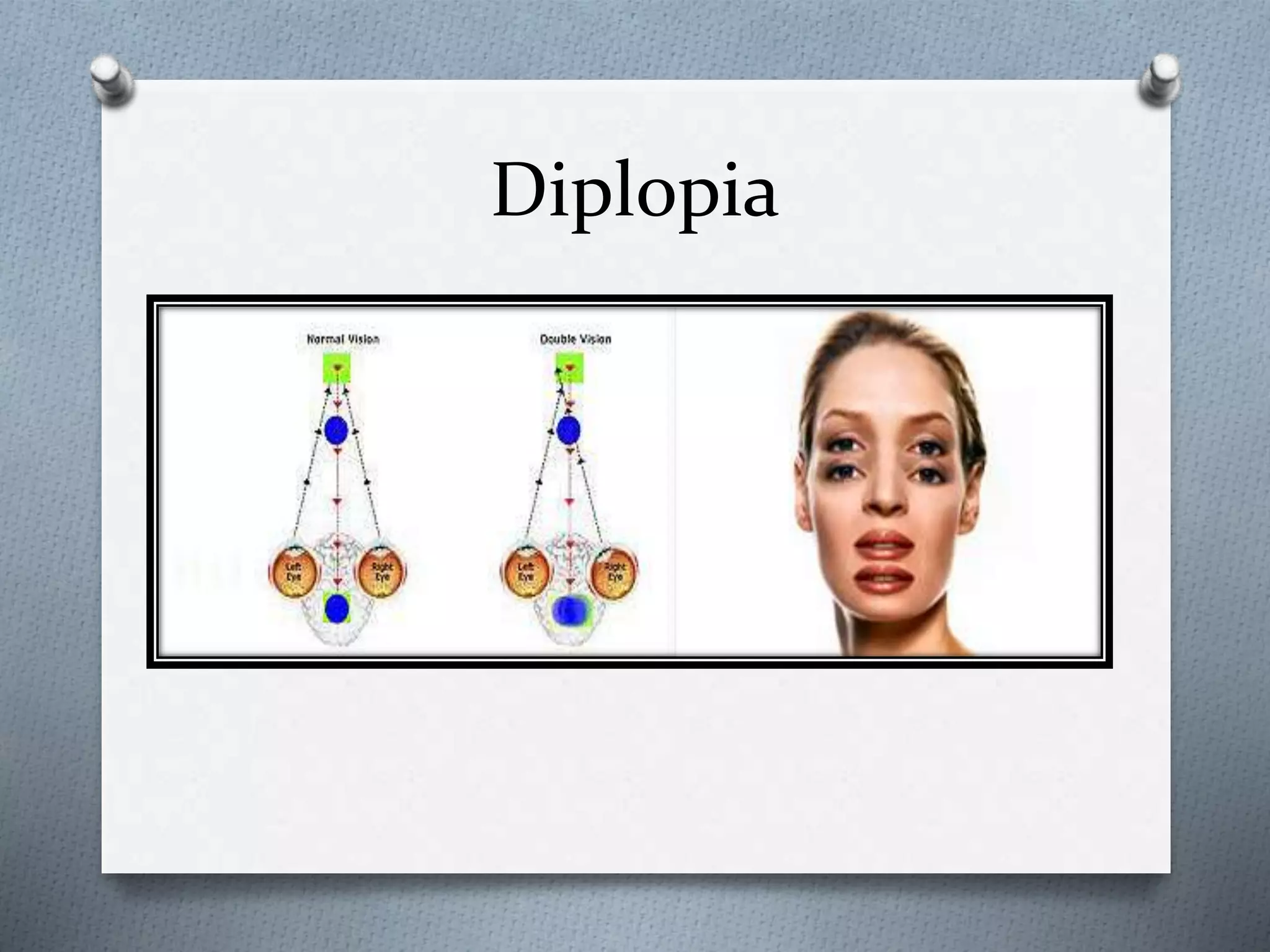
O The eyes are normally positioned so that the
image falls exactly on the same spot on the
retina of each eye
O Slightest displacement of either eye causes
DIPLOPIA as the image is shifted to a
different position on the retina of the displaced
eye.
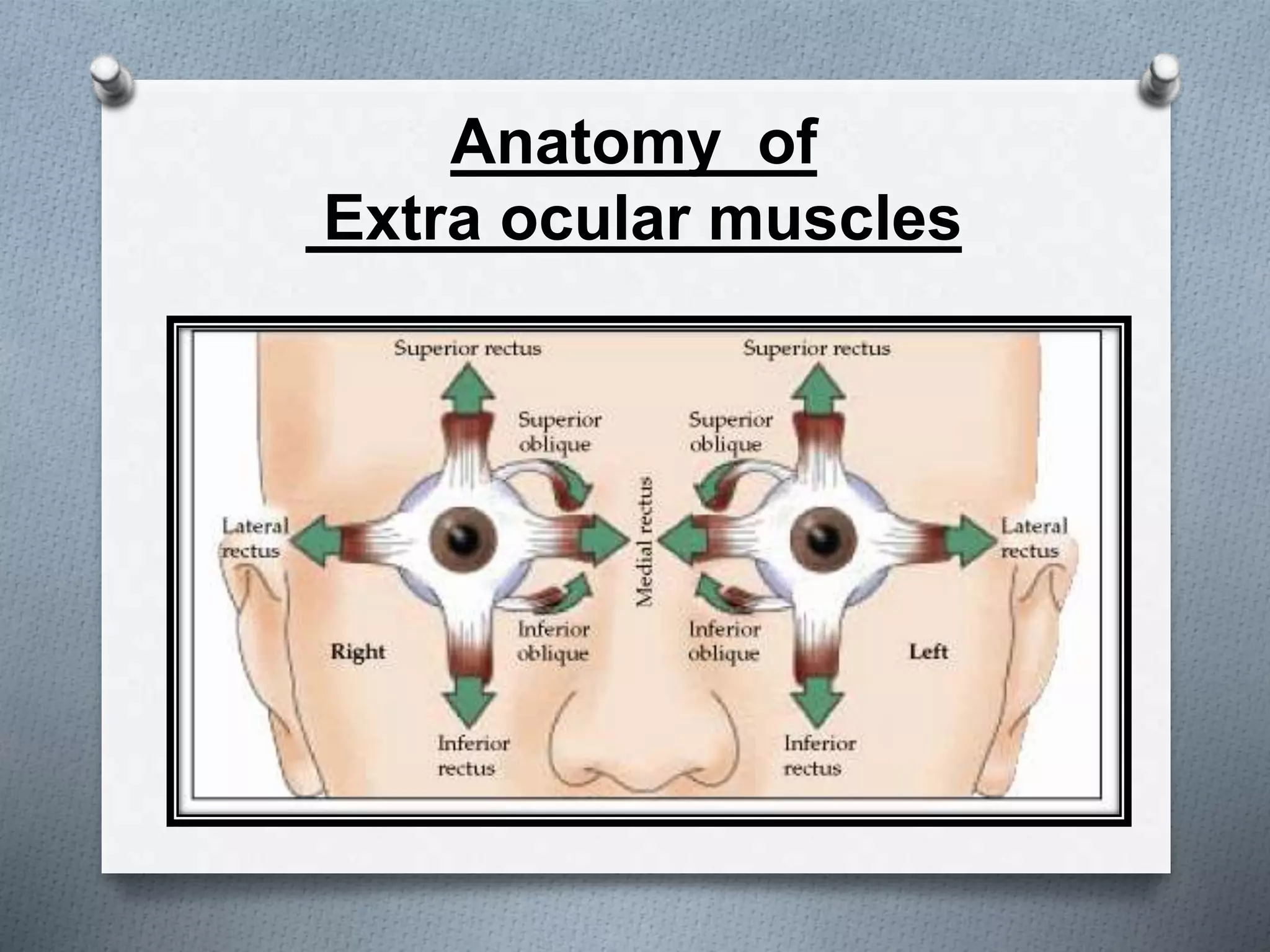
Anatomy of
Extra ocular muscles
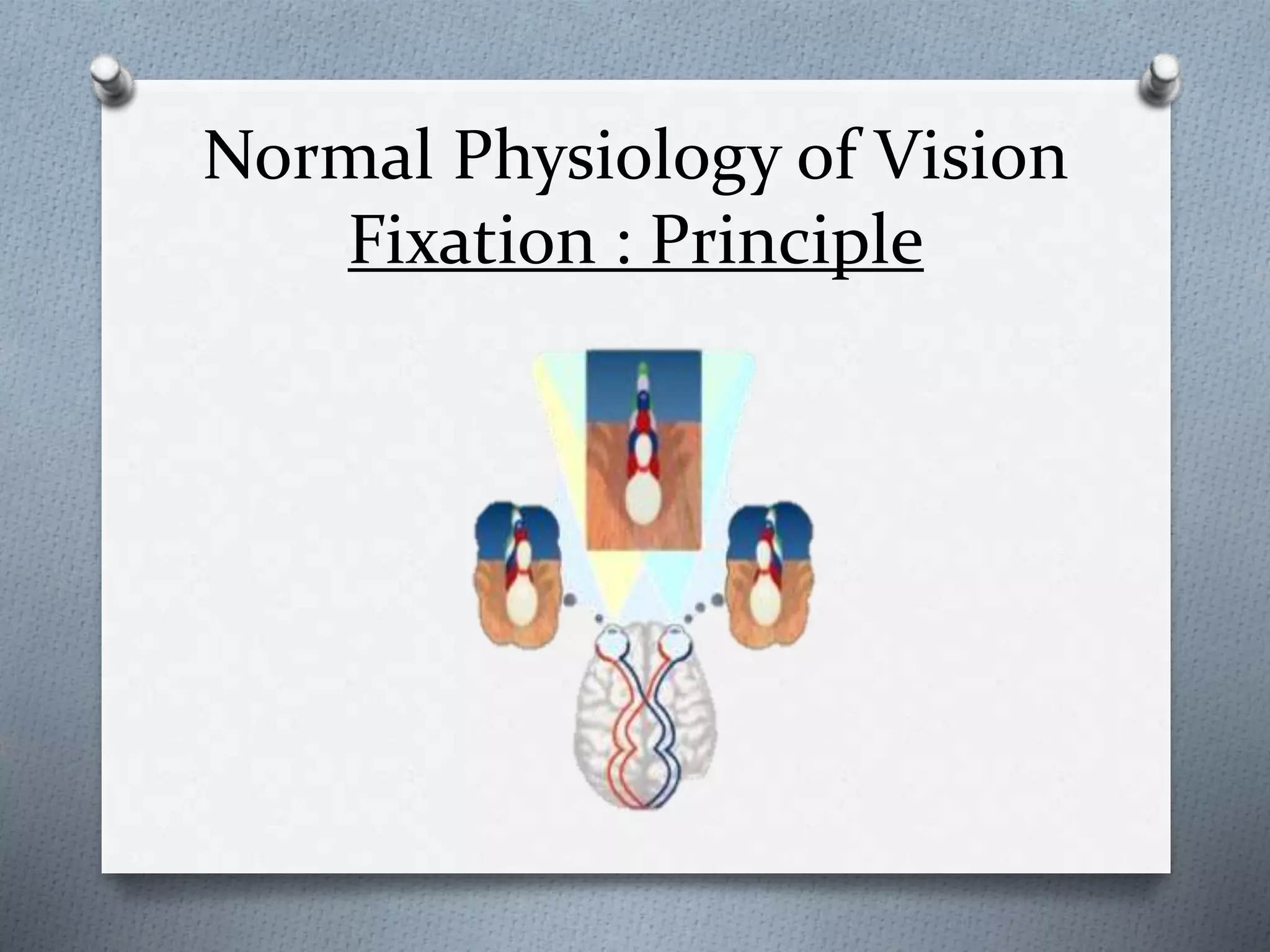
Normal Physiology of Vision
Fixation : Principle
Diplopia
Evaluation of Diplopia
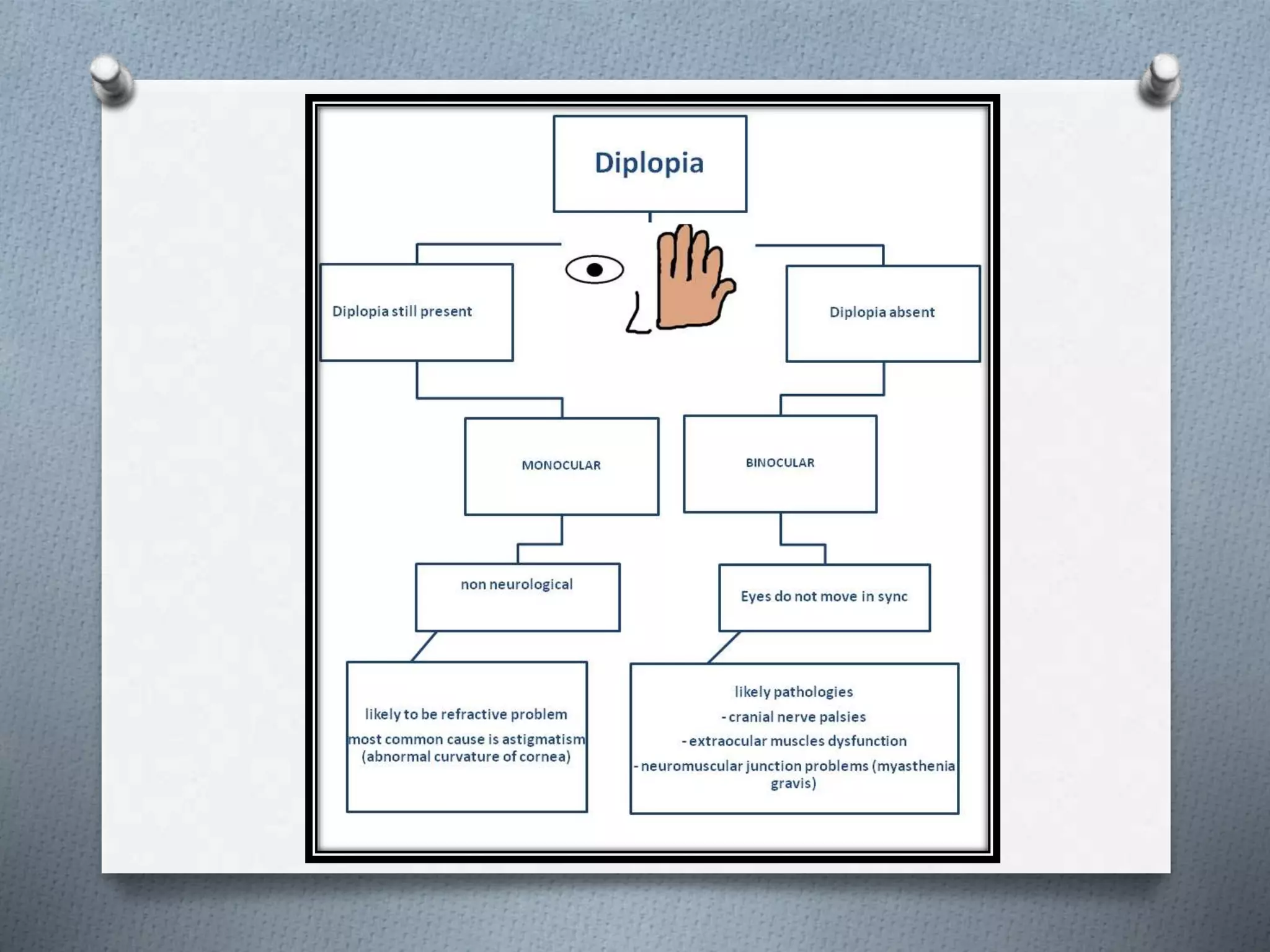
O Determine the nature either
O Monocular or Binocular
O Monocular is often an ocular problem
O Binocular : occur when the images produced
by the two eyes do not absolutely match.
O So that images produced are relatively
misaligned
O Mainly a neurological problem.
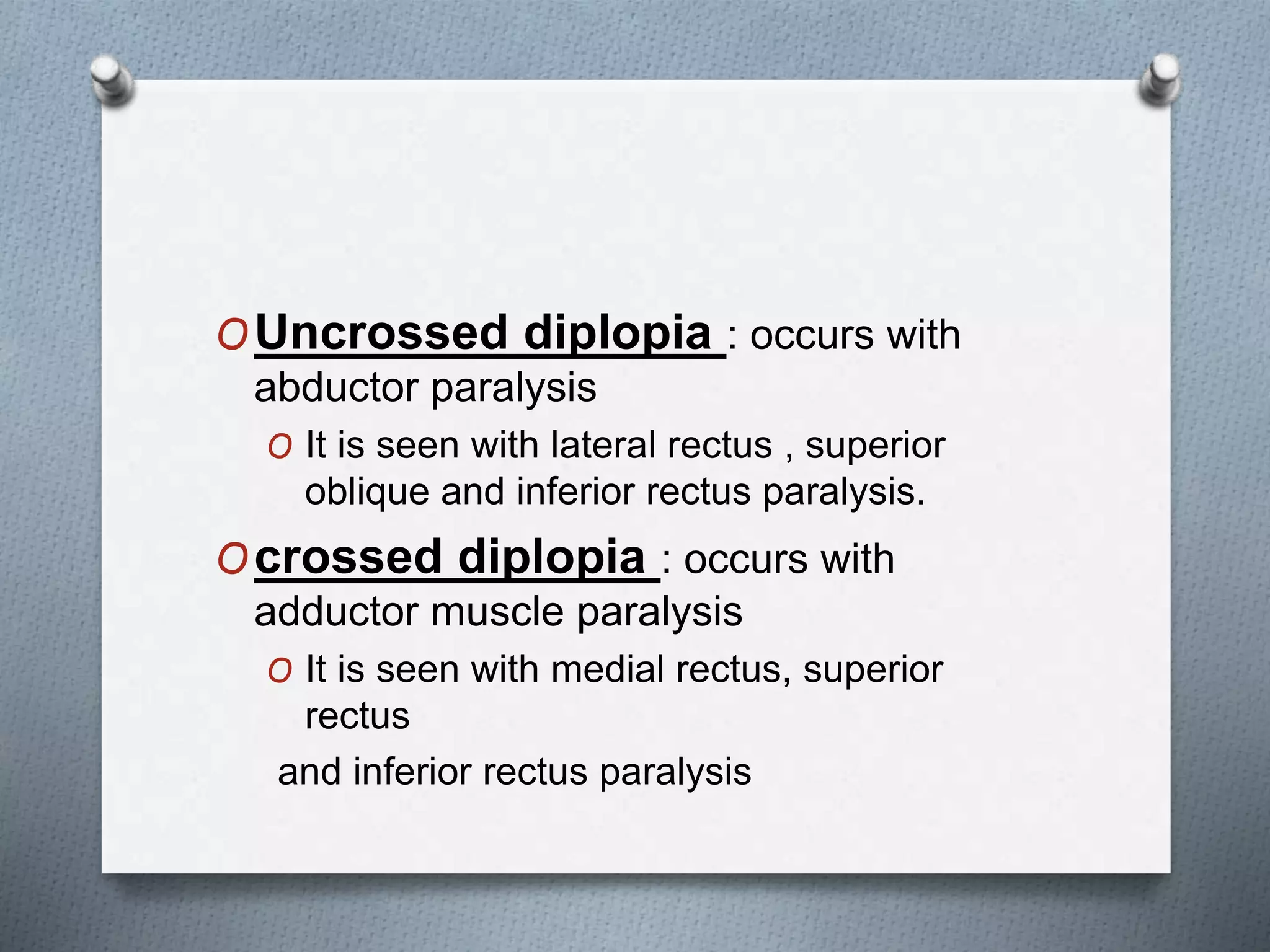
OUncrossed diplopia : occurs with
abductor paralysis
O It is seen with lateral rectus , superior
oblique and inferior rectus paralysis.
Ocrossed diplopia : occurs with
adductor muscle paralysis
O It is seen with medial rectus, superior
rectus
and inferior rectus paralysis
Common causes of monocular
diplopia
O Dry eyes
O Ectopia lentis
O Corneal opacities
O Lens opacity or irregularity
O Macular or
O Retinal disorder
Binocular diplopia
O Due to weakness of extra ocular muscles
of eye
O Defective movement of affected eye
results in image of object falling on two
different points on the retina of two eyes.
O History: Sivani, a 26-year-old gymnastics instructor, presents
with complaints of muscle weakness in her face that comes and
goes, but has been getting worse over the past two months.
Most notably, she complains that her "jaw gets tired" as she
chews and that swallowing has become difficult. She also notes
diplopia ("double vision") which seems to come on late in the
evening, particularly after reading for a few minutes.
O On physical examination, she has notable ptosis ("drooping") of
both eyelids after repeated blinking exercises. When smiling,
she appears to be snarling.
O Electromyographic testing revealed progressive weakness and
decreased amplitude of contraction of the distal arm muscles
upon repeated mild shocks (5 shocks per second) of the ulnar
and median nerves. Both her symptoms and electromyographic
findings were reversed within 40 seconds of intravenous
administration of edrophonium (Tensilon),
O Blood testing revealed high levels of an anti-acetylcholine
receptor antibody in her plasma,
Myasthenia gravis
O Major cause of diplopia
O Diplopia is often intermittent,variable , not
confined to single ocular motor nerve
distribution.
O Fluctuating ptosis may be present.
O Diagnois :
O IV edrophonium inj. reversal of eyelid or eye
muscle weakness.
O Antibodies against ACH receptor or MuSK
protein.
Analysis of diplopia
O Rules governing the relationship of two
images
O RULE 1.displacement of the false image
may be horizontal or vertical or both
O RULE 2 : separation of the 2 images is
greatest in the direction in which the weak
muscle has its purest action
O RULE 3: False image is displaced furthest
in the direction in which the weak muscle
should move the eye
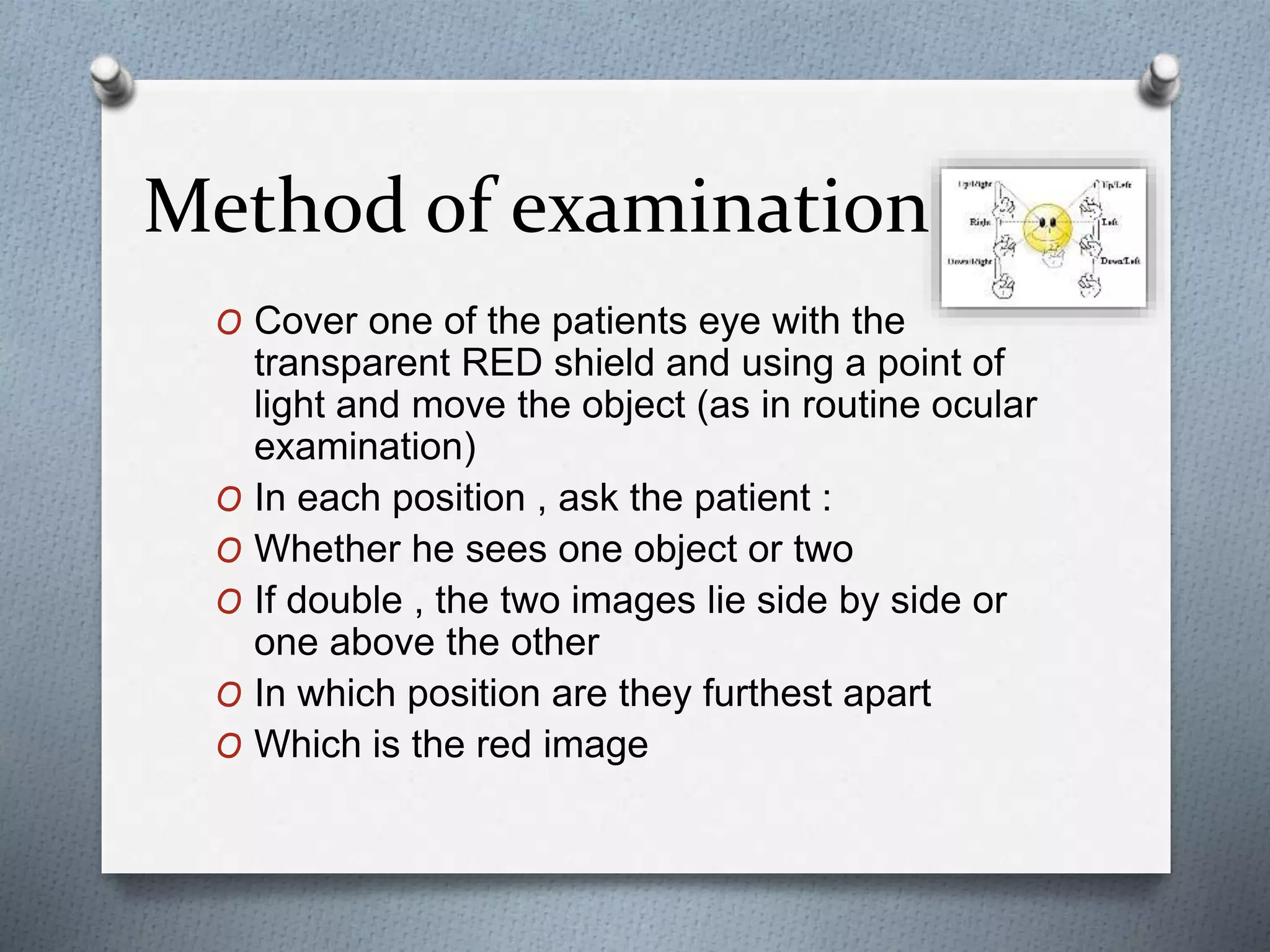
Method of examination
O Cover one of the patients eye with the
transparent RED shield and using a point of
light and move the object (as in routine ocular
examination)
O In each position , ask the patient :
O Whether he sees one object or two
O If double , the two images lie side by side or
one above the other
O In which position are they furthest apart
O Which is the red image
Interpretation
O If the images are exactly side by side it
will be only the external or internal recti
that are involved.
O If they are one above the other, either of
the obliques, or the superior and inferior
recti, may be defective.
Hirschberg test
(corneal light reflection test )
O To demonstrate the degree of diplopia and
to document .
Diplopia charting
Cover test
O Two types :
O Alternating cover test
O Unilateral cover test ( cover-uncover test )
O Lazy eye will deviate inward and outward.
Maddox Rod test
O Subjective test
O To detect small ocular deviations
O If normal alignment : redline will pass directly
through white light.
O If ocular misalignment : redline will
Assesment of patient with
diplopia
O History :
O Define symptoms
O Effect of covering either eye
O Horizontal /vertical seperation of images
O Monocular/binocular
O Effect of distance or target ( worse at near or far
)
O Effect of gaze direction
O Tilting of one image
Observation
O Head tilt or turn
O when the weak extraocular muscle is unable to
move the eye , the head moves the eye.
O There fore head tilts or turns or both in the
direction of action of weak muscle
O Ptosis(fatigue)
O Pupil size
O Proptosis
O Spontaneous eye movements
Examination
O Visual acuity ( each eye seperately )
O Versions ( pursuits, saccades & muscle overaction
O Convergence
O Ductions
O Ocular alignment ( muscle balance)
O Pupils
O Lids
O Vestibulo ocular reflex ( Dolls eye reflex)
O Bells phenomenon
O Prism measurements
O Optokinetic nystagmus
General approach
O 1.Was the onset acute or gradual :
O Worsening suggests infiltration of the nerves
O 2.Is there any variability or remission
O If symptoms vary from time to time : latent
strabismus or Myasthenia gravis
O 3. Is there any associated ptosis
O In acute 3rd nerve palsy there is complete ptosis
O Lesser/variable degree of ptosis Myasthenia
gravis/progressive ocular myopathy
O 4.Any pain
O Berry aneurysm3rd nerve palsy
O Aneurysmal dilatation of the intra cavernous part of
the carotid artery 3rd or 6th nerve palsy
O When there is associated incomplete loss of eye
movements and severe congestion of eye Tolosa
Hunt Syndrome (or)Pseudo tumor of orbit
O Migraine headache may be complicated by a
transient extra ocular nerve palsy.
O Herpes zoster ophthalmicus with an extra ocular
nerve palsy.
O 5 Any exophthalmos or proptosis
O Aneurysm in cavernous sinus
O Thrombosis of cavernous sinus with
vascular congestion
O Tumor in orbit.
Causes of III, IV and VI nerve palsies
Site Common causes
• Brain stem • Stroke
• Demyelination
• Intraxial neoplasm
• Meningeal • Meningitis
• Raised ICT
• Aneurysms
• Cerebellopontine angle
tumor
• Trauma
Cavernous sinus Infection
Thrombosis
Aneurysm
Cortico cavernous fistula
Superior orbital fissure Granuloma
Tumor
Orbit Ischemic
Infection
Tumor
Trauma
3rd nerve palsy
O Complete 3rd nerve lesion causes total paralysis of
the eye lid, so diplopia occurs only when the lid is
held up.
O When the lid is lifted the eye will be found deviated
outwards and downwards.
O Pupil may be dilated sluggish reactive or normal in
size.
O Compressive or non compressive 3rd nerve palsy
differentiation is made based on the involvement or
sparing of pupil.
O In elderly patients with DM/HTN sudden onset
painful 3rd nerve palsy with spared pupil non
compressive or microvascular etiology.;
Trochlear nerve palsy
O Principal action of the muscle is depress and
intort globe– palsy of it causes hypertropia
and excyclotorsion.
O Head Tilt test : Vertical diplopia is seen upon
reading or looking down– exacerbated by
tilting the head towards the side with muscle
palsy and alleviated by tilting away.
( Cardinal diagnostic feature)
O A base down prism (Fresnel lens ) may serve
as a temporary measure to alleviate diplopia
Abducens nerve palsy
O Abducens nuclear lesion produces a complete lateral
gaze palsy from weakness of both ipsilateral lateral
rectus and contralateral medial rectus
O Most common causes
O Infarct
O Tumor
O Hemorrhage
O Vascular malformation
O Multiple sclerosis
O UL/BL abducens palsy is a classic sign of raised
intracranial pressure
O Diagnosis is confirmed by papilladema (Fundus )
Differential Double vision
Inter nuclear ophthalmoplegia
O Results from the damage to the medial
longitudanal fasiculus ascending from the
abducens nucleus in the pons to the
oculomotor nucleus in the midbrain ( hence
“Inter”nuclear Opthalmoplegia.
O Damage to it results in a failure of adduction
of on attempted lateral gaze.
O Causes :
O Multiple sclerosis (most common )
O Tumor
O Stroke
O Trauma
Treatment
O Patching ( occlusive ) therapy
O Identify and treat the underlying cause of the
problem.
O Other options include eye exercises,
O wearing an eye patch on alternative eyes,
O prism correction
O In more extreme situations, surgery
or botulinum toxin
References
 Bickerstaff Neurology
 John Patten Neurological Differential
Diagnosis
 Harrison 19th edition
 API updates 2016
 Anatomy and Physiology of eye : AK
Khurana
Diplopia by yugandhar tummala

Diplopia by yugandhar tummala

  • 1.
  • 2.
    DEFINITION OF DIPLOPIA OThe term diplopia is derived from Greek O Diplous  Double O Ops  Eye O The eyes are normally positioned so that the image falls exactly on the same spot on the retina of each eye O Slightest displacement of either eye causes DIPLOPIA as the image is shifted to a different position on the retina of the displaced eye.
  • 3.
  • 4.
    Normal Physiology ofVision Fixation : Principle
  • 5.
  • 6.
    Evaluation of Diplopia ODetermine the nature either O Monocular or Binocular O Monocular is often an ocular problem O Binocular : occur when the images produced by the two eyes do not absolutely match. O So that images produced are relatively misaligned O Mainly a neurological problem.
  • 7.
    OUncrossed diplopia :occurs with abductor paralysis O It is seen with lateral rectus , superior oblique and inferior rectus paralysis. Ocrossed diplopia : occurs with adductor muscle paralysis O It is seen with medial rectus, superior rectus and inferior rectus paralysis
  • 9.
    Common causes ofmonocular diplopia O Dry eyes O Ectopia lentis O Corneal opacities O Lens opacity or irregularity O Macular or O Retinal disorder
  • 10.
    Binocular diplopia O Dueto weakness of extra ocular muscles of eye O Defective movement of affected eye results in image of object falling on two different points on the retina of two eyes.
  • 11.
    O History: Sivani,a 26-year-old gymnastics instructor, presents with complaints of muscle weakness in her face that comes and goes, but has been getting worse over the past two months. Most notably, she complains that her "jaw gets tired" as she chews and that swallowing has become difficult. She also notes diplopia ("double vision") which seems to come on late in the evening, particularly after reading for a few minutes. O On physical examination, she has notable ptosis ("drooping") of both eyelids after repeated blinking exercises. When smiling, she appears to be snarling. O Electromyographic testing revealed progressive weakness and decreased amplitude of contraction of the distal arm muscles upon repeated mild shocks (5 shocks per second) of the ulnar and median nerves. Both her symptoms and electromyographic findings were reversed within 40 seconds of intravenous administration of edrophonium (Tensilon), O Blood testing revealed high levels of an anti-acetylcholine receptor antibody in her plasma,
  • 12.
    Myasthenia gravis O Majorcause of diplopia O Diplopia is often intermittent,variable , not confined to single ocular motor nerve distribution. O Fluctuating ptosis may be present. O Diagnois : O IV edrophonium inj. reversal of eyelid or eye muscle weakness. O Antibodies against ACH receptor or MuSK protein.
  • 13.
    Analysis of diplopia ORules governing the relationship of two images O RULE 1.displacement of the false image may be horizontal or vertical or both O RULE 2 : separation of the 2 images is greatest in the direction in which the weak muscle has its purest action O RULE 3: False image is displaced furthest in the direction in which the weak muscle should move the eye
  • 14.
    Method of examination OCover one of the patients eye with the transparent RED shield and using a point of light and move the object (as in routine ocular examination) O In each position , ask the patient : O Whether he sees one object or two O If double , the two images lie side by side or one above the other O In which position are they furthest apart O Which is the red image
  • 15.
    Interpretation O If theimages are exactly side by side it will be only the external or internal recti that are involved. O If they are one above the other, either of the obliques, or the superior and inferior recti, may be defective.
  • 16.
    Hirschberg test (corneal lightreflection test ) O To demonstrate the degree of diplopia and to document .
  • 17.
  • 18.
    Cover test O Twotypes : O Alternating cover test O Unilateral cover test ( cover-uncover test ) O Lazy eye will deviate inward and outward.
  • 19.
    Maddox Rod test OSubjective test O To detect small ocular deviations O If normal alignment : redline will pass directly through white light. O If ocular misalignment : redline will
  • 20.
    Assesment of patientwith diplopia O History : O Define symptoms O Effect of covering either eye O Horizontal /vertical seperation of images O Monocular/binocular O Effect of distance or target ( worse at near or far ) O Effect of gaze direction O Tilting of one image
  • 21.
    Observation O Head tiltor turn O when the weak extraocular muscle is unable to move the eye , the head moves the eye. O There fore head tilts or turns or both in the direction of action of weak muscle O Ptosis(fatigue) O Pupil size O Proptosis O Spontaneous eye movements
  • 22.
    Examination O Visual acuity( each eye seperately ) O Versions ( pursuits, saccades & muscle overaction O Convergence O Ductions O Ocular alignment ( muscle balance) O Pupils O Lids O Vestibulo ocular reflex ( Dolls eye reflex) O Bells phenomenon O Prism measurements O Optokinetic nystagmus
  • 23.
    General approach O 1.Wasthe onset acute or gradual : O Worsening suggests infiltration of the nerves O 2.Is there any variability or remission O If symptoms vary from time to time : latent strabismus or Myasthenia gravis O 3. Is there any associated ptosis O In acute 3rd nerve palsy there is complete ptosis O Lesser/variable degree of ptosis Myasthenia gravis/progressive ocular myopathy
  • 24.
    O 4.Any pain OBerry aneurysm3rd nerve palsy O Aneurysmal dilatation of the intra cavernous part of the carotid artery 3rd or 6th nerve palsy O When there is associated incomplete loss of eye movements and severe congestion of eye Tolosa Hunt Syndrome (or)Pseudo tumor of orbit O Migraine headache may be complicated by a transient extra ocular nerve palsy. O Herpes zoster ophthalmicus with an extra ocular nerve palsy.
  • 25.
    O 5 Anyexophthalmos or proptosis O Aneurysm in cavernous sinus O Thrombosis of cavernous sinus with vascular congestion O Tumor in orbit.
  • 26.
    Causes of III,IV and VI nerve palsies Site Common causes • Brain stem • Stroke • Demyelination • Intraxial neoplasm • Meningeal • Meningitis • Raised ICT • Aneurysms • Cerebellopontine angle tumor • Trauma
  • 27.
    Cavernous sinus Infection Thrombosis Aneurysm Corticocavernous fistula Superior orbital fissure Granuloma Tumor Orbit Ischemic Infection Tumor Trauma
  • 28.
    3rd nerve palsy OComplete 3rd nerve lesion causes total paralysis of the eye lid, so diplopia occurs only when the lid is held up. O When the lid is lifted the eye will be found deviated outwards and downwards. O Pupil may be dilated sluggish reactive or normal in size. O Compressive or non compressive 3rd nerve palsy differentiation is made based on the involvement or sparing of pupil. O In elderly patients with DM/HTN sudden onset painful 3rd nerve palsy with spared pupil non compressive or microvascular etiology.;
  • 29.
    Trochlear nerve palsy OPrincipal action of the muscle is depress and intort globe– palsy of it causes hypertropia and excyclotorsion. O Head Tilt test : Vertical diplopia is seen upon reading or looking down– exacerbated by tilting the head towards the side with muscle palsy and alleviated by tilting away. ( Cardinal diagnostic feature) O A base down prism (Fresnel lens ) may serve as a temporary measure to alleviate diplopia
  • 30.
    Abducens nerve palsy OAbducens nuclear lesion produces a complete lateral gaze palsy from weakness of both ipsilateral lateral rectus and contralateral medial rectus O Most common causes O Infarct O Tumor O Hemorrhage O Vascular malformation O Multiple sclerosis O UL/BL abducens palsy is a classic sign of raised intracranial pressure O Diagnosis is confirmed by papilladema (Fundus )
  • 32.
  • 33.
    Inter nuclear ophthalmoplegia OResults from the damage to the medial longitudanal fasiculus ascending from the abducens nucleus in the pons to the oculomotor nucleus in the midbrain ( hence “Inter”nuclear Opthalmoplegia. O Damage to it results in a failure of adduction of on attempted lateral gaze. O Causes : O Multiple sclerosis (most common ) O Tumor O Stroke O Trauma
  • 34.
    Treatment O Patching (occlusive ) therapy O Identify and treat the underlying cause of the problem. O Other options include eye exercises, O wearing an eye patch on alternative eyes, O prism correction O In more extreme situations, surgery or botulinum toxin
  • 35.
    References  Bickerstaff Neurology John Patten Neurological Differential Diagnosis  Harrison 19th edition  API updates 2016  Anatomy and Physiology of eye : AK Khurana