


OphthalmologyOphthalmology
Eponyms!Eponyms!
By
Dr.Ahmed Alsherbiny
MSc. Ophth
For The Great
Ophthalmologists Whom
Paved The Way For Us , I
Dedicate This
Presentation :)
Vogt
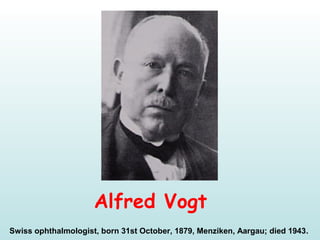
Alfred Vogt
Swiss ophthalmologist, born 31st October, 1879, Menziken, Aargau; died 1943.
limbal girdle of Vogt
Corneal opacity that occurs in an arc concentric pattern and is
adjacent to the limbus within the palpebral fissure at 3 and 9 o'clock.
it is more common nasally than temporally, but it is frequently both.
It is found in 60% of patients older than 40 years and occurs more
frequently in women than in men
Vogt's striae
Vertical stress lines seen deep in the affected
stroma of keratoconus
Vogt's anterior mosaic crocodile
shagreen
bilateral, polygonal, grayish-white opacities in the deep layers of the
epithelium and in Bowman's layer
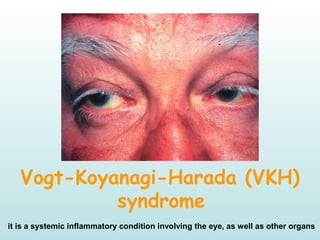
Vogt-Koyanagi-Harada (VKH)
syndrome
it is a systemic inflammatory condition involving the eye, as well as other organs
White lines of Vogt
Sheathed or sclerosed vessels seen in Lattice
degeneration
Palisades of Vogt
The stem cells of the corneal epithelium are situated at the limbus,
nestled within the undulating folds of the Palisades of Vogt
Fuchs
Ernst Fuchs
Austrian ophthalmologist, born 14th June, 1851, Vienna; died November
21, 1930, Vienna.
Fuchs' corneal dystrophy
seen more commonly in women, with clouding of the cornea
Fuchs' heterochromic cyclitis
An idiopathic disorder of the eye, with heterochromia, uveitis of the
lighter coloured eye, iridocyclitis, keratitic precipitates and often
cataract
Fuchs' spot
A small black spot on the fundus in high myopia, occurring after macular
haemorrhage
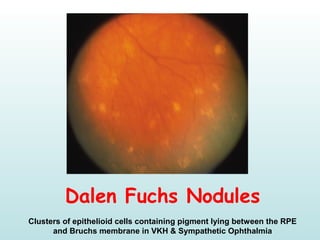
Dalen Fuchs Nodules
Clusters of epithelioid cells containing pigment lying between the RPE
and Bruchs membrane in VKH & Sympathetic Ophthalmia
Bell
Sir Charles Bell
Scottish anatomist, surgeon, and physiologist, born November 1774; died 28th
April, 1842, North Hallow, Worcestershire.
Bell's palsy
Peripheral, usually unilateral, idiopathic paralysis of facial nerve.
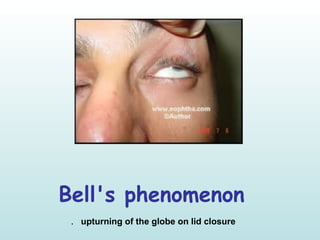
Bell's phenomenon
upturning of the globe on lid closure. 
Weber
Frederick Parkes Weber
English physician, born 8th May, 1863, London; died 1962.
Sturge-Weber syndrome
A congenital disorder involving the brain, skin and eyes
Rendu-Osler-Weber disease
A familial syndrome characterised by multiple telangiectasia of the
skin, and of the oral, nasal, conjunctival and gastrointestinal mucous
membranes.
Henle
Friedrich Gustav Jacob Henle
German anatomist and pathologist, born 19th July, 1809, Fürth, near
Nuremberg, Bavaria; died 13th May, 1885, Göttingen
Henle's fibers
1.Outer plexiform layer makes synapses with dendrites of bipolar
cells In the macular region, this is known as the Fiber layer of Henle
Hassle-Henle bodies
Small hyaline excrescences in the periphery of the Descemet
membrane.
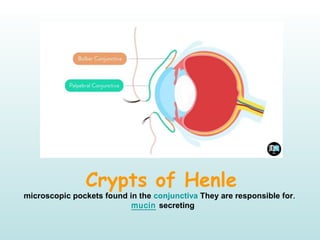
Crypts of Henle
.microscopic pockets found in the conjunctiva They are responsible for
secreting mucin
Elschnig
Anton Elschnig
(August 22, 1863 – 1939) was an ophthalmologist born in Leibnitz, Austria.
Elschnig's pearls
Pearl-like clusters formed by growth of epithelial cells on the
posterior lens capsule
Elschnig's spots
black spots surrounded by bright yellow or red halos in patients
with advanced hypertensive retinopathy
Goldmann
Hans Goldmann
Swiss ophthalmologist born 1899 died 1991
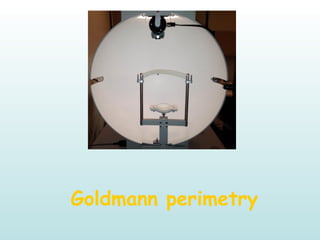
Goldmann perimetry
Goldmann tonometer
Goldmann Goniolens
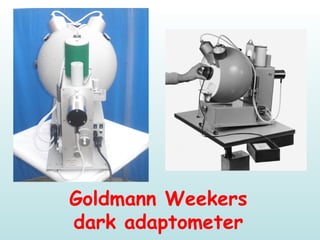
Goldmann Weekers
dark adaptometer
Goldmann-Favre disease
congenital retinoschisis with pigmentation in the fundus, complete
night blindness, or loss of the scotopic b-wave of the ERG.
The disease is transmitted by autosomal recessive inheritance. 
Amsler
Marc Amsler
Swiss ophthalmologist, born 1891, died 1968.
Amsler grid
Chart used to detect or document macular diseases 
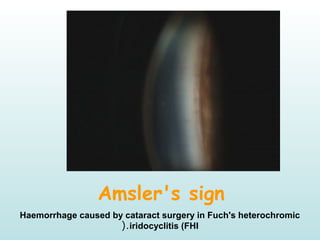
Amsler's sign
Haemorrhage caused by cataract surgery in Fuch's heterochromic
iridocyclitis (FHI(.
Leber
Theodor Leber
German ophthalmologist, born 29th February, 1840, Karlsruhe; died 1917
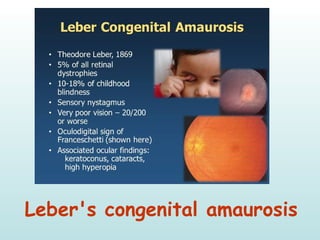
Leber's congenital amaurosis
Leber's optic atrophy
A rare hereditary form of optic atrophy that usually affects young males
Leber's miliary aneurysm
A form of unilateral exudative retinopathy occurring in
children before puberty, it is now considered as a milder
form of Coat's disease.
von Graefe
Friedrich Wilhelm Ernst Albrecht
von Graefe
German ophthalmologist, born 22nd May, 1828, Finkenheerd (Mark
Brandenburg) Berlin; died 20th July, 1870; Berlin
Graefe's sign
Failure of the upper lid to follow a downward movement of the eyeball
when the patient changes his or her vision from looking up to looking
down. 
Graefe's knife
knife designed for cataract extraction. Now of historical interest.
Cogan
David Glendenning Cogan
American ophthalmologist, born 1908, Fall River, Massachusets; died 9th
September, 1993, Bethesda.
Cogan’s Dystrophy
epithelial basement membrane dystrophy
Cogan's sign
Cogan's lid twitch, in patients with myasthenia. When the patient's
eyes are directed downward for 10 to 20 seconds and the patient is
then instructed to make a vertical saccade back to primary position,
the upper eyelid elevates and either slowly begins to droop or else
twitches several times before settling into a stable position
Cogan-Reese disease
characterized by a matted or smudged appearance to the
surface of the iris, unilateral glaucoma in the eyes with multiple
peripheral anterior synechiae, multiple nodules of the iris
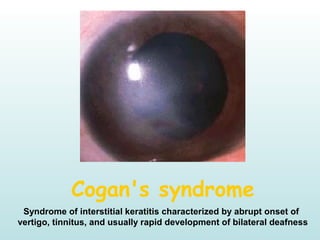
Cogan's syndrome
Syndrome of interstitial keratitis characterized by abrupt onset of
vertigo, tinnitus, and usually rapid development of bilateral deafness
Cogan’s rule
Testing for optokinetic nystagmus. Finding asymmetrical OKN ...the
lesion is more likely to reside in the parietal lobe, and more likely to be
nonvascular, that is a tumor (Cogan's rule(
Marcus Gunn
Robert Marcus Gunn
Scottish ophthalmologist, born 1850, Dunnet – died on 29 November
1909, Hindhead
Marcus Gunn jaw-winking
phenomenon
unilateral eyelid movement with movement of the jaw
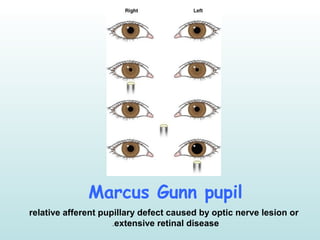
Marcus Gunn pupil
relative afferent pupillary defect caused by optic nerve lesion or
extensive retinal disease.
Gunn's dots
light reflectios from internal limiting membrane around
disc and macula
Gunn’s Sign
AV, or arteriovenous nicking is the phenomenon where a small
artery (arteriole) is seen crossing a small vein (venule), which results
in the compression of the vein with bulging on either side of the
crossing. This is most commonly seen in eye disease caused by
high blood pressure
Thank You

Ophthalmology Eponyms !