Ophthalmic Nerve

1
Ophthalmic Nerve
•
•
•
•

First division of the trigeminal nerve.
Is a sensory nerve.
Smallest of the three divisions of the trigeminal.
Arises - upper part of the semi lunar ganglion as a short,
flattened band, passes forward along the lateral wall of the
cavernous sinus.
• Before entering the orbit through superior orbital fissure, it
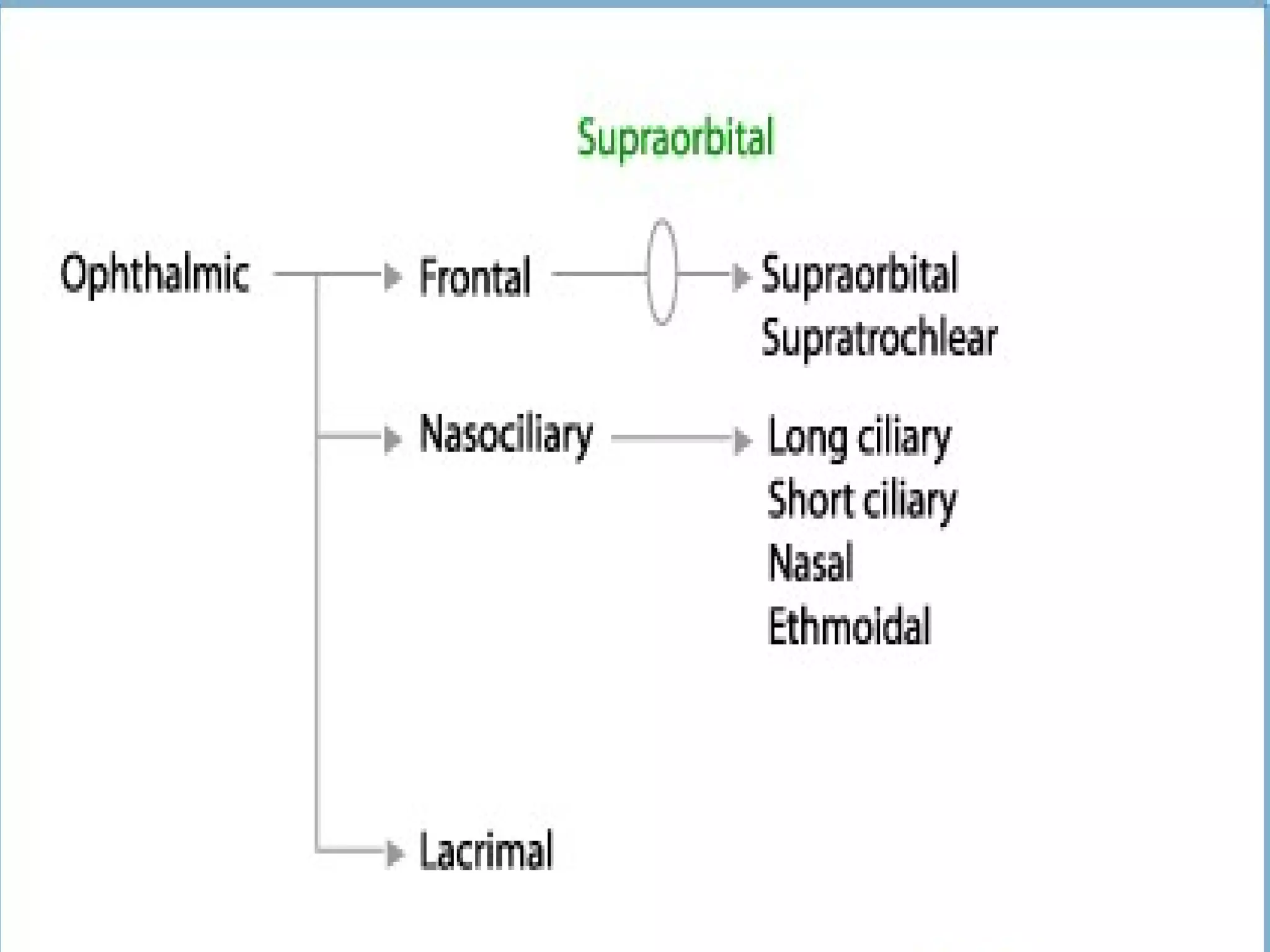
divides into three branches,
Lacrimal,
Frontal and
Nasociliary.
LACRIMAL NERVE:
• Smallest of the three branches.
• Enters orbit through the narrowest part of the superior orbital
fissure.
• In orbit - runs along the upper border of the lateral Rectus
with the lacrimal artery - communicates with the zygomatic
branch of the maxillary nerve.
• Enters the lacrimal gland - gives off several filaments, which
supply the gland and the conjunctiva.
• Finally - pierces the orbital septum - ends in the skin of the
upper eyelid, joining with filaments of the facial nerve.
OPHTHALMIC NERVE BRANCHES

A. Infratrochlear
B. Anterior Ethmoid
C. Posterior Ethmoid
D. Lacrimal
E. Supraorbital
F. Supratrochlear
G. Nasociliary
FRONTAL NERVE:
• Largest branch of ophthalmic.
• Enters the orbit - superior orbital fissure and runs forward between the
Levator palpebræ superioris and the periosteum.
• Midway between the apex and base of the orbit it divides into two
branches
Supratrochlear
Supraorbital
SUPRATROCHLEAR NERVE:
• Smaller of the two .

•

Escapes from the orbit between the superior oblique and the supraorbital
foramen.

•

Supplies - skin of the lower part of the forehead close to the middle
line and
- sends filaments to the
conjunctiva and skin of
the upper eyelid.
SUPRAORBITAL NERVE:
• Passes - supraorbital foramen - gives off palpebral filaments to
the upper eyelid.
• Then ascends upon the forehead and ends in two branches
Medial
Lateral
which supply the integument of the scalp,
reaching nearly as far back as the lambdoidal suture.
• Both branches supply small twigs to the pericranium.
NASOCILIARY NERVE:
• Intermediate in size b/w the frontal and lacrimal and is more
deeply placed.
• Enters - orbit b/w the two heads of the lateral Rectus and
between the superior and inferior rami of the oculomotor
nerve -to medial wall of the orbital cavity.
• Passes through the anterior ethmoidal foramen and enters the
cranium.
• Supplies - Internal nasal branches - to the mucous membrane
of the front part of the septum and lateral wall of the nasal
cavity.
• Finally emerges as - external nasal branch b/w the lower
border of nasal bone and the lateral nasal cartilage - passing
down beneath the Nasalis muscle - supplies the skin of the ala
and apex of the nose.
• Branches of nasociliary
Long root of the ciliary ganglion
Long ciliary
Ethmoidal nerves.
LONG ROOT OF CILIARY GANGLION:
• Supplies ciliary ganglion.
LONG CILIARY NERVE:
• Two or three in number
• Accompany the short ciliary nerves from the ciliary ganglion pierce the posterior part of the sclera and running forward b/w
it and the choroid - distributed to the iris and cornea.
INFRATROCHLEAR NERVE:
• Given off from nasociliary just before it enters the anterior
ethmoidal foramen.
• Runs forward along the upper border of the medial Rectus.
• Then passes to - medial angle of the eye.
• Supplies - skin of the eyelids and side of the nose,
- the conjunctiva,
- lacrimal sac, and
- caruncula lacrimalis.
ETHMOIDAL BRANCH:
• Supply the ethmoidal cells.
• Posterior branch leaves the orbital cavity through the posterior
ethmoidal foramen and gives some filaments to the sphenoidal
sinus.
Functions
• Transmits sensory innervations from
Eye ball,
Skin of upper face,
Anterior scalp,
Lining of upper part of nasal cavity, air cells.
Meninges of anterior cranial fossa.
• Conveys parasympathetic fibers to the ciliary
and iris muscle for accommodation and pupillary
constriction and to the lacrimal gland.

Ophthalmic nerve dental surgery

  • 1.
  • 2.
    Ophthalmic Nerve • • • • First divisionof the trigeminal nerve. Is a sensory nerve. Smallest of the three divisions of the trigeminal. Arises - upper part of the semi lunar ganglion as a short, flattened band, passes forward along the lateral wall of the cavernous sinus. • Before entering the orbit through superior orbital fissure, it divides into three branches, Lacrimal, Frontal and Nasociliary.
  • 6.
    LACRIMAL NERVE: • Smallestof the three branches. • Enters orbit through the narrowest part of the superior orbital fissure. • In orbit - runs along the upper border of the lateral Rectus with the lacrimal artery - communicates with the zygomatic branch of the maxillary nerve. • Enters the lacrimal gland - gives off several filaments, which supply the gland and the conjunctiva. • Finally - pierces the orbital septum - ends in the skin of the upper eyelid, joining with filaments of the facial nerve.
  • 7.
    OPHTHALMIC NERVE BRANCHES A.Infratrochlear B. Anterior Ethmoid C. Posterior Ethmoid D. Lacrimal E. Supraorbital F. Supratrochlear G. Nasociliary
  • 8.
    FRONTAL NERVE: • Largestbranch of ophthalmic. • Enters the orbit - superior orbital fissure and runs forward between the Levator palpebræ superioris and the periosteum. • Midway between the apex and base of the orbit it divides into two branches Supratrochlear Supraorbital
  • 9.
    SUPRATROCHLEAR NERVE: • Smallerof the two . • Escapes from the orbit between the superior oblique and the supraorbital foramen. • Supplies - skin of the lower part of the forehead close to the middle line and - sends filaments to the conjunctiva and skin of the upper eyelid.
  • 10.
    SUPRAORBITAL NERVE: • Passes- supraorbital foramen - gives off palpebral filaments to the upper eyelid. • Then ascends upon the forehead and ends in two branches Medial Lateral which supply the integument of the scalp, reaching nearly as far back as the lambdoidal suture. • Both branches supply small twigs to the pericranium.
  • 11.
    NASOCILIARY NERVE: • Intermediatein size b/w the frontal and lacrimal and is more deeply placed. • Enters - orbit b/w the two heads of the lateral Rectus and between the superior and inferior rami of the oculomotor nerve -to medial wall of the orbital cavity. • Passes through the anterior ethmoidal foramen and enters the cranium. • Supplies - Internal nasal branches - to the mucous membrane of the front part of the septum and lateral wall of the nasal cavity.
  • 12.
    • Finally emergesas - external nasal branch b/w the lower border of nasal bone and the lateral nasal cartilage - passing down beneath the Nasalis muscle - supplies the skin of the ala and apex of the nose. • Branches of nasociliary Long root of the ciliary ganglion Long ciliary Ethmoidal nerves.
  • 13.
    LONG ROOT OFCILIARY GANGLION: • Supplies ciliary ganglion. LONG CILIARY NERVE: • Two or three in number • Accompany the short ciliary nerves from the ciliary ganglion pierce the posterior part of the sclera and running forward b/w it and the choroid - distributed to the iris and cornea.
  • 14.
    INFRATROCHLEAR NERVE: • Givenoff from nasociliary just before it enters the anterior ethmoidal foramen. • Runs forward along the upper border of the medial Rectus. • Then passes to - medial angle of the eye. • Supplies - skin of the eyelids and side of the nose, - the conjunctiva, - lacrimal sac, and - caruncula lacrimalis.
  • 15.
    ETHMOIDAL BRANCH: • Supplythe ethmoidal cells. • Posterior branch leaves the orbital cavity through the posterior ethmoidal foramen and gives some filaments to the sphenoidal sinus.
  • 17.
    Functions • Transmits sensoryinnervations from Eye ball, Skin of upper face, Anterior scalp, Lining of upper part of nasal cavity, air cells. Meninges of anterior cranial fossa. • Conveys parasympathetic fibers to the ciliary and iris muscle for accommodation and pupillary constriction and to the lacrimal gland.