Menatalla M. Elhindawy
SHEDDING
 Definition.
 Factor affecting shedding.
Histology of shedding.
Pattern of shedding.
Abnormalities in shedding.
Definition
 To give off, discharge, or expel from the body of a plant or
animal, slough off, or lose as part of the normal processes of
life.
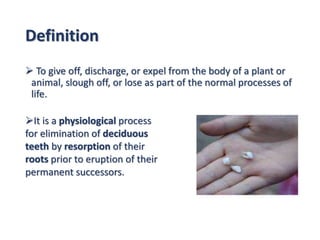
It is a physiological process
for elimination of deciduous
teeth by resorption of their
roots prior to eruption of their
permanent successors.
Factor affecting shedding
1. Local factors
Pressure from the erupting successional tooth plays
an important role in shedding.
Growth of the face and jaws and Enlargement of
the masticatory muscles probably increase the forces
applied over the deciduous teeth.
Pressure + Enlargement = Loss of
Supporting Tissue Tooth Exfoliation
Accelerated.
Factor affecting shedding
2. Genetic factors
Apoptosis in the periodontal ligament fibers.
The initiation of root resorption may be inherent
developmental process.
Any questions??
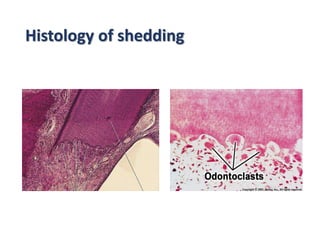
Histology of shedding
Resorption of the hard tissue
“odontocalst”
Resorption of the soft tissue:
Pulp.
Periodontal ligament.
Histology of shedding
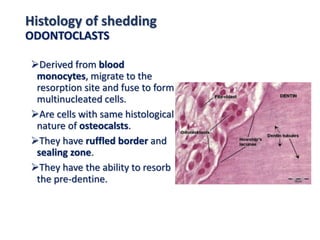
ODONTOCLASTS
Derived from blood
monocytes, migrate to the
resorption site and fuse to form
multinucleated cells.
Are cells with same histological
nature of osteocalsts.
They have ruffled border and
sealing zone.
They have the ability to resorb
the pre-dentine.
Histology of shedding
PULP response.
While the root is being resorped; coronal
pulp appears normal with odontoblasts line
the pre-dentine.
Once the root resorption is almost
completed the odontoblasts degenerate,
mononuclear cells migrate form pulpal bl. v.
and fuse forming odontoclasts.
Histology of shedding
PULP response.
Just before exfoliation, the odontocalsts
migrate away from the dentine surface and the
remaining pulp tissue secreats cement like
tissue.
The tooth is shed with some pulpal tissue
intact.
Histology of shedding
PERIODONTAL LIGAMENT response.
Fibroblasts of the P L exhibit sings of interface
with cytotoxic alteration as well as apoptosis.
These changes leads to abrupt loss of the P L.
Any questions??
Pattern of shedding
The pattern of shedding is
symmetric in both Rt and Lt sides.
The lower E shed before the
upper E.
Girls teeth shed before that of
boys.
Sequence of shedding in the
mandible follows anterior to
posterior order; while in the
maxilla the 1st molar shed before
the canine.
Pattern of shedding
Pattern of shedding
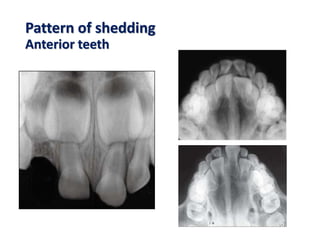
Anterior teeth
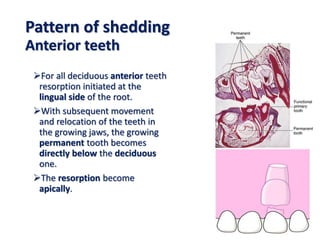
For all deciduous anterior teeth
resorption initiated at the
lingual side of the root.
With subsequent movement
and relocation of the teeth in
the growing jaws, the growing
permanent tooth becomes
directly below the deciduous
one.
The resorption become
apically.
Pattern of shedding
Anterior teeth
Pattern of shedding
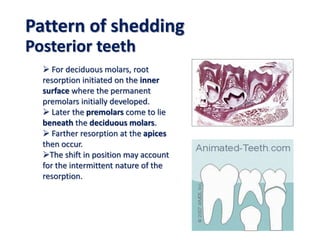
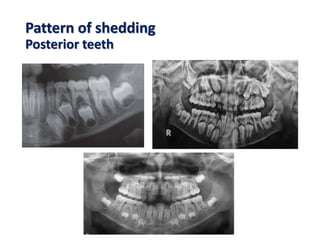
Posterior teeth
 For deciduous molars, root
resorption initiated on the inner
surface where the permanent
premolars initially developed.
 Later the premolars come to lie
beneath the deciduous molars.
 Farther resorption at the apices
then occur.
The shift in position may account
for the intermittent nature of the
resorption.
Pattern of shedding
Posterior teeth
Any questions??
Clinical considerations
Abnormalities of shedding
1. Retained deciduous teeth.
2. Submerged deciduous teeth.
3. Remnants of deciduous teeth.
4. Pre-deciduous teeth.
Abnormalities of shedding
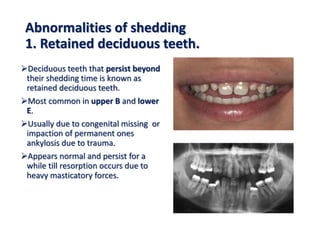
1. Retained deciduous teeth.
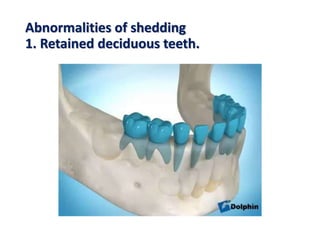
Deciduous teeth that persist beyond
their shedding time is known as
retained deciduous teeth.
Most common in upper B and lower
E.
Usually due to congenital missing or
impaction of permanent ones
ankylosis due to trauma.
Appears normal and persist for a
while till resorption occurs due to
heavy masticatory forces.
Abnormalities of shedding
1. Retained deciduous teeth.
Abnormalities of shedding
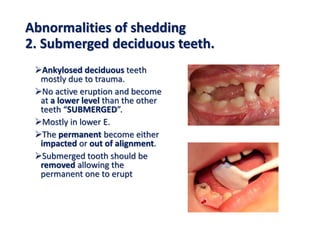
2. Submerged deciduous teeth.
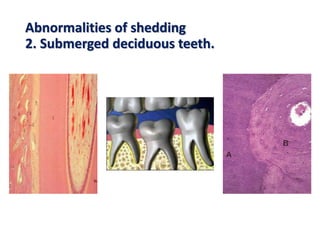
Ankylosed deciduous teeth
mostly due to trauma.
No active eruption and become
at a lower level than the other
teeth “SUBMERGED”.
Mostly in lower E.
The permanent become either
impacted or out of alignment.
Submerged tooth should be
removed allowing the
permanent one to erupt
Abnormalities of shedding
2. Submerged deciduous teeth.
Abnormalities of shedding
2. Submerged deciduous teeth.
Abnormalities of shedding
3. Remnants of deciduous teeth.
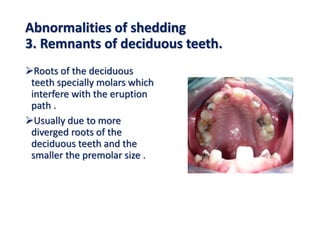
Roots of the deciduous
teeth specially molars which
interfere with the eruption
path .
Usually due to more
diverged roots of the
deciduous teeth and the
smaller the premolar size .
Abnormalities of shedding
4. Pre-deciduous teeth.
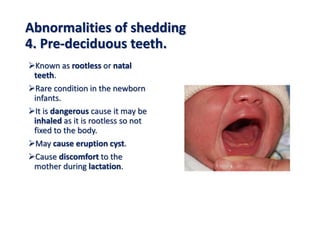
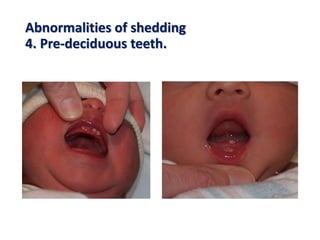
Known as rootless or natal
teeth.
Rare condition in the newborn
infants.
It is dangerous cause it may be
inhaled as it is rootless so not
fixed to the body.
May cause eruption cyst.
Cause discomfort to the
mother during lactation.
Abnormalities of shedding
4. Pre-deciduous teeth.
Any questions??
Thank you..

Shedding

  • 1.
  • 2.
    SHEDDING  Definition.  Factoraffecting shedding. Histology of shedding. Pattern of shedding. Abnormalities in shedding.
  • 3.
    Definition  To giveoff, discharge, or expel from the body of a plant or animal, slough off, or lose as part of the normal processes of life. It is a physiological process for elimination of deciduous teeth by resorption of their roots prior to eruption of their permanent successors.
  • 4.
    Factor affecting shedding 1.Local factors Pressure from the erupting successional tooth plays an important role in shedding. Growth of the face and jaws and Enlargement of the masticatory muscles probably increase the forces applied over the deciduous teeth. Pressure + Enlargement = Loss of Supporting Tissue Tooth Exfoliation Accelerated.
  • 5.
    Factor affecting shedding 2.Genetic factors Apoptosis in the periodontal ligament fibers. The initiation of root resorption may be inherent developmental process.
  • 6.
  • 7.
    Histology of shedding Resorptionof the hard tissue “odontocalst” Resorption of the soft tissue: Pulp. Periodontal ligament.
  • 8.
    Histology of shedding ODONTOCLASTS Derivedfrom blood monocytes, migrate to the resorption site and fuse to form multinucleated cells. Are cells with same histological nature of osteocalsts. They have ruffled border and sealing zone. They have the ability to resorb the pre-dentine.
  • 9.
  • 10.
    Histology of shedding PULPresponse. While the root is being resorped; coronal pulp appears normal with odontoblasts line the pre-dentine. Once the root resorption is almost completed the odontoblasts degenerate, mononuclear cells migrate form pulpal bl. v. and fuse forming odontoclasts.
  • 11.
    Histology of shedding PULPresponse. Just before exfoliation, the odontocalsts migrate away from the dentine surface and the remaining pulp tissue secreats cement like tissue. The tooth is shed with some pulpal tissue intact.
  • 12.
    Histology of shedding PERIODONTALLIGAMENT response. Fibroblasts of the P L exhibit sings of interface with cytotoxic alteration as well as apoptosis. These changes leads to abrupt loss of the P L.
  • 13.
  • 14.
    Pattern of shedding Thepattern of shedding is symmetric in both Rt and Lt sides. The lower E shed before the upper E. Girls teeth shed before that of boys. Sequence of shedding in the mandible follows anterior to posterior order; while in the maxilla the 1st molar shed before the canine.
  • 15.
  • 16.
    Pattern of shedding Anteriorteeth For all deciduous anterior teeth resorption initiated at the lingual side of the root. With subsequent movement and relocation of the teeth in the growing jaws, the growing permanent tooth becomes directly below the deciduous one. The resorption become apically.
  • 17.
  • 18.
    Pattern of shedding Posteriorteeth  For deciduous molars, root resorption initiated on the inner surface where the permanent premolars initially developed.  Later the premolars come to lie beneath the deciduous molars.  Farther resorption at the apices then occur. The shift in position may account for the intermittent nature of the resorption.
  • 19.
  • 20.
  • 21.
    Clinical considerations Abnormalities ofshedding 1. Retained deciduous teeth. 2. Submerged deciduous teeth. 3. Remnants of deciduous teeth. 4. Pre-deciduous teeth.
  • 22.
    Abnormalities of shedding 1.Retained deciduous teeth. Deciduous teeth that persist beyond their shedding time is known as retained deciduous teeth. Most common in upper B and lower E. Usually due to congenital missing or impaction of permanent ones ankylosis due to trauma. Appears normal and persist for a while till resorption occurs due to heavy masticatory forces.
  • 23.
    Abnormalities of shedding 1.Retained deciduous teeth.
  • 24.
    Abnormalities of shedding 2.Submerged deciduous teeth. Ankylosed deciduous teeth mostly due to trauma. No active eruption and become at a lower level than the other teeth “SUBMERGED”. Mostly in lower E. The permanent become either impacted or out of alignment. Submerged tooth should be removed allowing the permanent one to erupt
  • 25.
    Abnormalities of shedding 2.Submerged deciduous teeth.
  • 26.
    Abnormalities of shedding 2.Submerged deciduous teeth.
  • 27.
    Abnormalities of shedding 3.Remnants of deciduous teeth. Roots of the deciduous teeth specially molars which interfere with the eruption path . Usually due to more diverged roots of the deciduous teeth and the smaller the premolar size .
  • 28.
    Abnormalities of shedding 4.Pre-deciduous teeth. Known as rootless or natal teeth. Rare condition in the newborn infants. It is dangerous cause it may be inhaled as it is rootless so not fixed to the body. May cause eruption cyst. Cause discomfort to the mother during lactation.
  • 29.
    Abnormalities of shedding 4.Pre-deciduous teeth.
  • 30.
  • 31.