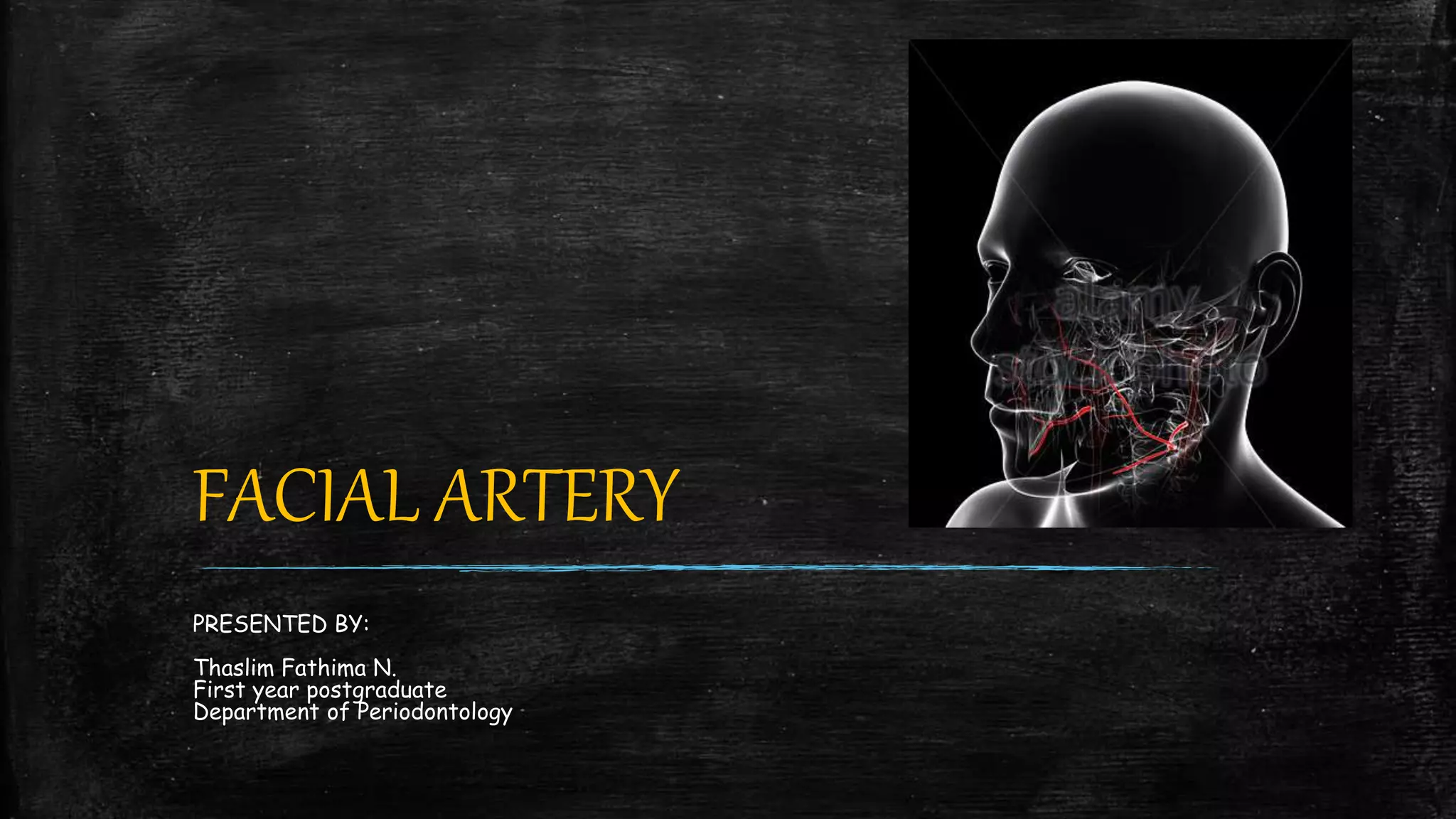
FACIAL ARTERY
PRESENTED BY:
Thaslim Fathima N.
First year postgraduate
Department of Periodontology
INTRODUCTION
Chief artery of the face
Branch of external carotid artery
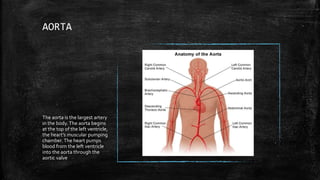
AORTA
The aorta is the largest artery
in the body.The aorta begins
at the top of the left ventricle,
the heart's muscular pumping
chamber. The heart pumps
blood from the left ventricle
into the aorta through the
aortic valve
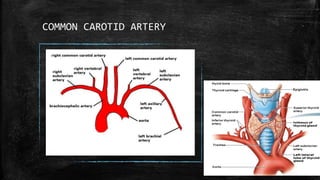
COMMON CAROTID ARTERY
EMBRYOLOGY OF ECA
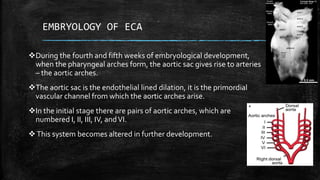
During the fourth and fifth weeks of embryological development,
when the pharyngeal arches form, the aortic sac gives rise to arteries
– the aortic arches.
The aortic sac is the endothelial lined dilation, it is the primordial
vascular channel from which the aortic arches arise.
In the initial stage there are pairs of aortic arches, which are
numbered I, II, III, IV, andVI.
This system becomes altered in further development.
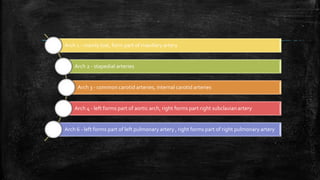
Arch 1 - mainly lost, form part of maxillary artery
Arch 2 - stapedial arteries
Arch 3 - common carotid arteries, internal carotid arteries
Arch 4 - left forms part of aortic arch, right forms part right subclavian artery
Arch 6 - left forms part of left pulmonary artery , right forms part of right pulmonary artery
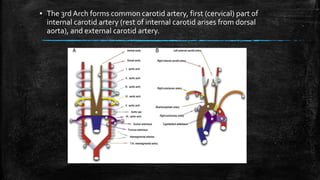
▪ The 3rd Arch forms common carotid artery, first (cervical) part of
internal carotid artery (rest of internal carotid arises from dorsal
aorta), and external carotid artery.
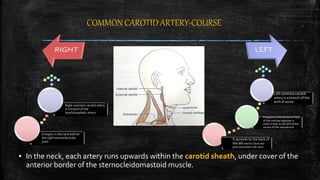
COMMON CAROTID ARTERY-COURSE
▪ In the neck, each artery runs upwards within the carotid sheath, under cover of the
anterior border of the sternocleidomastoid muscle.
It begins in the neck behind
the right sternoclavicular
joint.
Right common carotid artery
is a branch of the
brachiocephalic artery.
It begins in the thorax in front
of the trachea opposite a
point a little to the left of the
centre of the manubrium.
Left common carotid
artery is a branch of the
arch of aorta
It ascends to the back of
the left sterno-clavicular
joint and enters the neck.
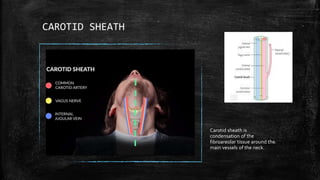
CAROTID SHEATH
Carotid sheath is
condensation of the
fibroareolar tissue around the
main vessels of the neck.
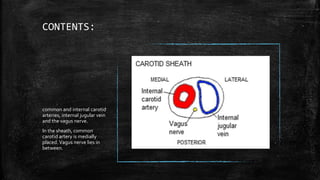
CONTENTS:
common and internal carotid
arteries, internal jugular vein
and the vagus nerve.
In the sheath, common
carotid artery is medially
placed. Vagus nerve lies in
between.
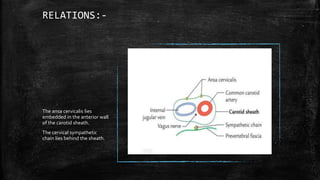
RELATIONS:-
The ansa cervicalis lies
embedded in the anterior wall
of the carotid sheath.
The cervical sympathetic
chain lies behind the sheath.
BIFURCATION OF COMMON CAROTID ARTERY
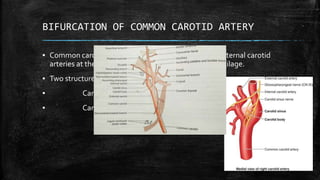
▪ Common carotid artery bifurcates into external and internal carotid
arteries at the level of upper border of the thyroid cartilage.
▪ Two structures of importance at the bifurcation are
▪ Carotid sinus
▪ Carotid body
CAROTID SINUS
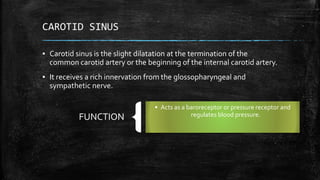
▪ Carotid sinus is the slight dilatation at the termination of the
common carotid artery or the beginning of the internal carotid artery.
▪ It receives a rich innervation from the glossopharyngeal and
sympathetic nerve.
FUNCTION
• Acts as a baroreceptor or pressure receptor and
regulates blood pressure.
APPLIED ANATOMY
Carotid sinus syndrome
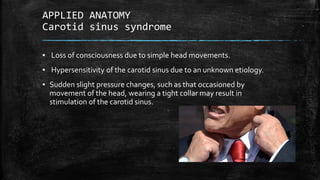
▪ Loss of consciousness due to simple head movements.
▪ Hypersensitivity of the carotid sinus due to an unknown etiology.
▪ Sudden slight pressure changes, such as that occasioned by
movement of the head, wearing a tight collar may result in
stimulation of the carotid sinus.
▪ Impulses transmitted by the sinus reduce blood pressure and slow
the pumping action of the heart.
▪ Thus decreasing blood supply to the brain and resulting in sudden
loss of consciousness.
▪ While supporting the mandible care should be taken not to apply
pressure on the carotid sinus.
CAROTID BODY
▪ Carotid body is a small, oval reddish-brown structure situated behind
the bifurcation.
▪ It receives nerve supply mainly from the glossopharyngeal nerve, but
also from the vagus and sympathetic nerves.
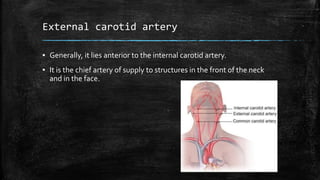
External carotid artery
▪ Generally, it lies anterior to the internal carotid artery.
▪ It is the chief artery of supply to structures in the front of the neck
and in the face.
COURSE AND RELATIONS
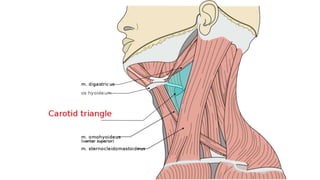
▪ The external carotid artery begins in the carotid triangle at the level
of the upper border of the thyroid cartilage opposite the disc
between the third and fourth cervical vertebrae.
▪ It runs upwards and slightly backwards and laterally, and terminates
behind the neck of the mandible by dividing into the maxillary and
superficial temporal arteries.
▪ The external carotid artery has a slightly curved course, so that it is
anteromedial to the internal carotid artery in its lower part, and
anterolateral to the internal carotid artery in its upper part.
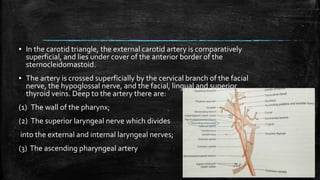
▪ In the carotid triangle, the external carotid artery is comparatively
superficial, and lies under cover of the anterior border of the
sternocleidomastoid.
▪ The artery is crossed superficially by the cervical branch of the facial
nerve, the hypoglossal nerve, and the facial, lingual and superior
thyroid veins. Deep to the artery there are:
(1) The wall of the pharynx;
(2) The superior laryngeal nerve which divides
into the external and internal laryngeal nerves;
(3) The ascending pharyngeal artery
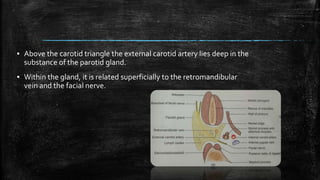
▪ Above the carotid triangle the external carotid artery lies deep in the
substance of the parotid gland.
▪ Within the gland, it is related superficially to the retromandibular
vein and the facial nerve.
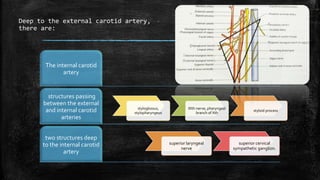
Deep to the external carotid artery,
there are:
The internal carotid
artery
structures passing
between the external
and internal carotid
arteries
two structures deep
to the internal carotid
artery
styloglossus,
stylopharyngeus
IXth nerve, pharyngeal
branch of Xth
styloid process
superior laryngeal
nerve
superior cervical
sympathetic ganglion.
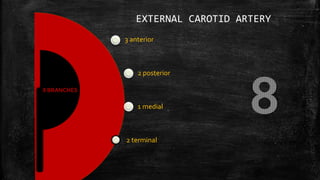
3 anterior
2 posterior
1 medial
2 terminal
8 BRANCHES
EXTERNAL CAROTID ARTERY
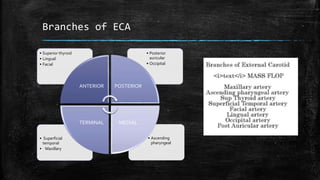
Branches of ECA
• Ascending
pharyngeal
• Superficial
temporal
• Maxillary
• Posterior
auricular
• Occipital
• Superior thyroid
• Lingual
• Facial
ANTERIOR POSTERIOR
MEDIALTERMINAL
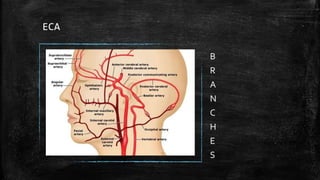
ECA
B
R
A
N
C
H
E
S
INTERNAL CAROTID ARTERY
▪ Origin
▪ It is one of the terminal branch of common carotid artery originates
along with external carotid artery at the upper border of thyroid
cartilage at the disk of third and fourth cervical vertebra.
BRANCHES
▪ Cervical part in the neck
▪ Petrous part in the petrous temporal bone
▪ Cavernous part in the cavernous sinus
▪ Cerebral part in relation to base of brain
Facial Artery
Origin :
▪ Arises from the ECA just above the greater cornu of the hyoid bone
▪ It has two parts, first cervical part in the neck and facial part.
▪ It enters the face by winding around the base of the mandible by
piercing deep cervical facia.
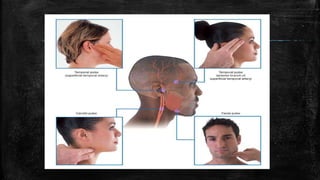
▪ At the antero-inferior angle of the masseter muscle, it can be
palpated here and is called as “anaesthetist’s artery”
COURSE:
▪ Runs upwards in -- neck as cervical part ; face -- facial part.
▪ Tortuous course—In neck allows free movements of pharynx
during deglutition,
▪ on face -- free movements of mandible , lips, & cheek during
mastication & facial expressions, escapes traction & pressure during
movements.
Cervical part
▪ Cervical part Runs upwards on superior constrictor of pharynx deep
to the posterior belly of digastric.
▪ It grooves the posterior border of sub-mandibular gland, makes S-
bend [2 loops] 1st winding down over sub-mandibular gland & then
up over the base of mandible.
Facial part
▪ The vessel enters the face by winding around the base of the
mandible, and by piercing the deep cervical fascia at the antero-
inferior angle of the masseter muscle.
▪ It runs upwards and forwards deep to the risorus, to a point 1.25cm
lateral to the angle of the mouth.
▪ Then it ascends by the side of the nose upto the medial angle of the
eye where it terminates by anastomosing with the dorsal nasal
branch of the ophthalmic artery.
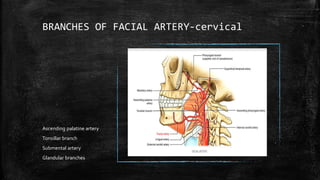
BRANCHES OF FACIAL ARTERY-cervical
Ascending palatine artery
Tonsillar branch
Submental artery
Glandular branches
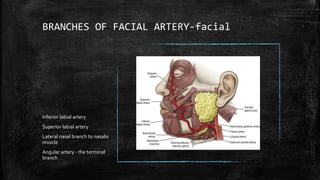
BRANCHES OF FACIAL ARTERY-facial
Inferior labial artery
Superior labial artery
Lateral nasal branch to nasalis
muscle
Angular artery - the terminal
branch
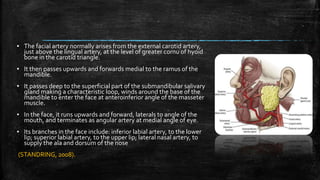
▪ The facial artery normally arises from the external carotid artery,
just above the lingual artery, at the level of greater cornu of hyoid
bone in the carotid triangle.
▪ It then passes upwards and forwards medial to the ramus of the
mandible.
▪ It passes deep to the superficial part of the submandibular salivary
gland making a characteristic loop, winds around the base of the
mandible to enter the face at anteroinferior angle of the masseter
muscle.
▪ In the face, it runs upwards and forward, laterals to angle of the
mouth, and terminates as angular artery at medial angle of eye.
▪ Its branches in the face include: inferior labial artery, to the lower
lip; superior labial artery, to the upper lip; lateral nasal artery, to
supply the ala and dorsum of the nose
(STANDRING, 2008).
ANASTOMOSES
▪ 1.The large anterior branches anastomose with similar branches of
the opposite side and with the mental artery. In the lips,
anastomoses are large, so that cut arteries spurt from both ends.
▪ 2.Small posterior branches anastomose with the transverse facial
and infraorbital arteries.
▪ 3.At the medial angle of the eye, terminal branches of the facial
artery anastomose with branches of the ophthalmic artery.This is,
therefore, a site for anastomosis between the branches of the
external and internal carotid arteries.
VIDEO
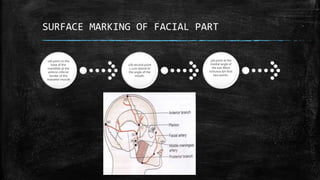
SURFACE MARKING OF FACIAL PART
1)A point on the
base of the
mandible at the
anterio-inferior
border of the
masseter muscle
2)A second point
1.2cm lateral to
the angle of the
mouth.
3)A point at the
medial angle of
the eye.More
tortuous b/n first
two points.
BRANCHES
CERVICAL PART
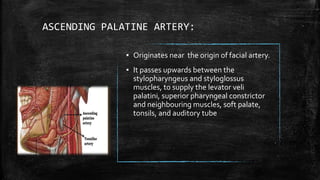
ASCENDING PALATINE ARTERY:
▪ Originates near the origin of facial artery.
▪ It passes upwards between the
stylopharyngeus and styloglossus
muscles, to supply the levator veli
palatini, superior pharyngeal constrictor
and neighbouring muscles, soft palate,
tonsils, and auditory tube
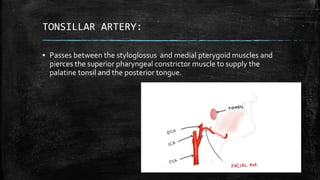
TONSILLAR ARTERY:
▪ Passes between the styloglossus and medial pterygoid muscles and
pierces the superior pharyngeal constrictor muscle to supply the
palatine tonsil and the posterior tongue.
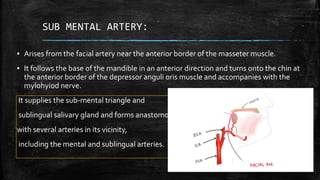
SUB MENTAL ARTERY:
▪ Arises from the facial artery near the anterior border of the masseter muscle.
▪ It follows the base of the mandible in an anterior direction and turns onto the chin at
the anterior border of the depressor anguli oris muscle and accompanies with the
mylohyiod nerve.
It supplies the sub-mental triangle and
sublingual salivary gland and forms anastomoses
with several arteries in its vicinity,
including the mental and sublingual arteries.
GLANDULAR ARTERIES:
▪ Distribute as three or four vessels to the submandibular gland to
supply it and the adjacent area.
▪ Glandular branches supply submandibular gland and submandibular
lymph glands
BRANCHES
FACIAL PART
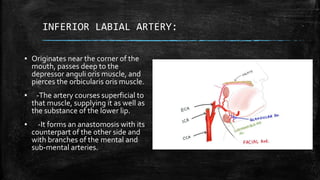
INFERIOR LABIAL ARTERY:
▪ Originates near the corner of the
mouth, passes deep to the
depressor anguli oris muscle, and
pierces the orbicularis oris muscle.
▪ -The artery courses superficial to
that muscle, supplying it as well as
the substance of the lower lip.
▪ -It forms an anastomosis with its
counterpart of the other side and
with branches of the mental and
sub-mental arteries.
SUPERIOR LABIAL ARTERY
▪ Arises just above the inferior labial artery. It passes superficial to the
orbicularis oris muscle in the upper lip to serve that muscle as well as
the substance of the upper lip.
▪ - It sends a small twig, the SEPTAL BRANCH to supply antero-
inferior part of the nasal septum and another one, the ALAR
BRANCH, into the wing of the nose.
▪ -The terminus of the vessel will anastomose with its counterpart of
the opposite side.
LATERAL NASAL ARTERY:
▪ Small branch arising at and passing into the wing and bridge of the
nose.
▪ This supplies ala and dorsum of the nose.This vessel will anastomose
with various other arteries in its vicinity.
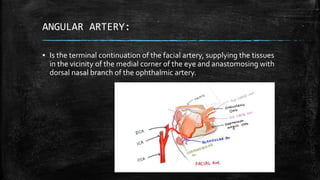
ANGULAR ARTERY:
▪ Is the terminal continuation of the facial artery, supplying the tissues
in the vicinity of the medial corner of the eye and anastomosing with
dorsal nasal branch of the ophthalmic artery.
VARIATIONS
A STUDY ON FACIAL ARTERY VARIATION AND ITS
CLINICAL IMPLICATION FOR FACIAL SURGERIES
▪ Results:The variations in the facial artery were grouped under three
categories following the classification of Bayramet.al, 2010.
▪ Type I category – Facial artery terminated as angular artery ;
▪ Type II category – facial artery terminated as superior labial ;
▪ Type III – Facial artery terminated as inferior labial .
▪ In present study (type-II) is seen. Premasseteric branch was
observed.
Md Khaleel Ahmed 1, Pradeep K. Murudkar 2, Md.Kafeel Ahmed 3. International Journal of Anatomy
and Research,IntJ Anat Res 2015,Vol 3(1):966-69
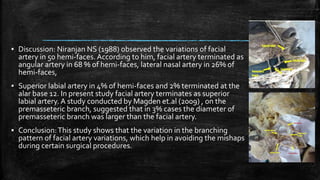
▪ Discussion: Niranjan NS (1988) observed the variations of facial
artery in 50 hemi-faces. According to him, facial artery terminated as
angular artery in 68 % of hemi-faces, lateral nasal artery in 26% of
hemi-faces,
▪ Superior labial artery in 4% of hemi-faces and 2% terminated at the
alar base 12. In present study facial artery terminates as superior
labial artery. A study conducted by Magden et.al (2009) , on the
premasseteric branch, suggested that in 3% cases the diameter of
premasseteric branch was larger than the facial artery.
▪ Conclusion:This study shows that the variation in the branching
pattern of facial artery variations, which help in avoiding the mishaps
during certain surgical procedures.
Applied Anatomy
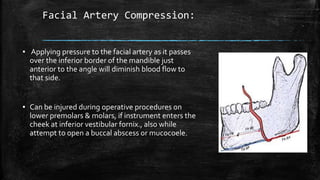
Facial Artery Compression:
▪ Applying pressure to the facial artery as it passes
over the inferior border of the mandible just
anterior to the angle will diminish blood flow to
that side.
▪ Can be injured during operative procedures on
lower premolars & molars, if instrument enters the
cheek at inferior vestibular fornix., also while
attempt to open a buccal abscess or mucocoele.
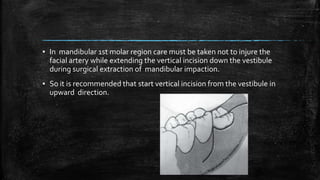
▪ In mandibular 1st molar region care must be taken not to injure the
facial artery while extending the vertical incision down the vestibule
during surgical extraction of mandibular impaction.
▪ So it is recommended that start vertical incision from the vestibule in
upward direction.
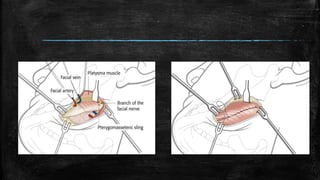
▪ While excising the submandibular gland,the facial artery should be
ligated at two points and should be secured before dividing it,
otherwise it may retract through stylomandibular ligament causing
serious bleeding.
▪ During the surgical removal of the submandibular salivary gland the
incision is made ½ inch below the lower border of the mandible
parallel to mandibular branch of facial nerve.
▪ Facial artery can be severed during the attempts to open buccal
abscess of the first molar.
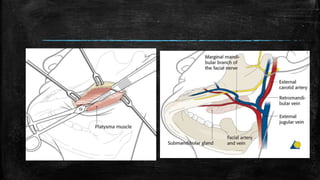
LIGATION OF FACIAL ARTERY
▪ Exposed -at the point crossing the lower border of mandible .
▪ Using contracted masseter as a landmark, pulse of facial artery felt at
point situated anterior to the attachment of masseter.
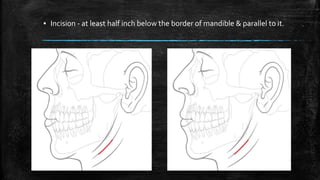
▪ Incision - at least half inch below the border of mandible & parallel to it.
APPLIED ANATOMY-COMPLICATIONS
▪ During injury of the face bleeding from the facial artery can be stopped by
compressing the artery against the lower border of mandible.
▪ The pulsation of the artery can be felt along the lower border of the
mandible near the anteroinferior angle of masseter muscle.
▪ In the lips branches of the facial artery are found nearer to the mucous
membrane than to the skin.
▪ Hence injuries caused by the teeth on the mucous membrane of the mouth
may develop hidden haematomas.
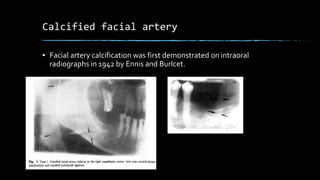
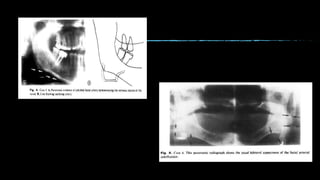
Calcified facial artery
▪ Facial artery calcification was first demonstrated on intraoral
radiographs in 1942 by Ennis and BurIcet.
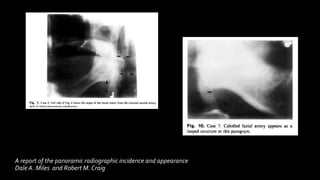
A report of the panoramic radiographic incidence and appearance
Dale A. Miles and Robert M. Craig
REFERENCES
▪ B.D.Chaurasia Human Anatomy for Dental Students,5th edition
▪ Textbook of Oral and Maxillofacial surgery,S.M.Balaji,1st edition
▪ Cunningham’s ManualOf PracticalAnatomy,G.J. Romanes
▪ Ram’sTextbook of Human Anatomy, MV Ramasamy
▪ Anatomy For Dental Students , A S Moni
▪ Surgical complications in oral implantology,LouieAl-Faraje
▪ A report of the panoramic radiographic incidence and appearance Dale A. Miles
and Robert M. Craig
▪ Md Khaleel Ahmed 1, Pradeep K. Murudkar 2, Md.Kafeel Ahmed 3. International
Journal of Anatomy and Research,Int J Anat Res 2015,Vol 3(1):966-69
Facial artery

Facial artery

  • 1.
    FACIAL ARTERY PRESENTED BY: ThaslimFathima N. First year postgraduate Department of Periodontology
  • 2.
    INTRODUCTION Chief artery ofthe face Branch of external carotid artery
  • 3.
    AORTA The aorta isthe largest artery in the body.The aorta begins at the top of the left ventricle, the heart's muscular pumping chamber. The heart pumps blood from the left ventricle into the aorta through the aortic valve
  • 4.
  • 5.
    EMBRYOLOGY OF ECA Duringthe fourth and fifth weeks of embryological development, when the pharyngeal arches form, the aortic sac gives rise to arteries – the aortic arches. The aortic sac is the endothelial lined dilation, it is the primordial vascular channel from which the aortic arches arise. In the initial stage there are pairs of aortic arches, which are numbered I, II, III, IV, andVI. This system becomes altered in further development.
  • 6.
    Arch 1 -mainly lost, form part of maxillary artery Arch 2 - stapedial arteries Arch 3 - common carotid arteries, internal carotid arteries Arch 4 - left forms part of aortic arch, right forms part right subclavian artery Arch 6 - left forms part of left pulmonary artery , right forms part of right pulmonary artery
  • 7.
    ▪ The 3rdArch forms common carotid artery, first (cervical) part of internal carotid artery (rest of internal carotid arises from dorsal aorta), and external carotid artery.
  • 8.
    COMMON CAROTID ARTERY-COURSE ▪In the neck, each artery runs upwards within the carotid sheath, under cover of the anterior border of the sternocleidomastoid muscle. It begins in the neck behind the right sternoclavicular joint. Right common carotid artery is a branch of the brachiocephalic artery. It begins in the thorax in front of the trachea opposite a point a little to the left of the centre of the manubrium. Left common carotid artery is a branch of the arch of aorta It ascends to the back of the left sterno-clavicular joint and enters the neck.
  • 9.
    CAROTID SHEATH Carotid sheathis condensation of the fibroareolar tissue around the main vessels of the neck.
  • 10.
    CONTENTS: common and internalcarotid arteries, internal jugular vein and the vagus nerve. In the sheath, common carotid artery is medially placed. Vagus nerve lies in between.
  • 11.
    RELATIONS:- The ansa cervicalislies embedded in the anterior wall of the carotid sheath. The cervical sympathetic chain lies behind the sheath.
  • 12.
    BIFURCATION OF COMMONCAROTID ARTERY ▪ Common carotid artery bifurcates into external and internal carotid arteries at the level of upper border of the thyroid cartilage. ▪ Two structures of importance at the bifurcation are ▪ Carotid sinus ▪ Carotid body
  • 13.
    CAROTID SINUS ▪ Carotidsinus is the slight dilatation at the termination of the common carotid artery or the beginning of the internal carotid artery. ▪ It receives a rich innervation from the glossopharyngeal and sympathetic nerve. FUNCTION • Acts as a baroreceptor or pressure receptor and regulates blood pressure.
  • 14.
    APPLIED ANATOMY Carotid sinussyndrome ▪ Loss of consciousness due to simple head movements. ▪ Hypersensitivity of the carotid sinus due to an unknown etiology. ▪ Sudden slight pressure changes, such as that occasioned by movement of the head, wearing a tight collar may result in stimulation of the carotid sinus.
  • 15.
    ▪ Impulses transmittedby the sinus reduce blood pressure and slow the pumping action of the heart. ▪ Thus decreasing blood supply to the brain and resulting in sudden loss of consciousness. ▪ While supporting the mandible care should be taken not to apply pressure on the carotid sinus.
  • 16.
    CAROTID BODY ▪ Carotidbody is a small, oval reddish-brown structure situated behind the bifurcation. ▪ It receives nerve supply mainly from the glossopharyngeal nerve, but also from the vagus and sympathetic nerves.
  • 18.
    External carotid artery ▪Generally, it lies anterior to the internal carotid artery. ▪ It is the chief artery of supply to structures in the front of the neck and in the face.
  • 19.
    COURSE AND RELATIONS ▪The external carotid artery begins in the carotid triangle at the level of the upper border of the thyroid cartilage opposite the disc between the third and fourth cervical vertebrae. ▪ It runs upwards and slightly backwards and laterally, and terminates behind the neck of the mandible by dividing into the maxillary and superficial temporal arteries. ▪ The external carotid artery has a slightly curved course, so that it is anteromedial to the internal carotid artery in its lower part, and anterolateral to the internal carotid artery in its upper part.
  • 21.
    ▪ In thecarotid triangle, the external carotid artery is comparatively superficial, and lies under cover of the anterior border of the sternocleidomastoid. ▪ The artery is crossed superficially by the cervical branch of the facial nerve, the hypoglossal nerve, and the facial, lingual and superior thyroid veins. Deep to the artery there are: (1) The wall of the pharynx; (2) The superior laryngeal nerve which divides into the external and internal laryngeal nerves; (3) The ascending pharyngeal artery
  • 22.
    ▪ Above thecarotid triangle the external carotid artery lies deep in the substance of the parotid gland. ▪ Within the gland, it is related superficially to the retromandibular vein and the facial nerve.
  • 23.
    Deep to theexternal carotid artery, there are: The internal carotid artery structures passing between the external and internal carotid arteries two structures deep to the internal carotid artery styloglossus, stylopharyngeus IXth nerve, pharyngeal branch of Xth styloid process superior laryngeal nerve superior cervical sympathetic ganglion.
  • 24.
    3 anterior 2 posterior 1medial 2 terminal 8 BRANCHES EXTERNAL CAROTID ARTERY
  • 25.
    Branches of ECA •Ascending pharyngeal • Superficial temporal • Maxillary • Posterior auricular • Occipital • Superior thyroid • Lingual • Facial ANTERIOR POSTERIOR MEDIALTERMINAL
  • 26.
  • 27.
    INTERNAL CAROTID ARTERY ▪Origin ▪ It is one of the terminal branch of common carotid artery originates along with external carotid artery at the upper border of thyroid cartilage at the disk of third and fourth cervical vertebra.
  • 28.
    BRANCHES ▪ Cervical partin the neck ▪ Petrous part in the petrous temporal bone ▪ Cavernous part in the cavernous sinus ▪ Cerebral part in relation to base of brain
  • 29.
  • 30.
    Origin : ▪ Arisesfrom the ECA just above the greater cornu of the hyoid bone ▪ It has two parts, first cervical part in the neck and facial part. ▪ It enters the face by winding around the base of the mandible by piercing deep cervical facia. ▪ At the antero-inferior angle of the masseter muscle, it can be palpated here and is called as “anaesthetist’s artery”
  • 31.
    COURSE: ▪ Runs upwardsin -- neck as cervical part ; face -- facial part. ▪ Tortuous course—In neck allows free movements of pharynx during deglutition, ▪ on face -- free movements of mandible , lips, & cheek during mastication & facial expressions, escapes traction & pressure during movements.
  • 32.
    Cervical part ▪ Cervicalpart Runs upwards on superior constrictor of pharynx deep to the posterior belly of digastric. ▪ It grooves the posterior border of sub-mandibular gland, makes S- bend [2 loops] 1st winding down over sub-mandibular gland & then up over the base of mandible.
  • 33.
    Facial part ▪ Thevessel enters the face by winding around the base of the mandible, and by piercing the deep cervical fascia at the antero- inferior angle of the masseter muscle. ▪ It runs upwards and forwards deep to the risorus, to a point 1.25cm lateral to the angle of the mouth. ▪ Then it ascends by the side of the nose upto the medial angle of the eye where it terminates by anastomosing with the dorsal nasal branch of the ophthalmic artery.
  • 34.
    BRANCHES OF FACIALARTERY-cervical Ascending palatine artery Tonsillar branch Submental artery Glandular branches
  • 35.
    BRANCHES OF FACIALARTERY-facial Inferior labial artery Superior labial artery Lateral nasal branch to nasalis muscle Angular artery - the terminal branch
  • 36.
    ▪ The facialartery normally arises from the external carotid artery, just above the lingual artery, at the level of greater cornu of hyoid bone in the carotid triangle. ▪ It then passes upwards and forwards medial to the ramus of the mandible. ▪ It passes deep to the superficial part of the submandibular salivary gland making a characteristic loop, winds around the base of the mandible to enter the face at anteroinferior angle of the masseter muscle. ▪ In the face, it runs upwards and forward, laterals to angle of the mouth, and terminates as angular artery at medial angle of eye. ▪ Its branches in the face include: inferior labial artery, to the lower lip; superior labial artery, to the upper lip; lateral nasal artery, to supply the ala and dorsum of the nose (STANDRING, 2008).
  • 37.
    ANASTOMOSES ▪ 1.The largeanterior branches anastomose with similar branches of the opposite side and with the mental artery. In the lips, anastomoses are large, so that cut arteries spurt from both ends. ▪ 2.Small posterior branches anastomose with the transverse facial and infraorbital arteries. ▪ 3.At the medial angle of the eye, terminal branches of the facial artery anastomose with branches of the ophthalmic artery.This is, therefore, a site for anastomosis between the branches of the external and internal carotid arteries.
  • 38.
  • 39.
    SURFACE MARKING OFFACIAL PART 1)A point on the base of the mandible at the anterio-inferior border of the masseter muscle 2)A second point 1.2cm lateral to the angle of the mouth. 3)A point at the medial angle of the eye.More tortuous b/n first two points.
  • 40.
  • 41.
    ASCENDING PALATINE ARTERY: ▪Originates near the origin of facial artery. ▪ It passes upwards between the stylopharyngeus and styloglossus muscles, to supply the levator veli palatini, superior pharyngeal constrictor and neighbouring muscles, soft palate, tonsils, and auditory tube
  • 42.
    TONSILLAR ARTERY: ▪ Passesbetween the styloglossus and medial pterygoid muscles and pierces the superior pharyngeal constrictor muscle to supply the palatine tonsil and the posterior tongue.
  • 43.
    SUB MENTAL ARTERY: ▪Arises from the facial artery near the anterior border of the masseter muscle. ▪ It follows the base of the mandible in an anterior direction and turns onto the chin at the anterior border of the depressor anguli oris muscle and accompanies with the mylohyiod nerve. It supplies the sub-mental triangle and sublingual salivary gland and forms anastomoses with several arteries in its vicinity, including the mental and sublingual arteries.
  • 44.
    GLANDULAR ARTERIES: ▪ Distributeas three or four vessels to the submandibular gland to supply it and the adjacent area. ▪ Glandular branches supply submandibular gland and submandibular lymph glands
  • 45.
  • 46.
    INFERIOR LABIAL ARTERY: ▪Originates near the corner of the mouth, passes deep to the depressor anguli oris muscle, and pierces the orbicularis oris muscle. ▪ -The artery courses superficial to that muscle, supplying it as well as the substance of the lower lip. ▪ -It forms an anastomosis with its counterpart of the other side and with branches of the mental and sub-mental arteries.
  • 47.
    SUPERIOR LABIAL ARTERY ▪Arises just above the inferior labial artery. It passes superficial to the orbicularis oris muscle in the upper lip to serve that muscle as well as the substance of the upper lip. ▪ - It sends a small twig, the SEPTAL BRANCH to supply antero- inferior part of the nasal septum and another one, the ALAR BRANCH, into the wing of the nose. ▪ -The terminus of the vessel will anastomose with its counterpart of the opposite side.
  • 48.
    LATERAL NASAL ARTERY: ▪Small branch arising at and passing into the wing and bridge of the nose. ▪ This supplies ala and dorsum of the nose.This vessel will anastomose with various other arteries in its vicinity.
  • 49.
    ANGULAR ARTERY: ▪ Isthe terminal continuation of the facial artery, supplying the tissues in the vicinity of the medial corner of the eye and anastomosing with dorsal nasal branch of the ophthalmic artery.
  • 50.
  • 51.
    A STUDY ONFACIAL ARTERY VARIATION AND ITS CLINICAL IMPLICATION FOR FACIAL SURGERIES ▪ Results:The variations in the facial artery were grouped under three categories following the classification of Bayramet.al, 2010. ▪ Type I category – Facial artery terminated as angular artery ; ▪ Type II category – facial artery terminated as superior labial ; ▪ Type III – Facial artery terminated as inferior labial . ▪ In present study (type-II) is seen. Premasseteric branch was observed. Md Khaleel Ahmed 1, Pradeep K. Murudkar 2, Md.Kafeel Ahmed 3. International Journal of Anatomy and Research,IntJ Anat Res 2015,Vol 3(1):966-69
  • 52.
    ▪ Discussion: NiranjanNS (1988) observed the variations of facial artery in 50 hemi-faces. According to him, facial artery terminated as angular artery in 68 % of hemi-faces, lateral nasal artery in 26% of hemi-faces, ▪ Superior labial artery in 4% of hemi-faces and 2% terminated at the alar base 12. In present study facial artery terminates as superior labial artery. A study conducted by Magden et.al (2009) , on the premasseteric branch, suggested that in 3% cases the diameter of premasseteric branch was larger than the facial artery. ▪ Conclusion:This study shows that the variation in the branching pattern of facial artery variations, which help in avoiding the mishaps during certain surgical procedures.
  • 53.
  • 54.
    Facial Artery Compression: ▪Applying pressure to the facial artery as it passes over the inferior border of the mandible just anterior to the angle will diminish blood flow to that side. ▪ Can be injured during operative procedures on lower premolars & molars, if instrument enters the cheek at inferior vestibular fornix., also while attempt to open a buccal abscess or mucocoele.
  • 55.
    ▪ In mandibular1st molar region care must be taken not to injure the facial artery while extending the vertical incision down the vestibule during surgical extraction of mandibular impaction. ▪ So it is recommended that start vertical incision from the vestibule in upward direction.
  • 56.
    ▪ While excisingthe submandibular gland,the facial artery should be ligated at two points and should be secured before dividing it, otherwise it may retract through stylomandibular ligament causing serious bleeding. ▪ During the surgical removal of the submandibular salivary gland the incision is made ½ inch below the lower border of the mandible parallel to mandibular branch of facial nerve. ▪ Facial artery can be severed during the attempts to open buccal abscess of the first molar.
  • 57.
    LIGATION OF FACIALARTERY ▪ Exposed -at the point crossing the lower border of mandible . ▪ Using contracted masseter as a landmark, pulse of facial artery felt at point situated anterior to the attachment of masseter.
  • 58.
    ▪ Incision -at least half inch below the border of mandible & parallel to it.
  • 61.
    APPLIED ANATOMY-COMPLICATIONS ▪ Duringinjury of the face bleeding from the facial artery can be stopped by compressing the artery against the lower border of mandible. ▪ The pulsation of the artery can be felt along the lower border of the mandible near the anteroinferior angle of masseter muscle. ▪ In the lips branches of the facial artery are found nearer to the mucous membrane than to the skin. ▪ Hence injuries caused by the teeth on the mucous membrane of the mouth may develop hidden haematomas.
  • 62.
    Calcified facial artery ▪Facial artery calcification was first demonstrated on intraoral radiographs in 1942 by Ennis and BurIcet.
  • 64.
    A report ofthe panoramic radiographic incidence and appearance Dale A. Miles and Robert M. Craig
  • 66.
    REFERENCES ▪ B.D.Chaurasia HumanAnatomy for Dental Students,5th edition ▪ Textbook of Oral and Maxillofacial surgery,S.M.Balaji,1st edition ▪ Cunningham’s ManualOf PracticalAnatomy,G.J. Romanes ▪ Ram’sTextbook of Human Anatomy, MV Ramasamy ▪ Anatomy For Dental Students , A S Moni ▪ Surgical complications in oral implantology,LouieAl-Faraje ▪ A report of the panoramic radiographic incidence and appearance Dale A. Miles and Robert M. Craig ▪ Md Khaleel Ahmed 1, Pradeep K. Murudkar 2, Md.Kafeel Ahmed 3. International Journal of Anatomy and Research,Int J Anat Res 2015,Vol 3(1):966-69