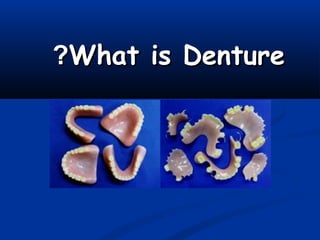
What is DentureWhat is Denture??
A substitute for the lostA substitute for the lost
natural dentitionnatural dentition
Substitutes the whole
arch
Substitutes some
teeth
Partial Denture
Parts of the dentureParts of the denture
A. Denture baseA. Denture base
 Covers the residual ridge andCovers the residual ridge and
restore the lost gingival partsrestore the lost gingival parts
 Supports and holds the artificialSupports and holds the artificial
teethteeth
 Responsible for dentureResponsible for denture
retentionretention
B. Artificial teethB. Artificial teeth
 A substitute for the lost naturalA substitute for the lost natural
teeth doing their functionteeth doing their function
((estheticesthetic,, chewingchewing andand phonationphonation))
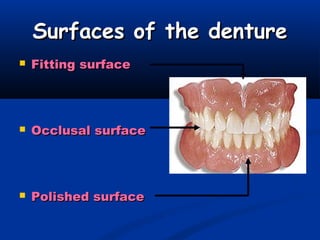
Surfaces of the dentureSurfaces of the denture
 Fitting surfaceFitting surface
 Occlusal surfaceOcclusal surface
 Polished surfacePolished surface
Requirements of denture baseRequirements of denture base
materialsmaterials
1.1. Should beShould be biologically acceptablebiologically acceptable (non-toxic,(non-toxic,
non-irritant, tasteless, and odorless).non-irritant, tasteless, and odorless).
2.2. HaveHave adequate mechanical propertiesadequate mechanical properties such assuch as
impact, transverse and fatigue strengths.impact, transverse and fatigue strengths.
3.3. HaveHave satisfactory thermal propertiessatisfactory thermal properties..
4.4. Light in weightLight in weight and haveand have color matchescolor matches toto thatthat
of gingival tissuesof gingival tissues
5.5. Have to beHave to be stable in different oral environmentstable in different oral environment
(Resistant to degradation and the change in(Resistant to degradation and the change in
temperature).temperature).
6.6. Should beShould be dimensionally stabledimensionally stable..
7.7. ShouldShould achieve chemical bond to the artificialachieve chemical bond to the artificial
teeth.teeth.
8.8. Easily fabricated and repair .Easily fabricated and repair .
9.9. Should be ofShould be of low costlow cost..
Requirements of denture baseRequirements of denture base
materialsmaterials
Denture BaseDenture Base
AcrylicsAcrylics
1. Heat-cured Acrylic Resin1. Heat-cured Acrylic Resin
(PMMA)(PMMA)
2. Modified Acrylic Resin2. Modified Acrylic Resin
Heat-cured PMMAHeat-cured PMMA
A. Powder (polymer)A. Powder (polymer)
CompositionComposition
 Pre-polymerized PMMA….Pre-polymerized PMMA…. (to reduce the(to reduce the
polymerization shrinkage)polymerization shrinkage)
 Benzoyl peroxide….Benzoyl peroxide….(Polymerization initiator)(Polymerization initiator)
 Co-polymer of PMMA-PEMACo-polymer of PMMA-PEMA
 Dibutyl phethalate….Dibutyl phethalate….(plasticizer)(plasticizer)
 Bromo-polymer additives.…Bromo-polymer additives.…(Radiopacifiers)(Radiopacifiers)
 Pigments….Pigments….(to give the gingival pink color)(to give the gingival pink color)
Heat-cured PMMAHeat-cured PMMA
B. Liquid (monomer)B. Liquid (monomer)
CompositionComposition
 Monomer of MMA….Monomer of MMA…. (The actual reactant)(The actual reactant)
 0.0006% Hydroquinon….0.0006% Hydroquinon…. (polymerization inhibitor)(polymerization inhibitor)
 TEG-DMA….TEG-DMA…. (Cross-linking agent)(Cross-linking agent)
 Dibytyl phethalate….Dibytyl phethalate…. (plasticizer)(plasticizer)
Setting of theSetting of the
Heat-cured acrylicHeat-cured acrylic
resinresin
At FirstAt First
When the Powder and Liquid are mixedWhen the Powder and Liquid are mixed
at the proper ratioat the proper ratio (3:1 Vol. or 2:1 Wt.)(3:1 Vol. or 2:1 Wt.)
certain physical changes will happencertain physical changes will happen
1. Sandy stage1. Sandy stage
- Due to wetting of polymer powder particlesDue to wetting of polymer powder particles
with the liquid monomerwith the liquid monomer
- The mix isThe mix is FriableFriable andand looks like the wet sandlooks like the wet sand
- Not adhere to glass wallNot adhere to glass wall
2. Stringy stage2. Stringy stage
- Due toDue to ↑↑ dissolution of polymer particles in thedissolution of polymer particles in the
monomer (organic solvent)monomer (organic solvent)
- Formation of stringsFormation of strings is a characterizing featureis a characterizing feature
- The mix stillThe mix still Not coherentNot coherent andand Adhere to glassAdhere to glass
wallwall
3. Dough stage3. Dough stage
- Due to Complete dissolution of polymer in theDue to Complete dissolution of polymer in the
monomermonomer
- The mix looksThe mix looks coherentcoherent andand putty likeputty like massmass
- Not stick to and easily collected from glassNot stick to and easily collected from glass
wallwall
- Few strings may be existFew strings may be exist
- It is the proper stage for moldingIt is the proper stage for molding (shaping or(shaping or
packing) the acrylicpacking) the acrylic
5. Hard stage5. Hard stage
- Due to evaporation of whole monomer as aDue to evaporation of whole monomer as a
result of prolonged waiting before activation.result of prolonged waiting before activation.
- The mix looks asThe mix looks as granulargranular (packed particles),(packed particles),
hardhard andand brittlebrittle massmass
4. Rubber stage4. Rubber stage
- Due to evaporation of some monomerDue to evaporation of some monomer
- The mass becomeThe mass become rubbery,rubbery,
- not easily moldednot easily molded (the workability is dramatically(the workability is dramatically
reduced)reduced)
Setting of theSetting of the
Heat-cured acrylicHeat-cured acrylic
resinresin
ThenThen
The addition polymerization reactionThe addition polymerization reaction
startsstarts onlyonly when the material iswhen the material is
heated gradually above 65heated gradually above 65oo
CC
1. Water bath curing1. Water bath curing
A thermostatic-controlled water bath is usedA thermostatic-controlled water bath is used
A. Short curing cycleA. Short curing cycle
1- The flask is heated gradually to 741- The flask is heated gradually to 74oo
C in 1.5 hrs.C in 1.5 hrs.
(During this stage thick portions of the denture are(During this stage thick portions of the denture are
cured)cured)
2- The temperature is then raised to 1002- The temperature is then raised to 100oo
C in 30C in 30
min and fixed for another 30 min.min and fixed for another 30 min.
(During this stage thin portions of the denture are(During this stage thin portions of the denture are
cured)cured)
1. Water bath curing1. Water bath curing
A thermostatic-controlled water bath is usedA thermostatic-controlled water bath is used
B. Long curing cycleB. Long curing cycle (over night curing)(over night curing)
The flask is heated gradually to 74The flask is heated gradually to 74oo
C andC and
maintained at this temperature for 8 or moremaintained at this temperature for 8 or more
hrs.hrs.
Using the short cycle results in acrylic with ;Using the short cycle results in acrylic with ;
1.1. Higher degree of polymerization,Higher degree of polymerization,
2.2. Higher mechanical properties andHigher mechanical properties and
3.3. Lower residual monomer contentLower residual monomer content
2. Microwave2. Microwave
curingcuring
Microwave oven is usedMicrowave oven is used asas
an alternative heat sourcean alternative heat source
to activate theto activate the
polymerization of the heat-polymerization of the heat-
cured PMMAcured PMMACharactersCharacters
1.1. Utilizes only 4-5 minUtilizes only 4-5 min (Saves time )(Saves time )
2.2. RequiresRequires non-metallic flasknon-metallic flask (Polycarbonate flask).(Polycarbonate flask).
3.3. Requires a specially formulated acrylicRequires a specially formulated acrylic to reduce theto reduce the
expected porosityexpected porosity
4.4. The resultant dentures show acceptable fitting andThe resultant dentures show acceptable fitting and
physical propertiesphysical properties
Construction ofConstruction of
Heat-cured acrylicHeat-cured acrylic
denture basesdenture bases
A. Using compression moldingA. Using compression molding
techniquetechnique
B. Using injection moldingB. Using injection molding
techniquetechnique
Compression molding techniqueCompression molding technique
1. Denture Flask1. Denture Flask
Compression molding techniqueCompression molding technique
2. Flasking procedure2. Flasking procedure
Compression molding techniqueCompression molding technique
3. Cleaned mold3. Cleaned mold
Compression molding techniqueCompression molding technique
4. Packing of acrylic dough4. Packing of acrylic dough
Compression molding techniqueCompression molding technique
5. Finished dentures5. Finished dentures
Injection molding techniqueInjection molding technique
Making Dentures.flv

denture base materials dental material

  • 1.
    What is DentureWhatis Denture??
  • 2.
    A substitute forthe lostA substitute for the lost natural dentitionnatural dentition Substitutes the whole arch Substitutes some teeth Partial Denture
  • 3.
    Parts of thedentureParts of the denture A. Denture baseA. Denture base  Covers the residual ridge andCovers the residual ridge and restore the lost gingival partsrestore the lost gingival parts  Supports and holds the artificialSupports and holds the artificial teethteeth  Responsible for dentureResponsible for denture retentionretention B. Artificial teethB. Artificial teeth  A substitute for the lost naturalA substitute for the lost natural teeth doing their functionteeth doing their function ((estheticesthetic,, chewingchewing andand phonationphonation))
  • 4.
    Surfaces of thedentureSurfaces of the denture  Fitting surfaceFitting surface  Occlusal surfaceOcclusal surface  Polished surfacePolished surface
  • 5.
    Requirements of denturebaseRequirements of denture base materialsmaterials 1.1. Should beShould be biologically acceptablebiologically acceptable (non-toxic,(non-toxic, non-irritant, tasteless, and odorless).non-irritant, tasteless, and odorless). 2.2. HaveHave adequate mechanical propertiesadequate mechanical properties such assuch as impact, transverse and fatigue strengths.impact, transverse and fatigue strengths. 3.3. HaveHave satisfactory thermal propertiessatisfactory thermal properties.. 4.4. Light in weightLight in weight and haveand have color matchescolor matches toto thatthat of gingival tissuesof gingival tissues
  • 6.
    5.5. Have tobeHave to be stable in different oral environmentstable in different oral environment (Resistant to degradation and the change in(Resistant to degradation and the change in temperature).temperature). 6.6. Should beShould be dimensionally stabledimensionally stable.. 7.7. ShouldShould achieve chemical bond to the artificialachieve chemical bond to the artificial teeth.teeth. 8.8. Easily fabricated and repair .Easily fabricated and repair . 9.9. Should be ofShould be of low costlow cost.. Requirements of denture baseRequirements of denture base materialsmaterials
  • 7.
    Denture BaseDenture Base AcrylicsAcrylics 1.Heat-cured Acrylic Resin1. Heat-cured Acrylic Resin (PMMA)(PMMA) 2. Modified Acrylic Resin2. Modified Acrylic Resin
  • 8.
  • 9.
    Heat-cured PMMAHeat-cured PMMA A.Powder (polymer)A. Powder (polymer) CompositionComposition  Pre-polymerized PMMA….Pre-polymerized PMMA…. (to reduce the(to reduce the polymerization shrinkage)polymerization shrinkage)  Benzoyl peroxide….Benzoyl peroxide….(Polymerization initiator)(Polymerization initiator)  Co-polymer of PMMA-PEMACo-polymer of PMMA-PEMA  Dibutyl phethalate….Dibutyl phethalate….(plasticizer)(plasticizer)  Bromo-polymer additives.…Bromo-polymer additives.…(Radiopacifiers)(Radiopacifiers)  Pigments….Pigments….(to give the gingival pink color)(to give the gingival pink color)
  • 10.
    Heat-cured PMMAHeat-cured PMMA B.Liquid (monomer)B. Liquid (monomer) CompositionComposition  Monomer of MMA….Monomer of MMA…. (The actual reactant)(The actual reactant)  0.0006% Hydroquinon….0.0006% Hydroquinon…. (polymerization inhibitor)(polymerization inhibitor)  TEG-DMA….TEG-DMA…. (Cross-linking agent)(Cross-linking agent)  Dibytyl phethalate….Dibytyl phethalate…. (plasticizer)(plasticizer)
  • 11.
    Setting of theSettingof the Heat-cured acrylicHeat-cured acrylic resinresin At FirstAt First When the Powder and Liquid are mixedWhen the Powder and Liquid are mixed at the proper ratioat the proper ratio (3:1 Vol. or 2:1 Wt.)(3:1 Vol. or 2:1 Wt.) certain physical changes will happencertain physical changes will happen
  • 12.
    1. Sandy stage1.Sandy stage - Due to wetting of polymer powder particlesDue to wetting of polymer powder particles with the liquid monomerwith the liquid monomer - The mix isThe mix is FriableFriable andand looks like the wet sandlooks like the wet sand - Not adhere to glass wallNot adhere to glass wall 2. Stringy stage2. Stringy stage - Due toDue to ↑↑ dissolution of polymer particles in thedissolution of polymer particles in the monomer (organic solvent)monomer (organic solvent) - Formation of stringsFormation of strings is a characterizing featureis a characterizing feature - The mix stillThe mix still Not coherentNot coherent andand Adhere to glassAdhere to glass wallwall
  • 13.
    3. Dough stage3.Dough stage - Due to Complete dissolution of polymer in theDue to Complete dissolution of polymer in the monomermonomer - The mix looksThe mix looks coherentcoherent andand putty likeputty like massmass - Not stick to and easily collected from glassNot stick to and easily collected from glass wallwall - Few strings may be existFew strings may be exist - It is the proper stage for moldingIt is the proper stage for molding (shaping or(shaping or packing) the acrylicpacking) the acrylic
  • 14.
    5. Hard stage5.Hard stage - Due to evaporation of whole monomer as aDue to evaporation of whole monomer as a result of prolonged waiting before activation.result of prolonged waiting before activation. - The mix looks asThe mix looks as granulargranular (packed particles),(packed particles), hardhard andand brittlebrittle massmass 4. Rubber stage4. Rubber stage - Due to evaporation of some monomerDue to evaporation of some monomer - The mass becomeThe mass become rubbery,rubbery, - not easily moldednot easily molded (the workability is dramatically(the workability is dramatically reduced)reduced)
  • 15.
    Setting of theSettingof the Heat-cured acrylicHeat-cured acrylic resinresin ThenThen The addition polymerization reactionThe addition polymerization reaction startsstarts onlyonly when the material iswhen the material is heated gradually above 65heated gradually above 65oo CC
  • 16.
    1. Water bathcuring1. Water bath curing A thermostatic-controlled water bath is usedA thermostatic-controlled water bath is used A. Short curing cycleA. Short curing cycle 1- The flask is heated gradually to 741- The flask is heated gradually to 74oo C in 1.5 hrs.C in 1.5 hrs. (During this stage thick portions of the denture are(During this stage thick portions of the denture are cured)cured) 2- The temperature is then raised to 1002- The temperature is then raised to 100oo C in 30C in 30 min and fixed for another 30 min.min and fixed for another 30 min. (During this stage thin portions of the denture are(During this stage thin portions of the denture are cured)cured)
  • 17.
    1. Water bathcuring1. Water bath curing A thermostatic-controlled water bath is usedA thermostatic-controlled water bath is used B. Long curing cycleB. Long curing cycle (over night curing)(over night curing) The flask is heated gradually to 74The flask is heated gradually to 74oo C andC and maintained at this temperature for 8 or moremaintained at this temperature for 8 or more hrs.hrs. Using the short cycle results in acrylic with ;Using the short cycle results in acrylic with ; 1.1. Higher degree of polymerization,Higher degree of polymerization, 2.2. Higher mechanical properties andHigher mechanical properties and 3.3. Lower residual monomer contentLower residual monomer content
  • 18.
    2. Microwave2. Microwave curingcuring Microwaveoven is usedMicrowave oven is used asas an alternative heat sourcean alternative heat source to activate theto activate the polymerization of the heat-polymerization of the heat- cured PMMAcured PMMACharactersCharacters 1.1. Utilizes only 4-5 minUtilizes only 4-5 min (Saves time )(Saves time ) 2.2. RequiresRequires non-metallic flasknon-metallic flask (Polycarbonate flask).(Polycarbonate flask). 3.3. Requires a specially formulated acrylicRequires a specially formulated acrylic to reduce theto reduce the expected porosityexpected porosity 4.4. The resultant dentures show acceptable fitting andThe resultant dentures show acceptable fitting and physical propertiesphysical properties
  • 19.
    Construction ofConstruction of Heat-curedacrylicHeat-cured acrylic denture basesdenture bases A. Using compression moldingA. Using compression molding techniquetechnique B. Using injection moldingB. Using injection molding techniquetechnique
  • 20.
    Compression molding techniqueCompressionmolding technique 1. Denture Flask1. Denture Flask
  • 21.
    Compression molding techniqueCompressionmolding technique 2. Flasking procedure2. Flasking procedure
  • 22.
    Compression molding techniqueCompressionmolding technique 3. Cleaned mold3. Cleaned mold
  • 23.
    Compression molding techniqueCompressionmolding technique 4. Packing of acrylic dough4. Packing of acrylic dough
  • 24.
    Compression molding techniqueCompressionmolding technique 5. Finished dentures5. Finished dentures
  • 25.
    Injection molding techniqueInjectionmolding technique Making Dentures.flv