Abnormal Pupil Reactions
Hatlan Alhatlan
211525898
Pupil ?
Function of The Pupil
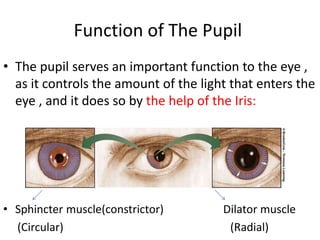
• The pupil serves an important function to the eye ,
as it controls the amount of the light that enters the
eye , and it does so by the help of the Iris:
• Sphincter muscle(constrictor) Dilator muscle
(Circular) (Radial)
Physiology of The Pupil
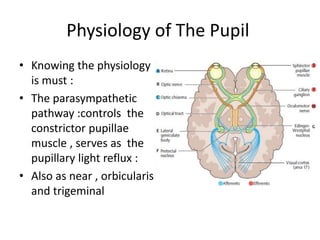
• Knowing the physiology
is must :
• The parasympathetic
pathway :controls the
constrictor pupillae
muscle , serves as the
pupillary light reflux :
• Also as near , orbicularis
and trigeminal
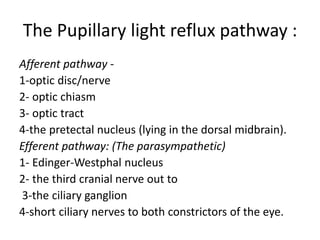
The Pupillary light reflux pathway :
Afferent pathway -
1-optic disc/nerve
2- optic chiasm
3- optic tract
4-the pretectal nucleus (lying in the dorsal midbrain).
Efferent pathway: (The parasympathetic)
1- Edinger-Westphal nucleus
2- the third cranial nerve out to
3-the ciliary ganglion
4-short ciliary nerves to both constrictors of the eye.
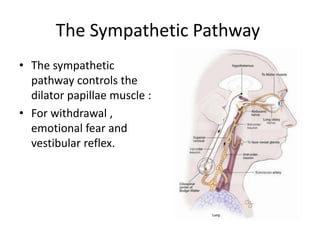
The Sympathetic Pathway
• The sympathetic
pathway controls the
dilator papillae muscle :
• For withdrawal ,
emotional fear and
vestibular reflex.
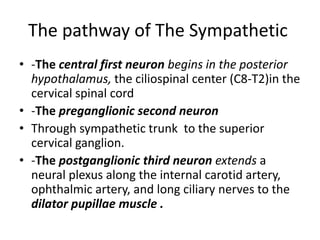
The pathway of The Sympathetic
• -The central first neuron begins in the posterior
hypothalamus, the ciliospinal center (C8-T2)in the
cervical spinal cord
• -The preganglionic second neuron
• Through sympathetic trunk to the superior
cervical ganglion.
• -The postganglionic third neuron extends a
neural plexus along the internal carotid artery,
ophthalmic artery, and long ciliary nerves to the
dilator pupillae muscle .
Let’s Start to evaluate the Pupil
• General examination of the patient
• Provide helpful clues as to what is going on,
particularly where there is an underlying
neurological cause.
• Telltale neck scar and associated ptosis in
patients with Horner's syndrome or a
neurosurgical scar in patients with a 3rd nerve
palsy.
Pupil Examination
• Important terminologies :
• Examination consists of four steps :
AnisocoriaIsocoria
Unequal pupils size
(efferent or
unilateral)
Equal pupils size
(afferent or
bilateral)
1-Pupil Observation
• Start by a general observation, noting
1. The shape
2. The size of the pupil in ambient bright light.
Size is measured in millimetres and the
normal pupil ranges from 1-8 mm.
3. The symmetry.
2-Light reflex test
• Used to assess the integrity of the pupillary
light reflex pathway.
• Direct light reflex :
The examined eye is constricted when the light
is shown.
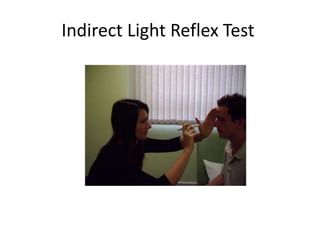
• Indirect (consensual) light reflex :
The fellow eye will constrict.
(don’t stand in the front of the patient!!)
Indirect Light Reflex Test
3- Swinging Flashlight Test
• Also known as (Marcus gunn test).
• Used to compare between direct and
consensual light reflex.
• It’s preformed by equal exposure of light to
each eye.
• Normally both pupils should be of the same
size and constricted.
• Abnormally if the pupil dilate if light is shown.
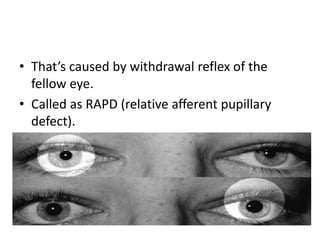
• That’s caused by withdrawal reflex of the
fellow eye.
• Called as RAPD (relative afferent pupillary
defect).
Near Reflex
• Used to test accommodation.
• Preformed by asking the patient to fixed at
distant the to bring it to a near object (arm’s
length).
• Normally the pupil will have a brisk
constriction.
• Near-light dissociation =significant better
pupillary near reflex than light reflex.
Normal Pupil Reactions
• Will be :
PERRLA, -MG
•Pupils Equal Round and
Responsive to Light and
Accommodation
•Negative Marcus Gunn response
Diagnosis Keys
• Determine which pupil is abnormal.
• Search for associated signs.
Disorders of the pupil may result from:
• Ocular disease.
• Disorders of the controlling neurological
pathway.
• Pharmacological action.
Anisocoria
• This is physiological in about 20% of people.
• How to assess it :
• An affected Large Pupil has poor constriction
in a well lit room.
• An affected small pupil has poor dilatation in
well lit room.
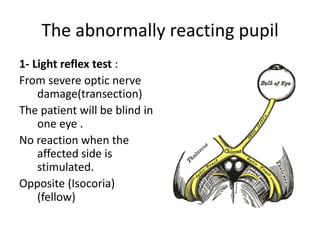
The abnormally reacting pupil
1- Light reflex test :
From severe optic nerve
damage(transection)
The patient will be blind in
one eye .
No reaction when the
affected side is
stimulated.
Opposite (Isocoria)
(fellow)
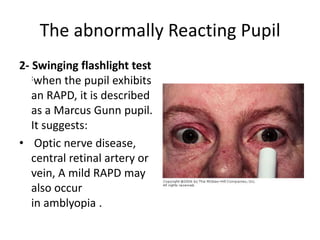
The abnormally Reacting Pupil
2- Swinging flashlight test
:when the pupil exhibits
an RAPD, it is described
as a Marcus Gunn pupil.
It suggests:
• Optic nerve disease,
central retinal artery or
vein, A mild RAPD may
also occur
in amblyopia .
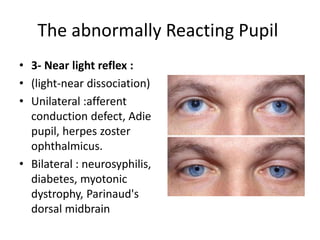
The abnormally Reacting Pupil
• 3- Near light reflex :
• (light-near dissociation)
• Unilateral :afferent
conduction defect, Adie
pupil, herpes zoster
ophthalmicus.
• Bilateral : neurosyphilis,
diabetes, myotonic
dystrophy, Parinaud's
dorsal midbrain
Diseases affecting the pupils
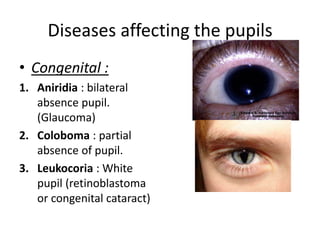
• Congenital :
1. Aniridia : bilateral
absence pupil.
(Glaucoma)
2. Coloboma : partial
absence of pupil.
3. Leukocoria : White
pupil (retinoblastoma
or congenital cataract)
Diseases affecting the pupils
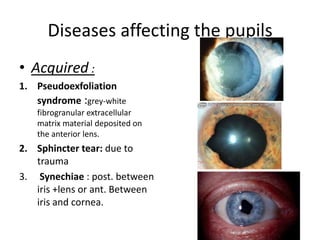
• Acquired :
1. Pseudoexfoliation
syndrome :grey-white
fibrogranular extracellular
matrix material deposited on
the anterior lens.
2. Sphincter tear: due to
trauma
3. Synechiae : post. between
iris +lens or ant. Between
iris and cornea.
Diseases affecting the pupils
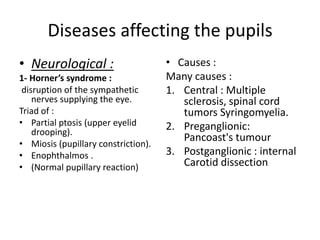
• Neurological :
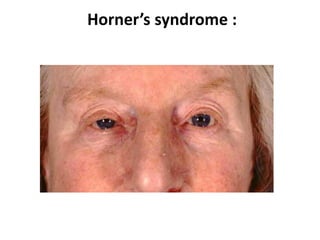
1- Horner’s syndrome :
disruption of the sympathetic
nerves supplying the eye.
Triad of :
• Partial ptosis (upper eyelid
drooping).
• Miosis (pupillary constriction).
• Enophthalmos .
• (Normal pupillary reaction)
• Causes :
Many causes :
1. Central : Multiple
sclerosis, spinal cord
tumors Syringomyelia.
2. Preganglionic:
Pancoast's tumour
3. Postganglionic : internal
Carotid dissection
Horner’s syndrome :
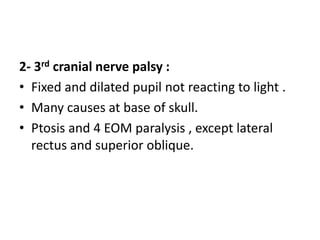
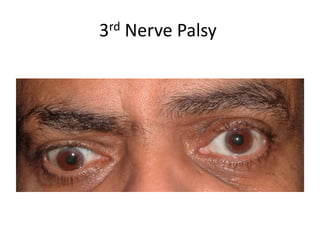
2- 3rd cranial nerve palsy :
• Fixed and dilated pupil not reacting to light .
• Many causes at base of skull.
• Ptosis and 4 EOM paralysis , except lateral
rectus and superior oblique.
3rd Nerve Palsy
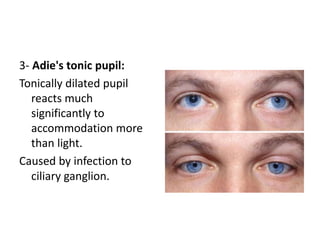
3- Adie's tonic pupil:
Tonically dilated pupil
reacts much
significantly to
accommodation more
than light.
Caused by infection to
ciliary ganglion.
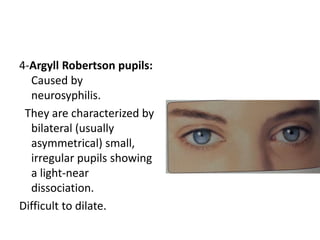
4-Argyll Robertson pupils:
Caused by
neurosyphilis.
They are characterized by
bilateral (usually
asymmetrical) small,
irregular pupils showing
a light-near
dissociation.
Difficult to dilate.
Drugs Affecting Pupil
•Mydriatics (bilateral or
unilateral )
• Topical : sympathomimetics
(eg, phenylephrine,
adrenaline) and
antimuscarinics (eg,
cyclopentolate,
tropicamide, atropine).
• Systemic:
sympathomimetics (eg,
adrenaline (epinephrine))
and antimuscarinics (eg,
atropine).
•Miotics (bilateral or unilateral)
• Topical : muscarinic
agonists (eg, pilocarpine).
• Systemic: opiates (eg,
morphine and
organophosphates).
Remember :
• Take a good history to help exclude an ocular
cause for the pupillary changes and to see if a
medical condition exists which may contribute
to the pupillary problem.
• Determine whether it is the small or the large
pupil that is abnormal.
• Search for associated signs that may help
make a diagnosis.
Resources :
• http://www.patient.co.uk/
• Lecture notes on ophthalmology 9th edition.
Thanxxxxxxxxxx

Abnormal Pupil Reactions

  • 1.
  • 2.
  • 3.
    Function of ThePupil • The pupil serves an important function to the eye , as it controls the amount of the light that enters the eye , and it does so by the help of the Iris: • Sphincter muscle(constrictor) Dilator muscle (Circular) (Radial)
  • 4.
    Physiology of ThePupil • Knowing the physiology is must : • The parasympathetic pathway :controls the constrictor pupillae muscle , serves as the pupillary light reflux : • Also as near , orbicularis and trigeminal
  • 5.
    The Pupillary lightreflux pathway : Afferent pathway - 1-optic disc/nerve 2- optic chiasm 3- optic tract 4-the pretectal nucleus (lying in the dorsal midbrain). Efferent pathway: (The parasympathetic) 1- Edinger-Westphal nucleus 2- the third cranial nerve out to 3-the ciliary ganglion 4-short ciliary nerves to both constrictors of the eye.
  • 6.
    The Sympathetic Pathway •The sympathetic pathway controls the dilator papillae muscle : • For withdrawal , emotional fear and vestibular reflex.
  • 7.
    The pathway ofThe Sympathetic • -The central first neuron begins in the posterior hypothalamus, the ciliospinal center (C8-T2)in the cervical spinal cord • -The preganglionic second neuron • Through sympathetic trunk to the superior cervical ganglion. • -The postganglionic third neuron extends a neural plexus along the internal carotid artery, ophthalmic artery, and long ciliary nerves to the dilator pupillae muscle .
  • 8.
    Let’s Start toevaluate the Pupil • General examination of the patient • Provide helpful clues as to what is going on, particularly where there is an underlying neurological cause. • Telltale neck scar and associated ptosis in patients with Horner's syndrome or a neurosurgical scar in patients with a 3rd nerve palsy.
  • 9.
    Pupil Examination • Importantterminologies : • Examination consists of four steps : AnisocoriaIsocoria Unequal pupils size (efferent or unilateral) Equal pupils size (afferent or bilateral)
  • 10.
    1-Pupil Observation • Startby a general observation, noting 1. The shape 2. The size of the pupil in ambient bright light. Size is measured in millimetres and the normal pupil ranges from 1-8 mm. 3. The symmetry.
  • 11.
    2-Light reflex test •Used to assess the integrity of the pupillary light reflex pathway. • Direct light reflex : The examined eye is constricted when the light is shown. • Indirect (consensual) light reflex : The fellow eye will constrict. (don’t stand in the front of the patient!!)
  • 12.
  • 13.
    3- Swinging FlashlightTest • Also known as (Marcus gunn test). • Used to compare between direct and consensual light reflex. • It’s preformed by equal exposure of light to each eye. • Normally both pupils should be of the same size and constricted. • Abnormally if the pupil dilate if light is shown.
  • 14.
    • That’s causedby withdrawal reflex of the fellow eye. • Called as RAPD (relative afferent pupillary defect).
  • 15.
    Near Reflex • Usedto test accommodation. • Preformed by asking the patient to fixed at distant the to bring it to a near object (arm’s length). • Normally the pupil will have a brisk constriction. • Near-light dissociation =significant better pupillary near reflex than light reflex.
  • 16.
    Normal Pupil Reactions •Will be : PERRLA, -MG •Pupils Equal Round and Responsive to Light and Accommodation •Negative Marcus Gunn response
  • 17.
    Diagnosis Keys • Determinewhich pupil is abnormal. • Search for associated signs. Disorders of the pupil may result from: • Ocular disease. • Disorders of the controlling neurological pathway. • Pharmacological action.
  • 18.
    Anisocoria • This isphysiological in about 20% of people. • How to assess it : • An affected Large Pupil has poor constriction in a well lit room. • An affected small pupil has poor dilatation in well lit room.
  • 19.
    The abnormally reactingpupil 1- Light reflex test : From severe optic nerve damage(transection) The patient will be blind in one eye . No reaction when the affected side is stimulated. Opposite (Isocoria) (fellow)
  • 20.
    The abnormally ReactingPupil 2- Swinging flashlight test :when the pupil exhibits an RAPD, it is described as a Marcus Gunn pupil. It suggests: • Optic nerve disease, central retinal artery or vein, A mild RAPD may also occur in amblyopia .
  • 21.
    The abnormally ReactingPupil • 3- Near light reflex : • (light-near dissociation) • Unilateral :afferent conduction defect, Adie pupil, herpes zoster ophthalmicus. • Bilateral : neurosyphilis, diabetes, myotonic dystrophy, Parinaud's dorsal midbrain
  • 22.
    Diseases affecting thepupils • Congenital : 1. Aniridia : bilateral absence pupil. (Glaucoma) 2. Coloboma : partial absence of pupil. 3. Leukocoria : White pupil (retinoblastoma or congenital cataract)
  • 23.
    Diseases affecting thepupils • Acquired : 1. Pseudoexfoliation syndrome :grey-white fibrogranular extracellular matrix material deposited on the anterior lens. 2. Sphincter tear: due to trauma 3. Synechiae : post. between iris +lens or ant. Between iris and cornea.
  • 24.
    Diseases affecting thepupils • Neurological : 1- Horner’s syndrome : disruption of the sympathetic nerves supplying the eye. Triad of : • Partial ptosis (upper eyelid drooping). • Miosis (pupillary constriction). • Enophthalmos . • (Normal pupillary reaction) • Causes : Many causes : 1. Central : Multiple sclerosis, spinal cord tumors Syringomyelia. 2. Preganglionic: Pancoast's tumour 3. Postganglionic : internal Carotid dissection
  • 25.
  • 26.
    2- 3rd cranialnerve palsy : • Fixed and dilated pupil not reacting to light . • Many causes at base of skull. • Ptosis and 4 EOM paralysis , except lateral rectus and superior oblique.
  • 27.
  • 28.
    3- Adie's tonicpupil: Tonically dilated pupil reacts much significantly to accommodation more than light. Caused by infection to ciliary ganglion.
  • 29.
    4-Argyll Robertson pupils: Causedby neurosyphilis. They are characterized by bilateral (usually asymmetrical) small, irregular pupils showing a light-near dissociation. Difficult to dilate.
  • 30.
    Drugs Affecting Pupil •Mydriatics(bilateral or unilateral ) • Topical : sympathomimetics (eg, phenylephrine, adrenaline) and antimuscarinics (eg, cyclopentolate, tropicamide, atropine). • Systemic: sympathomimetics (eg, adrenaline (epinephrine)) and antimuscarinics (eg, atropine). •Miotics (bilateral or unilateral) • Topical : muscarinic agonists (eg, pilocarpine). • Systemic: opiates (eg, morphine and organophosphates).
  • 31.
    Remember : • Takea good history to help exclude an ocular cause for the pupillary changes and to see if a medical condition exists which may contribute to the pupillary problem. • Determine whether it is the small or the large pupil that is abnormal. • Search for associated signs that may help make a diagnosis.
  • 32.
    Resources : • http://www.patient.co.uk/ •Lecture notes on ophthalmology 9th edition.
  • 33.