Viral Warts
Hatlan Alhatlan
211525898
Contents
• Warts
• HPV warts
• General characteristics
• Common warts
• Plantar warts
• Flat warts
• Genital warts
• Others
• Investigations
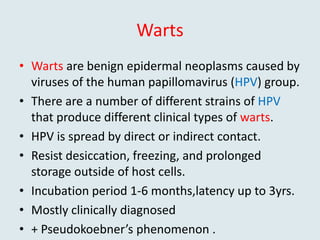
Warts
• Warts are benign epidermal neoplasms caused by
viruses of the human papillomavirus (HPV) group.
• There are a number of different strains of HPV
that produce different clinical types of warts.
• HPV is spread by direct or indirect contact.
• Resist desiccation, freezing, and prolonged
storage outside of host cells.
• Incubation period 1-6 months,latency up to 3yrs.
• Mostly clinically diagnosed
• + Pseudokoebner’s phenomenon .
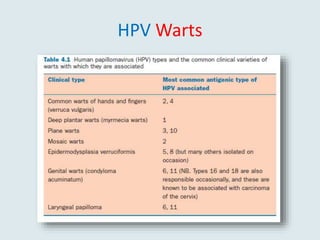
HPV Warts
General Warts Characters
• There are usually little black dots near the
surface of the wart, representing thrombosed
capillaries in elongated dermal papillae.
• In Immunocompromised, risk for squamous
cell carcinoma.
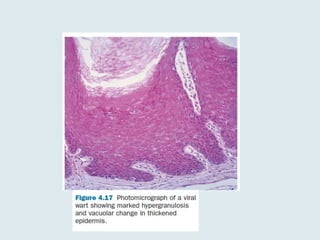
• There is epidermal thickening, with particular
increase in the granular cell layer, which also
shows a characteristic basophilic stippled
appearance.
Common Warts
• These are raised, cauliflower;like lesions that
occur most frequently on the hands.
• Common in children + early adulthood.
• They may be scattered, grouped or periungual
in distribution.
• Common warts in children usually resolve
spontaneously.
• Ttt: salicylic acid(12-20%), or lactic acid(4-
20%) for 3 months , if no response
cryotherapy with liquid nitrogen.
Common Warts
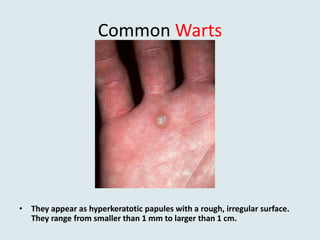
• They appear as hyperkeratotic papules with a rough, irregular surface.
They range from smaller than 1 mm to larger than 1 cm.
Plantar Warts
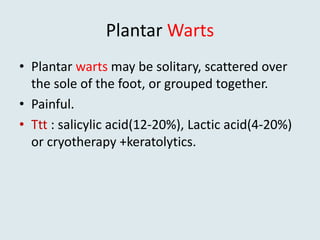
• Plantar warts may be solitary, scattered over
the sole of the foot, or grouped together.
• Painful.
• Ttt : salicylic acid(12-20%), Lactic acid(4-20%)
or cryotherapy +keratolytics.
Plantar Warts
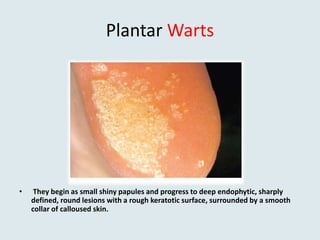
• They begin as small shiny papules and progress to deep endophytic, sharply
defined, round lesions with a rough keratotic surface, surrounded by a smooth
collar of calloused skin.
Plane Warts
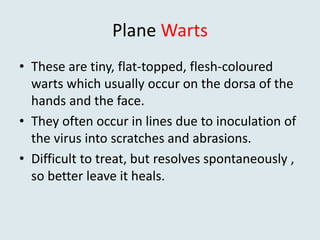
• These are tiny, flat-topped, flesh-coloured
warts which usually occur on the dorsa of the
hands and the face.
• They often occur in lines due to inoculation of
the virus into scratches and abrasions.
• Difficult to treat, but resolves spontaneously ,
so better leave it heals.
Plane Warts
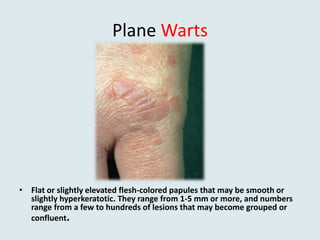
• Flat or slightly elevated flesh-colored papules that may be smooth or
slightly hyperkeratotic. They range from 1-5 mm or more, and numbers
range from a few to hundreds of lesions that may become grouped or
confluent.
Genital warts
• Known also as condylomata acuminata.
• HPV 6 & 11
• Sexually transmitted.
• Highly infectious.
• No cure , may resolve in its own or ablation
(cryotherapy, excision) and topicals
(Podophyllotoxin)
Genital warts
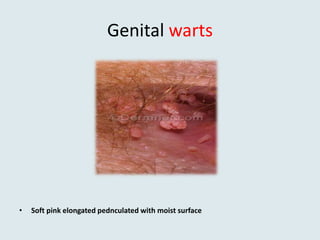
• Soft pink elongated pednculated with moist surface
Other Warts
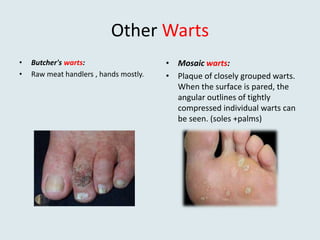
• Butcher's warts:
• Raw meat handlers , hands mostly.
• Mosaic warts:
• Plaque of closely grouped warts.
When the surface is pared, the
angular outlines of tightly
compressed individual warts can
be seen. (soles +palms)
Other Warts
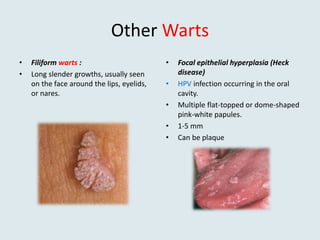
• Filiform warts :
• Long slender growths, usually seen
on the face around the lips, eyelids,
or nares.
• Focal epithelial hyperplasia (Heck
disease)
• HPV infection occurring in the oral
cavity.
• Multiple flat-topped or dome-shaped
pink-white papules.
• 1-5 mm
• Can be plaque
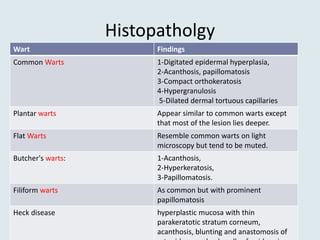
Histopatholgy
FindingsWart
1-Digitated epidermal hyperplasia,
2-Acanthosis, papillomatosis
3-Compact orthokeratosis
4-Hypergranulosis
5-Dilated dermal tortuous capillaries
Common Warts
Appear similar to common warts except
that most of the lesion lies deeper.
Plantar warts
Resemble common warts on light
microscopy but tend to be muted.
Flat Warts
1-Acanthosis,
2-Hyperkeratosis,
3-Papillomatosis.
Butcher's warts:
As common but with prominent
papillomatosis
Filiform warts
hyperplastic mucosa with thin
parakeratotic stratum corneum,
acanthosis, blunting and anastomosis of
Heck disease
Sources
1. Nongenital Warts
Author: Philip D Shenefelt, MD, MS; Chief Editor:
William D James, MD.
2. Lecture notes dermatology , 10th edition.
3. ROXBURGH’S Common Skin Diseases, 17th
edition.
thanxxxxxxxxxxx

Viral warts

  • 1.
  • 2.
    Contents • Warts • HPVwarts • General characteristics • Common warts • Plantar warts • Flat warts • Genital warts • Others • Investigations
  • 3.
    Warts • Warts arebenign epidermal neoplasms caused by viruses of the human papillomavirus (HPV) group. • There are a number of different strains of HPV that produce different clinical types of warts. • HPV is spread by direct or indirect contact. • Resist desiccation, freezing, and prolonged storage outside of host cells. • Incubation period 1-6 months,latency up to 3yrs. • Mostly clinically diagnosed • + Pseudokoebner’s phenomenon .
  • 4.
  • 5.
    General Warts Characters •There are usually little black dots near the surface of the wart, representing thrombosed capillaries in elongated dermal papillae. • In Immunocompromised, risk for squamous cell carcinoma. • There is epidermal thickening, with particular increase in the granular cell layer, which also shows a characteristic basophilic stippled appearance.
  • 7.
    Common Warts • Theseare raised, cauliflower;like lesions that occur most frequently on the hands. • Common in children + early adulthood. • They may be scattered, grouped or periungual in distribution. • Common warts in children usually resolve spontaneously. • Ttt: salicylic acid(12-20%), or lactic acid(4- 20%) for 3 months , if no response cryotherapy with liquid nitrogen.
  • 8.
    Common Warts • Theyappear as hyperkeratotic papules with a rough, irregular surface. They range from smaller than 1 mm to larger than 1 cm.
  • 9.
    Plantar Warts • Plantarwarts may be solitary, scattered over the sole of the foot, or grouped together. • Painful. • Ttt : salicylic acid(12-20%), Lactic acid(4-20%) or cryotherapy +keratolytics.
  • 10.
    Plantar Warts • Theybegin as small shiny papules and progress to deep endophytic, sharply defined, round lesions with a rough keratotic surface, surrounded by a smooth collar of calloused skin.
  • 11.
    Plane Warts • Theseare tiny, flat-topped, flesh-coloured warts which usually occur on the dorsa of the hands and the face. • They often occur in lines due to inoculation of the virus into scratches and abrasions. • Difficult to treat, but resolves spontaneously , so better leave it heals.
  • 12.
    Plane Warts • Flator slightly elevated flesh-colored papules that may be smooth or slightly hyperkeratotic. They range from 1-5 mm or more, and numbers range from a few to hundreds of lesions that may become grouped or confluent.
  • 13.
    Genital warts • Knownalso as condylomata acuminata. • HPV 6 & 11 • Sexually transmitted. • Highly infectious. • No cure , may resolve in its own or ablation (cryotherapy, excision) and topicals (Podophyllotoxin)
  • 14.
    Genital warts • Softpink elongated pednculated with moist surface
  • 15.
    Other Warts • Butcher'swarts: • Raw meat handlers , hands mostly. • Mosaic warts: • Plaque of closely grouped warts. When the surface is pared, the angular outlines of tightly compressed individual warts can be seen. (soles +palms)
  • 16.
    Other Warts • Filiformwarts : • Long slender growths, usually seen on the face around the lips, eyelids, or nares. • Focal epithelial hyperplasia (Heck disease) • HPV infection occurring in the oral cavity. • Multiple flat-topped or dome-shaped pink-white papules. • 1-5 mm • Can be plaque
  • 17.
    Histopatholgy FindingsWart 1-Digitated epidermal hyperplasia, 2-Acanthosis,papillomatosis 3-Compact orthokeratosis 4-Hypergranulosis 5-Dilated dermal tortuous capillaries Common Warts Appear similar to common warts except that most of the lesion lies deeper. Plantar warts Resemble common warts on light microscopy but tend to be muted. Flat Warts 1-Acanthosis, 2-Hyperkeratosis, 3-Papillomatosis. Butcher's warts: As common but with prominent papillomatosis Filiform warts hyperplastic mucosa with thin parakeratotic stratum corneum, acanthosis, blunting and anastomosis of Heck disease
  • 18.
    Sources 1. Nongenital Warts Author:Philip D Shenefelt, MD, MS; Chief Editor: William D James, MD. 2. Lecture notes dermatology , 10th edition. 3. ROXBURGH’S Common Skin Diseases, 17th edition.
  • 19.