SUPPLY CHAIN AND
LOGISTICS MANAGEMENT
Mr.Chethan.S,
Assistant Professor,
Department of Management,
Acharya Institute of Graduate Studies
1
2
3
CHAPTER-5
DEMAND MANAGEMENT
IN SUPPLY CHAIN
4
What do you mean by
Demand Management
in Supply Chain?
5
Introduction
● Each organization has a certain amount of demand for goods
and services. Managing this demand is necessary for an
organization to be successful and meet its goals.
● Demand management is a way to ensure that the demand for
something stays the same as the available amount.
● It is essential for businesses and organizations. Companies
can optimize resources and improve operational efficiency
by understanding and managing demand.
6
Meaning of Demand Management?
Demand management is the process of controlling
how much material a company needs. This is done
by predicting how much material will be used. In
other words, it is a system of analyzing customer
behavior and industry trends to improve the
effectiveness of marketing products and services.
The key factors determining demand management
are Pricing, Purchasing, and Supplier.
7
8
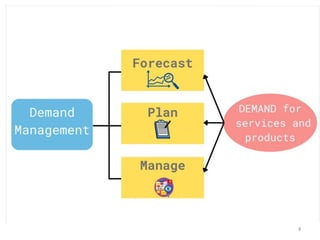
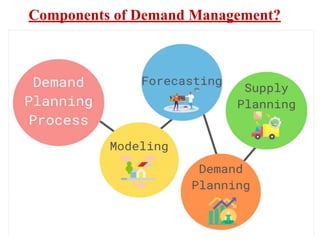
Components of Demand Management?
9
Continue….
1. Modeling: It is the process of representing reality in a simplified way that allows us to
understand and predict behavior. In other words, it is a means of understanding the past
to anticipate the future better.
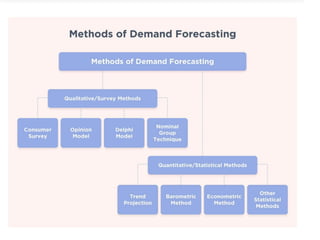
2. Demand Forecasting is the process of making predictions about future events based on
past data. This data can come from many sources, including historical sales.
3. Demand planning: Making a demand plan requires the right tools, information, and
operation. Depending on its strategic objectives, product positioning, and inventory
needs, it may be different for each organization.
4. Supply Planning: It determines the correct quantity of materials, parts, and products to
produce or procure to meet customer demand. It ensures that an organization has the
proper inventory to meet customer demand while maximizing profits.
10
Factors affecting Demand Mangement
Many factors will influence demand. Here I am listing a few factors.
External factors
● Market situations: It is a significant factor that directly affects the demand—for
example, recessions and strikes.
● Competitor’s step: If your competitor starts giving the same product or services with
good quality at less price, then there will be a chance of a sudden reduction of
demand for your product or service.
● Seasonality: Some products’ demand increases or decreases depending on seasons.
For example, ice cream, woolen cloths, umbrellas, school bags, etc.
● Trends: Market trend is one of the major factors that increases or decreases demand.
11
Continue….
Internal factors
● Pricing approach
● Maintenance
● Customer relationship
● Promotion and advertisement for products/services
● Product alteration
12
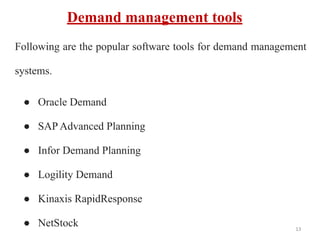
Demand management tools
Following are the popular software tools for demand management
systems.
● Oracle Demand
● SAP Advanced Planning
● Infor Demand Planning
● Logility Demand
● Kinaxis RapidResponse
● NetStock 13
14
Collaborative
planning demand
forecasting
15
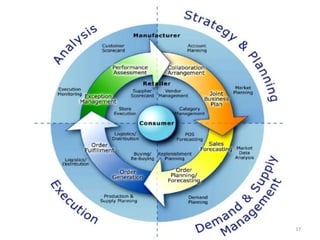
Collaborative Planning, Forecasting and
Replenishment (CPFR) is an approach which
aims to enhance supply chain integration by
supporting and assisting joint practices. CPFR
seeks cooperative management of inventory
through joint visibility and replenishment of
products throughout the supply chain.
16
17
18
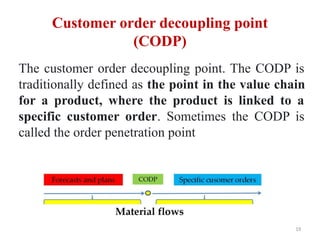
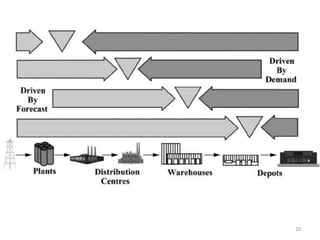
Customer order decoupling point
(CODP)
The customer order decoupling point. The CODP is
traditionally defined as the point in the value chain
for a product, where the product is linked to a
specific customer order. Sometimes the CODP is
called the order penetration point
19
20
21
Marketing
environment of
supply chain
22
23
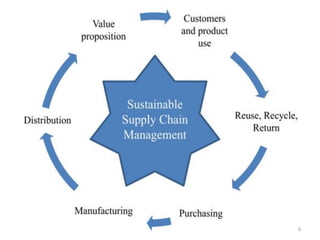
SUSTAINABILITY
24
25
26
27

DEMAND MANAGEMENT IN SUPPLY CHAIN

  • 1.
    SUPPLY CHAIN AND LOGISTICSMANAGEMENT Mr.Chethan.S, Assistant Professor, Department of Management, Acharya Institute of Graduate Studies 1
  • 2.
  • 3.
  • 4.
  • 5.
    What do youmean by Demand Management in Supply Chain? 5
  • 6.
    Introduction ● Each organizationhas a certain amount of demand for goods and services. Managing this demand is necessary for an organization to be successful and meet its goals. ● Demand management is a way to ensure that the demand for something stays the same as the available amount. ● It is essential for businesses and organizations. Companies can optimize resources and improve operational efficiency by understanding and managing demand. 6
  • 7.
    Meaning of DemandManagement? Demand management is the process of controlling how much material a company needs. This is done by predicting how much material will be used. In other words, it is a system of analyzing customer behavior and industry trends to improve the effectiveness of marketing products and services. The key factors determining demand management are Pricing, Purchasing, and Supplier. 7
  • 8.
  • 9.
    Components of DemandManagement? 9
  • 10.
    Continue…. 1. Modeling: Itis the process of representing reality in a simplified way that allows us to understand and predict behavior. In other words, it is a means of understanding the past to anticipate the future better. 2. Demand Forecasting is the process of making predictions about future events based on past data. This data can come from many sources, including historical sales. 3. Demand planning: Making a demand plan requires the right tools, information, and operation. Depending on its strategic objectives, product positioning, and inventory needs, it may be different for each organization. 4. Supply Planning: It determines the correct quantity of materials, parts, and products to produce or procure to meet customer demand. It ensures that an organization has the proper inventory to meet customer demand while maximizing profits. 10
  • 11.
    Factors affecting DemandMangement Many factors will influence demand. Here I am listing a few factors. External factors ● Market situations: It is a significant factor that directly affects the demand—for example, recessions and strikes. ● Competitor’s step: If your competitor starts giving the same product or services with good quality at less price, then there will be a chance of a sudden reduction of demand for your product or service. ● Seasonality: Some products’ demand increases or decreases depending on seasons. For example, ice cream, woolen cloths, umbrellas, school bags, etc. ● Trends: Market trend is one of the major factors that increases or decreases demand. 11
  • 12.
    Continue…. Internal factors ● Pricingapproach ● Maintenance ● Customer relationship ● Promotion and advertisement for products/services ● Product alteration 12
  • 13.
    Demand management tools Followingare the popular software tools for demand management systems. ● Oracle Demand ● SAP Advanced Planning ● Infor Demand Planning ● Logility Demand ● Kinaxis RapidResponse ● NetStock 13
  • 14.
  • 15.
  • 16.
    Collaborative Planning, Forecastingand Replenishment (CPFR) is an approach which aims to enhance supply chain integration by supporting and assisting joint practices. CPFR seeks cooperative management of inventory through joint visibility and replenishment of products throughout the supply chain. 16
  • 17.
  • 18.
  • 19.
    Customer order decouplingpoint (CODP) The customer order decoupling point. The CODP is traditionally defined as the point in the value chain for a product, where the product is linked to a specific customer order. Sometimes the CODP is called the order penetration point 19
  • 20.
  • 21.
  • 22.
  • 23.
  • 24.
  • 25.
  • 26.
  • 27.