
Pharma Industry
Agenda :

 Introduction
 Major player
 SWOT
 Indian Scenario
 Global Scenario
 Future outlook
 Conclusion
Introduction


 In 1930, in Calcutta the first pharmaceutical company called Bengal
  Chemicals and Pharmaceutical Works, which still is today as one of 5
  government-owned drug manufacturers was started.

 The history of Indian pharmaceutical market in 1970's was almost non-
  existent. Today, India has gained immense importance and carved a
  niche for itself in the pharmaceutical domain. In fact, it has emerged as
  a big mart for the pharmaceutical industry.

 Formulations, bulk drugs, generics, Novel Drug Delivery Systems, New
  Chemical Entities, or Biotechnology, etc. Indian companies are
  dominating in the marketplace which was traditionally manned by
  MNC.
Contd..


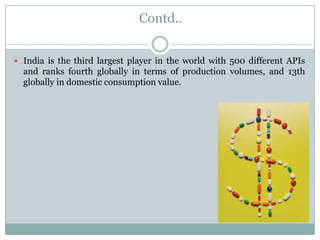
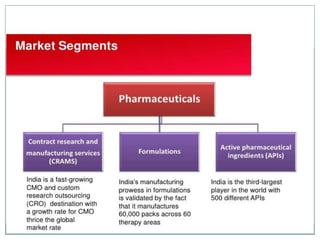
 India is the third largest player in the world with 500 different APIs
  and ranks fourth globally in terms of production volumes, and 13th
  globally in domestic consumption value.
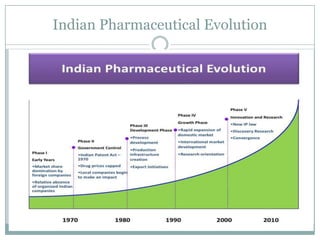
Indian Pharmaceutical Evolution
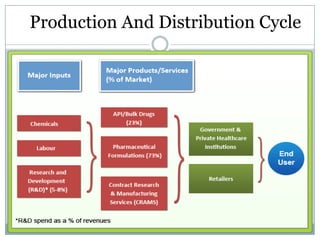
Production And Distribution Cycle
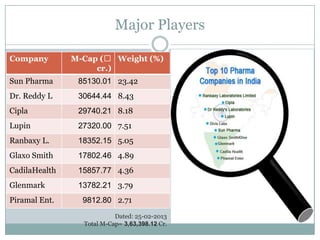
Major Players

Company        M-Cap (₹ Weight (%)
                    cr.)
Sun Pharma      85130.01 23.42
Dr. Reddy L     30644.44 8.43
Cipla           29740.21 8.18
Lupin           27320.00 7.51
Ranbaxy L.      18352.15 5.05
Glaxo Smith     17802.46 4.89
CadilaHealth    15857.77 4.36
Glenmark        13782.21 3.79
Piramal Ent.     9812.80 2.71
                           Dated: 25-02-2013
                 Total M-Cap= 3,63,398.12 Cr.
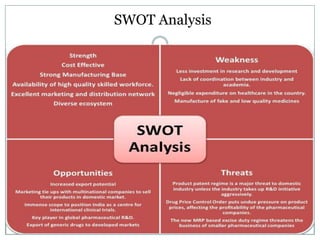
SWOT Analysis
Indian Scenario

    India is now among the top five pharmaceutical emerging markets, Pharmaceutical
    industry contributed 1.71% of GDP in 2011.

 Domestic formulation market stood at Rs 58,300 crore (US$ 10.88 billion) and has been
  ranked third in terms of volume and tenth in terms of value, globally.
 The country is the largest exporter globally of generic formulations in volume.


   The growing size of the Indian geriatric population will be a key factor in influencing the
    growth of the chronic segment.

   The Indian population is experiencing a shift in disease profiles. Traditionally, the acute
    disease segment held a significant share of the Indian pharmaceutical market.

   The varied functions such as contract research and manufacturing, clinical research,
    research and development pertaining to vaccines are the strengths of the Pharma
    Industry in India. Multinational pharmaceutical corporations outsource these activities
    and help the growth of the sector. The Indian Pharmaceutical Industry has a bright
    future.
Global Scenario

 The Indian Pharmaceutical Industry is one of fastest emerging
  international center for contract research and manufacturing services
  or CRAMS.

 The main factors for the growth of the CRAMS is due to the
  international standard quality and low cost.

 US constitutes 27 percent of India's pharma exports, followed by
  Europe 19 percent, Africa 17 percent, Middle East seven percent, Latin
  America six percent and CIS Countries five percent.

 Exports of pharmaceuticals in 2004 was Rs 17,000 crore.In the last
  nine years, it reported a strong growth and in 2012, exports stood at Rs
  63,500 crore.
Contd….

 For the period ending Mar 31, 2013, we are contemplating to grow by
  25 percent to around Rs 75,000 crore", Pharmexcil Director General
  Appaji PV.

 Around 50 more new manufacturing units are to be set up in
  accordance to the USFDA and UK Medicines and Healthcare
  Regulatory Agency (MHRA) standards.

 With all these development India is posed to become the biggest
  producer of drugs in the world.

 Indian already has the biggest number of US Food and Drug
  Administration (USFDA) standardized manufacturing units outside the
  territory of United States.
Future Outlook

 India's pharmaceutical sector is expected to touch US$ 74 billion in
  sales by 2020 from the current US$ 11 billion, according to a
  PricewaterhouseCoopers (PwC) report.

 The Indian pharmaceutical market is expected to grow at a compound
  annual growth rate (CAGR) of 14-17 per cent over 2012-16.

 The   outlook on the Indian pharmaceutical industry remains
  favorable, according to a report by ICRA and Moody's.

 The Indian Pharmaceutical sector is also expected to be among the top
  ten Pharma based markets in the world in the next ten years.

 The national Pharma market would experience the rise in the sales of
  the patent drugs.
Contd…

 With the increase in the medical infrastructure, the health services
  would be transformed and it would help the growth of the Pharma
  industry further.

 With the   large concentration of multi national pharmaceutical
  companies in India, it becomes easier to attract foreign direct
  investments .

 The Pharma industry in India is one of the major foreign direct
  investments encouraging sectors.
Conclusion

           Step required for boosting competitiveness….
 Industry –academic relationship can be further explored.


 Income tax exemptions should be given on clinical trials & contract
  research done outside the company & abroad.

 Spurious drug problem should be tackled.


 India should exploit its age old know how on traditional & herbal
  medicines.

 Govt. should provide TAX holidays for some specific periods, so that
  Indian companies can exploit the opportunity arising from patented
  drug & take up marketing of GENERICS t0 US.
Contd…

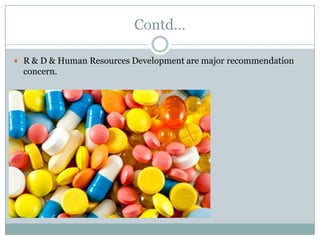
 R & D & Human Resources Development are major recommendation
  concern.
Indian Pharma Industry

Indian Pharma Industry

  • 1.
  • 2.
    Agenda :  Introduction Major player  SWOT  Indian Scenario  Global Scenario  Future outlook  Conclusion
  • 3.
    Introduction  In 1930,in Calcutta the first pharmaceutical company called Bengal Chemicals and Pharmaceutical Works, which still is today as one of 5 government-owned drug manufacturers was started.  The history of Indian pharmaceutical market in 1970's was almost non- existent. Today, India has gained immense importance and carved a niche for itself in the pharmaceutical domain. In fact, it has emerged as a big mart for the pharmaceutical industry.  Formulations, bulk drugs, generics, Novel Drug Delivery Systems, New Chemical Entities, or Biotechnology, etc. Indian companies are dominating in the marketplace which was traditionally manned by MNC.
  • 4.
    Contd..  India isthe third largest player in the world with 500 different APIs and ranks fourth globally in terms of production volumes, and 13th globally in domestic consumption value.
  • 5.
  • 6.
  • 7.
    Major Players Company M-Cap (₹ Weight (%) cr.) Sun Pharma 85130.01 23.42 Dr. Reddy L 30644.44 8.43 Cipla 29740.21 8.18 Lupin 27320.00 7.51 Ranbaxy L. 18352.15 5.05 Glaxo Smith 17802.46 4.89 CadilaHealth 15857.77 4.36 Glenmark 13782.21 3.79 Piramal Ent. 9812.80 2.71 Dated: 25-02-2013 Total M-Cap= 3,63,398.12 Cr.
  • 8.
  • 9.
    Indian Scenario  India is now among the top five pharmaceutical emerging markets, Pharmaceutical industry contributed 1.71% of GDP in 2011.  Domestic formulation market stood at Rs 58,300 crore (US$ 10.88 billion) and has been ranked third in terms of volume and tenth in terms of value, globally.  The country is the largest exporter globally of generic formulations in volume.  The growing size of the Indian geriatric population will be a key factor in influencing the growth of the chronic segment.  The Indian population is experiencing a shift in disease profiles. Traditionally, the acute disease segment held a significant share of the Indian pharmaceutical market.  The varied functions such as contract research and manufacturing, clinical research, research and development pertaining to vaccines are the strengths of the Pharma Industry in India. Multinational pharmaceutical corporations outsource these activities and help the growth of the sector. The Indian Pharmaceutical Industry has a bright future.
  • 11.
    Global Scenario  TheIndian Pharmaceutical Industry is one of fastest emerging international center for contract research and manufacturing services or CRAMS.  The main factors for the growth of the CRAMS is due to the international standard quality and low cost.  US constitutes 27 percent of India's pharma exports, followed by Europe 19 percent, Africa 17 percent, Middle East seven percent, Latin America six percent and CIS Countries five percent.  Exports of pharmaceuticals in 2004 was Rs 17,000 crore.In the last nine years, it reported a strong growth and in 2012, exports stood at Rs 63,500 crore.
  • 12.
    Contd….  For theperiod ending Mar 31, 2013, we are contemplating to grow by 25 percent to around Rs 75,000 crore", Pharmexcil Director General Appaji PV.  Around 50 more new manufacturing units are to be set up in accordance to the USFDA and UK Medicines and Healthcare Regulatory Agency (MHRA) standards.  With all these development India is posed to become the biggest producer of drugs in the world.  Indian already has the biggest number of US Food and Drug Administration (USFDA) standardized manufacturing units outside the territory of United States.
  • 13.
    Future Outlook  India'spharmaceutical sector is expected to touch US$ 74 billion in sales by 2020 from the current US$ 11 billion, according to a PricewaterhouseCoopers (PwC) report.  The Indian pharmaceutical market is expected to grow at a compound annual growth rate (CAGR) of 14-17 per cent over 2012-16.  The outlook on the Indian pharmaceutical industry remains favorable, according to a report by ICRA and Moody's.  The Indian Pharmaceutical sector is also expected to be among the top ten Pharma based markets in the world in the next ten years.  The national Pharma market would experience the rise in the sales of the patent drugs.
  • 14.
    Contd…  With theincrease in the medical infrastructure, the health services would be transformed and it would help the growth of the Pharma industry further.  With the large concentration of multi national pharmaceutical companies in India, it becomes easier to attract foreign direct investments .  The Pharma industry in India is one of the major foreign direct investments encouraging sectors.
  • 15.
    Conclusion Step required for boosting competitiveness….  Industry –academic relationship can be further explored.  Income tax exemptions should be given on clinical trials & contract research done outside the company & abroad.  Spurious drug problem should be tackled.  India should exploit its age old know how on traditional & herbal medicines.  Govt. should provide TAX holidays for some specific periods, so that Indian companies can exploit the opportunity arising from patented drug & take up marketing of GENERICS t0 US.
  • 16.
    Contd…  R &D & Human Resources Development are major recommendation concern.