The organization of the
  conversion process
Types of Production Systems
• A process is a group of related tasks with
  specific inputs and outputs. processes exist to
  create value for the customers, the
  shareholders or society. process design
  defines what tasks need to be done and how
  they are to be coordinated among functions,
  people and organizations. Process technology
  refers to the collection of equipment, people
  and procedures used to produce the firm’s
  products and services.
                                                    2
• The organization of manufacturing systems,
  planning and control of production depends
  on type of product and product line. The
  following are the types of production systems.
1. Job Shop:
• Production of small batches of a large number
  of different products, most of which require a
  different set of processing steps. Examples
  include commercial printing firms, airplane
  manufacturers and plants that make custom
  designed printed circuit boards are of this
                                               3
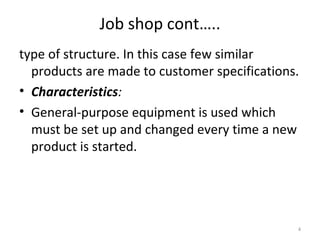
Job shop cont…..
type of structure. In this case few similar
  products are made to customer specifications.
• Characteristics:
• General-purpose equipment is used which
  must be set up and changed every time a new
  product is started.


                                              4
2. Batch Production/technology/flow
• These systems process many different jobs
  through the system in groups (or batches).
• It is characterized by fluctuating demand,
  short production runs of a wide variety of
  products, and small to moderate quantities of
  any given product made to customer order,
  general purpose equipment is used which
  must be set up and changed every time a new
  product is started, flexibility is required, skilled
  workers are needed.
                                                     5
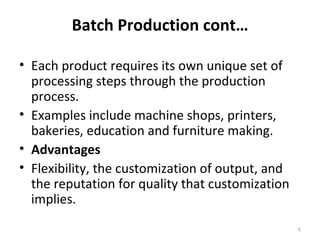
Batch Production cont…

• Each product requires its own unique set of
  processing steps through the production
  process.
• Examples include machine shops, printers,
  bakeries, education and furniture making.
• Advantages
• Flexibility, the customization of output, and
  the reputation for quality that customization
  implies.
                                                  6
Batch Production cont…

• Disadvantages
• High per-unit costs, frequent changes in
  product mix, complex scheduling problems,
  variations in capacity requirements and
  lengthy job completion times


                                              7
Mass production/ Assembly line technology
• Mass production is also called repetitive
  production. It produces large volumes of a
  standard product for a mass market. Demand
  is stable and volume is high. The system is
  basically capital intensive, with specialised
  equipment, limited variety of the product and
  limited labour skills. It is usually associated
  with assembly lines or flow lines.
• Examples; automobiles, televisions, personal
  computers, fast foods, newspaper publishing
  and consumer goods
                                                    8
• Advantages:
• It is efficient, low per-unit cost, ease of
  manufacture and control, and speed.
• Disadvantages:
• High cost of equipment, underutilization of
  human capabilities, difficulties of adopting to
  changes in demand, technology, or product
  design and lack of responsiveness to individual
  customer requests.

                                                9
Continuous production/ technology
• These are used for very high volume
  commodity products, which are highly
  standardized. Materials and products are
  produced in continuous endless flows rather
  than in batches. The system is highly
  automated and operation goes on continually
  on a 24 hr basis. Out put is also continuous.
  Examples; steel paper, paints, chemicals,
  breweries and foodstuffs. Companies that
  operate in this fashion are referred to as
  process industries.
                                              10
• Advantages:
• Efficiency, ease of control, and enormous
  capacity.
• Disadvantages
• Large investment in plant and equipment,
  limited variety of items that can be processed,
  the inability to adapt to volume changes, the
  cost of correcting errors in production and the
  difficulties of keeping pace with new
  technology.
                                                11
Examples of production systems
• Job shop: Tailors shop, cycle and repair shops,
  job typing shops etc
• Batch production shop: cosmetic
  manufacturing companies, drug
  manufacturing companies etc
• Mass production shop: News paper
  companies, components of industrial products
  etc
• Flow production: cement factory, sugar
  factory, oil refinery etc
                                                12
Reading assignment two
• Method study, work measurement and
  framework


                                       13

Organisation's operation's management

  • 1.
    The organization ofthe conversion process
  • 2.
    Types of ProductionSystems • A process is a group of related tasks with specific inputs and outputs. processes exist to create value for the customers, the shareholders or society. process design defines what tasks need to be done and how they are to be coordinated among functions, people and organizations. Process technology refers to the collection of equipment, people and procedures used to produce the firm’s products and services. 2
  • 3.
    • The organizationof manufacturing systems, planning and control of production depends on type of product and product line. The following are the types of production systems. 1. Job Shop: • Production of small batches of a large number of different products, most of which require a different set of processing steps. Examples include commercial printing firms, airplane manufacturers and plants that make custom designed printed circuit boards are of this 3
  • 4.
    Job shop cont….. typeof structure. In this case few similar products are made to customer specifications. • Characteristics: • General-purpose equipment is used which must be set up and changed every time a new product is started. 4
  • 5.
    2. Batch Production/technology/flow •These systems process many different jobs through the system in groups (or batches). • It is characterized by fluctuating demand, short production runs of a wide variety of products, and small to moderate quantities of any given product made to customer order, general purpose equipment is used which must be set up and changed every time a new product is started, flexibility is required, skilled workers are needed. 5
  • 6.
    Batch Production cont… •Each product requires its own unique set of processing steps through the production process. • Examples include machine shops, printers, bakeries, education and furniture making. • Advantages • Flexibility, the customization of output, and the reputation for quality that customization implies. 6
  • 7.
    Batch Production cont… •Disadvantages • High per-unit costs, frequent changes in product mix, complex scheduling problems, variations in capacity requirements and lengthy job completion times 7
  • 8.
    Mass production/ Assemblyline technology • Mass production is also called repetitive production. It produces large volumes of a standard product for a mass market. Demand is stable and volume is high. The system is basically capital intensive, with specialised equipment, limited variety of the product and limited labour skills. It is usually associated with assembly lines or flow lines. • Examples; automobiles, televisions, personal computers, fast foods, newspaper publishing and consumer goods 8
  • 9.
    • Advantages: • Itis efficient, low per-unit cost, ease of manufacture and control, and speed. • Disadvantages: • High cost of equipment, underutilization of human capabilities, difficulties of adopting to changes in demand, technology, or product design and lack of responsiveness to individual customer requests. 9
  • 10.
    Continuous production/ technology •These are used for very high volume commodity products, which are highly standardized. Materials and products are produced in continuous endless flows rather than in batches. The system is highly automated and operation goes on continually on a 24 hr basis. Out put is also continuous. Examples; steel paper, paints, chemicals, breweries and foodstuffs. Companies that operate in this fashion are referred to as process industries. 10
  • 11.
    • Advantages: • Efficiency,ease of control, and enormous capacity. • Disadvantages • Large investment in plant and equipment, limited variety of items that can be processed, the inability to adapt to volume changes, the cost of correcting errors in production and the difficulties of keeping pace with new technology. 11
  • 12.
    Examples of productionsystems • Job shop: Tailors shop, cycle and repair shops, job typing shops etc • Batch production shop: cosmetic manufacturing companies, drug manufacturing companies etc • Mass production shop: News paper companies, components of industrial products etc • Flow production: cement factory, sugar factory, oil refinery etc 12
  • 13.
    Reading assignment two •Method study, work measurement and framework 13