Amity Global Business School

PRESENTATION ON:
HISTORY OF PRODUCTION AND
OPERATIONS MANAGEMENT

Presented by:
Prashant Ranka
B.B.A VI sem.
Production management?
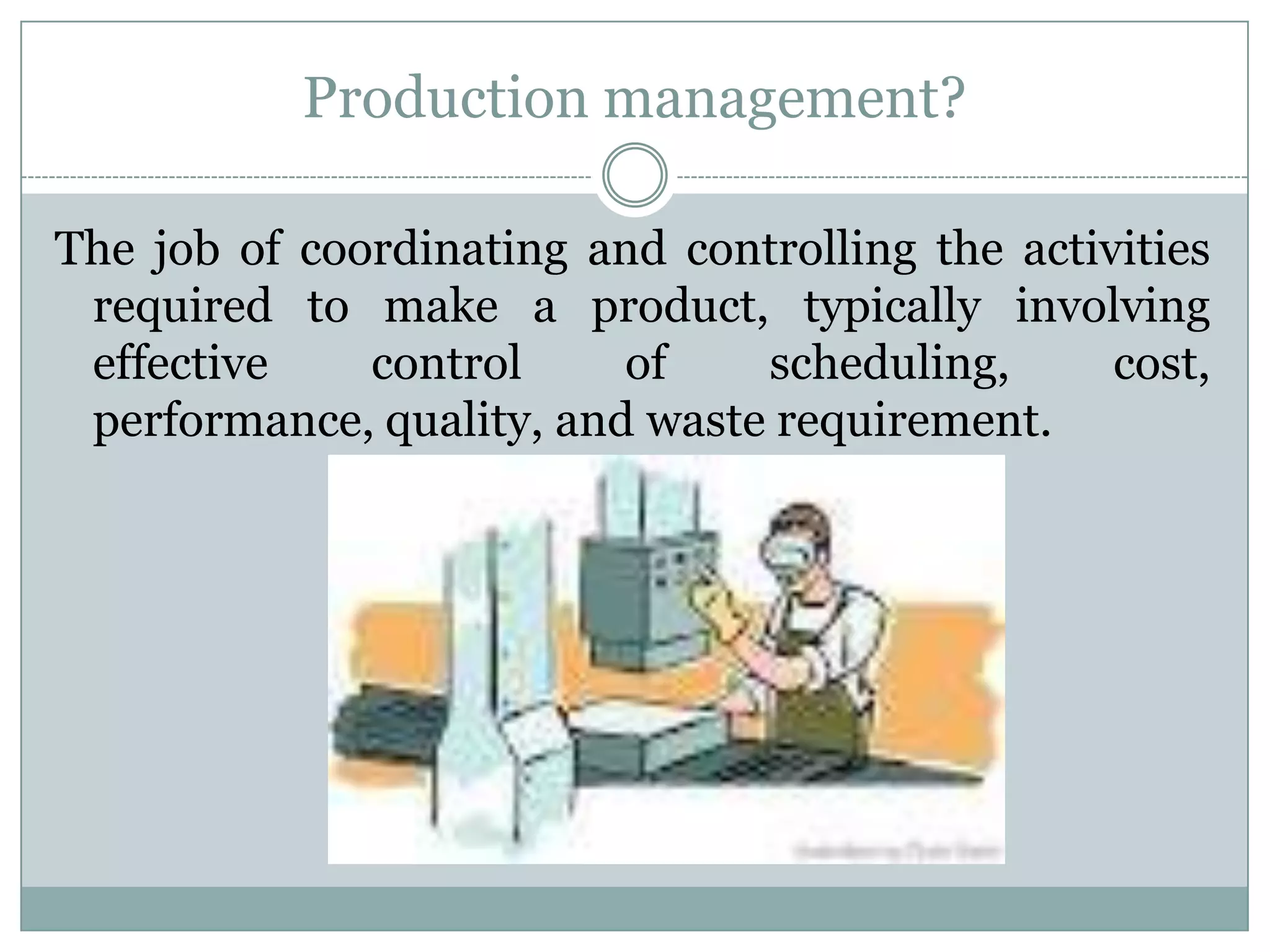
The job of coordinating and controlling the activities
required to make a product, typically involving
effective
control
of
scheduling,
cost,
performance, quality, and waste requirement.
Operations management?
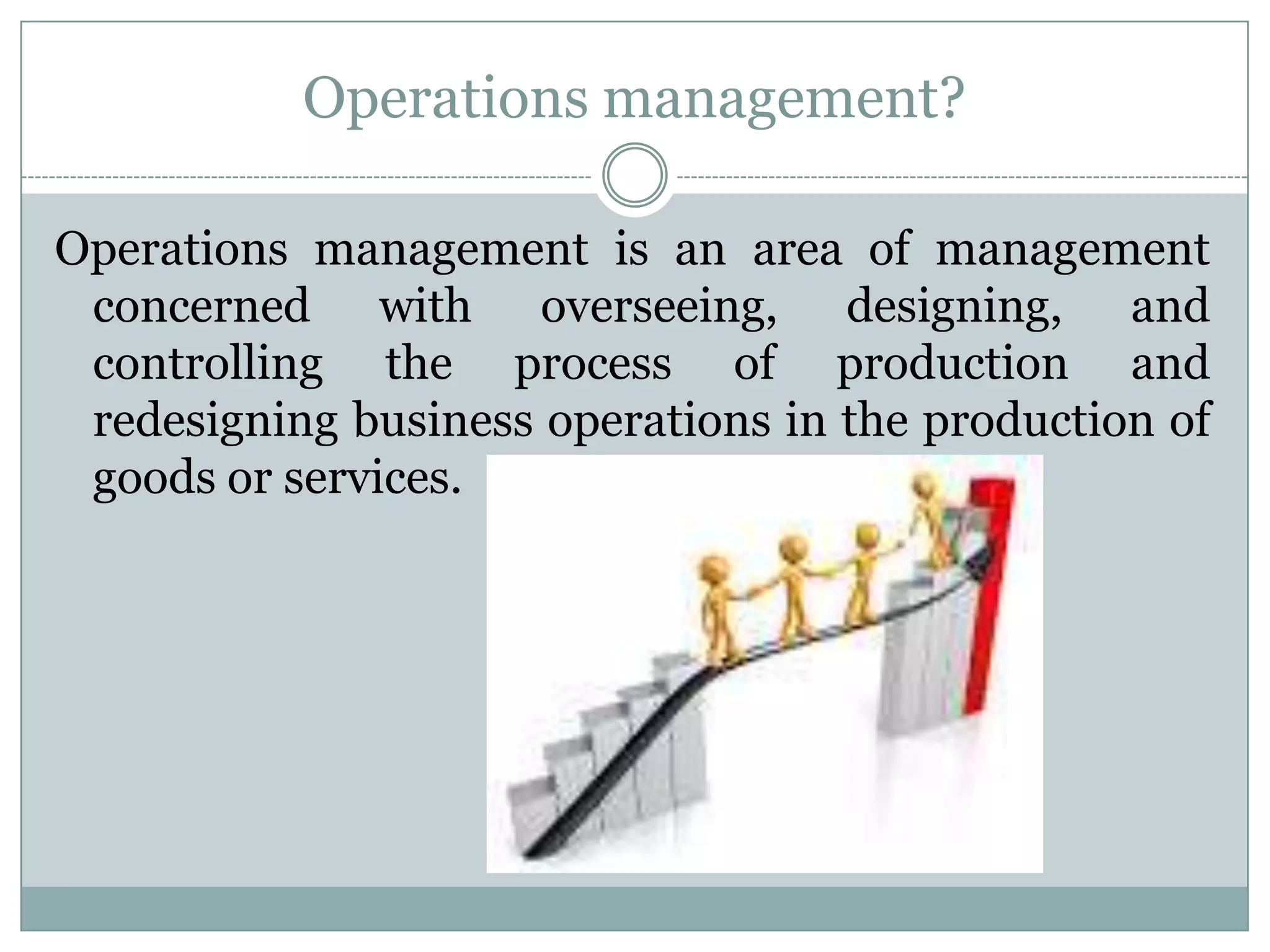
Operations management is an area of management
concerned with overseeing, designing, and
controlling the process of production and
redesigning business operations in the production of
goods or services.
Twin definition
Conversion of inputs into outputs using physical
resources and process to provide the desired utility
to customers while meeting the other organizational
objectives of effectiveness, efficiency & adaptability.
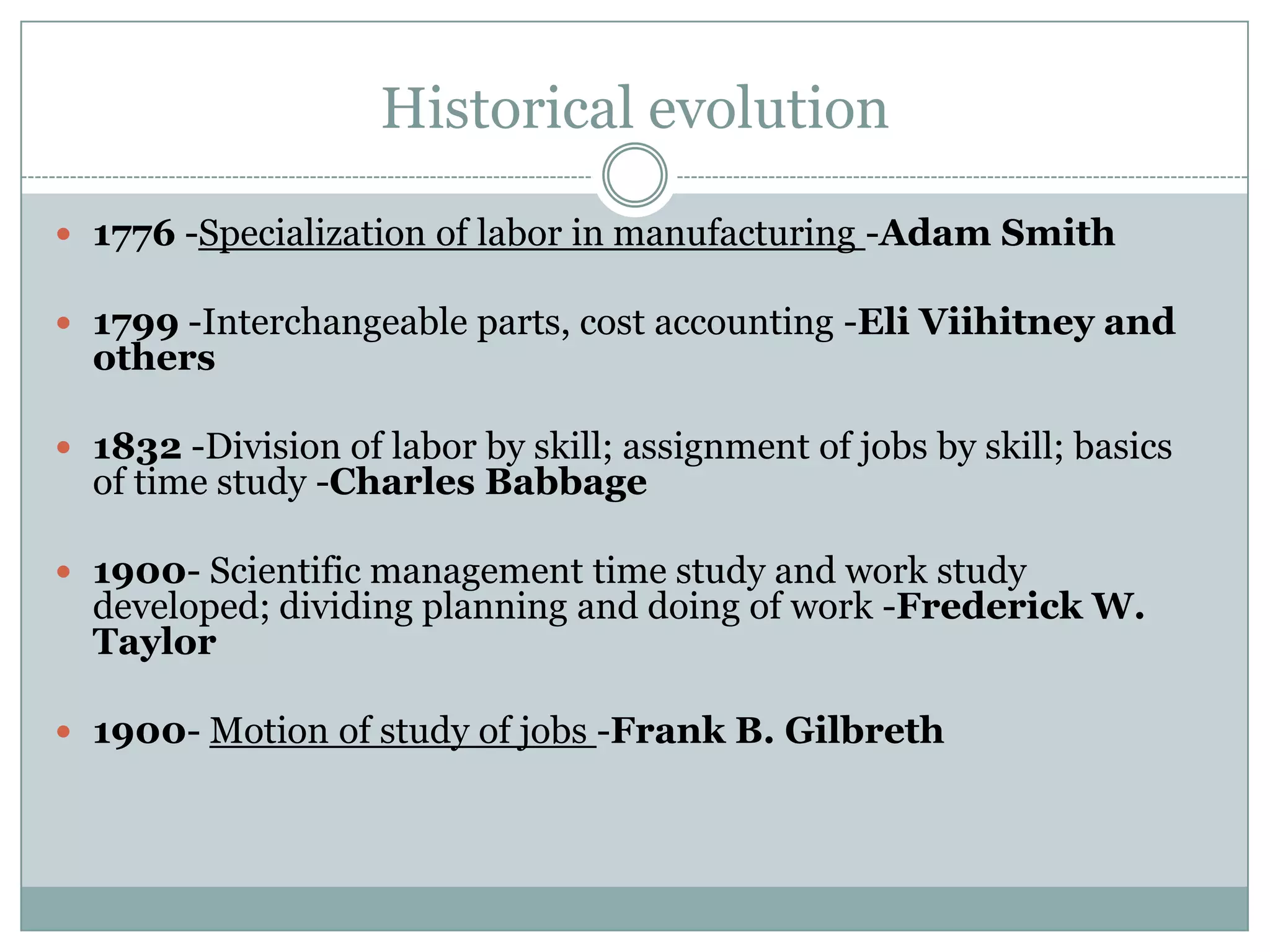
Historical evolution
 1776 -Specialization of labor in manufacturing -Adam Smith

 1799 -Interchangeable parts, cost accounting -Eli Viihitney and

others

 1832 -Division of labor by skill; assignment of jobs by skill; basics

of time study -Charles Babbage

 1900- Scientific management time study and work study

developed; dividing planning and doing of work -Frederick W.
Taylor

 1900- Motion of study of jobs -Frank B. Gilbreth
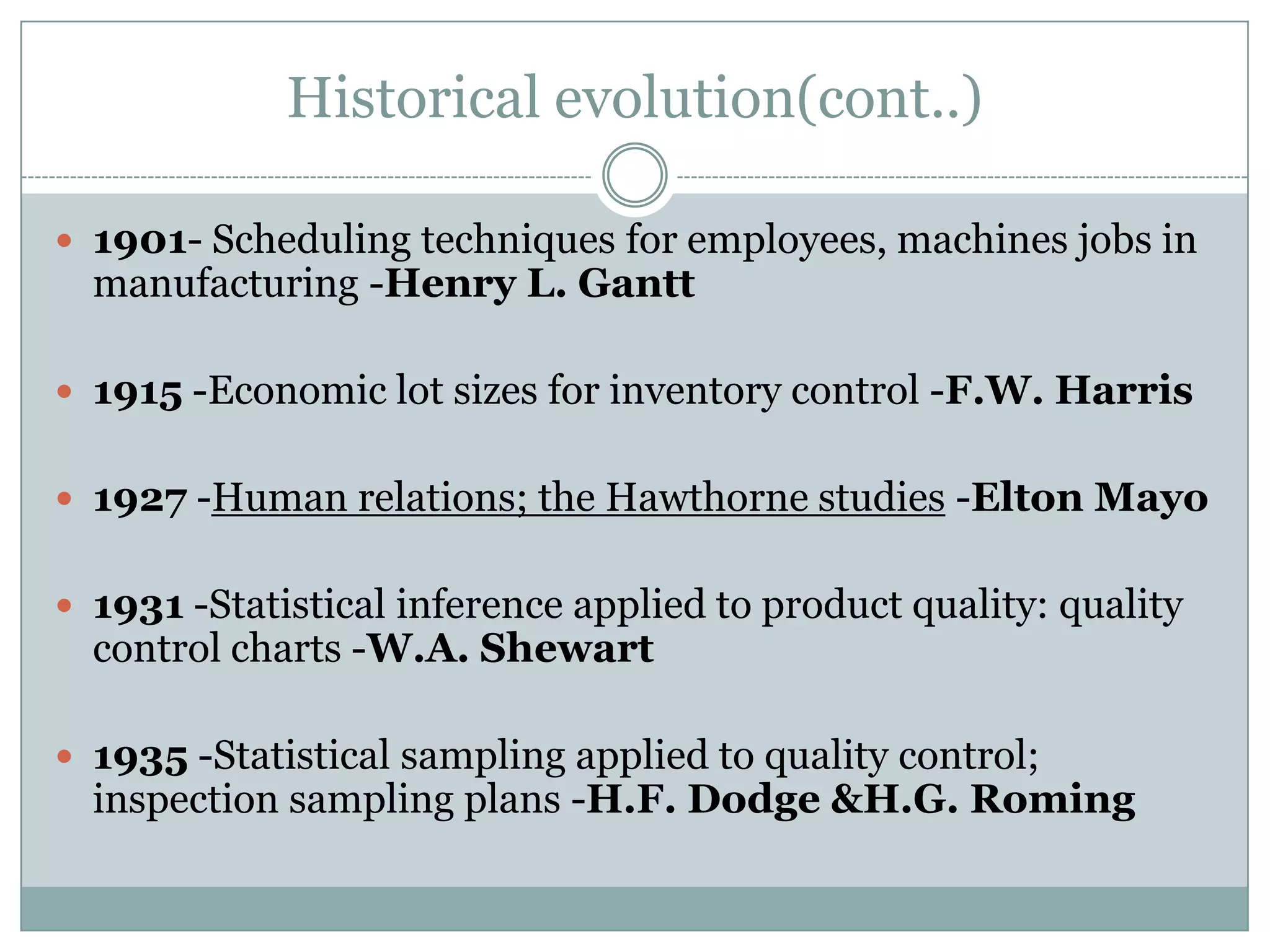
Historical evolution(cont..)
 1901- Scheduling techniques for employees, machines jobs in

manufacturing -Henry L. Gantt

 1915 -Economic lot sizes for inventory control -F.W. Harris
 1927 -Human relations; the Hawthorne studies -Elton Mayo
 1931 -Statistical inference applied to product quality: quality

control charts -W.A. Shewart

 1935 -Statistical sampling applied to quality control;

inspection sampling plans -H.F. Dodge &H.G. Roming
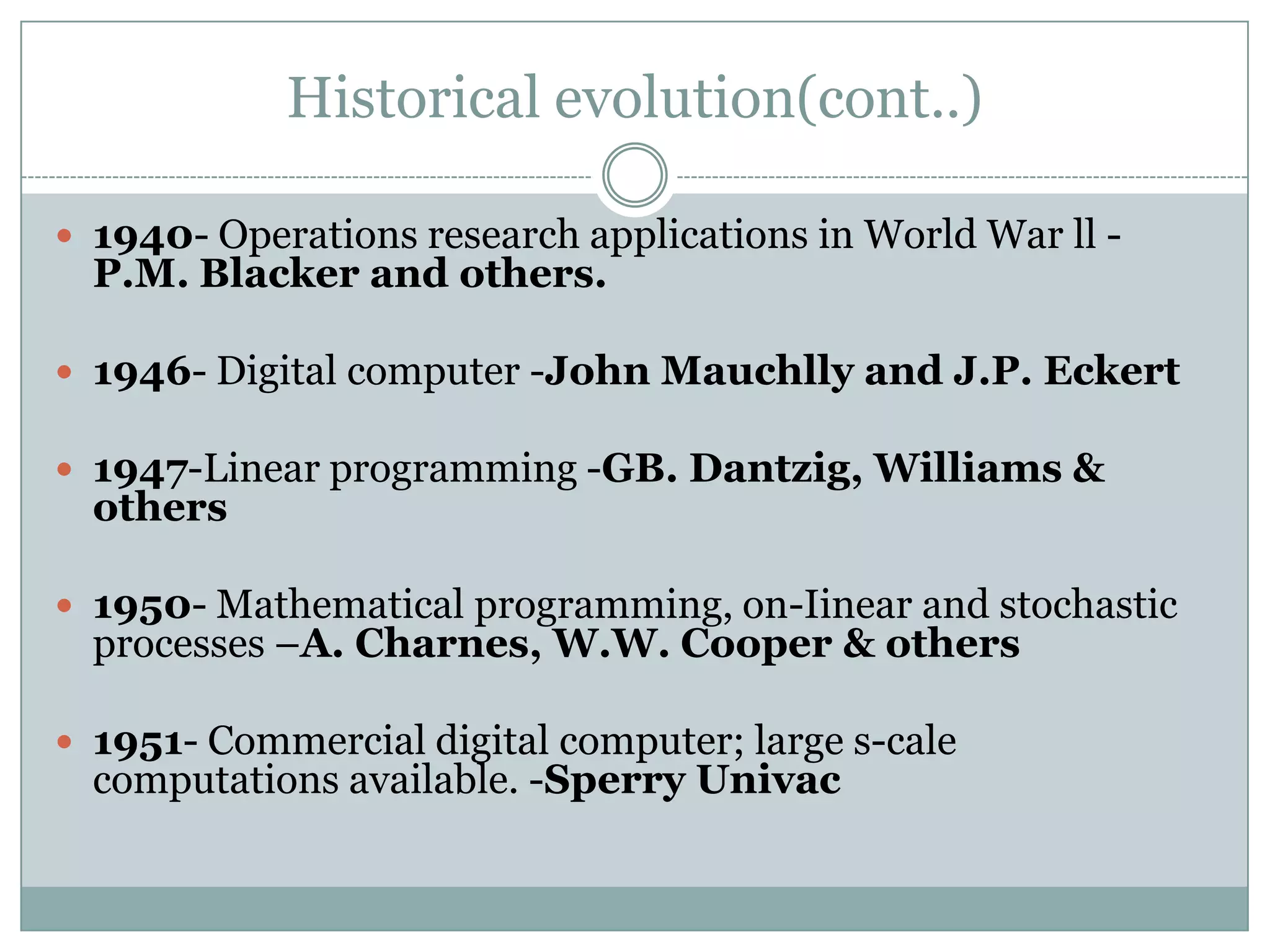
Historical evolution(cont..)
 1940- Operations research applications in World War ll -

P.M. Blacker and others.

 1946- Digital computer -John Mauchlly and J.P. Eckert
 1947-Linear programming -GB. Dantzig, Williams &

others

 1950- Mathematical programming, on-Iinear and stochastic

processes –A. Charnes, W.W. Cooper & others

 1951- Commercial digital computer; large s-cale

computations available. -Sperry Univac
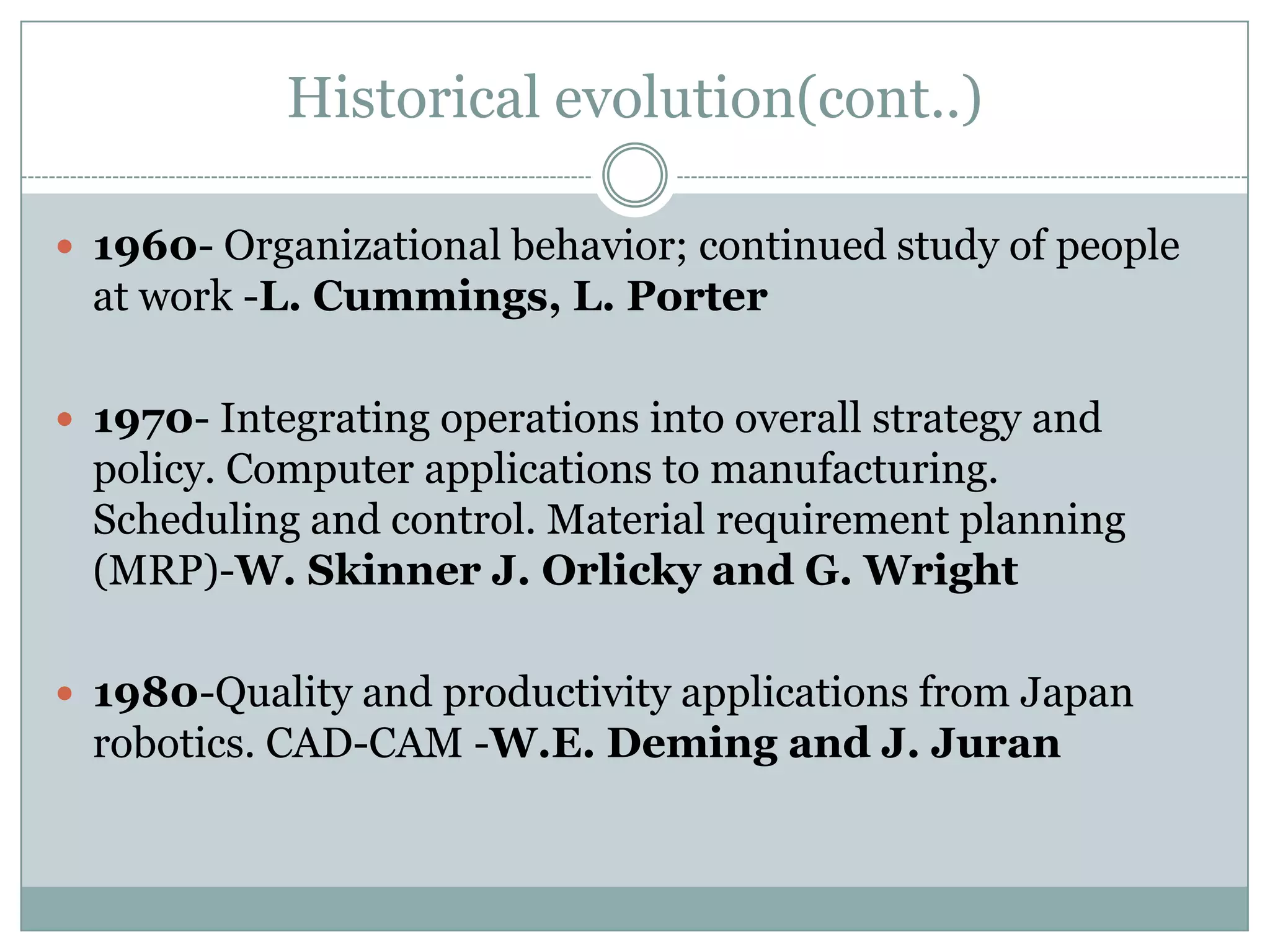
Historical evolution(cont..)
 1960- Organizational behavior; continued study of people

at work -L. Cummings, L. Porter
 1970- Integrating operations into overall strategy and

policy. Computer applications to manufacturing.
Scheduling and control. Material requirement planning
(MRP)-W. Skinner J. Orlicky and G. Wright
 1980-Quality and productivity applications from Japan

robotics. CAD-CAM -W.E. Deming and J. Juran
Specialization of labour in manufacturing
 The specialization theory was devised by Adam Smith.
 The specialization theory is better known as division of

labour.
 The theory was created for specialized knowledge of a
particular trade or task, also known as self interest.
 Division of labour involved in the production of a
particular product leads to increased productivity
Specialization of labour(cont..)
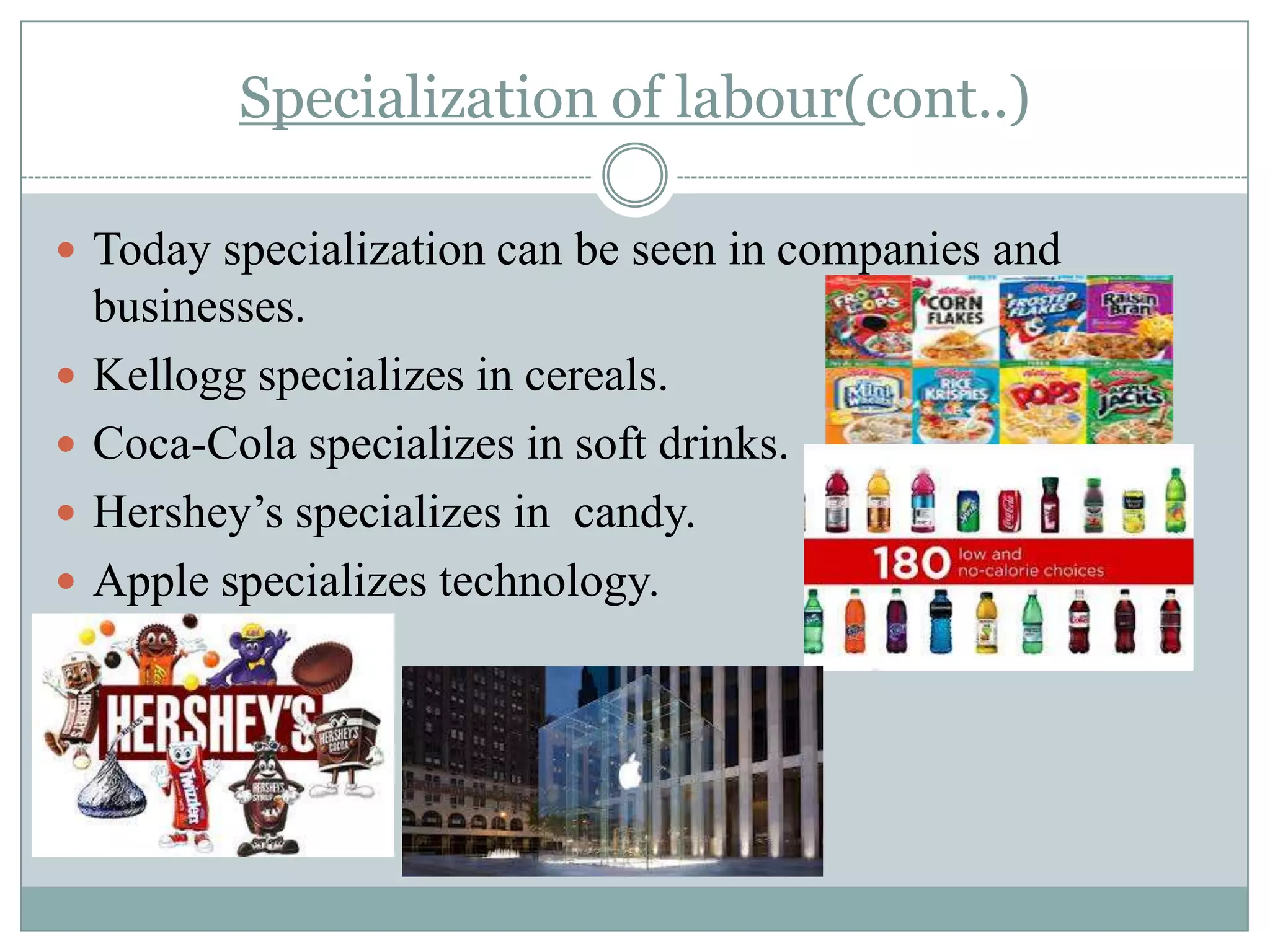
 Today specialization can be seen in companies and





businesses.
Kellogg specializes in cereals.
Coca-Cola specializes in soft drinks.
Hershey’s specializes in candy.
Apple specializes technology.
Motion of study of jobs
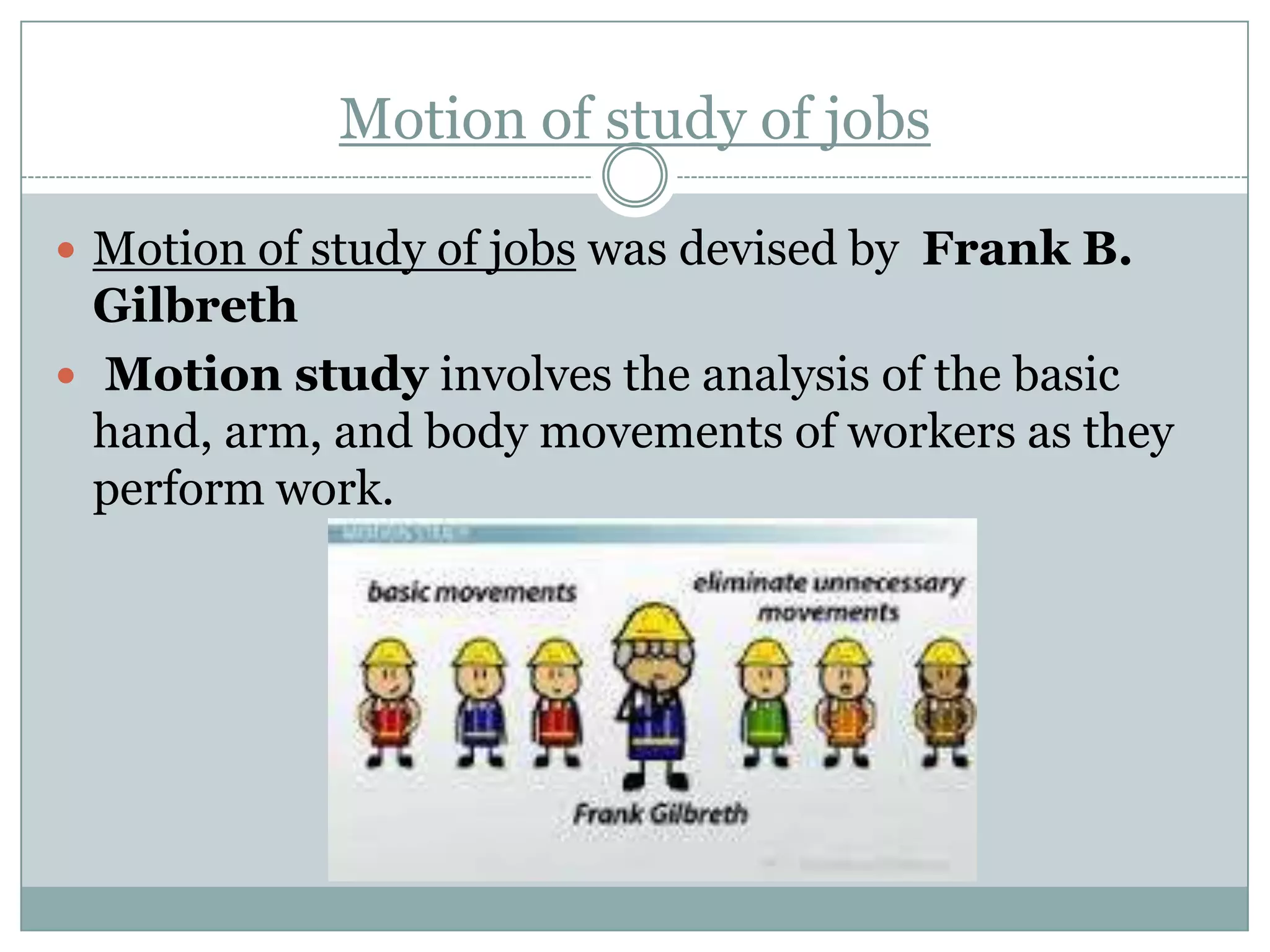
 Motion of study of jobs was devised by Frank B.

Gilbreth
 Motion study involves the analysis of the basic
hand, arm, and body movements of workers as they
perform work.
Human relations
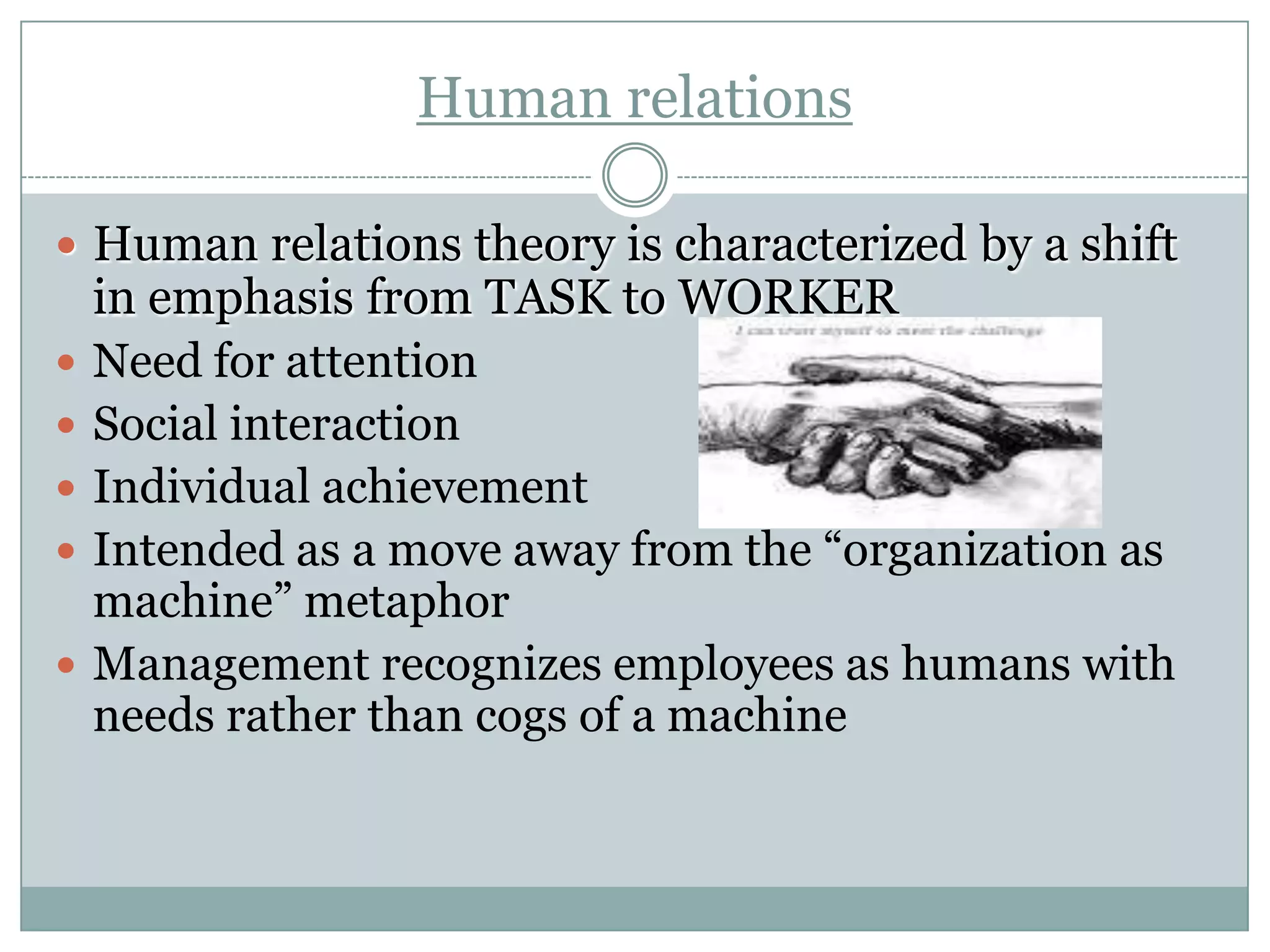
 Human relations theory is characterized by a shift







in emphasis from TASK to WORKER
Need for attention
Social interaction
Individual achievement
Intended as a move away from the “organization as
machine” metaphor
Management recognizes employees as humans with
needs rather than cogs of a machine
The Hawthorne studies
 “The Hawthorne Studies were conducted from 1927-1932 at

the Western Electric Hawthorne Works in Chicago, where
Harvard Business School Professor Elton Mayo examined
productivity and work conditions.”
 “Mayo wanted to find out what effect fatigue and monotony
had on job productivity and how to control them through
such variables as rest breaks, work hours, temperatures and
humidity.”
Historical Milestones in OM
 The Industrial Revolution
 Post-Civil War Period
 Scientific Management
 Operations Research
 The Service Revolution
 The Computer Revolution
The Industrial Revolution
 The industrial revolution developed in England in

the 1700s.
 The steam engine, invented by James Watt in 1764,
largely replaced human and water power for
factories.
 Adam Smith’s The Wealth of Nations in 1776 touted
the economic benefits of the specialization of labor.
 Thus the late-1700s factories had not only machine
power but also ways of planning and controlling the
tasks of workers
The Industrial Revolution(cont..)
 The industrial revolution spread from England to

other European countries and to the United Sates.
 In 1790 an American, Eli Whitney, developed the
concept of interchangeable parts.
 The first great industry in the US was the textile
industry.
 In the 1800s the development of the gasoline engine
and electricity further advanced the revolution.
Post-Civil War Period
 During the post-Civil War period great expansion of

production capacity occurred.
 By post-Civil War the following developments set the
stage for the great production explosion of the 20th
century:





increased capital and production capacity
the expanded urban workforce
new Western US markets
an effective national transportation system
Scientific Management
 Frederick Taylor is known as the father of scientific

management. His system employed these steps:









Each worker’s skill, strength, and learning ability were
determined.
Stopwatch studies were conducted to precisely set standard
output per worker on each task.
Material specifications, work methods, and routing sequences
were used to organize the shop.
Supervisors were carefully selected and trained.
Incentive pay systems were initiated.
Operations Research
 During World War II, enormous quantities of resources

(personnel, supplies, equipment, …) had to be deployed.
 Military operations research (OR) teams were formed to
deal with the complexity of the deployment.
 After the war, operations researchers found their way
back to universities, industry, government, and
consulting firms.
 OR helps operations managers make decisions when
problems are complex and wrong decisions are costly.
The Service Revolution
 The creation of services organizations accelerated






sharply after World War II.
Today, more than two-thirds of the US workforce is
employed in services.
About two-thirds of the US GDP is from services.
There is a huge trade surplus in services.
Investment per office worker now exceeds the
investment per factory worker.
Thus there is a growing need for service operations
management.
The Computer Revolution
 Explosive growth of computer and communication







technologies
Easy access to information and the availability of
more information
Advances in software applications such as Enterprise
Resource Planning (ERP) software
Widespread use of email
More and more firms becoming involved in EBusiness using the Internet
Result: faster, better decisions over greater distances
Thank You

History of production and operations management

  • 1.
    Amity Global BusinessSchool PRESENTATION ON: HISTORY OF PRODUCTION AND OPERATIONS MANAGEMENT Presented by: Prashant Ranka B.B.A VI sem.
  • 2.
    Production management? The jobof coordinating and controlling the activities required to make a product, typically involving effective control of scheduling, cost, performance, quality, and waste requirement.
  • 3.
    Operations management? Operations managementis an area of management concerned with overseeing, designing, and controlling the process of production and redesigning business operations in the production of goods or services.
  • 4.
    Twin definition Conversion ofinputs into outputs using physical resources and process to provide the desired utility to customers while meeting the other organizational objectives of effectiveness, efficiency & adaptability.
  • 5.
    Historical evolution  1776-Specialization of labor in manufacturing -Adam Smith  1799 -Interchangeable parts, cost accounting -Eli Viihitney and others  1832 -Division of labor by skill; assignment of jobs by skill; basics of time study -Charles Babbage  1900- Scientific management time study and work study developed; dividing planning and doing of work -Frederick W. Taylor  1900- Motion of study of jobs -Frank B. Gilbreth
  • 6.
    Historical evolution(cont..)  1901-Scheduling techniques for employees, machines jobs in manufacturing -Henry L. Gantt  1915 -Economic lot sizes for inventory control -F.W. Harris  1927 -Human relations; the Hawthorne studies -Elton Mayo  1931 -Statistical inference applied to product quality: quality control charts -W.A. Shewart  1935 -Statistical sampling applied to quality control; inspection sampling plans -H.F. Dodge &H.G. Roming
  • 7.
    Historical evolution(cont..)  1940-Operations research applications in World War ll - P.M. Blacker and others.  1946- Digital computer -John Mauchlly and J.P. Eckert  1947-Linear programming -GB. Dantzig, Williams & others  1950- Mathematical programming, on-Iinear and stochastic processes –A. Charnes, W.W. Cooper & others  1951- Commercial digital computer; large s-cale computations available. -Sperry Univac
  • 8.
    Historical evolution(cont..)  1960-Organizational behavior; continued study of people at work -L. Cummings, L. Porter  1970- Integrating operations into overall strategy and policy. Computer applications to manufacturing. Scheduling and control. Material requirement planning (MRP)-W. Skinner J. Orlicky and G. Wright  1980-Quality and productivity applications from Japan robotics. CAD-CAM -W.E. Deming and J. Juran
  • 9.
    Specialization of labourin manufacturing  The specialization theory was devised by Adam Smith.  The specialization theory is better known as division of labour.  The theory was created for specialized knowledge of a particular trade or task, also known as self interest.  Division of labour involved in the production of a particular product leads to increased productivity
  • 10.
    Specialization of labour(cont..) Today specialization can be seen in companies and     businesses. Kellogg specializes in cereals. Coca-Cola specializes in soft drinks. Hershey’s specializes in candy. Apple specializes technology.
  • 11.
    Motion of studyof jobs  Motion of study of jobs was devised by Frank B. Gilbreth  Motion study involves the analysis of the basic hand, arm, and body movements of workers as they perform work.
  • 12.
    Human relations  Humanrelations theory is characterized by a shift      in emphasis from TASK to WORKER Need for attention Social interaction Individual achievement Intended as a move away from the “organization as machine” metaphor Management recognizes employees as humans with needs rather than cogs of a machine
  • 13.
    The Hawthorne studies “The Hawthorne Studies were conducted from 1927-1932 at the Western Electric Hawthorne Works in Chicago, where Harvard Business School Professor Elton Mayo examined productivity and work conditions.”  “Mayo wanted to find out what effect fatigue and monotony had on job productivity and how to control them through such variables as rest breaks, work hours, temperatures and humidity.”
  • 14.
    Historical Milestones inOM  The Industrial Revolution  Post-Civil War Period  Scientific Management  Operations Research  The Service Revolution  The Computer Revolution
  • 15.
    The Industrial Revolution The industrial revolution developed in England in the 1700s.  The steam engine, invented by James Watt in 1764, largely replaced human and water power for factories.  Adam Smith’s The Wealth of Nations in 1776 touted the economic benefits of the specialization of labor.  Thus the late-1700s factories had not only machine power but also ways of planning and controlling the tasks of workers
  • 16.
    The Industrial Revolution(cont..) The industrial revolution spread from England to other European countries and to the United Sates.  In 1790 an American, Eli Whitney, developed the concept of interchangeable parts.  The first great industry in the US was the textile industry.  In the 1800s the development of the gasoline engine and electricity further advanced the revolution.
  • 17.
    Post-Civil War Period During the post-Civil War period great expansion of production capacity occurred.  By post-Civil War the following developments set the stage for the great production explosion of the 20th century:     increased capital and production capacity the expanded urban workforce new Western US markets an effective national transportation system
  • 18.
    Scientific Management  FrederickTaylor is known as the father of scientific management. His system employed these steps:      Each worker’s skill, strength, and learning ability were determined. Stopwatch studies were conducted to precisely set standard output per worker on each task. Material specifications, work methods, and routing sequences were used to organize the shop. Supervisors were carefully selected and trained. Incentive pay systems were initiated.
  • 19.
    Operations Research  DuringWorld War II, enormous quantities of resources (personnel, supplies, equipment, …) had to be deployed.  Military operations research (OR) teams were formed to deal with the complexity of the deployment.  After the war, operations researchers found their way back to universities, industry, government, and consulting firms.  OR helps operations managers make decisions when problems are complex and wrong decisions are costly.
  • 20.
    The Service Revolution The creation of services organizations accelerated      sharply after World War II. Today, more than two-thirds of the US workforce is employed in services. About two-thirds of the US GDP is from services. There is a huge trade surplus in services. Investment per office worker now exceeds the investment per factory worker. Thus there is a growing need for service operations management.
  • 21.
    The Computer Revolution Explosive growth of computer and communication      technologies Easy access to information and the availability of more information Advances in software applications such as Enterprise Resource Planning (ERP) software Widespread use of email More and more firms becoming involved in EBusiness using the Internet Result: faster, better decisions over greater distances
  • 22.