CHAPTER 3
PRODUCT DESIGN AND
PROCESS SELECTION
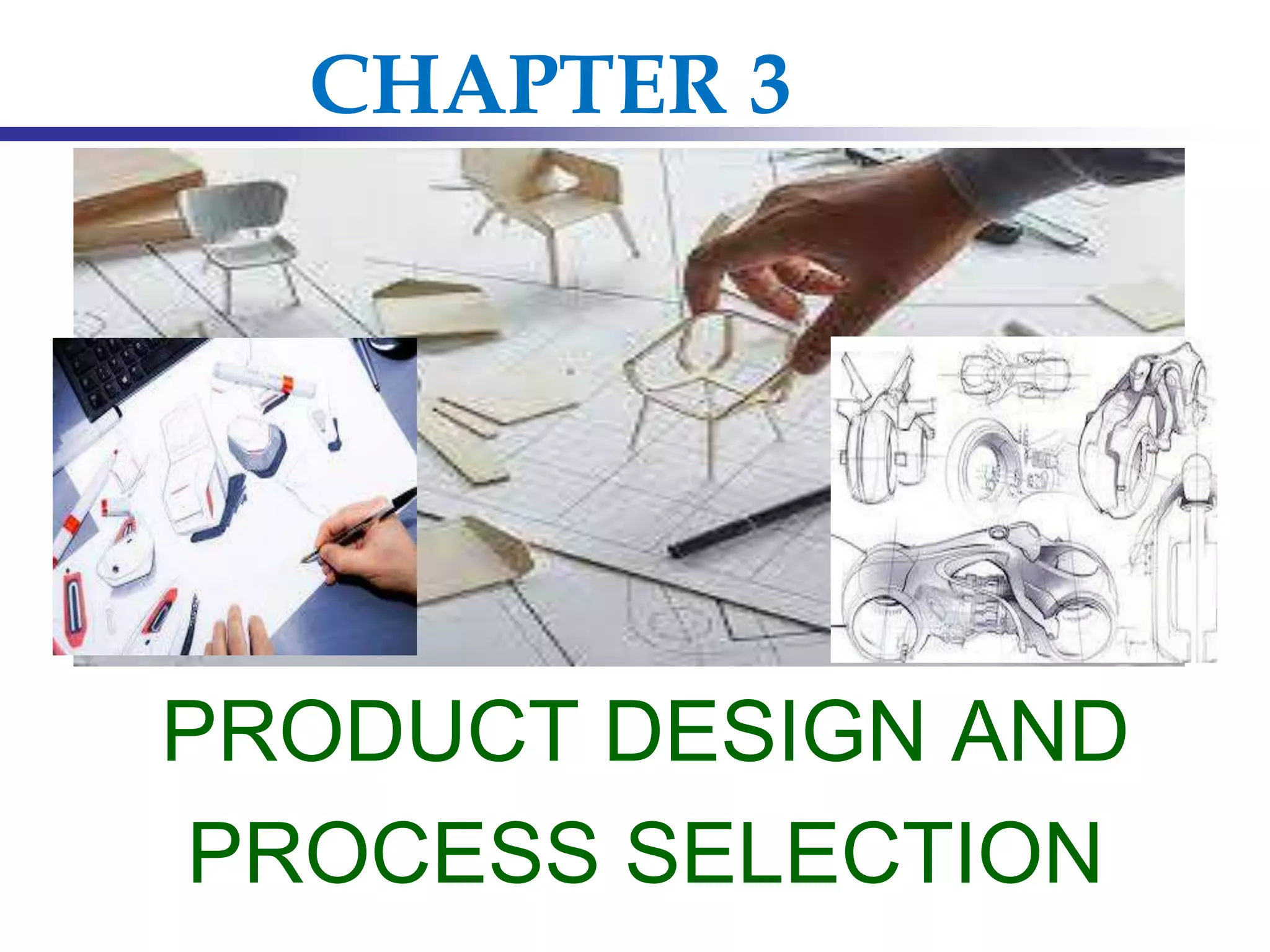
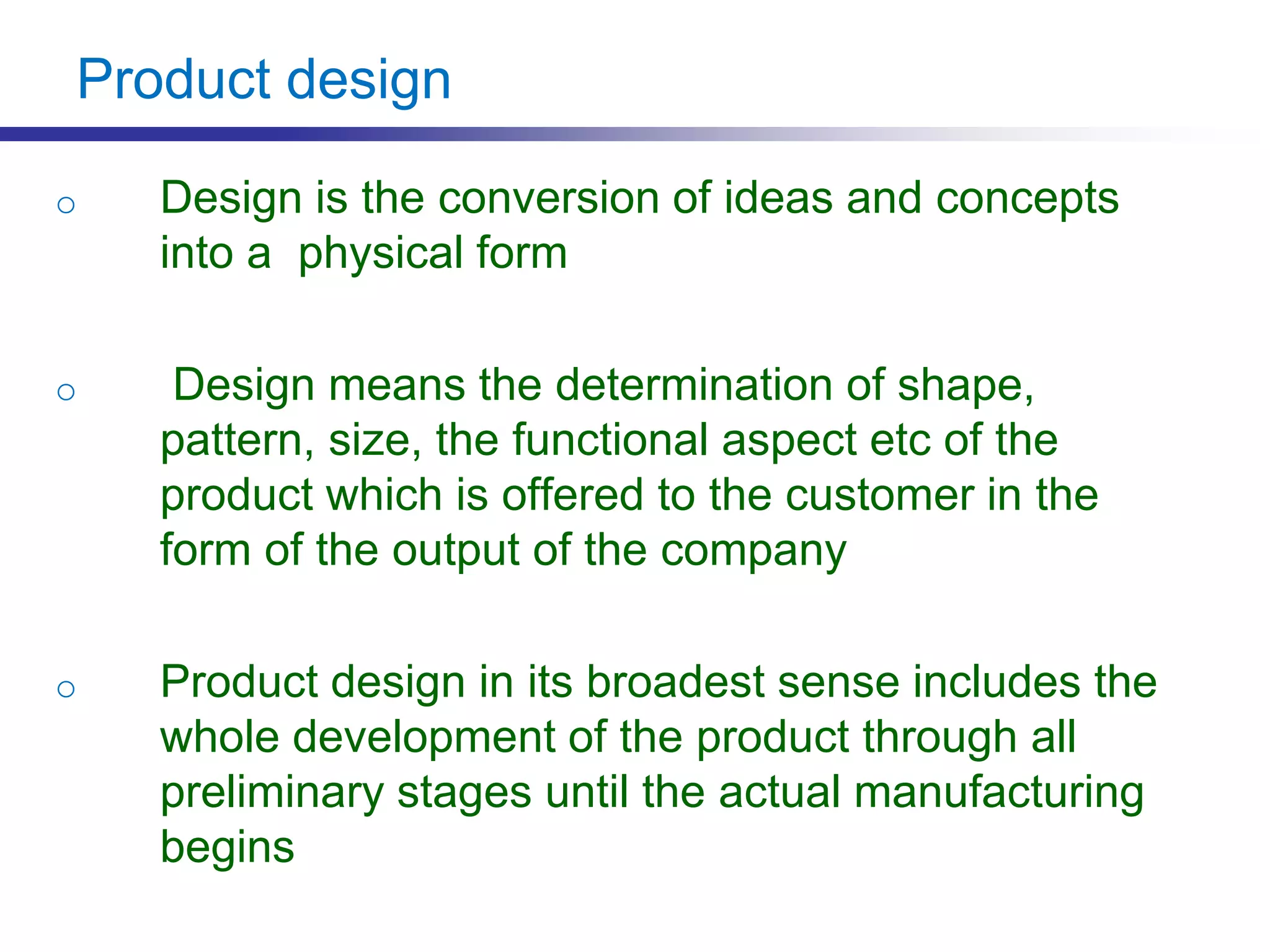
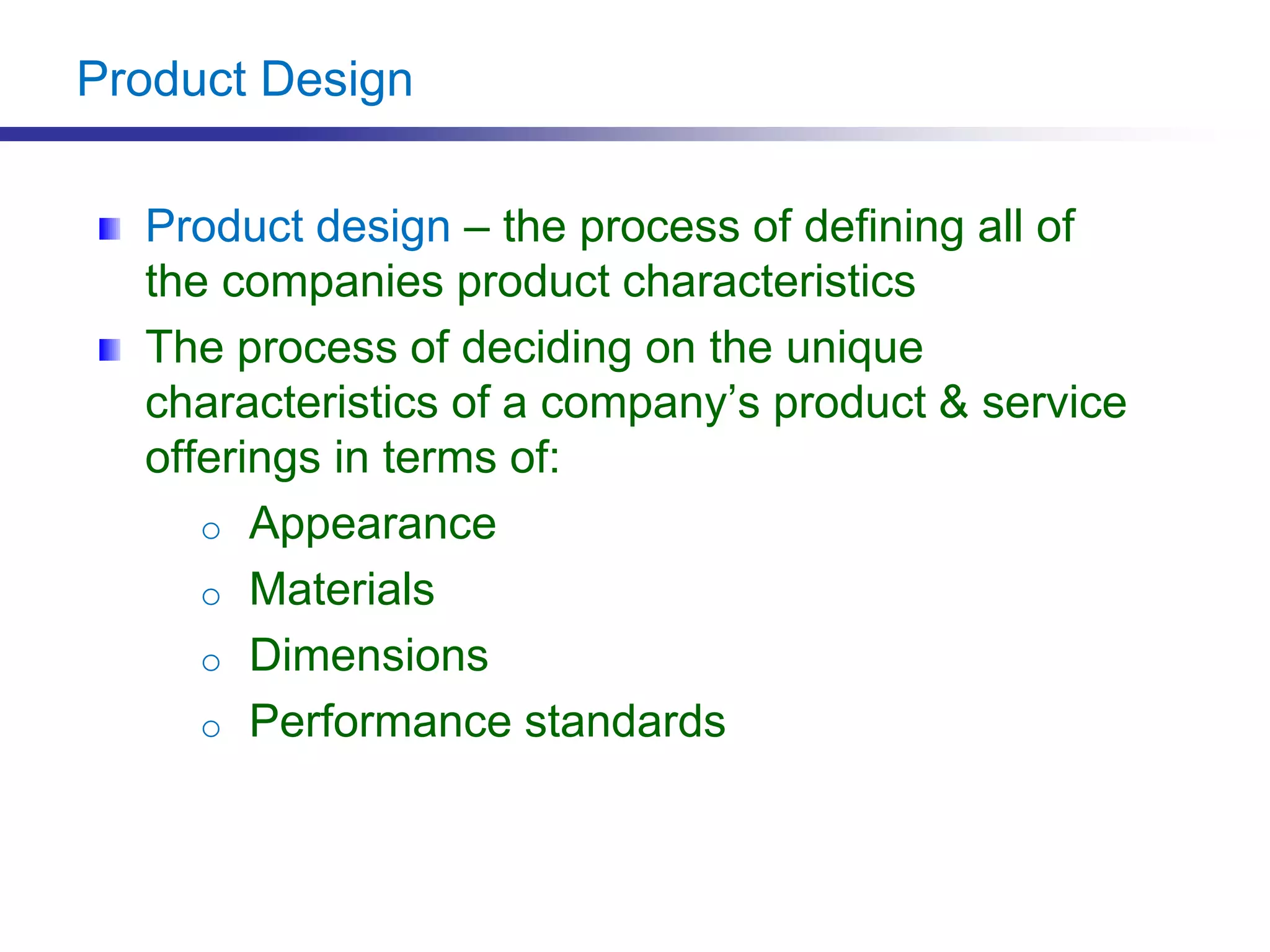
Product design
o Design is the conversion of ideas and concepts
into a physical form
o Design means the determination of shape,
pattern, size, the functional aspect etc of the
product which is offered to the customer in the
form of the output of the company
o Product design in its broadest sense includes the
whole development of the product through all
preliminary stages until the actual manufacturing
begins
Product Design
Product design – the process of defining all of
the companies product characteristics
The process of deciding on the unique
characteristics of a company’s product & service
offerings in terms of:
o Appearance
o Materials
o Dimensions
o Performance standards
Reasons for product or service design
Economic
o Low demand
o Excessive warranty claims
Social and demographic
o Changing tastes
o Aging population
Political, liability, or legal
o Safety issues
o New regulations
o Government changes
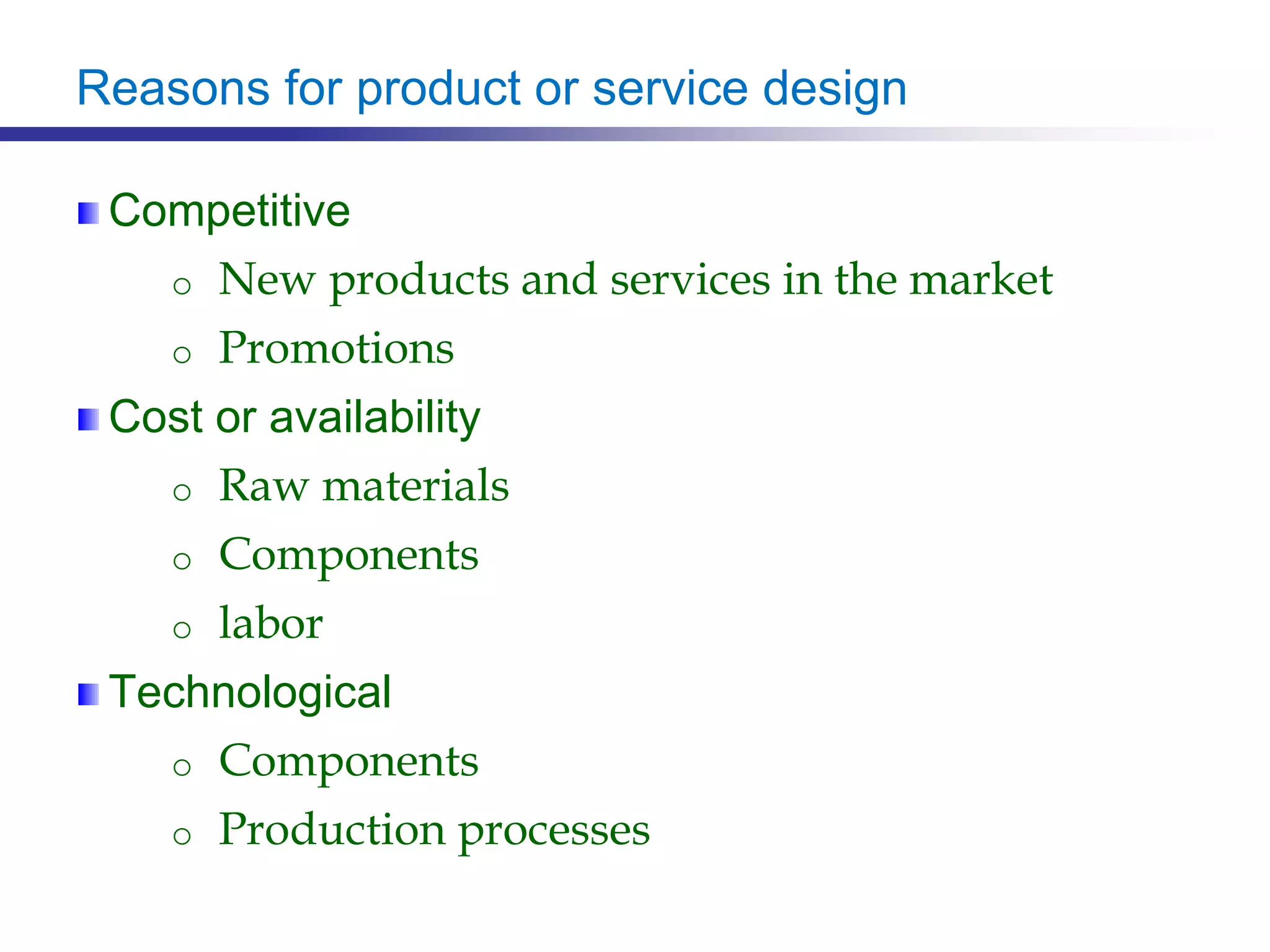
Reasons for product or service design
Competitive
o New products and services in the market
o Promotions
Cost or availability
o Raw materials
o Components
o labor
Technological
o Components
o Production processes
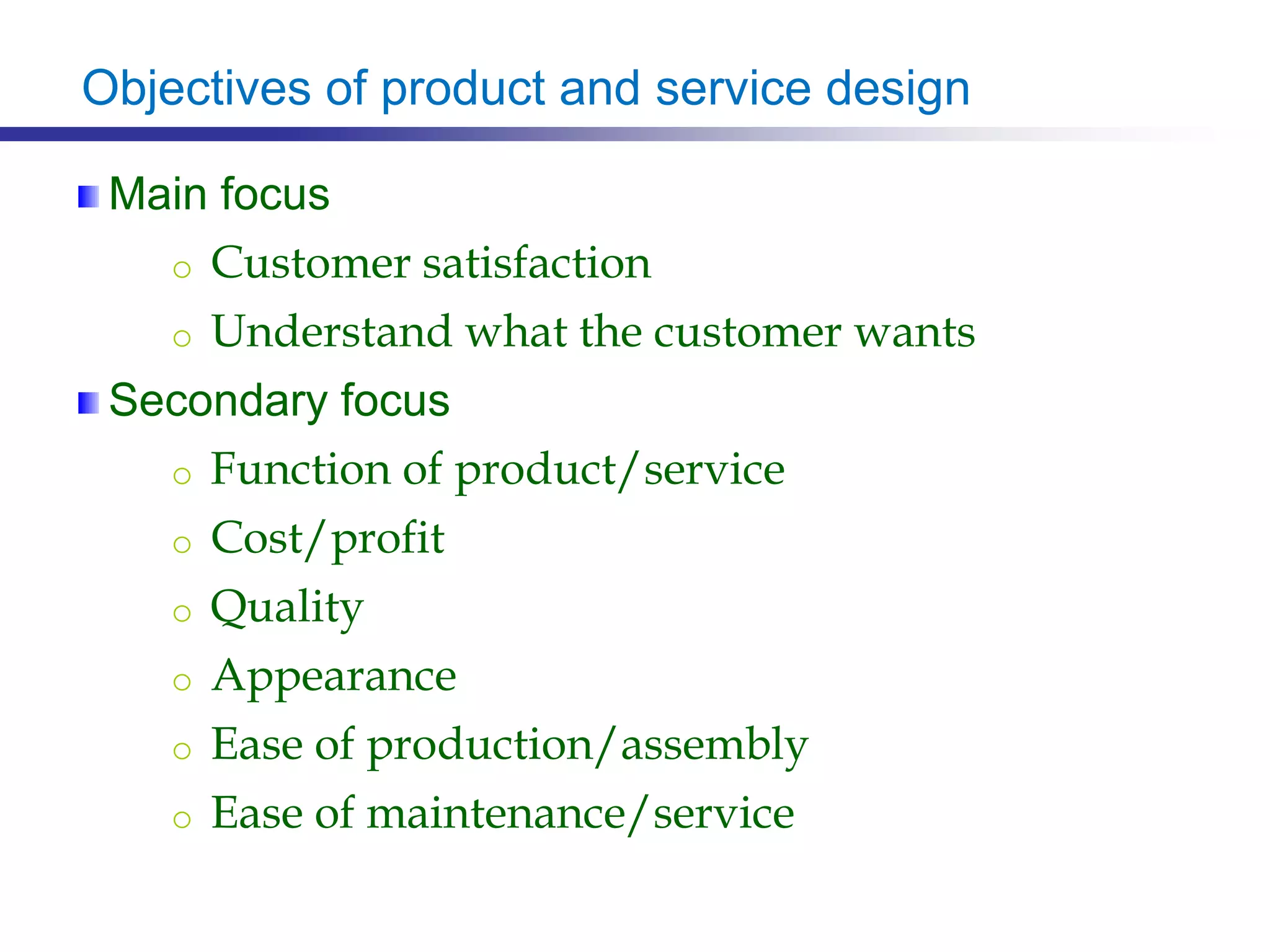
Objectives of product and service design
Main focus
o Customer satisfaction
o Understand what the customer wants
Secondary focus
o Function of product/service
o Cost/profit
o Quality
o Appearance
o Ease of production/assembly
o Ease of maintenance/service
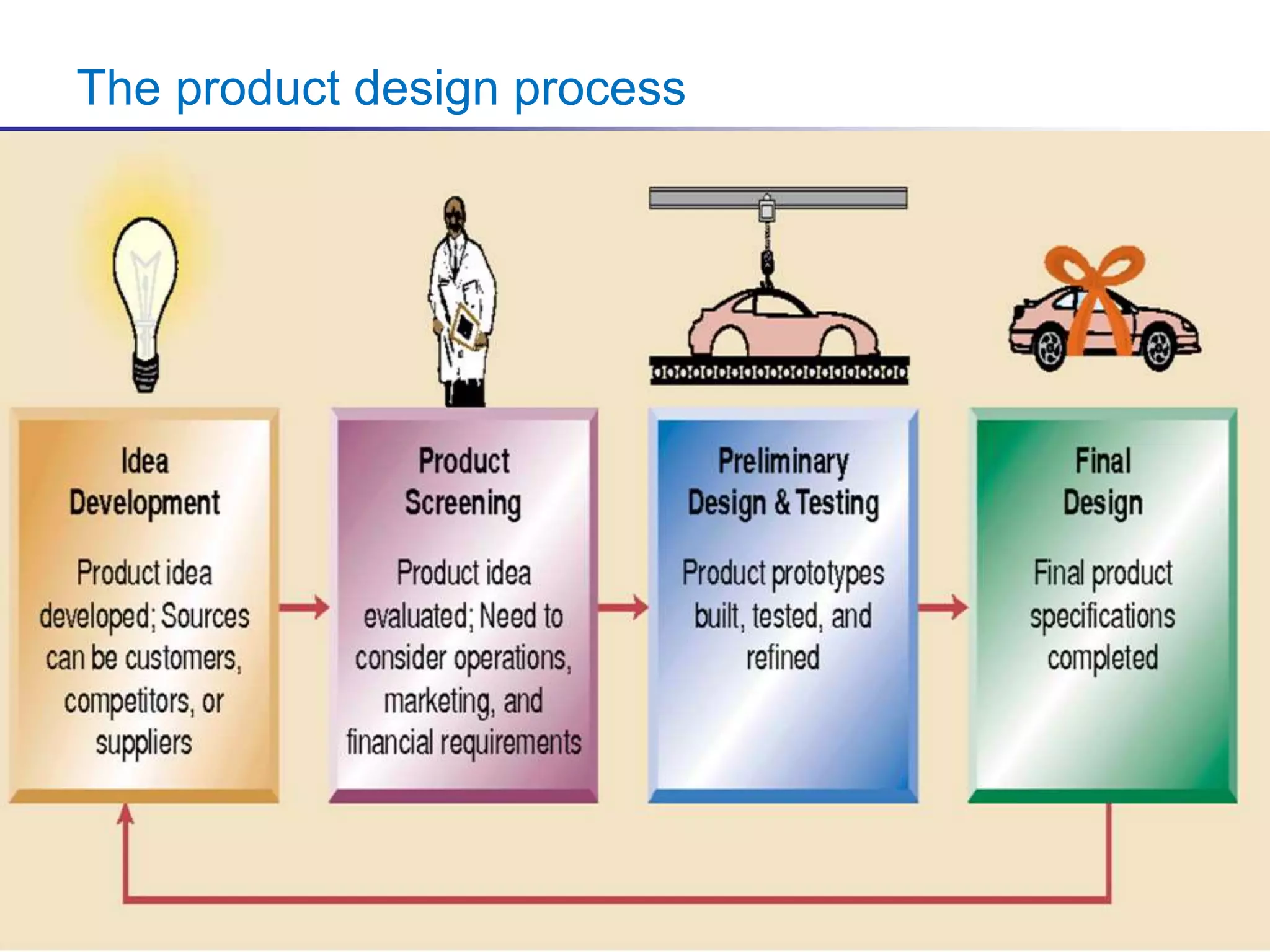
The product design process
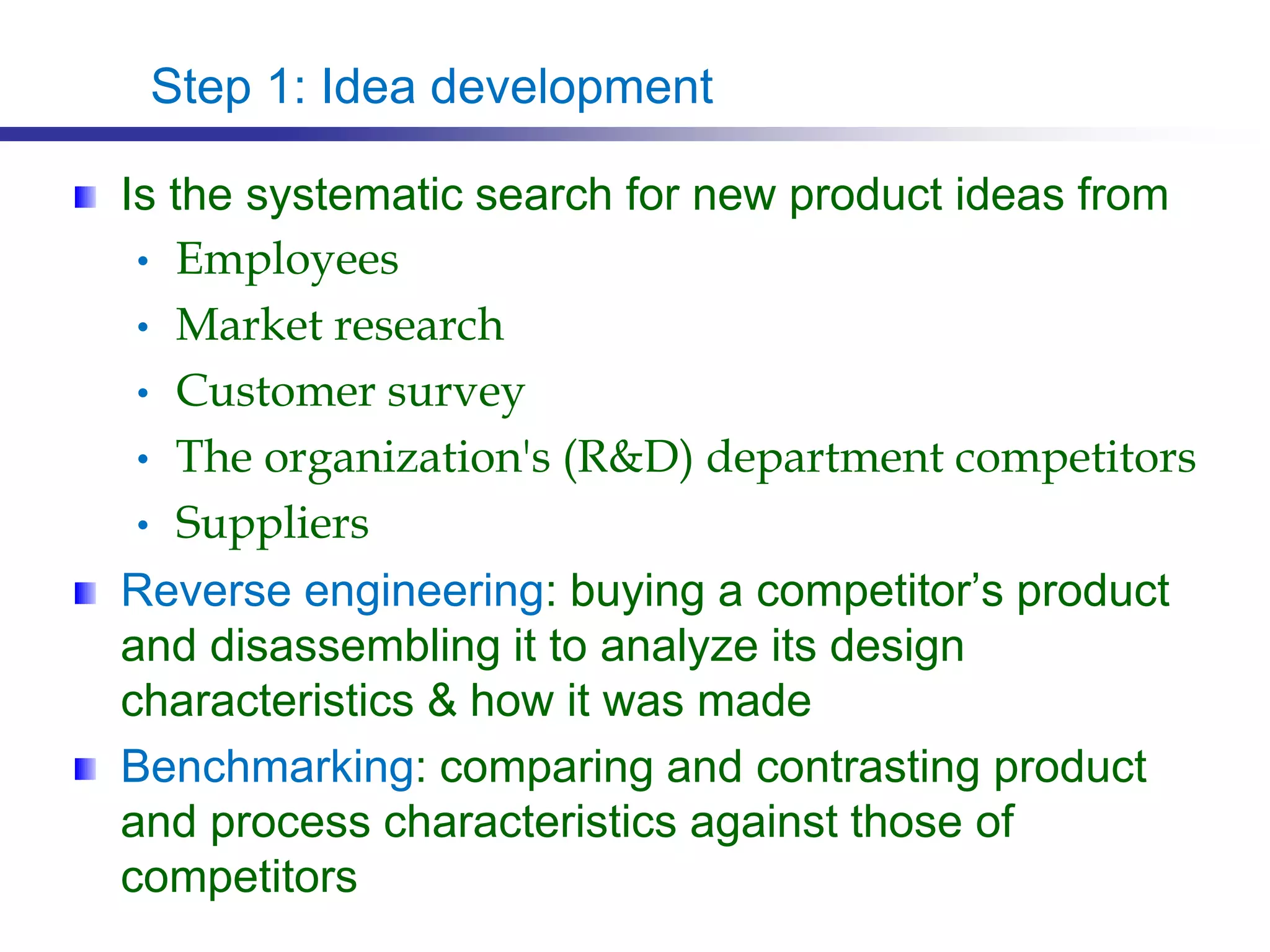
Step 1: Idea development
Is the systematic search for new product ideas from
• Employees
• Market research
• Customer survey
• The organization's (R&D) department competitors
• Suppliers
Reverse engineering: buying a competitor’s product
and disassembling it to analyze its design
characteristics & how it was made
Benchmarking: comparing and contrasting product
and process characteristics against those of
competitors
Step 2 - Product Screening
Process to spot good ideas and drop poor ones as
soon as possible.
Many companies have systems for rating and
screening ideas which estimate:
o Fit with facility
o Availability of labor skills & raw materials
o Market Size and long-term potential
o Product Price
o Development Time & Costs
o Manufacturing Costs
o Return on sales
o Break-even analysis etc.
Step 3: Preliminary Design
General performance characteristics are
translated into technical specifications
Prototypes are built & tested (maybe offered
for sale on a small scale)
Step Four : Final Design
Specifications are set & then used to:
Develop processing and service delivery
instructions
Guide equipment selection
Outline jobs to be performed
Negotiate contracts with suppliers and distributors
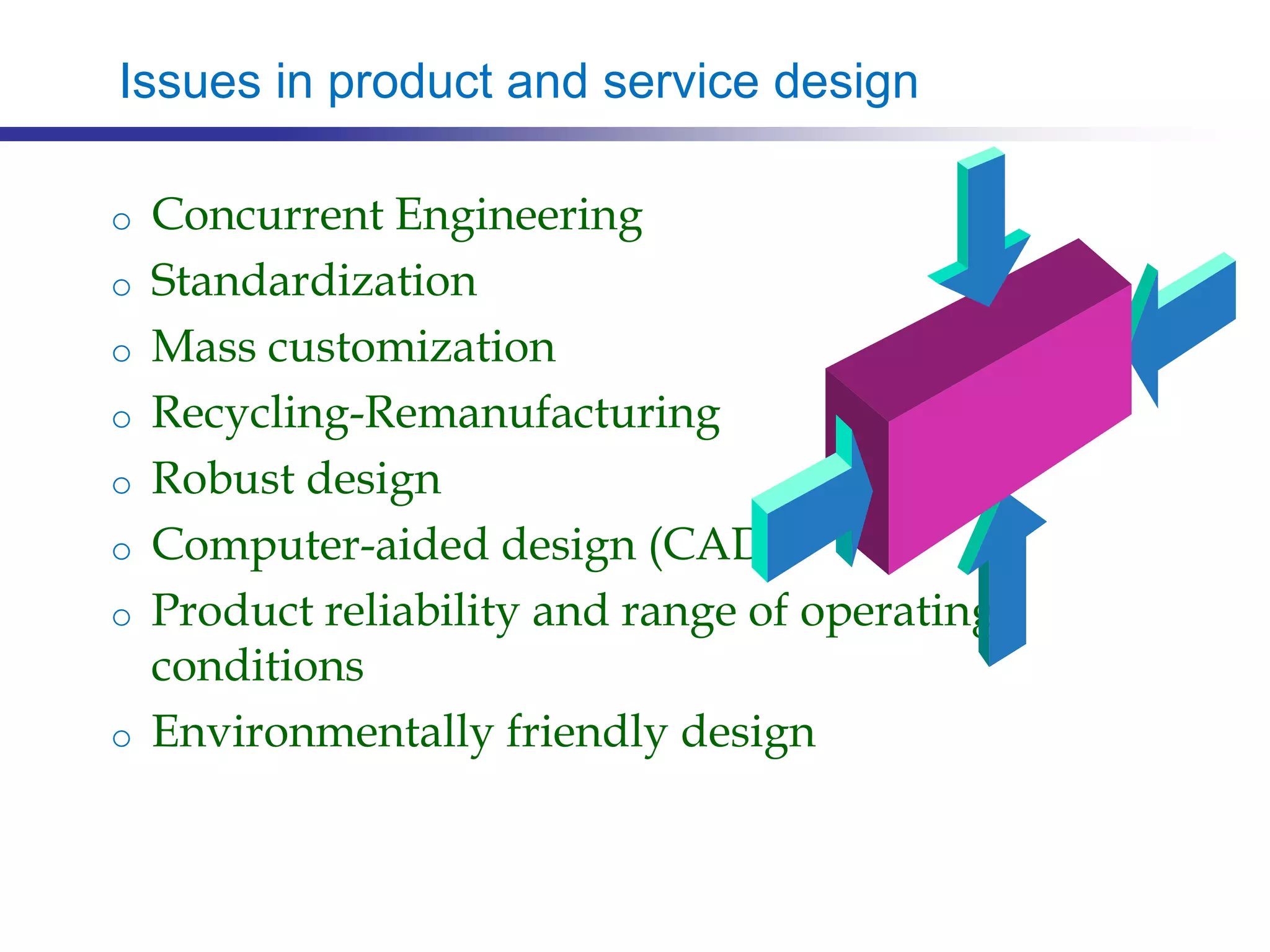
Issues in product and service design
o Concurrent Engineering
o Standardization
o Mass customization
o Recycling-Remanufacturing
o Robust design
o Computer-aided design (CAD)
o Product reliability and range of operating
conditions
o Environmentally friendly design
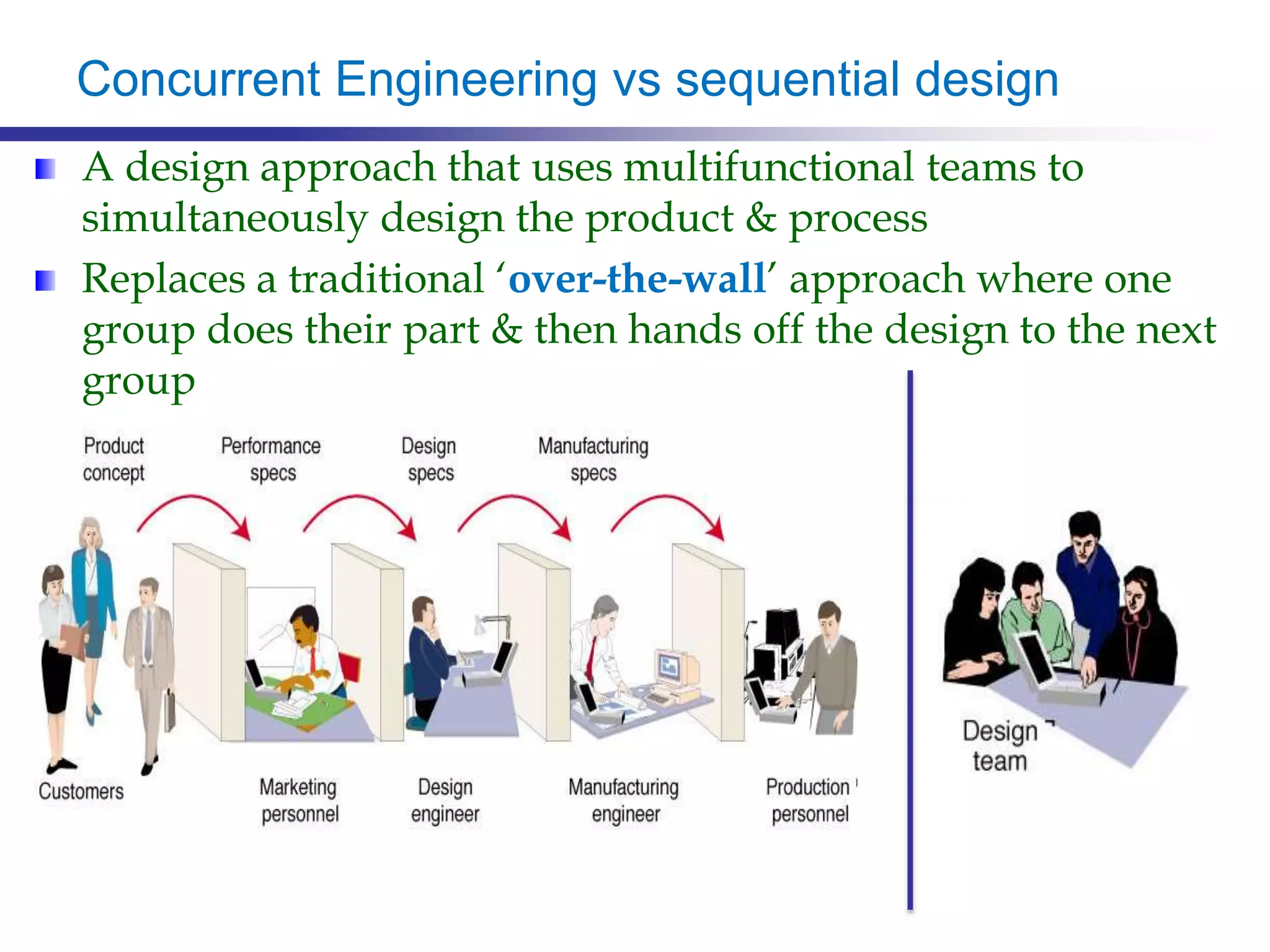
Concurrent Engineering vs sequential design
A design approach that uses multifunctional teams to
simultaneously design the product & process
Replaces a traditional ‘over-the-wall’ approach where one
group does their part & then hands off the design to the next
group
Standardization
Extent to which there is an absence of variety in a
product, service or process
Design which enable a company to offer
similar/identical products or product which satisfy
the Mass
Standardized products are immediately available to
customers
Example calculators, pen etc
Advantages of Standardization
Fewer parts to deal with in inventory &
manufacturing
o Less costly to fill orders from inventory
Reduced training costs and time
More routine purchasing, handling, and inspection
procedures
Opportunities for long production runs, automation
Possibility of perfecting designs and improving
quality control procedures.
Disadvantages of Standardization
Decreased variety results in less consumer appeal.
Designs may be frozen with too many imperfections
remaining.
High cost of design changes increases resistance
to improvements
Standard systems are more vulnerable to failure
Mass Customization
 A strategy of producing standardized goods or
services, but incorporating some degree of
customization
o Delayed differentiation
o Modular design
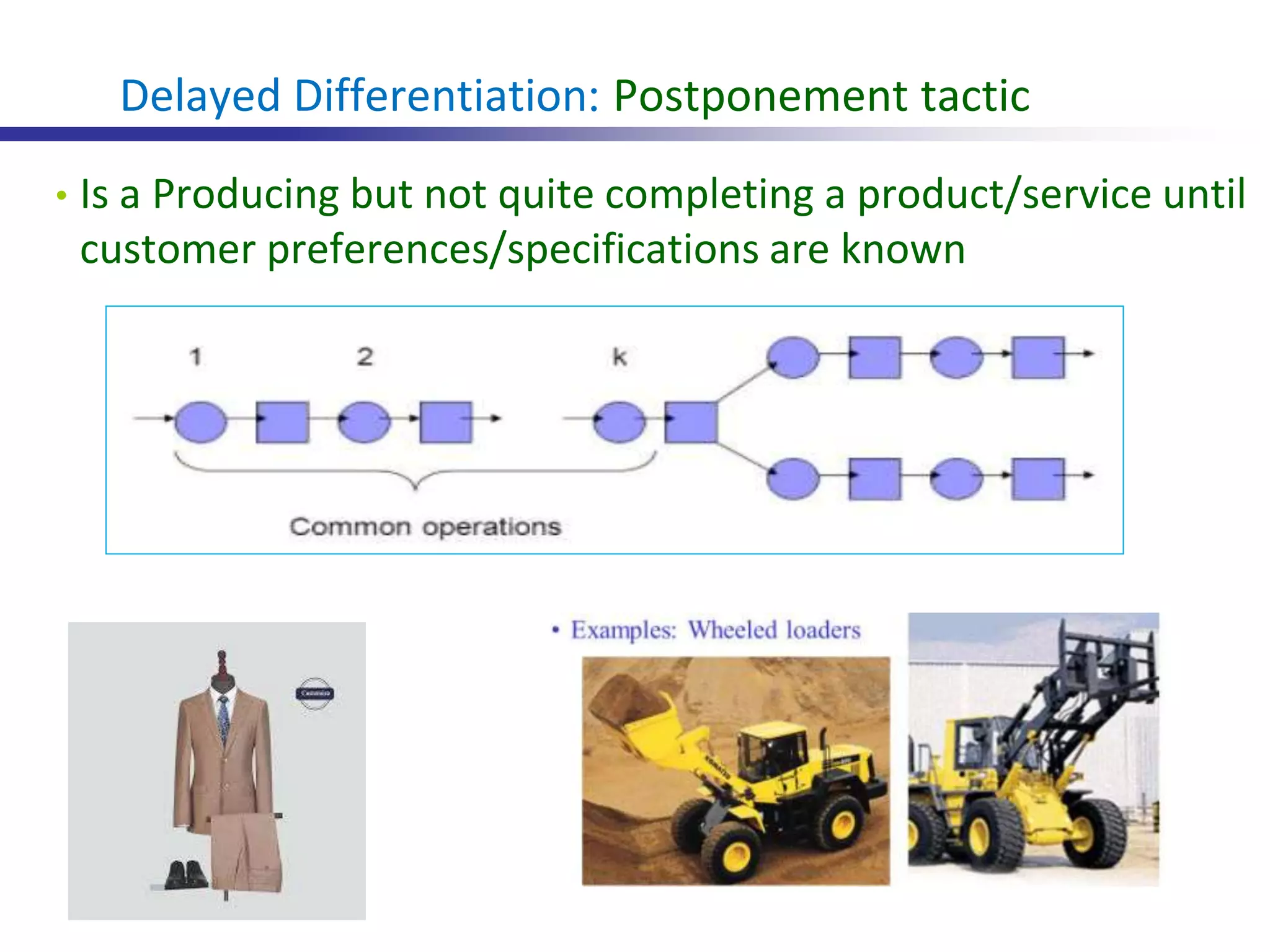
Delayed Differentiation: Postponement tactic
• Is a Producing but not quite completing a product/service until
customer preferences/specifications are known
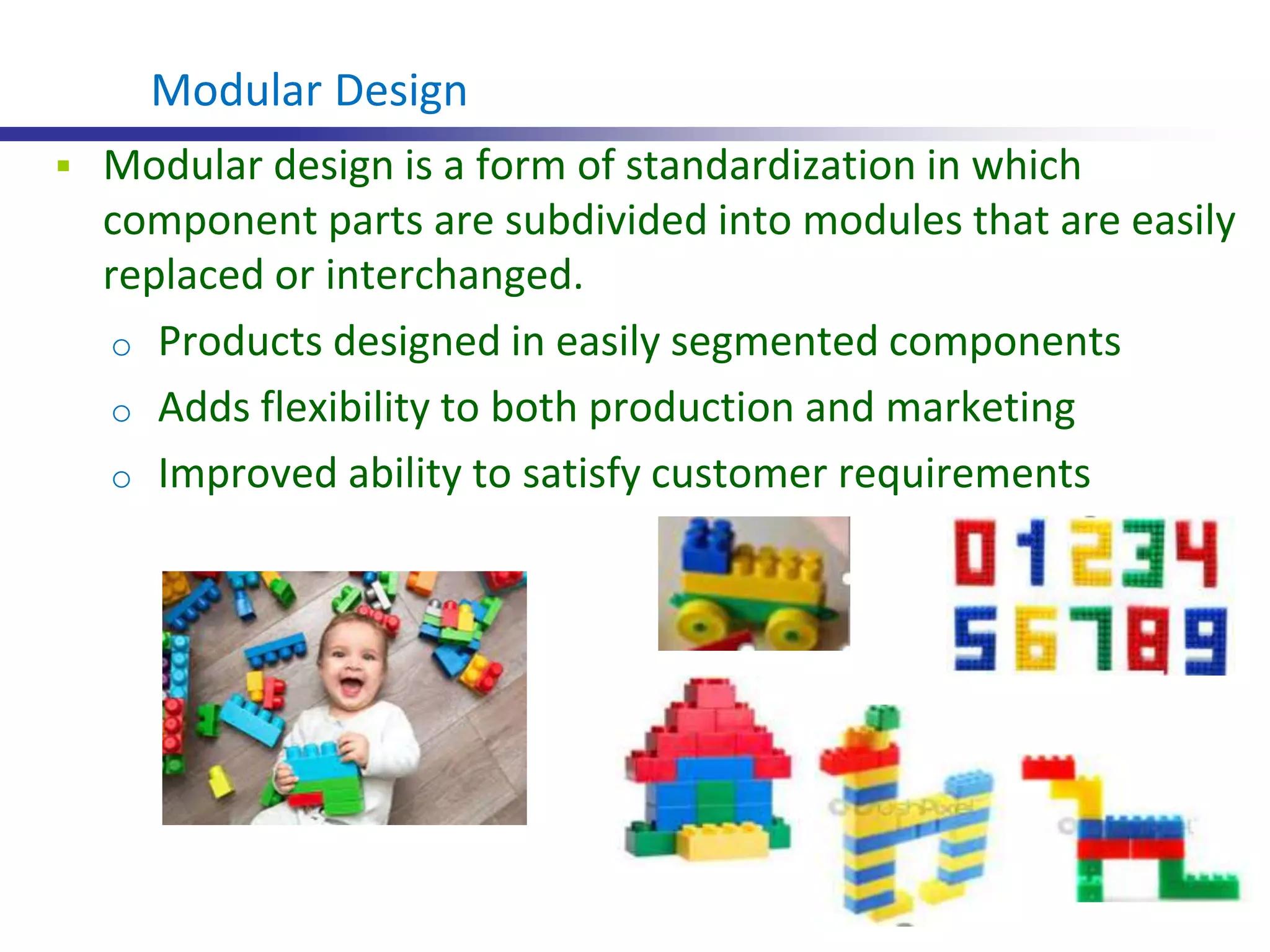
 Modular design is a form of standardization in which
component parts are subdivided into modules that are easily
replaced or interchanged.
o Products designed in easily segmented components
o Adds flexibility to both production and marketing
o Improved ability to satisfy customer requirements
Modular Design
Reliability and normal operating conditions
Reliability: The ability of a product, part, or system to
perform its intended function under a prescribed set of
conditions
Failure: Situation in which a product, part, or system
does not perform as intended
Normal operating conditions: The set of conditions
under which an item’s reliability is specified
A regular car is not to be driven at 200 mph
A bed is not to be used as a trampoline(sport)
Recycling: recovering materials for future use
o Cost savings
o Environment concerns
o Environment regulations
Remanufacturing: replacing worn out parts in used
products
Kodak cameras
Recycling-Remanufacturing
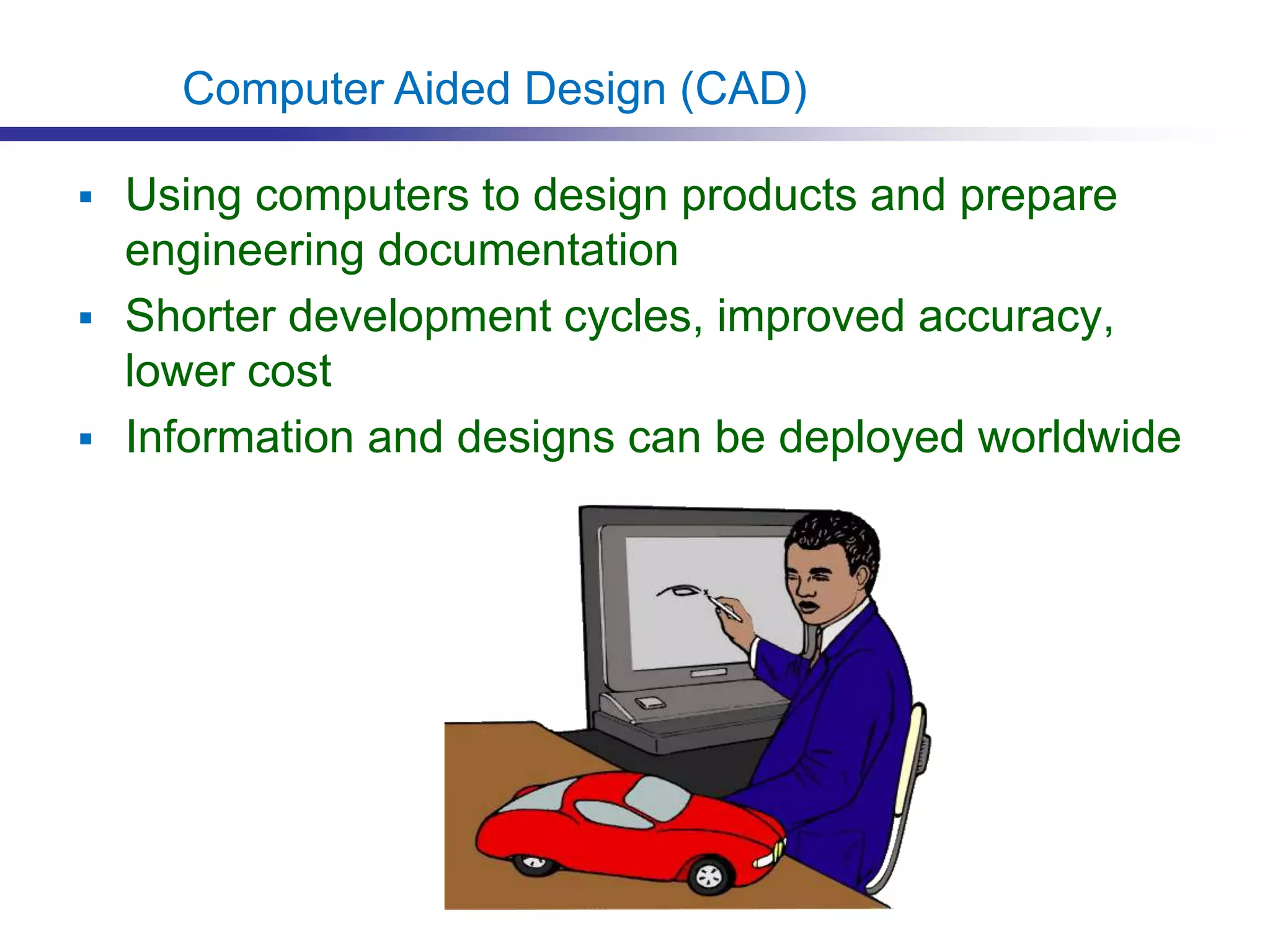
 Using computers to design products and prepare
engineering documentation
 Shorter development cycles, improved accuracy,
lower cost
 Information and designs can be deployed worldwide
Computer Aided Design (CAD)
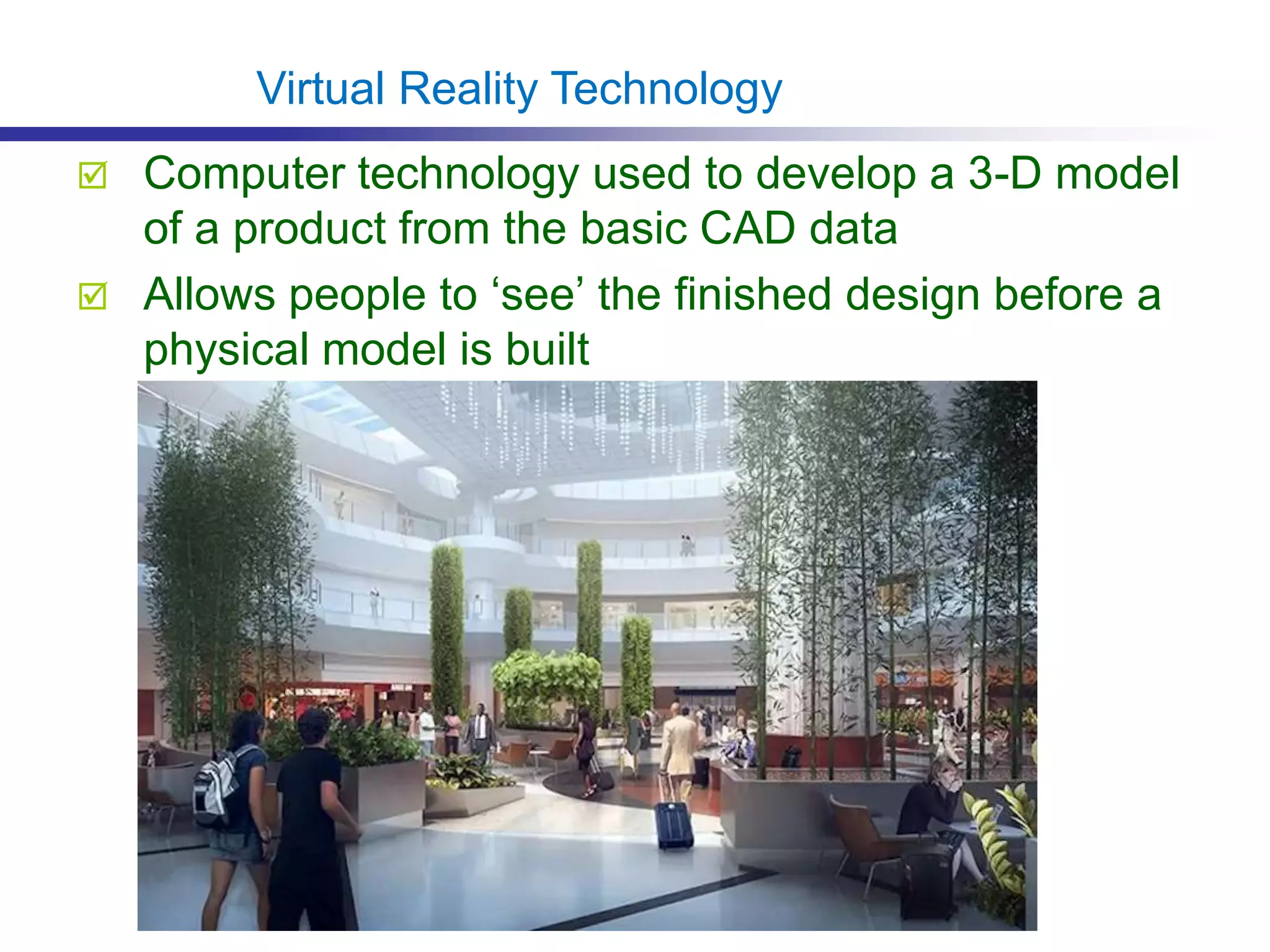
 Computer technology used to develop a 3-D model
of a product from the basic CAD data
 Allows people to ‘see’ the finished design before a
physical model is built
Virtual Reality Technology
 Design that results in products or services that can
function over a broad range of conditions
 In a design of a new system, any activity can be called
robust design, if it causes the system…
o To have longer life(higher reliability)
o To have more consistent from use to use
o To be more consistent from product to product
o To perform consistently as temperature and
other conditions
Robust Design
• Designing a product from material that can be recycled,
ease of repair, minimize packaging minimize material and
energy used during manufacture, consumption and
disposal
Goals of environmentally friendly designs
o Develop safe and environmentally sound products
o Minimize waste of raw materials and energy
o Reduce environmental liabilities
o Increase cost-effectiveness of complying with
environmental regulations
o Be recognized as a good corporate citizen
Environmentally Friendly Designs
Process and Process Selection
Process: Any set of activities performed by an
organization that takes inputs and transforms them
into outputs ideally of greater value to the
organization than the original inputs.
Process selection refers to the strategic decision of
selecting with which kind of production processes
to have in the manufacturing plant.
 It has major implications for
Capacity planning
Layout of facilities
Equipment
Design of work systems
Process Selection: considerations
Process selection is based on five considerations
1. Type of process; range from intermittent to
continuous
2. Degree of vertical integration
3. Flexibility of resources
4. Mix between capital & human resources
5. Degree of customer contact
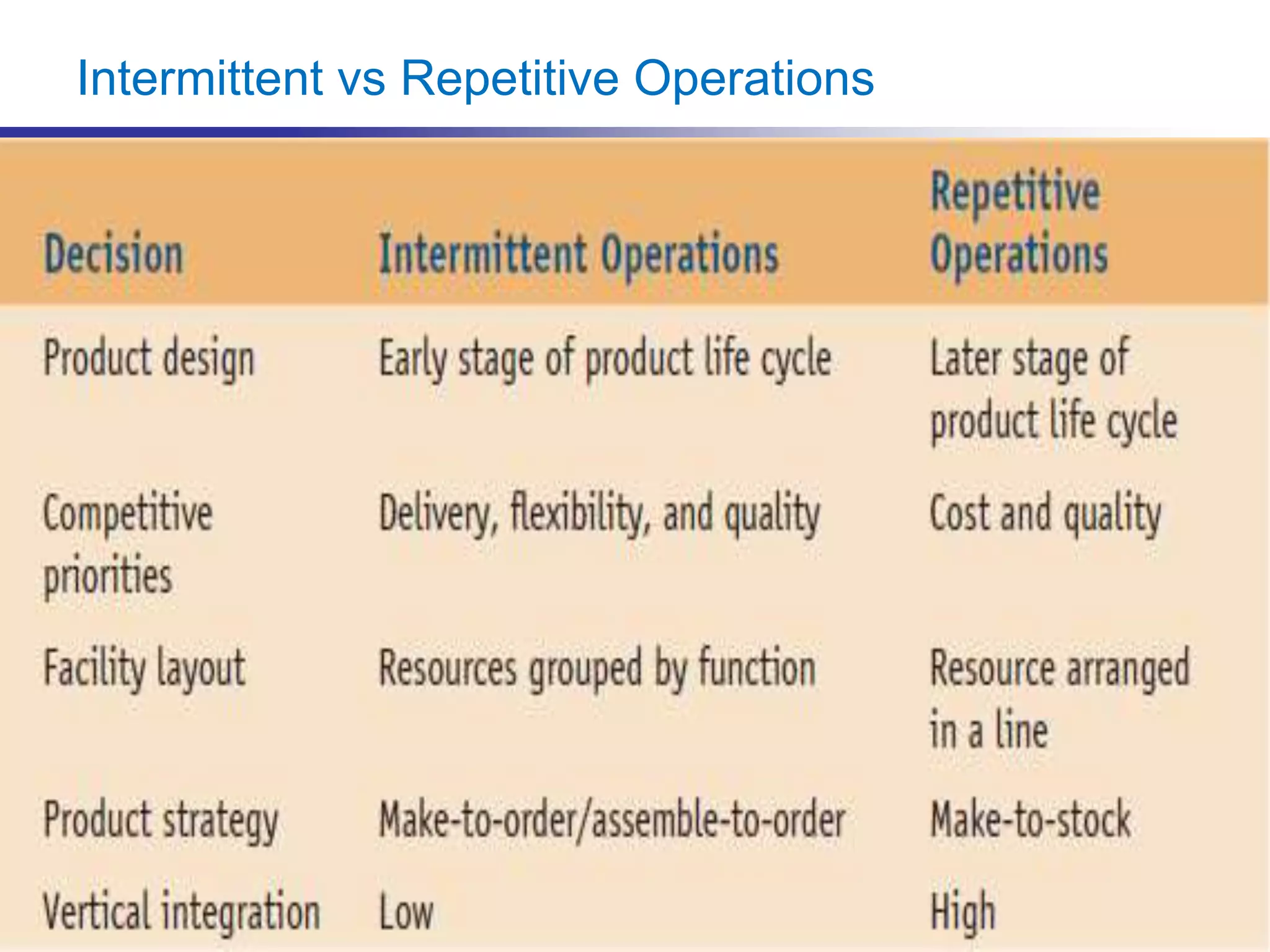
Process Selection types
Two broad process classifications include
Intermittent operations – produce a variety of
products in lower volumes
Repetitive operations – produce one or a few
standardized products in high volume
Intermittent vs Repetitive Operations
Specific types of process
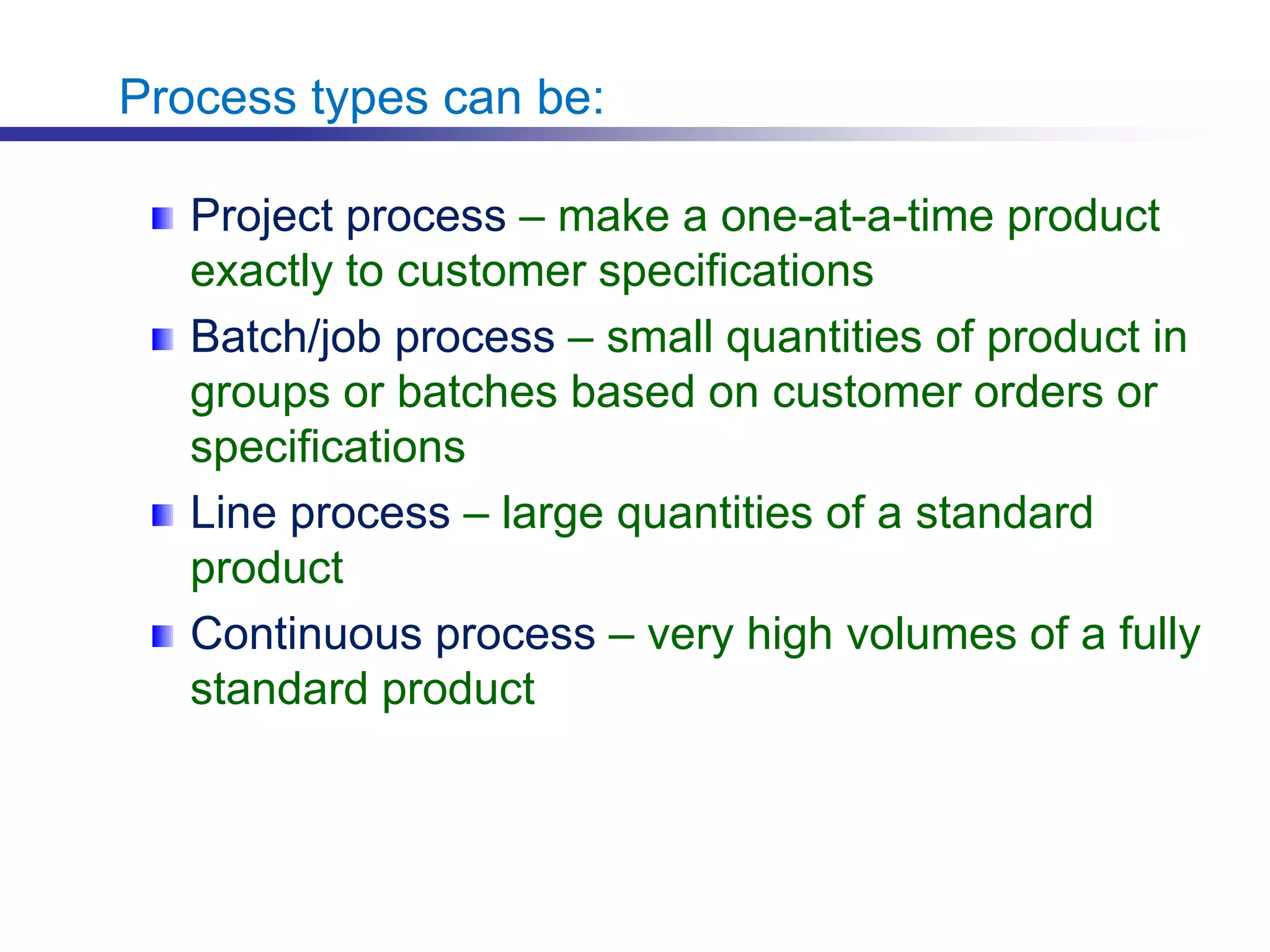
Process types can be:
Project process – make a one-at-a-time product
exactly to customer specifications
Batch/job process – small quantities of product in
groups or batches based on customer orders or
specifications
Line process – large quantities of a standard
product
Continuous process – very high volumes of a fully
standard product
Project process characteristics
1. Makes a one-of-a-kind product (volume = 1)
2. Uses general purpose equipment
3. Has informal relationships with many vendors
4. Very little vertical integration
5. Flexible layout often with factors of production
moving to job
The Job shop process characteristics
1. Makes many products types in small volume
2. Uses general purpose equipment, grouped by the
same function in Work Centres
3. Has informal relationships with vendors
4. Very little vertical integration
5. Similar product follows the same path, produced in
batches to reduce the impact of setup time.
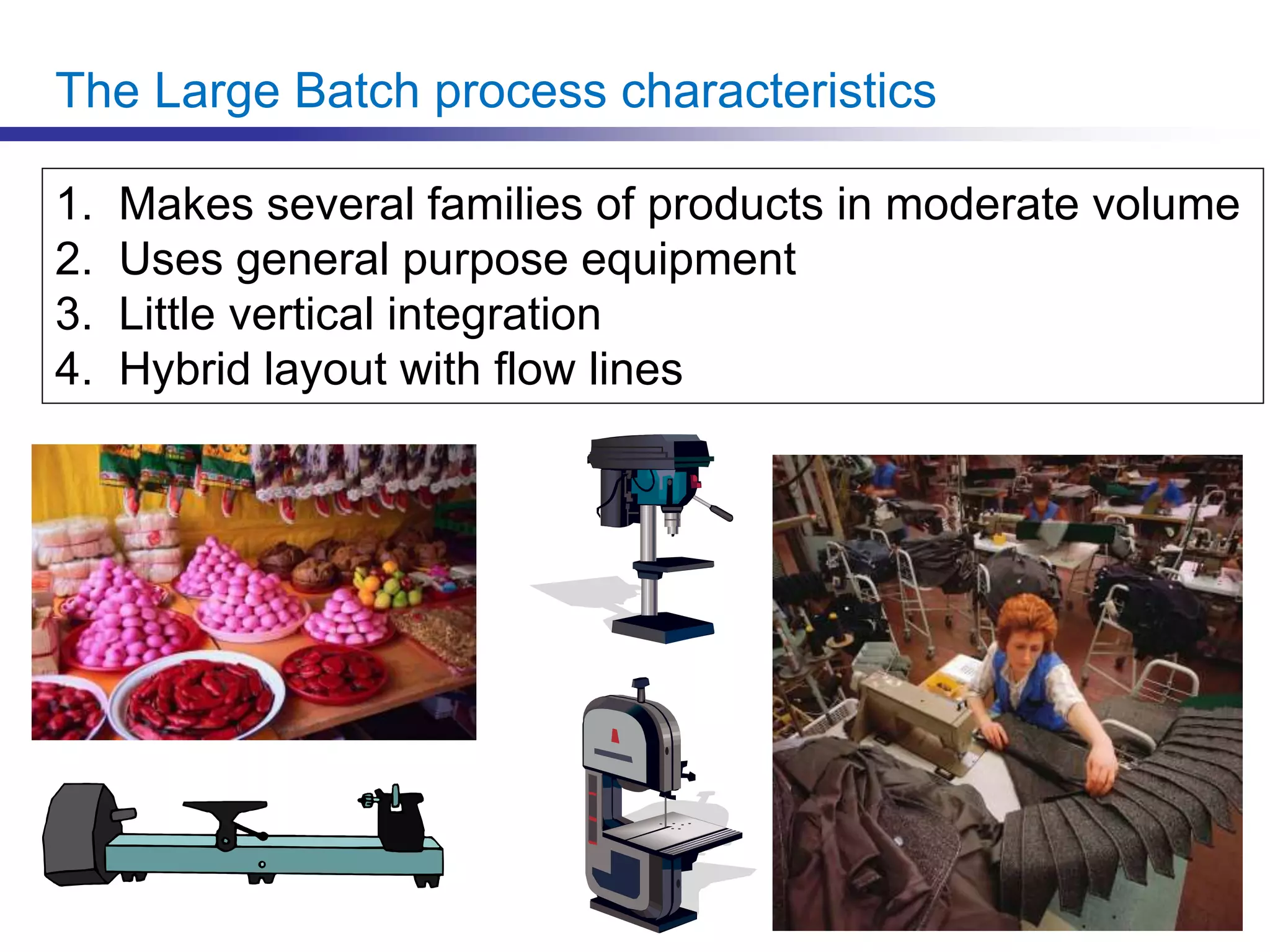
The Large Batch process characteristics
1. Makes several families of products in moderate volume
2. Uses general purpose equipment
3. Little vertical integration
4. Hybrid layout with flow lines
The Assembly Linecharacteristics
1. Makes few products in large volume
2. Uses specialized high-volume equipment
3. Has formal relationships with vendors
4. May use vertical integration
5. Product-based layout with linear flow
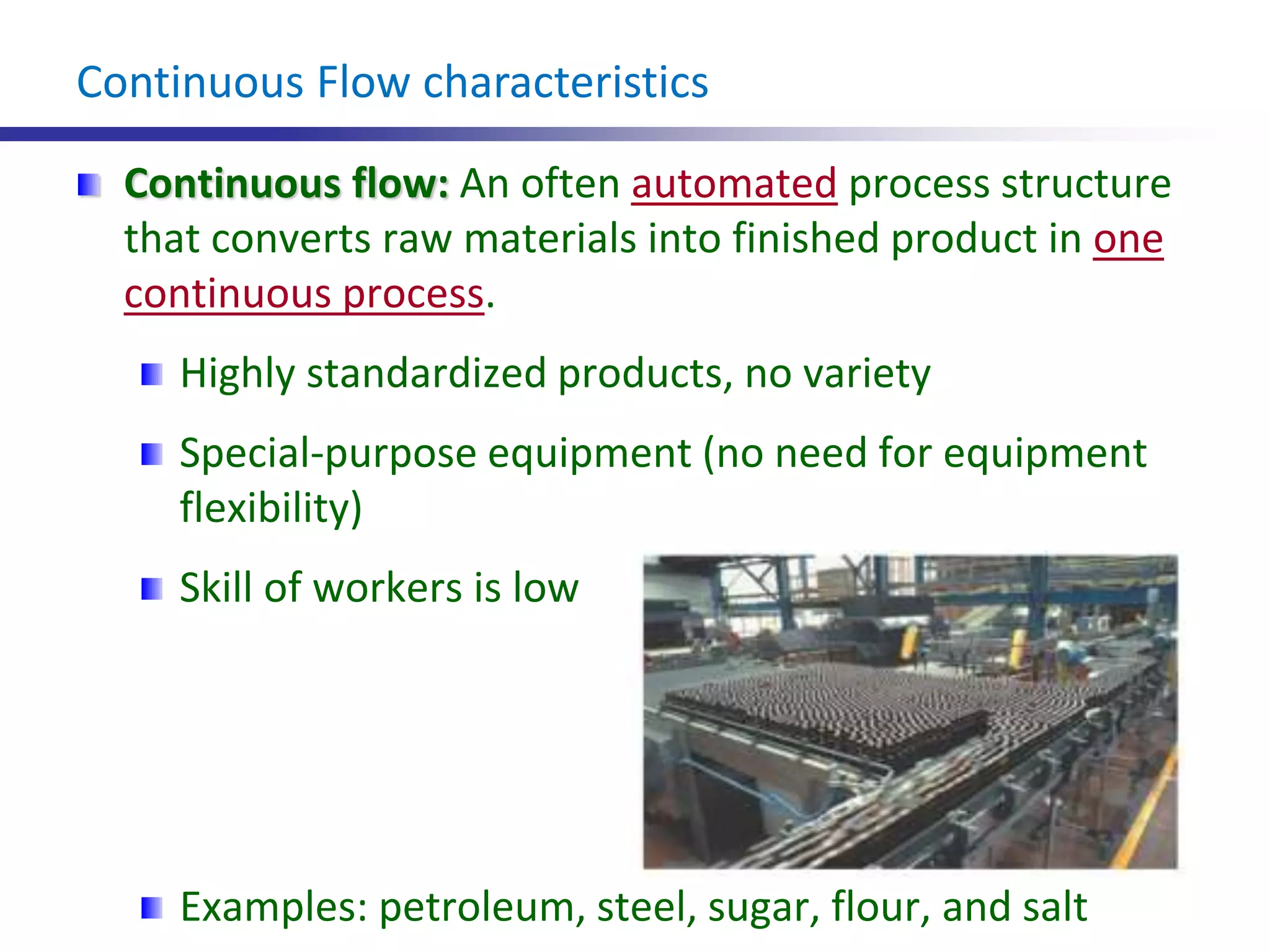
Continuous Flow characteristics
Continuous flow: An often automated process structure
that converts raw materials into finished product in one
continuous process.
Highly standardized products, no variety
Special-purpose equipment (no need for equipment
flexibility)
Skill of workers is low
Examples: petroleum, steel, sugar, flour, and salt
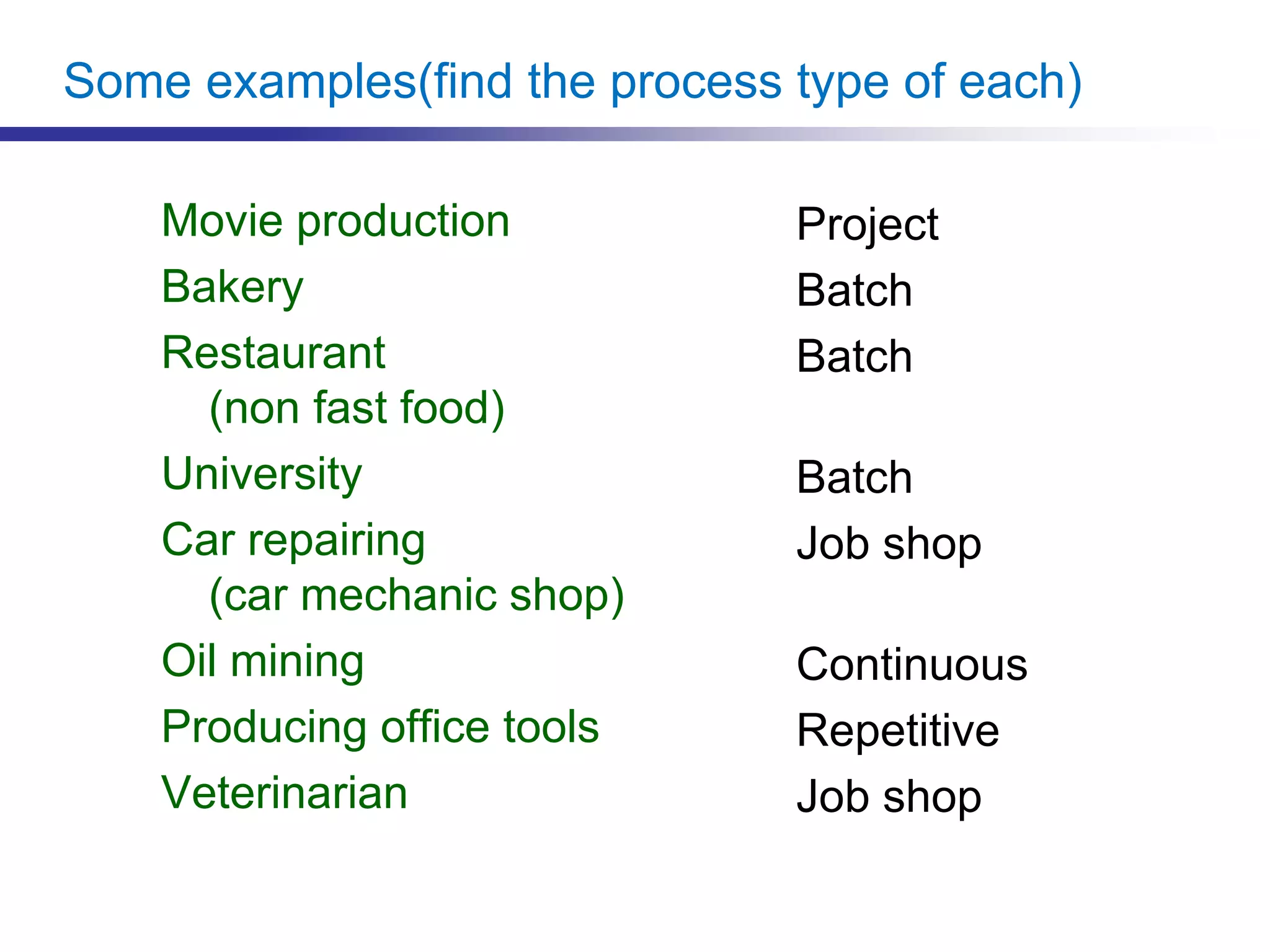
Some examples(find the process type of each)
Movie production
Bakery
Restaurant
(non fast food)
University
Car repairing
(car mechanic shop)
Oil mining
Producing office tools
Veterinarian
Project
Batch
Batch
Batch
Job shop
Continuous
Repetitive
Job shop

om chapter 3.ppt

  • 1.
    CHAPTER 3 PRODUCT DESIGNAND PROCESS SELECTION
  • 2.
    Product design o Designis the conversion of ideas and concepts into a physical form o Design means the determination of shape, pattern, size, the functional aspect etc of the product which is offered to the customer in the form of the output of the company o Product design in its broadest sense includes the whole development of the product through all preliminary stages until the actual manufacturing begins
  • 3.
    Product Design Product design– the process of defining all of the companies product characteristics The process of deciding on the unique characteristics of a company’s product & service offerings in terms of: o Appearance o Materials o Dimensions o Performance standards
  • 4.
    Reasons for productor service design Economic o Low demand o Excessive warranty claims Social and demographic o Changing tastes o Aging population Political, liability, or legal o Safety issues o New regulations o Government changes
  • 5.
    Reasons for productor service design Competitive o New products and services in the market o Promotions Cost or availability o Raw materials o Components o labor Technological o Components o Production processes
  • 6.
    Objectives of productand service design Main focus o Customer satisfaction o Understand what the customer wants Secondary focus o Function of product/service o Cost/profit o Quality o Appearance o Ease of production/assembly o Ease of maintenance/service
  • 7.
  • 8.
    Step 1: Ideadevelopment Is the systematic search for new product ideas from • Employees • Market research • Customer survey • The organization's (R&D) department competitors • Suppliers Reverse engineering: buying a competitor’s product and disassembling it to analyze its design characteristics & how it was made Benchmarking: comparing and contrasting product and process characteristics against those of competitors
  • 9.
    Step 2 -Product Screening Process to spot good ideas and drop poor ones as soon as possible. Many companies have systems for rating and screening ideas which estimate: o Fit with facility o Availability of labor skills & raw materials o Market Size and long-term potential o Product Price o Development Time & Costs o Manufacturing Costs o Return on sales o Break-even analysis etc.
  • 10.
    Step 3: PreliminaryDesign General performance characteristics are translated into technical specifications Prototypes are built & tested (maybe offered for sale on a small scale)
  • 11.
    Step Four :Final Design Specifications are set & then used to: Develop processing and service delivery instructions Guide equipment selection Outline jobs to be performed Negotiate contracts with suppliers and distributors
  • 12.
    Issues in productand service design o Concurrent Engineering o Standardization o Mass customization o Recycling-Remanufacturing o Robust design o Computer-aided design (CAD) o Product reliability and range of operating conditions o Environmentally friendly design
  • 13.
    Concurrent Engineering vssequential design A design approach that uses multifunctional teams to simultaneously design the product & process Replaces a traditional ‘over-the-wall’ approach where one group does their part & then hands off the design to the next group
  • 14.
    Standardization Extent to whichthere is an absence of variety in a product, service or process Design which enable a company to offer similar/identical products or product which satisfy the Mass Standardized products are immediately available to customers Example calculators, pen etc
  • 15.
    Advantages of Standardization Fewerparts to deal with in inventory & manufacturing o Less costly to fill orders from inventory Reduced training costs and time More routine purchasing, handling, and inspection procedures Opportunities for long production runs, automation Possibility of perfecting designs and improving quality control procedures.
  • 16.
    Disadvantages of Standardization Decreasedvariety results in less consumer appeal. Designs may be frozen with too many imperfections remaining. High cost of design changes increases resistance to improvements Standard systems are more vulnerable to failure
  • 17.
    Mass Customization  Astrategy of producing standardized goods or services, but incorporating some degree of customization o Delayed differentiation o Modular design
  • 18.
    Delayed Differentiation: Postponementtactic • Is a Producing but not quite completing a product/service until customer preferences/specifications are known
  • 19.
     Modular designis a form of standardization in which component parts are subdivided into modules that are easily replaced or interchanged. o Products designed in easily segmented components o Adds flexibility to both production and marketing o Improved ability to satisfy customer requirements Modular Design
  • 20.
    Reliability and normaloperating conditions Reliability: The ability of a product, part, or system to perform its intended function under a prescribed set of conditions Failure: Situation in which a product, part, or system does not perform as intended Normal operating conditions: The set of conditions under which an item’s reliability is specified A regular car is not to be driven at 200 mph A bed is not to be used as a trampoline(sport)
  • 21.
    Recycling: recovering materialsfor future use o Cost savings o Environment concerns o Environment regulations Remanufacturing: replacing worn out parts in used products Kodak cameras Recycling-Remanufacturing
  • 22.
     Using computersto design products and prepare engineering documentation  Shorter development cycles, improved accuracy, lower cost  Information and designs can be deployed worldwide Computer Aided Design (CAD)
  • 23.
     Computer technologyused to develop a 3-D model of a product from the basic CAD data  Allows people to ‘see’ the finished design before a physical model is built Virtual Reality Technology
  • 24.
     Design thatresults in products or services that can function over a broad range of conditions  In a design of a new system, any activity can be called robust design, if it causes the system… o To have longer life(higher reliability) o To have more consistent from use to use o To be more consistent from product to product o To perform consistently as temperature and other conditions Robust Design
  • 25.
    • Designing aproduct from material that can be recycled, ease of repair, minimize packaging minimize material and energy used during manufacture, consumption and disposal Goals of environmentally friendly designs o Develop safe and environmentally sound products o Minimize waste of raw materials and energy o Reduce environmental liabilities o Increase cost-effectiveness of complying with environmental regulations o Be recognized as a good corporate citizen Environmentally Friendly Designs
  • 26.
    Process and ProcessSelection Process: Any set of activities performed by an organization that takes inputs and transforms them into outputs ideally of greater value to the organization than the original inputs. Process selection refers to the strategic decision of selecting with which kind of production processes to have in the manufacturing plant.  It has major implications for Capacity planning Layout of facilities Equipment Design of work systems
  • 27.
    Process Selection: considerations Processselection is based on five considerations 1. Type of process; range from intermittent to continuous 2. Degree of vertical integration 3. Flexibility of resources 4. Mix between capital & human resources 5. Degree of customer contact
  • 28.
    Process Selection types Twobroad process classifications include Intermittent operations – produce a variety of products in lower volumes Repetitive operations – produce one or a few standardized products in high volume
  • 29.
  • 30.
  • 31.
  • 32.
    Process types canbe: Project process – make a one-at-a-time product exactly to customer specifications Batch/job process – small quantities of product in groups or batches based on customer orders or specifications Line process – large quantities of a standard product Continuous process – very high volumes of a fully standard product
  • 33.
    Project process characteristics 1.Makes a one-of-a-kind product (volume = 1) 2. Uses general purpose equipment 3. Has informal relationships with many vendors 4. Very little vertical integration 5. Flexible layout often with factors of production moving to job
  • 34.
    The Job shopprocess characteristics 1. Makes many products types in small volume 2. Uses general purpose equipment, grouped by the same function in Work Centres 3. Has informal relationships with vendors 4. Very little vertical integration 5. Similar product follows the same path, produced in batches to reduce the impact of setup time.
  • 35.
    The Large Batchprocess characteristics 1. Makes several families of products in moderate volume 2. Uses general purpose equipment 3. Little vertical integration 4. Hybrid layout with flow lines
  • 36.
    The Assembly Linecharacteristics 1.Makes few products in large volume 2. Uses specialized high-volume equipment 3. Has formal relationships with vendors 4. May use vertical integration 5. Product-based layout with linear flow
  • 37.
    Continuous Flow characteristics Continuousflow: An often automated process structure that converts raw materials into finished product in one continuous process. Highly standardized products, no variety Special-purpose equipment (no need for equipment flexibility) Skill of workers is low Examples: petroleum, steel, sugar, flour, and salt
  • 38.
    Some examples(find theprocess type of each) Movie production Bakery Restaurant (non fast food) University Car repairing (car mechanic shop) Oil mining Producing office tools Veterinarian Project Batch Batch Batch Job shop Continuous Repetitive Job shop