Understanding how Pharmaceutical & Biotech Companies Work
Summary
• Introduction to Healthcare & different Products
• Role of Pharmaceutical in Healthcare
• Drug Details
 What a drug is made of ?
 Classification of drugs
 Product Life Cycle of a Drug
• Drug Development Phases
• Regulatory Framework & various Regulatory Bodies
Introduction to Healthcare
• One of the world's largest and fastest-growing industries
• Also called medical industry
• Provides goods & services to treat patients with curative, preventive,
rehabilitative & palliative care
Different Healthcare Products
Products Description
Pharmaceutical Medicine/vaccines for human use, may have a trademark, may be prescribed or
over the counter
Diagnostics Equipment & Supplies used in screening, detecting, diagnostics
Medical Devices Advanced instrumentation & appliances used for medical therapy e.g. joint
replacements, pacemakers, syringes, infusion pumps
Medical Supplies E.g. surgical gowns and gloves
Durable Medical Equipment Reusable products e.g. walkers, wheelchairs, oxygen equipment
Role of Pharmaceutical in Healthcare
• Socially important
• Varied use from Out patient (self-administered) to Inpatient (professionally
administered)
• Spectrum of Care Settings
 Home based Care
 Primary Care
 Secondary Care
 Tertiary Care
 End Stage Care
Drug Details
1) Drug Definition/ Drug Category
 Drug Definition
 Any substance that produces a physical /psychological change
 Under FFDCA – Any substance intended for use in diagnosis, cure, mitigation, treatment
or prevention of a disease
 Examples :
 Aspirin , antibiotics, products contained in food – caffeine & others like fluoride
 Drug Category
Drug Details (cont.)
2) What are Drugs Made of ?
7
• (API) Active Pharmaceutical Ingredient – Used in drug manufacture. API – mainly fall into
2 categories:
 Chemical - Small molecule products (manufactured by chemical process)
 Biological– Large molecule products (manufactured from living materials –
humans/plants/micro-organisms
• Biological Division :
 Genetically Engineered (recombinant)
 Non Recombinant
Drug Details (cont.)
3) Drug Classification
8
 Classification based on
 Therapeutic Categories
 Target Customers
 Novelty
 Market Potential
 Access Rights
Drug Development Life Cycle
9
 Discovery
 Development
 Launch & Growth
 Maturity
 Generic Erosion
 Commodity/ Obsolete Product
Drug Development Life Cycle
Discovery Phase
10
• Represents first stage
• Is the process by which drugs are discovered and/or designed
• To understand how disease and infection are controlled at the molecular and
physiological level and to target specific entities based on this knowledge
• Identify cellular and genetic factors that play a role in specific diseases
Drug Development Life Cycle
Drug Discovery - A Closer Look
11
 Disease and Target Selection
 Select the disease targets
 TPP
 Lead Identification
 Search for one or more lead compounds
 Compound screening, Molecular Modeling, Simulation
 Lead Series and Lead Optimization
 Means of identifying promising compounds
 Involves testing
 Discovery Phase goes till 2-4 years
Drug Development Life Cycle
Discovery Phase – Patent Protection
12
Patent Protection
A truly promising set of lead compounds – need to be protected
Primary means of protection – is called PATENT
Also called as “Composition of Matter”
Undiscovered molecule is called (NCE)/ (NME)
Patent is given by a regulatory body and issued for 20 years
Patent Authority of India
The Patent Controller of India
Importance of Regulatory Framework
13
 Regulations are designed to:
 Protect public welfare
 Ensure that critical new therapies reach market quickly & safely
 Some of the Regulatory bodies :
 FDA – Food and Drug Administration, US
 CDSCO - Central Drugs Standard Control Organization, India
 PMDA - Pharmaceuticals and Medical Devices Agency, Japan
 EMA - European Medicines Agency, European Union agency
Drug Development Life Cycle
Development Phase
14
 Phase where promising compound is transformed into a marketable product/shelved
 Process of taking a new chemical lead through the stages necessary to allow it to be
tested in human clinical trials
 Development Phase goes till 12-13 years
Drug Development Life Cycle
Development Phase - A Closer Look
Development Phase is further divided into
15
Drug Development Life Cycle
Preclinical Development
16
“FIRST LINE OF DEFENSE”
Establish initial parameters for safety and efficiency
Bioavailability
Effectiveness of the compound in terms of - ADME (Absorption, distribution, metabolism and
excretion)
Toxicology/Pharmacology
Develop initial formulation and manufacturing plan
Perform both in vitro and in vivo studies
Key milestone – submission of IND to FDA
Drug Development Life Cycle
Investigational New Drug (IND)
17
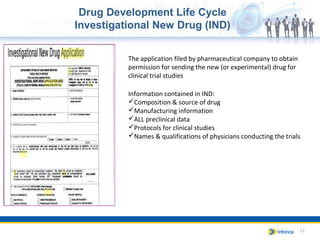
The application filed by pharmaceutical company to obtain
permission for sending the new (or experimental) drug for
clinical trial studies
Information contained in IND:
Composition & source of drug
Manufacturing information
ALL preclinical data
Protocols for clinical studies
Names & qualifications of physicians conducting the trials
D Drug Development Life Cycle
Clinical Trials
18
• Process of testing a drug in human subjects
• The trial may be carried out in a clinic or other medical facility
• First 3 phases termed as – Regisrational or label enabling
• PHASE I : Human Pharmacology
• PHASE II : Initial Clinical Trials
• PHASE III : Comparative Clinical Trials
• PHASE IV : Controlled Marketing
Development Life Cycle
Phase I, II
19
Phase
Name
Activities Goal
Phase 1 • First administration to humans
• Testing on a limited population of healthy
volunteers
• To establish – safe dosage range
• To demonstrate that drug
is safe to be tested with
target disease
Phase 2 • Establish EFFICACY & appropriate dosage
• First set of test of the drug for patients who have
disease/condition
• Small scale trails of patients with the target disease
(100-200)
• To generate POC
• To establish min & max
effective dosage
• To look for side effects
Drug Development Life Cycle
Phase III, IV
20
Phase
Name
Activities Goal
Phase 3 • Extensive, multiple sites, clinical trials
• Testing on a large scale randomized blinded,
placebo- controlled trials in app 1,000-5,000
subjects with the target disease
• Elaborate design
• Represents largest investment in terms of
money and time
• To provide basis for a New
Drug Application (NDA)
Phase 4 • Post-Marketing Surveillance/Post Approval
• Occurs after FDA issues an NDA Approval and
under controlled marketing
• Addition explorations
• Additional safety studies
• To generate additional data
base to demonstrate the
efficiency and safety of
21
Clinical Trials in a Nut Shell

Pharma Industry Overview

  • 1.
    Understanding how Pharmaceutical& Biotech Companies Work
  • 2.
    Summary • Introduction toHealthcare & different Products • Role of Pharmaceutical in Healthcare • Drug Details  What a drug is made of ?  Classification of drugs  Product Life Cycle of a Drug • Drug Development Phases • Regulatory Framework & various Regulatory Bodies
  • 3.
    Introduction to Healthcare •One of the world's largest and fastest-growing industries • Also called medical industry • Provides goods & services to treat patients with curative, preventive, rehabilitative & palliative care
  • 4.
    Different Healthcare Products ProductsDescription Pharmaceutical Medicine/vaccines for human use, may have a trademark, may be prescribed or over the counter Diagnostics Equipment & Supplies used in screening, detecting, diagnostics Medical Devices Advanced instrumentation & appliances used for medical therapy e.g. joint replacements, pacemakers, syringes, infusion pumps Medical Supplies E.g. surgical gowns and gloves Durable Medical Equipment Reusable products e.g. walkers, wheelchairs, oxygen equipment
  • 5.
    Role of Pharmaceuticalin Healthcare • Socially important • Varied use from Out patient (self-administered) to Inpatient (professionally administered) • Spectrum of Care Settings  Home based Care  Primary Care  Secondary Care  Tertiary Care  End Stage Care
  • 6.
    Drug Details 1) DrugDefinition/ Drug Category  Drug Definition  Any substance that produces a physical /psychological change  Under FFDCA – Any substance intended for use in diagnosis, cure, mitigation, treatment or prevention of a disease  Examples :  Aspirin , antibiotics, products contained in food – caffeine & others like fluoride  Drug Category
  • 7.
    Drug Details (cont.) 2)What are Drugs Made of ? 7 • (API) Active Pharmaceutical Ingredient – Used in drug manufacture. API – mainly fall into 2 categories:  Chemical - Small molecule products (manufactured by chemical process)  Biological– Large molecule products (manufactured from living materials – humans/plants/micro-organisms • Biological Division :  Genetically Engineered (recombinant)  Non Recombinant
  • 8.
    Drug Details (cont.) 3)Drug Classification 8  Classification based on  Therapeutic Categories  Target Customers  Novelty  Market Potential  Access Rights
  • 9.
    Drug Development LifeCycle 9  Discovery  Development  Launch & Growth  Maturity  Generic Erosion  Commodity/ Obsolete Product
  • 10.
    Drug Development LifeCycle Discovery Phase 10 • Represents first stage • Is the process by which drugs are discovered and/or designed • To understand how disease and infection are controlled at the molecular and physiological level and to target specific entities based on this knowledge • Identify cellular and genetic factors that play a role in specific diseases
  • 11.
    Drug Development LifeCycle Drug Discovery - A Closer Look 11  Disease and Target Selection  Select the disease targets  TPP  Lead Identification  Search for one or more lead compounds  Compound screening, Molecular Modeling, Simulation  Lead Series and Lead Optimization  Means of identifying promising compounds  Involves testing  Discovery Phase goes till 2-4 years
  • 12.
    Drug Development LifeCycle Discovery Phase – Patent Protection 12 Patent Protection A truly promising set of lead compounds – need to be protected Primary means of protection – is called PATENT Also called as “Composition of Matter” Undiscovered molecule is called (NCE)/ (NME) Patent is given by a regulatory body and issued for 20 years Patent Authority of India The Patent Controller of India
  • 13.
    Importance of RegulatoryFramework 13  Regulations are designed to:  Protect public welfare  Ensure that critical new therapies reach market quickly & safely  Some of the Regulatory bodies :  FDA – Food and Drug Administration, US  CDSCO - Central Drugs Standard Control Organization, India  PMDA - Pharmaceuticals and Medical Devices Agency, Japan  EMA - European Medicines Agency, European Union agency
  • 14.
    Drug Development LifeCycle Development Phase 14  Phase where promising compound is transformed into a marketable product/shelved  Process of taking a new chemical lead through the stages necessary to allow it to be tested in human clinical trials  Development Phase goes till 12-13 years
  • 15.
    Drug Development LifeCycle Development Phase - A Closer Look Development Phase is further divided into 15
  • 16.
    Drug Development LifeCycle Preclinical Development 16 “FIRST LINE OF DEFENSE” Establish initial parameters for safety and efficiency Bioavailability Effectiveness of the compound in terms of - ADME (Absorption, distribution, metabolism and excretion) Toxicology/Pharmacology Develop initial formulation and manufacturing plan Perform both in vitro and in vivo studies Key milestone – submission of IND to FDA
  • 17.
    Drug Development LifeCycle Investigational New Drug (IND) 17 The application filed by pharmaceutical company to obtain permission for sending the new (or experimental) drug for clinical trial studies Information contained in IND: Composition & source of drug Manufacturing information ALL preclinical data Protocols for clinical studies Names & qualifications of physicians conducting the trials
  • 18.
    D Drug DevelopmentLife Cycle Clinical Trials 18 • Process of testing a drug in human subjects • The trial may be carried out in a clinic or other medical facility • First 3 phases termed as – Regisrational or label enabling • PHASE I : Human Pharmacology • PHASE II : Initial Clinical Trials • PHASE III : Comparative Clinical Trials • PHASE IV : Controlled Marketing
  • 19.
    Development Life Cycle PhaseI, II 19 Phase Name Activities Goal Phase 1 • First administration to humans • Testing on a limited population of healthy volunteers • To establish – safe dosage range • To demonstrate that drug is safe to be tested with target disease Phase 2 • Establish EFFICACY & appropriate dosage • First set of test of the drug for patients who have disease/condition • Small scale trails of patients with the target disease (100-200) • To generate POC • To establish min & max effective dosage • To look for side effects
  • 20.
    Drug Development LifeCycle Phase III, IV 20 Phase Name Activities Goal Phase 3 • Extensive, multiple sites, clinical trials • Testing on a large scale randomized blinded, placebo- controlled trials in app 1,000-5,000 subjects with the target disease • Elaborate design • Represents largest investment in terms of money and time • To provide basis for a New Drug Application (NDA) Phase 4 • Post-Marketing Surveillance/Post Approval • Occurs after FDA issues an NDA Approval and under controlled marketing • Addition explorations • Additional safety studies • To generate additional data base to demonstrate the efficiency and safety of
  • 21.