A Presentation On

Presented to:
Miss. Krupali Jhala
Mam

Presented By:
Sajid Khan
ECN 1st Sem
Contents









Introduction
History
Why OS
Structure of OS
Services
Types
DOS
Win 95









Win 98
Win 2000
Win XP
Win 7
Linux
Unix
Window versus
Linux
Introduction
An operating system is the set of
programs that controls a computer Or the
software that controls the hardware.
Such as - UNIX, MS-DOS, Windows,
Windows/NT, MacOS etc.
History





The 1940's - First Generations
The 1950's - Second Generation
The 1960's - Third Generation
Fourth Generation
Why Operating System






To hide details of hardware
Manage resources
Provide a effective user interface
Provide platform for applications
Structure of OS








Process Management
Main-Memory Management
File Management
I/O System Management
Secondary-Storage Management
Protection System
Command Interpreter System
OS Services






Program Execution
I/O Operations
File System Manipulation
Communications
Error Detection
Some Operating Systems









MS-DOS
Windows
Windows
Windows
Windows
Windows
Unix
Linux

95
98
2000
XP
7
MS-DOS




MS-DOS stand for
Microsoft-Disk Operating
System which is used for
operating the system.
The main functions of DOS
are to manage disk files,
allocate system resources
according to the
requirement.
Features of DOS




Single user single task OS.
Also comes along with Windows.
Command base OS.

System Requirement



Minimum 256 KB of RAM.
360 KB of Floppy Drive.
Windows 95
It is the entry point
to a 32-bit operating
environment with
less set of hardware
requirements. It has
more compatibility
with other software.
Features of Win 95









Graphical User Interface
Start Button
Windows Explorer
Long File Names
Shortcuts
Easy Internet Access
Software Compatibility
Find Utility
System Requirement





A computer with 386 or higher
processor
4 Megabytes of RAM or higher
40 MB Hard disk space.
Windows 98
Windows 98 is a
graphical operating
system by Microsoft.
It is the second
major release in the
Windows 9x line of
operating systems.
Features of Win 98 :







Multiple Display Support
System File Checker Utility
Windows Tune-Up Wizard
Built-in Networking
Plug and Play hardware and software
New Background Properties
Supports USB
System Requirement





A computer with 486 or higher
processor
24 Megabytes of RAM or higher
225 MB Hard disk space.
Windows 2000
Windows 2000 Is based
of the Windows NT Kernel
and is sometimes referred
to as Windows NT 5.0.
Windows 2000 has a range
of multilingual features
that make it very useful for
anyone involved with more
than one language.
Features of Win 2000







DVD support
Large Support for your devices
Hibernation
Auto Correct
Net Meeting
Supports NTFS
System Requirement







133 MHz or more Pentium
microprocessor.
32 MB RAM is the minimum 4
GB is the maximum.
CD drive or DVD drive
650 MB of Hard disk space.
Windows XP
Windows XP is the second most
popular version of Windows.
Which is The NT-based versions of
Windows, which are programmed in
C, C++, and assembly.
The name "XP" is short
for "eXPerience.
Features of Windows XP








Less Crashing
Treats a CD-RW like a real drive
System Restore
AutoPlay
Software Restriction Policies
Windows Security Center
Bluetooth support
System Requirement






Pentium 233-megahertz
64 MB RAM
CD drive or DVD drive
1.5 GB of Hard disk space.
Sound Card
Windows 7
Windows 7 is the latest release
64 bit OS of Microsoft, a series of
including home and business
Desktop, Laptop, Notepad, Tablet
PCs Windows 7 was released to
manufacturing on July 22, 2009,
and reached general retail
availability worldwide
Features of Windows 7







Thumbnail previews
AppLocker
Boot performance
Automatic Desktop Wallpaper
Shuffling
Libraries Make File Management
Easy
Linux
As an open operating system,
Linux is developed collaboratively.

Features of Linux






Cost
Security
Little Viruses
Customizable
Totally Secure
Problems With Linux




Understanding
Compatibility
Alternative Programs
Unix






Multi-user
Multitasking
More stable
Leader in serving the Web
Portable
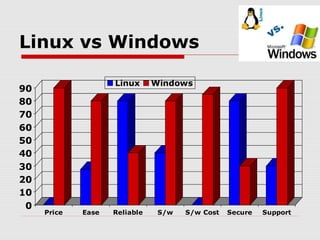
Linux vs Windows
90
80
70
60
50
40
30
20
10
0

Linux

Price

Ease

Reliable

Windows

S/w

S/w Cost

Secure

Support
Query Session

Operating System Presentation