Online Safety


       Mrs. Alejandro
Contents
•   Statistics
•   Social Networking
•   Dangers of the Internet
•   Tips for Online Safety
•   Reporting Online Predators
Teen Online Statistics
• 95% of parents don’t recognize the lingo
  kids use to let people know that their
  parents are watching.
• 76% of parents don’t have rules about
  what their kids can do on the computer.
• 20% of children age 10-17 have been
  solicited sexually online.
• 75% of youth who received an online
  sexual solicitation did not tell a parent.
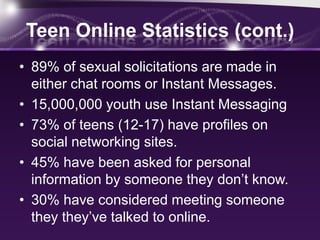
Teen Online Statistics (cont.)
• 89% of sexual solicitations are made in
  either chat rooms or Instant Messages.
• 15,000,000 youth use Instant Messaging
• 73% of teens (12-17) have profiles on
  social networking sites.
• 45% have been asked for personal
  information by someone they don’t know.
• 30% have considered meeting someone
  they they’ve talked to online.
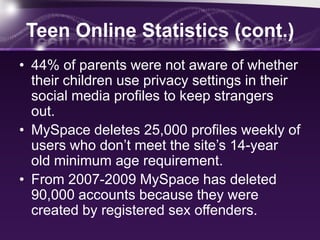
Teen Online Statistics (cont.)
• 44% of parents were not aware of whether
  their children use privacy settings in their
  social media profiles to keep strangers
  out.
• MySpace deletes 25,000 profiles weekly of
  users who don’t meet the site’s 14-year
  old minimum age requirement.
• From 2007-2009 MySpace has deleted
  90,000 accounts because they were
  created by registered sex offenders.
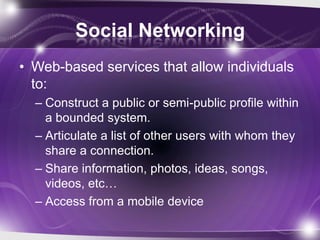
Social Networking
• Web-based services that allow individuals
  to:
  – Construct a public or semi-public profile within
    a bounded system.
  – Articulate a list of other users with whom they
    share a connection.
  – Share information, photos, ideas, songs,
    videos, etc…
  – Access from a mobile device
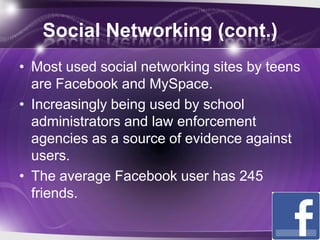
Social Networking (cont.)
• Most used social networking sites by teens
  are Facebook and MySpace.
• Increasingly being used by school
  administrators and law enforcement
  agencies as a source of evidence against
  users.
• The average Facebook user has 245
  friends.
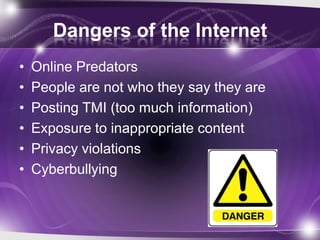
Dangers of the Internet
•   Online Predators
•   People are not who they say they are
•   Posting TMI (too much information)
•   Exposure to inappropriate content
•   Privacy violations
•   Cyberbullying
Tips for Online Safety
• Don’t believe everything you see online.
• Bee leery of those who want to know too
  much.
• Keep your information to yourself.
• Make sure your screen name doesn’t say
  too much about you.
• Post only information that you are
  comfortable with others seeing.
Tips for Online Safety
• Remember that once you post information
  online, you can’t take it back.
• Consider not posting your photo.
• Flirting with strangers online could have
  serious consequences.
• Be wary if a friend wants to meet you in
  person.
• Trust your gut if you have suspicions.
Tips for Online Safety
• Use privacy setting and sharing controls.
• Keep your primary email address private.
• Be very careful when someone offers you
  something for nothing, such as gifts or
  money.
• Share online safety tips with others.
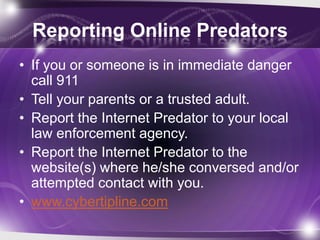
Reporting Online Predators
• If you or someone is in immediate danger
  call 911
• Tell your parents or a trusted adult.
• Report the Internet Predator to your local
  law enforcement agency.
• Report the Internet Predator to the
  website(s) where he/she conversed and/or
  attempted contact with you.
• www.cybertipline.com

Online safety

  • 1.
    Online Safety Mrs. Alejandro
  • 2.
    Contents • Statistics • Social Networking • Dangers of the Internet • Tips for Online Safety • Reporting Online Predators
  • 3.
    Teen Online Statistics •95% of parents don’t recognize the lingo kids use to let people know that their parents are watching. • 76% of parents don’t have rules about what their kids can do on the computer. • 20% of children age 10-17 have been solicited sexually online. • 75% of youth who received an online sexual solicitation did not tell a parent.
  • 4.
    Teen Online Statistics(cont.) • 89% of sexual solicitations are made in either chat rooms or Instant Messages. • 15,000,000 youth use Instant Messaging • 73% of teens (12-17) have profiles on social networking sites. • 45% have been asked for personal information by someone they don’t know. • 30% have considered meeting someone they they’ve talked to online.
  • 5.
    Teen Online Statistics(cont.) • 44% of parents were not aware of whether their children use privacy settings in their social media profiles to keep strangers out. • MySpace deletes 25,000 profiles weekly of users who don’t meet the site’s 14-year old minimum age requirement. • From 2007-2009 MySpace has deleted 90,000 accounts because they were created by registered sex offenders.
  • 6.
    Social Networking • Web-basedservices that allow individuals to: – Construct a public or semi-public profile within a bounded system. – Articulate a list of other users with whom they share a connection. – Share information, photos, ideas, songs, videos, etc… – Access from a mobile device
  • 7.
    Social Networking (cont.) •Most used social networking sites by teens are Facebook and MySpace. • Increasingly being used by school administrators and law enforcement agencies as a source of evidence against users. • The average Facebook user has 245 friends.
  • 8.
    Dangers of theInternet • Online Predators • People are not who they say they are • Posting TMI (too much information) • Exposure to inappropriate content • Privacy violations • Cyberbullying
  • 9.
    Tips for OnlineSafety • Don’t believe everything you see online. • Bee leery of those who want to know too much. • Keep your information to yourself. • Make sure your screen name doesn’t say too much about you. • Post only information that you are comfortable with others seeing.
  • 10.
    Tips for OnlineSafety • Remember that once you post information online, you can’t take it back. • Consider not posting your photo. • Flirting with strangers online could have serious consequences. • Be wary if a friend wants to meet you in person. • Trust your gut if you have suspicions.
  • 11.
    Tips for OnlineSafety • Use privacy setting and sharing controls. • Keep your primary email address private. • Be very careful when someone offers you something for nothing, such as gifts or money. • Share online safety tips with others.
  • 12.
    Reporting Online Predators •If you or someone is in immediate danger call 911 • Tell your parents or a trusted adult. • Report the Internet Predator to your local law enforcement agency. • Report the Internet Predator to the website(s) where he/she conversed and/or attempted contact with you. • www.cybertipline.com