Dyslexia and
Technology
Presented by: Sandra Paul and
Dana Giorgianni
Today’s Agenda
Definition
Scientific and Neurological Aspects
NJ Legislature regarding Dyslexia
NJ Professional Development Guidelines regarding Dyslexia
Middlesex and Ocean County Guidelines
Instructional Practices
Project-Based Learning
Assistive Technology
Review
Why would a Chief Technology Officer care about
Dyslexia?
First Teaching Position
First Director Technology position - technical staff member with Dyslexia
Special Education
ARRA and IDEA funding
Dislecksia: a bifront wai ov lerning
Facts regarding Dyslexia
Approximately 15-20% of the population have some of
the symptoms of dyslexia including slow or inaccurate
reading, poor spelling, poor writing, or mixing up
similar words.
Runs in families
People of all backgrounds
Students can be very bright. Capable of or gifted in
areas such as art, computer science, design, drama,
electronics, math, mechanics, music, physics, sales
and sports
What is Dyslexia? - Definition
Neurological
Difficulties with accuracy and/or word fluent word
recognition
Poor spelling and decoding abilities
Deficit in the phonological component of language
Unexpected in relation to other cognitive abilities
Can lead to problems in reading comprehension and impede
growth in vocabulary
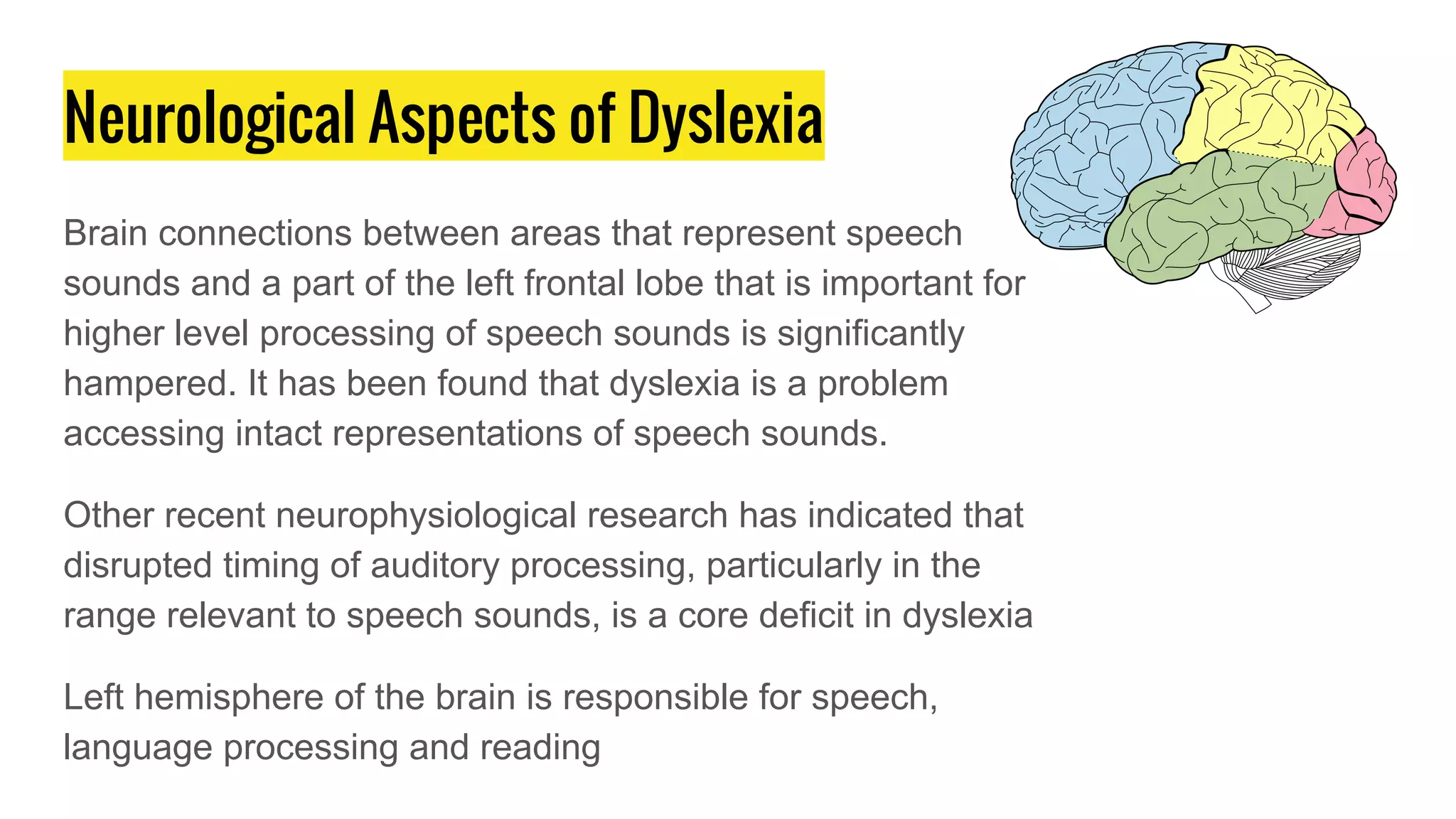
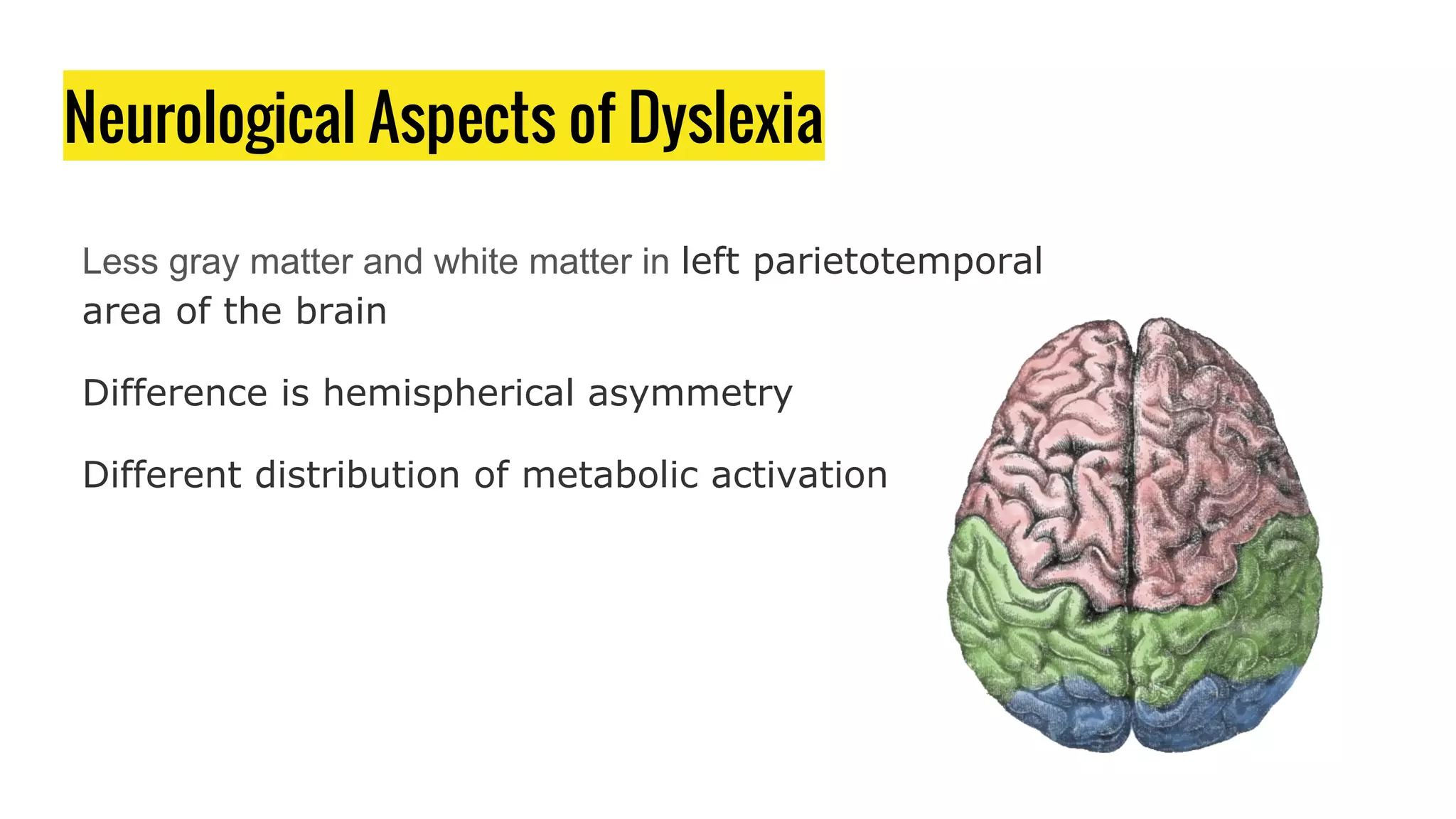
Neurological Aspects of Dyslexia
Brain connections between areas that represent speech
sounds and a part of the left frontal lobe that is important for
higher level processing of speech sounds is significantly
hampered. It has been found that dyslexia is a problem
accessing intact representations of speech sounds.
Other recent neurophysiological research has indicated that
disrupted timing of auditory processing, particularly in the
range relevant to speech sounds, is a core deficit in dyslexia
Left hemisphere of the brain is responsible for speech,
language processing and reading
Neurological Aspects of Dyslexia
Less gray matter and white matter in left parietotemporal
area of the brain
Difference is hemispherical asymmetry
Different distribution of metabolic activation
NJ Legislature regarding Dyslexia
P.L.2013, c131 requires the NJDOE promulgate regulations incorporating the
International Dyslexia Association’s definition of Dyslexia.
P.L.2013, c105 requires a minimum of 2 hrs of PD each year for general ed
teacher k-3rd grade, special education, basic skills and English as a second
language teachers, learning disabilities consultants and speech language
specialists.
P.L.2013, c210 requires that the NJDOE provide districts with information on
screening instruments
NJ PD Guidelines for Dyslexia
2 hours minimum each year
Screening, Intervention, Accommodation and use of
technology for students with reading disabilities
including Dyslexia
Documentation maintained by the district
NJDOE will be offering workshops but not required to
participate in these training
District decides on how staff meets these
requirements
Middlesex and Mercer County
Unpacking New Jersey’s Dyslexia Legislation: Guidelines
Dyslexia April 23rd, 2015 Presentation and Handouts
● include sample screening instruments
● research based best practices for intervention
● data driven instruction
● milestones for first and second graders
● NJ 1-3 grade implementation guidelines
Teacher’s Point of View
● Don’t reinvent the wheel; use what you have and​
tweek it.​
● Don’t forget the “oldies”; not everyone is going to get ​
all the shiny new equipment.​
● Keep it simple. Make it fun.​
● Let everyone try/use it. Don’t make it something “special”
make it an option.​
● Have a backup plan.
Instructional Practices: introduce, practice, review, assess
Materials: (used in most
classroom)​
workbooks & textbooks​
worksheets​
written assignments​
assessments​
My Instructional Practices: tell, show, do
Materials: (used in my classrooms)​
workbooks & textbooks​
worksheets​
written assignments​
assessments​
● centers​
● multi-sensory activities​
● computers​
● ipads​
Instructional Strategies (ways to make the work accessible to all learners)
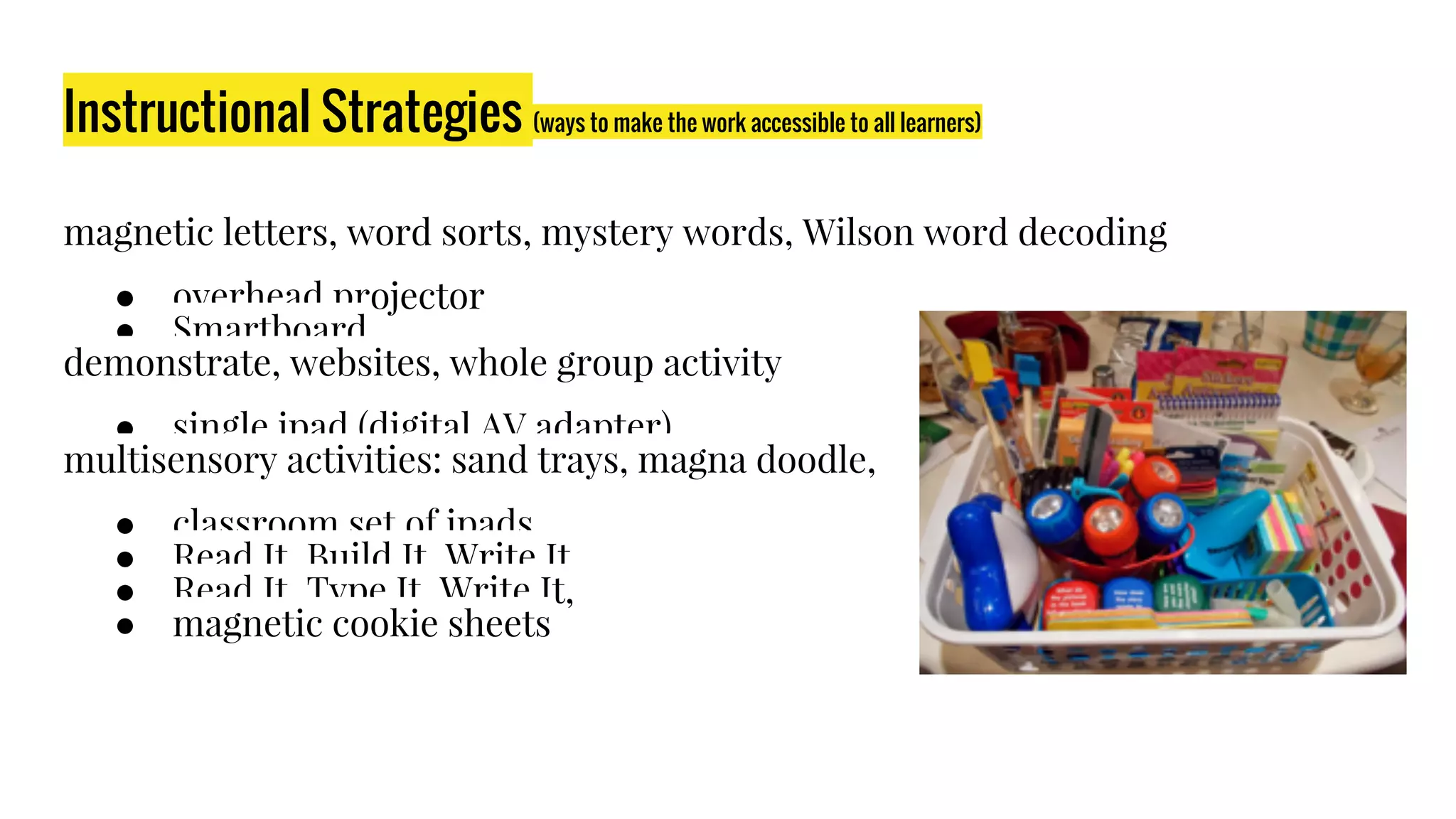
magnetic letters, word sorts, mystery words, Wilson word decoding​
● overhead projector​
● Smartboard​
demonstrate, websites, whole group activity​
● single ipad (digital AV adapter)​
multisensory activities: sand trays, magna doodle, ​
● classroom set of ipads​
● Read It, Build It, Write It, ​
● Read It, Type It, Write It, ​
● magnetic cookie sheets​
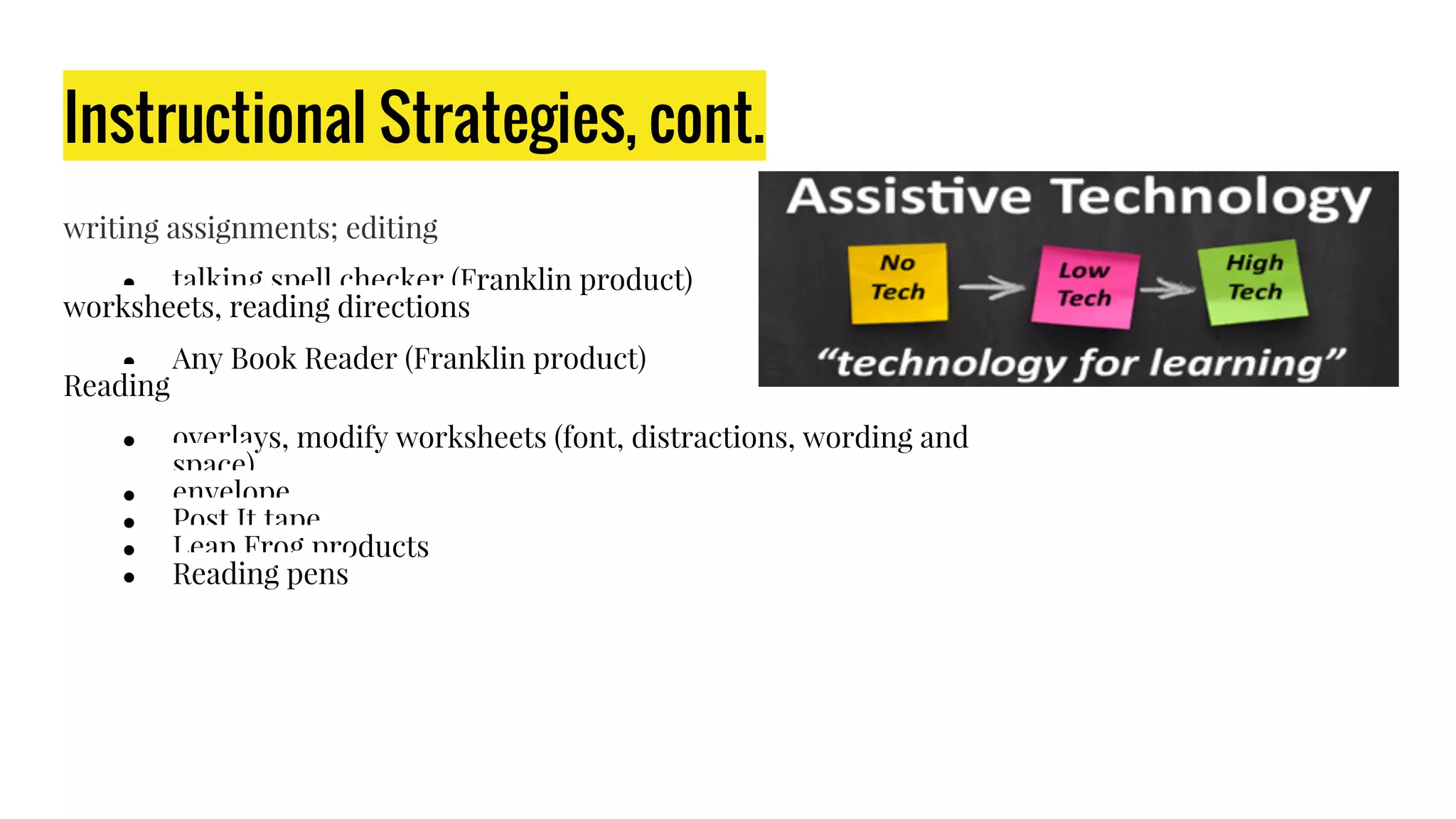
Instructional Strategies, cont.
writing assignments; editing​
● talking spell checker (Franklin product)​
worksheets, reading directions​
● Any Book Reader (Franklin product)​
Reading​
● overlays, modify worksheets (font, distractions, wording and
space)​
● envelope​
● Post It tape​
● Leap Frog products​
● Reading pens
Web- sites & Apps
National Geographic Young Explorers, Word Talk, Open Dyslexia, Read & Write​
Handwriting Without Tears: (4.99) Wet, Dry, Try; Letter School​
FREE: Chatterpix, TACU, PIC Collage, Glow Magic, Sand Draw, Doodoo Pad, Draw Free, Dust, Gold
Dust, Touch Fire, Magnetic ABCs, Mood Pad, Real Chalkboard, iSpeak and Spell, Kid Recorder, Paper
Chibi, Doodle Buddy​
Teacherspayteachers: ($3.00 ea.) Dyslexic Cursive Practice; Dyslexia Letter Practice; Dyslexia
worksheets: help with reversals; Read It, Type It, Write It; Read It, Build It, Write It; LapTop Sight
Words ​
($17.00) EZ Read, EZ Write, EZ Brain Games)
Dyslexia Font for Reading and Writing
Teaching Dyslexic Students
Project Based-Learning
Visual Learning
Multi-sensory Strategies
Information and Communication Tech
(ICT) for enhancing learning
Bloom’s Taxonomy
How technology can help
Screening
Intervention
Accommodation
Suggested technology intervention
Audio Players and Recorders -text to speech
Reading support - text to speech, line-by-line highlighting
Timers as visual aids
FM Audio systems
Calculators
Writing support - word predictions, speech recognition,
Graphic Organizers - mapping,
Spelling devices and Talking Dictionaries
Assistive Technology
Assistive add-ons on a devices such as text-to-speech,
Dragon Dictation and Dragon Search
ZenTap - word prediction
Kidspiration/Inspiration
Popplet - web-based graphic organizer tool
Mindomo - web-based graphic organizer tool
Website assistive technology
LearningAlly.com
Bookshare.org
Librivox.org - audiobooks
Audible.com - audiobooks
Don Johnston, Inc. - Co-Writer, SOLO Suite, Draft: Builder, Read: OutLoud
Technology Accomodations
Public Library audiobooks and ebooks - Overdrive
LiveScibe Smart Pens
InfoScan Notetaking Pens - scans up to 20,000 lines, stored on pen then transfer
to word processor
Wordmaker -Students who lack proficient decoding skills struggle to achieve
fluency and comprehension. WordMaker provides a systematic and interactive
approach to teaching spelling, reading, and writing skills.
Kuzweil 3000
Review
Definition
Scientific and Neurological Aspects
NJ Legislature regarding Dyslexia
NJ Professional Development Guidelines regarding Dyslexia
Middlesex and Ocean County Guidelines
Instructional Practices
Project-Based Learning
Assistive Technology
Review
Thank you for listening
Contact information:
Email: spaul6414@gmail.com
Twitter: @spaul6414
LinkedIn: Sandra Paul
Cell: 908-433-7076
Contact information:
Email: dana.giorgianni@sayrevillek12.net
Phone Number: 732-316-4050
Resources
NJDOE: Decoding Dyslexia - NJ
http://www.Understood.org
http://www.Dyslexia.com
http://www.Learningally.com
http://www.DonJohnston.com
http://www.Bookshare.org
http://www.eida.com - International Dyslexia Association
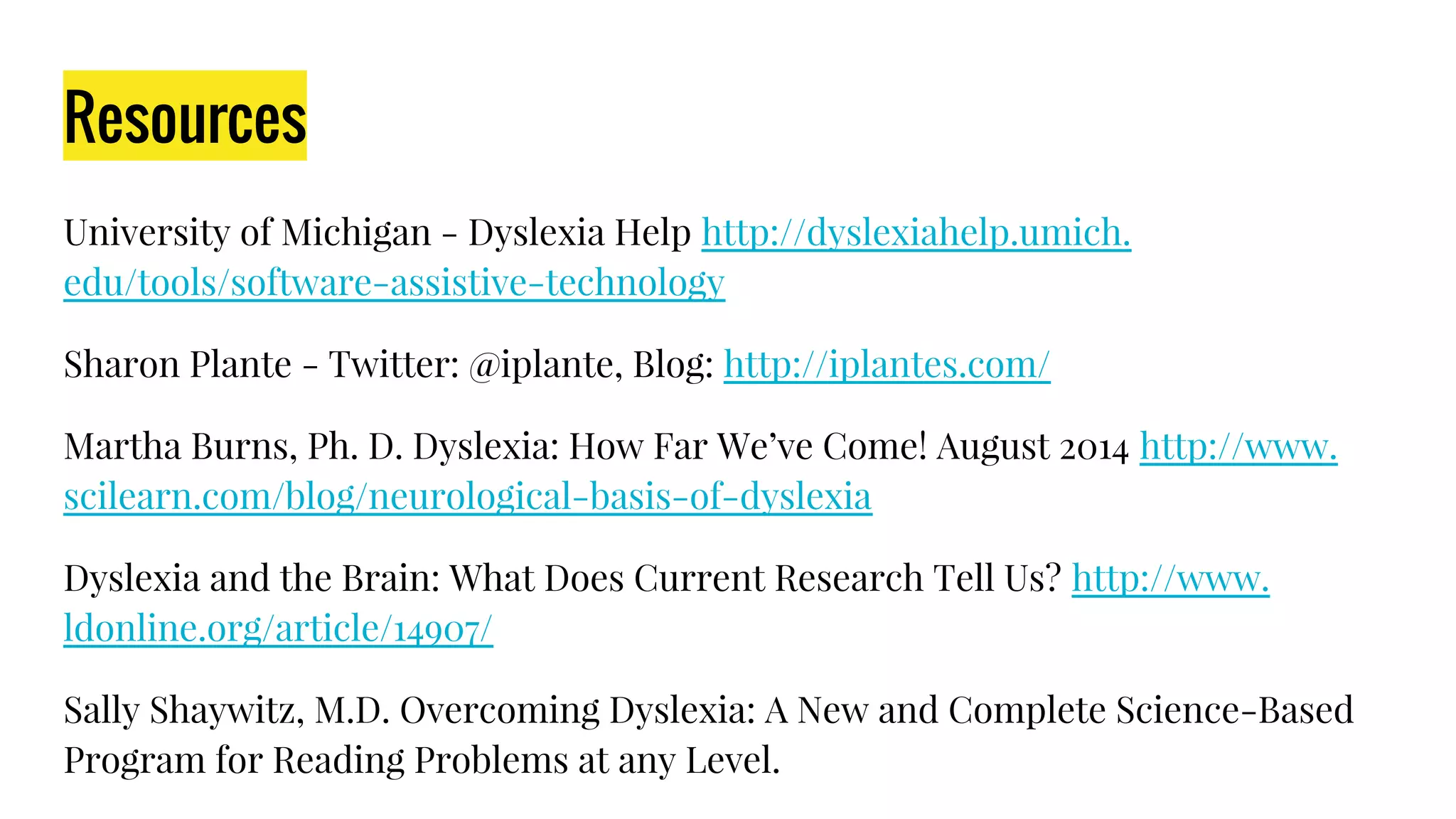
Resources
University of Michigan - Dyslexia Help http://dyslexiahelp.umich.
edu/tools/software-assistive-technology
Sharon Plante - Twitter: @iplante, Blog: http://iplantes.com/
Martha Burns, Ph. D. Dyslexia: How Far We’ve Come! August 2014 http://www.
scilearn.com/blog/neurological-basis-of-dyslexia
Dyslexia and the Brain: What Does Current Research Tell Us? http://www.
ldonline.org/article/14907/
Sally Shaywitz, M.D. Overcoming Dyslexia: A New and Complete Science-Based
Program for Reading Problems at any Level.

Dyslexia and technology

  • 1.
    Dyslexia and Technology Presented by:Sandra Paul and Dana Giorgianni
  • 2.
    Today’s Agenda Definition Scientific andNeurological Aspects NJ Legislature regarding Dyslexia NJ Professional Development Guidelines regarding Dyslexia Middlesex and Ocean County Guidelines Instructional Practices Project-Based Learning Assistive Technology Review
  • 3.
    Why would aChief Technology Officer care about Dyslexia? First Teaching Position First Director Technology position - technical staff member with Dyslexia Special Education ARRA and IDEA funding
  • 4.
    Dislecksia: a bifrontwai ov lerning
  • 5.
    Facts regarding Dyslexia Approximately15-20% of the population have some of the symptoms of dyslexia including slow or inaccurate reading, poor spelling, poor writing, or mixing up similar words. Runs in families People of all backgrounds Students can be very bright. Capable of or gifted in areas such as art, computer science, design, drama, electronics, math, mechanics, music, physics, sales and sports
  • 6.
    What is Dyslexia?- Definition Neurological Difficulties with accuracy and/or word fluent word recognition Poor spelling and decoding abilities Deficit in the phonological component of language Unexpected in relation to other cognitive abilities Can lead to problems in reading comprehension and impede growth in vocabulary
  • 7.
    Neurological Aspects ofDyslexia Brain connections between areas that represent speech sounds and a part of the left frontal lobe that is important for higher level processing of speech sounds is significantly hampered. It has been found that dyslexia is a problem accessing intact representations of speech sounds. Other recent neurophysiological research has indicated that disrupted timing of auditory processing, particularly in the range relevant to speech sounds, is a core deficit in dyslexia Left hemisphere of the brain is responsible for speech, language processing and reading
  • 8.
    Neurological Aspects ofDyslexia Less gray matter and white matter in left parietotemporal area of the brain Difference is hemispherical asymmetry Different distribution of metabolic activation
  • 9.
    NJ Legislature regardingDyslexia P.L.2013, c131 requires the NJDOE promulgate regulations incorporating the International Dyslexia Association’s definition of Dyslexia. P.L.2013, c105 requires a minimum of 2 hrs of PD each year for general ed teacher k-3rd grade, special education, basic skills and English as a second language teachers, learning disabilities consultants and speech language specialists. P.L.2013, c210 requires that the NJDOE provide districts with information on screening instruments
  • 10.
    NJ PD Guidelinesfor Dyslexia 2 hours minimum each year Screening, Intervention, Accommodation and use of technology for students with reading disabilities including Dyslexia Documentation maintained by the district NJDOE will be offering workshops but not required to participate in these training District decides on how staff meets these requirements
  • 11.
    Middlesex and MercerCounty Unpacking New Jersey’s Dyslexia Legislation: Guidelines Dyslexia April 23rd, 2015 Presentation and Handouts ● include sample screening instruments ● research based best practices for intervention ● data driven instruction ● milestones for first and second graders ● NJ 1-3 grade implementation guidelines
  • 12.
    Teacher’s Point ofView ● Don’t reinvent the wheel; use what you have and​ tweek it.​ ● Don’t forget the “oldies”; not everyone is going to get ​ all the shiny new equipment.​ ● Keep it simple. Make it fun.​ ● Let everyone try/use it. Don’t make it something “special” make it an option.​ ● Have a backup plan.
  • 13.
    Instructional Practices: introduce,practice, review, assess Materials: (used in most classroom)​ workbooks & textbooks​ worksheets​ written assignments​ assessments​
  • 14.
    My Instructional Practices:tell, show, do Materials: (used in my classrooms)​ workbooks & textbooks​ worksheets​ written assignments​ assessments​ ● centers​ ● multi-sensory activities​ ● computers​ ● ipads​
  • 15.
    Instructional Strategies (waysto make the work accessible to all learners) magnetic letters, word sorts, mystery words, Wilson word decoding​ ● overhead projector​ ● Smartboard​ demonstrate, websites, whole group activity​ ● single ipad (digital AV adapter)​ multisensory activities: sand trays, magna doodle, ​ ● classroom set of ipads​ ● Read It, Build It, Write It, ​ ● Read It, Type It, Write It, ​ ● magnetic cookie sheets​
  • 16.
    Instructional Strategies, cont. writingassignments; editing​ ● talking spell checker (Franklin product)​ worksheets, reading directions​ ● Any Book Reader (Franklin product)​ Reading​ ● overlays, modify worksheets (font, distractions, wording and space)​ ● envelope​ ● Post It tape​ ● Leap Frog products​ ● Reading pens
  • 17.
    Web- sites &Apps National Geographic Young Explorers, Word Talk, Open Dyslexia, Read & Write​ Handwriting Without Tears: (4.99) Wet, Dry, Try; Letter School​ FREE: Chatterpix, TACU, PIC Collage, Glow Magic, Sand Draw, Doodoo Pad, Draw Free, Dust, Gold Dust, Touch Fire, Magnetic ABCs, Mood Pad, Real Chalkboard, iSpeak and Spell, Kid Recorder, Paper Chibi, Doodle Buddy​ Teacherspayteachers: ($3.00 ea.) Dyslexic Cursive Practice; Dyslexia Letter Practice; Dyslexia worksheets: help with reversals; Read It, Type It, Write It; Read It, Build It, Write It; LapTop Sight Words ​ ($17.00) EZ Read, EZ Write, EZ Brain Games)
  • 18.
    Dyslexia Font forReading and Writing
  • 19.
    Teaching Dyslexic Students ProjectBased-Learning Visual Learning Multi-sensory Strategies Information and Communication Tech (ICT) for enhancing learning Bloom’s Taxonomy
  • 20.
    How technology canhelp Screening Intervention Accommodation
  • 21.
    Suggested technology intervention AudioPlayers and Recorders -text to speech Reading support - text to speech, line-by-line highlighting Timers as visual aids FM Audio systems Calculators Writing support - word predictions, speech recognition, Graphic Organizers - mapping, Spelling devices and Talking Dictionaries
  • 22.
    Assistive Technology Assistive add-onson a devices such as text-to-speech, Dragon Dictation and Dragon Search ZenTap - word prediction Kidspiration/Inspiration Popplet - web-based graphic organizer tool Mindomo - web-based graphic organizer tool
  • 23.
    Website assistive technology LearningAlly.com Bookshare.org Librivox.org- audiobooks Audible.com - audiobooks Don Johnston, Inc. - Co-Writer, SOLO Suite, Draft: Builder, Read: OutLoud
  • 24.
    Technology Accomodations Public Libraryaudiobooks and ebooks - Overdrive LiveScibe Smart Pens InfoScan Notetaking Pens - scans up to 20,000 lines, stored on pen then transfer to word processor Wordmaker -Students who lack proficient decoding skills struggle to achieve fluency and comprehension. WordMaker provides a systematic and interactive approach to teaching spelling, reading, and writing skills. Kuzweil 3000
  • 25.
    Review Definition Scientific and NeurologicalAspects NJ Legislature regarding Dyslexia NJ Professional Development Guidelines regarding Dyslexia Middlesex and Ocean County Guidelines Instructional Practices Project-Based Learning Assistive Technology Review
  • 26.
    Thank you forlistening Contact information: Email: spaul6414@gmail.com Twitter: @spaul6414 LinkedIn: Sandra Paul Cell: 908-433-7076 Contact information: Email: dana.giorgianni@sayrevillek12.net Phone Number: 732-316-4050
  • 27.
    Resources NJDOE: Decoding Dyslexia- NJ http://www.Understood.org http://www.Dyslexia.com http://www.Learningally.com http://www.DonJohnston.com http://www.Bookshare.org http://www.eida.com - International Dyslexia Association
  • 28.
    Resources University of Michigan- Dyslexia Help http://dyslexiahelp.umich. edu/tools/software-assistive-technology Sharon Plante - Twitter: @iplante, Blog: http://iplantes.com/ Martha Burns, Ph. D. Dyslexia: How Far We’ve Come! August 2014 http://www. scilearn.com/blog/neurological-basis-of-dyslexia Dyslexia and the Brain: What Does Current Research Tell Us? http://www. ldonline.org/article/14907/ Sally Shaywitz, M.D. Overcoming Dyslexia: A New and Complete Science-Based Program for Reading Problems at any Level.