The OSI Model
Computer Maintenance
What is the OSI Model
• OSI – Open System Interconnection
• A set of seven layers that define the
different stages that data must go through
to travel from one device to another over a
network.
The Layers
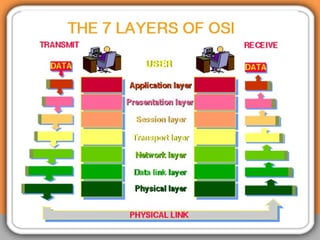
• Layer 7: Application - This is the layer
that actually interacts with the operating
system or application whenever the user
chooses to transfer files, read messages
or perform other network-related activities.
• Layer 6: Presentation - Layer 6 takes the
data provided by the Application layer and
converts it into a standard format that the
other layers can understand.
The Layers (cont.)
• Layer 5: Session - Layer 5 establishes,
maintains and ends communication with
the receiving device.
• Layer 4: Transport - This layer maintains
flow control of data and provides for error
checking and recovery of data between
the devices.
The Layers (cont.)
• Layer 3: Network - The way that the data
will be sent to the recipient device is
determined in this layer.
• Layer 2: Data Link - In this layer, the
appropriate physical protocol is assigned
to the data. Also, the frames are
transmitted from node to node based on
station address.
The Layers (cont.)
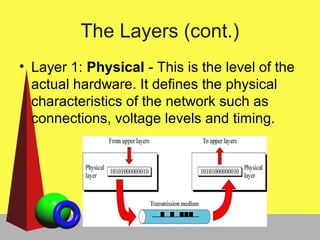
• Layer 1: Physical - This is the level of the
actual hardware. It defines the physical
characteristics of the network such as
connections, voltage levels and timing.

The osi model

  • 1.
  • 2.
    What is theOSI Model • OSI – Open System Interconnection • A set of seven layers that define the different stages that data must go through to travel from one device to another over a network.
  • 4.
    The Layers • Layer7: Application - This is the layer that actually interacts with the operating system or application whenever the user chooses to transfer files, read messages or perform other network-related activities. • Layer 6: Presentation - Layer 6 takes the data provided by the Application layer and converts it into a standard format that the other layers can understand.
  • 5.
    The Layers (cont.) •Layer 5: Session - Layer 5 establishes, maintains and ends communication with the receiving device. • Layer 4: Transport - This layer maintains flow control of data and provides for error checking and recovery of data between the devices.
  • 6.
    The Layers (cont.) •Layer 3: Network - The way that the data will be sent to the recipient device is determined in this layer. • Layer 2: Data Link - In this layer, the appropriate physical protocol is assigned to the data. Also, the frames are transmitted from node to node based on station address.
  • 7.
    The Layers (cont.) •Layer 1: Physical - This is the level of the actual hardware. It defines the physical characteristics of the network such as connections, voltage levels and timing.

Editor's Notes

  • #6 Flow control means that the Transport layer looks to see if data is coming from more than one application and integrates each application's data into a single stream for the physical network.