
Youth Safety on the Social Web Larry Magid & Anne Collier Co-directors ConnectSafely.org Revised 1/09 © 2009 ConnectSafely.org
What  is  the social Web? -- Also known as ‘Web 2.0’-- User-produced, youth-driven Multiple devices Multimedia Uploadable, downloadable Difficult to control
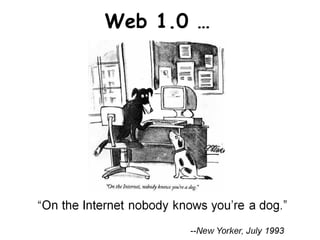
Web 1.0 …
On Web 2.0...  -- Michael Kinsley, Slate.com, 11/27/06 “ ... everybody  knows you’re a dog.”
Social networking is whatever… … anyone wants it to be! Entertainment + socializing + homework help + media-sharing + creative outlet + friends’ latest news A place to learn digital-media skills A “hangout” on Web, phones, gaming
Today’s phones are full-blown mobile computers with... Mobile social networking  Social mapping Photo- & video-sharing Web browsing 24/7 texting Even less adult supervision Cellphones too
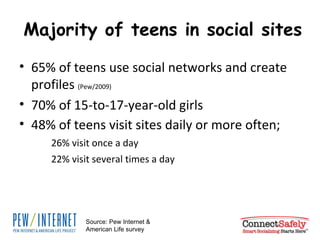
Majority of teens in social sites 65% of teens use social networks and create profiles  (Pew/2009) 70% of 15-to-17-year-old girls 48% of teens visit sites daily or more often;  26% visit once a day 22% visit several times a day Source: Pew Internet & American Life survey
Not just  MySpace & Facebook YouTube, MyYearbook, Bebo, Hi5  & many  niche  social network sites Ning:  Allows users to create their own social networks, or mini-MySpaces. Allows porn (with splash page).  Twitter & Plurk:  Micro-blogging - 140 characters or less. Kind of like blended chat & IM. Twitter mostly adults, Plurk a little younger. Second Life & other virtual worlds : Users create avatars that interact in a virtual world. Hulu:  Fast-growing video-sharing site (153 million video streams, 9/08); popular for viewing whole shows online And some are a bit more questionable …. JuicyCampus  Gossip site, total anonymity, no rules.… Stickam : Social video-streaming site with live webcam chat.
What are they  doing   in there? Good or “normal”… “ Social producing” Learning social rules Decorating profiles (self-expression) Exploring identity Writing blogs Writing software code Risk assessment Discovering music Producing & editing videos Discussing interests Social/political activism Keeping in touch with friends long-term
What  else  are they doing  in there? Neutral or negative… Seeking validation Competing in a popularity contest Venting  Showing off Embarrassing themselves Pulling pranks Getting even Harassing
The ‘ Net  effect’ Persistence & searchability:  Net as permanent searchable archive Replicability : ability to copy and paste from anywhere, to anywhere Scalability:  high potential visibility Invisible audiences:  you never know who’s watching Collapsed contexts:  different audiences hear & see different things Blurring of public and private:  boundaries not clear Source: danah boyd:  Taken out of Context, 2008
Mostly for real-life friends 72% use sites to socialize with their real-life friends.  Only a modest number (17%) of social-networking teens say they use the sites to flirt. Source: Pew Internet & American Life survey January 2007
Teens  do  have a clue when it comes to safety & privacy 66% of teens who have created a profile say that their profile is not visible by all Internet users. They limit access to their profiles.  21% say their profile is not currently visible. Just 1% of social-network users say they do not know who can see their profile. Source: Pew Internet & American Life survey January 2007
Are they careful about photos? Yes and no (more on Web than on phones) Cellphones : Reports of“sexting” (nude photo-sharing) are growing Web : 39% say they restrict access to their photos “most of the time.”  38% report restricting access “only sometimes.”  21% of teens who post photos say they “never” restrict access to the images they upload. (Online  adults  are more lax in restricting access.) Source: Pew Internet & American Life survey January 2007
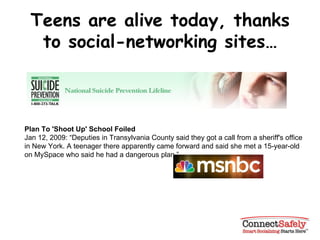
Teens are alive today, thanks to social-networking sites… Plan To 'Shoot Up' School Foiled Jan 12, 2009: “Deputies in Transylvania County said they got a call from a sheriff's office in New York. A teenager there apparently came forward and said she met a 15-year-old on MySpace who said he had a dangerous plan.”
Question : What proportion of teens have been approached online by a predator? 1 in 20 1 in 10 1 in 7 1 in 5 Almost half
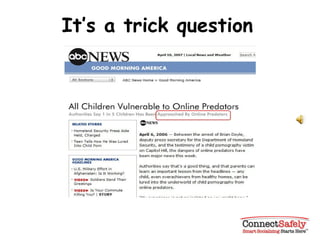
It’s a trick question
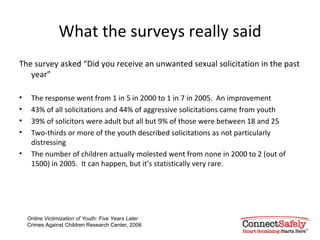
What the surveys really said The survey asked “Did you receive an unwanted sexual solicitation in the past year” The response went from 1 in 5 in 2000 to 1 in 7 in 2005.  An improvement 43% of all solicitations and 44% of aggressive solicitations came from youth 39% of solicitors were adult but all but 9% of those were between 18 and 25 Two-thirds or more of the youth described solicitations as not particularly distressing The number of children actually molested went from none in 2000 to 2 (out of 1500) in 2005.  It can happen, but it’s statistically very rare.  Online Victimization of Youth: Five Years Later Crimes Against Children Research Center, 2006
Question Do you agree that the growth in young people’s use of the Internet correlates with a rise in sexual abuse against children?
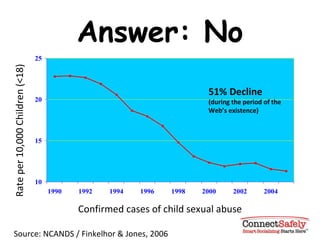
SA Sub 1990-2005* Rate per 10,000 Children (<18) Source: NCANDS / Finkelhor & Jones, 2006  51% Decline  (during the period of the Web’s existence) Answer: No Confirmed cases of child sexual abuse
Deception rarely involved Victims are aware of the approximate age and sexual intentions of the adults who contact them. Only 5% of offenders pretend to be teens.  In some cases, the kids are being aggressive and sexually suggestive and pose in ways to make themselves look older than they are. --Janis Wolak, University of New Hampshire’s Crimes Against Children Research Center (paraphrase, not exact quote)
What causes risk? Aggressive behavior in the form of making rude or nasty comments increased the odds of being victimized 2.3 times Frequently embarrassing others increased the risk almost 5 times Meeting people in multiple ways increased the odds 3.4 times Talking about sex online with strangers doubled the risk Engaging in multiple risky behaviors puts you at greatest risk Posting personal information is  not  related to victimization Source: Archives of Pediatrics & Adolescent Medicine, Feb 2007 Ybarra, Mitchell, Finkelhor, Wolak
The kids most at risk online are those at risk offline Online risks are not radically different in nature or scope than the risks minors have long faced offline. Minors most at risk in the offline world continue to be most at risk online. The psychosocial makeup and family dynamics surrounding a child are better predictors of risk than the technology used.  Messages need to be tailored to the child. One-size-fits-all doesn’t work. Source: Internet Safety Technical Task Force Report, January 2009
More likely risks Damaged reputation Emotional hurt Self-created child porn Negative validation Defamation Impersonation Permanent archive Inappropriate content PC security Cyberbullying…
Cyberbullying The risk that affects the most children 2 separate studies: About 33% of US teens have been harassed or bullied* Online harassment (more common) vs. bullying Cyberbullying : repeated aggression; associated with real life; power imbalance It’s more a developmental than a technology problem Sources: Patchin and Hinduja, 2006; Pew/Internet, 2007; Crimes Against Children Research Center, 2007
Signs of cyberbullying Loss of friends Depression Anxiety Loss of sleep Doesn’t want to go to school Covers screen or turns off device when others come into room* * can also be a sign of an inappropriate online relationship
What to tell kids facing cyberbullying Don’t react  (often the bully’s goal) Don’t retaliate Block the bully Save the evidence Talk to a trusted adult
Keys to finding solutions Understanding that the teenage brain is “a work in progress” (brain takes up to 25 years to develop) What’s happening online is more about adolescent behavior/development than tech Net = amplifier, searchable archive, pretty permanent; User/producers have multiple invisible audiences Collaborative solution-making needed
To summarize The social Web…   is good and bad for teens is a fact of life - not going away is user-driven (little control) Social Web safety requires… Growing understanding of benefits, risks Multiple forms of expertise Collaborative, long-term response Targeting real risks not high-frequency, low-risk behaviors
Thank you & please visit our forum at www.ConnectSafely.org Larry Magid Co-director, ConnectSafely.org [email_address] Anne Collier, Co-director [email_address]

Netsafetyoct30 Sound

  • 1.
    YouthSafety on the Social Web Larry Magid & Anne Collier Co-directors ConnectSafely.org Revised 1/09 © 2009 ConnectSafely.org
  • 2.
    What is the social Web? -- Also known as ‘Web 2.0’-- User-produced, youth-driven Multiple devices Multimedia Uploadable, downloadable Difficult to control
  • 3.
  • 4.
    On Web 2.0... -- Michael Kinsley, Slate.com, 11/27/06 “ ... everybody knows you’re a dog.”
  • 5.
    Social networking iswhatever… … anyone wants it to be! Entertainment + socializing + homework help + media-sharing + creative outlet + friends’ latest news A place to learn digital-media skills A “hangout” on Web, phones, gaming
  • 6.
    Today’s phones arefull-blown mobile computers with... Mobile social networking Social mapping Photo- & video-sharing Web browsing 24/7 texting Even less adult supervision Cellphones too
  • 7.
    Majority of teensin social sites 65% of teens use social networks and create profiles (Pew/2009) 70% of 15-to-17-year-old girls 48% of teens visit sites daily or more often; 26% visit once a day 22% visit several times a day Source: Pew Internet & American Life survey
  • 8.
    Not just MySpace & Facebook YouTube, MyYearbook, Bebo, Hi5 & many niche social network sites Ning: Allows users to create their own social networks, or mini-MySpaces. Allows porn (with splash page). Twitter & Plurk: Micro-blogging - 140 characters or less. Kind of like blended chat & IM. Twitter mostly adults, Plurk a little younger. Second Life & other virtual worlds : Users create avatars that interact in a virtual world. Hulu: Fast-growing video-sharing site (153 million video streams, 9/08); popular for viewing whole shows online And some are a bit more questionable …. JuicyCampus Gossip site, total anonymity, no rules.… Stickam : Social video-streaming site with live webcam chat.
  • 9.
    What are they doing in there? Good or “normal”… “ Social producing” Learning social rules Decorating profiles (self-expression) Exploring identity Writing blogs Writing software code Risk assessment Discovering music Producing & editing videos Discussing interests Social/political activism Keeping in touch with friends long-term
  • 10.
    What else are they doing in there? Neutral or negative… Seeking validation Competing in a popularity contest Venting Showing off Embarrassing themselves Pulling pranks Getting even Harassing
  • 11.
    The ‘ Net effect’ Persistence & searchability: Net as permanent searchable archive Replicability : ability to copy and paste from anywhere, to anywhere Scalability: high potential visibility Invisible audiences: you never know who’s watching Collapsed contexts: different audiences hear & see different things Blurring of public and private: boundaries not clear Source: danah boyd: Taken out of Context, 2008
  • 12.
    Mostly for real-lifefriends 72% use sites to socialize with their real-life friends. Only a modest number (17%) of social-networking teens say they use the sites to flirt. Source: Pew Internet & American Life survey January 2007
  • 13.
    Teens do have a clue when it comes to safety & privacy 66% of teens who have created a profile say that their profile is not visible by all Internet users. They limit access to their profiles. 21% say their profile is not currently visible. Just 1% of social-network users say they do not know who can see their profile. Source: Pew Internet & American Life survey January 2007
  • 14.
    Are they carefulabout photos? Yes and no (more on Web than on phones) Cellphones : Reports of“sexting” (nude photo-sharing) are growing Web : 39% say they restrict access to their photos “most of the time.” 38% report restricting access “only sometimes.” 21% of teens who post photos say they “never” restrict access to the images they upload. (Online adults are more lax in restricting access.) Source: Pew Internet & American Life survey January 2007
  • 15.
    Teens are alivetoday, thanks to social-networking sites… Plan To 'Shoot Up' School Foiled Jan 12, 2009: “Deputies in Transylvania County said they got a call from a sheriff's office in New York. A teenager there apparently came forward and said she met a 15-year-old on MySpace who said he had a dangerous plan.”
  • 16.
    Question : Whatproportion of teens have been approached online by a predator? 1 in 20 1 in 10 1 in 7 1 in 5 Almost half
  • 17.
  • 18.
    What the surveysreally said The survey asked “Did you receive an unwanted sexual solicitation in the past year” The response went from 1 in 5 in 2000 to 1 in 7 in 2005. An improvement 43% of all solicitations and 44% of aggressive solicitations came from youth 39% of solicitors were adult but all but 9% of those were between 18 and 25 Two-thirds or more of the youth described solicitations as not particularly distressing The number of children actually molested went from none in 2000 to 2 (out of 1500) in 2005. It can happen, but it’s statistically very rare. Online Victimization of Youth: Five Years Later Crimes Against Children Research Center, 2006
  • 19.
    Question Do youagree that the growth in young people’s use of the Internet correlates with a rise in sexual abuse against children?
  • 20.
    SA Sub 1990-2005*Rate per 10,000 Children (<18) Source: NCANDS / Finkelhor & Jones, 2006 51% Decline (during the period of the Web’s existence) Answer: No Confirmed cases of child sexual abuse
  • 21.
    Deception rarely involvedVictims are aware of the approximate age and sexual intentions of the adults who contact them. Only 5% of offenders pretend to be teens. In some cases, the kids are being aggressive and sexually suggestive and pose in ways to make themselves look older than they are. --Janis Wolak, University of New Hampshire’s Crimes Against Children Research Center (paraphrase, not exact quote)
  • 22.
    What causes risk?Aggressive behavior in the form of making rude or nasty comments increased the odds of being victimized 2.3 times Frequently embarrassing others increased the risk almost 5 times Meeting people in multiple ways increased the odds 3.4 times Talking about sex online with strangers doubled the risk Engaging in multiple risky behaviors puts you at greatest risk Posting personal information is not related to victimization Source: Archives of Pediatrics & Adolescent Medicine, Feb 2007 Ybarra, Mitchell, Finkelhor, Wolak
  • 23.
    The kids mostat risk online are those at risk offline Online risks are not radically different in nature or scope than the risks minors have long faced offline. Minors most at risk in the offline world continue to be most at risk online. The psychosocial makeup and family dynamics surrounding a child are better predictors of risk than the technology used. Messages need to be tailored to the child. One-size-fits-all doesn’t work. Source: Internet Safety Technical Task Force Report, January 2009
  • 24.
    More likely risksDamaged reputation Emotional hurt Self-created child porn Negative validation Defamation Impersonation Permanent archive Inappropriate content PC security Cyberbullying…
  • 25.
    Cyberbullying The riskthat affects the most children 2 separate studies: About 33% of US teens have been harassed or bullied* Online harassment (more common) vs. bullying Cyberbullying : repeated aggression; associated with real life; power imbalance It’s more a developmental than a technology problem Sources: Patchin and Hinduja, 2006; Pew/Internet, 2007; Crimes Against Children Research Center, 2007
  • 26.
    Signs of cyberbullyingLoss of friends Depression Anxiety Loss of sleep Doesn’t want to go to school Covers screen or turns off device when others come into room* * can also be a sign of an inappropriate online relationship
  • 27.
    What to tellkids facing cyberbullying Don’t react (often the bully’s goal) Don’t retaliate Block the bully Save the evidence Talk to a trusted adult
  • 28.
    Keys to findingsolutions Understanding that the teenage brain is “a work in progress” (brain takes up to 25 years to develop) What’s happening online is more about adolescent behavior/development than tech Net = amplifier, searchable archive, pretty permanent; User/producers have multiple invisible audiences Collaborative solution-making needed
  • 29.
    To summarize Thesocial Web… is good and bad for teens is a fact of life - not going away is user-driven (little control) Social Web safety requires… Growing understanding of benefits, risks Multiple forms of expertise Collaborative, long-term response Targeting real risks not high-frequency, low-risk behaviors
  • 30.
    Thank you &please visit our forum at www.ConnectSafely.org Larry Magid Co-director, ConnectSafely.org [email_address] Anne Collier, Co-director [email_address]