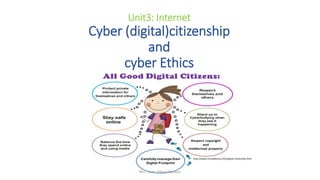
Unit3: Internet
Cyber (digital)citizenship
and
cyber Ethics
Mrs. Imen Tekaya Bouaziz
http://www.virtuallibrary.info/digital-citizenship.html
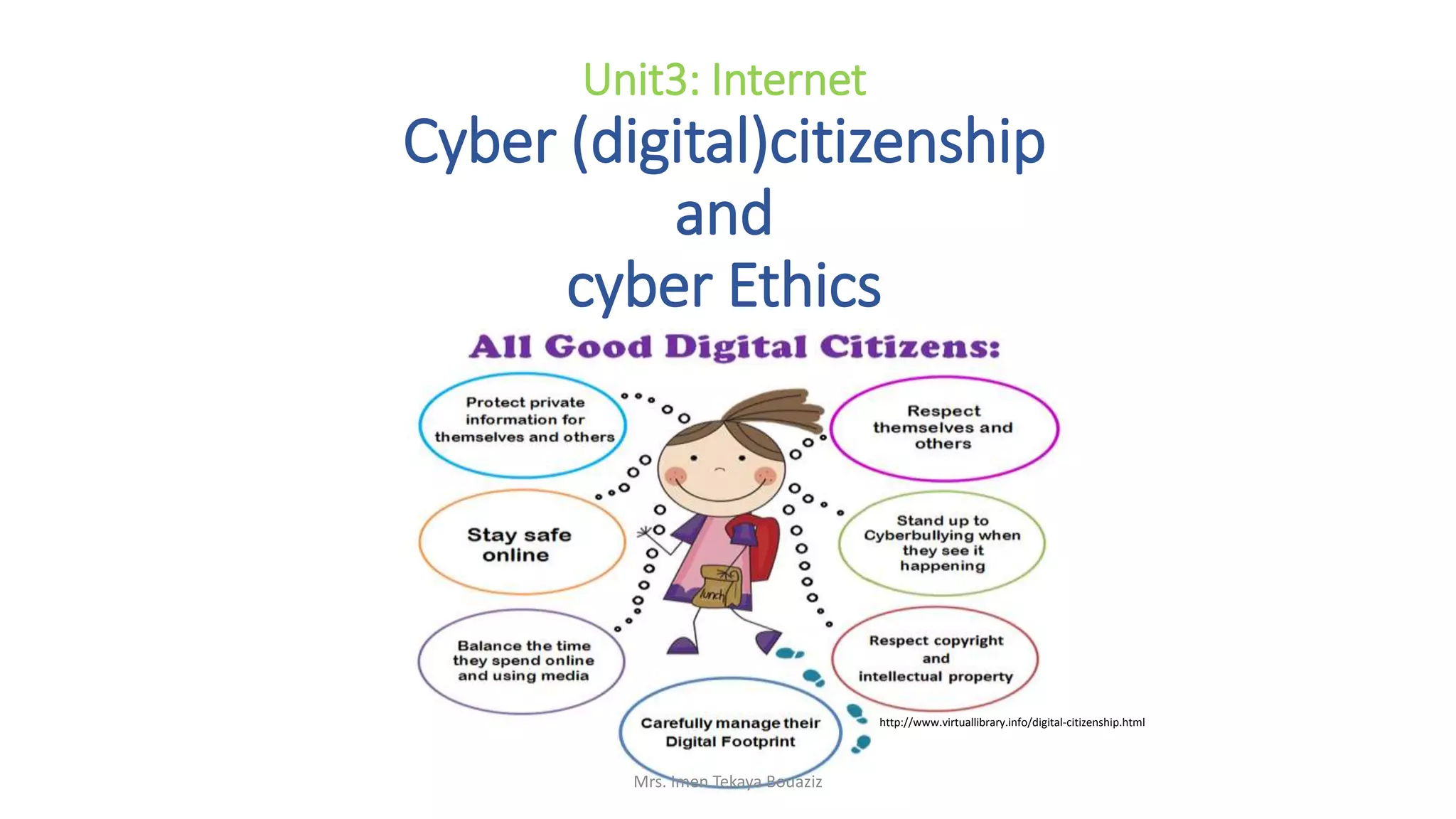
Cyber Citizen also known as Digital Citizen
• When they’re online, children and teenagers
are mostly social and collaborative.
• Digital citizenship also lets teenagers express
themselves by sharing and posting comments,
photos and videos. They can explore who they
are and take action on issues they care about by
starting or signing online petitions, joining or
creating online communities and interest
groups, or just by creating content like
animations or blogs.
• the Internet gives teenagers good access to
news and health information, and many turn to
the internet first to find out about themselves
and the world.
Mrs. Imen Tekaya Bouaziz http://d97cooltools.blogspot.com/2013/10/4-digital-citizenship-week-
resources.html?utm_content=buffer6cf9a&utm_source=buffer&utm_medium=twitter&utm_campaign=Buffer#.
WOJfWVXhBII
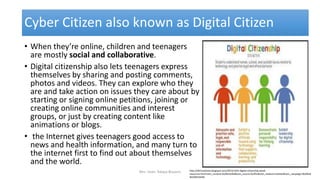
Why is being a Good
Cyber Citizen important?
• It keeps the Internet free from hurtful
statements.
• It creates a culture of more and more
reliable information.
• It allows people to be given credit for
what they've created.
• More criminals or bullies can be caught
when kids are honest and talk to adults.
• Keeps your information private.
Mrs. Imen Tekaya Bouaziz
http://blogs.egusd.net/digitalcitizenship/2015/01/06/free-digital-citizenship-posters-for-the-classroom/
the World Wide Web has its own etiquette or “netiquette”,
and "netiquette", refers to responsible cyber social behavior -
Cyber citizenship is a term that refers to being responsible when using the Internet.
What you do on-line when no one is looking tells a lot about your character and morals.
You are the first generation to be born into a world that already had computers. This means that
you need to learn the rights and consequences of living in a digital world.
You need to learn how to navigate through all the information that is available on-line.
Cyber Citizenship is kind of like the manners and etiquette of the Web.
Using Internet anonymously could be liberating for you, it allows you to feel more comfortable to
share your thoughts and ideas and opinions online through social media which is great to be a part
of the digital world and to participate in this sharing of information, but certain responsibilities
are required. Mrs. Imen Tekaya Bouaziz
Mrs. Imen Tekaya Bouaziz
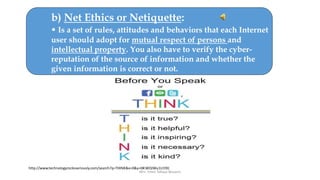
b) Net Ethics or Netiquette:
• Is a set of rules, attitudes and behaviors that each Internet
user should adopt for mutual respect of persons and
intellectual property. You also have to verify the cyber-
reputation of the source of information and whether the
given information is correct or not.
http://www.technologyrocksseriously.com/search?q=THINK&x=0&y=0#.WOJWu1U19IJ
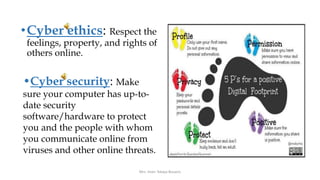
•Cyber ethics: Respect the
feelings, property, and rights of
others online.
•Cyber security: Make
sure your computer has up-to-
date security
software/hardware to protect
you and the people with whom
you communicate online from
viruses and other online threats.
Mrs. Imen Tekaya Bouaziz
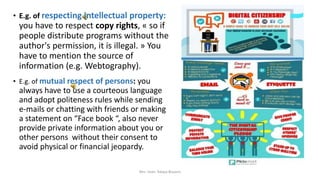
• E.g. of respecting intellectual property:
you have to respect copy rights, « so if
people distribute programs without the
author's permission, it is illegal. » You
have to mention the source of
information (e.g. Webtography).
• E.g. of mutual respect of persons: you
always have to use a courteous language
and adopt politeness rules while sending
e-mails or chatting with friends or making
a statement on “Face book “, also never
provide private information about you or
other persons without their consent to
avoid physical or financial jeopardy.
Mrs. Imen Tekaya Bouaziz
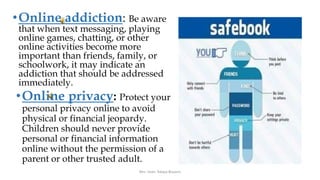
•Online addiction: Be aware
that when text messaging, playing
online games, chatting, or other
online activities become more
important than friends, family, or
schoolwork, it may indicate an
addiction that should be addressed
immediately.
•Online privacy: Protect your
personal privacy online to avoid
physical or financial jeopardy.
Children should never provide
personal or financial information
online without the permission of a
parent or other trusted adult.
Mrs. Imen Tekaya Bouaziz
Spying surfers Exchanging data between friends Using the surfer identity
Giving his real identity when he is
asked about it
Diffusing private information about
persons without their consent
Giving the job of your parents for
reading your Electronic mail
Attaching a document to an e-mail Surfing the web Reading the mail of other persons
Giving his phone number to download
a game
Sending annoying messages to surfers Listening to music
Sending messages for harming the other
persons
Communicating his password Giving your user name and password to
your friends
• Protection of private life/ online privacy
Activity
Among the list below, there are some actions that can present a danger for your, or for your family or they can be
harmful for other persons.
Cross out the action that you have to avoid when using Internet
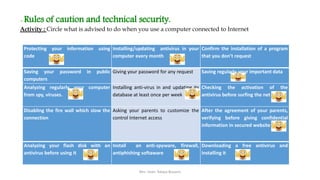
Protecting your information using
code
Installing/updating antivirus in your
computer every month
Confirm the installation of a program
that you don’t request
Saving your password in public
computers
Giving your password for any request Saving regularly your important data
Analyzing regularly your computer
from spy, viruses.
Installing anti-virus in and updating its
database at least once per week
Checking the activation of the
antivirus before surfing the net
Disabling the fire wall which slow the
connection
Asking your parents to customize the
control Internet access
After the agreement of your parents,
verifying before giving confidential
information in secured website
Analyzing your flash disk with an
antivirus before using it
Install an anti-spyware, firewall,
antiphishing softaware
Downloading a free antivirus and
installing it
Mrs. Imen Tekaya Bouaziz
• Rules of caution and technical security.
Activity : Circle what is advised to do when you use a computer connected to Internet
Mrs. Imen Tekaya Bouaziz
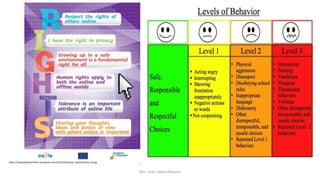
https://cybersafetynet.files.wordpress.com/2013/02/poster_back2school_a4.jpg
Mrs. Imen Tekaya Bouaziz
• http://raisingchildren.net.au/articles/digital_citizenship.html
• http://www.virtuallibrary.info/digital-citizenship.html
• http://www.livebinders.com/play/play?id=1736567
• https://www.fractuslearning.com/2014/09/09/digital-citizenship-poster/
• https://sites.google.com/site/itrestrumenti/topic-taught/cyber-citizenship
• https://www.getcybersafe.gc.ca/cnt/blg/pst-20130827-en.aspx
• https://www.getcybersafe.gc.ca/cnt/prtct-yrslf/prtctn-dntty/scl-ntwrk-en.aspx
• https://www.getcybersafe.gc.ca/cnt/prtct-yrslf/prtctn-dntty/dntty-101-en.aspx
• http://www.scoop.it/t/cyberbullying-it-s-not-a-game-it-s-your-life
• http://www.educatorstechnology.com/2013/10/5-excellent-videos-to-teach-your.html
• https://drive.google.com/drive/folders/0B_FwK3u-_PH1S0hTRDhIX3VsTFk
• http://blogs.egusd.net/digitalcitizenship/2015/01/06/free-digital-citizenship-posters-for-the-classroom/
• https://support.google.com/youtube/topic/2803240?visit_id=1-636268329177748153-4049298452&rd=1
• http://schoolinternetsafety.pbworks.com/w/page/27971343/Cyber%20Citizenship
• http://www.digitalcitizenship.net/Nine_Elements.html
Mrs. Imen Tekaya Bouaziz

Cyber citizenship imen tekaya

  • 1.
    Unit3: Internet Cyber (digital)citizenship and cyberEthics Mrs. Imen Tekaya Bouaziz http://www.virtuallibrary.info/digital-citizenship.html
  • 2.
    Cyber Citizen alsoknown as Digital Citizen • When they’re online, children and teenagers are mostly social and collaborative. • Digital citizenship also lets teenagers express themselves by sharing and posting comments, photos and videos. They can explore who they are and take action on issues they care about by starting or signing online petitions, joining or creating online communities and interest groups, or just by creating content like animations or blogs. • the Internet gives teenagers good access to news and health information, and many turn to the internet first to find out about themselves and the world. Mrs. Imen Tekaya Bouaziz http://d97cooltools.blogspot.com/2013/10/4-digital-citizenship-week- resources.html?utm_content=buffer6cf9a&utm_source=buffer&utm_medium=twitter&utm_campaign=Buffer#. WOJfWVXhBII
  • 3.
    Why is beinga Good Cyber Citizen important? • It keeps the Internet free from hurtful statements. • It creates a culture of more and more reliable information. • It allows people to be given credit for what they've created. • More criminals or bullies can be caught when kids are honest and talk to adults. • Keeps your information private. Mrs. Imen Tekaya Bouaziz http://blogs.egusd.net/digitalcitizenship/2015/01/06/free-digital-citizenship-posters-for-the-classroom/
  • 4.
    the World WideWeb has its own etiquette or “netiquette”, and "netiquette", refers to responsible cyber social behavior - Cyber citizenship is a term that refers to being responsible when using the Internet. What you do on-line when no one is looking tells a lot about your character and morals. You are the first generation to be born into a world that already had computers. This means that you need to learn the rights and consequences of living in a digital world. You need to learn how to navigate through all the information that is available on-line. Cyber Citizenship is kind of like the manners and etiquette of the Web. Using Internet anonymously could be liberating for you, it allows you to feel more comfortable to share your thoughts and ideas and opinions online through social media which is great to be a part of the digital world and to participate in this sharing of information, but certain responsibilities are required. Mrs. Imen Tekaya Bouaziz
  • 5.
    Mrs. Imen TekayaBouaziz b) Net Ethics or Netiquette: • Is a set of rules, attitudes and behaviors that each Internet user should adopt for mutual respect of persons and intellectual property. You also have to verify the cyber- reputation of the source of information and whether the given information is correct or not. http://www.technologyrocksseriously.com/search?q=THINK&x=0&y=0#.WOJWu1U19IJ
  • 6.
    •Cyber ethics: Respectthe feelings, property, and rights of others online. •Cyber security: Make sure your computer has up-to- date security software/hardware to protect you and the people with whom you communicate online from viruses and other online threats. Mrs. Imen Tekaya Bouaziz
  • 7.
    • E.g. ofrespecting intellectual property: you have to respect copy rights, « so if people distribute programs without the author's permission, it is illegal. » You have to mention the source of information (e.g. Webtography). • E.g. of mutual respect of persons: you always have to use a courteous language and adopt politeness rules while sending e-mails or chatting with friends or making a statement on “Face book “, also never provide private information about you or other persons without their consent to avoid physical or financial jeopardy. Mrs. Imen Tekaya Bouaziz
  • 8.
    •Online addiction: Beaware that when text messaging, playing online games, chatting, or other online activities become more important than friends, family, or schoolwork, it may indicate an addiction that should be addressed immediately. •Online privacy: Protect your personal privacy online to avoid physical or financial jeopardy. Children should never provide personal or financial information online without the permission of a parent or other trusted adult. Mrs. Imen Tekaya Bouaziz
  • 9.
    Mrs. Imen TekayaBouaziz Spying surfers Exchanging data between friends Using the surfer identity Giving his real identity when he is asked about it Diffusing private information about persons without their consent Giving the job of your parents for reading your Electronic mail Attaching a document to an e-mail Surfing the web Reading the mail of other persons Giving his phone number to download a game Sending annoying messages to surfers Listening to music Sending messages for harming the other persons Communicating his password Giving your user name and password to your friends • Protection of private life/ online privacy Activity Among the list below, there are some actions that can present a danger for your, or for your family or they can be harmful for other persons. Cross out the action that you have to avoid when using Internet
  • 10.
    Protecting your informationusing code Installing/updating antivirus in your computer every month Confirm the installation of a program that you don’t request Saving your password in public computers Giving your password for any request Saving regularly your important data Analyzing regularly your computer from spy, viruses. Installing anti-virus in and updating its database at least once per week Checking the activation of the antivirus before surfing the net Disabling the fire wall which slow the connection Asking your parents to customize the control Internet access After the agreement of your parents, verifying before giving confidential information in secured website Analyzing your flash disk with an antivirus before using it Install an anti-spyware, firewall, antiphishing softaware Downloading a free antivirus and installing it Mrs. Imen Tekaya Bouaziz • Rules of caution and technical security. Activity : Circle what is advised to do when you use a computer connected to Internet
  • 11.
    Mrs. Imen TekayaBouaziz https://cybersafetynet.files.wordpress.com/2013/02/poster_back2school_a4.jpg
  • 12.
  • 13.
  • 14.
    • http://raisingchildren.net.au/articles/digital_citizenship.html • http://www.virtuallibrary.info/digital-citizenship.html •http://www.livebinders.com/play/play?id=1736567 • https://www.fractuslearning.com/2014/09/09/digital-citizenship-poster/ • https://sites.google.com/site/itrestrumenti/topic-taught/cyber-citizenship • https://www.getcybersafe.gc.ca/cnt/blg/pst-20130827-en.aspx • https://www.getcybersafe.gc.ca/cnt/prtct-yrslf/prtctn-dntty/scl-ntwrk-en.aspx • https://www.getcybersafe.gc.ca/cnt/prtct-yrslf/prtctn-dntty/dntty-101-en.aspx • http://www.scoop.it/t/cyberbullying-it-s-not-a-game-it-s-your-life • http://www.educatorstechnology.com/2013/10/5-excellent-videos-to-teach-your.html • https://drive.google.com/drive/folders/0B_FwK3u-_PH1S0hTRDhIX3VsTFk • http://blogs.egusd.net/digitalcitizenship/2015/01/06/free-digital-citizenship-posters-for-the-classroom/ • https://support.google.com/youtube/topic/2803240?visit_id=1-636268329177748153-4049298452&rd=1 • http://schoolinternetsafety.pbworks.com/w/page/27971343/Cyber%20Citizenship • http://www.digitalcitizenship.net/Nine_Elements.html Mrs. Imen Tekaya Bouaziz
  • 15.