CCNC 2014

Online Games:
Traffic Characterization and
Network Support
Jose Saldana

Mirko Suznjevic

University of Zaragoza, Spain

University of Zagreb, Croatia

GTC

Communication
Technologies Group
University of Zagreb

CCNC, Las Vegas, January 10th, 2014
10.01.2014.

1
CCNC 2014

Goals of this presentation
• Information about current practices in online
games industry
• Traffic of online games – trends and
characteristics
• Current network related issues and Quality of
Experience (QoE) requirements
• Live QoE testing
• perfect excuse to play for a while…
10.01.2014.

2
CCNC 2014

Goals of this presentation
• Information about current practices in online
games industry
• Traffic of online games – trends and
characteristics
• Current network related issues and Quality of
Experience (QoE) requirements
• Live QoE testing - a perfect excuse to play for a
while…
10.01.2014.

3
CCNC 2014

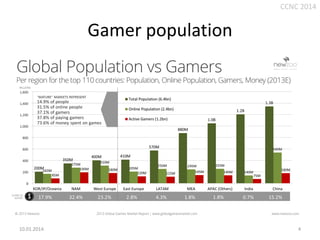
Gamer population

10.01.2014.

4
CCNC 2014

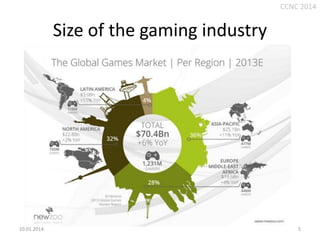
Size of the gaming industry

10.01.2014.

5
CCNC 2014

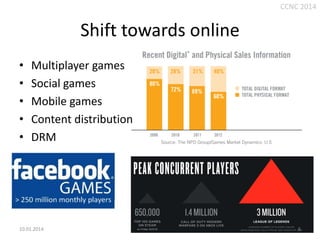
Shift towards online
•
•
•
•
•

Multiplayer games
Social games
Mobile games
Content distribution
DRM

10.01.2014.

6
CCNC 2014

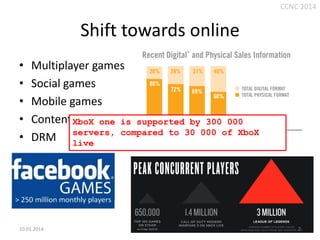
Shift towards online
•
•
•
•
•

Multiplayer games
Social games
Mobile games
Content XboX one is supported by 300 000
distribution
servers, compared to 30 000 of XboX
DRM live

10.01.2014.

7
CCNC 2014

Types of multiplayer
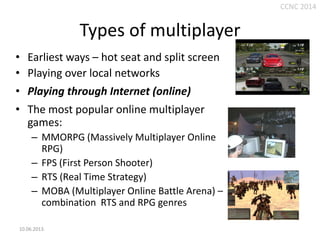
• Earliest ways – hot seat and split screen
• Playing over local networks
• Playing through Internet (online)
• The most popular online multiplayer
games:
– MMORPG (Massively Multiplayer Online
RPG)
– FPS (First Person Shooter)
– RTS (Real Time Strategy)
– MOBA (Multiplayer Online Battle Arena) –
combination RTS and RPG genres
10.06.2013.
CCNC 2014

Social games
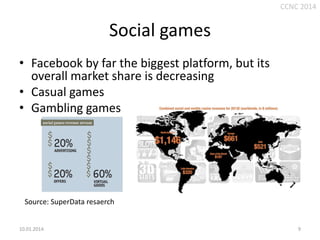
• Facebook by far the biggest platform, but its
overall market share is decreasing
• Casual games
• Gambling games

Source: SuperData resaerch

10.01.2014.

9
CCNC 2014

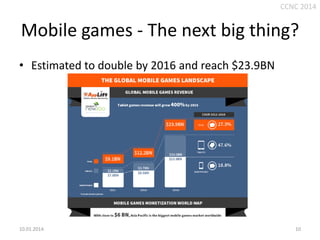
Mobile games - The next big thing?
• Estimated to double by 2016 and reach $23.9BN

10.01.2014.

10
CCNC 2014

Content distribution
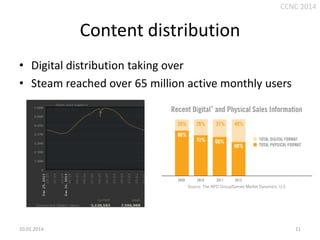
• Digital distribution taking over
• Steam reached over 65 million active monthly users

10.01.2014.

11
CCNC 2014

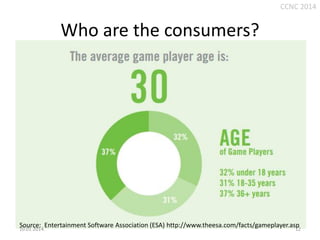
Who are the consumers?

Source: Entertainment Software Association (ESA) http://www.theesa.com/facts/gameplayer.asp
12

10.01.2014.
CCNC 2014

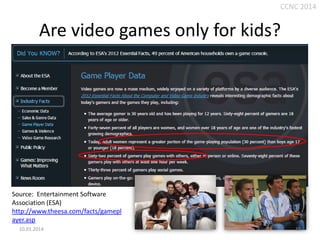
Are video games only for kids?

Source: Entertainment Software
Association (ESA)
http://www.theesa.com/facts/gamepl
ayer.asp
10.01.2014.

13
CCNC 2014

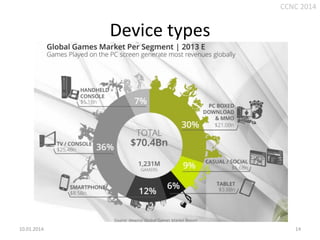
Device types

10.01.2014.

14
CCNC 2014

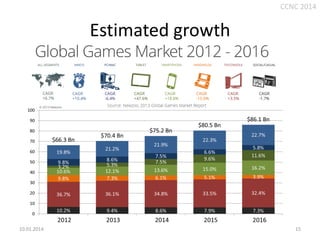
Estimated growth

10.01.2014.

15
CCNC 2014

Personal Computer (PC)
• Multi purpose device – not dedicated purely
for purpose of playing games
• “Natural” place for networked games
• Almost all PCs equipped with a network
interface
• “Core players” – perceived as a device for core
gaming audience

10.01.2014.

16
CCNC 2014

Consoles
• Consoles of the newest generation are
equipped with network interfaces
• Supported by cloud server infrastructure
• XboX One supported by 300 000 servers
• Additional payment for multiplayer
– PlayStation Plus account
– Microsoft Xbox Live account

10.01.2014.

17
CCNC 2014

Mobile
•
•
•
•

Mobile phones, tablets, handheld consoles
Relatively new but very large market
Clash of Clans – 1 million dollars a day
Time spent in games can be larger then even time
spent in social networks (some of the games
work offline and do not generate network traffic)
• Biggest problems for Quality of Experience of
online games – variability of network parameters
(latency, latency variation, and packet loss)
Source: Ericsson Mobility Report http://www.ericsson.com/res/docs/2013/ericsson-mobilityreport-june-2013.pdf
10.01.2014.

18
CCNC 2014

Business models
• Pay to play
– Game client/account
– Subscription
– Additions to existing games

• Free to play (F2P)
–
–
–
–

Micro transactions
Additional content
Premium accounts
Cosmetic/usability improvements

• Combinations
• F2P demands full server control!!!
10.01.2014.

19
CCNC 2014

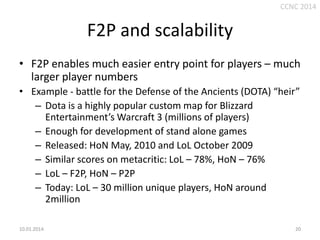
F2P and scalability
• F2P enables much easier entry point for players – much
larger player numbers
• Example - battle for the Defense of the Ancients (DOTA) “heir”
– Dota is a highly popular custom map for Blizzard
Entertainment’s Warcraft 3 (millions of players)
– Enough for development of stand alone games
– Released: HoN May, 2010 and LoL October 2009
– Similar scores on metacritic: LoL – 78%, HoN – 76%
– LoL – F2P, HoN – P2P
– Today: LoL – 30 million unique players, HoN around
2million
10.01.2014.

20
CCNC 2014

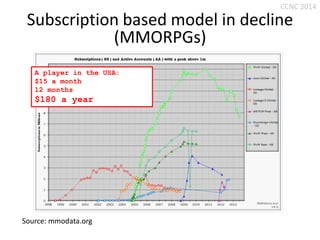
Subscription based model in decline
(MMORPGs)
A player in the USA:
$15 a month
12 months

$180 a year

Source: mmodata.org
CCNC 2014

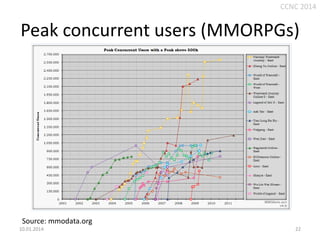
Peak concurrent users (MMORPGs)

Source: mmodata.org
10.01.2014.

22
CCNC 2014

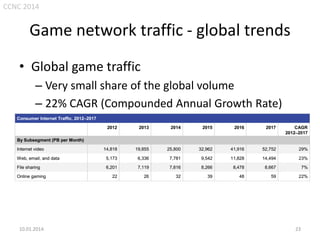
Game network traffic - global trends
• Global game traffic
– Very small share of the global volume
– 22% CAGR (Compounded Annual Growth Rate)

10.01.2014.

23
CCNC 2014

Bandwidth [PB per month]

250

Game network traffic growth
estimation

200
150
Fixed

100

Mobile

50
0
2010

2011

2012
2013
Time [years]

2014

2015

Source: Cisco Visual Networking Index: Forecast and Methodology, 2010–2015 Global
Consumer Internet Gaming Traffic Growth
10.06.2013.
CCNC 2014

Architecture
• Increasing dominance of client – server (C-S)
– Cheating avoidance
– Easier synchronization
– Billing

• Peer to Peer (P2P)
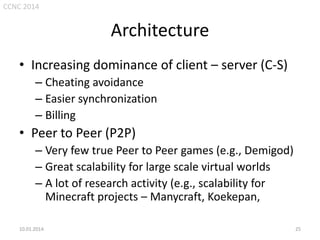
– Very few true Peer to Peer games (e.g., Demigod)
– Great scalability for large scale virtual worlds
– A lot of research activity (e.g., scalability for
Minecraft projects – Manycraft, Koekepan,
10.01.2014.

25
CCNC 2014

Bottlenecks
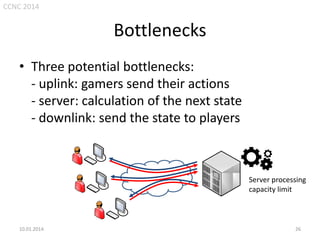
• Three potential bottlenecks:
- uplink: gamers send their actions
- server: calculation of the next state
- downlink: send the state to players

Server processing
capacity limit

10.01.2014.

26
CCNC 2014

Server organization in C-S model
• Server included in the game and one client acts
as the server (e.g., Warcraft 3)
• Dedicated server application released and players
create their own servers (e.g., Call of Duty)
• Server fully controlled by the
developer/publisher (e.g., World of Warcraft)
• Multiplayer match organization may be
orchestrated by the game provider, third parties,
or by players themselves
10.01.2014.

27
CCNC 2014

Client versions
• Specific application per game
– Full clients (all the information stored in the client on
player’s device – single player games)
– Hybrid clients (need to communicate with the server)

• Clients encompassing multiple games
– Browser based games
– Cloud based games (thin clients)

• Client version is dependant of where game logic
and rendering is executed which heavily affects
traffic characteristics
10.01.2014.

28
CCNC 2014

Game logic and rendering
• Stored fully on the client side (no information exchange
with the server)
• Game rendering on the client, game logic on the server
– Most games
– Virtual world updates from the server side
– Commands from client side

• Game rendering and logic on the server (cloud games)
– Video transferred from server to client
– Very sensitive to delay

• Game logic on the server and most of the rendering on the
server
– Only visual indicators of input on client (e.g., a flashing of a
button when the command is issued)
10.01.2014.

29
CCNC 2014

Information transferred
• What information does the traffic comprise?
–
–
–
–

Player commands/inputs
Virtual world state refreshes
Chat
Audio flows for player communication
• Some games have in-built VoIP systems
• Many players use stand alone applications (Teamspeak,
Ventrilo, Skype…)

– 3D data describing virtual world (Second Life)
– Video
• Send by cloud based games
• Streaming of gaming sessions
10.01.2014.

30
CCNC 2014

Traffic characterization
• Game flows:
–
–
–
–
–
–

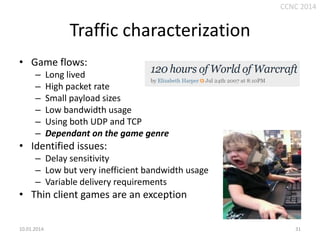
Long lived
High packet rate
Small payload sizes
Low bandwidth usage
Using both UDP and TCP
Dependant on the game genre

• Identified issues:
– Delay sensitivity
– Low but very inefficient bandwidth usage
– Variable delivery requirements

• Thin client games are an exception
10.01.2014.

31
CCNC 2014

Why so small?
• Market penetration!
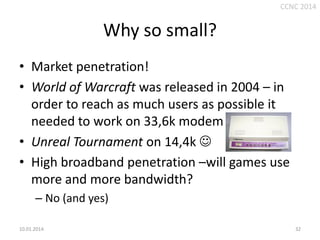
• World of Warcraft was released in 2004 – in
order to reach as much users as possible it
needed to work on 33,6k modem
• Unreal Tournament on 14,4k 
• High broadband penetration –will games use
more and more bandwidth?
– No (and yes)
10.01.2014.

32
CCNC 2014

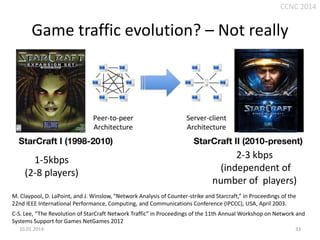
Game traffic evolution? – Not really

1-5kbps
(2-8 players)

2-3 kbps
(independent of
number of players)

M. Claypool, D. LaPoint, and J. Winslow, “Network Analysis of Counter-strike and Starcraft,” in Proceedings of the
22nd IEEE International Performance, Computing, and Communications Conference (IPCCC), USA, April 2003.
C-S. Lee, “The Revolution of StarCraft Network Traffic” in Proceedings of the 11th Annual Workshop on Network and
Systems Support for Games NetGames 2012
10.01.2014.

33
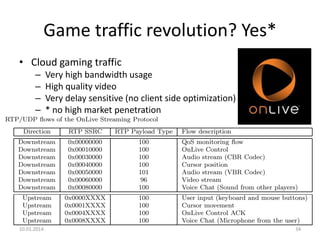
Game traffic revolution? Yes*
• Cloud gaming traffic
–
–
–
–

10.01.2014.

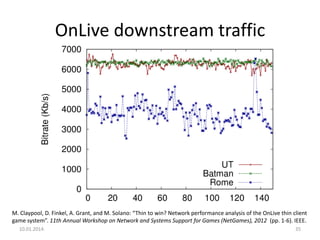
Very high bandwidth usage
High quality video
Very delay sensitive (no client side optimization)
* no high market penetration

34
OnLive downstream traffic

M. Claypool, D. Finkel, A. Grant, and M. Solano: “Thin to win? Network performance analysis of the OnLive thin client
game system”. 11th Annual Workshop on Network and Systems Support for Games (NetGames), 2012 (pp. 1-6). IEEE.
10.01.2014.

35
CCNC 2014

Game genres
• Game categorization:
–
–
–
–
–
–
–
–
–
–
–
–

Action (e.g., Grand Theft Auto)
Adventure (e.g., Broken Sword)
Arcade (e.g., Pinball)
Children’s Entertainment (e.g., Bob the Builder)
Family Entertainment (e.g., Mahjongg)
Fighting (e.g., Mortal Combat)
Flight (e.g., Wing Commander)
Racing (e.g., Need For Speed)
Role Playing (e.g., World of Warcraft)
Shooter (e.g., Quake)
Strategy (e.g., Starcraft)
Other Games

NPD Group Inc., NDP Software Category Definitions, 2008,
https://www5.npd.com/tech/pdf/swcategories.pdf.
10.01.2014.

36
CCNC 2014

Bandwidth usage across genres
10000

Bandwidth [kbit/s]

1000

100

10

1
10.01.2014.

Warcraft III
(RTS)

World of Madden NFL
Unreal
Second Life
Warcraft
(Sports)
Tournament
(CVE)
(MMORPG)
(FPS)

Crazy Taxi
(Cloud)

37
CCNC 2014

First Person Shooters (FPS)
• Gameplay characteristics:
– Very fast paced
– Very delay sensitive (in fact delay is usually shown as main information
on the server listings)
– Several tens of players in one virtual world

• Traffic characteristics
–
–
–
–
–
–
–

10.01.2014.

Use UDP
Loss tolerant (dependant on particular game)
Latency very important (usually displayed on server lists, or score lists)
Very high packet rate
Fairly regular packet sizes
Fairly regular packet inter-arrival times
In general most demanding game genre bandwidth wise (usually less
then 300kbps)
38
CCNC 2014

QoE for FPS
• For unimpaired < 80 ms of one way delay (160 ms
RTT)
• Loss tolerance dependant on the game (from 1%
to 30%)
• Methods to combat delay
– Cause inconsistencies, but increase QoE
– Client side prediction
– Server side delay compensation (merging virtual
realities which are out of sync due to network delay)
10.01.2014.

39
CCNC 2014

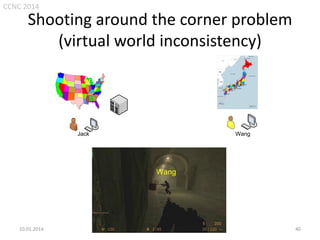
Shooting around the corner problem
(virtual world inconsistency)

Jack

Wang

Wang

10.01.2014.

40
CCNC 2014

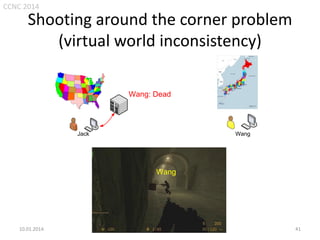
Shooting around the corner problem
(virtual world inconsistency)
Wang: Dead

Jack

Wang

Wang

10.01.2014.

41
CCNC 2014

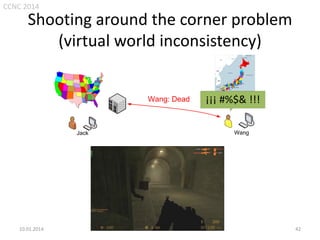
Shooting around the corner problem
(virtual world inconsistency)

Wang: Dead

Jack

10.01.2014.

¡¡¡ #%$& !!!
Wang

42
CCNC 2014

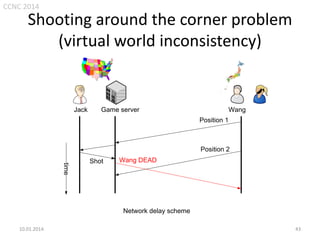
Shooting around the corner problem
(virtual world inconsistency)

Jack

Game server

Wang
Position 1

Position 2

time

Shot

Wang DEAD

Network delay scheme
10.01.2014.

43
CCNC 2014

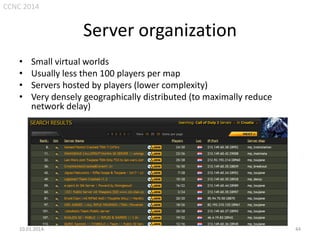
Server organization
•
•
•
•

Small virtual worlds
Usually less then 100 players per map
Servers hosted by players (lower complexity)
Very densely geographically distributed (to maximally reduce
network delay)

10.01.2014.

44
CCNC 2014

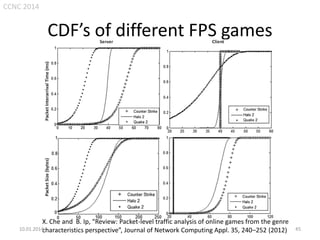
CDF’s of different FPS games

X. Che and B. Ip, “Review: Packet-level traffic analysis of online games from the genre
10.01.2014.
characteristics perspective”, Journal of Network Computing Appl. 35, 240–252 (2012)

45
CCNC 2014

World of Tanks
• Effect of player’s death on downlink
Server-to-client bandwidth
35
30

Bandwidth [kbps]

25
20
15
10

Bandwidth

5

Tank destroyed
0
0

10.01.2014.

100

200

300
400
game time [s]

500

600

700

46
CCNC 2014

World of Tanks
• No effect of death on uplink
Client-to-server bandwidth
25

Bandwidth [kbps]

20

15

10

5
Bandwidth
Tank destroyed
0
0

10.01.2014.

100

200

300
400
game time [s]

500

600

700

47
CCNC 2014

QoE testing
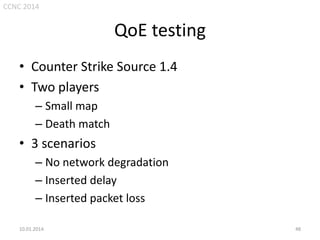
• Counter Strike Source 1.4
• Two players
– Small map
– Death match

• 3 scenarios
– No network degradation
– Inserted delay
– Inserted packet loss
10.01.2014.

48
CCNC 2014

Massively Multiplayer Role-Playing
Games (MMORPGs)
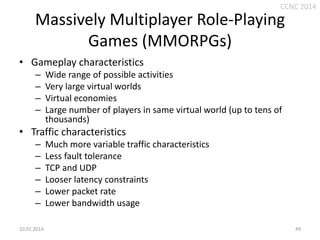
• Gameplay characteristics
–
–
–
–

Wide range of possible activities
Very large virtual worlds
Virtual economies
Large number of players in same virtual world (up to tens of
thousands)

• Traffic characteristics
–
–
–
–
–
–
10.01.2014.

Much more variable traffic characteristics
Less fault tolerance
TCP and UDP
Looser latency constraints
Lower packet rate
Lower bandwidth usage
49
CCNC 2014

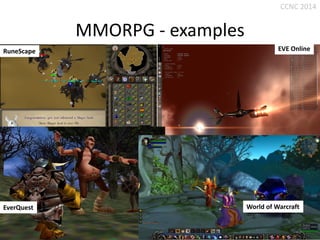
MMORPG - examples
RuneScape

EverQuest

EVE Online

World of Warcraft
CCNC 2014

MMORPGs and media
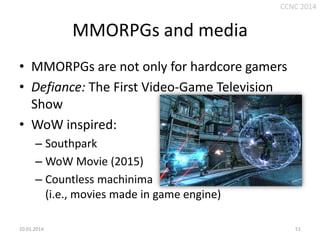
• MMORPGs are not only for hardcore gamers
• Defiance: The First Video-Game Television
Show
• WoW inspired:
– Southpark
– WoW Movie (2015)
– Countless machinima
(i.e., movies made in game engine)
10.01.2014.

51
CCNC 2014

MMORPG architecture: challenges
• Massively Multiplayer Online Role-Playing Games
– A large number of players which share one virtual world
– WoW – 12 million players (at the peak of popularity)

• Main issues:
–
–
–
–

Calculation of the virtual world state
Consistency
Cheating avoidance
Scalability (all servers need to be under control of the provider)

• Two solutions:
– Single space worlds (using huge server farms e.g., EvE Online)
– “Sharding” of virtual word into multiple replicas of the virtual world
across which the players are distributed
• In recent years overlay systems are created over shards (e.g., World of
Warcraft)

10.06.2013.
CCNC 2014

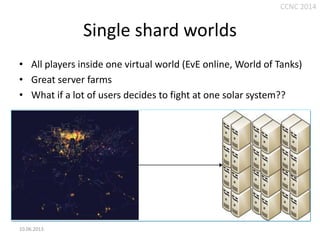
Single shard worlds
• All players inside one virtual world (EvE online, World of Tanks)
• Great server farms
• What if a lot of users decides to fight at one solar system??

10.06.2013.
CCNC 2014

The Asakai incident

Youtube link: http://www.youtube.com/watch?v=_iQw3YcLoQU
10.06.2013.

Višemedijske komunikacije
CCNC 2014

Integration of multiple games into one
virtual world (Dust 514 and EvE Online)

Youtube link: http://www.youtube.com/watch?v=eS4rAYrRHWc
10.01.2014.

55
CCNC 2014

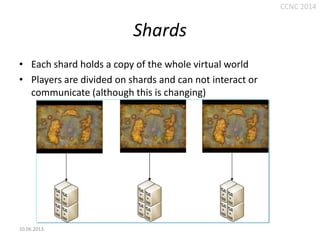
Shards
• Each shard holds a copy of the whole virtual world
• Players are divided on shards and can not interact or
communicate (although this is changing)

10.06.2013.
War without the warchief

Youtube link: http://www.youtube.com/watch?v=ZzsIiSTnQfI
10.06.2013.
CCNC 2014

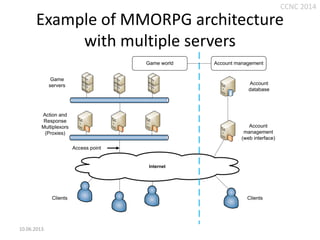
Example of MMORPG architecture
with multiple servers

10.06.2013.
CCNC 2014

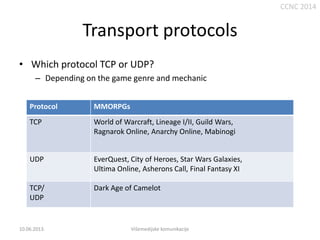
Transport protocols
• Which protocol TCP or UDP?
– Depending on the game genre and mechanic
Protocol

MMORPGs

TCP

World of Warcraft, Lineage I/II, Guild Wars,
Ragnarok Online, Anarchy Online, Mabinogi

UDP

EverQuest, City of Heroes, Star Wars Galaxies,
Ultima Online, Asherons Call, Final Fantasy XI

TCP/
UDP

Dark Age of Camelot

10.06.2013.

Višemedijske komunikacije
CCNC 2014

MMORPGs and TCP
• TCP not designed for a real time interactive
application!!! (yet it works)
• Application limited not network limited flows
• Multiple thin TCP flows behave unlike one fat TCP flow
• Mechanisms in TCP directly deteriorate the experience
of the players (delayed ACK, Nagle algorithm)
• Mechanisms of TCP do not work efficiently for
MMORPG (cwnd reduced due to application not
having something to send)
• High signaling overhead due to small packets
• High number of “pure” ACKS
10.01.2014.

60
CCNC 2014

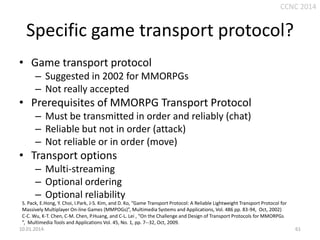
Specific game transport protocol?
• Game transport protocol
– Suggested in 2002 for MMORPGs
– Not really accepted

• Prerequisites of MMORPG Transport Protocol
– Must be transmitted in order and reliably (chat)
– Reliable but not in order (attack)
– Not reliable or in order (move)

• Transport options
– Multi-streaming
– Optional ordering
– Optional reliability
S. Pack, E.Hong, Y. Choi, I.Park, J-S. Kim, and D. Ko, “Game Transport Protocol: A Reliable Lightweight Transport Protocol for
Massively Multiplayer On-line Games (MMPOGs)”, Multimedia Systems and Applications, Vol. 486 pp. 83-94, Oct, 2002)
C-C. Wu, K-T. Chen, C-M. Chen, P.Huang, and C-L. Lei , “On the Challenge and Design of Transport Protocols for MMORPGs
”, Multimedia Tools and Applications Vol. 45, No. 1, pp. 7--32, Oct, 2009.
10.01.2014.

61
CCNC 2014

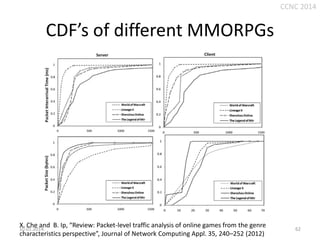
CDF’s of different MMORPGs

X. Che and B. Ip, “Review: Packet-level traffic analysis of online games from the genre
characteristics perspective”, Journal of Network Computing Appl. 35, 240–252 (2012)

10.01.2014.

62
CCNC 2014

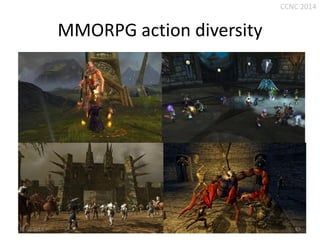
MMORPG action diversity

10.01.2014.

63
CCNC 2014

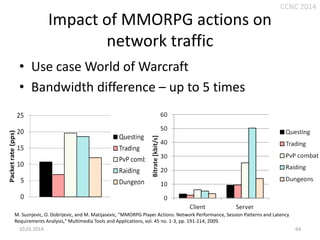
Impact of MMORPG actions on
network traffic
• Use case World of Warcraft
• Bandwidth difference – up to 5 times

M. Suznjevic, O. Dobrijevic, and M. Matijasevic, "MMORPG Player Actions: Network Performance, Session Patterns and Latency
Requirements Analysis," Multimedia Tools and Applications, vol. 45 no. 1-3, pp. 191-214, 2009.
10.01.2014.

64
CCNC 2014

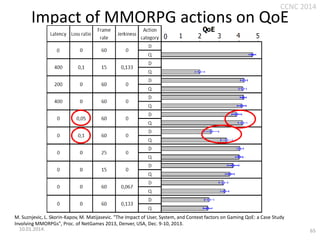
Impact of MMORPG actions on QoE

M. Suznjevic, L. Skorin-Kapov, M. Matijasevic. "The Impact of User, System, and Context factors on Gaming QoE: a Case Study
Involving MMORPGs", Proc. of NetGames 2013, Denver, USA, Dec. 9-10, 2013.
10.01.2014.

65
CCNC 2014

QoE testing
• World of Warcraft
• Duels!
– Hunter vs. Warrior
– Warrior overpowered at lower levels ;)

• 3 scenarios
– No network degradation
– Inserted delay
– Inserted packet loss
10.01.2014.

66
CCNC 2014

Real Time Strategies (RTS)
• Usually omnipresent perspective
• Two major components
– Development
– Fighting

• Smaller scale in multiplayer commonly < 10
players in a match
• Recently a sub-genre of RTS games has
increased in popularity – Action RTS (or
Multiplayer Online Battle Arena – MOBA)
10.01.2014.

67
CCNC 2014

Game network engines
• Synchronization of the game state between participating
players
• Starcraft 2 uses the “simulation model”
– P2P in a client server model!
– No central authority (server does NOT hold the game state)
– Game completely deterministic – same inputs should yield the
same results
– Every player’s command is queued up to be done at some point
in the future (typically, around 12 frames i. e. 200ms).
– Every player sends the inputs to other players (through the
server)
– Once all inputs are received game tick is calculated on client side
10.01.2014.

68
CCNC 2014

Pros and cons
• Pros:
– Synchronization of only a few commands
instead of positions of thousands of units
– Very low bandwidth usage
• Cons
– Observable input delay (i.e., “lag”) – units do not
respond immediately
– Slowest player slowing down the game for all
– Possible desynchronization – end of a match
10.01.2014.

69
CCNC 2014

Why is there a server in SC2?
• Traffic scaling - all players send their
commands to the server which distributes
them to others (no need for each player to
send its data to all other players)
• Storing player’s data
• Matchmaking (i.e., matching players with
similar skill levels)
• Anti-cheating mechanisms
• Anti-piracy
10.01.2014.

70
CCNC 2014

ARTS (MOBA)
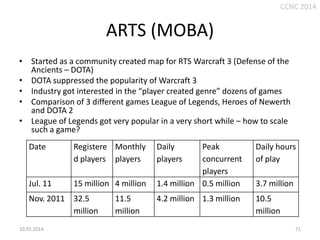
• Started as a community created map for RTS Warcraft 3 (Defense of the
Ancients – DOTA)
• DOTA suppressed the popularity of Warcraft 3
• Industry got interested in the “player created genre” dozens of games
• Comparison of 3 different games League of Legends, Heroes of Newerth
and DOTA 2
• League of Legends got very popular in a very short while – how to scale
such a game?
Date

Registere Monthly
d players players

Jul. 11

15 million 4 million

Nov. 2011 32.5
million
10.01.2014.

11.5
million

Daily
players

Peak
concurrent
players
1.4 million 0.5 million

Daily hours
of play

4.2 million 1.3 million

10.5
million

3.7 million

71
CCNC 2014

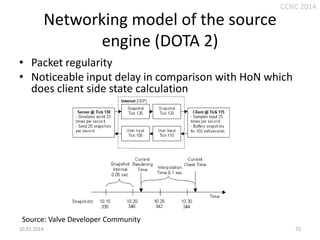
Networking model of the source
engine (DOTA 2)
• Packet regularity
• Noticeable input delay in comparison with HoN which
does client side state calculation

Source: Valve Developer Community
10.01.2014.

72
CCNC 2014

Traffic characteristics comparison
300
200
100

20000
HoN
LoL
Dota2

0

Bandwidth usage
[bps]

Packet size [b]

400

15000
10000
5000

HoN
LoL
Dota2

0

Packet rate [pps]

80
60
40
20

HoN
LoL
Dota2

0

10.01.2014.

73
CCNC 2014

QoE testing
•
•
•
•
•

More robust to network impairments
Testing one game 2 actions
Warcraft III
Building the base – delay not an issue
Fighting – delay more noticable

10.01.2014.

74
CCNC 2014

Let us play that online race!
• The web page starts the game application
• One of the players acts as the server
– It is not the one who creates the race
– Perhaps the one with the best connection

• Scalability advantage
– The game company does not have to set up a high
number of servers
– They only orchestrate the players
CCNC 2014

Let us play that online race!
• Problems:
– You have to deal with NAT, since a computer has
to be the server
– You have to download the characteristics of the
other cars, since they are improved and painted

• Extra delay does not affect, since interaction
between cars is not very significant (only at
the beginning)
CCNC 2014

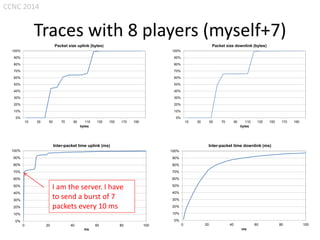
Traces with 8 players (myself+7)
Packet size uplink (bytes)

Packet size downlink (bytes)

100%

100%

90%

90%

80%

80%

70%

70%

60%

60%

50%

50%

40%

40%

30%

30%

20%

20%

10%

10%

0%

0%
10

30

50

70

90

110
bytes

130

150

170

190

10

Inter-packet time uplink (ms)

30

50

70

90

110
bytes

130

150

170

190

Inter-packet time downlink (ms)

100%

100%

90%

90%

80%

80%

70%

70%

60%

60%

I am the server. I have
to send a burst of 7
packets every 10 ms

50%

40%
30%
20%

50%
40%
30%
20%
10%

10%

0%

0%
0

20

40

60
ms

80

100

0

20

40

60
ms

80

100
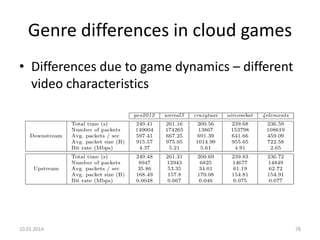
Genre differences in cloud games
• Differences due to game dynamics – different
video characteristics

10.01.2014.

78
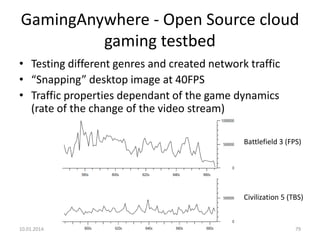
GamingAnywhere - Open Source cloud
gaming testbed
• Testing different genres and created network traffic
• “Snapping” desktop image at 40FPS
• Traffic properties dependant of the game dynamics
(rate of the change of the video stream)
Battlefield 3 (FPS)

Civilization 5 (TBS)

10.01.2014.

79
Summary of problems
• Delay sensitivity
• Sensitive to varying network conditions (mobile networks)
• Very low (and inefficient) bandwidth usage of “regular”
games
• Very high bandwidth requirements of cloud based games
• Issues regarding consistency of the distributed virtual world
state (network engines)
• Fairness
• Scalability problems
• Adapting to player behavior
• Protocol related issues

10.01.2014.

80
CCNC 2014

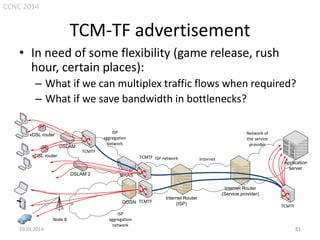
TCM-TF advertisement
• In need of some flexibility (game release, rush
hour, certain places):
– What if we can multiplex traffic flows when required?
– What if we save bandwidth in bottlenecks?
ISP
aggregation
network

xDSL router
DSLAM
xDSL router

Network of
the service
provider

TCMTF
TCMTF ISP network
DSLAM 2

10.01.2014.

Application
server

BRAS

GGSN TCMTF

Node B

Internet

ISP
aggregation
network

Internet Router
(ISP)

Internet Router
(Service provider)
TCMTF

81
CCNC 2014

TCM-TF advertisement
First Person Shooter game:
Four IPv4/UDP client-to-server packets of Counter Strike
η=61/89=68%
One IPv4/TCM packet multiplexing four client-to-server Counter Strike packets

saving

η=244/293=83%

MMORPG:

TCP ACKs without payload

Seven IPv4/TCP client-to-server packets of World of Warcraft. E[P]=20bytes
η=20/60=33%
One IPv4/TCM packet multiplexing seven client-to-server W. of Warcraft packets

saving

η=120/187=64%

VoIP

VoIP (exactly like RFC4170):

One IPv4/UDP/RTP VoIP packet with two samples of 10 bytes
η=20/60=33%

40 to 6-8 bytes compression

Five IPv4/UDP/RTP VoIP packets with two samples of 10 bytes
η=20/60=33%

One IPv4 TCMTF Packet multiplexing five two sample packets
η=100/161=62%

10.01.2014.

saving

82
Acknowledgments
• Projects that supported this work:
– Content Delivery and Mobility of Users and Services in
New Generation Networks,” by the Ministry of Science,
Education, and Sports of the Republic of Croatia;
– The European Community Seventh Framework Programme
under Grant Agreement no. 285939 (ACROSS);
– CPUFLIPI Project (MICINN TIN2010-17298);
– Project TAMA, Government of Aragon;
– Project Catedra Telefonica, University Zaragoza;
– European Social Fund in collaboration with the
Government of Aragon.
10.01.2014.

83
CCNC 2014

Thank you!

10.01.2014.

84

Online games traffic characterization and network support

  • 1.
    CCNC 2014 Online Games: TrafficCharacterization and Network Support Jose Saldana Mirko Suznjevic University of Zaragoza, Spain University of Zagreb, Croatia GTC Communication Technologies Group University of Zagreb CCNC, Las Vegas, January 10th, 2014 10.01.2014. 1
  • 2.
    CCNC 2014 Goals ofthis presentation • Information about current practices in online games industry • Traffic of online games – trends and characteristics • Current network related issues and Quality of Experience (QoE) requirements • Live QoE testing • perfect excuse to play for a while… 10.01.2014. 2
  • 3.
    CCNC 2014 Goals ofthis presentation • Information about current practices in online games industry • Traffic of online games – trends and characteristics • Current network related issues and Quality of Experience (QoE) requirements • Live QoE testing - a perfect excuse to play for a while… 10.01.2014. 3
  • 4.
  • 5.
    CCNC 2014 Size ofthe gaming industry 10.01.2014. 5
  • 6.
    CCNC 2014 Shift towardsonline • • • • • Multiplayer games Social games Mobile games Content distribution DRM 10.01.2014. 6
  • 7.
    CCNC 2014 Shift towardsonline • • • • • Multiplayer games Social games Mobile games Content XboX one is supported by 300 000 distribution servers, compared to 30 000 of XboX DRM live 10.01.2014. 7
  • 8.
    CCNC 2014 Types ofmultiplayer • Earliest ways – hot seat and split screen • Playing over local networks • Playing through Internet (online) • The most popular online multiplayer games: – MMORPG (Massively Multiplayer Online RPG) – FPS (First Person Shooter) – RTS (Real Time Strategy) – MOBA (Multiplayer Online Battle Arena) – combination RTS and RPG genres 10.06.2013.
  • 9.
    CCNC 2014 Social games •Facebook by far the biggest platform, but its overall market share is decreasing • Casual games • Gambling games Source: SuperData resaerch 10.01.2014. 9
  • 10.
    CCNC 2014 Mobile games- The next big thing? • Estimated to double by 2016 and reach $23.9BN 10.01.2014. 10
  • 11.
    CCNC 2014 Content distribution •Digital distribution taking over • Steam reached over 65 million active monthly users 10.01.2014. 11
  • 12.
    CCNC 2014 Who arethe consumers? Source: Entertainment Software Association (ESA) http://www.theesa.com/facts/gameplayer.asp 12 10.01.2014.
  • 13.
    CCNC 2014 Are videogames only for kids? Source: Entertainment Software Association (ESA) http://www.theesa.com/facts/gamepl ayer.asp 10.01.2014. 13
  • 14.
  • 15.
  • 16.
    CCNC 2014 Personal Computer(PC) • Multi purpose device – not dedicated purely for purpose of playing games • “Natural” place for networked games • Almost all PCs equipped with a network interface • “Core players” – perceived as a device for core gaming audience 10.01.2014. 16
  • 17.
    CCNC 2014 Consoles • Consolesof the newest generation are equipped with network interfaces • Supported by cloud server infrastructure • XboX One supported by 300 000 servers • Additional payment for multiplayer – PlayStation Plus account – Microsoft Xbox Live account 10.01.2014. 17
  • 18.
    CCNC 2014 Mobile • • • • Mobile phones,tablets, handheld consoles Relatively new but very large market Clash of Clans – 1 million dollars a day Time spent in games can be larger then even time spent in social networks (some of the games work offline and do not generate network traffic) • Biggest problems for Quality of Experience of online games – variability of network parameters (latency, latency variation, and packet loss) Source: Ericsson Mobility Report http://www.ericsson.com/res/docs/2013/ericsson-mobilityreport-june-2013.pdf 10.01.2014. 18
  • 19.
    CCNC 2014 Business models •Pay to play – Game client/account – Subscription – Additions to existing games • Free to play (F2P) – – – – Micro transactions Additional content Premium accounts Cosmetic/usability improvements • Combinations • F2P demands full server control!!! 10.01.2014. 19
  • 20.
    CCNC 2014 F2P andscalability • F2P enables much easier entry point for players – much larger player numbers • Example - battle for the Defense of the Ancients (DOTA) “heir” – Dota is a highly popular custom map for Blizzard Entertainment’s Warcraft 3 (millions of players) – Enough for development of stand alone games – Released: HoN May, 2010 and LoL October 2009 – Similar scores on metacritic: LoL – 78%, HoN – 76% – LoL – F2P, HoN – P2P – Today: LoL – 30 million unique players, HoN around 2million 10.01.2014. 20
  • 21.
    CCNC 2014 Subscription basedmodel in decline (MMORPGs) A player in the USA: $15 a month 12 months $180 a year Source: mmodata.org
  • 22.
    CCNC 2014 Peak concurrentusers (MMORPGs) Source: mmodata.org 10.01.2014. 22
  • 23.
    CCNC 2014 Game networktraffic - global trends • Global game traffic – Very small share of the global volume – 22% CAGR (Compounded Annual Growth Rate) 10.01.2014. 23
  • 24.
    CCNC 2014 Bandwidth [PBper month] 250 Game network traffic growth estimation 200 150 Fixed 100 Mobile 50 0 2010 2011 2012 2013 Time [years] 2014 2015 Source: Cisco Visual Networking Index: Forecast and Methodology, 2010–2015 Global Consumer Internet Gaming Traffic Growth 10.06.2013.
  • 25.
    CCNC 2014 Architecture • Increasingdominance of client – server (C-S) – Cheating avoidance – Easier synchronization – Billing • Peer to Peer (P2P) – Very few true Peer to Peer games (e.g., Demigod) – Great scalability for large scale virtual worlds – A lot of research activity (e.g., scalability for Minecraft projects – Manycraft, Koekepan, 10.01.2014. 25
  • 26.
    CCNC 2014 Bottlenecks • Threepotential bottlenecks: - uplink: gamers send their actions - server: calculation of the next state - downlink: send the state to players Server processing capacity limit 10.01.2014. 26
  • 27.
    CCNC 2014 Server organizationin C-S model • Server included in the game and one client acts as the server (e.g., Warcraft 3) • Dedicated server application released and players create their own servers (e.g., Call of Duty) • Server fully controlled by the developer/publisher (e.g., World of Warcraft) • Multiplayer match organization may be orchestrated by the game provider, third parties, or by players themselves 10.01.2014. 27
  • 28.
    CCNC 2014 Client versions •Specific application per game – Full clients (all the information stored in the client on player’s device – single player games) – Hybrid clients (need to communicate with the server) • Clients encompassing multiple games – Browser based games – Cloud based games (thin clients) • Client version is dependant of where game logic and rendering is executed which heavily affects traffic characteristics 10.01.2014. 28
  • 29.
    CCNC 2014 Game logicand rendering • Stored fully on the client side (no information exchange with the server) • Game rendering on the client, game logic on the server – Most games – Virtual world updates from the server side – Commands from client side • Game rendering and logic on the server (cloud games) – Video transferred from server to client – Very sensitive to delay • Game logic on the server and most of the rendering on the server – Only visual indicators of input on client (e.g., a flashing of a button when the command is issued) 10.01.2014. 29
  • 30.
    CCNC 2014 Information transferred •What information does the traffic comprise? – – – – Player commands/inputs Virtual world state refreshes Chat Audio flows for player communication • Some games have in-built VoIP systems • Many players use stand alone applications (Teamspeak, Ventrilo, Skype…) – 3D data describing virtual world (Second Life) – Video • Send by cloud based games • Streaming of gaming sessions 10.01.2014. 30
  • 31.
    CCNC 2014 Traffic characterization •Game flows: – – – – – – Long lived High packet rate Small payload sizes Low bandwidth usage Using both UDP and TCP Dependant on the game genre • Identified issues: – Delay sensitivity – Low but very inefficient bandwidth usage – Variable delivery requirements • Thin client games are an exception 10.01.2014. 31
  • 32.
    CCNC 2014 Why sosmall? • Market penetration! • World of Warcraft was released in 2004 – in order to reach as much users as possible it needed to work on 33,6k modem • Unreal Tournament on 14,4k  • High broadband penetration –will games use more and more bandwidth? – No (and yes) 10.01.2014. 32
  • 33.
    CCNC 2014 Game trafficevolution? – Not really 1-5kbps (2-8 players) 2-3 kbps (independent of number of players) M. Claypool, D. LaPoint, and J. Winslow, “Network Analysis of Counter-strike and Starcraft,” in Proceedings of the 22nd IEEE International Performance, Computing, and Communications Conference (IPCCC), USA, April 2003. C-S. Lee, “The Revolution of StarCraft Network Traffic” in Proceedings of the 11th Annual Workshop on Network and Systems Support for Games NetGames 2012 10.01.2014. 33
  • 34.
    Game traffic revolution?Yes* • Cloud gaming traffic – – – – 10.01.2014. Very high bandwidth usage High quality video Very delay sensitive (no client side optimization) * no high market penetration 34
  • 35.
    OnLive downstream traffic M.Claypool, D. Finkel, A. Grant, and M. Solano: “Thin to win? Network performance analysis of the OnLive thin client game system”. 11th Annual Workshop on Network and Systems Support for Games (NetGames), 2012 (pp. 1-6). IEEE. 10.01.2014. 35
  • 36.
    CCNC 2014 Game genres •Game categorization: – – – – – – – – – – – – Action (e.g., Grand Theft Auto) Adventure (e.g., Broken Sword) Arcade (e.g., Pinball) Children’s Entertainment (e.g., Bob the Builder) Family Entertainment (e.g., Mahjongg) Fighting (e.g., Mortal Combat) Flight (e.g., Wing Commander) Racing (e.g., Need For Speed) Role Playing (e.g., World of Warcraft) Shooter (e.g., Quake) Strategy (e.g., Starcraft) Other Games NPD Group Inc., NDP Software Category Definitions, 2008, https://www5.npd.com/tech/pdf/swcategories.pdf. 10.01.2014. 36
  • 37.
    CCNC 2014 Bandwidth usageacross genres 10000 Bandwidth [kbit/s] 1000 100 10 1 10.01.2014. Warcraft III (RTS) World of Madden NFL Unreal Second Life Warcraft (Sports) Tournament (CVE) (MMORPG) (FPS) Crazy Taxi (Cloud) 37
  • 38.
    CCNC 2014 First PersonShooters (FPS) • Gameplay characteristics: – Very fast paced – Very delay sensitive (in fact delay is usually shown as main information on the server listings) – Several tens of players in one virtual world • Traffic characteristics – – – – – – – 10.01.2014. Use UDP Loss tolerant (dependant on particular game) Latency very important (usually displayed on server lists, or score lists) Very high packet rate Fairly regular packet sizes Fairly regular packet inter-arrival times In general most demanding game genre bandwidth wise (usually less then 300kbps) 38
  • 39.
    CCNC 2014 QoE forFPS • For unimpaired < 80 ms of one way delay (160 ms RTT) • Loss tolerance dependant on the game (from 1% to 30%) • Methods to combat delay – Cause inconsistencies, but increase QoE – Client side prediction – Server side delay compensation (merging virtual realities which are out of sync due to network delay) 10.01.2014. 39
  • 40.
    CCNC 2014 Shooting aroundthe corner problem (virtual world inconsistency) Jack Wang Wang 10.01.2014. 40
  • 41.
    CCNC 2014 Shooting aroundthe corner problem (virtual world inconsistency) Wang: Dead Jack Wang Wang 10.01.2014. 41
  • 42.
    CCNC 2014 Shooting aroundthe corner problem (virtual world inconsistency) Wang: Dead Jack 10.01.2014. ¡¡¡ #%$& !!! Wang 42
  • 43.
    CCNC 2014 Shooting aroundthe corner problem (virtual world inconsistency) Jack Game server Wang Position 1 Position 2 time Shot Wang DEAD Network delay scheme 10.01.2014. 43
  • 44.
    CCNC 2014 Server organization • • • • Smallvirtual worlds Usually less then 100 players per map Servers hosted by players (lower complexity) Very densely geographically distributed (to maximally reduce network delay) 10.01.2014. 44
  • 45.
    CCNC 2014 CDF’s ofdifferent FPS games X. Che and B. Ip, “Review: Packet-level traffic analysis of online games from the genre 10.01.2014. characteristics perspective”, Journal of Network Computing Appl. 35, 240–252 (2012) 45
  • 46.
    CCNC 2014 World ofTanks • Effect of player’s death on downlink Server-to-client bandwidth 35 30 Bandwidth [kbps] 25 20 15 10 Bandwidth 5 Tank destroyed 0 0 10.01.2014. 100 200 300 400 game time [s] 500 600 700 46
  • 47.
    CCNC 2014 World ofTanks • No effect of death on uplink Client-to-server bandwidth 25 Bandwidth [kbps] 20 15 10 5 Bandwidth Tank destroyed 0 0 10.01.2014. 100 200 300 400 game time [s] 500 600 700 47
  • 48.
    CCNC 2014 QoE testing •Counter Strike Source 1.4 • Two players – Small map – Death match • 3 scenarios – No network degradation – Inserted delay – Inserted packet loss 10.01.2014. 48
  • 49.
    CCNC 2014 Massively MultiplayerRole-Playing Games (MMORPGs) • Gameplay characteristics – – – – Wide range of possible activities Very large virtual worlds Virtual economies Large number of players in same virtual world (up to tens of thousands) • Traffic characteristics – – – – – – 10.01.2014. Much more variable traffic characteristics Less fault tolerance TCP and UDP Looser latency constraints Lower packet rate Lower bandwidth usage 49
  • 50.
    CCNC 2014 MMORPG -examples RuneScape EverQuest EVE Online World of Warcraft
  • 51.
    CCNC 2014 MMORPGs andmedia • MMORPGs are not only for hardcore gamers • Defiance: The First Video-Game Television Show • WoW inspired: – Southpark – WoW Movie (2015) – Countless machinima (i.e., movies made in game engine) 10.01.2014. 51
  • 52.
    CCNC 2014 MMORPG architecture:challenges • Massively Multiplayer Online Role-Playing Games – A large number of players which share one virtual world – WoW – 12 million players (at the peak of popularity) • Main issues: – – – – Calculation of the virtual world state Consistency Cheating avoidance Scalability (all servers need to be under control of the provider) • Two solutions: – Single space worlds (using huge server farms e.g., EvE Online) – “Sharding” of virtual word into multiple replicas of the virtual world across which the players are distributed • In recent years overlay systems are created over shards (e.g., World of Warcraft) 10.06.2013.
  • 53.
    CCNC 2014 Single shardworlds • All players inside one virtual world (EvE online, World of Tanks) • Great server farms • What if a lot of users decides to fight at one solar system?? 10.06.2013.
  • 54.
    CCNC 2014 The Asakaiincident Youtube link: http://www.youtube.com/watch?v=_iQw3YcLoQU 10.06.2013. Višemedijske komunikacije
  • 55.
    CCNC 2014 Integration ofmultiple games into one virtual world (Dust 514 and EvE Online) Youtube link: http://www.youtube.com/watch?v=eS4rAYrRHWc 10.01.2014. 55
  • 56.
    CCNC 2014 Shards • Eachshard holds a copy of the whole virtual world • Players are divided on shards and can not interact or communicate (although this is changing) 10.06.2013.
  • 57.
    War without thewarchief Youtube link: http://www.youtube.com/watch?v=ZzsIiSTnQfI 10.06.2013.
  • 58.
    CCNC 2014 Example ofMMORPG architecture with multiple servers 10.06.2013.
  • 59.
    CCNC 2014 Transport protocols •Which protocol TCP or UDP? – Depending on the game genre and mechanic Protocol MMORPGs TCP World of Warcraft, Lineage I/II, Guild Wars, Ragnarok Online, Anarchy Online, Mabinogi UDP EverQuest, City of Heroes, Star Wars Galaxies, Ultima Online, Asherons Call, Final Fantasy XI TCP/ UDP Dark Age of Camelot 10.06.2013. Višemedijske komunikacije
  • 60.
    CCNC 2014 MMORPGs andTCP • TCP not designed for a real time interactive application!!! (yet it works) • Application limited not network limited flows • Multiple thin TCP flows behave unlike one fat TCP flow • Mechanisms in TCP directly deteriorate the experience of the players (delayed ACK, Nagle algorithm) • Mechanisms of TCP do not work efficiently for MMORPG (cwnd reduced due to application not having something to send) • High signaling overhead due to small packets • High number of “pure” ACKS 10.01.2014. 60
  • 61.
    CCNC 2014 Specific gametransport protocol? • Game transport protocol – Suggested in 2002 for MMORPGs – Not really accepted • Prerequisites of MMORPG Transport Protocol – Must be transmitted in order and reliably (chat) – Reliable but not in order (attack) – Not reliable or in order (move) • Transport options – Multi-streaming – Optional ordering – Optional reliability S. Pack, E.Hong, Y. Choi, I.Park, J-S. Kim, and D. Ko, “Game Transport Protocol: A Reliable Lightweight Transport Protocol for Massively Multiplayer On-line Games (MMPOGs)”, Multimedia Systems and Applications, Vol. 486 pp. 83-94, Oct, 2002) C-C. Wu, K-T. Chen, C-M. Chen, P.Huang, and C-L. Lei , “On the Challenge and Design of Transport Protocols for MMORPGs ”, Multimedia Tools and Applications Vol. 45, No. 1, pp. 7--32, Oct, 2009. 10.01.2014. 61
  • 62.
    CCNC 2014 CDF’s ofdifferent MMORPGs X. Che and B. Ip, “Review: Packet-level traffic analysis of online games from the genre characteristics perspective”, Journal of Network Computing Appl. 35, 240–252 (2012) 10.01.2014. 62
  • 63.
    CCNC 2014 MMORPG actiondiversity 10.01.2014. 63
  • 64.
    CCNC 2014 Impact ofMMORPG actions on network traffic • Use case World of Warcraft • Bandwidth difference – up to 5 times M. Suznjevic, O. Dobrijevic, and M. Matijasevic, "MMORPG Player Actions: Network Performance, Session Patterns and Latency Requirements Analysis," Multimedia Tools and Applications, vol. 45 no. 1-3, pp. 191-214, 2009. 10.01.2014. 64
  • 65.
    CCNC 2014 Impact ofMMORPG actions on QoE M. Suznjevic, L. Skorin-Kapov, M. Matijasevic. "The Impact of User, System, and Context factors on Gaming QoE: a Case Study Involving MMORPGs", Proc. of NetGames 2013, Denver, USA, Dec. 9-10, 2013. 10.01.2014. 65
  • 66.
    CCNC 2014 QoE testing •World of Warcraft • Duels! – Hunter vs. Warrior – Warrior overpowered at lower levels ;) • 3 scenarios – No network degradation – Inserted delay – Inserted packet loss 10.01.2014. 66
  • 67.
    CCNC 2014 Real TimeStrategies (RTS) • Usually omnipresent perspective • Two major components – Development – Fighting • Smaller scale in multiplayer commonly < 10 players in a match • Recently a sub-genre of RTS games has increased in popularity – Action RTS (or Multiplayer Online Battle Arena – MOBA) 10.01.2014. 67
  • 68.
    CCNC 2014 Game networkengines • Synchronization of the game state between participating players • Starcraft 2 uses the “simulation model” – P2P in a client server model! – No central authority (server does NOT hold the game state) – Game completely deterministic – same inputs should yield the same results – Every player’s command is queued up to be done at some point in the future (typically, around 12 frames i. e. 200ms). – Every player sends the inputs to other players (through the server) – Once all inputs are received game tick is calculated on client side 10.01.2014. 68
  • 69.
    CCNC 2014 Pros andcons • Pros: – Synchronization of only a few commands instead of positions of thousands of units – Very low bandwidth usage • Cons – Observable input delay (i.e., “lag”) – units do not respond immediately – Slowest player slowing down the game for all – Possible desynchronization – end of a match 10.01.2014. 69
  • 70.
    CCNC 2014 Why isthere a server in SC2? • Traffic scaling - all players send their commands to the server which distributes them to others (no need for each player to send its data to all other players) • Storing player’s data • Matchmaking (i.e., matching players with similar skill levels) • Anti-cheating mechanisms • Anti-piracy 10.01.2014. 70
  • 71.
    CCNC 2014 ARTS (MOBA) •Started as a community created map for RTS Warcraft 3 (Defense of the Ancients – DOTA) • DOTA suppressed the popularity of Warcraft 3 • Industry got interested in the “player created genre” dozens of games • Comparison of 3 different games League of Legends, Heroes of Newerth and DOTA 2 • League of Legends got very popular in a very short while – how to scale such a game? Date Registere Monthly d players players Jul. 11 15 million 4 million Nov. 2011 32.5 million 10.01.2014. 11.5 million Daily players Peak concurrent players 1.4 million 0.5 million Daily hours of play 4.2 million 1.3 million 10.5 million 3.7 million 71
  • 72.
    CCNC 2014 Networking modelof the source engine (DOTA 2) • Packet regularity • Noticeable input delay in comparison with HoN which does client side state calculation Source: Valve Developer Community 10.01.2014. 72
  • 73.
    CCNC 2014 Traffic characteristicscomparison 300 200 100 20000 HoN LoL Dota2 0 Bandwidth usage [bps] Packet size [b] 400 15000 10000 5000 HoN LoL Dota2 0 Packet rate [pps] 80 60 40 20 HoN LoL Dota2 0 10.01.2014. 73
  • 74.
    CCNC 2014 QoE testing • • • • • Morerobust to network impairments Testing one game 2 actions Warcraft III Building the base – delay not an issue Fighting – delay more noticable 10.01.2014. 74
  • 75.
    CCNC 2014 Let usplay that online race! • The web page starts the game application • One of the players acts as the server – It is not the one who creates the race – Perhaps the one with the best connection • Scalability advantage – The game company does not have to set up a high number of servers – They only orchestrate the players
  • 76.
    CCNC 2014 Let usplay that online race! • Problems: – You have to deal with NAT, since a computer has to be the server – You have to download the characteristics of the other cars, since they are improved and painted • Extra delay does not affect, since interaction between cars is not very significant (only at the beginning)
  • 77.
    CCNC 2014 Traces with8 players (myself+7) Packet size uplink (bytes) Packet size downlink (bytes) 100% 100% 90% 90% 80% 80% 70% 70% 60% 60% 50% 50% 40% 40% 30% 30% 20% 20% 10% 10% 0% 0% 10 30 50 70 90 110 bytes 130 150 170 190 10 Inter-packet time uplink (ms) 30 50 70 90 110 bytes 130 150 170 190 Inter-packet time downlink (ms) 100% 100% 90% 90% 80% 80% 70% 70% 60% 60% I am the server. I have to send a burst of 7 packets every 10 ms 50% 40% 30% 20% 50% 40% 30% 20% 10% 10% 0% 0% 0 20 40 60 ms 80 100 0 20 40 60 ms 80 100
  • 78.
    Genre differences incloud games • Differences due to game dynamics – different video characteristics 10.01.2014. 78
  • 79.
    GamingAnywhere - OpenSource cloud gaming testbed • Testing different genres and created network traffic • “Snapping” desktop image at 40FPS • Traffic properties dependant of the game dynamics (rate of the change of the video stream) Battlefield 3 (FPS) Civilization 5 (TBS) 10.01.2014. 79
  • 80.
    Summary of problems •Delay sensitivity • Sensitive to varying network conditions (mobile networks) • Very low (and inefficient) bandwidth usage of “regular” games • Very high bandwidth requirements of cloud based games • Issues regarding consistency of the distributed virtual world state (network engines) • Fairness • Scalability problems • Adapting to player behavior • Protocol related issues 10.01.2014. 80
  • 81.
    CCNC 2014 TCM-TF advertisement •In need of some flexibility (game release, rush hour, certain places): – What if we can multiplex traffic flows when required? – What if we save bandwidth in bottlenecks? ISP aggregation network xDSL router DSLAM xDSL router Network of the service provider TCMTF TCMTF ISP network DSLAM 2 10.01.2014. Application server BRAS GGSN TCMTF Node B Internet ISP aggregation network Internet Router (ISP) Internet Router (Service provider) TCMTF 81
  • 82.
    CCNC 2014 TCM-TF advertisement FirstPerson Shooter game: Four IPv4/UDP client-to-server packets of Counter Strike η=61/89=68% One IPv4/TCM packet multiplexing four client-to-server Counter Strike packets saving η=244/293=83% MMORPG: TCP ACKs without payload Seven IPv4/TCP client-to-server packets of World of Warcraft. E[P]=20bytes η=20/60=33% One IPv4/TCM packet multiplexing seven client-to-server W. of Warcraft packets saving η=120/187=64% VoIP VoIP (exactly like RFC4170): One IPv4/UDP/RTP VoIP packet with two samples of 10 bytes η=20/60=33% 40 to 6-8 bytes compression Five IPv4/UDP/RTP VoIP packets with two samples of 10 bytes η=20/60=33% One IPv4 TCMTF Packet multiplexing five two sample packets η=100/161=62% 10.01.2014. saving 82
  • 83.
    Acknowledgments • Projects thatsupported this work: – Content Delivery and Mobility of Users and Services in New Generation Networks,” by the Ministry of Science, Education, and Sports of the Republic of Croatia; – The European Community Seventh Framework Programme under Grant Agreement no. 285939 (ACROSS); – CPUFLIPI Project (MICINN TIN2010-17298); – Project TAMA, Government of Aragon; – Project Catedra Telefonica, University Zaragoza; – European Social Fund in collaboration with the Government of Aragon. 10.01.2014. 83
  • 84.