Optimization of Low-efficiency
Traffic in OpenFlow
Software Defined Networks
SPECTS 2014, International Symposium on Performance Evaluation of Computer and
Telecommunication Systems
July 6-10, 2014, Monterey, CA, USA
Jose Saldana, David de Hoz,
Julián Fernández-Navajas, José Ruiz-Mas
Fernando Pascual, Diego R. Lopez,
David Florez, Juan A. Castell,
Manuel Nuñez
SPECTS 2014 Optimization of Low-efficiency Traffic in OpenFlow SDNs
Index
1. Introduction
2. Proposed method
3. Results
4. Conclusions
SPECTS 2014 Optimization of Low-efficiency Traffic in OpenFlow SDNs
Index
1. Introduction
2. Proposed method
3. Results
4. Conclusions
Introduction
SPECTS 2014 Optimization of Low-efficiency Traffic in OpenFlow SDNs
 Software Defined Networks
 Separation of control and data planes
 Programmability of control plane
 Central control of the network as a whole
 Used in cloud computing: flexibility, efficiency
 Openflow: the most extended SDN standard
Introduction
SPECTS 2014 Optimization of Low-efficiency Traffic in OpenFlow SDNs
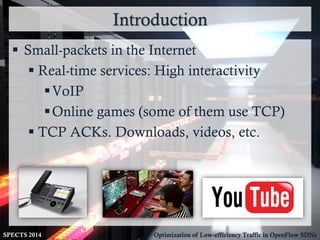
 Small-packets in the Internet
 Real-time services: High interactivity
VoIP
Online games (some of them use TCP)
 TCP ACKs. Downloads, videos, etc.
Introduction
SPECTS 2014 Optimization of Low-efficiency Traffic in OpenFlow SDNs
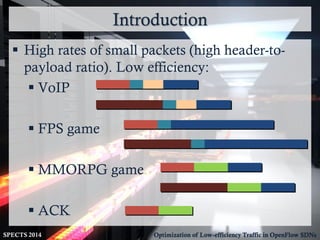
 High rates of small packets (high header-to-
payload ratio). Low efficiency:
 VoIP
 FPS game
 MMORPG game
 ACK
Introduction
SPECTS 2014 Optimization of Low-efficiency Traffic in OpenFlow SDNs
 Header compression can be used to reduce the
overhead:
 Many header fields are the same for every
packet in a flow: e.g., IP addresses, ports,
etc.
 These fields can be avoided, but:
 a context must be stored in both sides in order to
rebuild the packets
 Tunneling is necessary, since a packet with a
compressed header cannot be sent normally
Introduction
SPECTS 2014 Optimization of Low-efficiency Traffic in OpenFlow SDNs
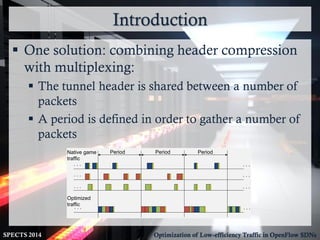
 One solution: combining header compression
with multiplexing:
 The tunnel header is shared between a number of
packets
 A period is defined in order to gather a number of
packets
Period
. . .
. . .
Native game
traffic
Optimized
traffic
Period Period
. . .
. . .
. . .
. . .
. . .
. . .
Introduction
SPECTS 2014 Optimization of Low-efficiency Traffic in OpenFlow SDNs
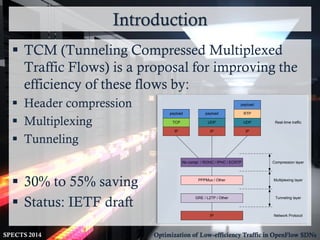
 TCM (Tunneling Compressed Multiplexed
Traffic Flows) is a proposal for improving the
efficiency of these flows by:
 Header compression
 Multiplexing
 Tunneling
 30% to 55% saving
 Status: IETF draft
IP IP IP
No compr. / ROHC / IPHC / ECRTP
PPPMux / Other
GRE / L2TP / Other
IP
Compression layer
Multiplexing layer
Tunneling layer
Real-time traffic
Network Protocol
UDP
RTP
payload
UDPTCP
payloadpayload
Introduction
SPECTS 2014 Optimization of Low-efficiency Traffic in OpenFlow SDNs
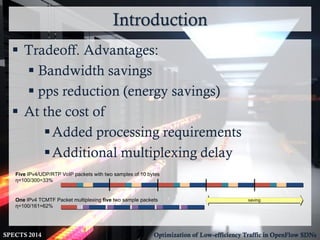
 Tradeoff. Advantages:
 Bandwidth savings
 pps reduction (energy savings)
 At the cost of
Added processing requirements
Additional multiplexing delay
Five IPv4/UDP/RTP VoIP packets with two samples of 10 bytes
η=100/300=33%
savingOne IPv4 TCMTF Packet multiplexing five two sample packets
η=100/161=62%
Introduction
SPECTS 2014 Optimization of Low-efficiency Traffic in OpenFlow SDNs
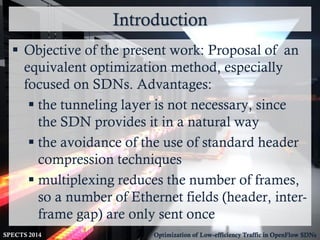
 Objective of the present work: Proposal of an
equivalent optimization method, especially
focused on SDNs. Advantages:
 the tunneling layer is not necessary, since
the SDN provides it in a natural way
 the avoidance of the use of standard header
compression techniques
 multiplexing reduces the number of frames,
so a number of Ethernet fields (header, inter-
frame gap) are only sent once
SPECTS 2014 Optimization of Low-efficiency Traffic in OpenFlow SDNs
Index
1. Introduction
2. Proposed method
3. Results
4. Conclusions
Proposed method
SPECTS 2014 Optimization of Low-efficiency Traffic in OpenFlow SDNs
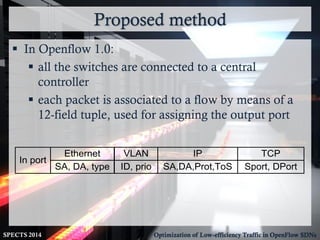
 In Openflow 1.0:
 all the switches are connected to a central
controller
 each packet is associated to a flow by means of a
12-field tuple, used for assigning the output port
SA,DA,Prot,ToS
In port
SA, DA, type
Ethernet IP TCP
Sport, DPortID, prio
VLAN
Proposed method
SPECTS 2014 Optimization of Low-efficiency Traffic in OpenFlow SDNs
 When a flow traverses a path, the IP and TCP tuple
fields of all the packets are the same for all the tables
of the switches of that path, and also in the
controller.
 Thus, the IP and TCP protocol fields already
included in the tuple are not necessary for switching
decisions but only for matching the packets with a
flow.
Proposed method
SPECTS 2014 Optimization of Low-efficiency Traffic in OpenFlow SDNs
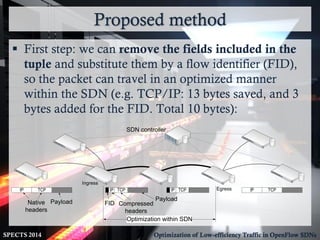
 First step: we can remove the fields included in the
tuple and substitute them by a flow identifier (FID),
so the packet can travel in an optimized manner
within the SDN (e.g. TCP/IP: 13 bytes saved, and 3
bytes added for the FID. Total 10 bytes):
PayloadNative
headers
Payload
Compressed
headers
FID
SDN controller
Ingress
EgressIP TCP TCPIP IP TCPTCPIP
Optimization within SDN
Proposed method
SPECTS 2014 Optimization of Low-efficiency Traffic in OpenFlow SDNs
 Openflow 1.1 allows switches and controllers to agree on
different flow matching syntaxes
 Second step: The inclusion in the tuple of other
NOCHANGE fields of Transport and Network layers.
 These fields are not required for identifying the flow
 But including them in the tuple would make it possible to
remove them from all the packets, thus allowing even
higher header compression ratios
 Counterpart: slight increase of the storage requirements of
the switches and the controller (about 40 bytes per flow)
 We can also include in the tuple application-layer fields
(e.g. RTP), obtaining more savings
Proposed method
SPECTS 2014 Optimization of Low-efficiency Traffic in OpenFlow SDNs
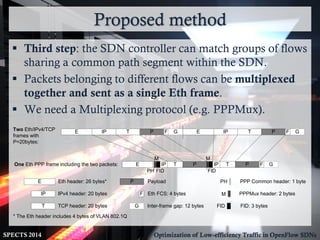
 Third step: the SDN controller can match groups of flows
sharing a common path segment within the SDN.
 Packets belonging to different flows can be multiplexed
together and sent as a single Eth frame.
 We need a Multiplexing protocol (e.g. PPPMux).
E
E
IPv4 header: 20 bytes
TCP header: 20 bytes Inter-frame gap: 12 bytes
PPP Common header: 1 byte
PPPMux header: 2 bytes
T
IP
Payload
IPTwo Eth/IPv4/TCP
frames with
P=20bytes:
T P E IP T P
T P IP T P GIP F
G
F GF
One Eth PPP frame including the two packets:
E Eth header: 26 bytes*
G
FID: 3 bytes
F Eth FCS: 4 bytes
P
PH
M
FID
M
FID
M
PH
FID
* The Eth header includes 4 bytes of VLAN 802.1Q
SPECTS 2014 Optimization of Low-efficiency Traffic in OpenFlow SDNs
Index
1. Introduction
2. Proposed method
3. Results
4. Conclusions
Results
SPECTS 2014 Optimization of Low-efficiency Traffic in OpenFlow SDNs
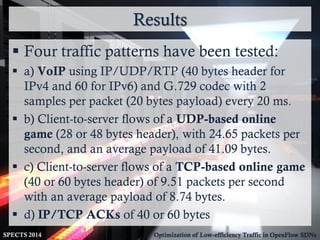
 Four traffic patterns have been tested:
 a) VoIP using IP/UDP/RTP (40 bytes header for
IPv4 and 60 for IPv6) and G.729 codec with 2
samples per packet (20 bytes payload) every 20 ms.
 b) Client-to-server flows of a UDP-based online
game (28 or 48 bytes header), with 24.65 packets per
second, and an average payload of 41.09 bytes.
 c) Client-to-server flows of a TCP-based online game
(40 or 60 bytes header) of 9.51 packets per second
with an average payload of 8.74 bytes.
 d) IP/TCP ACKs of 40 or 60 bytes
Results
SPECTS 2014 Optimization of Low-efficiency Traffic in OpenFlow SDNs
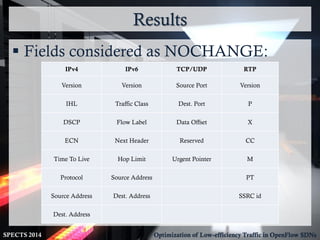
 Fields considered as NOCHANGE:
IPv4 IPv6 TCP/UDP RTP
Version Version Source Port Version
IHL Traffic Class Dest. Port P
DSCP Flow Label Data Offset X
ECN Next Header Reserved CC
Time To Live Hop Limit Urgent Pointer M
Protocol Source Address PT
Source Address Dest. Address SSRC id
Dest. Address
Results
SPECTS 2014 Optimization of Low-efficiency Traffic in OpenFlow SDNs
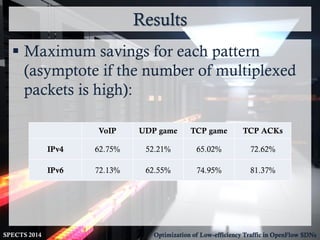
 Maximum savings for each pattern
(asymptote if the number of multiplexed
packets is high):
VoIP UDP game TCP game TCP ACKs
IPv4 62.75% 52.21% 65.02% 72.62%
IPv6 72.13% 62.55% 74.95% 81.37%
Results
SPECTS 2014 Optimization of Low-efficiency Traffic in OpenFlow SDNs
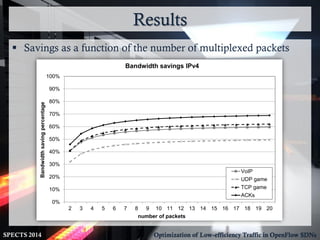
 Savings as a function of the number of multiplexed packets
0%
10%
20%
30%
40%
50%
60%
70%
80%
90%
100%
2 3 4 5 6 7 8 9 10 11 12 13 14 15 16 17 18 19 20
Bandwidthsavingpercentage
number of packets
Bandwidth savings IPv4
VoIP
UDP game
TCP game
ACKs
Results
SPECTS 2014 Optimization of Low-efficiency Traffic in OpenFlow SDNs
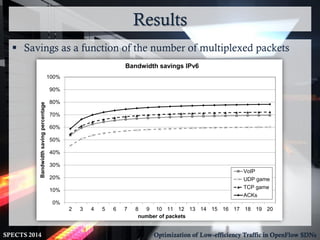
 Savings as a function of the number of multiplexed packets
0%
10%
20%
30%
40%
50%
60%
70%
80%
90%
100%
2 3 4 5 6 7 8 9 10 11 12 13 14 15 16 17 18 19 20
Bandwidthsavingpercentage
number of packets
Bandwidth savings IPv6
VoIP
UDP game
TCP game
ACKs
SPECTS 2014 Optimization of Low-efficiency Traffic in OpenFlow SDNs
Index
1. Introduction
2. Proposed method
3. Results
4. Conclusions
Conclusions
SPECTS 2014 Optimization of Low-efficiency Traffic in OpenFlow SDNs
 The SDN controller can find a number of flows
sharing a common path
 The flows that are constant can be avoided, using an
identifier
 With this method we can save bandwidth and reduce
the number of pps: 68% for IPv4 and 78% for IPv6
 Counterpart: additional latency. It can be kept under
tolerable limits for services sending high packet rates
Thank you very much!
Jose Saldana, David de Hoz,
Julián Fernández-Navajas, José Ruiz-Mas
Fernando Pascual, Diego R. Lopez,
David Florez, Juan A. Castell,
Manuel Nuñez

Optimization of Low-efficiency Traffic in OpenFlow Software Defined Networks

  • 1.
    Optimization of Low-efficiency Trafficin OpenFlow Software Defined Networks SPECTS 2014, International Symposium on Performance Evaluation of Computer and Telecommunication Systems July 6-10, 2014, Monterey, CA, USA Jose Saldana, David de Hoz, Julián Fernández-Navajas, José Ruiz-Mas Fernando Pascual, Diego R. Lopez, David Florez, Juan A. Castell, Manuel Nuñez
  • 2.
    SPECTS 2014 Optimizationof Low-efficiency Traffic in OpenFlow SDNs Index 1. Introduction 2. Proposed method 3. Results 4. Conclusions
  • 3.
    SPECTS 2014 Optimizationof Low-efficiency Traffic in OpenFlow SDNs Index 1. Introduction 2. Proposed method 3. Results 4. Conclusions
  • 4.
    Introduction SPECTS 2014 Optimizationof Low-efficiency Traffic in OpenFlow SDNs  Software Defined Networks  Separation of control and data planes  Programmability of control plane  Central control of the network as a whole  Used in cloud computing: flexibility, efficiency  Openflow: the most extended SDN standard
  • 5.
    Introduction SPECTS 2014 Optimizationof Low-efficiency Traffic in OpenFlow SDNs  Small-packets in the Internet  Real-time services: High interactivity VoIP Online games (some of them use TCP)  TCP ACKs. Downloads, videos, etc.
  • 6.
    Introduction SPECTS 2014 Optimizationof Low-efficiency Traffic in OpenFlow SDNs  High rates of small packets (high header-to- payload ratio). Low efficiency:  VoIP  FPS game  MMORPG game  ACK
  • 7.
    Introduction SPECTS 2014 Optimizationof Low-efficiency Traffic in OpenFlow SDNs  Header compression can be used to reduce the overhead:  Many header fields are the same for every packet in a flow: e.g., IP addresses, ports, etc.  These fields can be avoided, but:  a context must be stored in both sides in order to rebuild the packets  Tunneling is necessary, since a packet with a compressed header cannot be sent normally
  • 8.
    Introduction SPECTS 2014 Optimizationof Low-efficiency Traffic in OpenFlow SDNs  One solution: combining header compression with multiplexing:  The tunnel header is shared between a number of packets  A period is defined in order to gather a number of packets Period . . . . . . Native game traffic Optimized traffic Period Period . . . . . . . . . . . . . . . . . .
  • 9.
    Introduction SPECTS 2014 Optimizationof Low-efficiency Traffic in OpenFlow SDNs  TCM (Tunneling Compressed Multiplexed Traffic Flows) is a proposal for improving the efficiency of these flows by:  Header compression  Multiplexing  Tunneling  30% to 55% saving  Status: IETF draft IP IP IP No compr. / ROHC / IPHC / ECRTP PPPMux / Other GRE / L2TP / Other IP Compression layer Multiplexing layer Tunneling layer Real-time traffic Network Protocol UDP RTP payload UDPTCP payloadpayload
  • 10.
    Introduction SPECTS 2014 Optimizationof Low-efficiency Traffic in OpenFlow SDNs  Tradeoff. Advantages:  Bandwidth savings  pps reduction (energy savings)  At the cost of Added processing requirements Additional multiplexing delay Five IPv4/UDP/RTP VoIP packets with two samples of 10 bytes η=100/300=33% savingOne IPv4 TCMTF Packet multiplexing five two sample packets η=100/161=62%
  • 11.
    Introduction SPECTS 2014 Optimizationof Low-efficiency Traffic in OpenFlow SDNs  Objective of the present work: Proposal of an equivalent optimization method, especially focused on SDNs. Advantages:  the tunneling layer is not necessary, since the SDN provides it in a natural way  the avoidance of the use of standard header compression techniques  multiplexing reduces the number of frames, so a number of Ethernet fields (header, inter- frame gap) are only sent once
  • 12.
    SPECTS 2014 Optimizationof Low-efficiency Traffic in OpenFlow SDNs Index 1. Introduction 2. Proposed method 3. Results 4. Conclusions
  • 13.
    Proposed method SPECTS 2014Optimization of Low-efficiency Traffic in OpenFlow SDNs  In Openflow 1.0:  all the switches are connected to a central controller  each packet is associated to a flow by means of a 12-field tuple, used for assigning the output port SA,DA,Prot,ToS In port SA, DA, type Ethernet IP TCP Sport, DPortID, prio VLAN
  • 14.
    Proposed method SPECTS 2014Optimization of Low-efficiency Traffic in OpenFlow SDNs  When a flow traverses a path, the IP and TCP tuple fields of all the packets are the same for all the tables of the switches of that path, and also in the controller.  Thus, the IP and TCP protocol fields already included in the tuple are not necessary for switching decisions but only for matching the packets with a flow.
  • 15.
    Proposed method SPECTS 2014Optimization of Low-efficiency Traffic in OpenFlow SDNs  First step: we can remove the fields included in the tuple and substitute them by a flow identifier (FID), so the packet can travel in an optimized manner within the SDN (e.g. TCP/IP: 13 bytes saved, and 3 bytes added for the FID. Total 10 bytes): PayloadNative headers Payload Compressed headers FID SDN controller Ingress EgressIP TCP TCPIP IP TCPTCPIP Optimization within SDN
  • 16.
    Proposed method SPECTS 2014Optimization of Low-efficiency Traffic in OpenFlow SDNs  Openflow 1.1 allows switches and controllers to agree on different flow matching syntaxes  Second step: The inclusion in the tuple of other NOCHANGE fields of Transport and Network layers.  These fields are not required for identifying the flow  But including them in the tuple would make it possible to remove them from all the packets, thus allowing even higher header compression ratios  Counterpart: slight increase of the storage requirements of the switches and the controller (about 40 bytes per flow)  We can also include in the tuple application-layer fields (e.g. RTP), obtaining more savings
  • 17.
    Proposed method SPECTS 2014Optimization of Low-efficiency Traffic in OpenFlow SDNs  Third step: the SDN controller can match groups of flows sharing a common path segment within the SDN.  Packets belonging to different flows can be multiplexed together and sent as a single Eth frame.  We need a Multiplexing protocol (e.g. PPPMux). E E IPv4 header: 20 bytes TCP header: 20 bytes Inter-frame gap: 12 bytes PPP Common header: 1 byte PPPMux header: 2 bytes T IP Payload IPTwo Eth/IPv4/TCP frames with P=20bytes: T P E IP T P T P IP T P GIP F G F GF One Eth PPP frame including the two packets: E Eth header: 26 bytes* G FID: 3 bytes F Eth FCS: 4 bytes P PH M FID M FID M PH FID * The Eth header includes 4 bytes of VLAN 802.1Q
  • 18.
    SPECTS 2014 Optimizationof Low-efficiency Traffic in OpenFlow SDNs Index 1. Introduction 2. Proposed method 3. Results 4. Conclusions
  • 19.
    Results SPECTS 2014 Optimizationof Low-efficiency Traffic in OpenFlow SDNs  Four traffic patterns have been tested:  a) VoIP using IP/UDP/RTP (40 bytes header for IPv4 and 60 for IPv6) and G.729 codec with 2 samples per packet (20 bytes payload) every 20 ms.  b) Client-to-server flows of a UDP-based online game (28 or 48 bytes header), with 24.65 packets per second, and an average payload of 41.09 bytes.  c) Client-to-server flows of a TCP-based online game (40 or 60 bytes header) of 9.51 packets per second with an average payload of 8.74 bytes.  d) IP/TCP ACKs of 40 or 60 bytes
  • 20.
    Results SPECTS 2014 Optimizationof Low-efficiency Traffic in OpenFlow SDNs  Fields considered as NOCHANGE: IPv4 IPv6 TCP/UDP RTP Version Version Source Port Version IHL Traffic Class Dest. Port P DSCP Flow Label Data Offset X ECN Next Header Reserved CC Time To Live Hop Limit Urgent Pointer M Protocol Source Address PT Source Address Dest. Address SSRC id Dest. Address
  • 21.
    Results SPECTS 2014 Optimizationof Low-efficiency Traffic in OpenFlow SDNs  Maximum savings for each pattern (asymptote if the number of multiplexed packets is high): VoIP UDP game TCP game TCP ACKs IPv4 62.75% 52.21% 65.02% 72.62% IPv6 72.13% 62.55% 74.95% 81.37%
  • 22.
    Results SPECTS 2014 Optimizationof Low-efficiency Traffic in OpenFlow SDNs  Savings as a function of the number of multiplexed packets 0% 10% 20% 30% 40% 50% 60% 70% 80% 90% 100% 2 3 4 5 6 7 8 9 10 11 12 13 14 15 16 17 18 19 20 Bandwidthsavingpercentage number of packets Bandwidth savings IPv4 VoIP UDP game TCP game ACKs
  • 23.
    Results SPECTS 2014 Optimizationof Low-efficiency Traffic in OpenFlow SDNs  Savings as a function of the number of multiplexed packets 0% 10% 20% 30% 40% 50% 60% 70% 80% 90% 100% 2 3 4 5 6 7 8 9 10 11 12 13 14 15 16 17 18 19 20 Bandwidthsavingpercentage number of packets Bandwidth savings IPv6 VoIP UDP game TCP game ACKs
  • 24.
    SPECTS 2014 Optimizationof Low-efficiency Traffic in OpenFlow SDNs Index 1. Introduction 2. Proposed method 3. Results 4. Conclusions
  • 25.
    Conclusions SPECTS 2014 Optimizationof Low-efficiency Traffic in OpenFlow SDNs  The SDN controller can find a number of flows sharing a common path  The flows that are constant can be avoided, using an identifier  With this method we can save bandwidth and reduce the number of pps: 68% for IPv4 and 78% for IPv6  Counterpart: additional latency. It can be kept under tolerable limits for services sending high packet rates
  • 26.
    Thank you verymuch! Jose Saldana, David de Hoz, Julián Fernández-Navajas, José Ruiz-Mas Fernando Pascual, Diego R. Lopez, David Florez, Juan A. Castell, Manuel Nuñez