Outline
Background
Globus architecture
Globus Toolkit
Gridbus Architecture
2AOS
Background
 Globus its self a community for open source software development
(OGSI) and relate documentation for the creation of grid technologies
 In 1998 first version of Globus Toolkit (GT) released, and version 2.0 was
released in 2002. It was developed by using C programming language, first
it was useful for LINUX platforms and it was not fully supported for
Microsoft platforms. (Lock, R 2002) (Russell Lock. 11 February 2002 "An
introduction to the Globus toolkit"). Globus Toolkit 2 consist of
components Grid Resource Allocation Management (GRAM), Grid File
Transfer Protocol (GridFTP) and Monitoring and Discovery Service
(MDS).
3AOS
Globus architecture
 The Globus project provides open source software toolkit that
can be used to build computational grids and grid based
applications. It allows sharing of computing power, databases,
and other resources securely across corporate, institutional and
geographical boundaries without sacrificing local autonomy.
 The core services, interfaces and protocols in the Globus toolkit
allow users to access remote resources seamlessly while
simultaneously preserving local control over who can use
resources and when.
4AOS
Globus architecture…
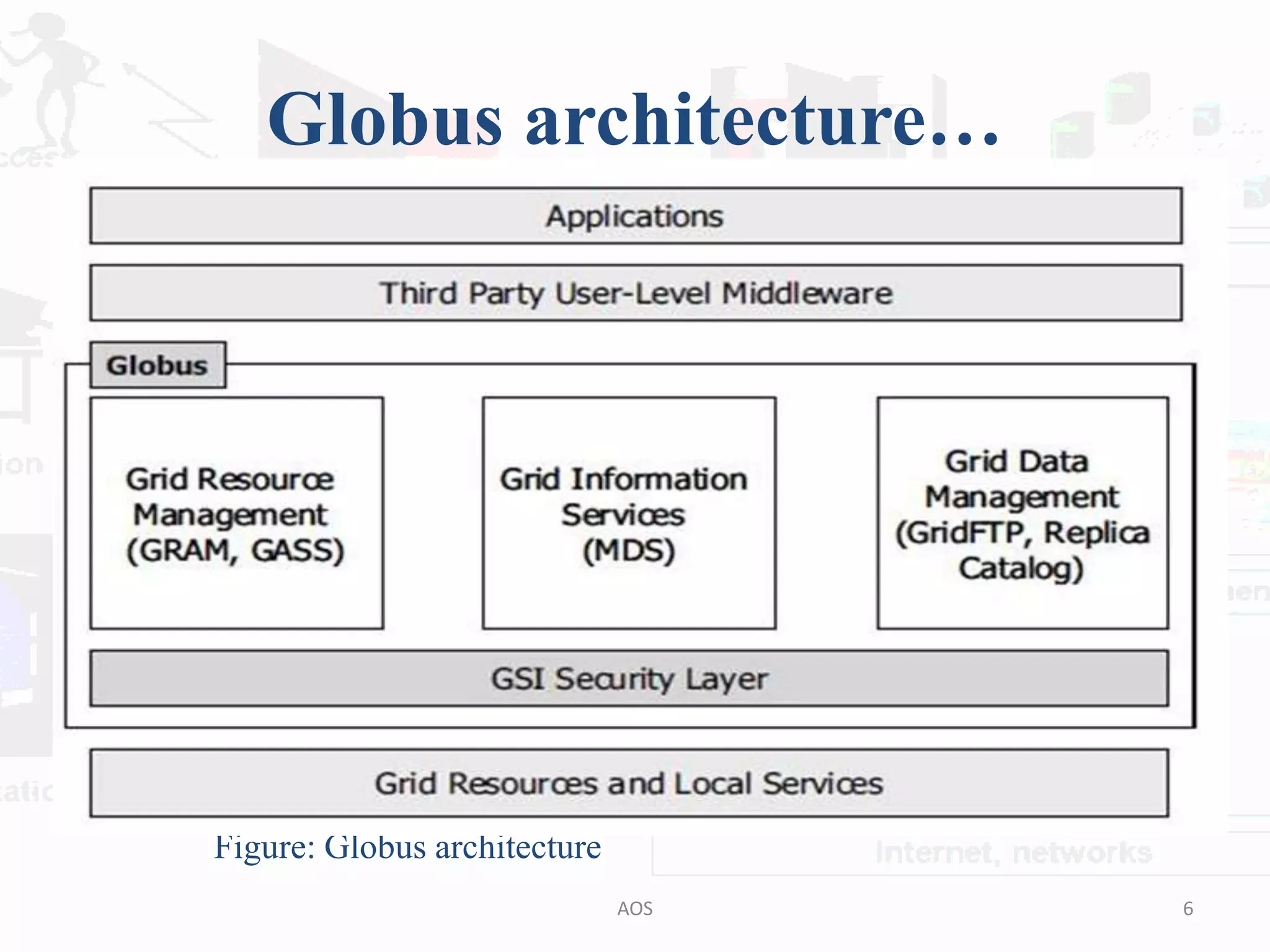
Figure: Globus architecture
6AOS
Globus architecture…
 The Globus Architecture has three main groups of services
accessible through a security layer.
 Resource management,
 Data Management ,and
 Information services.
Resource management: The resource management supports for:
Resource allocation, Submitting jobs, and Managing job status and
progress .
Information services: provides support for collecting information in the
grid and for querying this information, based on the Lightweight
Directory Access Protocol (LDAP).
Data management: provides support to transfer files among machines in
the grid and for the management of these transfers.
5AOS
Globus architecture…
 The local services layer contains the operating system services,
network services like TCP / IP , cluster scheduling services provided
by Load Leveler, job-submission, query of queues, and soon. The
higher layers of the Globus model enable the integration of multiple
or heterogeneous clusters. The core services layer contains the
Globus toolkit building blocks for security, job submission, data
management and resource information management. The high level
services and tools layer contains tools that integrate the lower level
services or implement missing functionality.
7AOS
Globus architecture…
 GSI Security Layer
 The GSI uses public key cryptography (also known as
asymmetric cryptography) as the basis for its functionality. Many
of the terms and concepts used in this description of the GSI
come from its use of public key cryptography.
The primary motivations behind the GSI are:
 The need for secure communication between elements of a
computational Grid.
 The need to support security across organizational boundaries
 The need to support "single sign-on" for users of the Grid
8AOS
Globus architecture…
 GSI Security Layer …
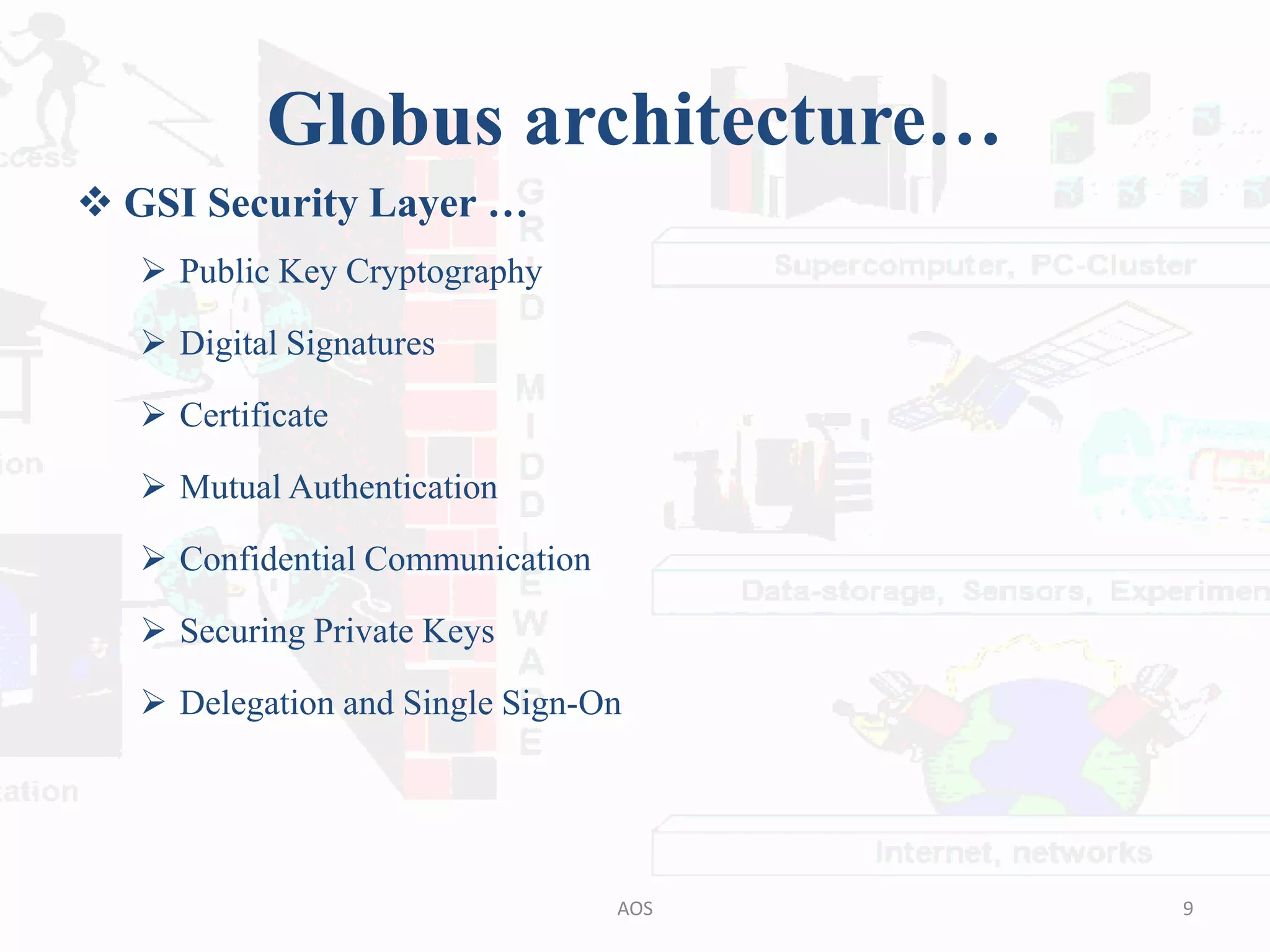
 Public Key Cryptography
 Digital Signatures
 Certificate
 Mutual Authentication
 Confidential Communication
 Securing Private Keys
 Delegation and Single Sign-On
9AOS
Globus architecture…
 GSI Security Layer …
 Public Key Cryptography: is cryptography in which a pair of keys is used to encrypt
and decrypt a message so that it arrives securely.
 Digital Signatures: Digital signatures are the public-key primitives of message
authentication.
 Certificate: is a user's Public Key, which has been signed and encrypted using the
private key of a well-known Certificate Authority.
 Mutual Authentication: Mutual authentication, also called two-way authentication, is a
process or technology in which both entities in a communications link authenticate each
other.
 Confidential Communication: protecting the information from disclosure to
unauthorized parties.
10AOS
Globus architecture…
 Globus Toolkit
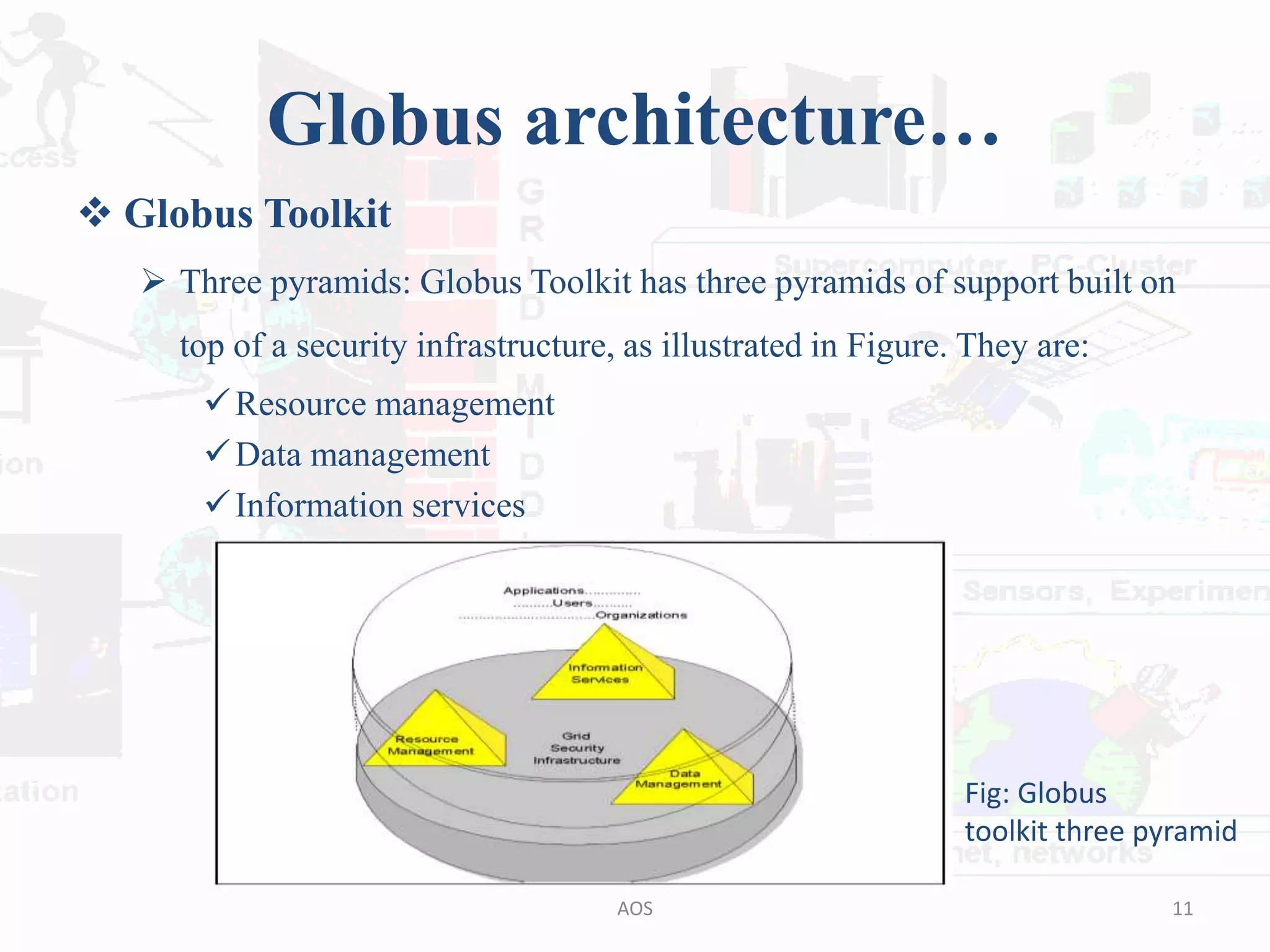
 Three pyramids: Globus Toolkit has three pyramids of support built on
top of a security infrastructure, as illustrated in Figure. They are:
Resource management
Data management
Information services
11AOS
Fig: Globus
toolkit three pyramid
Globus architecture…
 Globus Toolkit…
 Resource management: The resource management pyramid provides support
for:
 Resource allocation
 Submitting jobs: Remotely running executable files and receiving results
 Managing job status and progress
 Information services: provides support for collecting information in the grid
and for querying this information, based on the Lightweight Directory Access
Protocol (LDAP).
 Data management: provides support to transfer files among machines in the
grid and for the management of these transfers.
12AOS
Globus architecture…
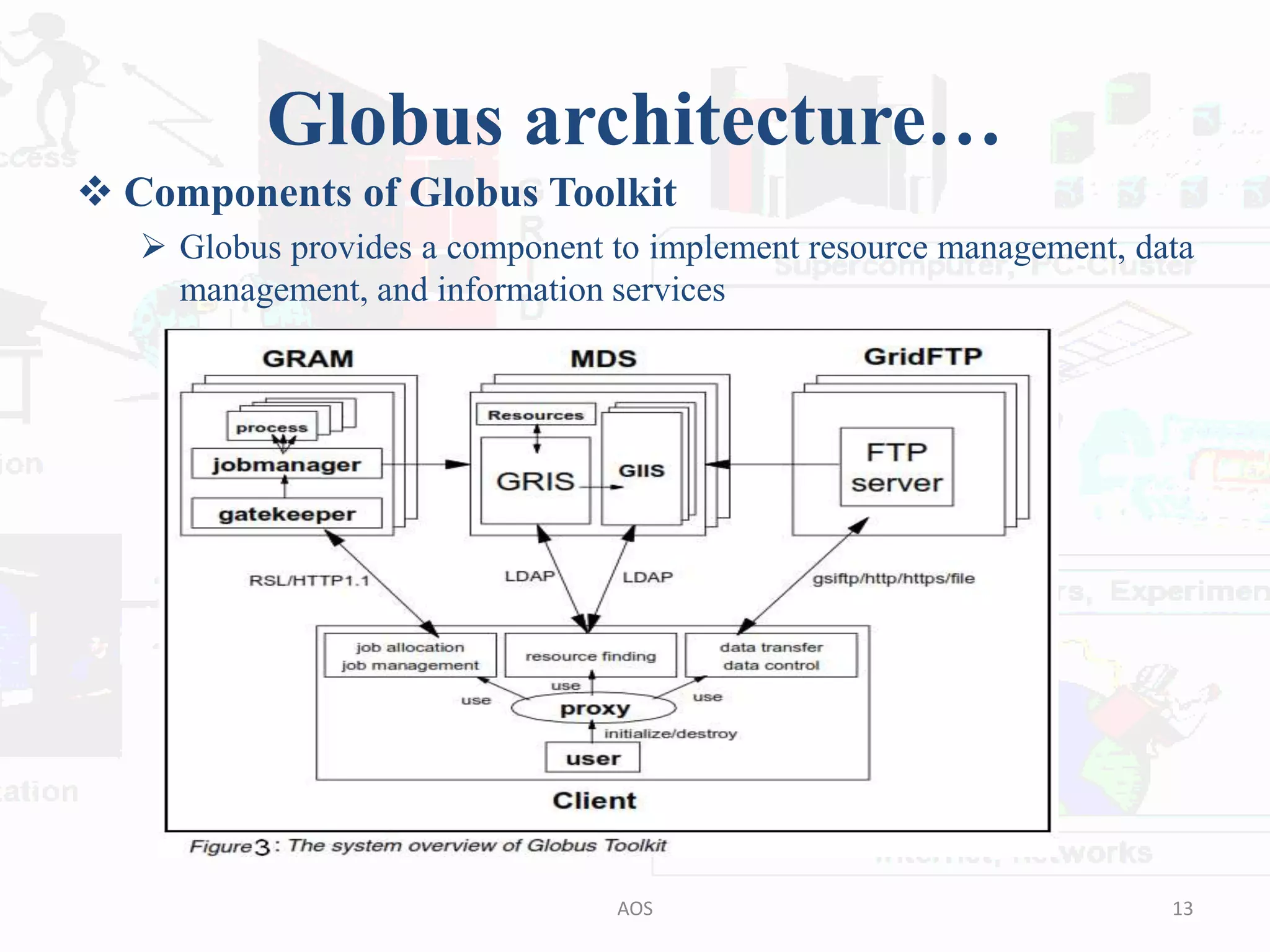
 Components of Globus Toolkit
 Globus provides a component to implement resource management, data
management, and information services
13AOS
Globus architecture…
 Components of Globus Toolkit…
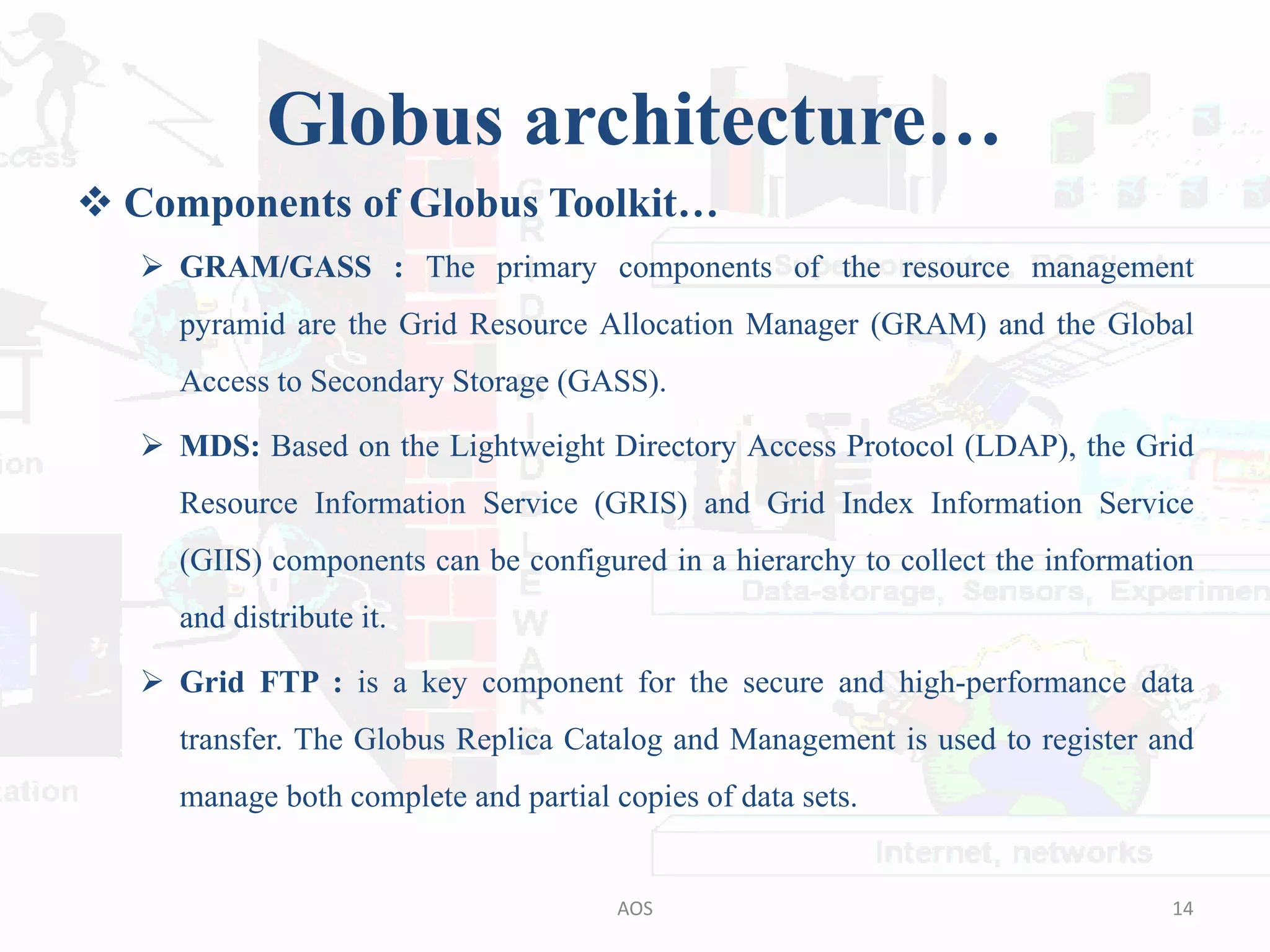
 GRAM/GASS : The primary components of the resource management
pyramid are the Grid Resource Allocation Manager (GRAM) and the Global
Access to Secondary Storage (GASS).
 MDS: Based on the Lightweight Directory Access Protocol (LDAP), the Grid
Resource Information Service (GRIS) and Grid Index Information Service
(GIIS) components can be configured in a hierarchy to collect the information
and distribute it.
 Grid FTP : is a key component for the secure and high-performance data
transfer. The Globus Replica Catalog and Management is used to register and
manage both complete and partial copies of data sets.
14AOS
Globus architecture…
 Components of Globus Toolkit…
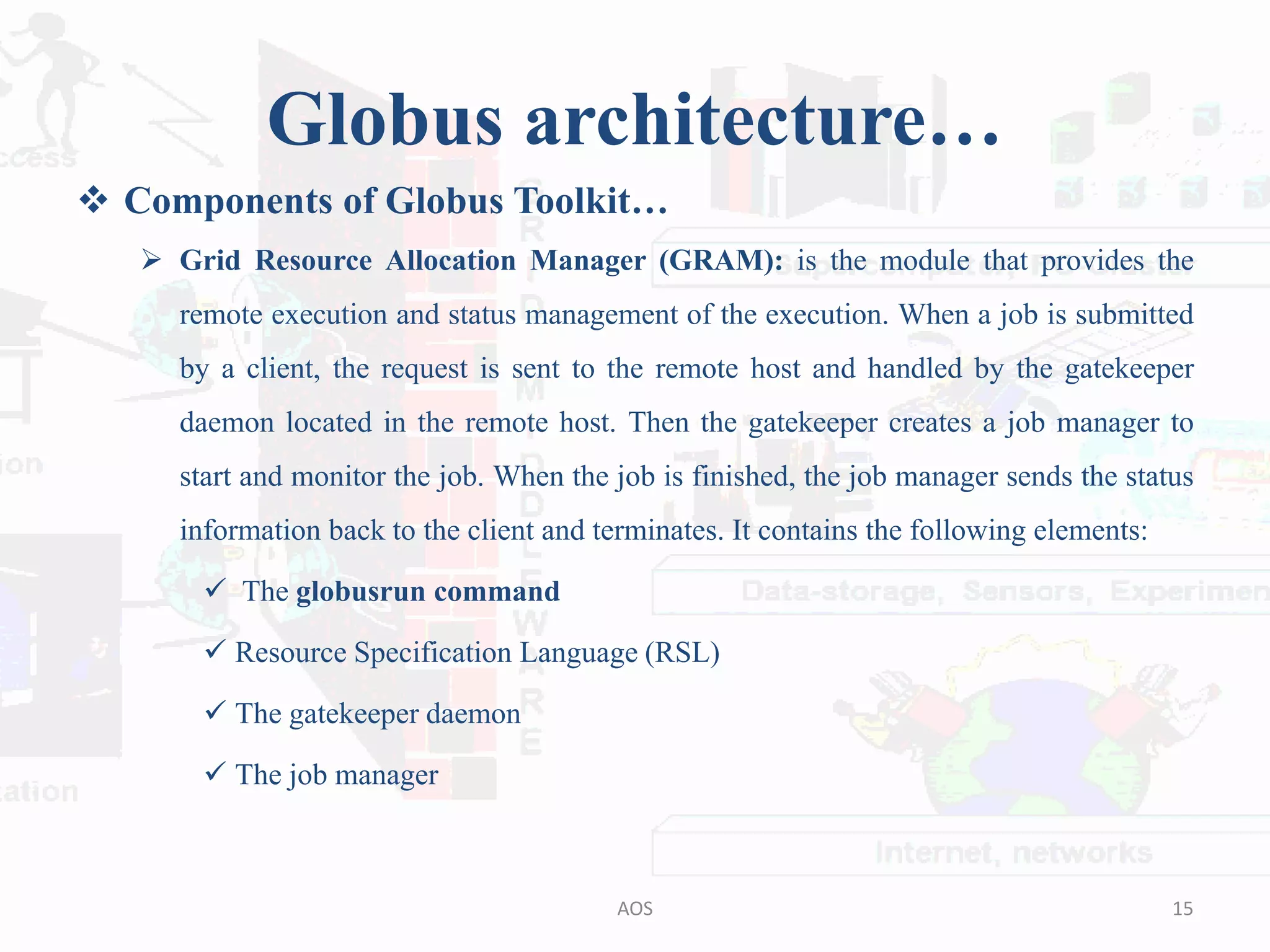
 Grid Resource Allocation Manager (GRAM): is the module that provides the
remote execution and status management of the execution. When a job is submitted
by a client, the request is sent to the remote host and handled by the gatekeeper
daemon located in the remote host. Then the gatekeeper creates a job manager to
start and monitor the job. When the job is finished, the job manager sends the status
information back to the client and terminates. It contains the following elements:
 The globusrun command
 Resource Specification Language (RSL)
 The gatekeeper daemon
 The job manager
15AOS
Globus architecture…
 Components of Globus Toolkit…
 Monitoring and Discovery Service (MDS): provides access to static and
dynamic information of resources. Basically, it contains the following
components: DS):
16AOS
Globus architecture…
 Monitoring and Discovery Service (MDS)…
 Resource information: Resource information contains the objects managed by
MDS, which represent components resources .
 Grid Resource Information Service (GRIS): is the repository of local resource
information derived from information providers.
 Grid Index Information Service (GIIS): GIIS is the repository that contains
indexes of resource information registered by the GRIS and other GIISs.
 Information providers: The information providers translate the properties and
status of local resources to the format defined in the schema and configuration files.
 MDS client: The MDS client is based on the LDAP client command, ldapsearch. A
search for resource information that you want in your grid environment is initially
performed by the MDS client.
17AOS
Gridbus Architecture
 Grid technologies such as Globus provide capabilities and services required for
secure access and execution of a job on resources. However, to achieve the
complete vision of Grid as a utility computing environment, a number of challenges
need to be addressed.
 They include composition of analysis software as a distributed application, resource
brokering methodologies and strategies for scheduling data-driven applications,
data grid economy for data management, application service specification, and
accounting of resource consumption.
 The application development and deployment services need to scale from desktop
environment to global grids and need to support both scientific and business
applications
 Grid bus emphasizes the end-to-end qulaity-of-sevices driven by computational
economy at various levels – clusters, peer-to-peer networks, and the grid for the
management of distributed computational, data and application services.
18AOS
Gridbus Architecture…
Fig: Gridbus architecture
19AOS
Gridbus Architecture…
 Gridbus supports commoditization of Grid services at various levels:
 Raw resource level ( eg. Selling CPU cycles and storage resources )
 Application level ( eg: molecular docking operations for drug design
application )
 Aggregated services ( eg: brokering and reselling of services across multiple
domains )
 Gridbus provides software technologies that spread across the following
categories:
 Enterprise Grid middleware ( Alchemi )
 Service-level agreements based allocation of cluster resources ( Libra)
 Grid economy and virtual enterprise ( Grid Market Directory, Compute Power
Market )
 Grid trading and accounting services ( GridBank )
 Grid resource brokering and scheduling ( GridBus Broker )
 Grid workflow management ( GridBus workflow Engine )
 Grid Application programming interface ( Visual Parametric Modeller )
 Grid portals ( Gmonitor, Gridscape)
 Grid modeling and simulation ( GridSim)
20AOS
Globus ppt

Globus ppt

  • 2.
  • 3.
    Background  Globus itsself a community for open source software development (OGSI) and relate documentation for the creation of grid technologies  In 1998 first version of Globus Toolkit (GT) released, and version 2.0 was released in 2002. It was developed by using C programming language, first it was useful for LINUX platforms and it was not fully supported for Microsoft platforms. (Lock, R 2002) (Russell Lock. 11 February 2002 "An introduction to the Globus toolkit"). Globus Toolkit 2 consist of components Grid Resource Allocation Management (GRAM), Grid File Transfer Protocol (GridFTP) and Monitoring and Discovery Service (MDS). 3AOS
  • 4.
    Globus architecture  TheGlobus project provides open source software toolkit that can be used to build computational grids and grid based applications. It allows sharing of computing power, databases, and other resources securely across corporate, institutional and geographical boundaries without sacrificing local autonomy.  The core services, interfaces and protocols in the Globus toolkit allow users to access remote resources seamlessly while simultaneously preserving local control over who can use resources and when. 4AOS
  • 5.
  • 6.
    Globus architecture…  TheGlobus Architecture has three main groups of services accessible through a security layer.  Resource management,  Data Management ,and  Information services. Resource management: The resource management supports for: Resource allocation, Submitting jobs, and Managing job status and progress . Information services: provides support for collecting information in the grid and for querying this information, based on the Lightweight Directory Access Protocol (LDAP). Data management: provides support to transfer files among machines in the grid and for the management of these transfers. 5AOS
  • 7.
    Globus architecture…  Thelocal services layer contains the operating system services, network services like TCP / IP , cluster scheduling services provided by Load Leveler, job-submission, query of queues, and soon. The higher layers of the Globus model enable the integration of multiple or heterogeneous clusters. The core services layer contains the Globus toolkit building blocks for security, job submission, data management and resource information management. The high level services and tools layer contains tools that integrate the lower level services or implement missing functionality. 7AOS
  • 8.
    Globus architecture…  GSISecurity Layer  The GSI uses public key cryptography (also known as asymmetric cryptography) as the basis for its functionality. Many of the terms and concepts used in this description of the GSI come from its use of public key cryptography. The primary motivations behind the GSI are:  The need for secure communication between elements of a computational Grid.  The need to support security across organizational boundaries  The need to support "single sign-on" for users of the Grid 8AOS
  • 9.
    Globus architecture…  GSISecurity Layer …  Public Key Cryptography  Digital Signatures  Certificate  Mutual Authentication  Confidential Communication  Securing Private Keys  Delegation and Single Sign-On 9AOS
  • 10.
    Globus architecture…  GSISecurity Layer …  Public Key Cryptography: is cryptography in which a pair of keys is used to encrypt and decrypt a message so that it arrives securely.  Digital Signatures: Digital signatures are the public-key primitives of message authentication.  Certificate: is a user's Public Key, which has been signed and encrypted using the private key of a well-known Certificate Authority.  Mutual Authentication: Mutual authentication, also called two-way authentication, is a process or technology in which both entities in a communications link authenticate each other.  Confidential Communication: protecting the information from disclosure to unauthorized parties. 10AOS
  • 11.
    Globus architecture…  GlobusToolkit  Three pyramids: Globus Toolkit has three pyramids of support built on top of a security infrastructure, as illustrated in Figure. They are: Resource management Data management Information services 11AOS Fig: Globus toolkit three pyramid
  • 12.
    Globus architecture…  GlobusToolkit…  Resource management: The resource management pyramid provides support for:  Resource allocation  Submitting jobs: Remotely running executable files and receiving results  Managing job status and progress  Information services: provides support for collecting information in the grid and for querying this information, based on the Lightweight Directory Access Protocol (LDAP).  Data management: provides support to transfer files among machines in the grid and for the management of these transfers. 12AOS
  • 13.
    Globus architecture…  Componentsof Globus Toolkit  Globus provides a component to implement resource management, data management, and information services 13AOS
  • 14.
    Globus architecture…  Componentsof Globus Toolkit…  GRAM/GASS : The primary components of the resource management pyramid are the Grid Resource Allocation Manager (GRAM) and the Global Access to Secondary Storage (GASS).  MDS: Based on the Lightweight Directory Access Protocol (LDAP), the Grid Resource Information Service (GRIS) and Grid Index Information Service (GIIS) components can be configured in a hierarchy to collect the information and distribute it.  Grid FTP : is a key component for the secure and high-performance data transfer. The Globus Replica Catalog and Management is used to register and manage both complete and partial copies of data sets. 14AOS
  • 15.
    Globus architecture…  Componentsof Globus Toolkit…  Grid Resource Allocation Manager (GRAM): is the module that provides the remote execution and status management of the execution. When a job is submitted by a client, the request is sent to the remote host and handled by the gatekeeper daemon located in the remote host. Then the gatekeeper creates a job manager to start and monitor the job. When the job is finished, the job manager sends the status information back to the client and terminates. It contains the following elements:  The globusrun command  Resource Specification Language (RSL)  The gatekeeper daemon  The job manager 15AOS
  • 16.
    Globus architecture…  Componentsof Globus Toolkit…  Monitoring and Discovery Service (MDS): provides access to static and dynamic information of resources. Basically, it contains the following components: DS): 16AOS
  • 17.
    Globus architecture…  Monitoringand Discovery Service (MDS)…  Resource information: Resource information contains the objects managed by MDS, which represent components resources .  Grid Resource Information Service (GRIS): is the repository of local resource information derived from information providers.  Grid Index Information Service (GIIS): GIIS is the repository that contains indexes of resource information registered by the GRIS and other GIISs.  Information providers: The information providers translate the properties and status of local resources to the format defined in the schema and configuration files.  MDS client: The MDS client is based on the LDAP client command, ldapsearch. A search for resource information that you want in your grid environment is initially performed by the MDS client. 17AOS
  • 18.
    Gridbus Architecture  Gridtechnologies such as Globus provide capabilities and services required for secure access and execution of a job on resources. However, to achieve the complete vision of Grid as a utility computing environment, a number of challenges need to be addressed.  They include composition of analysis software as a distributed application, resource brokering methodologies and strategies for scheduling data-driven applications, data grid economy for data management, application service specification, and accounting of resource consumption.  The application development and deployment services need to scale from desktop environment to global grids and need to support both scientific and business applications  Grid bus emphasizes the end-to-end qulaity-of-sevices driven by computational economy at various levels – clusters, peer-to-peer networks, and the grid for the management of distributed computational, data and application services. 18AOS
  • 19.
  • 20.
    Gridbus Architecture…  Gridbussupports commoditization of Grid services at various levels:  Raw resource level ( eg. Selling CPU cycles and storage resources )  Application level ( eg: molecular docking operations for drug design application )  Aggregated services ( eg: brokering and reselling of services across multiple domains )  Gridbus provides software technologies that spread across the following categories:  Enterprise Grid middleware ( Alchemi )  Service-level agreements based allocation of cluster resources ( Libra)  Grid economy and virtual enterprise ( Grid Market Directory, Compute Power Market )  Grid trading and accounting services ( GridBank )  Grid resource brokering and scheduling ( GridBus Broker )  Grid workflow management ( GridBus workflow Engine )  Grid Application programming interface ( Visual Parametric Modeller )  Grid portals ( Gmonitor, Gridscape)  Grid modeling and simulation ( GridSim) 20AOS