1
Client-Server Model
2
It defines:
• Which process may begin the interaction
• Which process may answer
• How error conditions may be managed.
3
Process classification
• Client process,:the process that requires a service
• Server process: the process that provides the
required service
• The client requires a service, the server provides the
service and makes available the results to the client
4
Client functions
In generally, client software:
• Is an arbitrary application program that becames a client
temporarily when remote access is needed, but also
performs other computation locally.
• Is invoked locally by a user, and executes only for one
session
• Runs locally on a user personal computer
• Actively initiates contact with a server
• Can access multiple services as needed, but actively
contacts one remote server at a time.
• Does not require special hardware or a sophisticated
operating system
5
Server functions
• Is a special purpose, privileged program dedicated to
providing one service, but can handle multiple remote
clients at the same time.
• Run on a shared computer(i.e. not a user’s personal
computer).
• Wait passively for contact from arbitrary remote clients
• Accepts contact from arbitrary clients, but offers a single
service
• Requires powerfull hardware and a sophisticated operating
system
A server must guarantee:
6
Authentication: client identity verification
Authorization: verification of the possibility for a client to
access to a particular service
Data Security: garantee that specific data cannot be read
and/or modified
Client Server Architecture:
1)2-teir Model
2)3-teir Model.
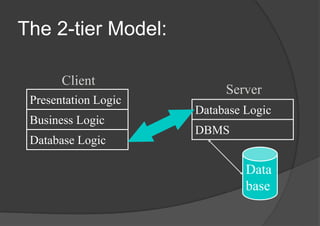
The 2-tier Model:
Presentation Logic
Business Logic
Database Logic
DBMS
Data
base
Database Logic
Client
Server
Points
 The database is on the server
 could some of it be moved to the client?
 Distributed database logic
 most of it is on the client
 The client does the presentation.
 ‘Fat’ versus ‘thin’ clients.
 Much simpler if all the database servers are the
same (homogenous).
The 3-tier Model :
Server
Data
Application servers Data Servers
Server
Data
UNIX
Win/NT
Clients
Three-level Client/Server Architecture
 The traditional client/server architecture involves two
levels, a client level and a server level.
 A three level architecture is constituted by three types of
machines: a user machine, a middle-level server and a back
end server.
 The user machine :(client) is typically a thin
client.
 The middle-level: server is the application server.
 The back-end :server is the data server.
11
12
Characteristics of a client-server architecture
• Client and server machines need different amount of hardware
and software resources.
• Client and server machines may belong to different vendors.
• Qrizzontal scalability (increase of the client machines) and
vertical scalability (migration to a more powerful server or to a
multiserver solution)
• A client or server application interacts directly with a transport
layer protocol to establish communication and to send or receive
information.
• The transport protocol then uses lower layer protocols to send or
receive individual messages. Thua, a computer needs a complete
stack of protocols to run either a client or a server.
Advantages of Client/Server
 Mainframe functionality can be made widely
available
 cost benefits
 Processing and data are localised on the server
 reduces network traffic, response time,
bandwidth requirements
 Business logic can be distributed (in 3-tier model)
 reuse, portability
continued
 Encourages open systems
 Present-day systems are too large and involve
too many users to be located on one machine.
Disadvantages of Client/Server
 The server becomes a bottleneck
 Distributed applications are much more complex
than non-distributed ones
 i.e. in development, run time, maintenance, upgrades
 Requires a shift in business practises
 local, simple data --> distributed, open, complex data
Client server model

Client server model

  • 1.
  • 2.
    Client-Server Model 2 It defines: •Which process may begin the interaction • Which process may answer • How error conditions may be managed.
  • 3.
    3 Process classification • Clientprocess,:the process that requires a service • Server process: the process that provides the required service • The client requires a service, the server provides the service and makes available the results to the client
  • 4.
    4 Client functions In generally,client software: • Is an arbitrary application program that becames a client temporarily when remote access is needed, but also performs other computation locally. • Is invoked locally by a user, and executes only for one session • Runs locally on a user personal computer • Actively initiates contact with a server • Can access multiple services as needed, but actively contacts one remote server at a time. • Does not require special hardware or a sophisticated operating system
  • 5.
    5 Server functions • Isa special purpose, privileged program dedicated to providing one service, but can handle multiple remote clients at the same time. • Run on a shared computer(i.e. not a user’s personal computer). • Wait passively for contact from arbitrary remote clients • Accepts contact from arbitrary clients, but offers a single service • Requires powerfull hardware and a sophisticated operating system
  • 6.
    A server mustguarantee: 6 Authentication: client identity verification Authorization: verification of the possibility for a client to access to a particular service Data Security: garantee that specific data cannot be read and/or modified
  • 7.
  • 8.
    The 2-tier Model: PresentationLogic Business Logic Database Logic DBMS Data base Database Logic Client Server
  • 9.
    Points  The databaseis on the server  could some of it be moved to the client?  Distributed database logic  most of it is on the client  The client does the presentation.  ‘Fat’ versus ‘thin’ clients.  Much simpler if all the database servers are the same (homogenous).
  • 10.
    The 3-tier Model: Server Data Application servers Data Servers Server Data UNIX Win/NT Clients
  • 11.
    Three-level Client/Server Architecture The traditional client/server architecture involves two levels, a client level and a server level.  A three level architecture is constituted by three types of machines: a user machine, a middle-level server and a back end server.  The user machine :(client) is typically a thin client.  The middle-level: server is the application server.  The back-end :server is the data server. 11
  • 12.
    12 Characteristics of aclient-server architecture • Client and server machines need different amount of hardware and software resources. • Client and server machines may belong to different vendors. • Qrizzontal scalability (increase of the client machines) and vertical scalability (migration to a more powerful server or to a multiserver solution) • A client or server application interacts directly with a transport layer protocol to establish communication and to send or receive information. • The transport protocol then uses lower layer protocols to send or receive individual messages. Thua, a computer needs a complete stack of protocols to run either a client or a server.
  • 13.
    Advantages of Client/Server Mainframe functionality can be made widely available  cost benefits  Processing and data are localised on the server  reduces network traffic, response time, bandwidth requirements  Business logic can be distributed (in 3-tier model)  reuse, portability continued
  • 14.
     Encourages opensystems  Present-day systems are too large and involve too many users to be located on one machine.
  • 15.
    Disadvantages of Client/Server The server becomes a bottleneck  Distributed applications are much more complex than non-distributed ones  i.e. in development, run time, maintenance, upgrades  Requires a shift in business practises  local, simple data --> distributed, open, complex data