Simplemux Traffic
Optimization Bar-BOF
Jose Saldana, University of Zaragoza (jsaldana@unizar.es)
IETF93
Prague, July 23, 2015
20:15 Registration Desk
23/07/2015 1
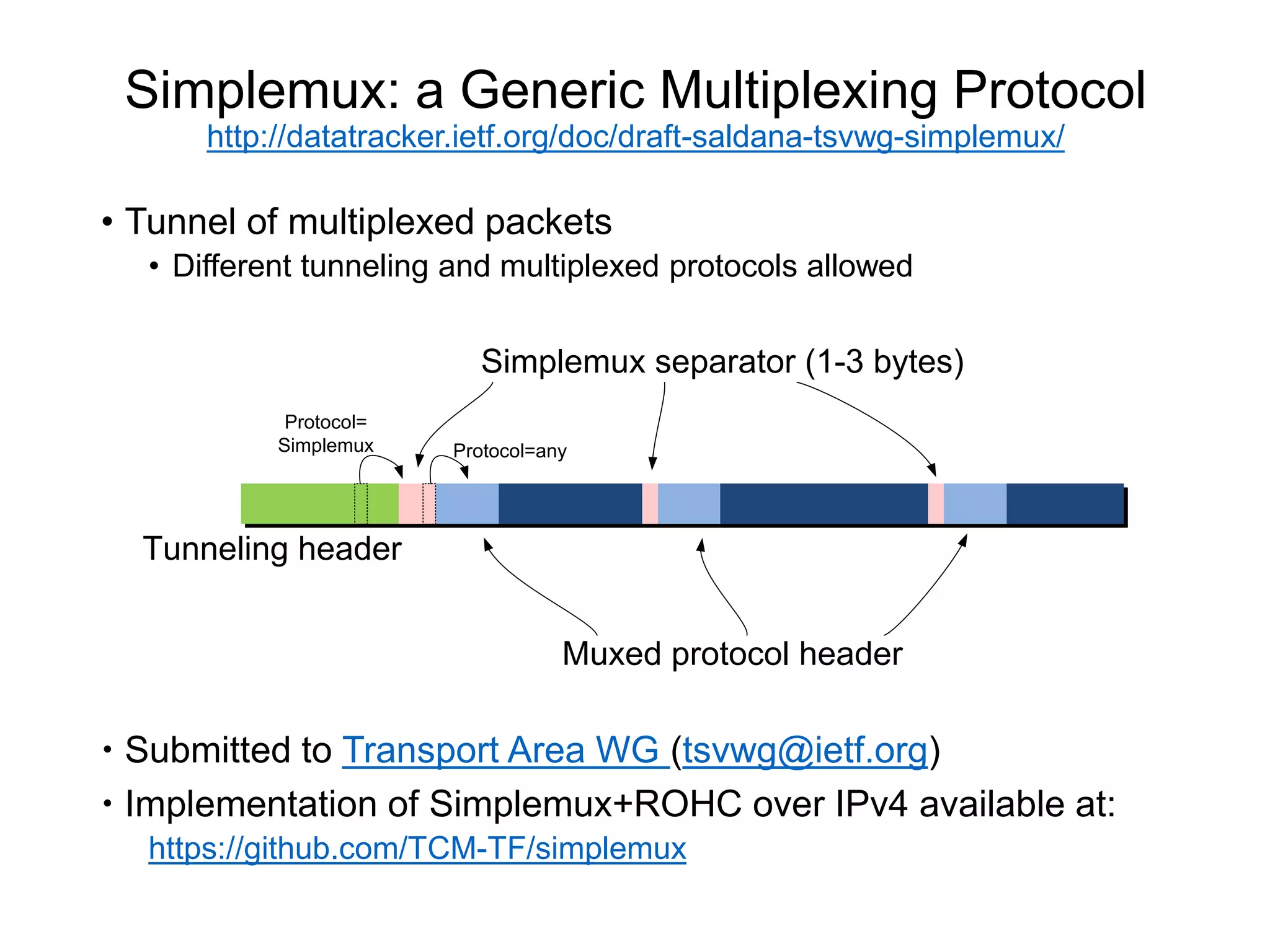
• Tunnel of multiplexed packets
• Different tunneling and multiplexed protocols allowed
 Submitted to Transport Area WG (tsvwg@ietf.org)
 Implementation of Simplemux+ROHC over IPv4 available at:
https://github.com/TCM-TF/simplemux
Simplemux separator (1-3 bytes)
Tunneling header
Muxed protocol header
Protocol=
Simplemux Protocol=any
Simplemux: a Generic Multiplexing Protocol
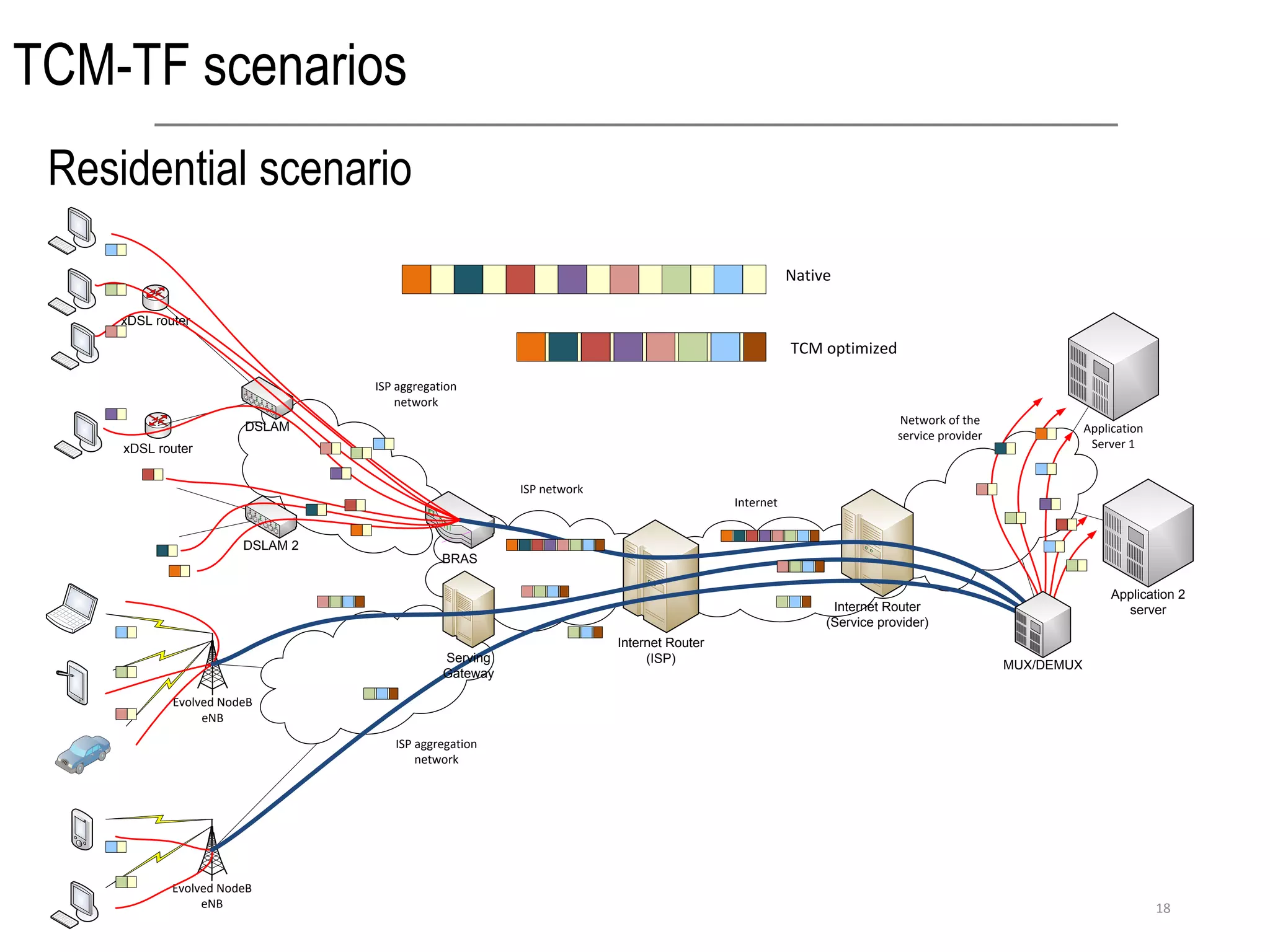
http://datatracker.ietf.org/doc/draft-saldana-tsvwg-simplemux/
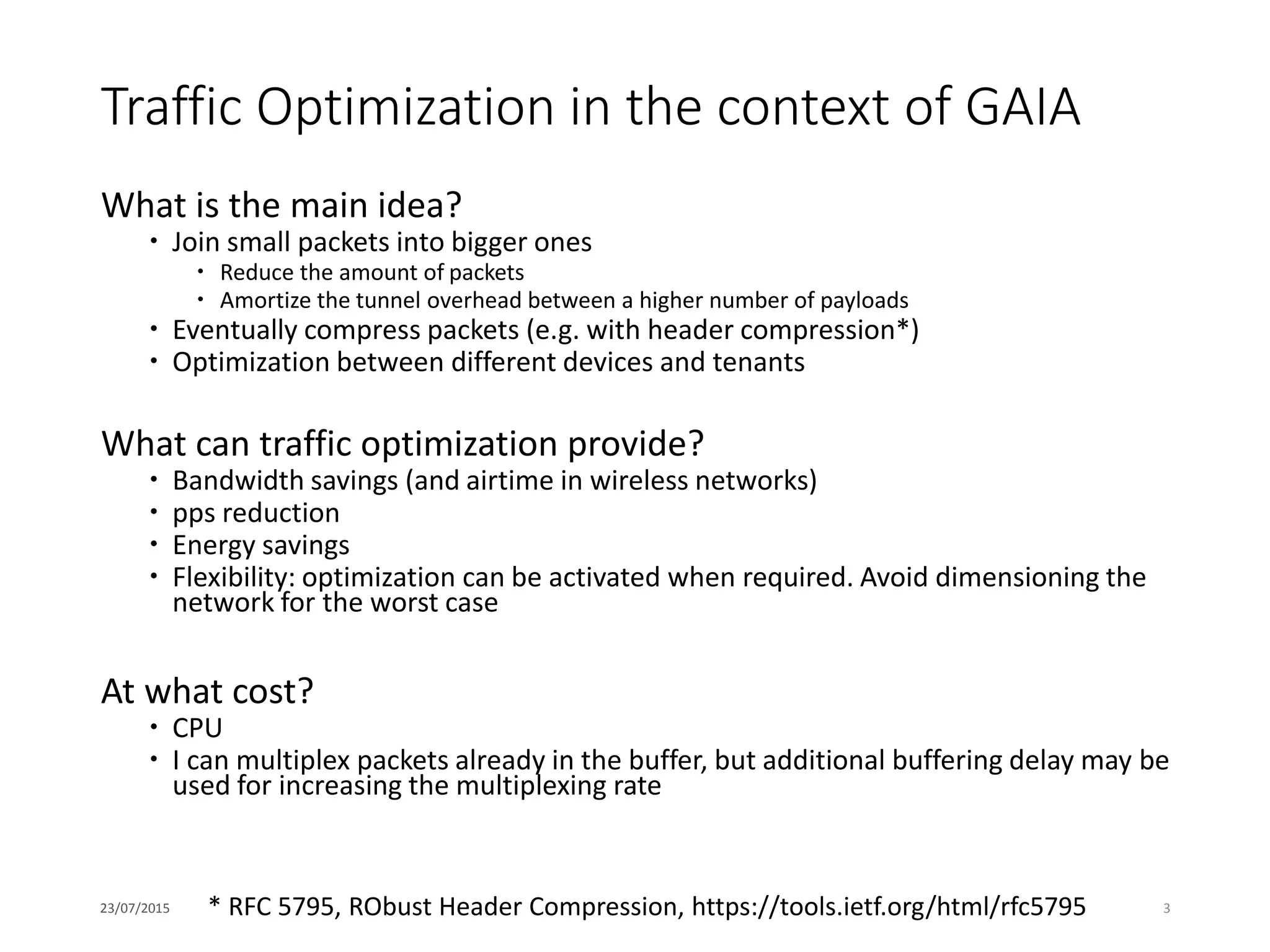
Traffic Optimization in the context of GAIA
What is the main idea?
 Join small packets into bigger ones
 Reduce the amount of packets
 Amortize the tunnel overhead between a higher number of payloads
 Eventually compress packets (e.g. with header compression*)
 Optimization between different devices and tenants
What can traffic optimization provide?
 Bandwidth savings (and airtime in wireless networks)
 pps reduction
 Energy savings
 Flexibility: optimization can be activated when required. Avoid dimensioning the
network for the worst case
At what cost?
 CPU
 I can multiplex packets already in the buffer, but additional buffering delay may be
used for increasing the multiplexing rate
23/07/2015 3* RFC 5795, RObust Header Compression, https://tools.ietf.org/html/rfc5795
0
10000
20000
30000
40000
50000
60000
70000
0 100 200 300 400 500 600 700 800 900 1000 1100 1200 1300 1400 1500
Numberofpackets
Packet size [bytes]
Packet size histogram Chicago 2015
Traffic profile in a public Internet node
Small packets in the public Internet (trace from CAIDA.org *)
23/07/2015 4
Source: https://data. caida.org/datasets/passive-2015/equinix-chicago/20150219-130000.UTC/equinix-
chicago.dirA.20150219-125911.UTC.anon.pcap.gz. Only first 200,000 packets used
44% packets are
1440 bytes or more
33% packets
are 60 bytes or
less
Average: 782 bytes
Overhead in wired networks (Ethernet)
23/07/2015 5
0
100
200
300
400
500
600
700
800
900
1,000
64 264 464 664 864 1064 1264 1464
MaximumThroughput[Mbps]
Frame size [bytes]
Maximum Ethernet Throughput (link speed 1Gbps)
TCP Payload efficiency
Eth payload efficiency
Source: Small Packet Traffic Performance Optimization for 8255x and 8254x Ethernet Controllers,
http://www.intel.com/content/dam/doc/application-note/8255x-8254x-ethernet-controllers-small-packet-traffic-performance-appl-note.pdf
Average: 782 bytes
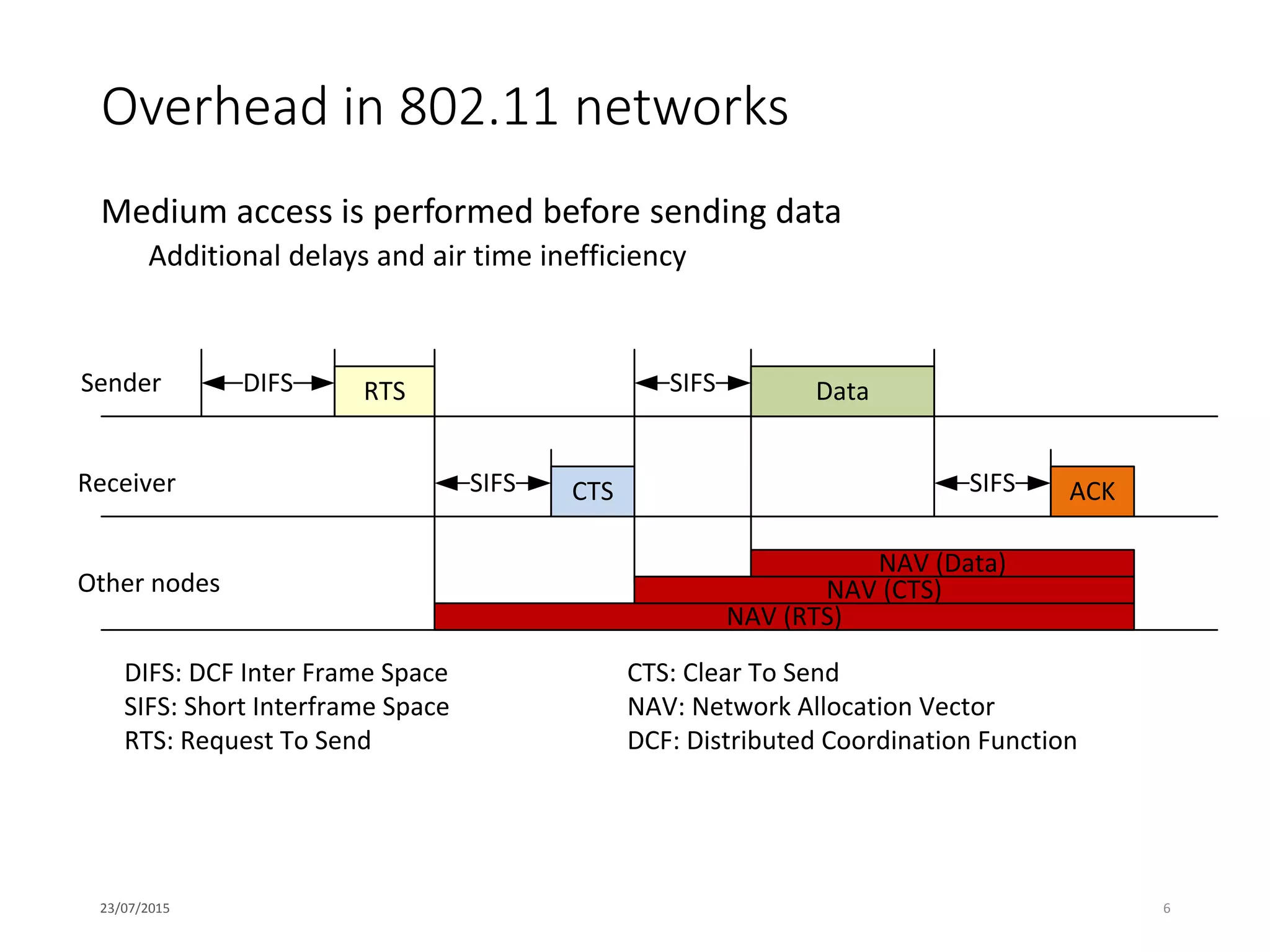
Overhead in 802.11 networks
Medium access is performed before sending data
Additional delays and air time inefficiency
23/07/2015 6
RTSDIFS
SIFS CTS
SIFS Data
SIFS ACK
NAV (RTS)
NAV (CTS)
NAV (Data)
Sender
Receiver
Other nodes
DIFS: DCF Inter Frame Space
SIFS: Short Interframe Space
RTS: Request To Send
CTS: Clear To Send
NAV: Network Allocation Vector
DCF: Distributed Coordination Function
0
0.1
0.2
0.3
0.4
0.5
0.6
0.7
0.8
0.9
1
0 250 500 750 1000 1250 1500 1750 2000 2250 2500
Efficiency(datarate/PHYrate)
Packet size [bytes]
Efficiency (PHY rate=54 Mbps)
1 MPDU, UDP
1 MPDU, TCP
Overhead in 802.11 networks
MAC mechanisms cause a low efficiency, and even lower for small packets
23/07/2015 7
Average: 782 bytes
Source: Model developed by Ginzburg, B.; Kesselman, A., "Performance analysis of A-MPDU and A-MSDU aggregation in
IEEE 802.11n," Sarnoff Symposium, 2007 IEEE , vol., no., pp.1,5, April 30 2007-May 2 2007
Frame grouping in 802.11 networks
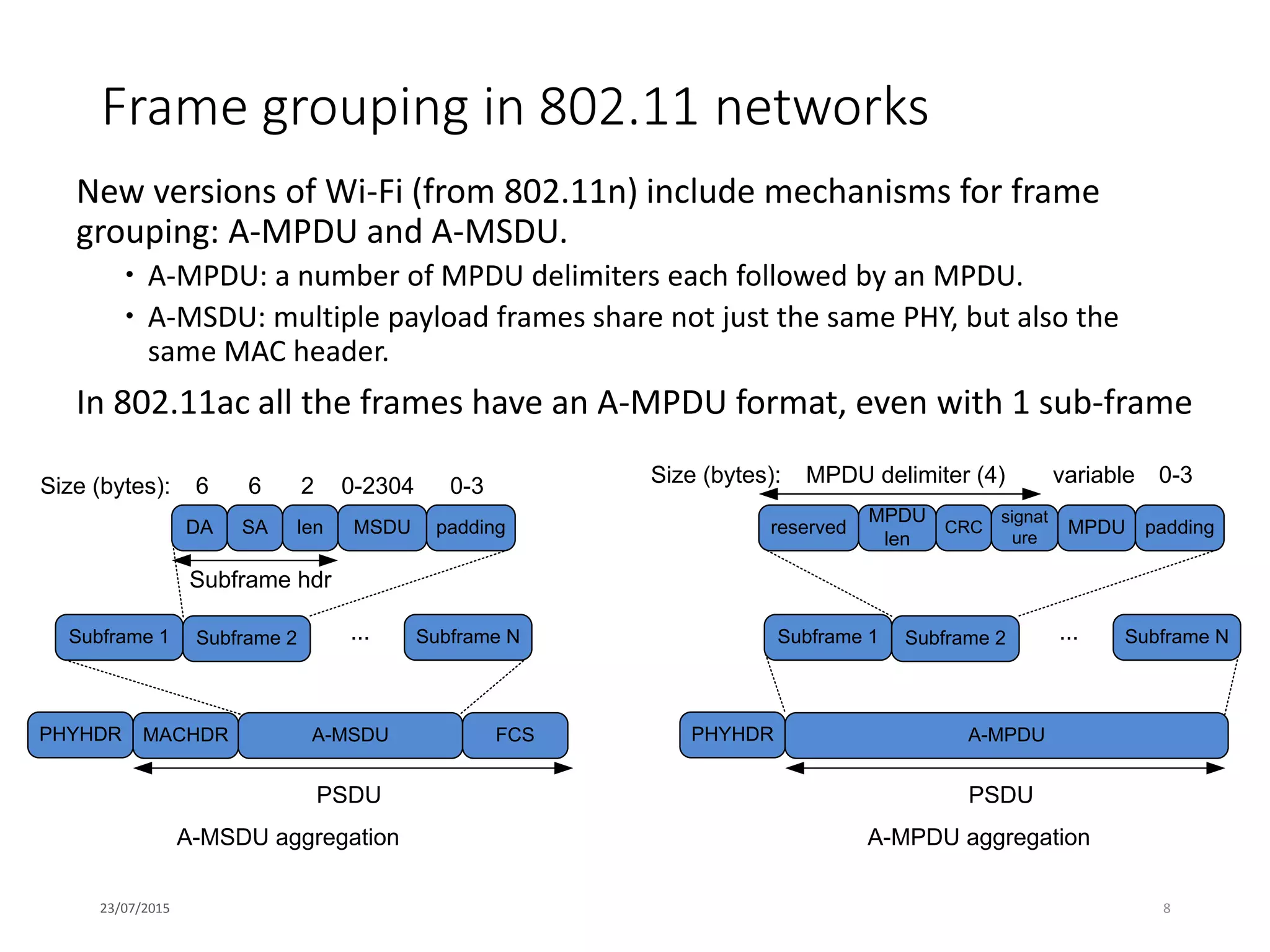
New versions of Wi-Fi (from 802.11n) include mechanisms for frame
grouping: A-MPDU and A-MSDU.
 A-MPDU: a number of MPDU delimiters each followed by an MPDU.
 A-MSDU: multiple payload frames share not just the same PHY, but also the
same MAC header.
In 802.11ac all the frames have an A-MPDU format, even with 1 sub-frame
23/07/2015 8
DA SA len MSDU padding
Subframe 1 Subframe 2 Subframe N...
Subframe hdr
6 6 2 0-2304 0-3
PHYHDR MACHDR A-MSDU FCS
PSDU
Size (bytes):
MPDU
len
CRC
signat
ure
MPDU padding
Subframe 1 Subframe 2 Subframe N...
MPDU delimiter (4) variable 0-3
PHYHDR A-MPDU
PSDU
Size (bytes):
reserved
A-MSDU aggregation A-MPDU aggregation
Frame grouping in 802.11 networks
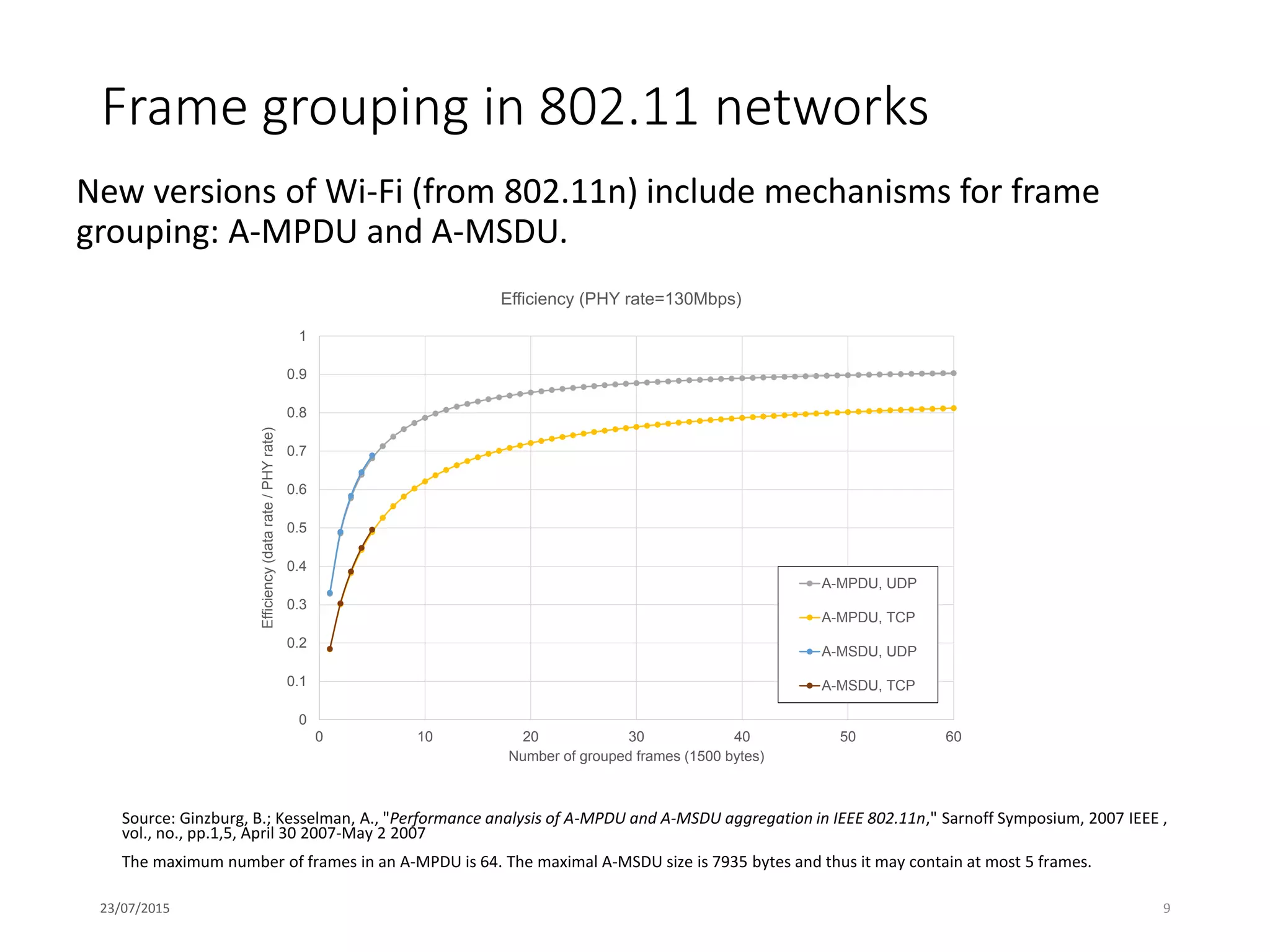
New versions of Wi-Fi (from 802.11n) include mechanisms for frame
grouping: A-MPDU and A-MSDU.
23/07/2015 9
Source: Ginzburg, B.; Kesselman, A., "Performance analysis of A-MPDU and A-MSDU aggregation in IEEE 802.11n," Sarnoff Symposium, 2007 IEEE ,
vol., no., pp.1,5, April 30 2007-May 2 2007
The maximum number of frames in an A-MPDU is 64. The maximal A-MSDU size is 7935 bytes and thus it may contain at most 5 frames.
0
0.1
0.2
0.3
0.4
0.5
0.6
0.7
0.8
0.9
1
0 10 20 30 40 50 60
Efficiency(datarate/PHYrate)
Number of grouped frames (1500 bytes)
Efficiency (PHY rate=130Mbps)
A-MPDU, UDP
A-MPDU, TCP
A-MSDU, UDP
A-MSDU, TCP
Main idea
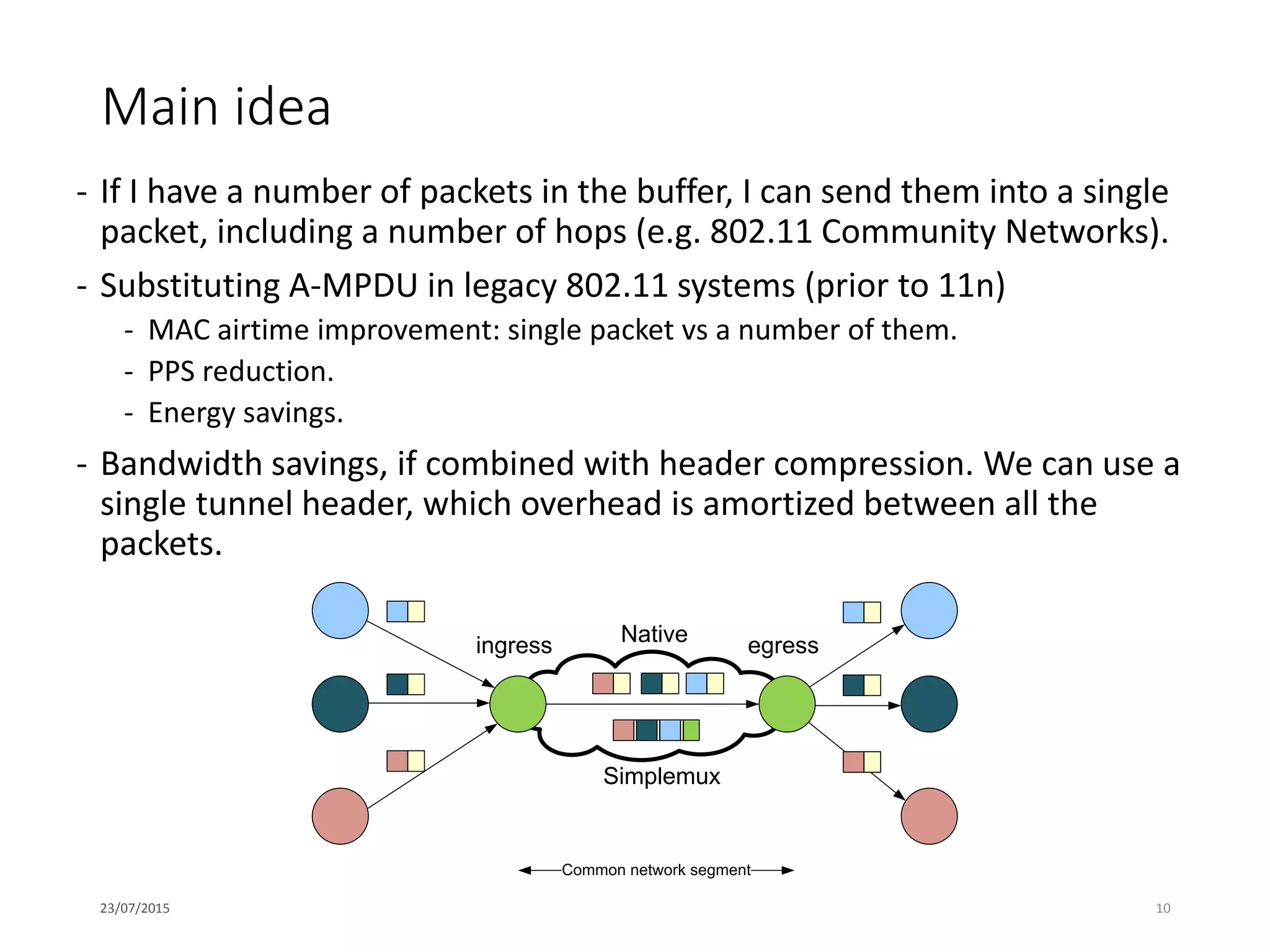
- If I have a number of packets in the buffer, I can send them into a single
packet, including a number of hops (e.g. 802.11 Community Networks).
- Substituting A-MPDU in legacy 802.11 systems (prior to 11n)
- MAC airtime improvement: single packet vs a number of them.
- PPS reduction.
- Energy savings.
- Bandwidth savings, if combined with header compression. We can use a
single tunnel header, which overhead is amortized between all the
packets.
23/07/2015 10
Native
Simplemux
ingress egress
Common network segment
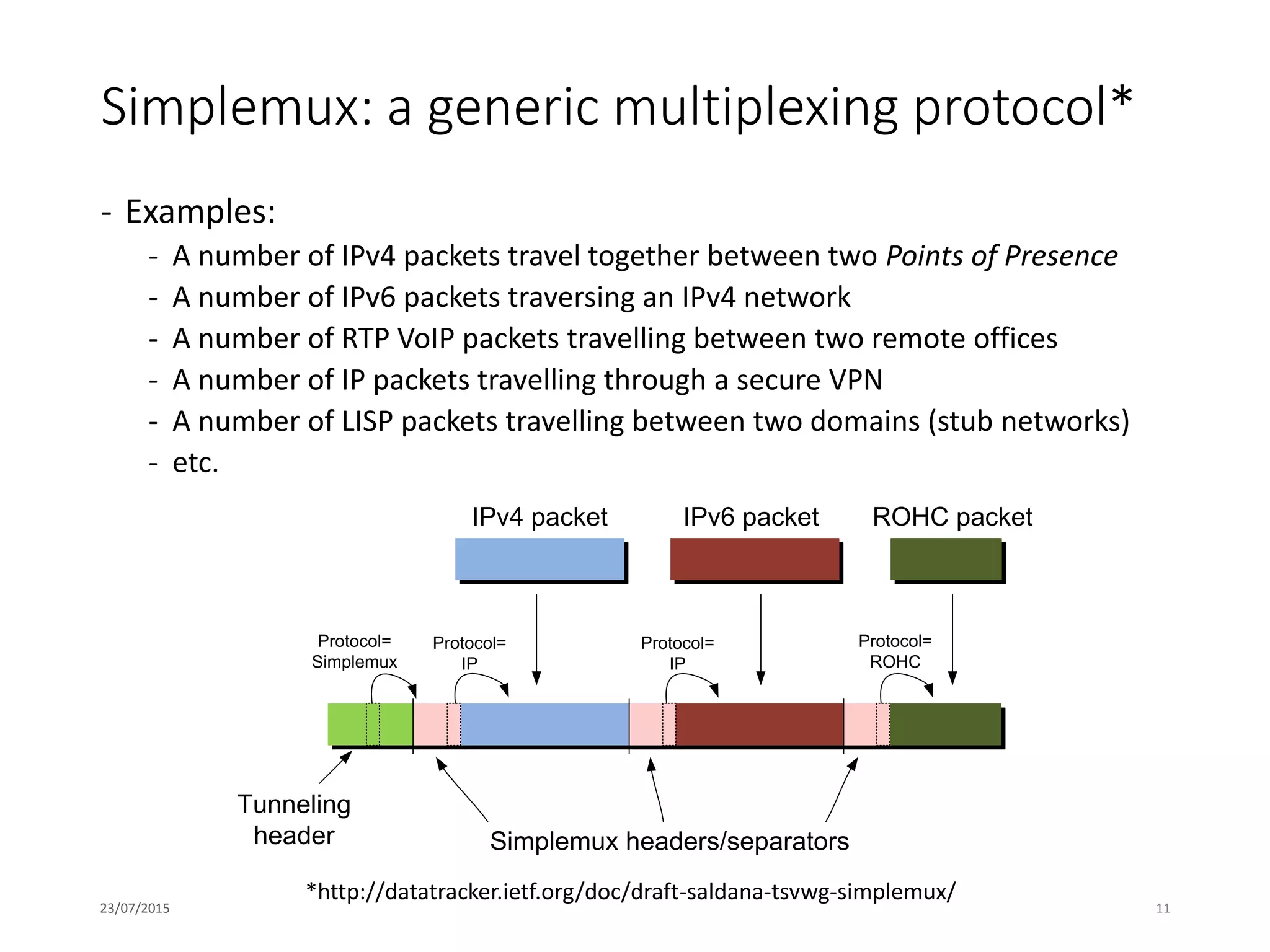
Simplemux: a generic multiplexing protocol*
- Examples:
- A number of IPv4 packets travel together between two Points of Presence
- A number of IPv6 packets traversing an IPv4 network
- A number of RTP VoIP packets travelling between two remote offices
- A number of IP packets travelling through a secure VPN
- A number of LISP packets travelling between two domains (stub networks)
- etc.
23/07/2015 11
*http://datatracker.ietf.org/doc/draft-saldana-tsvwg-simplemux/
IPv4 packet ROHC packetIPv6 packet
Tunneling
header
Protocol=
Simplemux
Protocol=
IP
Protocol=
IP
Protocol=
ROHC
Simplemux headers/separators
Implementation details*
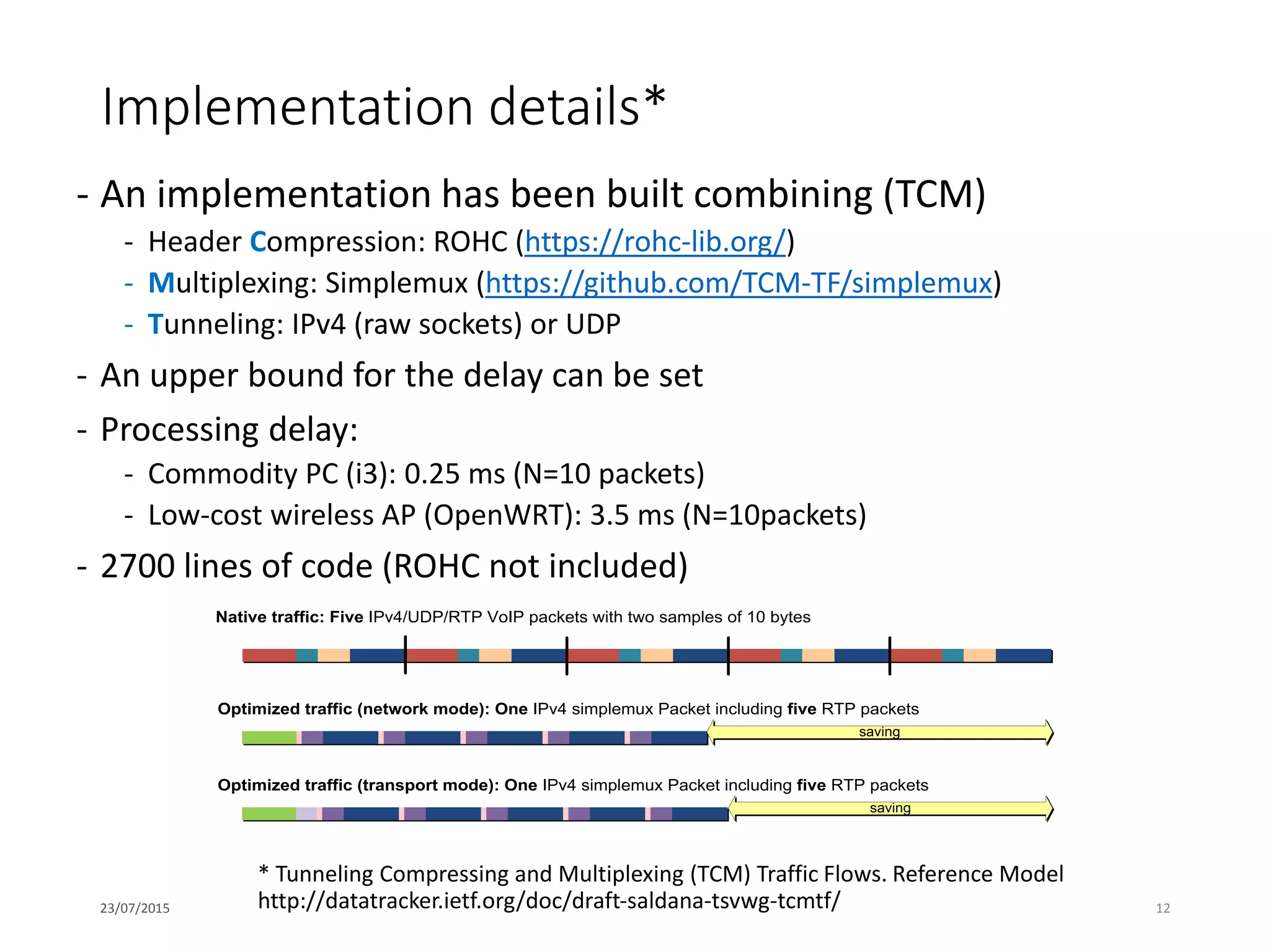
- An implementation has been built combining (TCM)
- Header Compression: ROHC (https://rohc-lib.org/)
- Multiplexing: Simplemux (https://github.com/TCM-TF/simplemux)
- Tunneling: IPv4 (raw sockets) or UDP
- An upper bound for the delay can be set
- Processing delay:
- Commodity PC (i3): 0.25 ms (N=10 packets)
- Low-cost wireless AP (OpenWRT): 3.5 ms (N=10packets)
- 2700 lines of code (ROHC not included)
23/07/2015 12
* Tunneling Compressing and Multiplexing (TCM) Traffic Flows. Reference Model
http://datatracker.ietf.org/doc/draft-saldana-tsvwg-tcmtf/
Native traffic: Five IPv4/UDP/RTP VoIP packets with two samples of 10 bytes
Optimized traffic (network mode): One IPv4 simplemux Packet including five RTP packets
IPv4 header: 20 bytes Tunnel IP header: 20 bytes
UDP header: 8 bytes Tunnel UDP header: 8 bytes
saving
Native traffic headers: Optimized traffic headers:
Optimized traffic (transport mode): One IPv4 simplemux Packet including five RTP packets
saving
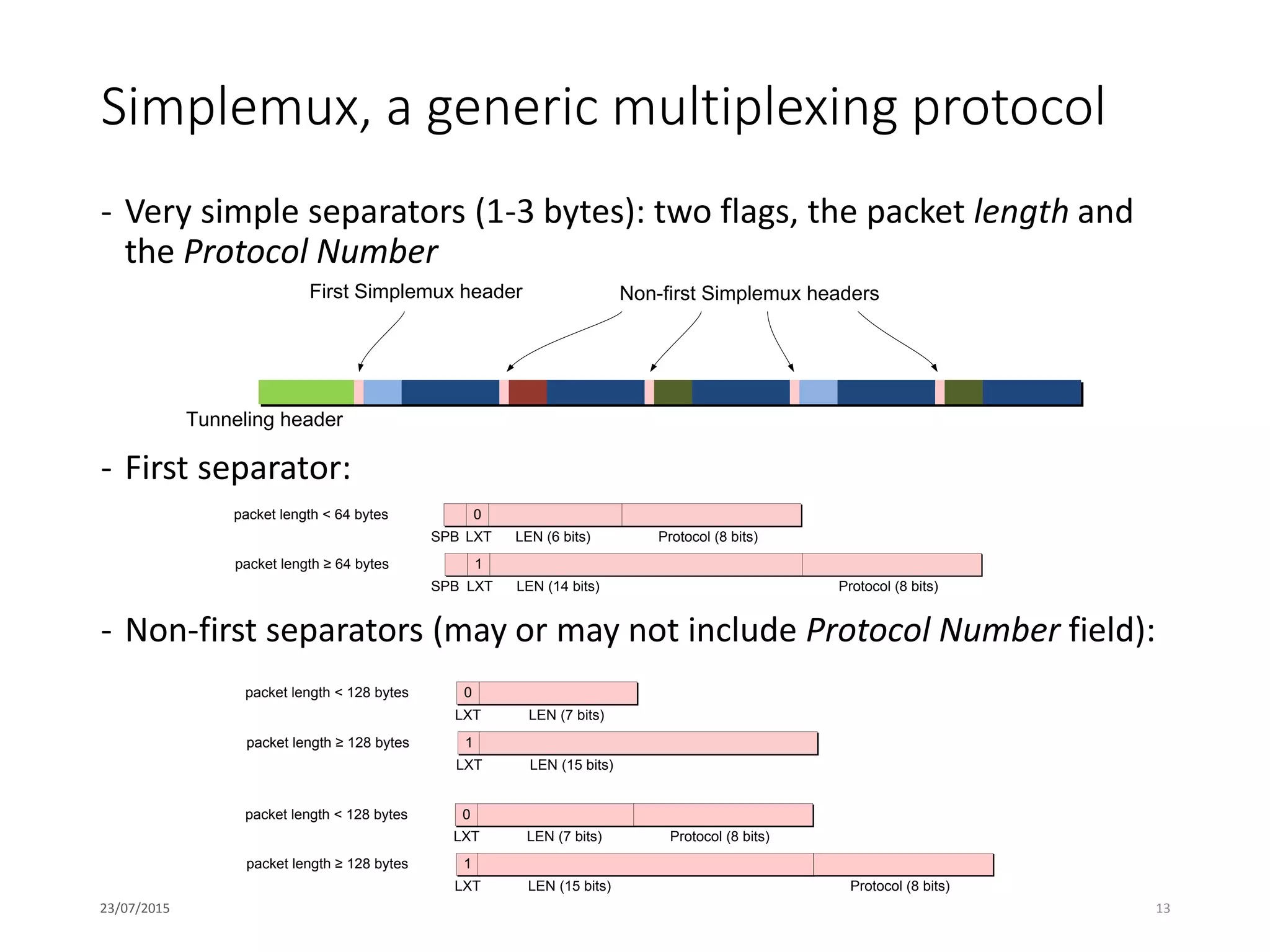
Simplemux, a generic multiplexing protocol
- Very simple separators (1-3 bytes): two flags, the packet length and
the Protocol Number
- First separator:
- Non-first separators (may or may not include Protocol Number field):
23/07/2015 13
0
SPB LXT LEN (6 bits)
packet length < 64 bytes
1
SPB LXT LEN (14 bits)
packet length ≥ 64 bytes
Protocol (8 bits)
Protocol (8 bits)
0
LXT LEN (7 bits)
packet length < 128 bytes
1
LXT LEN (15 bits)
packet length ≥ 128 bytes
0
LXT LEN (7 bits)
packet length < 128 bytes
1
LXT LEN (15 bits)
packet length ≥ 128 bytes
Protocol (8 bits)
Protocol (8 bits)
First Simplemux header Non-first Simplemux headers
Tunneling header
Can packets be grouped at higher layers?
- TMux [RFC1692] multiplexes a number of TCP segments between the
same pair of machines.
- PPPMux [RFC3153] is able to multiplex complete IP packets, using
separators. It requires the use of PPP and L2TP.
- Simplemux
23/07/2015 14
IP
IP TCP payload IP TCP payload
TCP payload TCP payload
TMux TMux
IP IP
IP TCP payload IP TCP payload
TCP payload IP TCP payload
tunnel
L2TP
PPP PPPMux PPPMux
IP IP
IP TCP payload IP TCP payload
TCP payload IP TCP payload
tunnel First Simplemux header Non-first Simplemux header
Some results with a Simplemux implementation
5 VoIP calls sharing an Ethernet link (RTP with different codecs)
23/07/2015 15Simplemux implementation: https://github.com/TCM-TF/simplemux
10%
15%
20%
25%
30%
35%
40%
45%
50%
20 40 60 80 100 120 140 160 180
BWsaving
Multiplexing period [ms]
Bandwidth Saving. 5 RTP calls
GSM
iLBC20ms
iLBC30ms
PCM-A, PCM-U
Some results with a Simplemux implementation
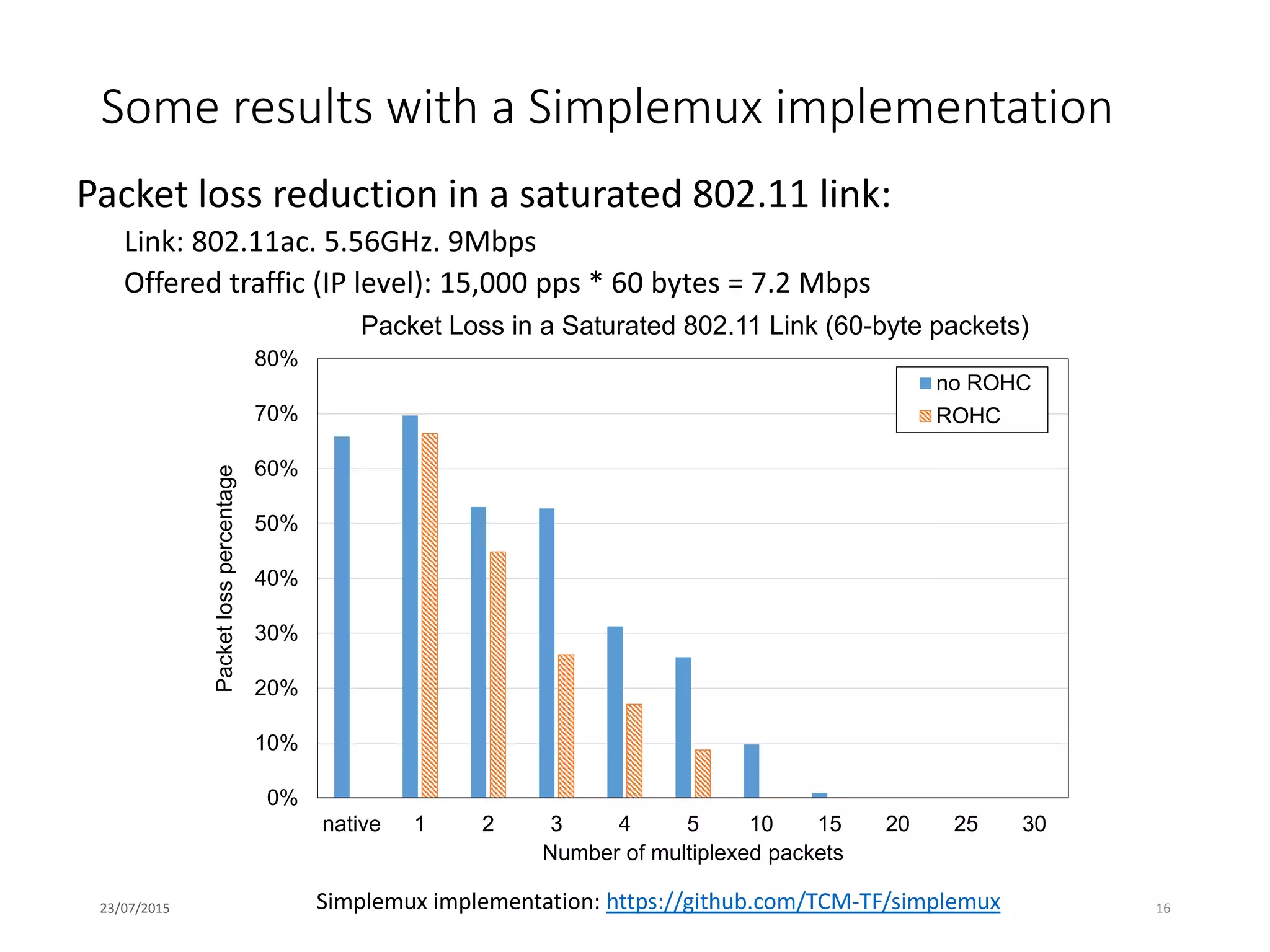
Packet loss reduction in a saturated 802.11 link:
Link: 802.11ac. 5.56GHz. 9Mbps
Offered traffic (IP level): 15,000 pps * 60 bytes = 7.2 Mbps
23/07/2015 16Simplemux implementation: https://github.com/TCM-TF/simplemux
0%
10%
20%
30%
40%
50%
60%
70%
80%
native 1 2 3 4 5 10 15 20 25 30
Packetlosspercentage
Number of multiplexed packets
Packet Loss in a Saturated 802.11 Link (60-byte packets)
no ROHC
ROHC
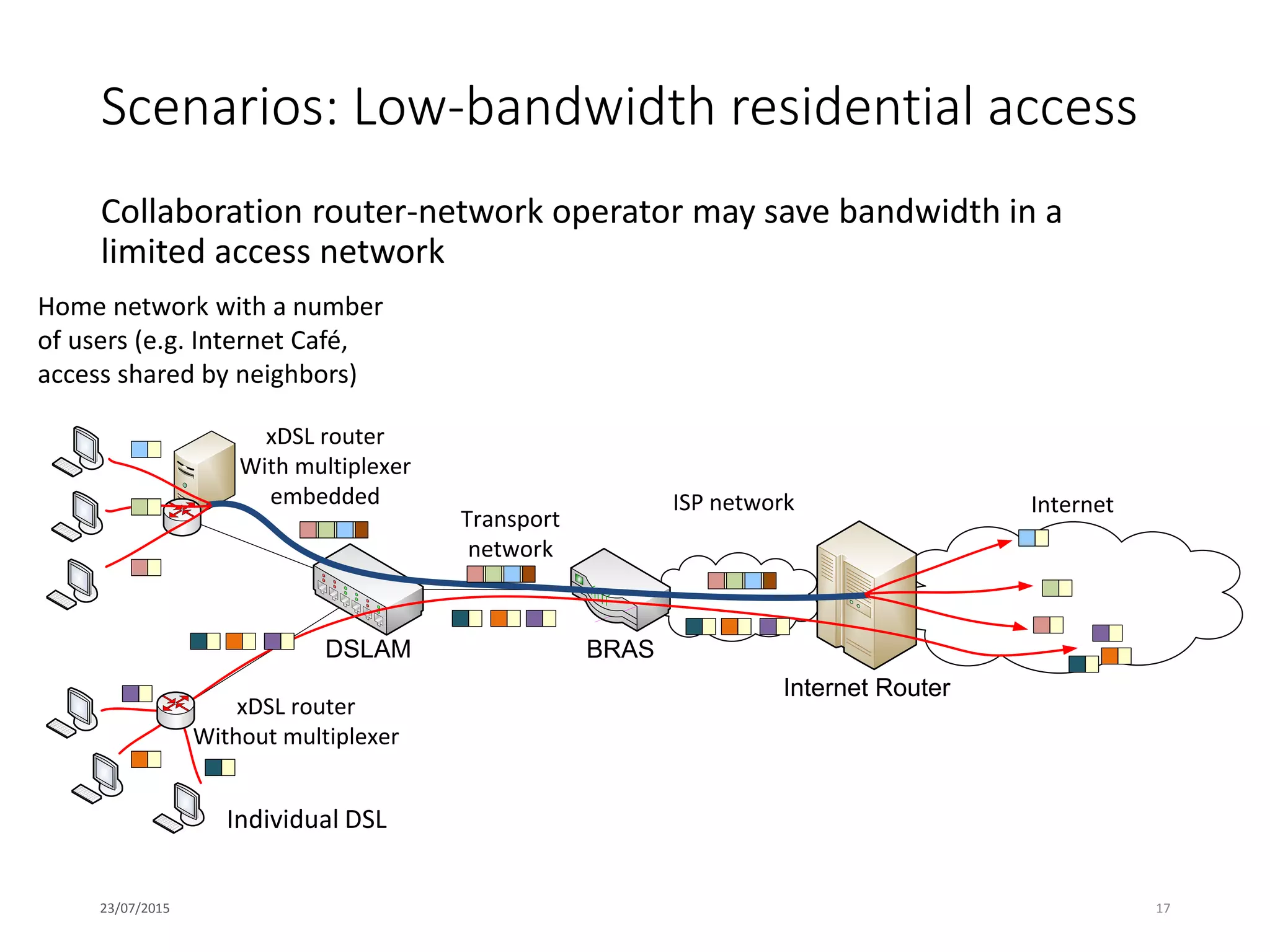
Scenarios: Low-bandwidth residential access
Collaboration router-network operator may save bandwidth in a
limited access network
23/07/2015 17
ISP network Internet
Transport
network
Internet Router
DSLAM BRAS
xDSL router
With multiplexer
embedded
xDSL router
Without multiplexer
Home network with a number
of users (e.g. Internet Café,
access shared by neighbors)
Individual DSL
TCM-TF scenarios
Residential scenario
ISP network
Internet
Evolved NodeB
eNB
Internet Router
(ISP)
xDSL router
xDSL router
DSLAM
BRAS
Network of the
service provider
Internet Router
(Service provider)
Application
Server 1
Evolved NodeB
eNB
DSLAM 2
ISP aggregation
network
Serving
Gateway
ISP aggregation
network
MUX/DEMUX
Application 2
server
Native
TCM optimized
18
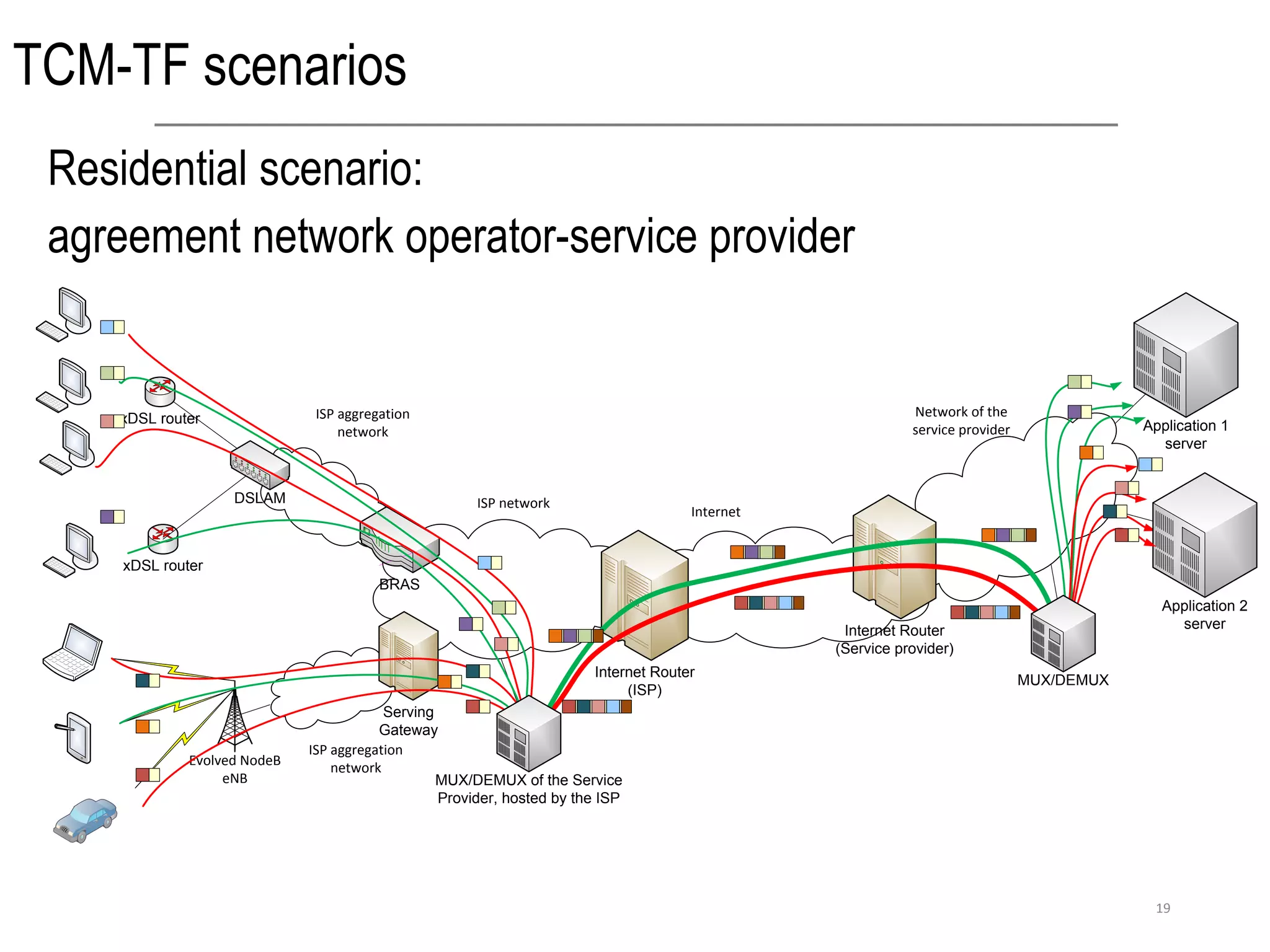
TCM-TF scenarios
Residential scenario:
agreement network operator-service provider
ISP network
Internet
Evolved NodeB
eNB
Internet Router
(ISP)
xDSL router
xDSL router
DSLAM
BRAS
Network of the
service provider
Internet Router
(Service provider)
Application 1
server
Serving
Gateway
MUX/DEMUX of the Service
Provider, hosted by the ISP
Application 2
server
ISP aggregation
network
ISP aggregation
network
MUX/DEMUX
19
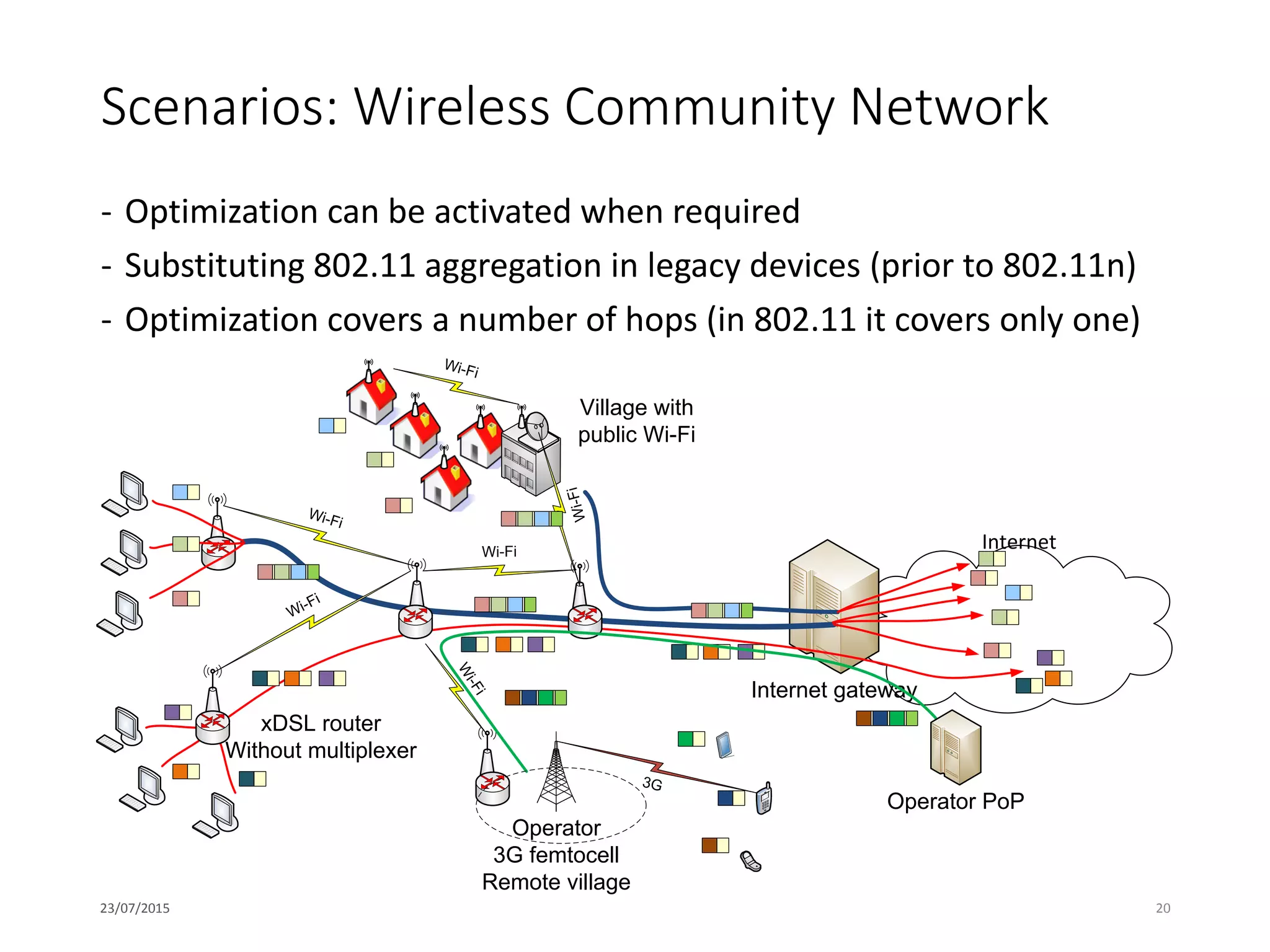
Scenarios: Wireless Community Network
- Optimization can be activated when required
- Substituting 802.11 aggregation in legacy devices (prior to 802.11n)
- Optimization covers a number of hops (in 802.11 it covers only one)
23/07/2015 20
Internet gateway
Internet
Village with
public Wi-Fi
xDSL router
Without multiplexer
Wi-Fi
Wi-Fi
Wi-Fi
Wi-Fi
Wi-Fi
W
i-Fi
Operator
3G femtocell
Remote village
3G
Operator PoP
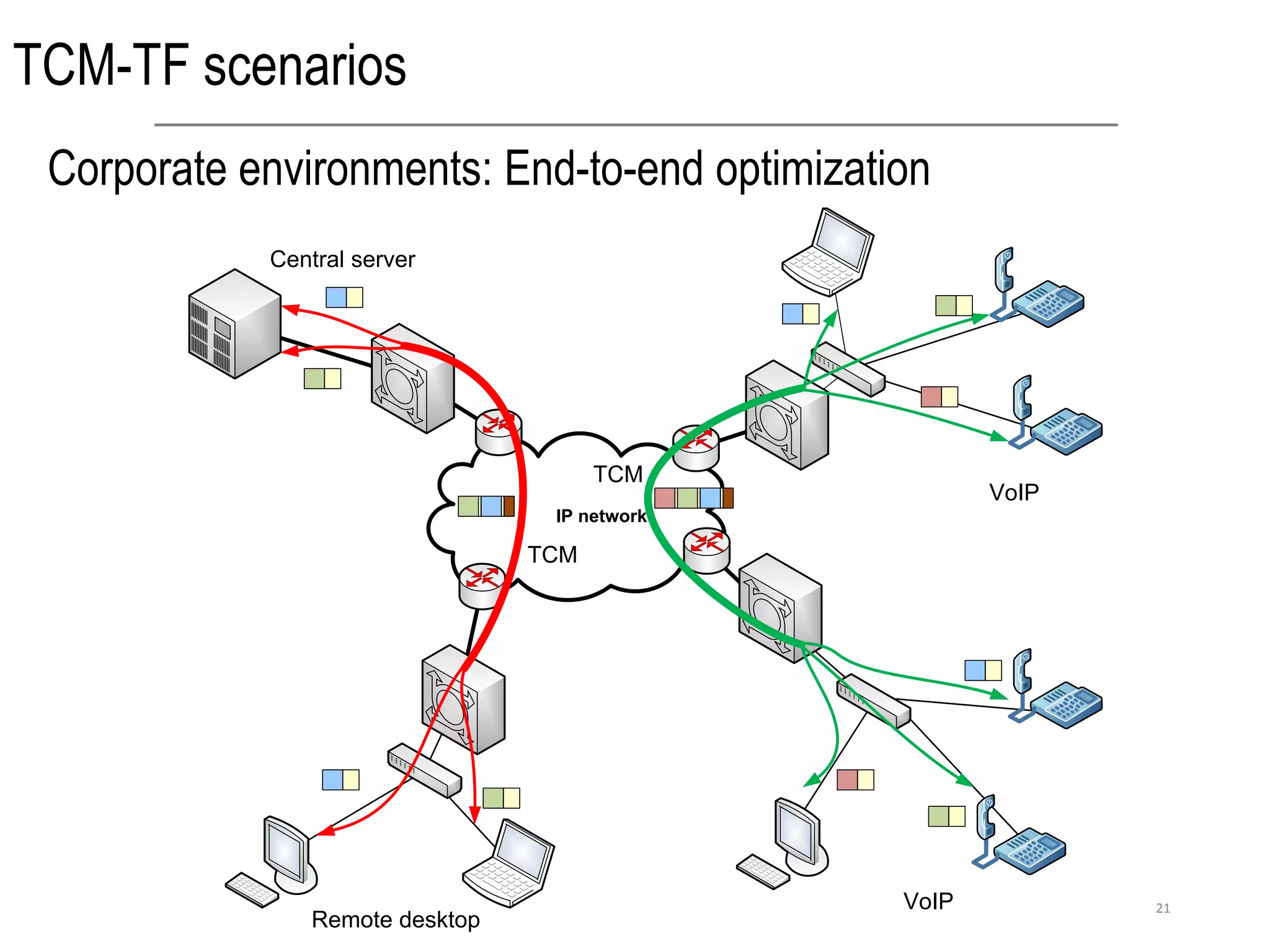
TCM-TF scenarios
Corporate environments: End-to-end optimization
IP network
Central server
Remote desktop
VoIP
VoIP
TCM
TCM
21
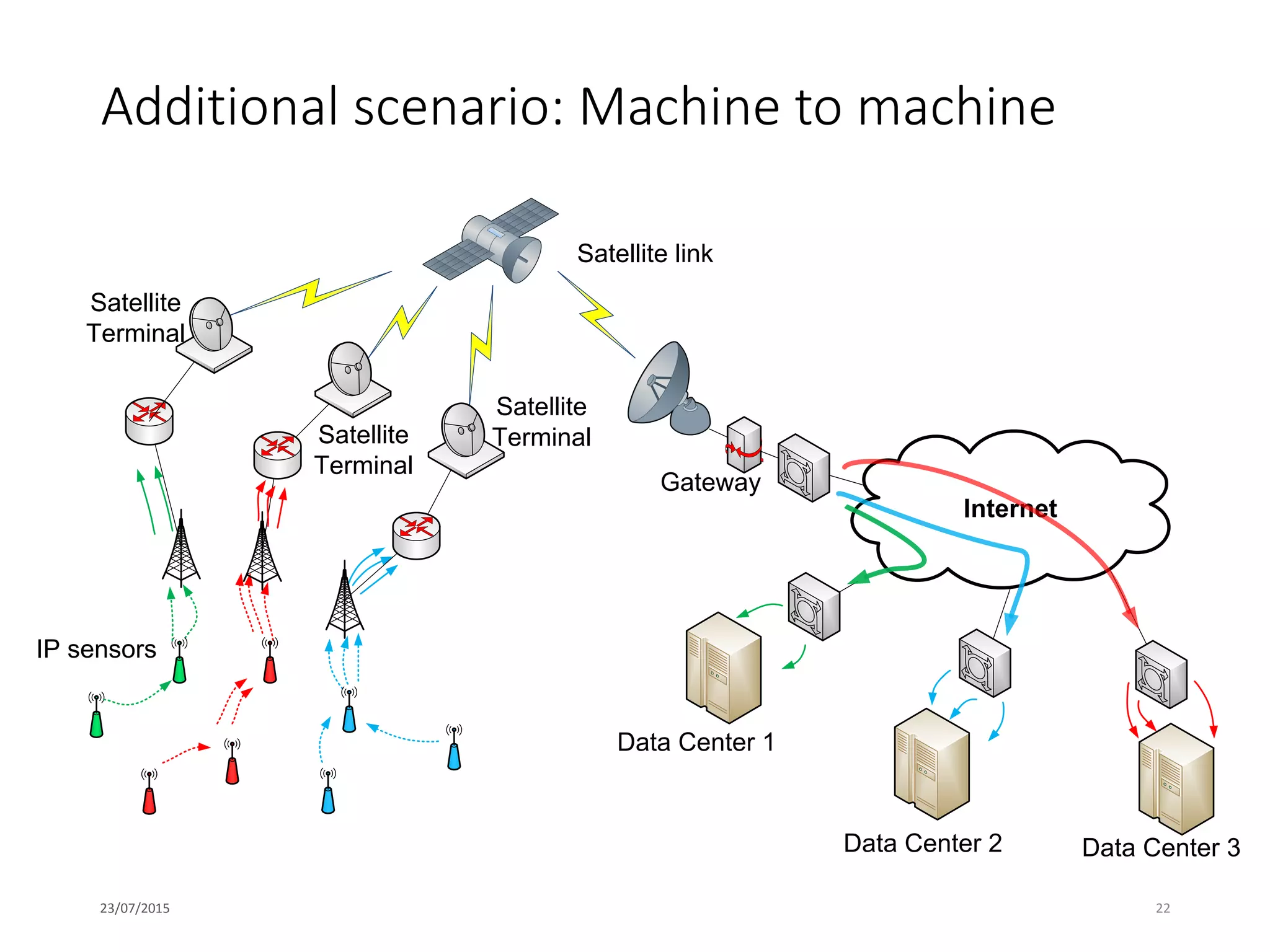
Additional scenario: Machine to machine
23/07/2015 22
Internet
Satellite link
Data Center 3
IP sensors
Data Center 2
Data Center 1
Satellite
Terminal
Gateway
Satellite
Terminal
Satellite
Terminal
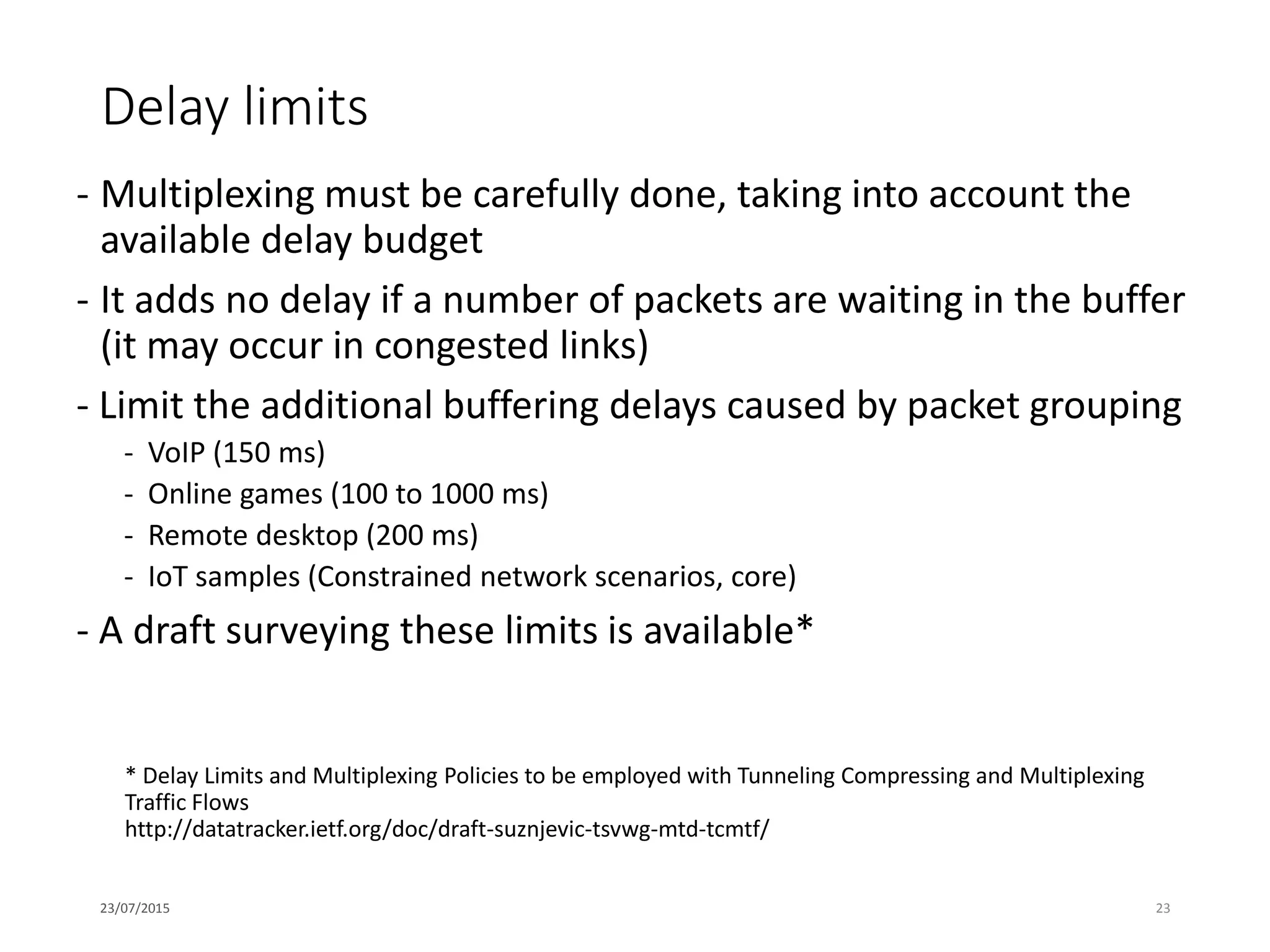
Delay limits
- Multiplexing must be carefully done, taking into account the
available delay budget
- It adds no delay if a number of packets are waiting in the buffer
(it may occur in congested links)
- Limit the additional buffering delays caused by packet grouping
- VoIP (150 ms)
- Online games (100 to 1000 ms)
- Remote desktop (200 ms)
- IoT samples (Constrained network scenarios, core)
- A draft surveying these limits is available*
23/07/2015 23
* Delay Limits and Multiplexing Policies to be employed with Tunneling Compressing and Multiplexing
Traffic Flows
http://datatracker.ietf.org/doc/draft-suznjevic-tsvwg-mtd-tcmtf/
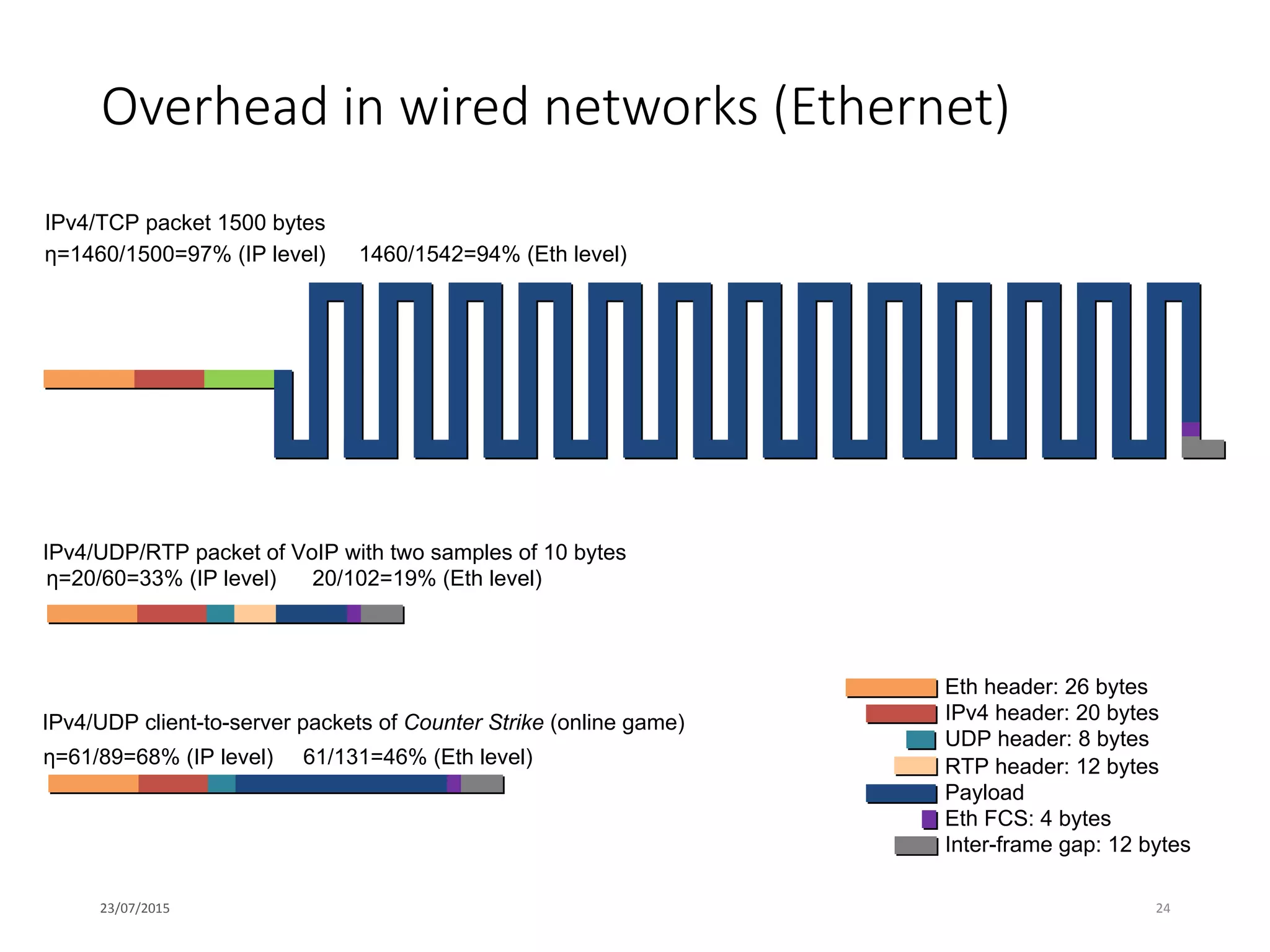
Overhead in wired networks (Ethernet)
23/07/2015 24
IPv4/TCP packet 1500 bytes
η=1460/1500=97% (IP level) 1460/1542=94% (Eth level)
IPv4/UDP/RTP packet of VoIP with two samples of 10 bytes
η=20/60=33% (IP level) 20/102=19% (Eth level)
IPv4/UDP client-to-server packets of Counter Strike (online game)
η=61/89=68% (IP level) 61/131=46% (Eth level)
IPv4 header: 20 bytes
UDP header: 8 bytes
Inter-frame gap: 12 bytes
Eth header: 26 bytes
Eth FCS: 4 bytes
Payload
RTP header: 12 bytes
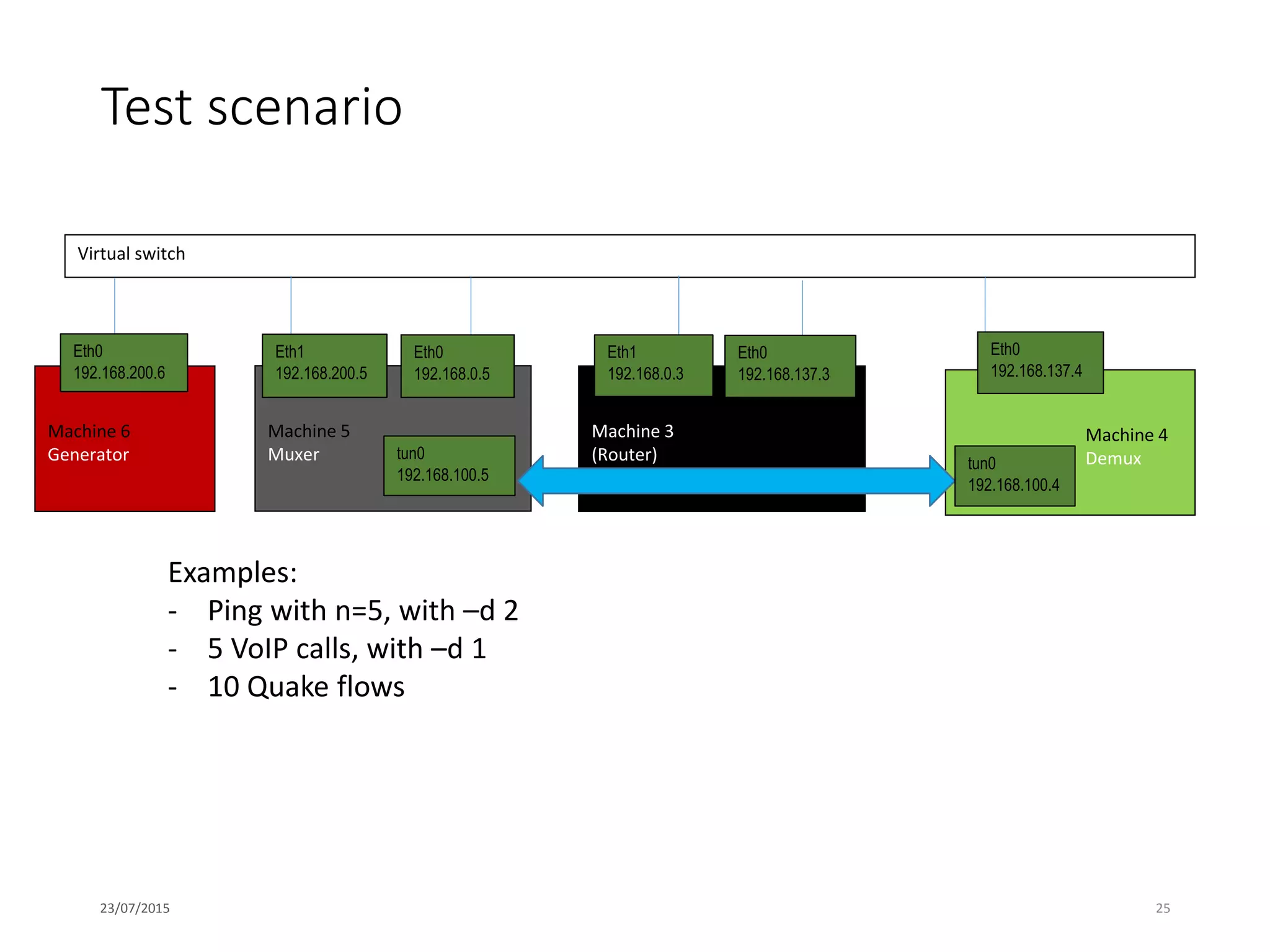
Test scenario
23/07/2015 25
Virtual switch
Machine 6
Generator
Machine 5
Muxer
Machine 3
(Router)
Machine 4
Demuxtun0
192.168.100.5
Eth0
192.168.200.6
Eth1
192.168.200.5
Eth0
192.168.0.5
Eth1
192.168.0.3
Eth0
192.168.137.3
Eth0
192.168.137.4
tun0
192.168.100.4
Examples:
- Ping with n=5, with –d 2
- 5 VoIP calls, with –d 1
- 10 Quake flows

Bar-BoF session about Simplemux at IETF93, Prague

  • 1.
    Simplemux Traffic Optimization Bar-BOF JoseSaldana, University of Zaragoza (jsaldana@unizar.es) IETF93 Prague, July 23, 2015 20:15 Registration Desk 23/07/2015 1
  • 2.
    • Tunnel ofmultiplexed packets • Different tunneling and multiplexed protocols allowed  Submitted to Transport Area WG (tsvwg@ietf.org)  Implementation of Simplemux+ROHC over IPv4 available at: https://github.com/TCM-TF/simplemux Simplemux separator (1-3 bytes) Tunneling header Muxed protocol header Protocol= Simplemux Protocol=any Simplemux: a Generic Multiplexing Protocol http://datatracker.ietf.org/doc/draft-saldana-tsvwg-simplemux/
  • 3.
    Traffic Optimization inthe context of GAIA What is the main idea?  Join small packets into bigger ones  Reduce the amount of packets  Amortize the tunnel overhead between a higher number of payloads  Eventually compress packets (e.g. with header compression*)  Optimization between different devices and tenants What can traffic optimization provide?  Bandwidth savings (and airtime in wireless networks)  pps reduction  Energy savings  Flexibility: optimization can be activated when required. Avoid dimensioning the network for the worst case At what cost?  CPU  I can multiplex packets already in the buffer, but additional buffering delay may be used for increasing the multiplexing rate 23/07/2015 3* RFC 5795, RObust Header Compression, https://tools.ietf.org/html/rfc5795
  • 4.
    0 10000 20000 30000 40000 50000 60000 70000 0 100 200300 400 500 600 700 800 900 1000 1100 1200 1300 1400 1500 Numberofpackets Packet size [bytes] Packet size histogram Chicago 2015 Traffic profile in a public Internet node Small packets in the public Internet (trace from CAIDA.org *) 23/07/2015 4 Source: https://data. caida.org/datasets/passive-2015/equinix-chicago/20150219-130000.UTC/equinix- chicago.dirA.20150219-125911.UTC.anon.pcap.gz. Only first 200,000 packets used 44% packets are 1440 bytes or more 33% packets are 60 bytes or less Average: 782 bytes
  • 5.
    Overhead in wirednetworks (Ethernet) 23/07/2015 5 0 100 200 300 400 500 600 700 800 900 1,000 64 264 464 664 864 1064 1264 1464 MaximumThroughput[Mbps] Frame size [bytes] Maximum Ethernet Throughput (link speed 1Gbps) TCP Payload efficiency Eth payload efficiency Source: Small Packet Traffic Performance Optimization for 8255x and 8254x Ethernet Controllers, http://www.intel.com/content/dam/doc/application-note/8255x-8254x-ethernet-controllers-small-packet-traffic-performance-appl-note.pdf Average: 782 bytes
  • 6.
    Overhead in 802.11networks Medium access is performed before sending data Additional delays and air time inefficiency 23/07/2015 6 RTSDIFS SIFS CTS SIFS Data SIFS ACK NAV (RTS) NAV (CTS) NAV (Data) Sender Receiver Other nodes DIFS: DCF Inter Frame Space SIFS: Short Interframe Space RTS: Request To Send CTS: Clear To Send NAV: Network Allocation Vector DCF: Distributed Coordination Function
  • 7.
    0 0.1 0.2 0.3 0.4 0.5 0.6 0.7 0.8 0.9 1 0 250 500750 1000 1250 1500 1750 2000 2250 2500 Efficiency(datarate/PHYrate) Packet size [bytes] Efficiency (PHY rate=54 Mbps) 1 MPDU, UDP 1 MPDU, TCP Overhead in 802.11 networks MAC mechanisms cause a low efficiency, and even lower for small packets 23/07/2015 7 Average: 782 bytes Source: Model developed by Ginzburg, B.; Kesselman, A., "Performance analysis of A-MPDU and A-MSDU aggregation in IEEE 802.11n," Sarnoff Symposium, 2007 IEEE , vol., no., pp.1,5, April 30 2007-May 2 2007
  • 8.
    Frame grouping in802.11 networks New versions of Wi-Fi (from 802.11n) include mechanisms for frame grouping: A-MPDU and A-MSDU.  A-MPDU: a number of MPDU delimiters each followed by an MPDU.  A-MSDU: multiple payload frames share not just the same PHY, but also the same MAC header. In 802.11ac all the frames have an A-MPDU format, even with 1 sub-frame 23/07/2015 8 DA SA len MSDU padding Subframe 1 Subframe 2 Subframe N... Subframe hdr 6 6 2 0-2304 0-3 PHYHDR MACHDR A-MSDU FCS PSDU Size (bytes): MPDU len CRC signat ure MPDU padding Subframe 1 Subframe 2 Subframe N... MPDU delimiter (4) variable 0-3 PHYHDR A-MPDU PSDU Size (bytes): reserved A-MSDU aggregation A-MPDU aggregation
  • 9.
    Frame grouping in802.11 networks New versions of Wi-Fi (from 802.11n) include mechanisms for frame grouping: A-MPDU and A-MSDU. 23/07/2015 9 Source: Ginzburg, B.; Kesselman, A., "Performance analysis of A-MPDU and A-MSDU aggregation in IEEE 802.11n," Sarnoff Symposium, 2007 IEEE , vol., no., pp.1,5, April 30 2007-May 2 2007 The maximum number of frames in an A-MPDU is 64. The maximal A-MSDU size is 7935 bytes and thus it may contain at most 5 frames. 0 0.1 0.2 0.3 0.4 0.5 0.6 0.7 0.8 0.9 1 0 10 20 30 40 50 60 Efficiency(datarate/PHYrate) Number of grouped frames (1500 bytes) Efficiency (PHY rate=130Mbps) A-MPDU, UDP A-MPDU, TCP A-MSDU, UDP A-MSDU, TCP
  • 10.
    Main idea - IfI have a number of packets in the buffer, I can send them into a single packet, including a number of hops (e.g. 802.11 Community Networks). - Substituting A-MPDU in legacy 802.11 systems (prior to 11n) - MAC airtime improvement: single packet vs a number of them. - PPS reduction. - Energy savings. - Bandwidth savings, if combined with header compression. We can use a single tunnel header, which overhead is amortized between all the packets. 23/07/2015 10 Native Simplemux ingress egress Common network segment
  • 11.
    Simplemux: a genericmultiplexing protocol* - Examples: - A number of IPv4 packets travel together between two Points of Presence - A number of IPv6 packets traversing an IPv4 network - A number of RTP VoIP packets travelling between two remote offices - A number of IP packets travelling through a secure VPN - A number of LISP packets travelling between two domains (stub networks) - etc. 23/07/2015 11 *http://datatracker.ietf.org/doc/draft-saldana-tsvwg-simplemux/ IPv4 packet ROHC packetIPv6 packet Tunneling header Protocol= Simplemux Protocol= IP Protocol= IP Protocol= ROHC Simplemux headers/separators
  • 12.
    Implementation details* - Animplementation has been built combining (TCM) - Header Compression: ROHC (https://rohc-lib.org/) - Multiplexing: Simplemux (https://github.com/TCM-TF/simplemux) - Tunneling: IPv4 (raw sockets) or UDP - An upper bound for the delay can be set - Processing delay: - Commodity PC (i3): 0.25 ms (N=10 packets) - Low-cost wireless AP (OpenWRT): 3.5 ms (N=10packets) - 2700 lines of code (ROHC not included) 23/07/2015 12 * Tunneling Compressing and Multiplexing (TCM) Traffic Flows. Reference Model http://datatracker.ietf.org/doc/draft-saldana-tsvwg-tcmtf/ Native traffic: Five IPv4/UDP/RTP VoIP packets with two samples of 10 bytes Optimized traffic (network mode): One IPv4 simplemux Packet including five RTP packets IPv4 header: 20 bytes Tunnel IP header: 20 bytes UDP header: 8 bytes Tunnel UDP header: 8 bytes saving Native traffic headers: Optimized traffic headers: Optimized traffic (transport mode): One IPv4 simplemux Packet including five RTP packets saving
  • 13.
    Simplemux, a genericmultiplexing protocol - Very simple separators (1-3 bytes): two flags, the packet length and the Protocol Number - First separator: - Non-first separators (may or may not include Protocol Number field): 23/07/2015 13 0 SPB LXT LEN (6 bits) packet length < 64 bytes 1 SPB LXT LEN (14 bits) packet length ≥ 64 bytes Protocol (8 bits) Protocol (8 bits) 0 LXT LEN (7 bits) packet length < 128 bytes 1 LXT LEN (15 bits) packet length ≥ 128 bytes 0 LXT LEN (7 bits) packet length < 128 bytes 1 LXT LEN (15 bits) packet length ≥ 128 bytes Protocol (8 bits) Protocol (8 bits) First Simplemux header Non-first Simplemux headers Tunneling header
  • 14.
    Can packets begrouped at higher layers? - TMux [RFC1692] multiplexes a number of TCP segments between the same pair of machines. - PPPMux [RFC3153] is able to multiplex complete IP packets, using separators. It requires the use of PPP and L2TP. - Simplemux 23/07/2015 14 IP IP TCP payload IP TCP payload TCP payload TCP payload TMux TMux IP IP IP TCP payload IP TCP payload TCP payload IP TCP payload tunnel L2TP PPP PPPMux PPPMux IP IP IP TCP payload IP TCP payload TCP payload IP TCP payload tunnel First Simplemux header Non-first Simplemux header
  • 15.
    Some results witha Simplemux implementation 5 VoIP calls sharing an Ethernet link (RTP with different codecs) 23/07/2015 15Simplemux implementation: https://github.com/TCM-TF/simplemux 10% 15% 20% 25% 30% 35% 40% 45% 50% 20 40 60 80 100 120 140 160 180 BWsaving Multiplexing period [ms] Bandwidth Saving. 5 RTP calls GSM iLBC20ms iLBC30ms PCM-A, PCM-U
  • 16.
    Some results witha Simplemux implementation Packet loss reduction in a saturated 802.11 link: Link: 802.11ac. 5.56GHz. 9Mbps Offered traffic (IP level): 15,000 pps * 60 bytes = 7.2 Mbps 23/07/2015 16Simplemux implementation: https://github.com/TCM-TF/simplemux 0% 10% 20% 30% 40% 50% 60% 70% 80% native 1 2 3 4 5 10 15 20 25 30 Packetlosspercentage Number of multiplexed packets Packet Loss in a Saturated 802.11 Link (60-byte packets) no ROHC ROHC
  • 17.
    Scenarios: Low-bandwidth residentialaccess Collaboration router-network operator may save bandwidth in a limited access network 23/07/2015 17 ISP network Internet Transport network Internet Router DSLAM BRAS xDSL router With multiplexer embedded xDSL router Without multiplexer Home network with a number of users (e.g. Internet Café, access shared by neighbors) Individual DSL
  • 18.
    TCM-TF scenarios Residential scenario ISPnetwork Internet Evolved NodeB eNB Internet Router (ISP) xDSL router xDSL router DSLAM BRAS Network of the service provider Internet Router (Service provider) Application Server 1 Evolved NodeB eNB DSLAM 2 ISP aggregation network Serving Gateway ISP aggregation network MUX/DEMUX Application 2 server Native TCM optimized 18
  • 19.
    TCM-TF scenarios Residential scenario: agreementnetwork operator-service provider ISP network Internet Evolved NodeB eNB Internet Router (ISP) xDSL router xDSL router DSLAM BRAS Network of the service provider Internet Router (Service provider) Application 1 server Serving Gateway MUX/DEMUX of the Service Provider, hosted by the ISP Application 2 server ISP aggregation network ISP aggregation network MUX/DEMUX 19
  • 20.
    Scenarios: Wireless CommunityNetwork - Optimization can be activated when required - Substituting 802.11 aggregation in legacy devices (prior to 802.11n) - Optimization covers a number of hops (in 802.11 it covers only one) 23/07/2015 20 Internet gateway Internet Village with public Wi-Fi xDSL router Without multiplexer Wi-Fi Wi-Fi Wi-Fi Wi-Fi Wi-Fi W i-Fi Operator 3G femtocell Remote village 3G Operator PoP
  • 21.
    TCM-TF scenarios Corporate environments:End-to-end optimization IP network Central server Remote desktop VoIP VoIP TCM TCM 21
  • 22.
    Additional scenario: Machineto machine 23/07/2015 22 Internet Satellite link Data Center 3 IP sensors Data Center 2 Data Center 1 Satellite Terminal Gateway Satellite Terminal Satellite Terminal
  • 23.
    Delay limits - Multiplexingmust be carefully done, taking into account the available delay budget - It adds no delay if a number of packets are waiting in the buffer (it may occur in congested links) - Limit the additional buffering delays caused by packet grouping - VoIP (150 ms) - Online games (100 to 1000 ms) - Remote desktop (200 ms) - IoT samples (Constrained network scenarios, core) - A draft surveying these limits is available* 23/07/2015 23 * Delay Limits and Multiplexing Policies to be employed with Tunneling Compressing and Multiplexing Traffic Flows http://datatracker.ietf.org/doc/draft-suznjevic-tsvwg-mtd-tcmtf/
  • 24.
    Overhead in wirednetworks (Ethernet) 23/07/2015 24 IPv4/TCP packet 1500 bytes η=1460/1500=97% (IP level) 1460/1542=94% (Eth level) IPv4/UDP/RTP packet of VoIP with two samples of 10 bytes η=20/60=33% (IP level) 20/102=19% (Eth level) IPv4/UDP client-to-server packets of Counter Strike (online game) η=61/89=68% (IP level) 61/131=46% (Eth level) IPv4 header: 20 bytes UDP header: 8 bytes Inter-frame gap: 12 bytes Eth header: 26 bytes Eth FCS: 4 bytes Payload RTP header: 12 bytes
  • 25.
    Test scenario 23/07/2015 25 Virtualswitch Machine 6 Generator Machine 5 Muxer Machine 3 (Router) Machine 4 Demuxtun0 192.168.100.5 Eth0 192.168.200.6 Eth1 192.168.200.5 Eth0 192.168.0.5 Eth1 192.168.0.3 Eth0 192.168.137.3 Eth0 192.168.137.4 tun0 192.168.100.4 Examples: - Ping with n=5, with –d 2 - 5 VoIP calls, with –d 1 - 10 Quake flows