IDS
Architecture
Classification
 Based on the place where data source
are collected and analyzed
 centralized
 distributed
 agent based
Centralized IDS
 The intrusion monitoring analysis and
detection are moved from the target
system to a separate system.
 With a centralized architecture, all of the
monitoring, detection, and response
activities are controlled directly by a
central console
 Most of current IDSs are centralized
systems.
Distributed
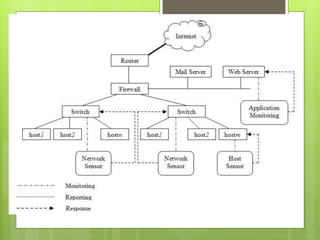
partially distributed ( hierarchical)
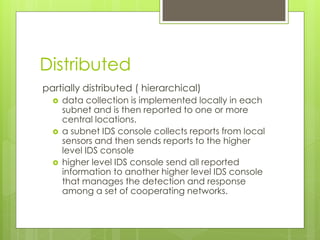
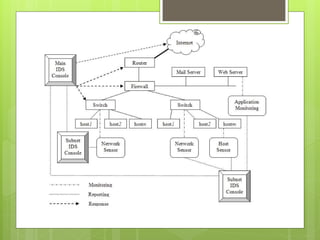
 data collection is implemented locally in each
subnet and is then reported to one or more
central locations.
 a subnet IDS console collects reports from local
sensors and then sends reports to the higher
level IDS console
 higher level IDS console send all reported
information to another higher level IDS console
that manages the detection and response
among a set of cooperating networks.
fully distributed IDS
 Agent based approach is used for
hierarchical IDSs
 utilized for implementing fully distributed
IDSs
 data is collected and analyzed at a
number of locations
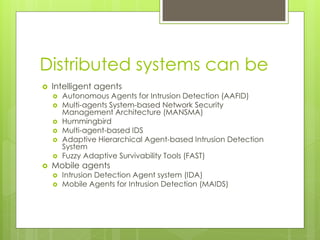
Distributed systems can be
 Intelligent agents
 Autonomous Agents for Intrusion Detection (AAFID)
 Multi-agents System-based Network Security
Management Architecture (MANSMA)
 Hummingbird
 Multi-agent-based IDS
 Adaptive Hierarchical Agent-based Intrusion Detection
System
 Fuzzy Adaptive Survivability Tools (FAST)
 Mobile agents
 Intrusion Detection Agent system (IDA)
 Mobile Agents for Intrusion Detection (MAIDS)
1. Intelligent Agents
 several independent and intelligent processes
cooperate in securing the network
 allows the complex IDS to be implemented in
a highly modular manner
 provides a possibility for the IDS to do an
active defense instead of reporting intrusions
passively.
 the individual agents are designed to
manage a particular task and work together
to fulfill the requirements of the whole system.
Agent-based IDS -
Advantages
 distribution of the computation cost
 the reduction in the amount of information sent
over the network
 the platform independence
 the asynchronous operation
 the ease of updating
 efficiency
 fault tolerance
 Extensibility
 Scalability
 resilience to degradation.
Drawbacks of Agent-based
IDS
 overhead of a large number of processes
 lack of viable research in understanding
and addressing agents’ potential security
problems.
Autonomous Agents for
Intrusion Detection (AAFID)
 developed by the Center for Education and
Research in Information Assurance and Security
(CERIAS) at the Purdue University
 agents are organized in a hierarchical fashion for
data collection and analysis
 four components in the system architecture
 Agents
 Filters
 transceivers
 monitors
 Filters provide a subscription-based service to
agents with two main functions-data selection and
data abstraction
 It implement all the system-dependent mechanisms
to obtain the data requested by the agents
 When an agent starts a subscription request to a
filter, it specifies which records it wants based on
some criteria
 Filter replies the request with records satisfying the
criteria to the agent
 A transceiver in AAFID receives findings reported by
agents.
 Operations of agents are monitored by the
transceivers on host entities
 The transceiver has the ability to start, stop or send
configuration commands to agents
 It can also perform data reduction on the data
received from different agents
 The transceivers report their results to one or more
monitors.
 Monitors have access to network-wide data
 They are able to perform higher-level intrusion
detection and correlation that involves several
hosts.
 Monitors can be organized in a hierarchical fashion
 In case an monitor is down or fails to do operations,
the transceiver can send its report to more than one
monitor
 This provide the redundancy and resistance to the
failure of one of the monitors.
 AAFID system can be distributed over any number
of hosts in a network.
 Each host contains a large number of agents that
monitor important events occurring in the host.
 The monitor agent can be a very simple program to
monitor a specific event or a complex software
system
Multi-agents System-based Network
Security ManagementArchitecture
 MANSMA consist of two layers
 Manager Layer
 Local Layer.
 Manager Layer is used to manage the global
security of a large network
 Local Layer is to manage the security of a domain.
 Three types of agents in Manager Layer
 Security Policy Manager Agent (SPMA)
 Extranet Manager Agent (EMA)
 Intranet Manager Agent (IMA).
 The SPMA maintains the global security policy that is
determined by a human administrator.
 The EMA takes the control of IMAs and manages
the distributed Extranet.
 Each IMA manages the security of a local network
and is able to control specified agents.
 The security of a domain is managed in the Local
Layer, where three types of Local Agents (LAs) are
defined
 Extranet LA
 Intranet LA
 Internet LA.
 The main functions of LAs contain
 monitoring specified activities
 sending report to the Manager Agents.
 MANSMA define three functions for each agent
 Event Filtering
 Interaction
 Deliberation.
 Event filtering function filters detected security
events according to the event class specified in the
detection goal of the agent.
 Interaction function allows agents to communicate
and exchange their analysis and knowledge.
 Deliberation function determines the agent’s
capability to built knowledge and experience and
to reason according to its mental attitudes.
 agents on each layer communicate and exchange
knowledge and analysis results for detecting
intrusive activities.
Hummingbird
 set of Hummer agents are deployed on a single
host or a set of hosts for detecting intrusions.
 Hummers communicate with each other through
a manager, a subordinate, and peer relationships.
 managers transmit commands to subordinates.
 commands include
 gather/stop for data gathering
 forward/stop for data forwarding.
 Peers send requests to other peers
 other peers then decide whether to accept or
reject such requests.
 The architecture of Hummingbird system mainly
consists of three parts
 Message Distribution Unit (MDU)
 Data Distribution Unit (DDU)
 Data Collection Unit (DCU).
 MDU communicates with other hummers
 DDU decides which data should be sent to other
hummers
 DCU uses data collection modules to collect data.
 The three components communicate with each
other through a local hummer network
 The Hummingbird system allows a system
administrator to monitor security threats on multiple
computers from one central console.
 Hummingbird gather data about possible security
problems and re-organize them into a standard
format.
 Hummingbird compiles data collected from
multiple workstations on different networks through
running a local hummer on each workstation.
 The advantage of Hummingbird system
 it can share data with other sites and does not
compromise the security and confidentiality of the
system.
 individual hummer agents can be used to generate
and distribute misuse reports, thus maximizing the
system’s modularity.
Multi-agent-based IDS
They classify agents into four categories:
1. Simple Reflex Agents, connecting with
networks and being able to collect packets
moving around
2. Analysis Agents, requesting the buffer from
the Simple Reflex Agents and building a list of
suspicious packets
3. Goal-based Agents, requesting the list of
suspicious packets from their complementary
analysis agents for making an intrusion
decision and taking necessary actions
4. Utility-based Agents, mapping the percept
states into a set of numbers that measure how
closely the goals are achieved.
Adaptive Hierarchical Agent-based
Intrusion Detection System
 AHA IDS, is based on a fully distributed, multi-agent
framework
 It consist of 4 major components:
1. Director Agents, being responsible for detecting
intrusive behavior
2. Surrogate Agents, taking and covering the
responsibilities of Director Agent when it fails in some
cases
3. Manager Agents, being responsible for detecting
intrusive activities on a subset of systems for which a
Director is responsible
4. Tool Agents, employed by a Manager agent to detect
intrusive activity.
Three types of detection adaption are provided by
the AHA-IDS framework,
 adjusting the amount of system resources devoted to
intrusion detection according to perceived degree of
threat
 invoking dynamically new combinations of low-level
detection agents in response to changing
circumstances
 adjusting the confidence metric associated to the
low-level Tool agents.
Fuzzy Adaptive Survivability
Tools (FAST)
 an intelligent multi-agent based intrusion detection system
 protect a network against the large-scale intrusions.
 based on an automated detection model
 a response approach for survivability
 different intelligent agents are used to identify normal and
abnormal patterns automatically and adaptively.
 The anomalous network variables are identified and then
are used for detecting the threat degree of known attacks
and events of interest.
 able to make decisions about events that meet the
predefined criteria and site-specific policies.
 fuzzy logic is used to identify the degree of suspicion of
each attack and to deal with the uncertainties of response.
 There are four different types of agents
 HCI agent
 Monitor agent
 Detection agent
 Decision agent
 The HCI agent provides an appropriate user interface
for the control of a human operator.
 The Monitor agent identifies and detects anomalous
network activities represented by different variables.
 The Detection agent inspects each flow in order to find
the attack sign appeared on the network.
 The Decision agent, upon receiving an attack alert will
initiate a task that involves selecting and executing a
predefined plan that is both relevant and applicable to
the event in the current context.
 There are three basic components of the
system,
 Sensor (S-box)
 Manager (MS-box)
 Console Software.
 MS-box consists of a management
box(M-box) along with its dedicated
sensor.
 A sensor operates at the lowest level of the system
hierarchy.
 The sensor is responsible for monitoring network
traffic, detecting malicious activities and providing
appropriate local responses.
 Each sensor has two interfaces to the local network.
 The first interface connects to the mirror port of the
local switch and is used for collecting network data
in promiscuous mode.
 The second interface connects to a regular network
port and is used for communication with a higher
level MS-box, console, and third party devices.
 The management module is responsible for managing S-boxes
and MS-boxes at a lower level of hierarchy in the network.
 This module includes an S-box module within itself
 MS-box is capable of performing jobs related to the S-box as
well as high level management of the sensors at lower level.
 The management tasks of this box include correlation of the
data received from the sensors as well as planning a global
response according to the current condition of the network.
 Each MS-box will communicate with other MS-boxes at a
higher hierarchical level of the network.
 The management modules at the higher level will control and
respond to their corresponding lower level management
modules in addition to the sensors that are connected to
them.
 Management modules monitor the network and they apply a
global response to their lower level sensors/managers
considering the correlated information received from them
and the global response received from the higher level
management.
 The console is the user interface for the FAST.
 The console software will run on a separate
computer and is designed to communicate with all
management and sensor modules in the network.
 Using the console software, the system administrator
can update the configuration of S- and MS-boxes.
 The console software also displays different
graphical and text information regarding the
attacks and current status of the network.
2. Mobile agents
 Mobile agents have been commonly used to
design and implement distributed applications in
a dynamic environment.
 They can be applied for the purpose of intrusion
detection.
 It is difficult to achieve an effective detection for
network intrusions when applying mobile agents.
 two typical mobile-agent based IDSs are
 Intrusion Detection Agent system (IDA)
 Mobile Agents for Intrusion Detection (MAIDS)
 Mobile agents are:
 expensive,
 difficult to develop, test and debug
 difficult to authenticate and control
 Vulnerable to a number of attacks coming
from malicious executing environments
 They do not have a ubiquitous infrastructure
and a shared language/ontology
 Might be easily exploited by worm attacks.
Intrusion Detection Agent system
(IDA)
 The agents in IDA collect the information related to
the intrusion along the intrusion-route and apply
them to make decisions about whether an
intrusion has occurred.
 The IDA system provides a set of functions that
enable efficient information retrieval and make it
possible to detect compromised intermediate
hosts.
 IDA system focuses on detecting intrusions
efficiently.
 IDA monitors and inspects events that are only
related to intrusions
 These suspicious events are called Marks Left by
Suspected Intruder (MLSI).
 When an MLSI gets detected, the IDA will collect
and analyze corresponding information, and then
make an intrusion decision.
 One advantage to use mobile agents in IDA is that
they can autonomously migrate to target systems
to collect information related to intrusions
 This eliminating the need to transfer system logs to
the server.
 IDA system is composed of 6 components
 Manager
 Sensors
 Bulletin Boards
 Message Boards
 Tracing Agents,
 Information-gathering Agents
 The IDA manager resides on each network segment.
 The sensors are deployed on each target system and are
used to monitor system logs for inspecting MLSIs.
 Once a MLSI is found by a sensor, it will be reported to the
manager agent.
 The intrusion-route tracing agent traces the path of an
intrusion and identifies the original point of a real attacker.
 During the intrusion route tracing period any intermediate
node that is compromised can be detected.
 The tracing agent migrates autonomously from machine to
machine and traces the intrusion independently without the
involvement of the manager.
 The mobile information-gathering agent in IDA
collects information related to MLSIs from a target
system.
 Each time a tracing agent is launched into a
target system, it activates an information-
gathering agent deployed in the system.
 The information gathering agent collects
information according to the MLSI type and then
reports the results to the manager.
 The information gathering agent is not able to
decide whether an intrusion has occurred.
 The bulletin board and the message board are
built for the purpose of information exchange
between the tracing agents and information-
gathering agents.
 The message board is deployed on each target
system and is used by tracing agents for
exchanging information.
 The bulletin board is installed on the manager’s
computer
 It is used for recording information collected by
information-gathering agents on target systems
and for integrating the information gathered
about tracing routes.
 The final intrusion decision is made by the
manager through analyzing information gathered
by the information-gathering agents.
 The manager agent has an interface between
administrators and the system
 It manages the mobile agents and bulletin
boards, and accumulates and weighs the
information entered by the mobile agents on the
bulletin board.
 If the weights exceed a predefined threshold, an
intrusion alert will be reported.
Mobile Agents for Intrusion Detection
(MAIDS)
 MAIDS is an intrusion detection system based on distributed
intelligent mobile agents.
 In this data mining techniques are performed to provide
global and temporal views for the entire network system.
 The lightweight agents in MAIDS can complete their essential
tasks with minimal code (cost) and can be updated or
upgraded dynamically due to their smaller size.
 In MAIDS, data gathering agents parse system logs and
activity data into a common format.
 The low level agents classify recent activities and then send
data and current classification states to other peers or higher
level agents.
 The higher level agents implement data mining based on the
entire knowledge base and data sources on the system.
 Distributed data cleaning agents process data
collected from log files, networks, and system
activities.
 The mobile agents above this layer, focus on system
calls, TCP connections, and logins.
 These lower-level agents form a rough opinion of
intrusions and can travel to each of their associated
data cleaning agents, gather recent information,
and classify the data to determine whether
suspicious activity is occurring.
 Above the layer of mobile agents is a mediation
component that is connected to database and
data mining and data fusion agents.
 Intelligent agents on this level maintain the data
warehouse by combining knowledge and data
from the lower layer of agents and then applying
data mining algorithms to them.
 As a result, they offer a potential to discover
associations among suspicious events that occur
together with some frequency and attack
patterns as well.
 An interface agent is located on top of the whole
structure and is an analysis console in which
system status reported from the low level agents.

IDS Architecture Classification and example.pdf

  • 1.
  • 2.
    Classification  Based onthe place where data source are collected and analyzed  centralized  distributed  agent based
  • 3.
    Centralized IDS  Theintrusion monitoring analysis and detection are moved from the target system to a separate system.  With a centralized architecture, all of the monitoring, detection, and response activities are controlled directly by a central console  Most of current IDSs are centralized systems.
  • 5.
    Distributed partially distributed (hierarchical)  data collection is implemented locally in each subnet and is then reported to one or more central locations.  a subnet IDS console collects reports from local sensors and then sends reports to the higher level IDS console  higher level IDS console send all reported information to another higher level IDS console that manages the detection and response among a set of cooperating networks.
  • 7.
    fully distributed IDS Agent based approach is used for hierarchical IDSs  utilized for implementing fully distributed IDSs  data is collected and analyzed at a number of locations
  • 9.
    Distributed systems canbe  Intelligent agents  Autonomous Agents for Intrusion Detection (AAFID)  Multi-agents System-based Network Security Management Architecture (MANSMA)  Hummingbird  Multi-agent-based IDS  Adaptive Hierarchical Agent-based Intrusion Detection System  Fuzzy Adaptive Survivability Tools (FAST)  Mobile agents  Intrusion Detection Agent system (IDA)  Mobile Agents for Intrusion Detection (MAIDS)
  • 10.
    1. Intelligent Agents several independent and intelligent processes cooperate in securing the network  allows the complex IDS to be implemented in a highly modular manner  provides a possibility for the IDS to do an active defense instead of reporting intrusions passively.  the individual agents are designed to manage a particular task and work together to fulfill the requirements of the whole system.
  • 11.
    Agent-based IDS - Advantages distribution of the computation cost  the reduction in the amount of information sent over the network  the platform independence  the asynchronous operation  the ease of updating  efficiency  fault tolerance  Extensibility  Scalability  resilience to degradation.
  • 12.
    Drawbacks of Agent-based IDS overhead of a large number of processes  lack of viable research in understanding and addressing agents’ potential security problems.
  • 13.
    Autonomous Agents for IntrusionDetection (AAFID)  developed by the Center for Education and Research in Information Assurance and Security (CERIAS) at the Purdue University  agents are organized in a hierarchical fashion for data collection and analysis  four components in the system architecture  Agents  Filters  transceivers  monitors
  • 14.
     Filters providea subscription-based service to agents with two main functions-data selection and data abstraction  It implement all the system-dependent mechanisms to obtain the data requested by the agents  When an agent starts a subscription request to a filter, it specifies which records it wants based on some criteria  Filter replies the request with records satisfying the criteria to the agent
  • 15.
     A transceiverin AAFID receives findings reported by agents.  Operations of agents are monitored by the transceivers on host entities  The transceiver has the ability to start, stop or send configuration commands to agents  It can also perform data reduction on the data received from different agents  The transceivers report their results to one or more monitors.
  • 16.
     Monitors haveaccess to network-wide data  They are able to perform higher-level intrusion detection and correlation that involves several hosts.  Monitors can be organized in a hierarchical fashion  In case an monitor is down or fails to do operations, the transceiver can send its report to more than one monitor  This provide the redundancy and resistance to the failure of one of the monitors.
  • 17.
     AAFID systemcan be distributed over any number of hosts in a network.  Each host contains a large number of agents that monitor important events occurring in the host.  The monitor agent can be a very simple program to monitor a specific event or a complex software system
  • 18.
    Multi-agents System-based Network SecurityManagementArchitecture  MANSMA consist of two layers  Manager Layer  Local Layer.  Manager Layer is used to manage the global security of a large network  Local Layer is to manage the security of a domain.
  • 19.
     Three typesof agents in Manager Layer  Security Policy Manager Agent (SPMA)  Extranet Manager Agent (EMA)  Intranet Manager Agent (IMA).  The SPMA maintains the global security policy that is determined by a human administrator.  The EMA takes the control of IMAs and manages the distributed Extranet.  Each IMA manages the security of a local network and is able to control specified agents.
  • 20.
     The securityof a domain is managed in the Local Layer, where three types of Local Agents (LAs) are defined  Extranet LA  Intranet LA  Internet LA.  The main functions of LAs contain  monitoring specified activities  sending report to the Manager Agents.
  • 21.
     MANSMA definethree functions for each agent  Event Filtering  Interaction  Deliberation.  Event filtering function filters detected security events according to the event class specified in the detection goal of the agent.  Interaction function allows agents to communicate and exchange their analysis and knowledge.  Deliberation function determines the agent’s capability to built knowledge and experience and to reason according to its mental attitudes.  agents on each layer communicate and exchange knowledge and analysis results for detecting intrusive activities.
  • 22.
    Hummingbird  set ofHummer agents are deployed on a single host or a set of hosts for detecting intrusions.  Hummers communicate with each other through a manager, a subordinate, and peer relationships.  managers transmit commands to subordinates.  commands include  gather/stop for data gathering  forward/stop for data forwarding.  Peers send requests to other peers  other peers then decide whether to accept or reject such requests.
  • 23.
     The architectureof Hummingbird system mainly consists of three parts  Message Distribution Unit (MDU)  Data Distribution Unit (DDU)  Data Collection Unit (DCU).  MDU communicates with other hummers  DDU decides which data should be sent to other hummers  DCU uses data collection modules to collect data.  The three components communicate with each other through a local hummer network
  • 24.
     The Hummingbirdsystem allows a system administrator to monitor security threats on multiple computers from one central console.  Hummingbird gather data about possible security problems and re-organize them into a standard format.  Hummingbird compiles data collected from multiple workstations on different networks through running a local hummer on each workstation.
  • 25.
     The advantageof Hummingbird system  it can share data with other sites and does not compromise the security and confidentiality of the system.  individual hummer agents can be used to generate and distribute misuse reports, thus maximizing the system’s modularity.
  • 26.
    Multi-agent-based IDS They classifyagents into four categories: 1. Simple Reflex Agents, connecting with networks and being able to collect packets moving around 2. Analysis Agents, requesting the buffer from the Simple Reflex Agents and building a list of suspicious packets 3. Goal-based Agents, requesting the list of suspicious packets from their complementary analysis agents for making an intrusion decision and taking necessary actions 4. Utility-based Agents, mapping the percept states into a set of numbers that measure how closely the goals are achieved.
  • 27.
    Adaptive Hierarchical Agent-based IntrusionDetection System  AHA IDS, is based on a fully distributed, multi-agent framework  It consist of 4 major components: 1. Director Agents, being responsible for detecting intrusive behavior 2. Surrogate Agents, taking and covering the responsibilities of Director Agent when it fails in some cases 3. Manager Agents, being responsible for detecting intrusive activities on a subset of systems for which a Director is responsible 4. Tool Agents, employed by a Manager agent to detect intrusive activity.
  • 28.
    Three types ofdetection adaption are provided by the AHA-IDS framework,  adjusting the amount of system resources devoted to intrusion detection according to perceived degree of threat  invoking dynamically new combinations of low-level detection agents in response to changing circumstances  adjusting the confidence metric associated to the low-level Tool agents.
  • 29.
    Fuzzy Adaptive Survivability Tools(FAST)  an intelligent multi-agent based intrusion detection system  protect a network against the large-scale intrusions.  based on an automated detection model  a response approach for survivability  different intelligent agents are used to identify normal and abnormal patterns automatically and adaptively.  The anomalous network variables are identified and then are used for detecting the threat degree of known attacks and events of interest.  able to make decisions about events that meet the predefined criteria and site-specific policies.  fuzzy logic is used to identify the degree of suspicion of each attack and to deal with the uncertainties of response.
  • 30.
     There arefour different types of agents  HCI agent  Monitor agent  Detection agent  Decision agent  The HCI agent provides an appropriate user interface for the control of a human operator.  The Monitor agent identifies and detects anomalous network activities represented by different variables.  The Detection agent inspects each flow in order to find the attack sign appeared on the network.  The Decision agent, upon receiving an attack alert will initiate a task that involves selecting and executing a predefined plan that is both relevant and applicable to the event in the current context.
  • 31.
     There arethree basic components of the system,  Sensor (S-box)  Manager (MS-box)  Console Software.  MS-box consists of a management box(M-box) along with its dedicated sensor.
  • 32.
     A sensoroperates at the lowest level of the system hierarchy.  The sensor is responsible for monitoring network traffic, detecting malicious activities and providing appropriate local responses.  Each sensor has two interfaces to the local network.  The first interface connects to the mirror port of the local switch and is used for collecting network data in promiscuous mode.  The second interface connects to a regular network port and is used for communication with a higher level MS-box, console, and third party devices.
  • 33.
     The managementmodule is responsible for managing S-boxes and MS-boxes at a lower level of hierarchy in the network.  This module includes an S-box module within itself  MS-box is capable of performing jobs related to the S-box as well as high level management of the sensors at lower level.  The management tasks of this box include correlation of the data received from the sensors as well as planning a global response according to the current condition of the network.  Each MS-box will communicate with other MS-boxes at a higher hierarchical level of the network.  The management modules at the higher level will control and respond to their corresponding lower level management modules in addition to the sensors that are connected to them.  Management modules monitor the network and they apply a global response to their lower level sensors/managers considering the correlated information received from them and the global response received from the higher level management.
  • 34.
     The consoleis the user interface for the FAST.  The console software will run on a separate computer and is designed to communicate with all management and sensor modules in the network.  Using the console software, the system administrator can update the configuration of S- and MS-boxes.  The console software also displays different graphical and text information regarding the attacks and current status of the network.
  • 35.
    2. Mobile agents Mobile agents have been commonly used to design and implement distributed applications in a dynamic environment.  They can be applied for the purpose of intrusion detection.  It is difficult to achieve an effective detection for network intrusions when applying mobile agents.  two typical mobile-agent based IDSs are  Intrusion Detection Agent system (IDA)  Mobile Agents for Intrusion Detection (MAIDS)
  • 36.
     Mobile agentsare:  expensive,  difficult to develop, test and debug  difficult to authenticate and control  Vulnerable to a number of attacks coming from malicious executing environments  They do not have a ubiquitous infrastructure and a shared language/ontology  Might be easily exploited by worm attacks.
  • 37.
    Intrusion Detection Agentsystem (IDA)  The agents in IDA collect the information related to the intrusion along the intrusion-route and apply them to make decisions about whether an intrusion has occurred.  The IDA system provides a set of functions that enable efficient information retrieval and make it possible to detect compromised intermediate hosts.  IDA system focuses on detecting intrusions efficiently.
  • 38.
     IDA monitorsand inspects events that are only related to intrusions  These suspicious events are called Marks Left by Suspected Intruder (MLSI).  When an MLSI gets detected, the IDA will collect and analyze corresponding information, and then make an intrusion decision.  One advantage to use mobile agents in IDA is that they can autonomously migrate to target systems to collect information related to intrusions  This eliminating the need to transfer system logs to the server.
  • 39.
     IDA systemis composed of 6 components  Manager  Sensors  Bulletin Boards  Message Boards  Tracing Agents,  Information-gathering Agents  The IDA manager resides on each network segment.  The sensors are deployed on each target system and are used to monitor system logs for inspecting MLSIs.  Once a MLSI is found by a sensor, it will be reported to the manager agent.  The intrusion-route tracing agent traces the path of an intrusion and identifies the original point of a real attacker.  During the intrusion route tracing period any intermediate node that is compromised can be detected.  The tracing agent migrates autonomously from machine to machine and traces the intrusion independently without the involvement of the manager.
  • 40.
     The mobileinformation-gathering agent in IDA collects information related to MLSIs from a target system.  Each time a tracing agent is launched into a target system, it activates an information- gathering agent deployed in the system.  The information gathering agent collects information according to the MLSI type and then reports the results to the manager.  The information gathering agent is not able to decide whether an intrusion has occurred.
  • 41.
     The bulletinboard and the message board are built for the purpose of information exchange between the tracing agents and information- gathering agents.  The message board is deployed on each target system and is used by tracing agents for exchanging information.  The bulletin board is installed on the manager’s computer  It is used for recording information collected by information-gathering agents on target systems and for integrating the information gathered about tracing routes.
  • 42.
     The finalintrusion decision is made by the manager through analyzing information gathered by the information-gathering agents.  The manager agent has an interface between administrators and the system  It manages the mobile agents and bulletin boards, and accumulates and weighs the information entered by the mobile agents on the bulletin board.  If the weights exceed a predefined threshold, an intrusion alert will be reported.
  • 43.
    Mobile Agents forIntrusion Detection (MAIDS)  MAIDS is an intrusion detection system based on distributed intelligent mobile agents.  In this data mining techniques are performed to provide global and temporal views for the entire network system.  The lightweight agents in MAIDS can complete their essential tasks with minimal code (cost) and can be updated or upgraded dynamically due to their smaller size.  In MAIDS, data gathering agents parse system logs and activity data into a common format.  The low level agents classify recent activities and then send data and current classification states to other peers or higher level agents.  The higher level agents implement data mining based on the entire knowledge base and data sources on the system.
  • 44.
     Distributed datacleaning agents process data collected from log files, networks, and system activities.  The mobile agents above this layer, focus on system calls, TCP connections, and logins.  These lower-level agents form a rough opinion of intrusions and can travel to each of their associated data cleaning agents, gather recent information, and classify the data to determine whether suspicious activity is occurring.  Above the layer of mobile agents is a mediation component that is connected to database and data mining and data fusion agents.
  • 45.
     Intelligent agentson this level maintain the data warehouse by combining knowledge and data from the lower layer of agents and then applying data mining algorithms to them.  As a result, they offer a potential to discover associations among suspicious events that occur together with some frequency and attack patterns as well.  An interface agent is located on top of the whole structure and is an analysis console in which system status reported from the low level agents.