Header compression and multiplexing in LISP
Jose Saldana, Julián Fernández-Navajas, José Ruiz-Mas {jsaldana, navajas, jruiz}@unizar.es
Proposal: draft-saldana-lisp-compress-mux
This document proposes to send together a number of small LISP
packets into a single one.
They will share a single LISP header, resulting in bandwidth savings and
packet per second reduction.
Header compression can also be applied to the EID headers (ROHC)
It relies on Simplemux: draft-saldana-tsvwg-Simplemux (submitted to
tsvwg). A paper about it: Improving Network Efficiency with Simplemux
Internet
RLOC Address Space
Stub 1
Stub 3
Stub 2
Border routers
Header compression and multiplexing in LISP
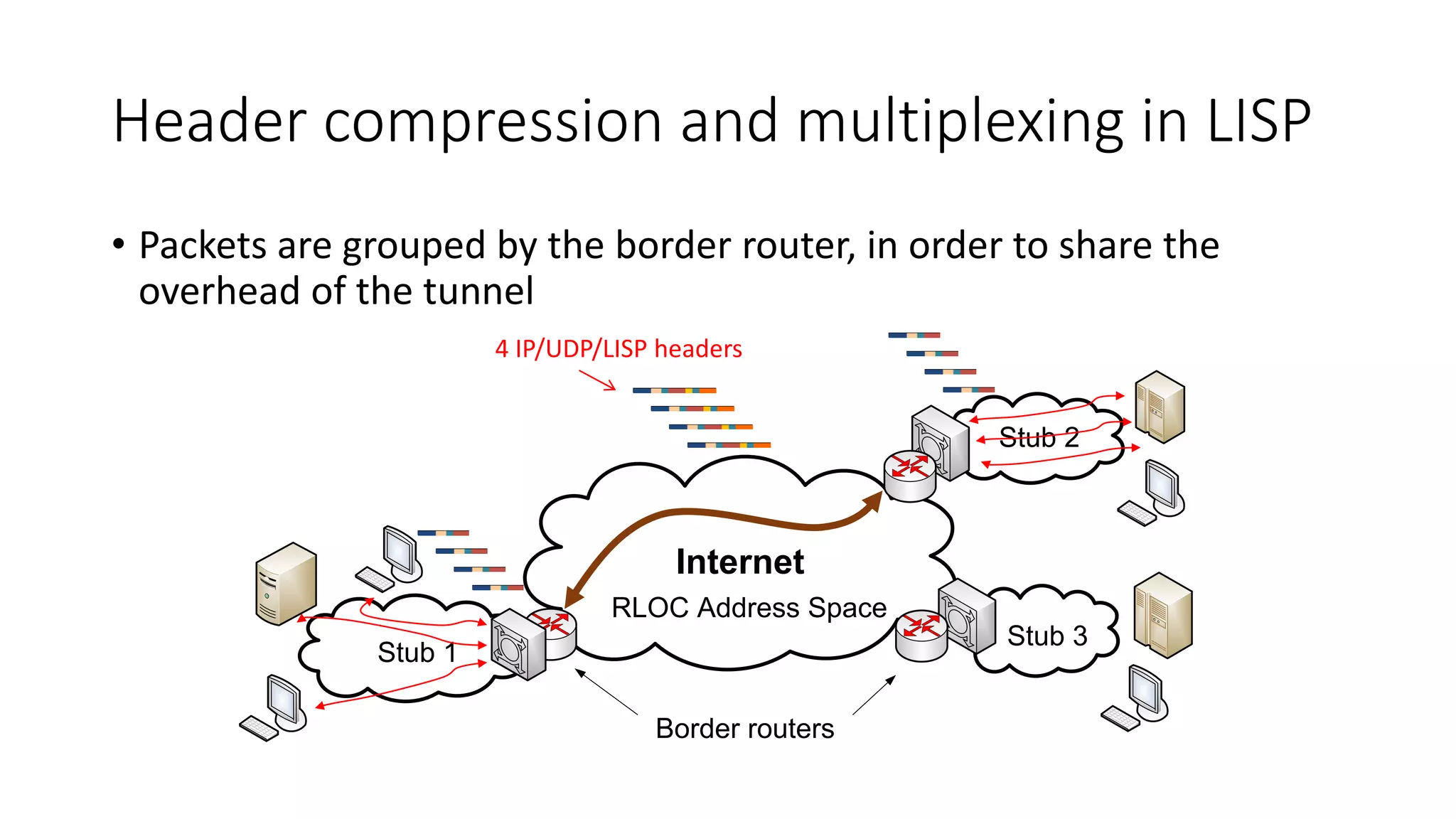
• Packets are grouped by the border router, in order to share the
overhead of the tunnel
4 IP/UDP/LISP headers
Header compression and multiplexing in LISP
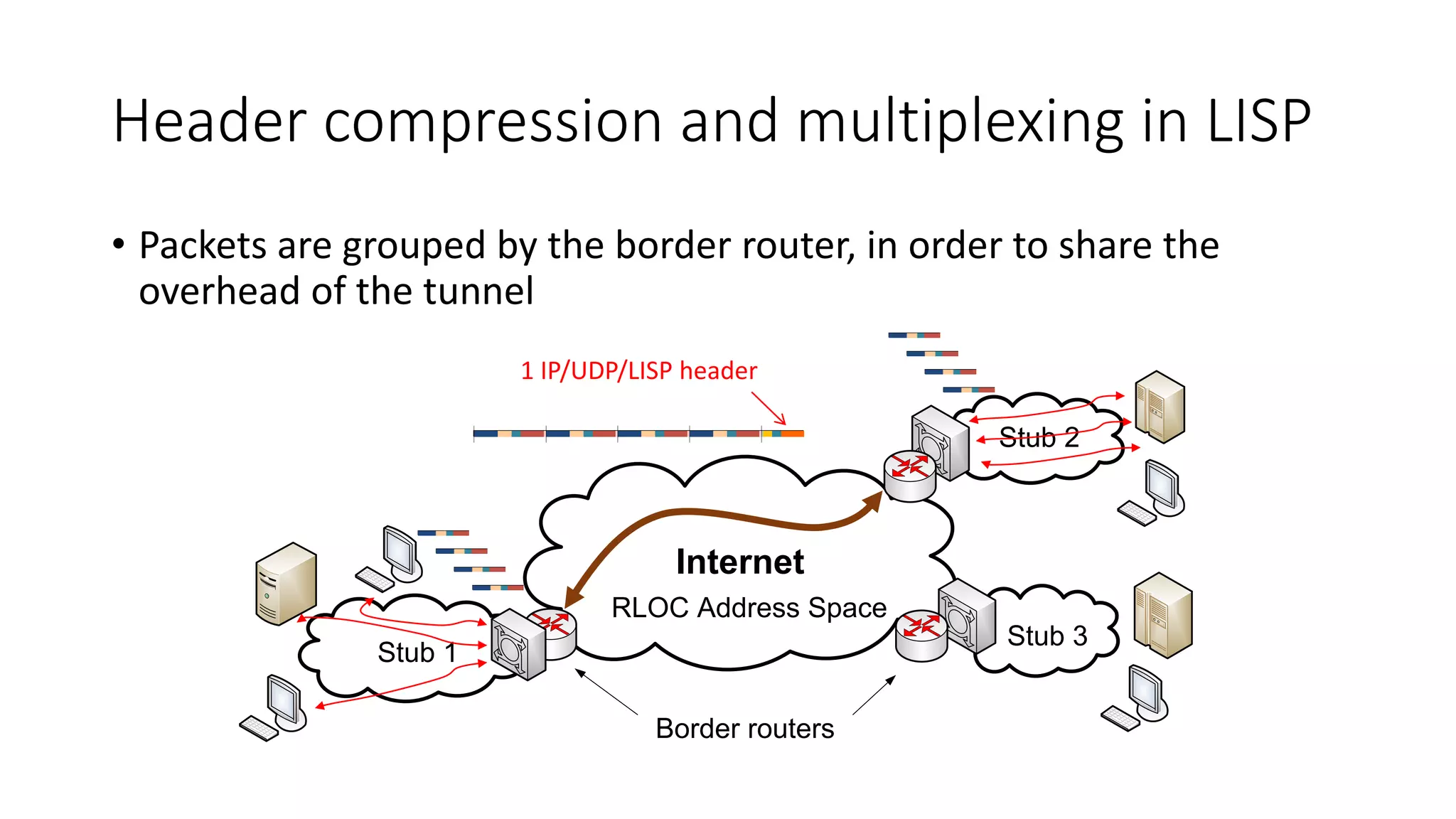
• Packets are grouped by the border router, in order to share the
overhead of the tunnel
Internet
RLOC Address Space
Stub 1
Stub 3
Stub 2
Border routers
1 IP/UDP/LISP header
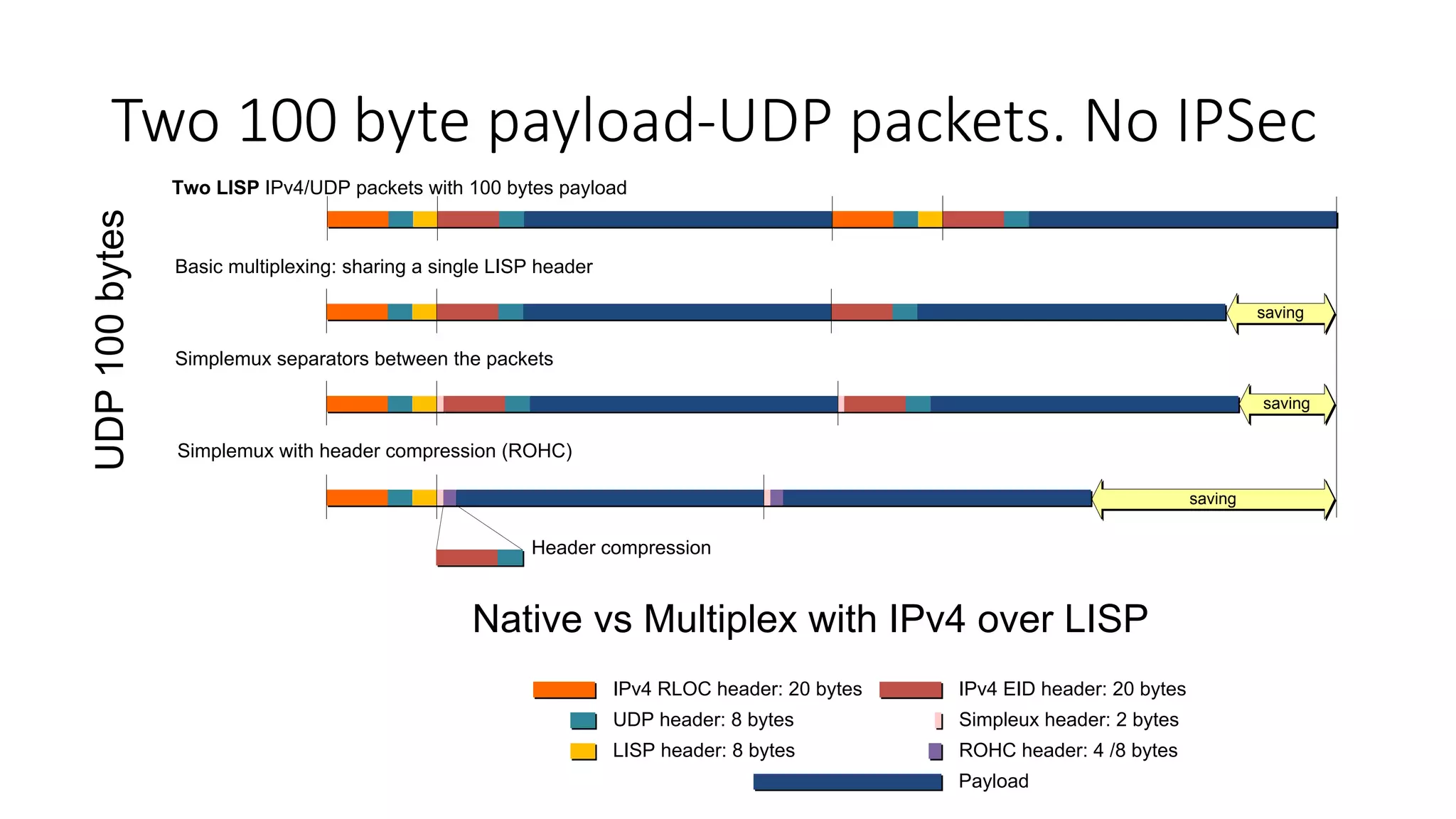
Two 100 byte payload-UDP packets. No IPSec
IPv4 EID header: 20 bytes
UDP header: 8 bytes Simpleux header: 2 bytes
ROHC header: 4 /8 bytes
Payload
Native vs Multiplex with IPv4 over LISP
IPv4 RLOC header: 20 bytes
LISP header: 8 bytes
Two LISP IPv4/UDP packets with 100 bytes payload
Simplemux with header compression (ROHC)
saving
UDP100bytes
Simplemux separators between the packets
Header compression
Basic multiplexing: sharing a single LISP header
saving
saving
IPv4 EID header: 20 bytes
UDP header: 8 bytes Simpleux header: 1-3 bytes
ROHC header: 4-8 bytes
Payload
Native vs Multiplex with IPSec over LISP
IPv4 RLOC header: 20 bytes
LISP header: 8 bytes
Two LISP IPv4/UDP packets with 100 bytes payload
Simplemux with header compression (ROHC)
saving
IPSecTransportmode
UDP100bytes
Simplemux separators between the packets
saving
IPSec
AH+ESP header: 32 bytes
ESP payload
IPsec
IPSec
Two 100 byte payload-UDP packets. IPSec
Tests with iPerf and tc
Header compression and multiplexing in LISP
iPerf tests
Source
IPerf
xTR xTR Destination
IPerf
MSMR
Virtual Machines and
switches
External switch
tc limit
IPSec
Traffic sent 1,5 Mbps of UDP packets with UDP payload 100 bytes
(saturated link) (128 bytes at IP level)
With LISP tunnel 128 + 36 (LISP) =178 bytes per packet
Traffic limit 1 Mbps at Eth level, using Linux tc
Limit 702 pps => (x100 x8) 576 kbps at application level
Implementation based on lispmob: https://github.com/Simplemux/lispmob-with-simplemux
400
500
600
700
800
900
1000
1 2 3 4 5 6 7 8 9 10
Throughput[kbps]
Number of multiplexed packets
Obtained throughput (application level)
Native
ROHC
Traffic traversing the 1Mbps link. No IPSec
We multiplex a fixed number of packets together. We multiplex based on a multiplexing period.
If we compress headers with ROHC, higher savings are achieved.
400
500
600
700
800
900
1000
0 1 2 3 4 5
Throughput[kbps]
Multiplexing period [ms]
Obtained throughput (application level)
Native
ROHC
400
500
600
700
800
900
1000
1 2 3 4 5 6 7 8 9 10
Throughput[kbps]
Number of multiplexed packets
Obtained throughput (application level)
Native
ROHC
Traffic traversing the 1Mbps link. No IPSec
We multiplex a fixed number of packets together. We multiplex based on a multiplexing period.
If we compress headers with ROHC, higher savings are achieved.
400
500
600
700
800
900
1000
0 1 2 3 4 5
Throughput[kbps]
Multiplexing period [ms]
Obtained throughput (application level)
Native
ROHC
181 bytes
690pps
552 kbps
1346 bytes
92 pps
742 kbps
1100 bytes
113 pps
909 kbps
Traffic traversing the 1Mbps link. IPSec is used
We multiplex based on a multiplexing period.
IPSec is running between both xTRs.
The multiplexed bundle goes through the IPSec tunnel.
If we compress headers with ROHC, higher savings are
achieved.
400
500
600
700
800
900
1000
0 1 2 3 4 5
Throughput[kbps]
Multiplexing period [ms]
Obtained throughput (application level, IPSec)
Native
ROHC
Backward compatibility
Header compression and multiplexing in LISP
Backward compatibility (1)
The "Basic multiplexing method" may probably have some backward
compatibility issues. The draft proposes this (as a preliminary idea):
One of the free bits in the LISP header should be
used to flag the fact that more than a single packet
is included in the encapsulated one.
Two LISP IPv4/UDP packets with 100 bytes payload
Basic multiplexing: sharing a single LISP header
saving
Backward compatibility (2)
The Simplemux methoe would also need some tweaks:
In this case, a port number different from 4341
should be used in the UDP header preceding the LISP
header, in order to indicate that the protocol
inside the LISP header is not IP but Simplemux.
Two LISP IPv4/UDP packets with 100 bytes payload
Simplemux separators between the packets
saving

Header compression and multiplexing in LISP

  • 1.
    Header compression andmultiplexing in LISP Jose Saldana, Julián Fernández-Navajas, José Ruiz-Mas {jsaldana, navajas, jruiz}@unizar.es Proposal: draft-saldana-lisp-compress-mux This document proposes to send together a number of small LISP packets into a single one. They will share a single LISP header, resulting in bandwidth savings and packet per second reduction. Header compression can also be applied to the EID headers (ROHC) It relies on Simplemux: draft-saldana-tsvwg-Simplemux (submitted to tsvwg). A paper about it: Improving Network Efficiency with Simplemux
  • 2.
    Internet RLOC Address Space Stub1 Stub 3 Stub 2 Border routers Header compression and multiplexing in LISP • Packets are grouped by the border router, in order to share the overhead of the tunnel 4 IP/UDP/LISP headers
  • 3.
    Header compression andmultiplexing in LISP • Packets are grouped by the border router, in order to share the overhead of the tunnel Internet RLOC Address Space Stub 1 Stub 3 Stub 2 Border routers 1 IP/UDP/LISP header
  • 4.
    Two 100 bytepayload-UDP packets. No IPSec IPv4 EID header: 20 bytes UDP header: 8 bytes Simpleux header: 2 bytes ROHC header: 4 /8 bytes Payload Native vs Multiplex with IPv4 over LISP IPv4 RLOC header: 20 bytes LISP header: 8 bytes Two LISP IPv4/UDP packets with 100 bytes payload Simplemux with header compression (ROHC) saving UDP100bytes Simplemux separators between the packets Header compression Basic multiplexing: sharing a single LISP header saving saving
  • 5.
    IPv4 EID header:20 bytes UDP header: 8 bytes Simpleux header: 1-3 bytes ROHC header: 4-8 bytes Payload Native vs Multiplex with IPSec over LISP IPv4 RLOC header: 20 bytes LISP header: 8 bytes Two LISP IPv4/UDP packets with 100 bytes payload Simplemux with header compression (ROHC) saving IPSecTransportmode UDP100bytes Simplemux separators between the packets saving IPSec AH+ESP header: 32 bytes ESP payload IPsec IPSec Two 100 byte payload-UDP packets. IPSec
  • 6.
    Tests with iPerfand tc Header compression and multiplexing in LISP
  • 7.
    iPerf tests Source IPerf xTR xTRDestination IPerf MSMR Virtual Machines and switches External switch tc limit IPSec Traffic sent 1,5 Mbps of UDP packets with UDP payload 100 bytes (saturated link) (128 bytes at IP level) With LISP tunnel 128 + 36 (LISP) =178 bytes per packet Traffic limit 1 Mbps at Eth level, using Linux tc Limit 702 pps => (x100 x8) 576 kbps at application level Implementation based on lispmob: https://github.com/Simplemux/lispmob-with-simplemux
  • 8.
    400 500 600 700 800 900 1000 1 2 34 5 6 7 8 9 10 Throughput[kbps] Number of multiplexed packets Obtained throughput (application level) Native ROHC Traffic traversing the 1Mbps link. No IPSec We multiplex a fixed number of packets together. We multiplex based on a multiplexing period. If we compress headers with ROHC, higher savings are achieved. 400 500 600 700 800 900 1000 0 1 2 3 4 5 Throughput[kbps] Multiplexing period [ms] Obtained throughput (application level) Native ROHC
  • 9.
    400 500 600 700 800 900 1000 1 2 34 5 6 7 8 9 10 Throughput[kbps] Number of multiplexed packets Obtained throughput (application level) Native ROHC Traffic traversing the 1Mbps link. No IPSec We multiplex a fixed number of packets together. We multiplex based on a multiplexing period. If we compress headers with ROHC, higher savings are achieved. 400 500 600 700 800 900 1000 0 1 2 3 4 5 Throughput[kbps] Multiplexing period [ms] Obtained throughput (application level) Native ROHC 181 bytes 690pps 552 kbps 1346 bytes 92 pps 742 kbps 1100 bytes 113 pps 909 kbps
  • 10.
    Traffic traversing the1Mbps link. IPSec is used We multiplex based on a multiplexing period. IPSec is running between both xTRs. The multiplexed bundle goes through the IPSec tunnel. If we compress headers with ROHC, higher savings are achieved. 400 500 600 700 800 900 1000 0 1 2 3 4 5 Throughput[kbps] Multiplexing period [ms] Obtained throughput (application level, IPSec) Native ROHC
  • 11.
  • 12.
    Backward compatibility (1) The"Basic multiplexing method" may probably have some backward compatibility issues. The draft proposes this (as a preliminary idea): One of the free bits in the LISP header should be used to flag the fact that more than a single packet is included in the encapsulated one. Two LISP IPv4/UDP packets with 100 bytes payload Basic multiplexing: sharing a single LISP header saving
  • 13.
    Backward compatibility (2) TheSimplemux methoe would also need some tweaks: In this case, a port number different from 4341 should be used in the UDP header preceding the LISP header, in order to indicate that the protocol inside the LISP header is not IP but Simplemux. Two LISP IPv4/UDP packets with 100 bytes payload Simplemux separators between the packets saving