Universidad Católica de la Santísima Concepción
English Pedagogy
Teaching Practice
SCARLETT ESPINOZA
School Class:
Nº of SS:
Date: Time: Length: Pre service Teacher:
Aim:
At the end of this lesson, students will be able to use different
vocabulary about food, ask and answer which one they like or
dislike, orally and in written.
Learning Outcome:
REF to General English Syllabus.
Exponent: I dislike tomatoes and broccoli.
| a d s la k tə m tə z ənd br kəli |ˈ ɪ ɪ ˈ ɪ ˈ ɑː ʊ ˈ ɒ
Target Language:
Use: - Present Simple. It could be used to meet new students in an
educational trip, or asking about their habits as well.
Meaning: The use of the present simple tense is to give information
about, according to this aim, what you like or dislike to eat.
Form: the use of verbs in present simple tenses with the 1st
(I) and 2nd
(you) person of singular, and the 1st
(you), 2nd
(we) , and 3rd
(they)
person of plural, is in its infinitive form without any variation (like,
dislike, prefer, eat). The use of verbs in present simple tenses with the
3rd
person of singular (he, she, it), is in its infinitive form + s (likes,
dislikes, preferes, eats). The components to build a whole present
simple sentence are: Subject+ verb+ complement+ adverbial phrase.
Assumed knowledge:
Some basic vocabulary about food that could be known by students,
such as rice, milk, or orange.
Anticipated problems: …..and Solution
- Ss could omit the auxiliary “do” or “does” at the beginning
of the questions in 1st
, 2nd
and 3rd
person of singular T makes Ss to repeat by drilling
until
- Ss could mispronunce some
Aids:
Whiteboard
Markers
Worsheet
vocabulary about food, such as
they pronounce the vocabulary
properly.
lettuce, meat and peanuts.
Pictures
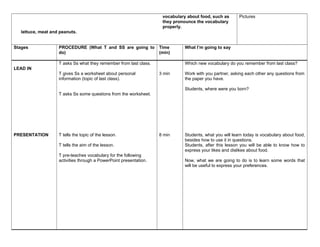
Stages PROCEDURE (What T and SS are going to
do)
Time
(min)
What I’m going to say
LEAD IN
PRESENTATION
T asks Ss what they remember from last class.
T gives Ss a worksheet about personal
information (topic of last class).
T asks Ss some questions from the worksheet.
T tells the topic of the lesson.
T tells the aim of the lesson.
T pre-teaches vocabulary for the following
activities through a PowerPoint presentation.
3 min
8 min
Which new vocabulary do you remember from last class?
Work with you partner, asking each other any questions from
the paper you have.
Students, where were you born?
Students, what you will learn today is vocabulary about food,
besides how to use it in questions.
Students, after this lesson you will be able to know how to
express your likes and dislikes about food.
Now, what we are going to do is to learn some words that
will be useful to express your preferences.
PRACTICE
PRODUCTION
T gives Ss a worksheet with vocabulary about
food. What Ss have to do is to put each of these
words in its correct category (vegetables, fruits,
etc.)
T asks Ss to write on the board what they have
done.
T checks if Ss learnt new vocabulary
T explains the following activity on the board. Ss
have to create their own questions about likes
and dislikes, using the vocabulary they learnt.
T asks Ss to create a dialogue orally with their
classmates, using the questions they created.
T asks Ss to speak loudly to check what they
did.
5 min
7 min
8 min
12 min
Look at the list of words, and put a number to each of them
with the correct category.
Now, write on each category 4 or 5 words from the ones you
selected in each category.
So, what does pork chop mean?
Students, now you have to create questions to ask
somebody which food he/she prefers, likes or dislikes. Use
the vocabulary provided.
Students, now you have to ask your classmates the
questions that you created. Make a dialogue.
Would you like to share your dialogue with me?
SCARLETT ESPINOZA
School Class:
Nº of SS:
Date: Time: Length: Pre service Teacher:
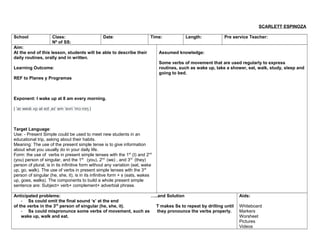
Aim:
At the end of this lesson, students will be able to describe their
daily routines, orally and in written.
Learning Outcome:
REF to Planes y Programas
Exponent: I wake up at 8 am every morning.
| a we k p ət e t e em evri m n ŋ |ˈ ɪ ɪ ʌ ɪ ˌ ɪˈ ˈ ˈ ɔː ɪ
Target Language:
Use: - Present Simple could be used to meet new students in an
educational trip, asking about their habits.
Meaning: The use of the present simple tense is to give information
about what you usually do in your daily life.
Form: the use of verbs in present simple tenses with the 1st
(I) and 2nd
(you) person of singular, and the 1st
(you), 2nd
(we) , and 3rd
(they)
person of plural, is in its infinitive form without any variation (eat, wake
up, go, walk). The use of verbs in present simple tenses with the 3rd
person of singular (he, she, it), is in its infinitive form + s (eats, wakes
up, goes, walks). The components to build a whole present simple
sentence are: Subject+ verb+ complement+ adverbial phrase.
Assumed knowledge:
Some verbs of movement that are used regularly to express
routines, such as wake up, take a shower, eat, walk, study, sleep and
going to bed.
Anticipated problems: …..and Solution
- Ss could omit the final sound ‘s’ at the end
of the verbs in the 3rd
person of singular (he, she, it). T makes Ss to repeat by drilling until
- Ss could mispronunce some verbs of movement, such as they pronounce the verbs properly.
wake up, walk and eat.
Aids:
Whiteboard
Markers
Worsheet
Pictures
Videos
Stages PROCEDURE (What T and SS are going to
do)
Time
(min)
What I’m going to say
LEAD IN
PRESENTATION
T shows a picture about her daily routines.
T asks students to talk about their daily routines.
T makes Ss try to predict what the lesson is
going to be about.
T checks predictions made by Ss carefully.
T tells the aim of the lesson.
T pre-teaches vocabulary for the following
activities.
3 min
8 min
What do I usually do in the morning on Mondays?
I wake up at 8 am on Mondays and then I eat a sandwich.
What do you do on Sundays in the morning?
Students, what do you think we are going to talk about in this
lesson?
Students, after this lesson you will be able to know how to
express the daily routines that you do regularly.
Now, what we are going to do is to learn some words that
will be useful to express daily routines.
PRACTICE
PRODUCTION
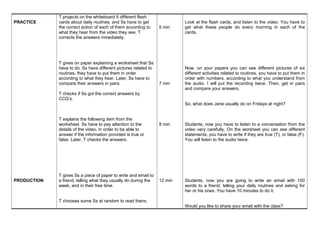
T projects on the whiteboard 5 different flash
cards about daily routines, and Ss have to get
the correct action of each of them according to
what they hear from the video they see. T
corrects the answers inmediately.
T gives on paper explaining a worksheet that Ss
have to do. Ss have different pictures related to
routines, they have to put them in order
according to what they hear. Later, Ss have to
compare their answers in pairs.
T checks if Ss got the correct answers by
CCQ’s.
T explains the following item from the
worksheet. Ss have to pay attention to the
details of the video, in order to be able to
answer if the information provided is true or
false. Later, T checks the answers.
T gives Ss a piece of paper to write and email to
a friend, telling what they usually do during the
week, and in their free time.
T chooses some Ss at random to read theirs.
5 min
7 min
8 min
12 min
Look at the flash cards, and listen to the video. You have to
get what these people do every morning in each of the
cards.
Now, on your papers you can see different pictures of six
different activities related to routines, you have to put them in
order with numbers, according to what you understand from
the audio. I will put the recording twice. Then, get in pairs
and compare your answers.
So, what does Jane usually do on Fridays at night?
Students, now you have to listen to a conversation from the
video very carefully. On the worsheet you can see different
statements, you have to write if they are true (T), or false (F).
You will listen to the audio twice.
Students, now you are going to write an email with 100
words to a friend, telling your daily routines and asking for
her or his ones. You have 10 minutes to do it.
Would you like to share your email with the class?
PRACTICE
PRODUCTION
T projects on the whiteboard 5 different flash
cards about daily routines, and Ss have to get
the correct action of each of them according to
what they hear from the video they see. T
corrects the answers inmediately.
T gives on paper explaining a worksheet that Ss
have to do. Ss have different pictures related to
routines, they have to put them in order
according to what they hear. Later, Ss have to
compare their answers in pairs.
T checks if Ss got the correct answers by
CCQ’s.
T explains the following item from the
worksheet. Ss have to pay attention to the
details of the video, in order to be able to
answer if the information provided is true or
false. Later, T checks the answers.
T gives Ss a piece of paper to write and email to
a friend, telling what they usually do during the
week, and in their free time.
T chooses some Ss at random to read theirs.
5 min
7 min
8 min
12 min
Look at the flash cards, and listen to the video. You have to
get what these people do every morning in each of the
cards.
Now, on your papers you can see different pictures of six
different activities related to routines, you have to put them in
order with numbers, according to what you understand from
the audio. I will put the recording twice. Then, get in pairs
and compare your answers.
So, what does Jane usually do on Fridays at night?
Students, now you have to listen to a conversation from the
video very carefully. On the worsheet you can see different
statements, you have to write if they are true (T), or false (F).
You will listen to the audio twice.
Students, now you are going to write an email with 100
words to a friend, telling your daily routines and asking for
her or his ones. You have 10 minutes to do it.
Would you like to share your email with the class?

Scarlett's Lesson Plans

  • 1.
    Universidad Católica dela Santísima Concepción English Pedagogy Teaching Practice SCARLETT ESPINOZA School Class: Nº of SS: Date: Time: Length: Pre service Teacher: Aim: At the end of this lesson, students will be able to use different vocabulary about food, ask and answer which one they like or dislike, orally and in written. Learning Outcome: REF to General English Syllabus. Exponent: I dislike tomatoes and broccoli. | a d s la k tə m tə z ənd br kəli |ˈ ɪ ɪ ˈ ɪ ˈ ɑː ʊ ˈ ɒ Target Language: Use: - Present Simple. It could be used to meet new students in an educational trip, or asking about their habits as well. Meaning: The use of the present simple tense is to give information about, according to this aim, what you like or dislike to eat. Form: the use of verbs in present simple tenses with the 1st (I) and 2nd (you) person of singular, and the 1st (you), 2nd (we) , and 3rd (they) person of plural, is in its infinitive form without any variation (like, dislike, prefer, eat). The use of verbs in present simple tenses with the 3rd person of singular (he, she, it), is in its infinitive form + s (likes, dislikes, preferes, eats). The components to build a whole present simple sentence are: Subject+ verb+ complement+ adverbial phrase. Assumed knowledge: Some basic vocabulary about food that could be known by students, such as rice, milk, or orange. Anticipated problems: …..and Solution - Ss could omit the auxiliary “do” or “does” at the beginning of the questions in 1st , 2nd and 3rd person of singular T makes Ss to repeat by drilling until - Ss could mispronunce some Aids: Whiteboard Markers Worsheet
  • 2.
    vocabulary about food,such as they pronounce the vocabulary properly. lettuce, meat and peanuts. Pictures Stages PROCEDURE (What T and SS are going to do) Time (min) What I’m going to say LEAD IN PRESENTATION T asks Ss what they remember from last class. T gives Ss a worksheet about personal information (topic of last class). T asks Ss some questions from the worksheet. T tells the topic of the lesson. T tells the aim of the lesson. T pre-teaches vocabulary for the following activities through a PowerPoint presentation. 3 min 8 min Which new vocabulary do you remember from last class? Work with you partner, asking each other any questions from the paper you have. Students, where were you born? Students, what you will learn today is vocabulary about food, besides how to use it in questions. Students, after this lesson you will be able to know how to express your likes and dislikes about food. Now, what we are going to do is to learn some words that will be useful to express your preferences.
  • 3.
    PRACTICE PRODUCTION T gives Ssa worksheet with vocabulary about food. What Ss have to do is to put each of these words in its correct category (vegetables, fruits, etc.) T asks Ss to write on the board what they have done. T checks if Ss learnt new vocabulary T explains the following activity on the board. Ss have to create their own questions about likes and dislikes, using the vocabulary they learnt. T asks Ss to create a dialogue orally with their classmates, using the questions they created. T asks Ss to speak loudly to check what they did. 5 min 7 min 8 min 12 min Look at the list of words, and put a number to each of them with the correct category. Now, write on each category 4 or 5 words from the ones you selected in each category. So, what does pork chop mean? Students, now you have to create questions to ask somebody which food he/she prefers, likes or dislikes. Use the vocabulary provided. Students, now you have to ask your classmates the questions that you created. Make a dialogue. Would you like to share your dialogue with me?
  • 4.
    SCARLETT ESPINOZA School Class: Nºof SS: Date: Time: Length: Pre service Teacher: Aim: At the end of this lesson, students will be able to describe their daily routines, orally and in written. Learning Outcome: REF to Planes y Programas Exponent: I wake up at 8 am every morning. | a we k p ət e t e em evri m n ŋ |ˈ ɪ ɪ ʌ ɪ ˌ ɪˈ ˈ ˈ ɔː ɪ Target Language: Use: - Present Simple could be used to meet new students in an educational trip, asking about their habits. Meaning: The use of the present simple tense is to give information about what you usually do in your daily life. Form: the use of verbs in present simple tenses with the 1st (I) and 2nd (you) person of singular, and the 1st (you), 2nd (we) , and 3rd (they) person of plural, is in its infinitive form without any variation (eat, wake up, go, walk). The use of verbs in present simple tenses with the 3rd person of singular (he, she, it), is in its infinitive form + s (eats, wakes up, goes, walks). The components to build a whole present simple sentence are: Subject+ verb+ complement+ adverbial phrase. Assumed knowledge: Some verbs of movement that are used regularly to express routines, such as wake up, take a shower, eat, walk, study, sleep and going to bed. Anticipated problems: …..and Solution - Ss could omit the final sound ‘s’ at the end of the verbs in the 3rd person of singular (he, she, it). T makes Ss to repeat by drilling until - Ss could mispronunce some verbs of movement, such as they pronounce the verbs properly. wake up, walk and eat. Aids: Whiteboard Markers Worsheet Pictures Videos
  • 5.
    Stages PROCEDURE (WhatT and SS are going to do) Time (min) What I’m going to say LEAD IN PRESENTATION T shows a picture about her daily routines. T asks students to talk about their daily routines. T makes Ss try to predict what the lesson is going to be about. T checks predictions made by Ss carefully. T tells the aim of the lesson. T pre-teaches vocabulary for the following activities. 3 min 8 min What do I usually do in the morning on Mondays? I wake up at 8 am on Mondays and then I eat a sandwich. What do you do on Sundays in the morning? Students, what do you think we are going to talk about in this lesson? Students, after this lesson you will be able to know how to express the daily routines that you do regularly. Now, what we are going to do is to learn some words that will be useful to express daily routines.
  • 6.
    PRACTICE PRODUCTION T projects onthe whiteboard 5 different flash cards about daily routines, and Ss have to get the correct action of each of them according to what they hear from the video they see. T corrects the answers inmediately. T gives on paper explaining a worksheet that Ss have to do. Ss have different pictures related to routines, they have to put them in order according to what they hear. Later, Ss have to compare their answers in pairs. T checks if Ss got the correct answers by CCQ’s. T explains the following item from the worksheet. Ss have to pay attention to the details of the video, in order to be able to answer if the information provided is true or false. Later, T checks the answers. T gives Ss a piece of paper to write and email to a friend, telling what they usually do during the week, and in their free time. T chooses some Ss at random to read theirs. 5 min 7 min 8 min 12 min Look at the flash cards, and listen to the video. You have to get what these people do every morning in each of the cards. Now, on your papers you can see different pictures of six different activities related to routines, you have to put them in order with numbers, according to what you understand from the audio. I will put the recording twice. Then, get in pairs and compare your answers. So, what does Jane usually do on Fridays at night? Students, now you have to listen to a conversation from the video very carefully. On the worsheet you can see different statements, you have to write if they are true (T), or false (F). You will listen to the audio twice. Students, now you are going to write an email with 100 words to a friend, telling your daily routines and asking for her or his ones. You have 10 minutes to do it. Would you like to share your email with the class?
  • 7.
    PRACTICE PRODUCTION T projects onthe whiteboard 5 different flash cards about daily routines, and Ss have to get the correct action of each of them according to what they hear from the video they see. T corrects the answers inmediately. T gives on paper explaining a worksheet that Ss have to do. Ss have different pictures related to routines, they have to put them in order according to what they hear. Later, Ss have to compare their answers in pairs. T checks if Ss got the correct answers by CCQ’s. T explains the following item from the worksheet. Ss have to pay attention to the details of the video, in order to be able to answer if the information provided is true or false. Later, T checks the answers. T gives Ss a piece of paper to write and email to a friend, telling what they usually do during the week, and in their free time. T chooses some Ss at random to read theirs. 5 min 7 min 8 min 12 min Look at the flash cards, and listen to the video. You have to get what these people do every morning in each of the cards. Now, on your papers you can see different pictures of six different activities related to routines, you have to put them in order with numbers, according to what you understand from the audio. I will put the recording twice. Then, get in pairs and compare your answers. So, what does Jane usually do on Fridays at night? Students, now you have to listen to a conversation from the video very carefully. On the worsheet you can see different statements, you have to write if they are true (T), or false (F). You will listen to the audio twice. Students, now you are going to write an email with 100 words to a friend, telling your daily routines and asking for her or his ones. You have 10 minutes to do it. Would you like to share your email with the class?