IFDC LENGUASVIVAS
TALLER DE PRÁCTICA DOCENTE III
ALUMNOPRACTICANTE: MARIA INES TRECH
Período de Práctica: Escuela Primaria
Institución Educativa: Escuela Manuel Belgrano – DIPREGEP Nº 662
Dirección: Costa Y Lequerica
Sala / Grado / Año – sección: 5to año A
Cantidad de alumnos: 30 alumnos
Nivel lingüístico de los cursos: beginners
Tipo de Planificación: Diaria
Unidad Temática: “Las comidas”
Clase N°: 1
Fecha: 6 de julio 2015
Hora: de 13.30 a 14.20 hs
Duración de la clase: 50 minutos
Fecha de primera entrega: 29 de junio
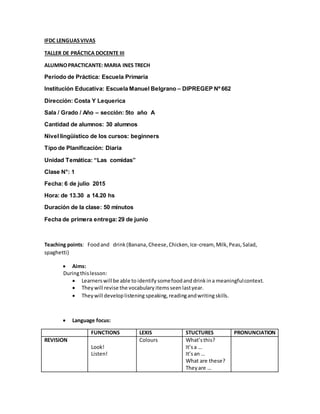
Teaching points: Foodand drink(Banana,Cheese,Chicken, Ice-cream,Milk,Peas, Salad,
spaghetti)
 Aims:
Duringthislesson:
 Learnerswill be able to identify somefoodand drink ina meaningfulcontext.
 Theywill revise the vocabulary itemsseenlastyear.
 Theywill developlistening speaking, readingandwritingskills.
 Language focus:
FUNCTIONS LEXIS STUCTURES PRONUNCIATION
REVISION
Look!
Listen!
Colours What’sthis?
It’sa …
It’san …
What are these?
Theyare …
NEW Speakingabout
likesanddislikes
aboutfoodand
drink.
Banana
Cheese
Chicken
Ice-cream
Milk
Peas
Salad
Spaghetti
Do youlike…?
Yes,I do.
No,I don’t.
/i:/ Ice- Cream
cheese
Peas
/i/ chicken
Milk
spaghetti
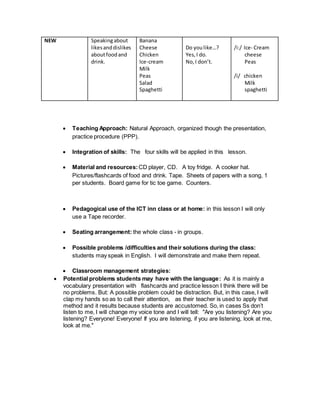
 Teaching Approach: Natural Approach, organized though the presentation,
practice procedure (PPP).
 Integration of skills: The four skills will be applied in this lesson.
 Material and resources:CD player, CD. A toy fridge. A cooker hat.
Pictures/flashcards of food and drink. Tape. Sheets of papers with a song, 1
per students. Board game for tic toe game. Counters.
 Pedagogical use of the ICT inn class or at home: in this lesson I will only
use a Tape recorder.
 Seating arrangement: the whole class - in groups.
 Possible problems /difficulties and their solutions during the class:
students may speak in English. I will demonstrate and make them repeat.
 Classroom management strategies:
 Potential problems students may have with the language: As it is mainly a
vocabulary presentation with flashcards and practice lesson I think there will be
no problems. But: A possible problem could be distraction. But, in this case, I will
clap my hands so as to call their attention, as their teacher is used to apply that
method and it results because students are accustomed. So, in cases Ss don’t
listen to me, I will change my voice tone and I will tell: "Are you listening? Are you
listening? Everyone! Everyone! If you are listening, if you are listening, look at me,
look at me."
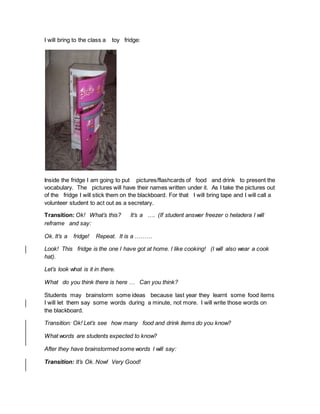
 Assessment: What will be assessed and how. I T will checkSs understandthe
namesof the differentfoodthembylisteningtothemwhenthey are completingthe song
or playingthe tic– tic – toe – game.
WARM UP:
Timing: 5 minutes.
Purpose: to start the lesson, to get students into the mood of work, establish rapport.
I will present myself telling the students my name. (They already know it because the
teacher of the course has already introduced me during the observation classes,
however I think it worth remembering them my name and the structure: My name
is…. )
Hello! Children Do you remember my name?
My name is ……
(If they do not remember I will tell them that my name is Maria Ines)
Routine: For this routine I will separate the classroom in two halves. Students will be
sat at their desks. I am going to play the tape twice, so the first time half of the class
will sing the first two stanzas and the other half will sing the last two stanzas of the song.
Te second time roles will be inverted.
Transition: Ok children, we are going to sing the Hello song:
Hello! Hello!
How are you today?
I’m fine, I’m fine
And you how are you
Taken from: Singing Songs: The Teacher’s magazine: EDIBA)
Transition: Well done! Boys and girls! Excellent!
PRESENTATION
Timing 15 minutes.
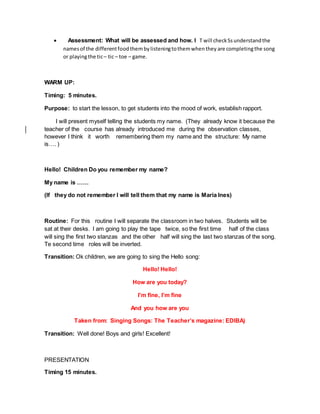
I will bring to the class a toy fridge:
Inside the fridge I am going to put pictures/flashcards of food and drink to present the
vocabulary. The pictures will have their names written under it. As I take the pictures out
of the fridge I will stick them on the blackboard. For that I will bring tape and I will call a
volunteer student to act out as a secretary.
Transition: Ok! What’s this? It’s a …. (If student answer freezer o heladera I will
reframe and say:
Ok. It’s a fridge! Repeat. It is a ………
Look! This fridge is the one I have got at home. I like cooking! (I will also wear a cook
hat).
Let’s look what is it in there.
What do you think there is here … Can you think?
Students may brainstorm some ideas because last year they learnt some food items
I will let them say some words during a minute, not more. I will write those words on
the blackboard.
Transition: Ok! Let’s see how many food and drink items do you know?
What words are students expected to know?
After they have brainstormed some words I will say:
Transition: It’s Ok. Now! Very Good!
Now! Let’s look what is in there in my fridge!
(I will open the fridge and then I will take some pictures out of it.)
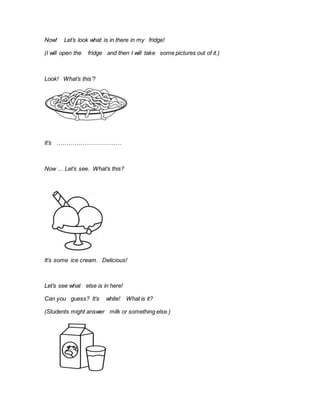
Look! What’s this’?
It’s ……………………………
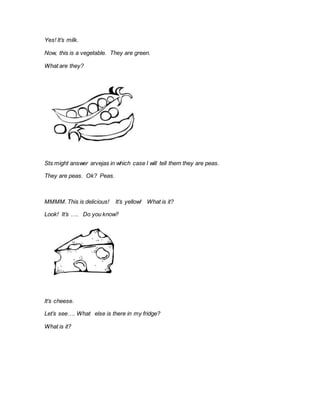
Now … Let’s see. What’s this?
It’s some ice cream. Delicious!
Let’s see what else is in here!
Can you guess? It’s white! What is it?
(Students might answer milk or something else.)
Yes! It’s milk.
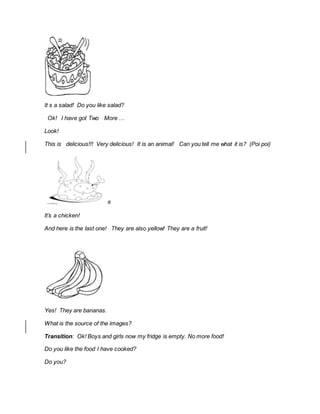
Now, this is a vegetable. They are green.
What are they?
Sts might answer arvejas in which case I will tell them they are peas.
They are peas. Ok? Peas.
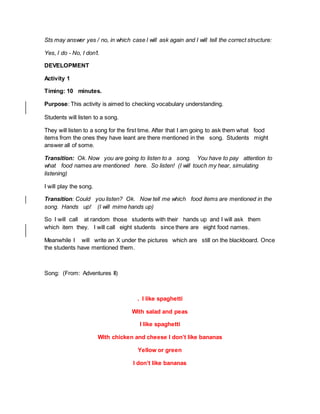
MMMM. This is delicious! It’s yellow! What is it?
Look! It’s …. Do you know?
It’s cheese.
Let’s see…. What else is there in my fridge?
What is it?
It s a salad! Do you like salad?
Ok! I have got Two More …
Look!
This is delicious!!! Very delicious! It is an animal! Can you tell me what it is? (Poi poi)
It’s a chicken!
And here is the last one! They are also yellow! They are a fruit!
Yes! They are bananas.
What is the source of the images?
Transition: Ok! Boys and girls now my fridge is empty. No more food!
Do you like the food I have cooked?
Do you?
Sts may answer yes / no, in which case I will ask again and I will tell the correct structure:
Yes, I do - No, I don’t.
DEVELOPMENT
Activity 1
Timing: 10 minutes.
Purpose: This activity is aimed to checking vocabulary understanding.
Students will listen to a song.
They will listen to a song for the first time. After that I am going to ask them what food
items from the ones they have leant are there mentioned in the song. Students might
answer all of some.
Transition: Ok. Now you are going to listen to a song. You have to pay attention to
what food names are mentioned here. So listen! (I will touch my hear, simulating
listening)
I will play the song.
Transition: Could you listen? Ok. Now tell me which food items are mentioned in the
song. Hands up! (I will mime hands up)
So I will call at random those students with their hands up and I will ask them
which item they. I will call eight students since there are eight food names.
Meanwhile I will write an X under the pictures which are still on the blackboard. Once
the students have mentioned them.
Song: (From: Adventures II)
. I like spaghetti
With salad and peas
I like spaghetti
With chicken and cheese I don’t like bananas
Yellow or green
I don’t like bananas
With milk or ice cream.
Once they have mentioned all / some of the food items I will play the song again in order
to check.
Activity 2.
Timing 10 minutes plus
Purpose: to go on working with vocabulary understanding.
Students will continue working with the same song but this time in groups of 4 / 5
students.
I will give one envelope per group, each envelope containing the lines of the song but
incomplete. Students will have to listen to the song and fill in the blanks with the missing
food items.
Then, they will have to match words and pictures.
Transition: Ok! Children. Now you are going to listen to the song again. Now you
have aworksheet. You have to match the food item with the correct place where they go.
So please. Listen carefully. Will they write down the words? How will they know the correct
spelling?
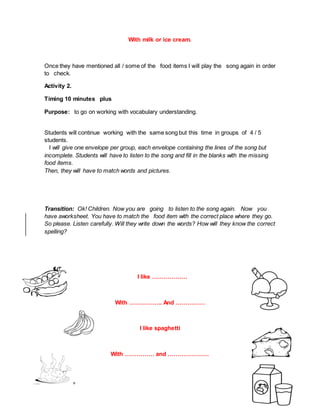
I like ………………
With …………….. And ……………
I like spaghetti
With …………… and …………………
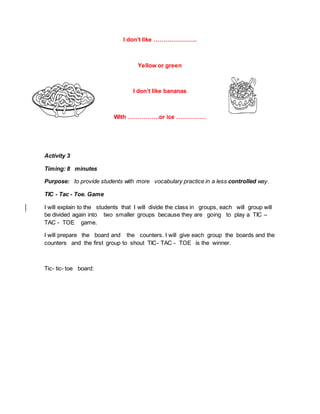
I don’t like ………………….
Yellow or green
I don’t like bananas
With …………….or ice ……………
Activity 3
Timing: 8 minutes
Purpose: to provide students with more vocabulary practice in a less controlled way.
TIC - Tac - Toe. Game
I will explain to the students that I will divide the class in groups, each will group will
be divided again into two smaller groups because they are going to play a TIC –
TAC - TOE game.
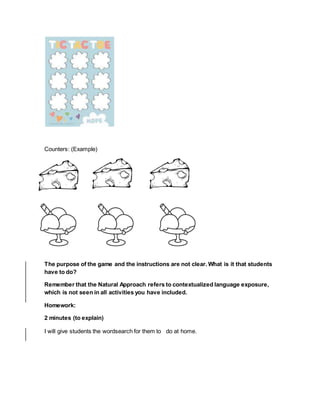
I will prepare the board and the counters. I will give each group the boards and the
counters and the first group to shout TIC- TAC - TOE is the winner.
Tic- tic- toe board:
Counters: (Example)
The purpose of the game and the instructions are not clear. What is it that students
have to do?
Remember that the Natural Approach refers to contextualized language exposure,
which is not seen in all activities you have included.
Homework:
2 minutes (to explain)
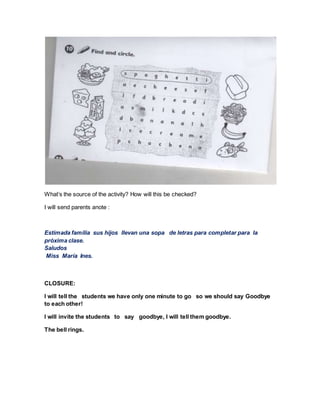
I will give students the wordsearch for them to do at home.
What’s the source of the activity? How will this be checked?
I will send parents anote :
Estimada familia sus hijos llevan una sopa de letras para completar para la
próxima clase.
Saludos
Miss María Ines.
CLOSURE:
I will tell the students we have only one minute to go so we should say Goodbye
to each other!
I will invite the students to say goodbye, I will tell them goodbye.
The bell rings.
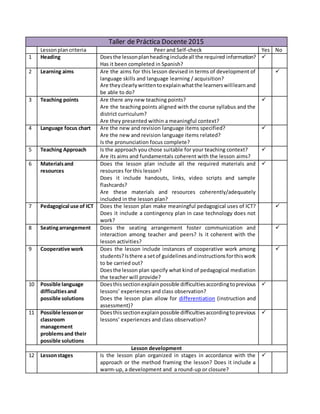
Taller de Práctica Docente 2015
Lessonplancriteria Peer and Self-check Yes No
1 Heading Doesthe lessonplanheadingincludeall the required information?
Has it been completed in Spanish?

2 Learning aims Are the aims for this lesson devised in terms of development of
language skills and language learning / acquisition?
Are theyclearlywrittentoexplainwhatthe learnerswilllearnand
be able to do?

3 Teaching points Are there any new teaching points?
Are the teaching points aligned with the course syllabus and the
district curriculum?
Are they presented within a meaningful context?

4 Language focus chart Are the new and revision language items specified?
Are the new and revision language items related?
Is the pronunciation focus complete?

5 Teaching Approach Is the approach you chose suitable for your teaching context?
Are its aims and fundamentals coherent with the lesson aims?

6 Materialsand
resources
Does the lesson plan include all the required materials and
resources for this lesson?
Does it include handouts, links, video scripts and sample
flashcards?
Are these materials and resources coherently/adequately
included in the lesson plan?

7 Pedagogical use of ICT Does the lesson plan make meaningful pedagogical uses of ICT?
Does it include a contingency plan in case technology does not
work?

8 Seatingarrangement Does the seating arrangement foster communication and
interaction among teacher and peers? Is it coherent with the
lesson activities?

9 Cooperative work Does the lesson include instances of cooperative work among
students?Isthere a setof guidelinesandinstructionsforthiswork
to be carried out?
Doesthe lesson plan specify what kind of pedagogical mediation
the teacher will provide?

10 Possible language
difficultiesand
possible solutions
Doesthissectionexplainpossible difficultiesaccordingtoprevious
lessons’ experiences and class observation?
Does the lesson plan allow for differentiation (instruction and
assessment)?

11 Possible lessonor
classroom
management
problemsand their
possible solutions
Doesthissectionexplainpossible difficultiesaccordingtoprevious
lessons’ experiences and class observation?

Lesson development
12 Lessonstages Is the lesson plan organized in stages in accordance with the
approach or the method framing the lesson? Does it include a
warm-up, a development and a round-up or closure?

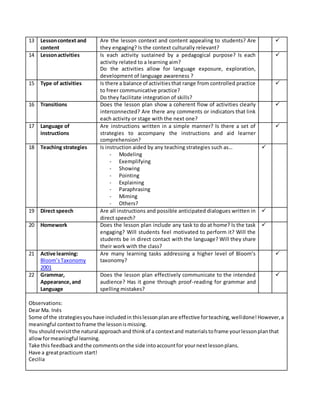
13 Lessoncontext and
content
Are the lesson context and content appealing to students? Are
they engaging? Is the context culturally relevant?

14 Lessonactivities Is each activity sustained by a pedagogical purpose? Is each
activity related to a learning aim?
Do the activities allow for language exposure, exploration,
development of language awareness ?

15 Type of activities Is there a balance of activitiesthat range from controlled practice
to freer communicative practice?
Do they facilitate integration of skills?

16 Transitions Does the lesson plan show a coherent flow of activities clearly
interconnected? Are there any comments or indicators that link
each activity or stage with the next one?

17 Language of
instructions
Are instructions written in a simple manner? Is there a set of
strategies to accompany the instructions and aid learner
comprehension?

18 Teaching strategies Is instruction aided by any teaching strategies such as…
- Modeling
- Exemplifying
- Showing
- Pointing
- Explaining
- Paraphrasing
- Miming
- Others?

19 Direct speech Are all instructions and possible anticipated dialogues written in
direct speech?

20 Homework Does the lesson plan include any task to do at home? Is the task
engaging? Will students feel motivated to perform it? Will the
students be in direct contact with the language? Will they share
their work with the class?

21 Active learning:
Bloom’sTaxonomy
2001
Are many learning tasks addressing a higher level of Bloom’s
taxonomy?

22 Grammar,
Appearance,and
Language
Does the lesson plan effectively communicate to the intended
audience? Has it gone through proof-reading for grammar and
spelling mistakes?

Observations:
Dear Ma. Inés
Some of the strategiesyouhave includedin thislessonplanare effective forteaching,welldone!However,a
meaningful contexttoframe the lessonismissing.
You shouldrevisitthe natural approachand thinkof a contextand materialstoframe yourlessonplanthat
allowformeaningful learning.
Take this feedbackandthe commentsonthe side intoaccountfor yournextlessonplans.
Have a greatpracticum start!
Cecilia
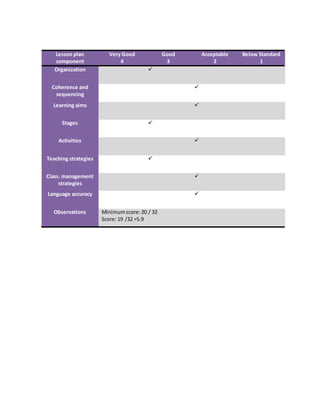
Lesson plan
component
Very Good
4
Good
3
Acceptable
2
Below Standard
1
Organization 
Coherence and
sequencing

Learning aims 
Stages 
Activities 
Teaching strategies 
Class. management
strategies

Language accuracy 
Observations Minimumscore:20 / 32
Score:19 /32 =5.9

Tdp trech-1st-llesson-plan-primaria-class-1-5.9

  • 1.
    IFDC LENGUASVIVAS TALLER DEPRÁCTICA DOCENTE III ALUMNOPRACTICANTE: MARIA INES TRECH Período de Práctica: Escuela Primaria Institución Educativa: Escuela Manuel Belgrano – DIPREGEP Nº 662 Dirección: Costa Y Lequerica Sala / Grado / Año – sección: 5to año A Cantidad de alumnos: 30 alumnos Nivel lingüístico de los cursos: beginners Tipo de Planificación: Diaria Unidad Temática: “Las comidas” Clase N°: 1 Fecha: 6 de julio 2015 Hora: de 13.30 a 14.20 hs Duración de la clase: 50 minutos Fecha de primera entrega: 29 de junio Teaching points: Foodand drink(Banana,Cheese,Chicken, Ice-cream,Milk,Peas, Salad, spaghetti)  Aims: Duringthislesson:  Learnerswill be able to identify somefoodand drink ina meaningfulcontext.  Theywill revise the vocabulary itemsseenlastyear.  Theywill developlistening speaking, readingandwritingskills.  Language focus: FUNCTIONS LEXIS STUCTURES PRONUNCIATION REVISION Look! Listen! Colours What’sthis? It’sa … It’san … What are these? Theyare …
  • 2.
    NEW Speakingabout likesanddislikes aboutfoodand drink. Banana Cheese Chicken Ice-cream Milk Peas Salad Spaghetti Do youlike…? Yes,Ido. No,I don’t. /i:/ Ice- Cream cheese Peas /i/ chicken Milk spaghetti  Teaching Approach: Natural Approach, organized though the presentation, practice procedure (PPP).  Integration of skills: The four skills will be applied in this lesson.  Material and resources:CD player, CD. A toy fridge. A cooker hat. Pictures/flashcards of food and drink. Tape. Sheets of papers with a song, 1 per students. Board game for tic toe game. Counters.  Pedagogical use of the ICT inn class or at home: in this lesson I will only use a Tape recorder.  Seating arrangement: the whole class - in groups.  Possible problems /difficulties and their solutions during the class: students may speak in English. I will demonstrate and make them repeat.  Classroom management strategies:  Potential problems students may have with the language: As it is mainly a vocabulary presentation with flashcards and practice lesson I think there will be no problems. But: A possible problem could be distraction. But, in this case, I will clap my hands so as to call their attention, as their teacher is used to apply that method and it results because students are accustomed. So, in cases Ss don’t listen to me, I will change my voice tone and I will tell: "Are you listening? Are you listening? Everyone! Everyone! If you are listening, if you are listening, look at me, look at me."
  • 3.
     Assessment: Whatwill be assessed and how. I T will checkSs understandthe namesof the differentfoodthembylisteningtothemwhenthey are completingthe song or playingthe tic– tic – toe – game. WARM UP: Timing: 5 minutes. Purpose: to start the lesson, to get students into the mood of work, establish rapport. I will present myself telling the students my name. (They already know it because the teacher of the course has already introduced me during the observation classes, however I think it worth remembering them my name and the structure: My name is…. ) Hello! Children Do you remember my name? My name is …… (If they do not remember I will tell them that my name is Maria Ines) Routine: For this routine I will separate the classroom in two halves. Students will be sat at their desks. I am going to play the tape twice, so the first time half of the class will sing the first two stanzas and the other half will sing the last two stanzas of the song. Te second time roles will be inverted. Transition: Ok children, we are going to sing the Hello song: Hello! Hello! How are you today? I’m fine, I’m fine And you how are you Taken from: Singing Songs: The Teacher’s magazine: EDIBA) Transition: Well done! Boys and girls! Excellent! PRESENTATION Timing 15 minutes.
  • 4.
    I will bringto the class a toy fridge: Inside the fridge I am going to put pictures/flashcards of food and drink to present the vocabulary. The pictures will have their names written under it. As I take the pictures out of the fridge I will stick them on the blackboard. For that I will bring tape and I will call a volunteer student to act out as a secretary. Transition: Ok! What’s this? It’s a …. (If student answer freezer o heladera I will reframe and say: Ok. It’s a fridge! Repeat. It is a ……… Look! This fridge is the one I have got at home. I like cooking! (I will also wear a cook hat). Let’s look what is it in there. What do you think there is here … Can you think? Students may brainstorm some ideas because last year they learnt some food items I will let them say some words during a minute, not more. I will write those words on the blackboard. Transition: Ok! Let’s see how many food and drink items do you know? What words are students expected to know? After they have brainstormed some words I will say: Transition: It’s Ok. Now! Very Good!
  • 5.
    Now! Let’s lookwhat is in there in my fridge! (I will open the fridge and then I will take some pictures out of it.) Look! What’s this’? It’s …………………………… Now … Let’s see. What’s this? It’s some ice cream. Delicious! Let’s see what else is in here! Can you guess? It’s white! What is it? (Students might answer milk or something else.)
  • 6.
    Yes! It’s milk. Now,this is a vegetable. They are green. What are they? Sts might answer arvejas in which case I will tell them they are peas. They are peas. Ok? Peas. MMMM. This is delicious! It’s yellow! What is it? Look! It’s …. Do you know? It’s cheese. Let’s see…. What else is there in my fridge? What is it?
  • 7.
    It s asalad! Do you like salad? Ok! I have got Two More … Look! This is delicious!!! Very delicious! It is an animal! Can you tell me what it is? (Poi poi) It’s a chicken! And here is the last one! They are also yellow! They are a fruit! Yes! They are bananas. What is the source of the images? Transition: Ok! Boys and girls now my fridge is empty. No more food! Do you like the food I have cooked? Do you?
  • 8.
    Sts may answeryes / no, in which case I will ask again and I will tell the correct structure: Yes, I do - No, I don’t. DEVELOPMENT Activity 1 Timing: 10 minutes. Purpose: This activity is aimed to checking vocabulary understanding. Students will listen to a song. They will listen to a song for the first time. After that I am going to ask them what food items from the ones they have leant are there mentioned in the song. Students might answer all of some. Transition: Ok. Now you are going to listen to a song. You have to pay attention to what food names are mentioned here. So listen! (I will touch my hear, simulating listening) I will play the song. Transition: Could you listen? Ok. Now tell me which food items are mentioned in the song. Hands up! (I will mime hands up) So I will call at random those students with their hands up and I will ask them which item they. I will call eight students since there are eight food names. Meanwhile I will write an X under the pictures which are still on the blackboard. Once the students have mentioned them. Song: (From: Adventures II) . I like spaghetti With salad and peas I like spaghetti With chicken and cheese I don’t like bananas Yellow or green I don’t like bananas
  • 9.
    With milk orice cream. Once they have mentioned all / some of the food items I will play the song again in order to check. Activity 2. Timing 10 minutes plus Purpose: to go on working with vocabulary understanding. Students will continue working with the same song but this time in groups of 4 / 5 students. I will give one envelope per group, each envelope containing the lines of the song but incomplete. Students will have to listen to the song and fill in the blanks with the missing food items. Then, they will have to match words and pictures. Transition: Ok! Children. Now you are going to listen to the song again. Now you have aworksheet. You have to match the food item with the correct place where they go. So please. Listen carefully. Will they write down the words? How will they know the correct spelling? I like ……………… With …………….. And …………… I like spaghetti With …………… and …………………
  • 10.
    I don’t like…………………. Yellow or green I don’t like bananas With …………….or ice …………… Activity 3 Timing: 8 minutes Purpose: to provide students with more vocabulary practice in a less controlled way. TIC - Tac - Toe. Game I will explain to the students that I will divide the class in groups, each will group will be divided again into two smaller groups because they are going to play a TIC – TAC - TOE game. I will prepare the board and the counters. I will give each group the boards and the counters and the first group to shout TIC- TAC - TOE is the winner. Tic- tic- toe board:
  • 11.
    Counters: (Example) The purposeof the game and the instructions are not clear. What is it that students have to do? Remember that the Natural Approach refers to contextualized language exposure, which is not seen in all activities you have included. Homework: 2 minutes (to explain) I will give students the wordsearch for them to do at home.
  • 12.
    What’s the sourceof the activity? How will this be checked? I will send parents anote : Estimada familia sus hijos llevan una sopa de letras para completar para la próxima clase. Saludos Miss María Ines. CLOSURE: I will tell the students we have only one minute to go so we should say Goodbye to each other! I will invite the students to say goodbye, I will tell them goodbye. The bell rings.
  • 13.
    Taller de PrácticaDocente 2015 Lessonplancriteria Peer and Self-check Yes No 1 Heading Doesthe lessonplanheadingincludeall the required information? Has it been completed in Spanish?  2 Learning aims Are the aims for this lesson devised in terms of development of language skills and language learning / acquisition? Are theyclearlywrittentoexplainwhatthe learnerswilllearnand be able to do?  3 Teaching points Are there any new teaching points? Are the teaching points aligned with the course syllabus and the district curriculum? Are they presented within a meaningful context?  4 Language focus chart Are the new and revision language items specified? Are the new and revision language items related? Is the pronunciation focus complete?  5 Teaching Approach Is the approach you chose suitable for your teaching context? Are its aims and fundamentals coherent with the lesson aims?  6 Materialsand resources Does the lesson plan include all the required materials and resources for this lesson? Does it include handouts, links, video scripts and sample flashcards? Are these materials and resources coherently/adequately included in the lesson plan?  7 Pedagogical use of ICT Does the lesson plan make meaningful pedagogical uses of ICT? Does it include a contingency plan in case technology does not work?  8 Seatingarrangement Does the seating arrangement foster communication and interaction among teacher and peers? Is it coherent with the lesson activities?  9 Cooperative work Does the lesson include instances of cooperative work among students?Isthere a setof guidelinesandinstructionsforthiswork to be carried out? Doesthe lesson plan specify what kind of pedagogical mediation the teacher will provide?  10 Possible language difficultiesand possible solutions Doesthissectionexplainpossible difficultiesaccordingtoprevious lessons’ experiences and class observation? Does the lesson plan allow for differentiation (instruction and assessment)?  11 Possible lessonor classroom management problemsand their possible solutions Doesthissectionexplainpossible difficultiesaccordingtoprevious lessons’ experiences and class observation?  Lesson development 12 Lessonstages Is the lesson plan organized in stages in accordance with the approach or the method framing the lesson? Does it include a warm-up, a development and a round-up or closure? 
  • 14.
    13 Lessoncontext and content Arethe lesson context and content appealing to students? Are they engaging? Is the context culturally relevant?  14 Lessonactivities Is each activity sustained by a pedagogical purpose? Is each activity related to a learning aim? Do the activities allow for language exposure, exploration, development of language awareness ?  15 Type of activities Is there a balance of activitiesthat range from controlled practice to freer communicative practice? Do they facilitate integration of skills?  16 Transitions Does the lesson plan show a coherent flow of activities clearly interconnected? Are there any comments or indicators that link each activity or stage with the next one?  17 Language of instructions Are instructions written in a simple manner? Is there a set of strategies to accompany the instructions and aid learner comprehension?  18 Teaching strategies Is instruction aided by any teaching strategies such as… - Modeling - Exemplifying - Showing - Pointing - Explaining - Paraphrasing - Miming - Others?  19 Direct speech Are all instructions and possible anticipated dialogues written in direct speech?  20 Homework Does the lesson plan include any task to do at home? Is the task engaging? Will students feel motivated to perform it? Will the students be in direct contact with the language? Will they share their work with the class?  21 Active learning: Bloom’sTaxonomy 2001 Are many learning tasks addressing a higher level of Bloom’s taxonomy?  22 Grammar, Appearance,and Language Does the lesson plan effectively communicate to the intended audience? Has it gone through proof-reading for grammar and spelling mistakes?  Observations: Dear Ma. Inés Some of the strategiesyouhave includedin thislessonplanare effective forteaching,welldone!However,a meaningful contexttoframe the lessonismissing. You shouldrevisitthe natural approachand thinkof a contextand materialstoframe yourlessonplanthat allowformeaningful learning. Take this feedbackandthe commentsonthe side intoaccountfor yournextlessonplans. Have a greatpracticum start! Cecilia
  • 15.
    Lesson plan component Very Good 4 Good 3 Acceptable 2 BelowStandard 1 Organization  Coherence and sequencing  Learning aims  Stages  Activities  Teaching strategies  Class. management strategies  Language accuracy  Observations Minimumscore:20 / 32 Score:19 /32 =5.9