Skills and Strategies for
Proficient Listening
By Pat Wilcox Peterson
JOVENEL B. DADULLA
MAED ENGLISH
Teaching English as a Second Language
How important is listening
in language learning?
“No other type of language input is
as easy to process as spoken
language, received through
listening.”
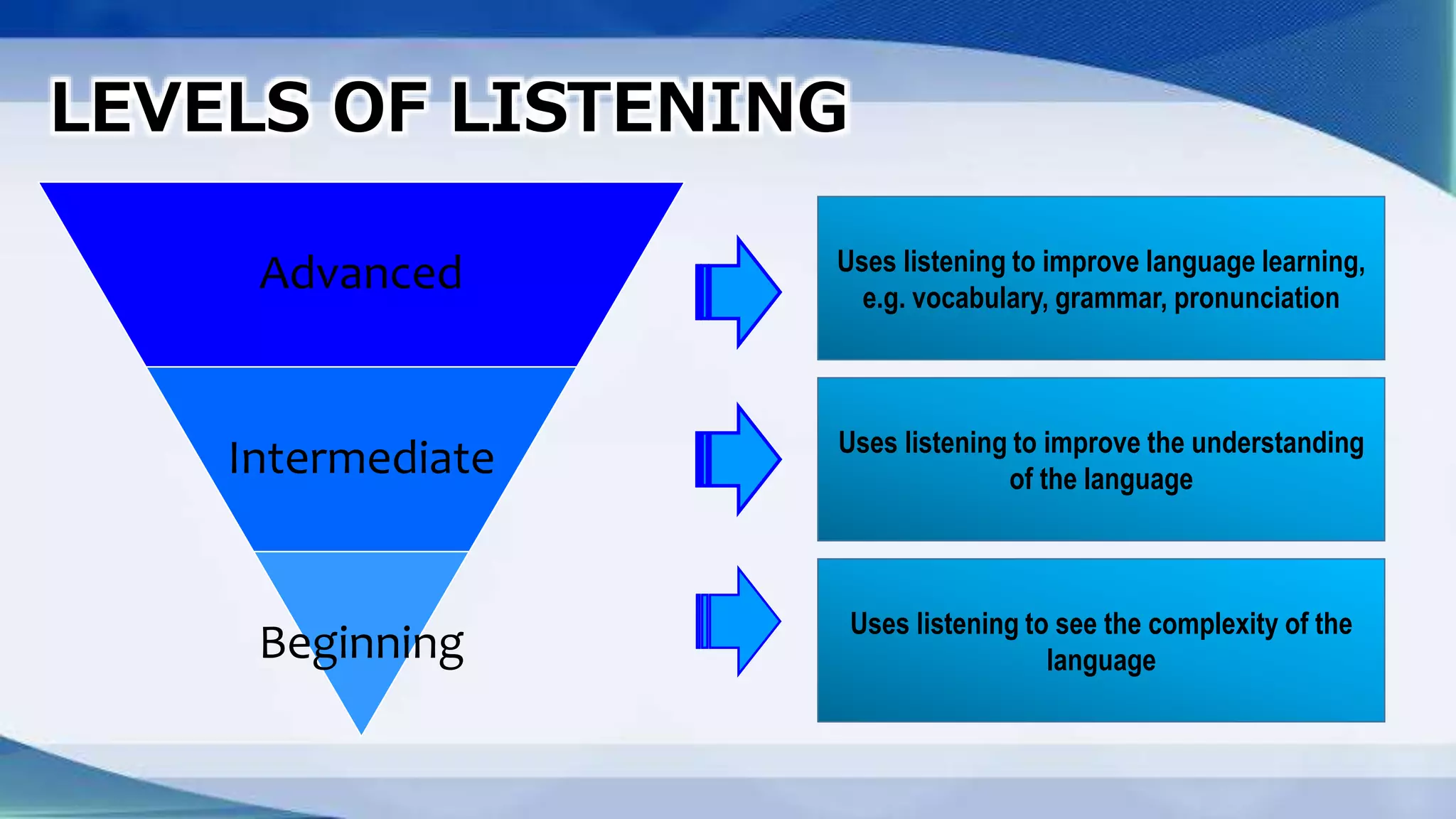
LEVELS OF LISTENING
Advanced
Intermediate
Beginning
Uses listening to improve language learning,
e.g. vocabulary, grammar, pronunciation
Uses listening to improve the understanding
of the language
Uses listening to see the complexity of the
language
THEORIES OF LANGUAGE
COMPREHENSION
THEORIES OF LANGUAGE COMPREHENSION
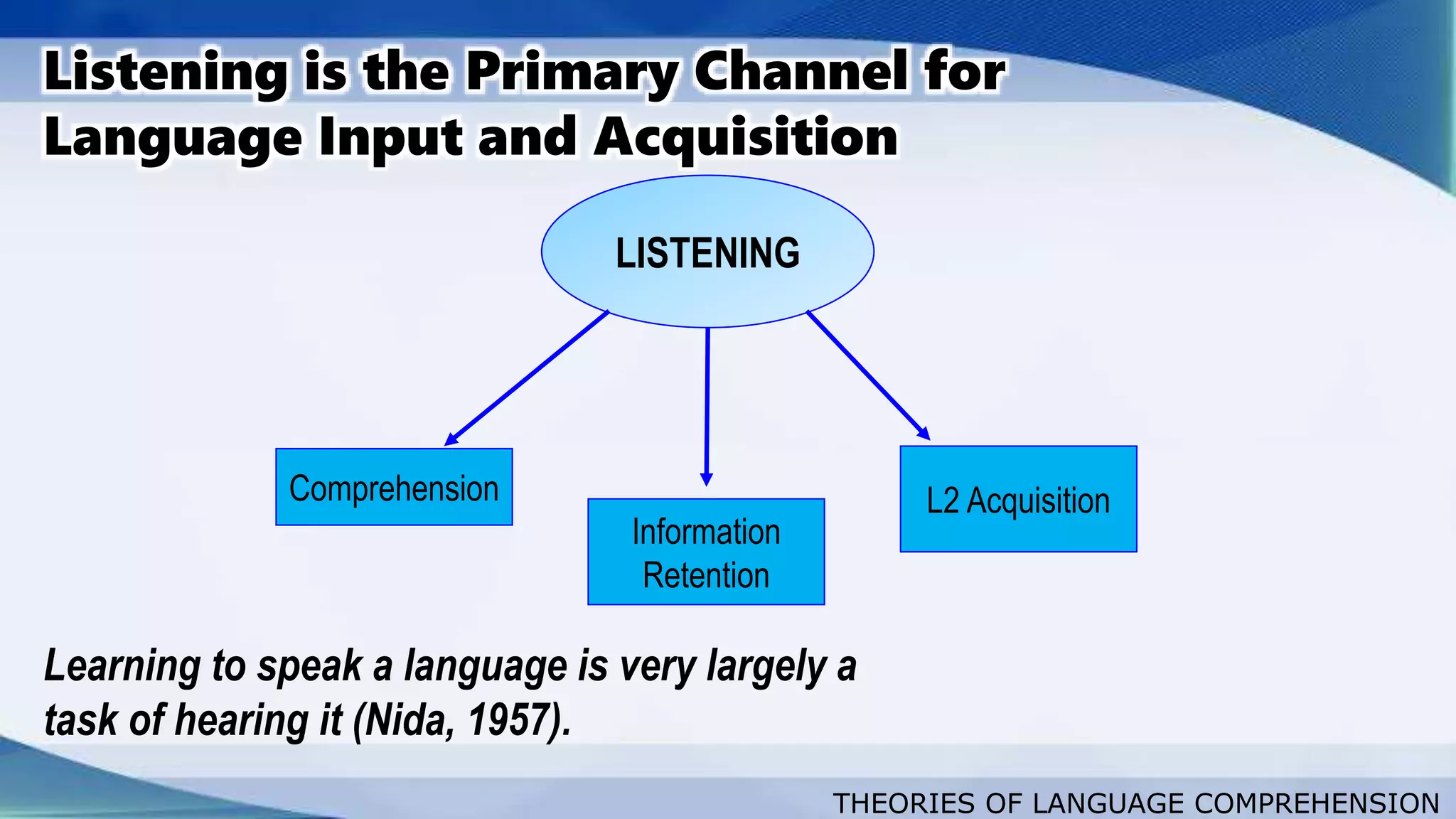
Listening is the Primary Channel for
Language Input and Acquisition
LISTENING
Comprehension
Information
Retention
L2 Acquisition
Learning to speak a language is very largely a
task of hearing it (Nida, 1957).
THEORIES OF LANGUAGE COMPREHENSION
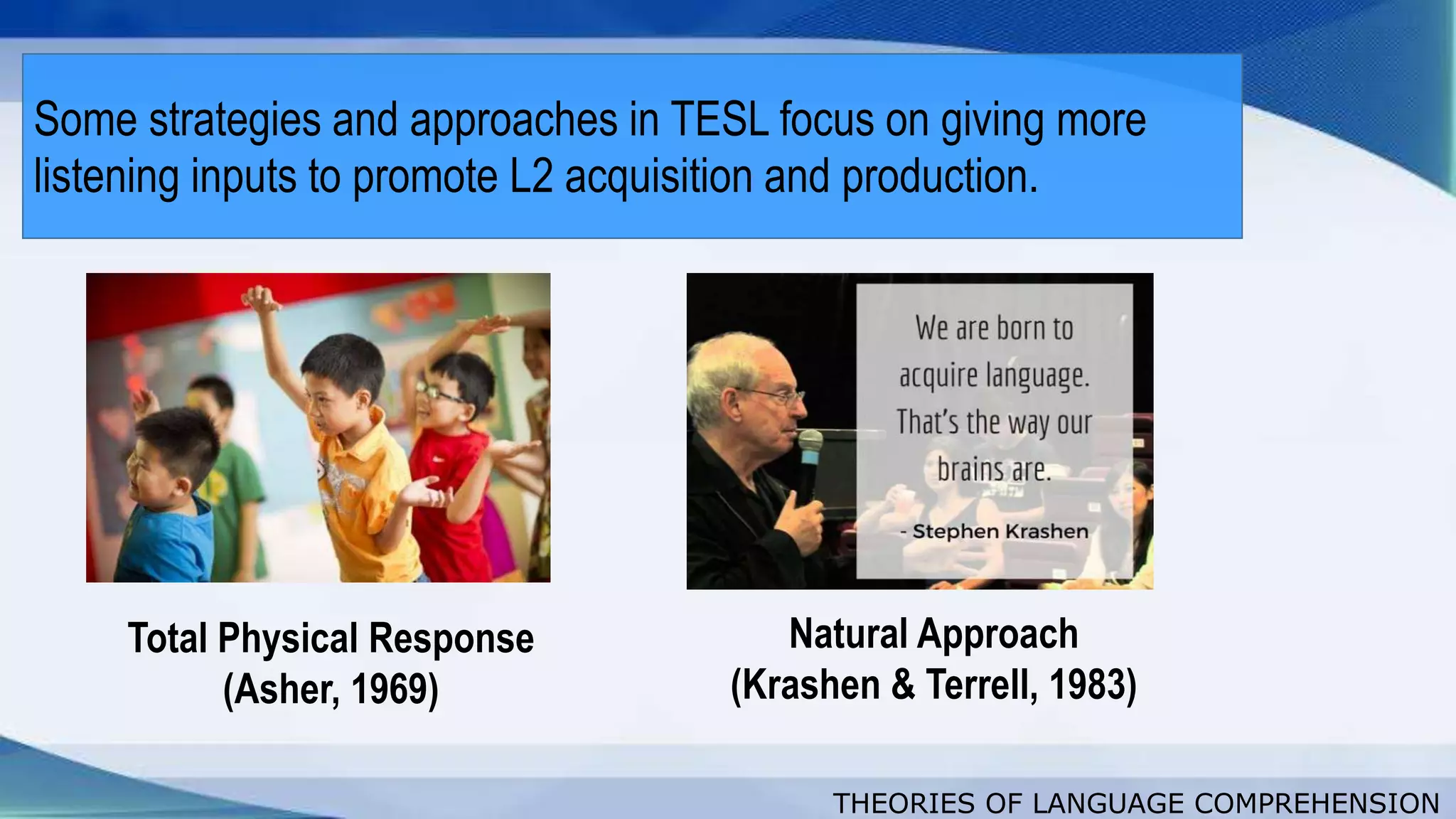
Some strategies and approaches in TESL focus on giving more
listening inputs to promote L2 acquisition and production.
Total Physical Response
(Asher, 1969)
Natural Approach
(Krashen & Terrell, 1983)
THEORIES OF LANGUAGE COMPREHENSION
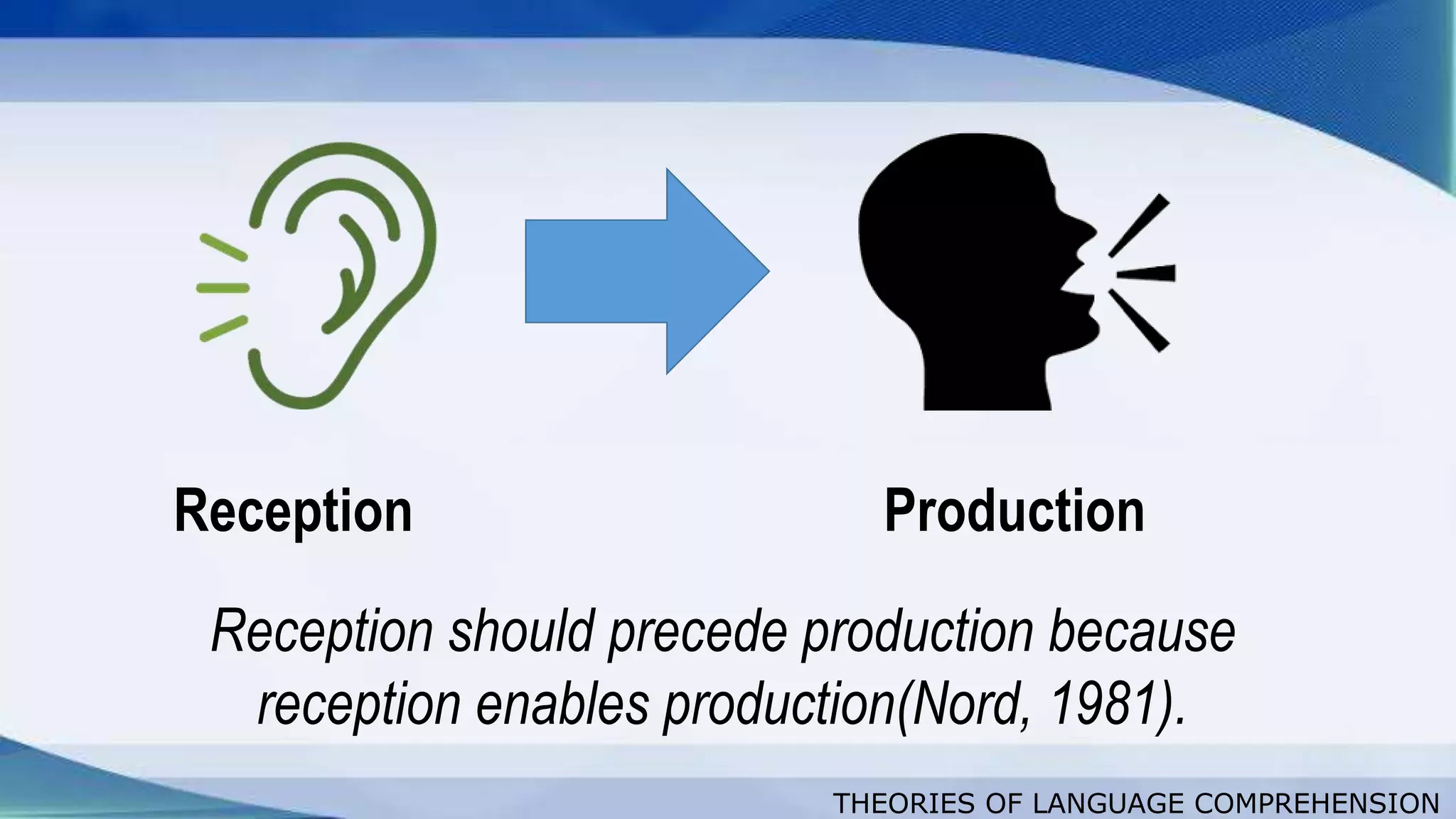
Reception Production
Reception should precede production because
reception enables production(Nord, 1981).
THEORIES OF LANGUAGE COMPREHENSION
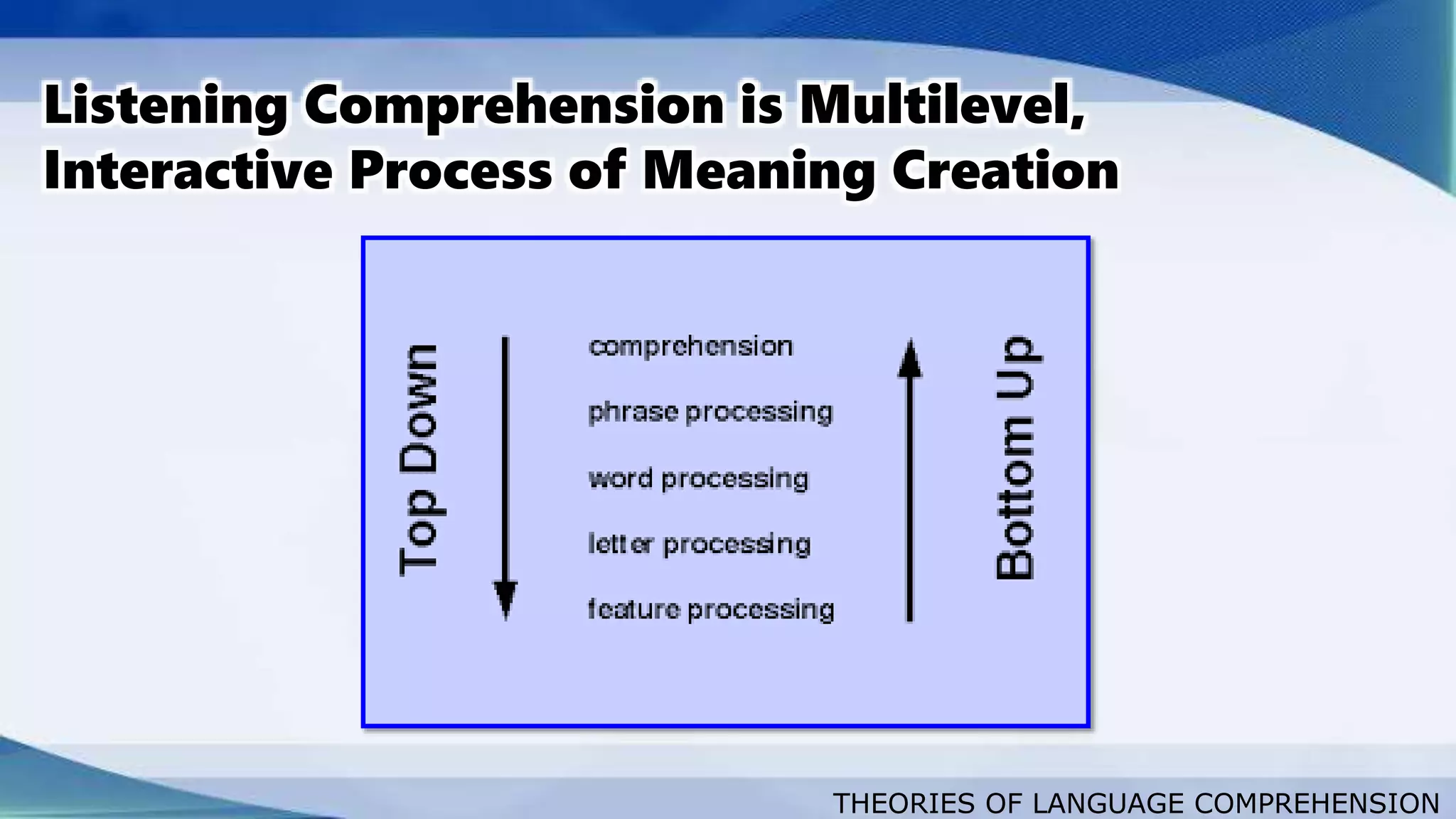
Listening Comprehension is Multilevel,
Interactive Process of Meaning Creation
THEORIES OF LANGUAGE COMPREHENSION
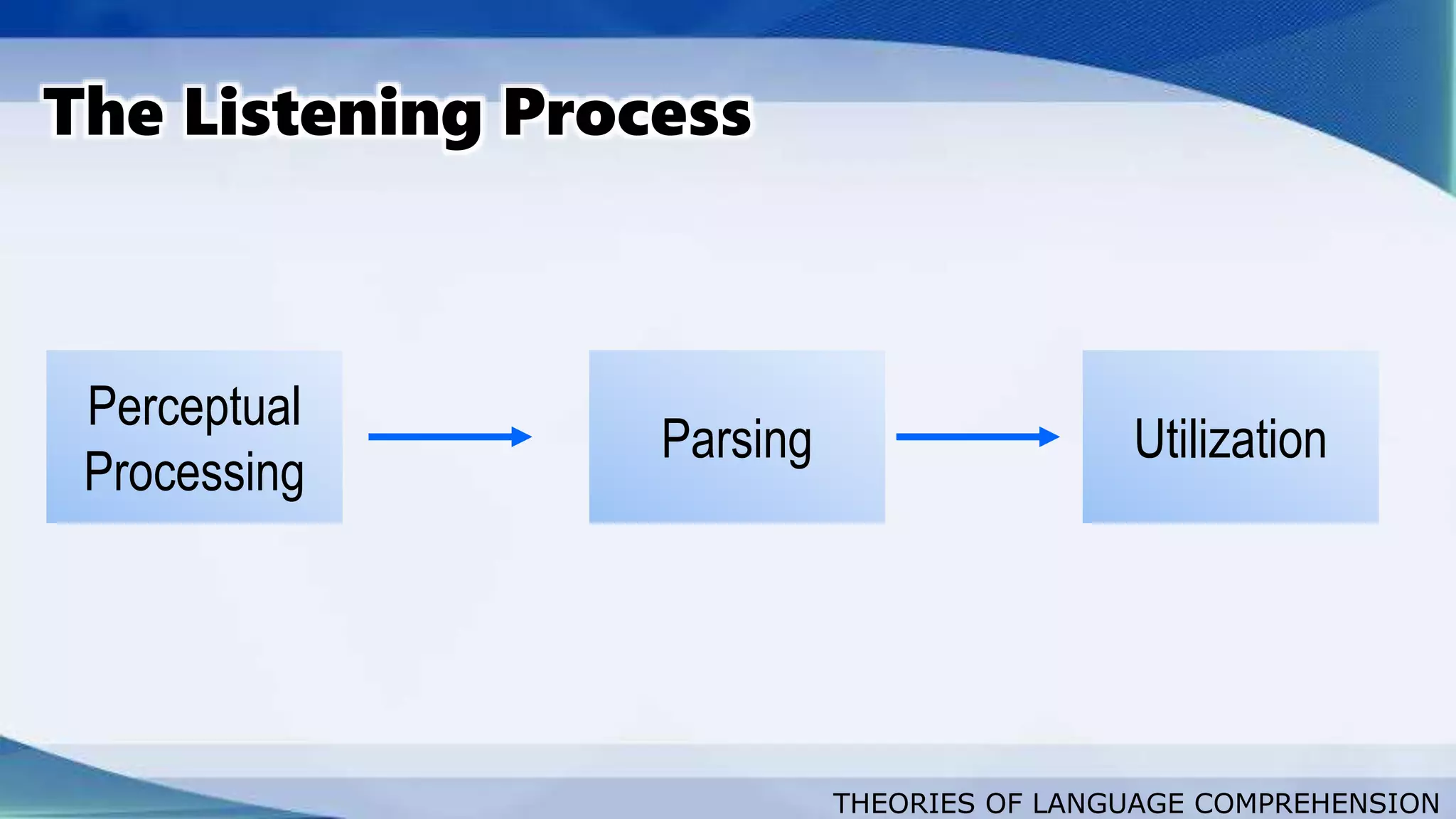
The Listening Process
Perceptual
Processing
Parsing Utilization
THEORIES OF LANGUAGE COMPREHENSION
Higher level language proficiency allows the listener to
have more time to process information received through
listening as they give little attention to specific sounds
and patterns in the L2.
LANGUAGE PROFICIENCY AND LISTENING COMPREHENSION
THEORIES OF LANGUAGE COMPREHENSION
Rumenlhart (1980) defines schema as “a data structure
for representing generic concepts stored in memory.”
THE SCHEMATA
THEORIES OF LANGUAGE COMPREHENSION
Models of Listening
Comprehension
THEORIES OF LANGUAGE COMPREHENSION
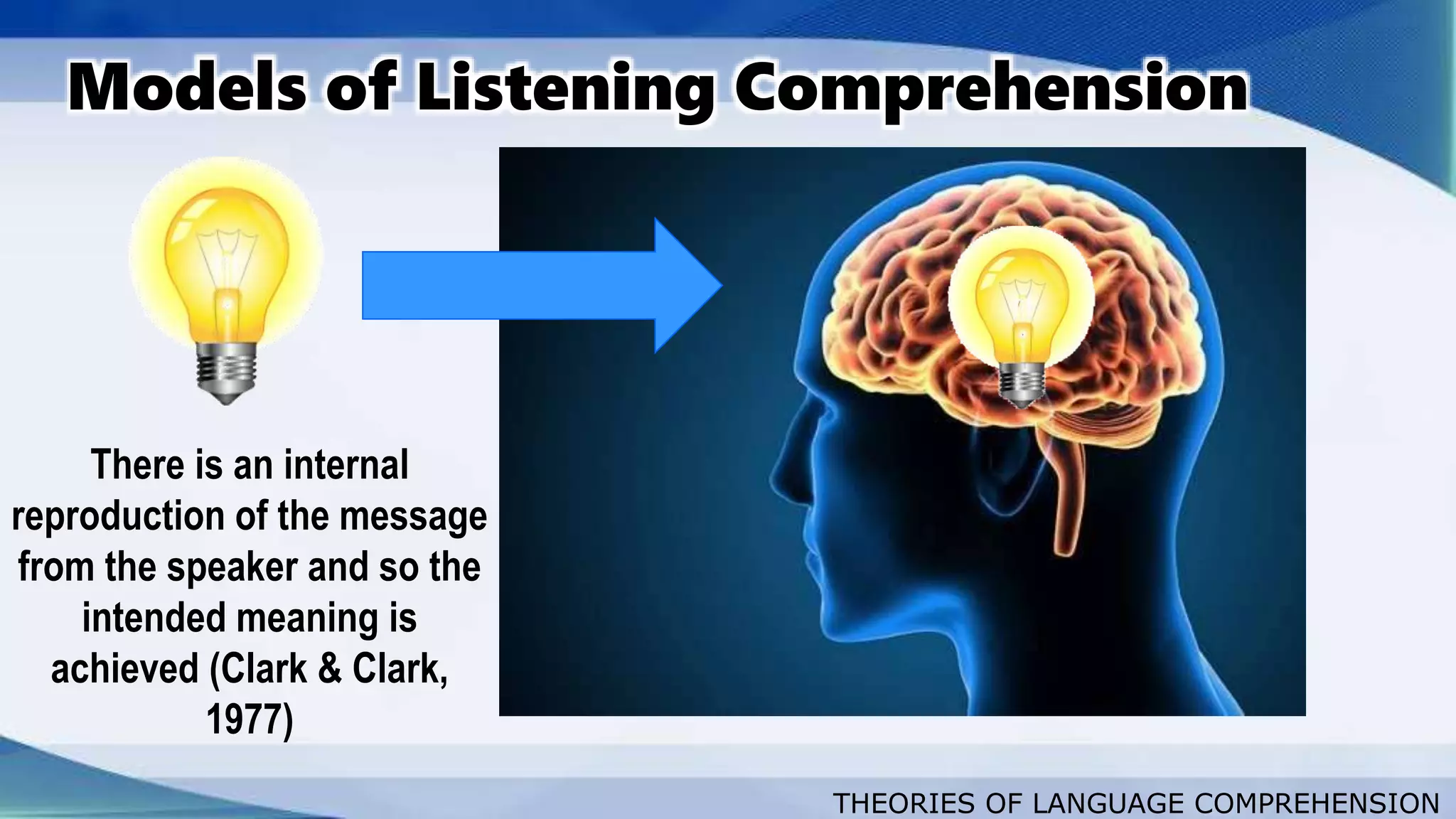
Models of Listening Comprehension
There is an internal
reproduction of the message
from the speaker and so the
intended meaning is
achieved (Clark & Clark,
1977)
THEORIES OF LANGUAGE COMPREHENSION
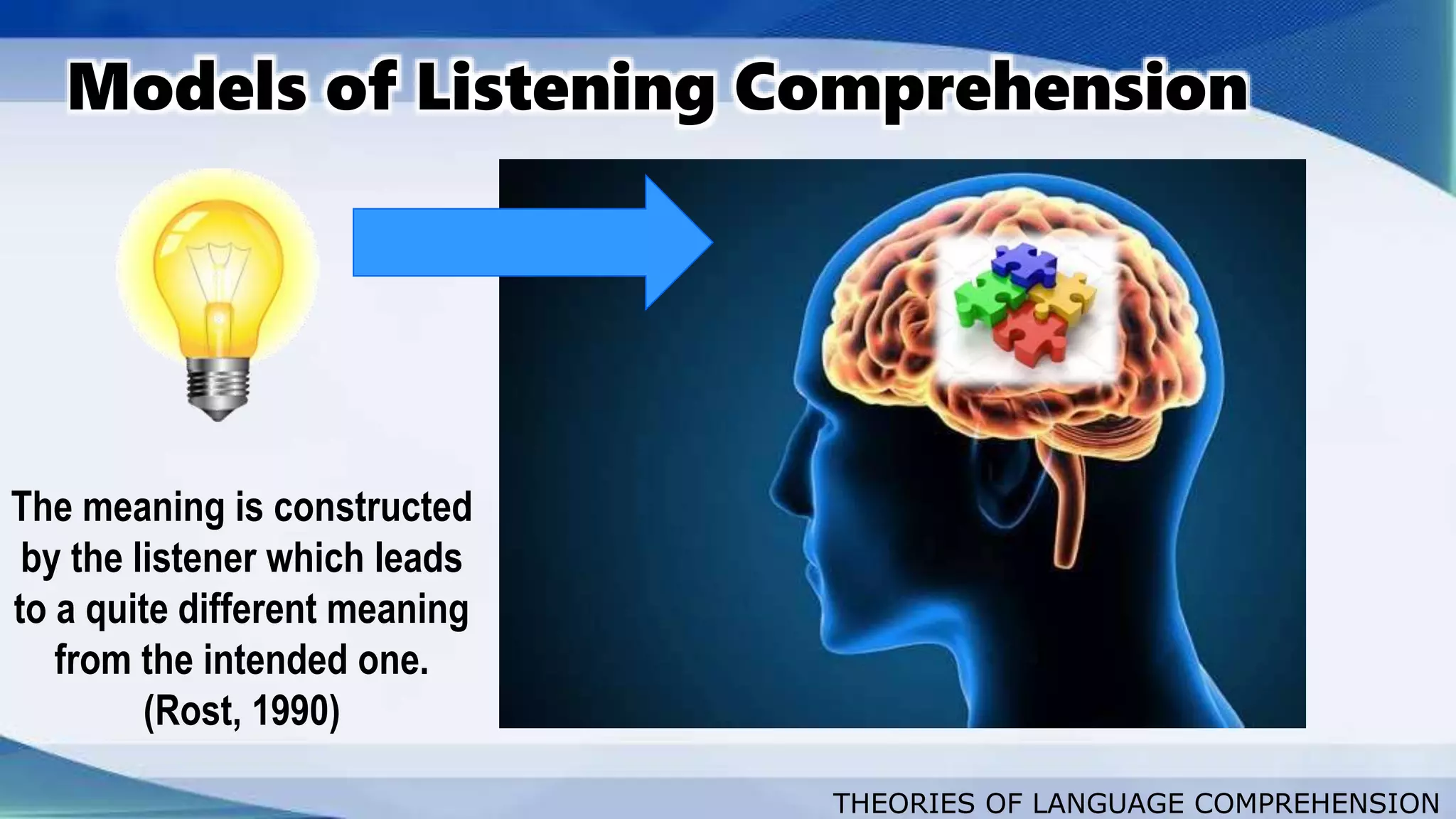
Models of Listening Comprehension
The meaning is constructed
by the listener which leads
to a quite different meaning
from the intended one.
(Rost, 1990)
THEORIES OF LANGUAGE COMPREHENSION
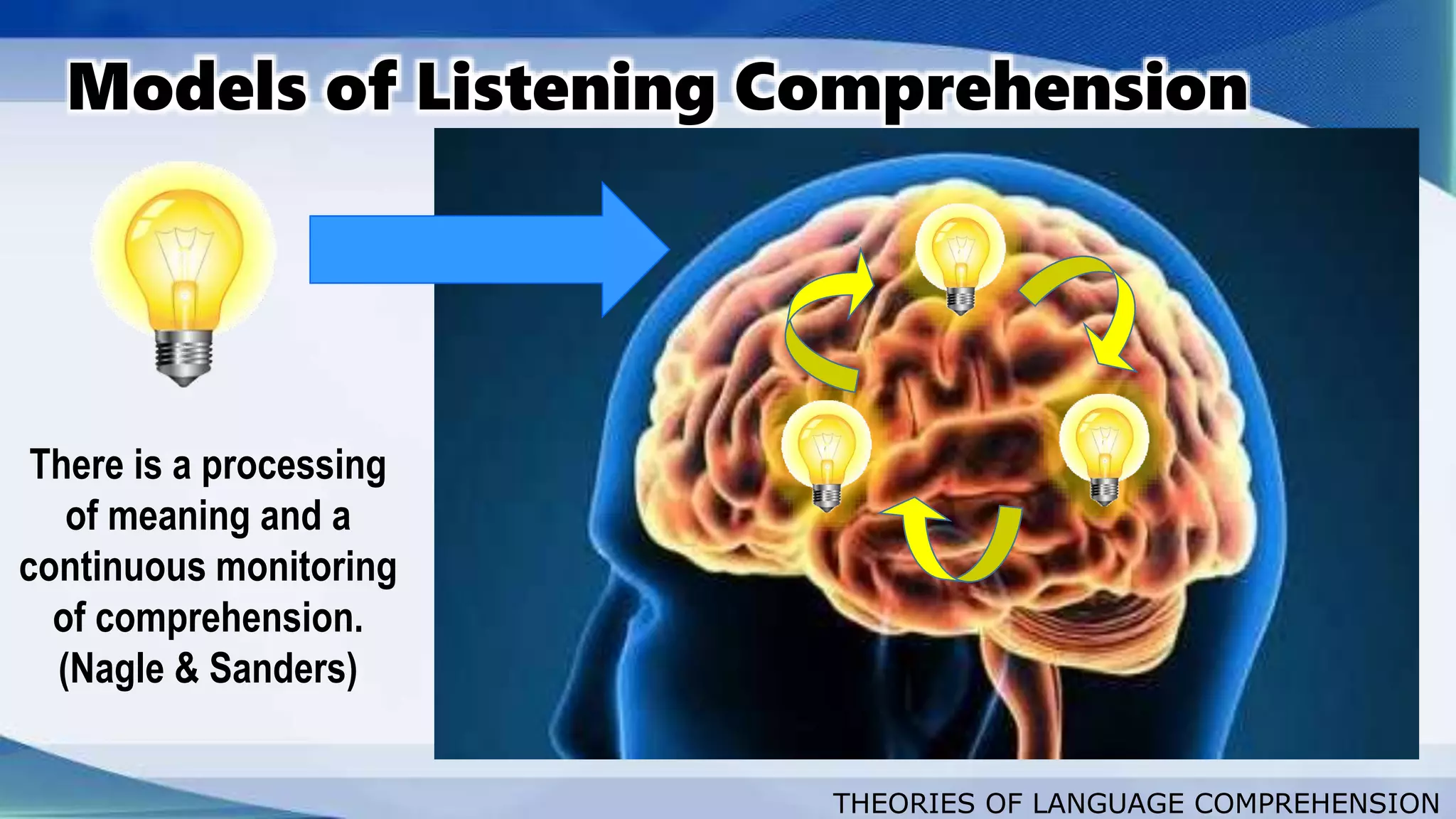
Models of Listening Comprehension
There is a processing
of meaning and a
continuous monitoring
of comprehension.
(Nagle & Sanders)
THEORIES OF LANGUAGE COMPREHENSION
Principles for Listening
in the Classroom
THEORIES OF LANGUAGE COMPREHENSION
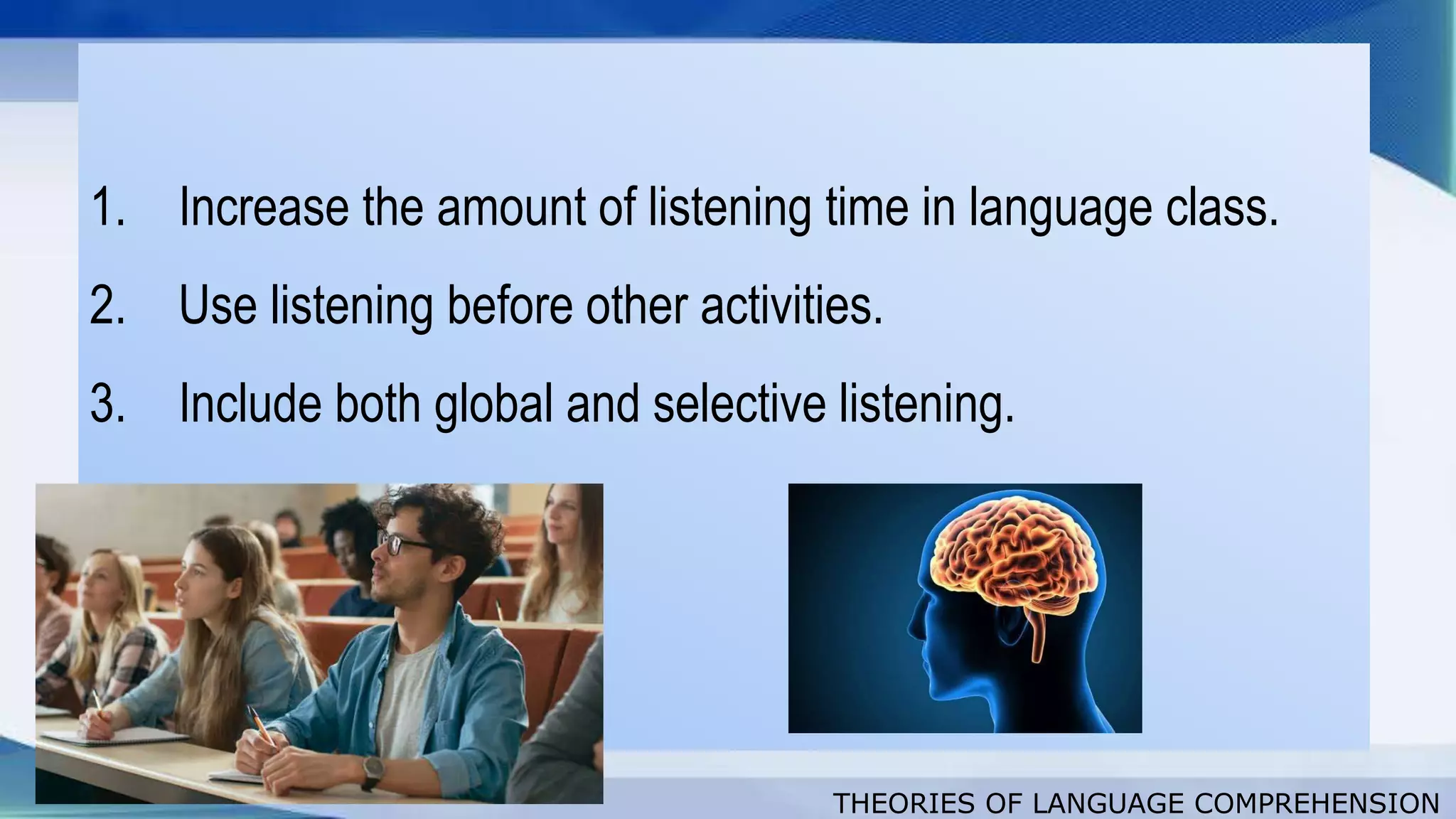
1. Increase the amount of listening time in language class.
2. Use listening before other activities.
3. Include both global and selective listening.
THEORIES OF LANGUAGE COMPREHENSION
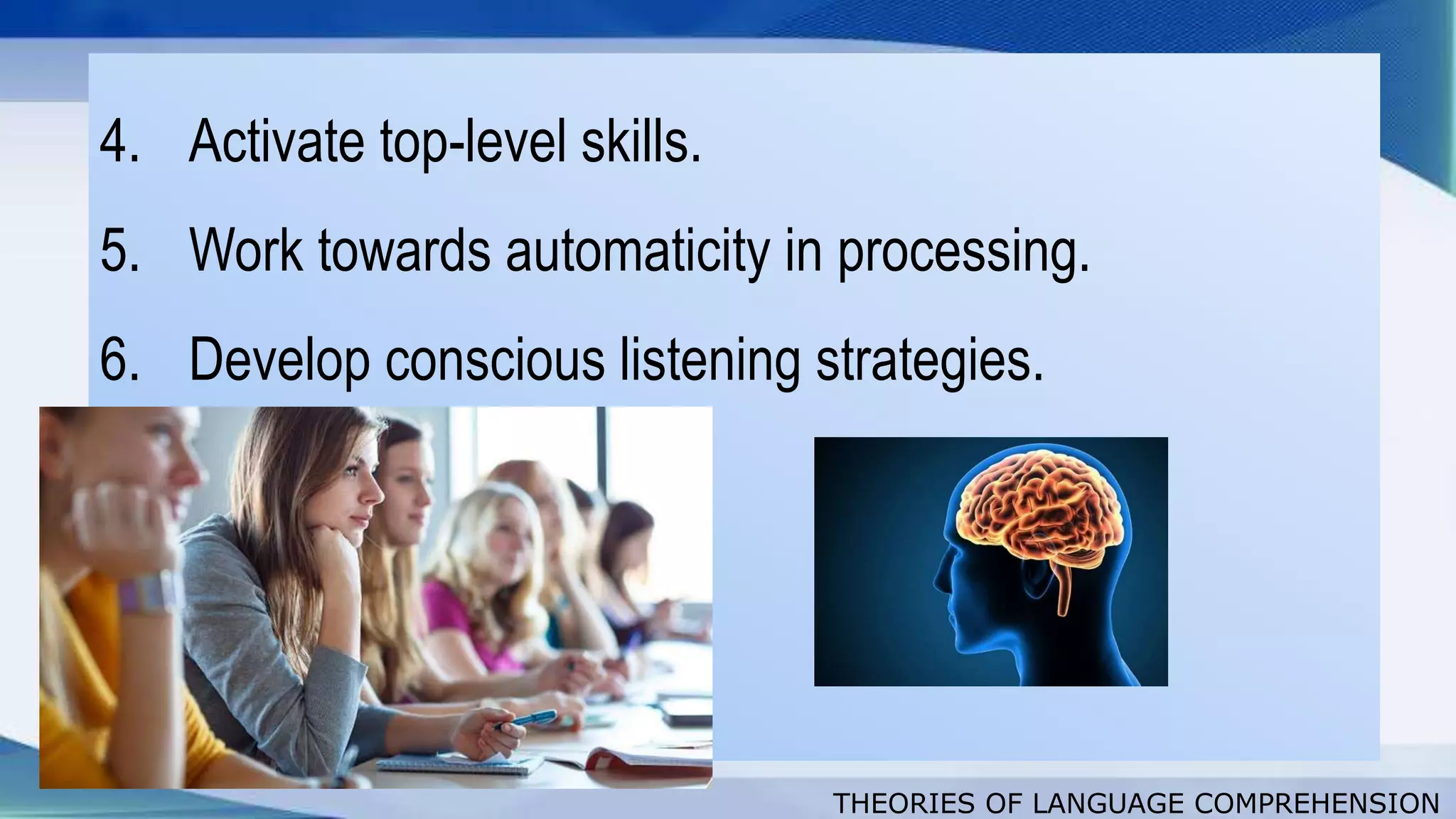
4. Activate top-level skills.
5. Work towards automaticity in processing.
6. Develop conscious listening strategies.
THEORIES OF LANGUAGE COMPREHENSION
Comprehension Process,
Skills, and Strategies
THEORIES OF LANGUAGE COMPREHENSION
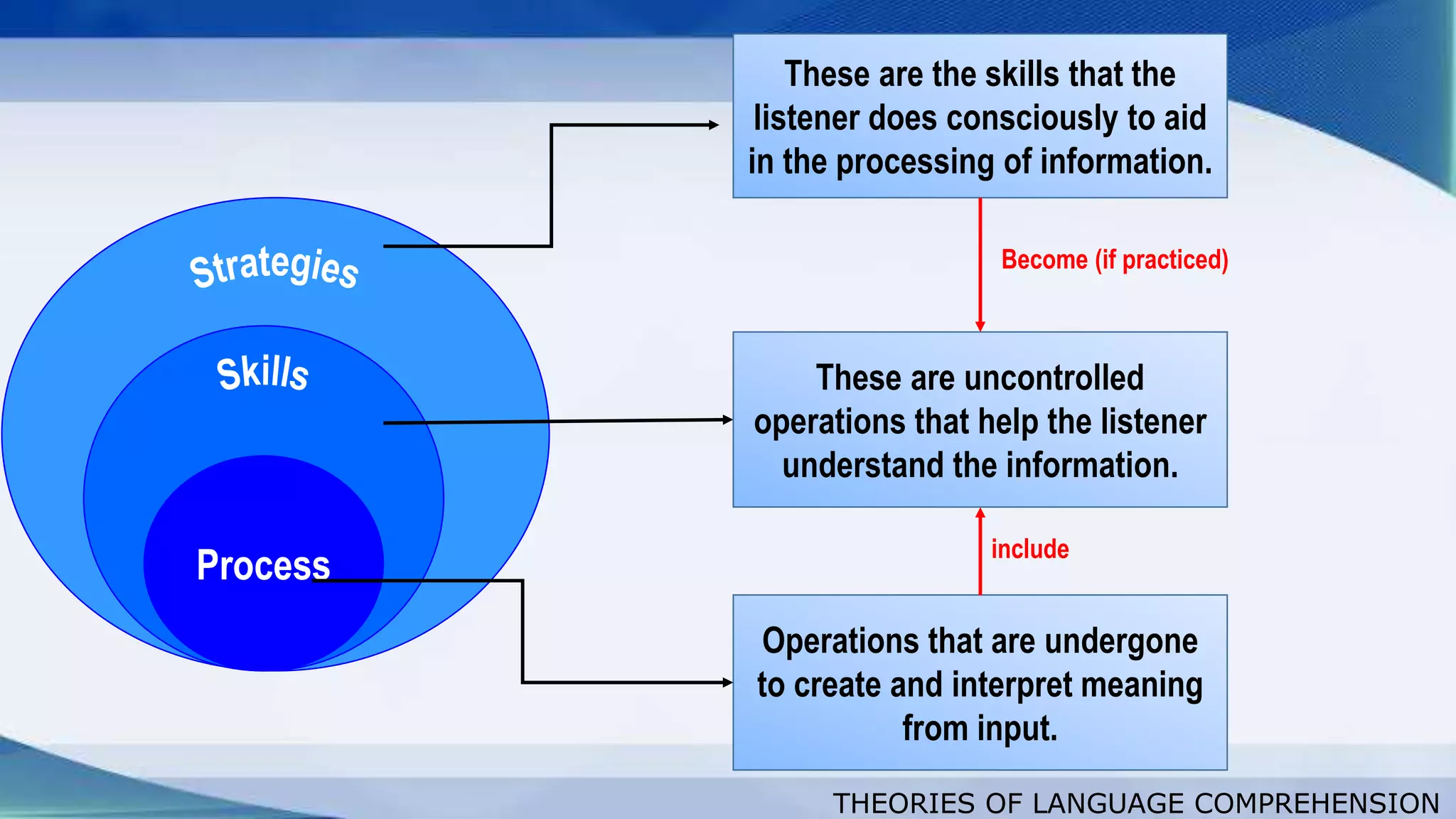
Process
These are the skills that the
listener does consciously to aid
in the processing of information.
These are uncontrolled
operations that help the listener
understand the information.
Operations that are undergone
to create and interpret meaning
from input.
include
Become (if practiced)
THEORIES OF LANGUAGE COMPREHENSION
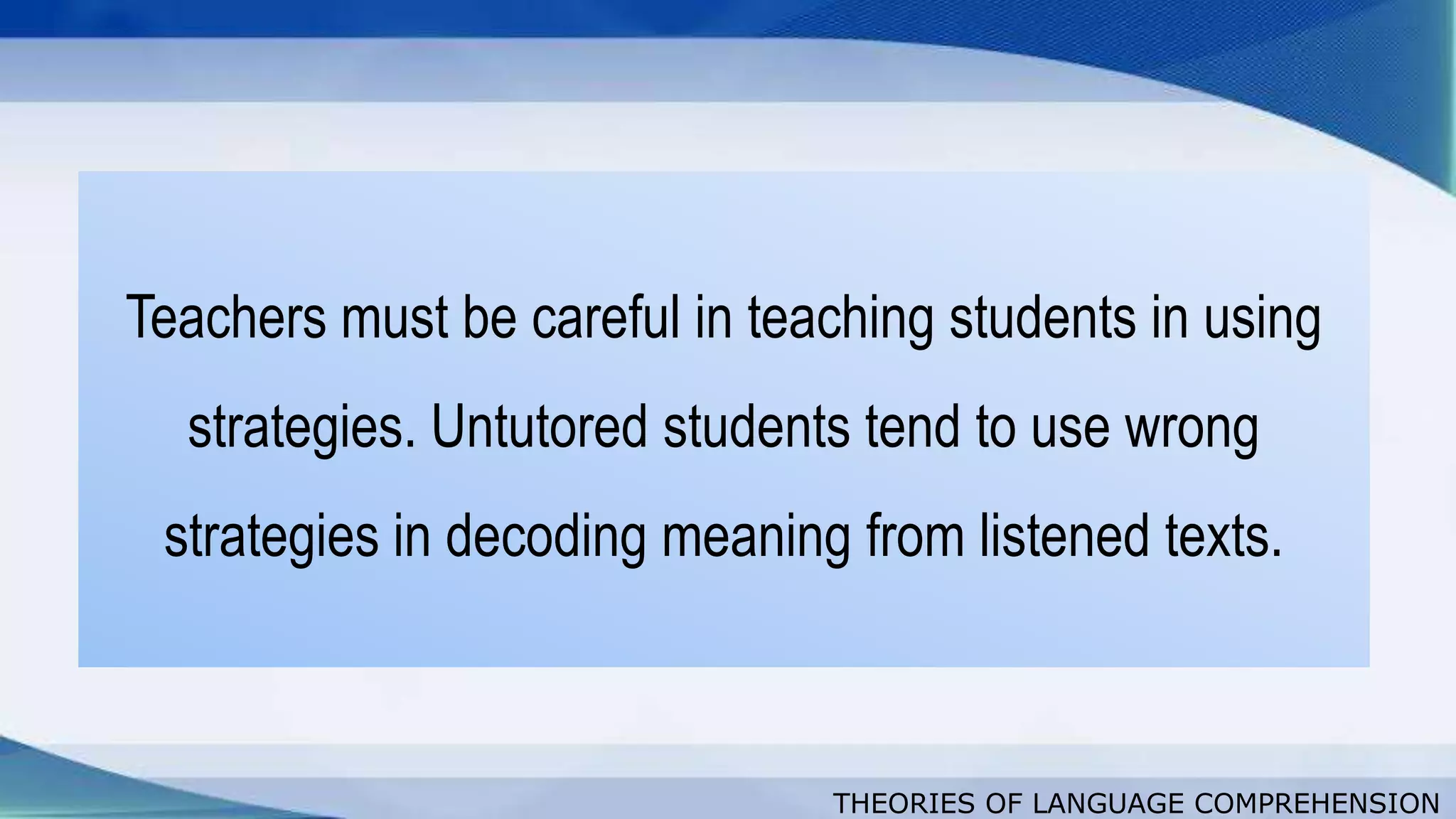
Teachers must be careful in teaching students in using
strategies. Untutored students tend to use wrong
strategies in decoding meaning from listened texts.
THEORIES OF LANGUAGE COMPREHENSION
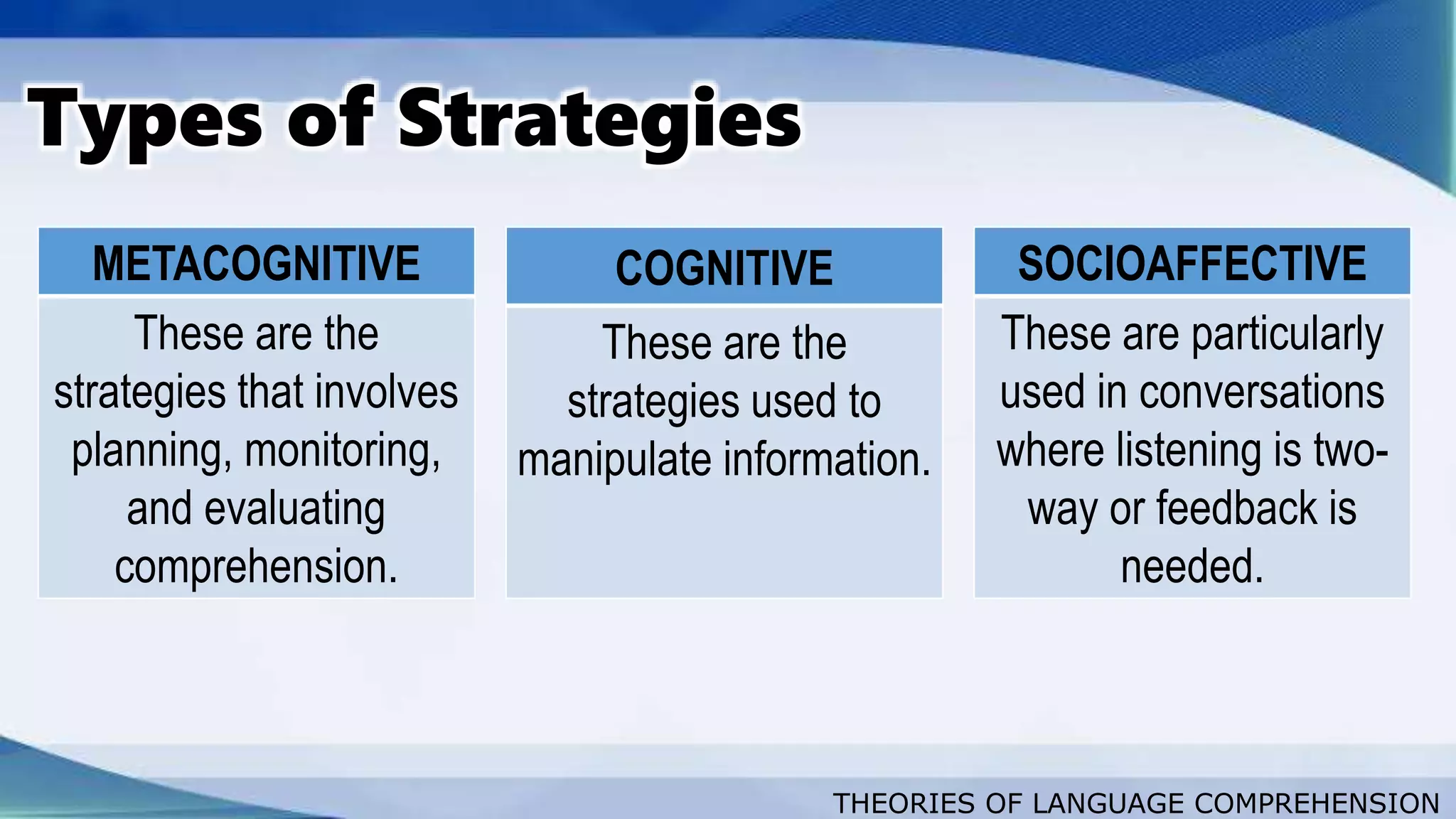
METACOGNITIVE
These are the
strategies that involves
planning, monitoring,
and evaluating
comprehension.
Types of Strategies
COGNITIVE
These are the
strategies used to
manipulate information.
SOCIOAFFECTIVE
These are particularly
used in conversations
where listening is two-
way or feedback is
needed.
THEORIES OF LANGUAGE COMPREHENSION
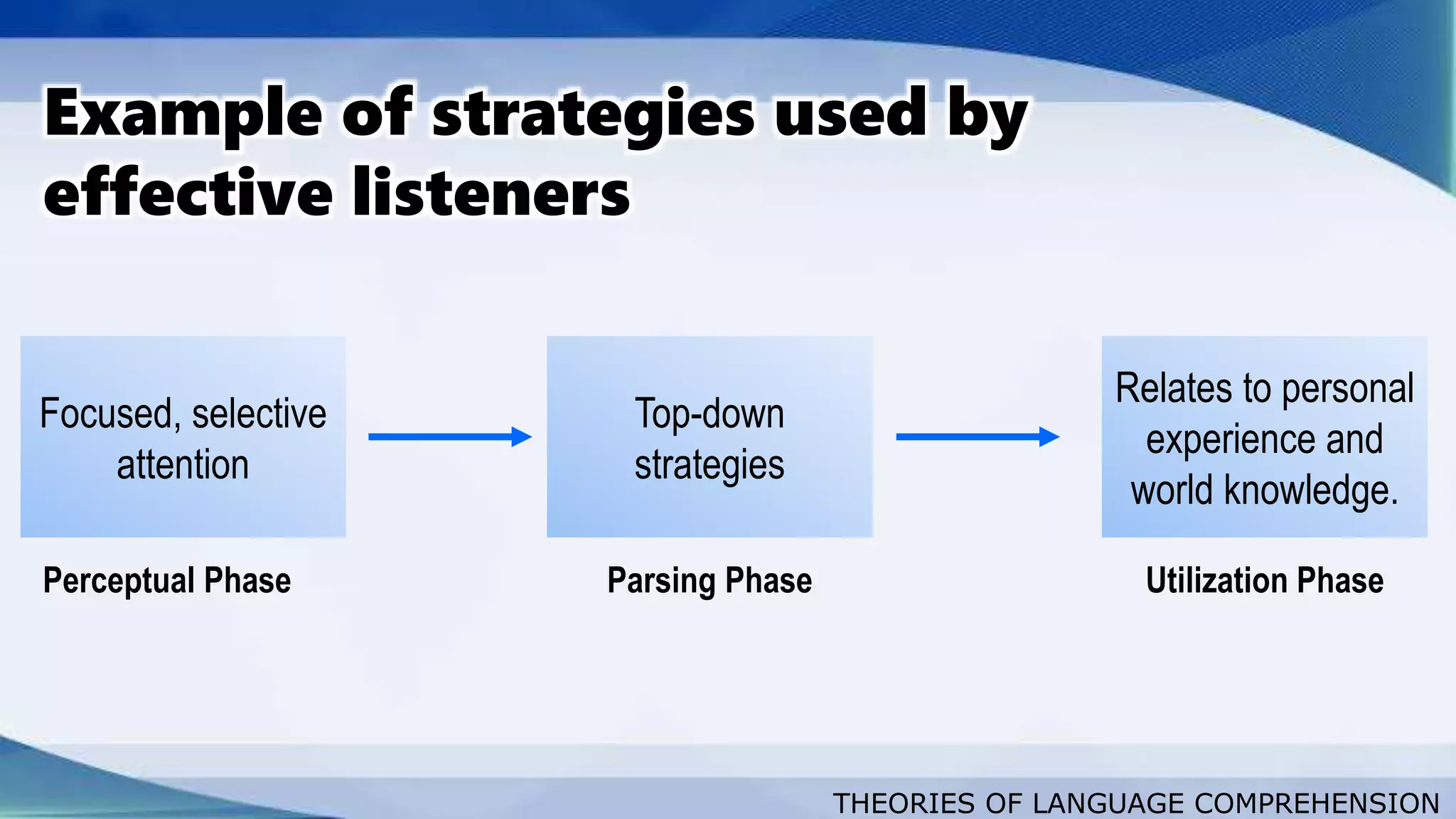
Example of strategies used by
effective listeners
Focused, selective
attention
Top-down
strategies
Relates to personal
experience and
world knowledge.
Perceptual Phase Parsing Phase Utilization Phase
A DEVELOPMENTAL VIEW
OF LISTENING SKILLS
A DEVELOPMENTAL VIEW OF LISTENING
True beginners in a second language lack adequate
bottom-up processing skills because they have not yet
developed the linguistic categories against which the
language must be heard.
Profile of Beginning-level Student in Listening
At this stage, the students tend to discover the ambiguity of
sounds and meaning and thus make guesses of meaning and
make use of real-world knowledge and analytical thinking.
Profile of Beginning-level Student in Listening A DEVELOPMENTAL VIEW OF LISTENING
THE IMPORTANCE OF THE NOVICE STAGE
Profile of Beginning-level Student in Listening A DEVELOPMENTAL VIEW OF LISTENING
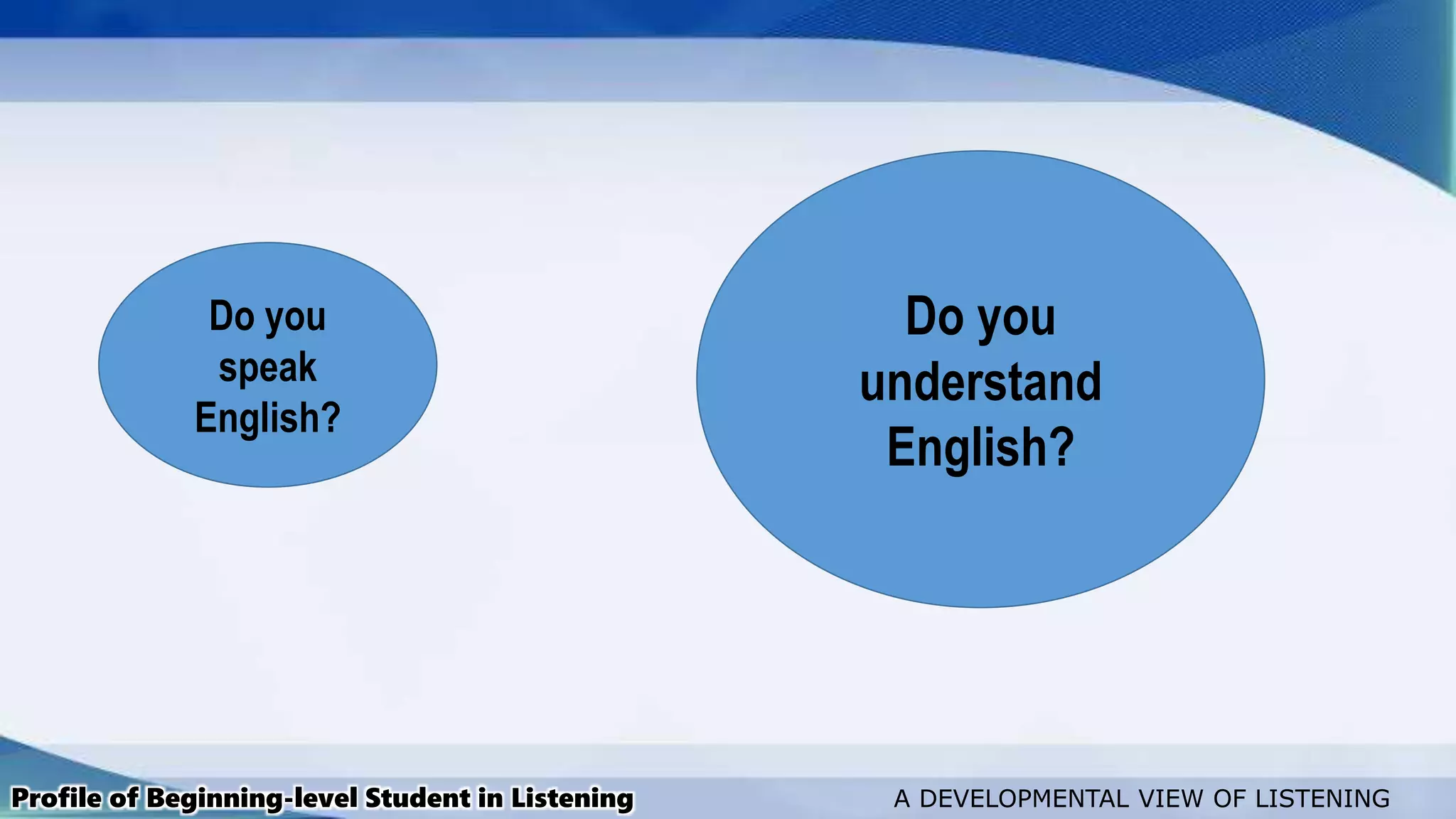
Do you
speak
English?
Do you
understand
English?
1. Global listening selections should be short.
2. Teachers must go down the level of students.
3. Add new material gradually.
4. Students should be kept active in the task to perform.
5. Selective listening exercises are easy to prepare.
Profile of Beginning-level Student in Listening A DEVELOPMENTAL VIEW OF LISTENING
Some suggestions for giving an effective input
1. Global listening selections should be short and preceded by a pre-
listening activity which includes the presentation of the theme of
the story through a picture.
Profile of Beginning-level Student in Listening A DEVELOPMENTAL VIEW OF LISTENING
Global Listening Techniques
2. The pre-listening stage should develop the students’ curiosity.
3. The new text must be read in a normal pace and must have short
pauses.
4. The teacher may also demonstrate or show the message of the text.
Profile of Beginning-level Student in Listening A DEVELOPMENTAL VIEW OF LISTENING
Global Listening Techniques
1. The focus is on form, sound, and grammatical structures.
Profile of Beginning-level Student in Listening A DEVELOPMENTAL VIEW OF LISTENING
Selective Listening Techniques
Intermediate-level learners have a fair understanding of the
phonemic system in L2 but still find it difficult to understand the
complexities of such. Still, they can now listen to short
conversations compared to only words for beginners.
Profile of Intermediate-level Student in Listening
Profile of Intermediate-level Learner A DEVELOPMENTAL VIEW OF LISTENING SKILLS
The teacher can introduce “authentic” text to the learners; those
that are not intended for non-native speakers.
Profile of Intermediate-level Learner A DEVELOPMENTAL VIEW OF LISTENING SKILLS
Global Listening Techniques
1. Focus on developing their accuracy in identifying
grammatical features.
2. Pronunciation training can be used in this stage.
3. Teach strategies for interactive listening.
Profile of Intermediate-level Learner A DEVELOPMENTAL VIEW OF LISTENING SKILLS
Selective Listening Techniques
Cummins (1981) notes that in proficient bilinguals, the second
language skills is used for acquiring knowledge. Advanced
learners listen to acquire knowledge from other areas.
Profile of Advanced Learner
Profile of Advanced Learner A DEVELOPMENTAL VIEW OF LISTENING
• They listen to longer texts such as those in television and
radio.
• Their vocabulary includes a broader sense.
• They begin to fill gaps and make inferences.
Profile of Advanced Learner
Profile of Advanced Learner A DEVELOPMENTAL VIEW OF LISTENING
It is also important to note that their understanding of the L2
remains literal. They usually miss jokes, idioms, slang, and
cultural references.
Profile of Advanced Learner
Profile of Advanced Learner A DEVELOPMENTAL VIEW OF LISTENING
• More study on the link between proficiency and strategy.
• Investigate on other variables that may affect the strategy-
use.
• Study the effects of social, cultural, and affective factors
that affect listening.
Directions for Future Research
Profile of Advanced Learner A DEVELOPMENTAL VIEW OF LISTENING
Students listen to learn. As teachers, let us not
neglect the importance of such a vital skill in
language learning.
THANK YOU! 

Skills and strategies for proficient listening

  • 1.
    Skills and Strategiesfor Proficient Listening By Pat Wilcox Peterson JOVENEL B. DADULLA MAED ENGLISH Teaching English as a Second Language
  • 2.
    How important islistening in language learning?
  • 3.
    “No other typeof language input is as easy to process as spoken language, received through listening.”
  • 4.
    LEVELS OF LISTENING Advanced Intermediate Beginning Useslistening to improve language learning, e.g. vocabulary, grammar, pronunciation Uses listening to improve the understanding of the language Uses listening to see the complexity of the language
  • 5.
  • 6.
    THEORIES OF LANGUAGECOMPREHENSION Listening is the Primary Channel for Language Input and Acquisition LISTENING Comprehension Information Retention L2 Acquisition Learning to speak a language is very largely a task of hearing it (Nida, 1957).
  • 7.
    THEORIES OF LANGUAGECOMPREHENSION Some strategies and approaches in TESL focus on giving more listening inputs to promote L2 acquisition and production. Total Physical Response (Asher, 1969) Natural Approach (Krashen & Terrell, 1983)
  • 8.
    THEORIES OF LANGUAGECOMPREHENSION Reception Production Reception should precede production because reception enables production(Nord, 1981).
  • 9.
    THEORIES OF LANGUAGECOMPREHENSION Listening Comprehension is Multilevel, Interactive Process of Meaning Creation
  • 10.
    THEORIES OF LANGUAGECOMPREHENSION The Listening Process Perceptual Processing Parsing Utilization
  • 11.
    THEORIES OF LANGUAGECOMPREHENSION Higher level language proficiency allows the listener to have more time to process information received through listening as they give little attention to specific sounds and patterns in the L2. LANGUAGE PROFICIENCY AND LISTENING COMPREHENSION
  • 12.
    THEORIES OF LANGUAGECOMPREHENSION Rumenlhart (1980) defines schema as “a data structure for representing generic concepts stored in memory.” THE SCHEMATA
  • 13.
    THEORIES OF LANGUAGECOMPREHENSION Models of Listening Comprehension
  • 14.
    THEORIES OF LANGUAGECOMPREHENSION Models of Listening Comprehension There is an internal reproduction of the message from the speaker and so the intended meaning is achieved (Clark & Clark, 1977)
  • 15.
    THEORIES OF LANGUAGECOMPREHENSION Models of Listening Comprehension The meaning is constructed by the listener which leads to a quite different meaning from the intended one. (Rost, 1990)
  • 16.
    THEORIES OF LANGUAGECOMPREHENSION Models of Listening Comprehension There is a processing of meaning and a continuous monitoring of comprehension. (Nagle & Sanders)
  • 17.
    THEORIES OF LANGUAGECOMPREHENSION Principles for Listening in the Classroom
  • 18.
    THEORIES OF LANGUAGECOMPREHENSION 1. Increase the amount of listening time in language class. 2. Use listening before other activities. 3. Include both global and selective listening.
  • 19.
    THEORIES OF LANGUAGECOMPREHENSION 4. Activate top-level skills. 5. Work towards automaticity in processing. 6. Develop conscious listening strategies.
  • 20.
    THEORIES OF LANGUAGECOMPREHENSION Comprehension Process, Skills, and Strategies
  • 21.
    THEORIES OF LANGUAGECOMPREHENSION Process These are the skills that the listener does consciously to aid in the processing of information. These are uncontrolled operations that help the listener understand the information. Operations that are undergone to create and interpret meaning from input. include Become (if practiced)
  • 22.
    THEORIES OF LANGUAGECOMPREHENSION Teachers must be careful in teaching students in using strategies. Untutored students tend to use wrong strategies in decoding meaning from listened texts.
  • 23.
    THEORIES OF LANGUAGECOMPREHENSION METACOGNITIVE These are the strategies that involves planning, monitoring, and evaluating comprehension. Types of Strategies COGNITIVE These are the strategies used to manipulate information. SOCIOAFFECTIVE These are particularly used in conversations where listening is two- way or feedback is needed.
  • 24.
    THEORIES OF LANGUAGECOMPREHENSION Example of strategies used by effective listeners Focused, selective attention Top-down strategies Relates to personal experience and world knowledge. Perceptual Phase Parsing Phase Utilization Phase
  • 25.
    A DEVELOPMENTAL VIEW OFLISTENING SKILLS
  • 26.
    A DEVELOPMENTAL VIEWOF LISTENING True beginners in a second language lack adequate bottom-up processing skills because they have not yet developed the linguistic categories against which the language must be heard. Profile of Beginning-level Student in Listening
  • 27.
    At this stage,the students tend to discover the ambiguity of sounds and meaning and thus make guesses of meaning and make use of real-world knowledge and analytical thinking. Profile of Beginning-level Student in Listening A DEVELOPMENTAL VIEW OF LISTENING THE IMPORTANCE OF THE NOVICE STAGE
  • 28.
    Profile of Beginning-levelStudent in Listening A DEVELOPMENTAL VIEW OF LISTENING Do you speak English? Do you understand English?
  • 29.
    1. Global listeningselections should be short. 2. Teachers must go down the level of students. 3. Add new material gradually. 4. Students should be kept active in the task to perform. 5. Selective listening exercises are easy to prepare. Profile of Beginning-level Student in Listening A DEVELOPMENTAL VIEW OF LISTENING Some suggestions for giving an effective input
  • 30.
    1. Global listeningselections should be short and preceded by a pre- listening activity which includes the presentation of the theme of the story through a picture. Profile of Beginning-level Student in Listening A DEVELOPMENTAL VIEW OF LISTENING Global Listening Techniques
  • 31.
    2. The pre-listeningstage should develop the students’ curiosity. 3. The new text must be read in a normal pace and must have short pauses. 4. The teacher may also demonstrate or show the message of the text. Profile of Beginning-level Student in Listening A DEVELOPMENTAL VIEW OF LISTENING Global Listening Techniques
  • 32.
    1. The focusis on form, sound, and grammatical structures. Profile of Beginning-level Student in Listening A DEVELOPMENTAL VIEW OF LISTENING Selective Listening Techniques
  • 33.
    Intermediate-level learners havea fair understanding of the phonemic system in L2 but still find it difficult to understand the complexities of such. Still, they can now listen to short conversations compared to only words for beginners. Profile of Intermediate-level Student in Listening Profile of Intermediate-level Learner A DEVELOPMENTAL VIEW OF LISTENING SKILLS
  • 34.
    The teacher canintroduce “authentic” text to the learners; those that are not intended for non-native speakers. Profile of Intermediate-level Learner A DEVELOPMENTAL VIEW OF LISTENING SKILLS Global Listening Techniques
  • 35.
    1. Focus ondeveloping their accuracy in identifying grammatical features. 2. Pronunciation training can be used in this stage. 3. Teach strategies for interactive listening. Profile of Intermediate-level Learner A DEVELOPMENTAL VIEW OF LISTENING SKILLS Selective Listening Techniques
  • 36.
    Cummins (1981) notesthat in proficient bilinguals, the second language skills is used for acquiring knowledge. Advanced learners listen to acquire knowledge from other areas. Profile of Advanced Learner Profile of Advanced Learner A DEVELOPMENTAL VIEW OF LISTENING
  • 37.
    • They listento longer texts such as those in television and radio. • Their vocabulary includes a broader sense. • They begin to fill gaps and make inferences. Profile of Advanced Learner Profile of Advanced Learner A DEVELOPMENTAL VIEW OF LISTENING
  • 38.
    It is alsoimportant to note that their understanding of the L2 remains literal. They usually miss jokes, idioms, slang, and cultural references. Profile of Advanced Learner Profile of Advanced Learner A DEVELOPMENTAL VIEW OF LISTENING
  • 39.
    • More studyon the link between proficiency and strategy. • Investigate on other variables that may affect the strategy- use. • Study the effects of social, cultural, and affective factors that affect listening. Directions for Future Research Profile of Advanced Learner A DEVELOPMENTAL VIEW OF LISTENING
  • 40.
    Students listen tolearn. As teachers, let us not neglect the importance of such a vital skill in language learning. THANK YOU! 