I.F.D.C. LENGUAS VIVAS
TALLER DE PRACTICA DOCENTE
ALUMNOPRACTICANTE: NataliaVaresio
Períodode Práctica: Primaria
InstituciónEducativa:I.C.E.B.L.E.
Dirección:Av.Koessler1820
Sala/Grado/Año-sección:5ºgrado
Cantidadde alumnos:25
Nivel lingüísticodel curso:Principiantes
Tipode Planificación:Clase
Unidadtemática: Comidas
Clase Nº : 1
Fecha:30/08/18
Hora: 9:45 a 10:20 hs
Duraciónde laclase:35’
Fechade primeraentrega: 25/08/18
The class isactually shortersince childrencome froma break or anotherclass.
Teaching points: FOOD ANDMEALS,(Ihave milk for breakfast)
 Aims: Duringthislesson,learnerswillbe able to..
- Recognize foodvocabulary
- Identifyandname foodanddrinks
- Use the structure:“I have (milk) forbreakfast”
- Develop theirwritingskillsbydescribingtheirmeals.
- Developtheiroral skillswhile talkingabouttheirmeals.
 Language focus
Lexis Function Structure Pronunciation
Revision
Hello!,
Goodbye!
Look!
Listen!
Breakfast,
lunch,dinner
Food:
Hamburger,
chicken,pasta,
orange juice,
cheese, fries,
chocolate cake
apple,ice-
cream
Greetings
Following
commandsor
instructions
Identifyand
name food.
Askingand
answering
questions
Let’sdo an
activity!
What isit?
It’sa chicken.
Do youlike
(soup)?
Yes,I like soup
No,I don’tlike
soup
What are they
eating?
The’re eatinga
sandwich
New Foodand
meals
Cereals,soup,
jam,toasts,
salad,coffee,
potatoes,fruits
water,fishand
chips.
vegetable pie
Identifyand
name food
Askingand
answering
questions
aboutfoodand
meals.
What do you
have for
(breakfast)?
I have (milk
and cereals)
for breakfast.
/əʊ/ sound
Toasts
 Teaching approach: The lessonisbasedonthe Natural Approach,andorganizedthrough the PPP procedure
(Harmer, 2010)
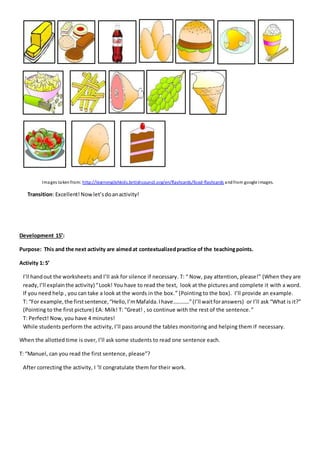
 Materials and resources: In the warm-up and presentation stage I’ll use flashcards made of cardboard.
During the activities students will work with worksheets.
 Pedagogical use of ICT in class: In this lesson, I´ll not use ICT.
.
 Seating arrangement: Students sit in rows sharing desks.
 Cooperative work: Students will work as a class interacting with the teacher. In the first activity, students
will work individually while in the second activity, students first will work individually but then, they will
share with the class about what they have for different meals.
 Potential problems student may have with the language: Since students have different levels of English,
some of them may not understand the teacher or the activities, so I’ll use different strategies such as:
miming, gesturing, modelling, exemplifying, etc. If necessary, I’ll apply the sandwich technique.
 Assessment: what will be assessedand how: I’ll check students’comprehensionthroughtheirparticipation
in the warm-up and presentation stage. I’ll check students comprehend the structure “I have (milk) for
(breakfast) by asking questions or eliciting “What do have for breakfast? Or Do you have milk or tea for
breakfast?”Inaddition,I’ll provide studentswithvisual aids to help comprehension. I’ll assess that student
understand different meals and food by encouraging them to produce some chunks of language. In the
activities, I’ll monitor students’ individual work.
Routine: 7’
Purpose: to start the lesson and establish rapport.
I’ll wait for students to get into the classroom and greet them: “Hello! How are you today?” EA: “Hello!”
I’ll tell the students:“My name isNatalia,remember? Now, I’ll give you these cards with your names so I can
remember you”
I’ll hand out the cards naming them one by one.
Transition: “ Good!, Now look what I have here………..
Warm up: 5’:
Purpose: To introduce the topic, the teaching pointsand recycle vocabulary.
I’ll activate students’previousknowledge andreview vocabulary studied in previous lessons by showing them the
pictures below.
T: “Look at this picture. What can you see? It’s eight in the morning (pointing to my watch) What are they doing?”
EA: “it’s breakfast!” T: “Very good, they are having breakfast. And what are they drinking?” EA: Orange juice! T:
“Excellent!Andtheyare having milkandcereals”.(pointingtothe picture). I’ll stickthe picture on the board next to
the title “Breakfast”. Then, I’ll show students another picture.
T: “Now, look at this picture. It’s one p.m. Where are the kids?” EA: At school! T: “Excellent!. And what are they
eating?EA:a sandwich,salad!T:“perfect!Sotheyare having…………”(I’llwaitfor answers) If nobodyanswers, I’ll say
: “They are having lunch” (I’ll stick the picture next to the title “Lunch”)
I’ll dothe same with the lastpicture. Then, I’ll explainstudentsthatbreakfast,lunchanddinner are meals( pointing
to each picture)
T: “Listen! Breakfast, lunch and dinner are meals (Pointing to the board). They’re the food that we eat at different
moments of the day. For example breakfast is the first meal of the day”
Transition: Excellent!Now,lookatMY meals……..
Presentation: 5’
Purpose: -tofurther expose the studentsto the target language using a meaningful contextand to revise previous
language items.
I’ll expose the studentstothe targetlanguage by tellingthemaboutwhatI eat during different meals. As I give my
speech, I’ll stick the flashcards next to the corresponding label ( Breakfast, lunch, dinner)
T: “ Look, for breakfast, I have coffee with milk and eat toasts with jam. Then, for lunch, I sometimes have
vegetable pie anddrink some water. Afterlunch , I like eatingfruits like applesorbananas . Andfor dinner, I have
soup , and fish and chips (pointing to the pictures) . Ah! And my favourite dessert is chocolate cake! Mmm,
delicious!”
As I give my speech, I’ll ask some questions in order to interact with the students, such as: “Do you like vegetable
pie?, Do you like soup? Can you guess my favourite dessert?
Breakfast
Lunch
Dinner
Then,I’ll askstudentssome questions aboutwhat they have at different meals in order to develop their oral skills.
I’ll provide vocabulary on demand if necessary with more flashcards (labeled with their names) about food so
studentscanchoose otheroptions. T: “What do you have for breakfast?” (pointingtotitle “breakfast”andpictures)
If nobody answers, I’ll ask a student directly. T: “Tell me, Ailin. What do you have for breakfast?” If no answer, I’ll
elicit answers : “Do you have milk or juice for breakfast” (pointing to the flashcard) Ailín “ yes milk! ” T: Good, so
repeat:“I have milkforbreakfast”. Guille, what do you have for breakfast? EA: “ I have milk with toasts” T: “ great!
What do you have for lunch?” (I’ll continue with the rest of the meals) If students respond in Spanish, I’ll give the
equivalent in English.
(I’ll have these flashcards at hand for my lessons and I’ll add some more)
Images takenfrom: http://learnenglishkids.britishcouncil.org/en/flashcards/food-flashcards andfrom google images.
Transition: Excellent!Nowlet’sdoanactivity!
Development 15’:
Purpose: This and the next activity are aimedat contextualizedpractice of the teachingpoints.
Activity 1: 5’
I’ll handout the worksheets and I’ll ask for silence if necessary. T: “ Now, pay attention, please!” (When they are
ready,I’ll explainthe activity)“Look! You have to read the text, look at the pictures and complete it with a word.
If you need help , you can take a look at the words in the box.” (Pointing to the box). I’ll provide an example.
T: “For example,the firstsentence,“Hello,I’mMafalda.Ihave…………”(I’ll waitforanswers) or I’ll ask “What is it?”
(Pointing to the first picture) EA: Milk! T: “Great! , so continue with the rest of the sentence.”
T: Perfect! Now, you have 4 minutes!
While students perform the activity, I’ll pass around the tables monitoring and helping them if necessary.
When the allotted time is over, I’ll ask some students to read one sentence each.
T: “Manuel, can you read the first sentence, please”?
After correcting the activity, I ‘ll congratulate them for their work.
Transition: Fantastic!Now,I’ll give youthe nextactivity….
Activity 2: 10’
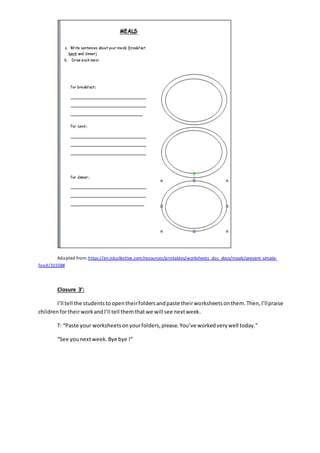
I’ll give the students the following worksheet to complete with information about their own meals. Then,
they can draw them.Finally,I’ll encouragestudentsto share with the class what they have for the different
meals.
T: “Now,lookat thisworksheet,youhave towrite sentencesabout breakfast, lunch and dinner (pointing to
each meal). You can start your sentences for example: I have tea and cookies for breakfast. (I’ll write it on
the board if necessary. Then, draw your meals in each plate. Is it clear? Can you explain the activity? “(To
check if they understood) Maybe the student will explain in L1.
I’ll gothroughthe desksmonitoringstudents’workandhelpingthemif necessary. Some students may want
to know new words, so I’ll provide vocabulary on demand.(or I’ll show them some flashcards)
Probably, there will be some fast finishers who will ask me for correction.
When all students finish the activity, I’ll ask some of them to talk about their meals.
T: “Did you finish?” EA: Yes! T: “ Great!, who wants to talk about your meals? You Nacho? OK!
I’ll also encourage shy students to read their sentences.
Adapted from: https://en.islcollective.com/resources/printables/worksheets_doc_docx/meals/present-simple-
food/31558#
Closure 3’:
I’ll tell the students toopentheirfoldersandpaste theirworksheetsonthem.Then,I’llpraise
children fortheirwork andI’ll tell them thatwe will see nextweek.
T: “Paste your worksheetsonyourfolders,please.You’ve workedverywell today.”
“See younextweek. Bye bye !”
Lesson plan
component
Excellent
5
Very Good
4
Good
3
Acceptable
2
Below Standard
1
Visual organization X
Coherence and
sequencing
X
Variety of resources
– Learning styles
X
Stages and activities X
Teaching strategies X
Language accuracy X
Observations Minimumscore:18 / 30
Score:_27___ /30
Great start, Nati!
I hope mycommentsare useful. 

Varesio primary - lesson 1 - passed

  • 1.
    I.F.D.C. LENGUAS VIVAS TALLERDE PRACTICA DOCENTE ALUMNOPRACTICANTE: NataliaVaresio Períodode Práctica: Primaria InstituciónEducativa:I.C.E.B.L.E. Dirección:Av.Koessler1820 Sala/Grado/Año-sección:5ºgrado Cantidadde alumnos:25 Nivel lingüísticodel curso:Principiantes Tipode Planificación:Clase Unidadtemática: Comidas Clase Nº : 1 Fecha:30/08/18 Hora: 9:45 a 10:20 hs Duraciónde laclase:35’ Fechade primeraentrega: 25/08/18 The class isactually shortersince childrencome froma break or anotherclass. Teaching points: FOOD ANDMEALS,(Ihave milk for breakfast)  Aims: Duringthislesson,learnerswillbe able to.. - Recognize foodvocabulary - Identifyandname foodanddrinks - Use the structure:“I have (milk) forbreakfast” - Develop theirwritingskillsbydescribingtheirmeals. - Developtheiroral skillswhile talkingabouttheirmeals.
  • 2.
     Language focus LexisFunction Structure Pronunciation Revision Hello!, Goodbye! Look! Listen! Breakfast, lunch,dinner Food: Hamburger, chicken,pasta, orange juice, cheese, fries, chocolate cake apple,ice- cream Greetings Following commandsor instructions Identifyand name food. Askingand answering questions Let’sdo an activity! What isit? It’sa chicken. Do youlike (soup)? Yes,I like soup No,I don’tlike soup What are they eating? The’re eatinga sandwich New Foodand meals Cereals,soup, jam,toasts, salad,coffee, potatoes,fruits water,fishand chips. vegetable pie Identifyand name food Askingand answering questions aboutfoodand meals. What do you have for (breakfast)? I have (milk and cereals) for breakfast. /əʊ/ sound Toasts  Teaching approach: The lessonisbasedonthe Natural Approach,andorganizedthrough the PPP procedure (Harmer, 2010)  Materials and resources: In the warm-up and presentation stage I’ll use flashcards made of cardboard. During the activities students will work with worksheets.  Pedagogical use of ICT in class: In this lesson, I´ll not use ICT. .  Seating arrangement: Students sit in rows sharing desks.
  • 3.
     Cooperative work:Students will work as a class interacting with the teacher. In the first activity, students will work individually while in the second activity, students first will work individually but then, they will share with the class about what they have for different meals.  Potential problems student may have with the language: Since students have different levels of English, some of them may not understand the teacher or the activities, so I’ll use different strategies such as: miming, gesturing, modelling, exemplifying, etc. If necessary, I’ll apply the sandwich technique.  Assessment: what will be assessedand how: I’ll check students’comprehensionthroughtheirparticipation in the warm-up and presentation stage. I’ll check students comprehend the structure “I have (milk) for (breakfast) by asking questions or eliciting “What do have for breakfast? Or Do you have milk or tea for breakfast?”Inaddition,I’ll provide studentswithvisual aids to help comprehension. I’ll assess that student understand different meals and food by encouraging them to produce some chunks of language. In the activities, I’ll monitor students’ individual work. Routine: 7’ Purpose: to start the lesson and establish rapport. I’ll wait for students to get into the classroom and greet them: “Hello! How are you today?” EA: “Hello!” I’ll tell the students:“My name isNatalia,remember? Now, I’ll give you these cards with your names so I can remember you” I’ll hand out the cards naming them one by one. Transition: “ Good!, Now look what I have here……….. Warm up: 5’: Purpose: To introduce the topic, the teaching pointsand recycle vocabulary. I’ll activate students’previousknowledge andreview vocabulary studied in previous lessons by showing them the pictures below. T: “Look at this picture. What can you see? It’s eight in the morning (pointing to my watch) What are they doing?” EA: “it’s breakfast!” T: “Very good, they are having breakfast. And what are they drinking?” EA: Orange juice! T: “Excellent!Andtheyare having milkandcereals”.(pointingtothe picture). I’ll stickthe picture on the board next to the title “Breakfast”. Then, I’ll show students another picture.
  • 4.
    T: “Now, lookat this picture. It’s one p.m. Where are the kids?” EA: At school! T: “Excellent!. And what are they eating?EA:a sandwich,salad!T:“perfect!Sotheyare having…………”(I’llwaitfor answers) If nobodyanswers, I’ll say : “They are having lunch” (I’ll stick the picture next to the title “Lunch”) I’ll dothe same with the lastpicture. Then, I’ll explainstudentsthatbreakfast,lunchanddinner are meals( pointing to each picture) T: “Listen! Breakfast, lunch and dinner are meals (Pointing to the board). They’re the food that we eat at different moments of the day. For example breakfast is the first meal of the day” Transition: Excellent!Now,lookatMY meals…….. Presentation: 5’ Purpose: -tofurther expose the studentsto the target language using a meaningful contextand to revise previous language items. I’ll expose the studentstothe targetlanguage by tellingthemaboutwhatI eat during different meals. As I give my speech, I’ll stick the flashcards next to the corresponding label ( Breakfast, lunch, dinner) T: “ Look, for breakfast, I have coffee with milk and eat toasts with jam. Then, for lunch, I sometimes have vegetable pie anddrink some water. Afterlunch , I like eatingfruits like applesorbananas . Andfor dinner, I have soup , and fish and chips (pointing to the pictures) . Ah! And my favourite dessert is chocolate cake! Mmm, delicious!” As I give my speech, I’ll ask some questions in order to interact with the students, such as: “Do you like vegetable pie?, Do you like soup? Can you guess my favourite dessert?
  • 5.
    Breakfast Lunch Dinner Then,I’ll askstudentssome questionsaboutwhat they have at different meals in order to develop their oral skills. I’ll provide vocabulary on demand if necessary with more flashcards (labeled with their names) about food so studentscanchoose otheroptions. T: “What do you have for breakfast?” (pointingtotitle “breakfast”andpictures) If nobody answers, I’ll ask a student directly. T: “Tell me, Ailin. What do you have for breakfast?” If no answer, I’ll elicit answers : “Do you have milk or juice for breakfast” (pointing to the flashcard) Ailín “ yes milk! ” T: Good, so repeat:“I have milkforbreakfast”. Guille, what do you have for breakfast? EA: “ I have milk with toasts” T: “ great! What do you have for lunch?” (I’ll continue with the rest of the meals) If students respond in Spanish, I’ll give the equivalent in English. (I’ll have these flashcards at hand for my lessons and I’ll add some more)
  • 6.
    Images takenfrom: http://learnenglishkids.britishcouncil.org/en/flashcards/food-flashcardsandfrom google images. Transition: Excellent!Nowlet’sdoanactivity! Development 15’: Purpose: This and the next activity are aimedat contextualizedpractice of the teachingpoints. Activity 1: 5’ I’ll handout the worksheets and I’ll ask for silence if necessary. T: “ Now, pay attention, please!” (When they are ready,I’ll explainthe activity)“Look! You have to read the text, look at the pictures and complete it with a word. If you need help , you can take a look at the words in the box.” (Pointing to the box). I’ll provide an example. T: “For example,the firstsentence,“Hello,I’mMafalda.Ihave…………”(I’ll waitforanswers) or I’ll ask “What is it?” (Pointing to the first picture) EA: Milk! T: “Great! , so continue with the rest of the sentence.” T: Perfect! Now, you have 4 minutes! While students perform the activity, I’ll pass around the tables monitoring and helping them if necessary. When the allotted time is over, I’ll ask some students to read one sentence each. T: “Manuel, can you read the first sentence, please”? After correcting the activity, I ‘ll congratulate them for their work.
  • 7.
    Transition: Fantastic!Now,I’ll giveyouthe nextactivity…. Activity 2: 10’ I’ll give the students the following worksheet to complete with information about their own meals. Then, they can draw them.Finally,I’ll encouragestudentsto share with the class what they have for the different meals. T: “Now,lookat thisworksheet,youhave towrite sentencesabout breakfast, lunch and dinner (pointing to each meal). You can start your sentences for example: I have tea and cookies for breakfast. (I’ll write it on the board if necessary. Then, draw your meals in each plate. Is it clear? Can you explain the activity? “(To check if they understood) Maybe the student will explain in L1. I’ll gothroughthe desksmonitoringstudents’workandhelpingthemif necessary. Some students may want to know new words, so I’ll provide vocabulary on demand.(or I’ll show them some flashcards) Probably, there will be some fast finishers who will ask me for correction. When all students finish the activity, I’ll ask some of them to talk about their meals. T: “Did you finish?” EA: Yes! T: “ Great!, who wants to talk about your meals? You Nacho? OK! I’ll also encourage shy students to read their sentences.
  • 8.
    Adapted from: https://en.islcollective.com/resources/printables/worksheets_doc_docx/meals/present-simple- food/31558# Closure3’: I’ll tell the students toopentheirfoldersandpaste theirworksheetsonthem.Then,I’llpraise children fortheirwork andI’ll tell them thatwe will see nextweek. T: “Paste your worksheetsonyourfolders,please.You’ve workedverywell today.” “See younextweek. Bye bye !”
  • 9.
    Lesson plan component Excellent 5 Very Good 4 Good 3 Acceptable 2 BelowStandard 1 Visual organization X Coherence and sequencing X Variety of resources – Learning styles X Stages and activities X Teaching strategies X Language accuracy X Observations Minimumscore:18 / 30 Score:_27___ /30 Great start, Nati! I hope mycommentsare useful. 