





Some  misconceptions  about Communicative language teaching Geoff Thompson ELT Journal Volume 50/1 January 1996 © Oxford University Press 1996 Presentation by  高歌 浙江外国语学院 英文学院   24 Aug. 2011 The first presentation by  Victor GAO GE   24 Aug. 2011
Abstract: Although  communicative language teaching is accepted by many applied linguists and teachers as the most effective approach among those in general use,  there are still a number of misconceptions about what it involves.
Abstract: This article  lists   four of the main misconceptions,   discusses  why they have arisen, why they can be so described.  define   some important characteristics of communicative language teaching
The structure of the presentation What is the misconception? Why do we have this view? Why it is not right? How to improve from that?
Misconception 1: CLT  means  not  teaching grammar
Why is not right?   This is the  most persistent and most damaging misconception.   however,  that there are good reasons for its existence.
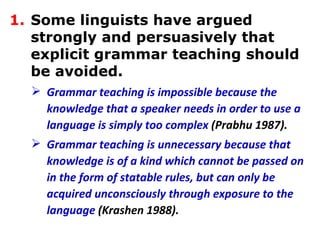
Some linguists have argued strongly and persuasively that explicit grammar teaching should be avoided.  Grammar teaching is impossible because the knowledge that a speaker needs in order to use a language is simply too complex  (Prabhu 1987).   Grammar teaching is unnecessary because that knowledge is of a kind which cannot be passed on in the form of statable rules, but can only be acquired unconsciously through exposure to the language  (Krashen 1988).
For most teachers, the effects of the above ideas was felt through their practical application in language textbooks and syllabuses.   the early  textbooks  like  Functions of English  included no explicit teaching of grammar  (although Functions of English was aimed at students who  had typically already been through a more conventional grammar-based course).   Syllabuses  defined the teaching aims predominantly functional e.g.  (‘make a telephone call to book a hotel room’; ‘scan a written text to extract specific information’), and ignored or minimized the underlying  knowledge of the language  that they would need to actually perform those tasks.
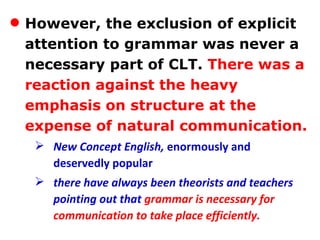
However, the exclusion of explicit attention to grammar was never a necessary part of CLT.   There was a reaction against the heavy emphasis on structure at the expense of natural communication. New Concept English,  enormously and deservedly popular  there have always been theorists and teachers pointing out that  grammar is necessary for communication to take place efficiently.
What is the right way? Learning grammar through CLT:  the retrospective approach   An appropriate amount of class time should be devoted to grammar, but not in a traditional way. The focus has now  moved away   from  the teacher  covering  grammar  to  the learners  discovering  grammar.
How? Learning grammar through  the retrospective approach   Learners are first exposed to new language in a comprehensible context, so that they are able to understand its function and meaning.  Only then is their attention turned to examining the grammatical forms that have been used to convey that meaning.
Learning grammar through  the retrospective approach   The discussion of grammar is explicit, but it is the learners who are doing most of the discussing, working out - with guidance from the teacher – as much of their new knowledge of the language as can easily and usefully be expressed.
Learning grammar through  the retrospective approach   Why? Behind this strategy lies the recognition that the learners may well have ‘understood’ more about the language than the learners or the teacher can put into words.
This ‘retrospective’ approach to grammar is a natural development from the original CLT emphasis on  viewing language as a system for communication;  it  also  takes into account the fact that  learning is likely to be more efficient if the learners have an opportunity to talk about what they are learning.
Ellis (1992) argues that  looking explicitly at grammar   may not lead immediately to learning, it   will facilitate learning at a later stage  when the learner is ready to internalize the new information about the language.  This approach  also  helps if the lesson is conducted in English as it  encourages the learners to communicate fairly naturally about an important subject: the language itself.
Misconception 2: CLT  means  teaching only speaking
Why do we have this view?  CLT was influenced by the general movement in linguistics towards  giving primacy to the spoken language.   A focus on  encouraging learners to communicate leads naturally towards thinking about what they will need to communicate  about,  and  why .   For many learners abroad, the main uses of the language  are oral:
Why do we have this view?  A further reason for this misconception is that  CLT stresses the need for the learners to have sufficient practice, of an appropriate kind.  This is often translated, especially by teacher trainers, into  the principle that TIT (teacher talking time) is to be reduced, and STT (student talking time) is to be maximized - chiefly by putting students into pairs and telling them to talk to their partners.
Why do we have this view?  At the same time,  while  the slogan ‘TTT bad, STT good’ almost certainly represents a useful (though perhaps rarely attained) goal for most teachers, it is  also  important to recognize that communication does not only take place through speech, and that it is not only the speaker (or writer) who is communicating.
Suggestions: CLT involves encouraging learners to take part in and reflect on communication in as many different contexts as possible (and as many as necessary,  not only  for their future language-using needs,  but also  for their present language-learning needs).
Suggestions: Perhaps,  rather than  student talking time, we should be thinking about the broader concept of student communicating time  (or even just student time, to include necessary periods of silent reflection undistracted by talk from teacher or partner).
Misconception 3: CLT  means  pair work, which means role play
Why it is a misconception The use of pair work is a physical signal of some degree of control and choice passing to the learners;  but  this needs to be complemented by real choice, which role play, particularly at simpler levels, may not encourage as much as other uses of pair work.
Misconception 4: CLT  means  expecting too much from the teacher
Suggestions: Perhaps,  rather than  student talking time, we should be thinking about the broader concept of student communicating time  (or even just student time, to include necessary periods of silent reflection undistracted by talk from teacher or partner).

Some misconceptions about clt

  • 1.
    Some misconceptions about Communicative language teaching Geoff Thompson ELT Journal Volume 50/1 January 1996 © Oxford University Press 1996 Presentation by 高歌 浙江外国语学院 英文学院 24 Aug. 2011 The first presentation by Victor GAO GE 24 Aug. 2011
  • 2.
    Abstract: Although communicative language teaching is accepted by many applied linguists and teachers as the most effective approach among those in general use, there are still a number of misconceptions about what it involves.
  • 3.
    Abstract: This article lists four of the main misconceptions, discusses why they have arisen, why they can be so described. define some important characteristics of communicative language teaching
  • 4.
    The structure ofthe presentation What is the misconception? Why do we have this view? Why it is not right? How to improve from that?
  • 5.
    Misconception 1: CLT means not teaching grammar
  • 6.
    Why is notright? This is the most persistent and most damaging misconception. however, that there are good reasons for its existence.
  • 7.
    Some linguists haveargued strongly and persuasively that explicit grammar teaching should be avoided. Grammar teaching is impossible because the knowledge that a speaker needs in order to use a language is simply too complex (Prabhu 1987). Grammar teaching is unnecessary because that knowledge is of a kind which cannot be passed on in the form of statable rules, but can only be acquired unconsciously through exposure to the language (Krashen 1988).
  • 8.
    For most teachers,the effects of the above ideas was felt through their practical application in language textbooks and syllabuses. the early textbooks like Functions of English included no explicit teaching of grammar (although Functions of English was aimed at students who had typically already been through a more conventional grammar-based course). Syllabuses defined the teaching aims predominantly functional e.g. (‘make a telephone call to book a hotel room’; ‘scan a written text to extract specific information’), and ignored or minimized the underlying knowledge of the language that they would need to actually perform those tasks.
  • 9.
    However, the exclusionof explicit attention to grammar was never a necessary part of CLT. There was a reaction against the heavy emphasis on structure at the expense of natural communication. New Concept English, enormously and deservedly popular there have always been theorists and teachers pointing out that grammar is necessary for communication to take place efficiently.
  • 10.
    What is theright way? Learning grammar through CLT: the retrospective approach An appropriate amount of class time should be devoted to grammar, but not in a traditional way. The focus has now moved away from the teacher covering grammar to the learners discovering grammar.
  • 11.
    How? Learning grammarthrough the retrospective approach Learners are first exposed to new language in a comprehensible context, so that they are able to understand its function and meaning. Only then is their attention turned to examining the grammatical forms that have been used to convey that meaning.
  • 12.
    Learning grammar through the retrospective approach The discussion of grammar is explicit, but it is the learners who are doing most of the discussing, working out - with guidance from the teacher – as much of their new knowledge of the language as can easily and usefully be expressed.
  • 13.
    Learning grammar through the retrospective approach Why? Behind this strategy lies the recognition that the learners may well have ‘understood’ more about the language than the learners or the teacher can put into words.
  • 14.
    This ‘retrospective’ approachto grammar is a natural development from the original CLT emphasis on viewing language as a system for communication; it also takes into account the fact that learning is likely to be more efficient if the learners have an opportunity to talk about what they are learning.
  • 15.
    Ellis (1992) arguesthat looking explicitly at grammar may not lead immediately to learning, it will facilitate learning at a later stage when the learner is ready to internalize the new information about the language. This approach also helps if the lesson is conducted in English as it encourages the learners to communicate fairly naturally about an important subject: the language itself.
  • 16.
    Misconception 2: CLT means teaching only speaking
  • 17.
    Why do wehave this view? CLT was influenced by the general movement in linguistics towards giving primacy to the spoken language. A focus on encouraging learners to communicate leads naturally towards thinking about what they will need to communicate about, and why . For many learners abroad, the main uses of the language are oral:
  • 18.
    Why do wehave this view? A further reason for this misconception is that CLT stresses the need for the learners to have sufficient practice, of an appropriate kind. This is often translated, especially by teacher trainers, into the principle that TIT (teacher talking time) is to be reduced, and STT (student talking time) is to be maximized - chiefly by putting students into pairs and telling them to talk to their partners.
  • 19.
    Why do wehave this view? At the same time, while the slogan ‘TTT bad, STT good’ almost certainly represents a useful (though perhaps rarely attained) goal for most teachers, it is also important to recognize that communication does not only take place through speech, and that it is not only the speaker (or writer) who is communicating.
  • 20.
    Suggestions: CLT involvesencouraging learners to take part in and reflect on communication in as many different contexts as possible (and as many as necessary, not only for their future language-using needs, but also for their present language-learning needs).
  • 21.
    Suggestions: Perhaps, rather than student talking time, we should be thinking about the broader concept of student communicating time (or even just student time, to include necessary periods of silent reflection undistracted by talk from teacher or partner).
  • 22.
    Misconception 3: CLT means pair work, which means role play
  • 23.
    Why it isa misconception The use of pair work is a physical signal of some degree of control and choice passing to the learners; but this needs to be complemented by real choice, which role play, particularly at simpler levels, may not encourage as much as other uses of pair work.
  • 24.
    Misconception 4: CLT means expecting too much from the teacher
  • 25.
    Suggestions: Perhaps, rather than student talking time, we should be thinking about the broader concept of student communicating time (or even just student time, to include necessary periods of silent reflection undistracted by talk from teacher or partner).