LANGUAGE SCHOOL
COMMUNITY LANGUAGE LEARNING
NAMES: Jojaira Hernández
Gisell Lema
Mayra Quiroz
ORIGIN
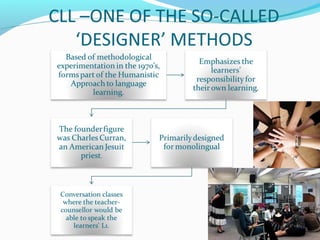
Community Language Learning (CLL) is the name of a
method developed by Charles A. Curran and his
associates in Chicago, 1955. Curran was a specialist in
counseling and a professor of psychology at Loyola
University, Chicago. His application of psychological
counseling techniques to learning is known as
Counseling-Learning. Community Language Learning
represents the use of Counseling-Learning theory to
teach languages.
INTRODUCTION
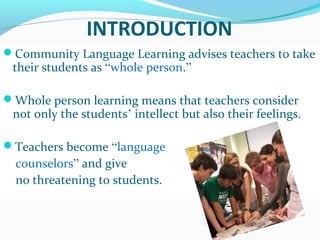
Community Language Learning advises teachers to take
their students as “whole person.”
Whole person learning means that teachers consider
not only the students’ intellect but also their feelings.
Teachers become “language
counselors” and give
no threatening to students.
UNIQUE FEATURES
Students decide topics
Teacher translates
Teachers are “counselors”
Students are “clients”
100% safe
Learning is inductive
HOW IT WORKS IN THE
CLASSROOM
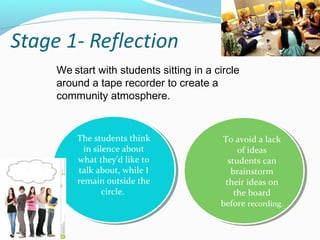
We start with students sitting in a circle
around a tape recorder to create a
community atmosphere.
The students think
in silence about
what they'd like to
talk about, while I
remain outside the
circle.
The students think
in silence about
what they'd like to
talk about, while I
remain outside the
circle.
To avoid a lack
of ideas
students can
brainstorm
their ideas on
the board
before recording.
To avoid a lack
of ideas
students can
brainstorm
their ideas on
the board
before recording.
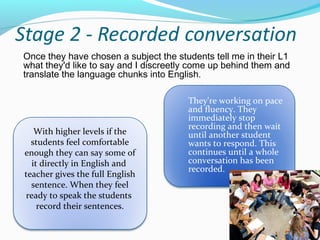
Once they have chosen a subject the students tell me in their L1
what they'd like to say and I discreetly come up behind them and
translate the language chunks into English.
With higher levels if the
students feel comfortable
enough they can say some of
it directly in English and
teacher gives the full English
sentence. When they feel
ready to speak the students
record their sentences.
They're working on pace
and fluency. They
immediately stop
recording and then wait
until another student
wants to respond. This
continues until a whole
conversation has been
recorded.
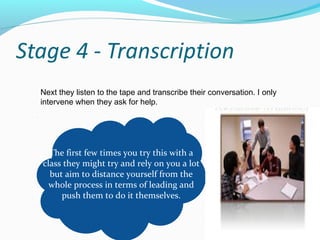
Next they listen to the tape and transcribe their conversation. I only
intervene when they ask for help.
The first few times you try this with a
class they might try and rely on you a lot
but aim to distance yourself from the
whole process in terms of leading and
push them to do it themselves.
This involves looking at the form of tenses and vocabulary
used and why certain ones were chosen, but it will depend on
the language produced by the students.
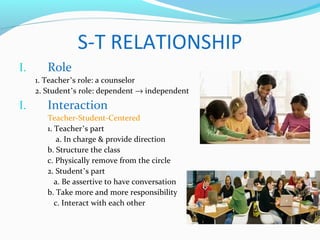
S-T RELATIONSHIP
I. Role
1. Teacher’s role: a counselor
2. Student’s role: dependent → independent
I. Interaction
Teacher-Student-Centered
1. Teacher’s part
a. In charge & provide direction
b. Structure the class
c. Physically remove from the circle
2. Student’s part
a. Be assertive to have conversation
b. Take more and more responsibility
c. Interact with each other
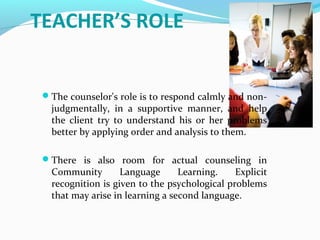
TEACHER’S ROLE
The counselor's role is to respond calmly and non-
judgmentally, in a supportive manner, and help
the client try to understand his or her problems
better by applying order and analysis to them.
There is also room for actual counseling in
Community Language Learning. Explicit
recognition is given to the psychological problems
that may arise in learning a second language.
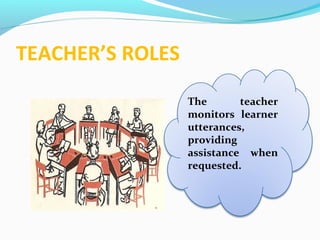
TEACHER’S ROLES
The teacher
monitors learner
utterances,
providing
assistance when
requested.
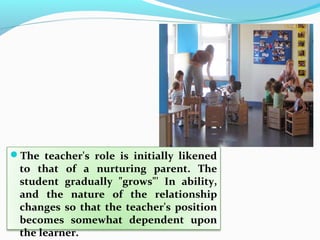
The teacher's role is initially likened
to that of a nurturing parent. The
student gradually "grows"' In ability,
and the nature of the relationship
changes so that the teacher's position
becomes somewhat dependent upon
the learner.
The teacher is
responsible for
providing a safe
environment in
which clients can
learn and grow.
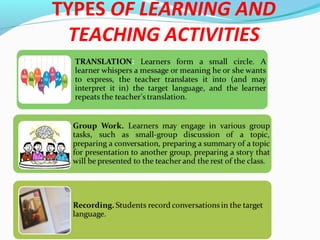
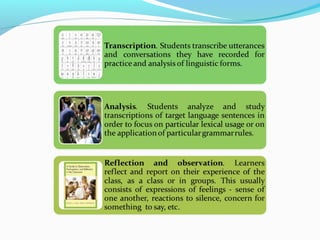
TYPES OF LEARNING AND
TEACHING ACTIVITIES
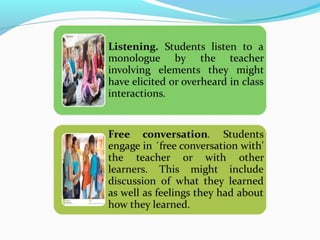
It implies giving support to fellow learners
and acting as a counsellor for other
students.
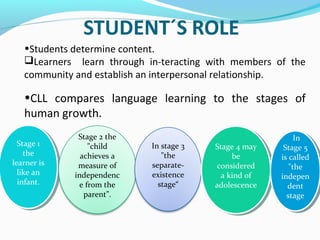
•Students determine content.
Learners learn through in­teracting with members of the
community and establish an interpersonal relationship.
•CLL compares language learning to the stages of
human growth.
Stage 1
the
learner is
like an
infant.
Stage 1
the
learner is
like an
infant.
Stage 2 the
"child
achieves a
measure of
independenc
e from the
parent”.
In stage 3
"the
separate-
existence
stage“
Stage 4 may
be
considered
a kind of
adolescence
Stage 4 may
be
considered
a kind of
adolescence
In
Stage 5
is called
"the
indepen
dent
stage
In
Stage 5
is called
"the
indepen
dent
stage
ADVANTAGES
Student interest
Student independence
Students learn inductive techniques
Nonthreatening
The councelor allow the learners to
determine type of coversation and to
analyze the language inductively.
The student centered nature of the
method can provide extrincic
motivation.
DISANVANTAGES
Time wasted
Teacher poor translator?
Students have mix of languages
Not enough time in school
Risks can be good
The counselor/teacher can
become too non directive.
Students often need directions .
The inductive learning method.
 Translation is a difficult task.
CONCLUSION
Learning is persons: whole-person language takes
place best in a relationship of trust, support, and
cooperation between teacher and students and among
students.
Learning is dynamic and creative: learning is a living
and developmental process.

Community language learning 1

  • 1.
    LANGUAGE SCHOOL COMMUNITY LANGUAGELEARNING NAMES: Jojaira Hernández Gisell Lema Mayra Quiroz
  • 2.
    ORIGIN Community Language Learning(CLL) is the name of a method developed by Charles A. Curran and his associates in Chicago, 1955. Curran was a specialist in counseling and a professor of psychology at Loyola University, Chicago. His application of psychological counseling techniques to learning is known as Counseling-Learning. Community Language Learning represents the use of Counseling-Learning theory to teach languages.
  • 3.
    INTRODUCTION Community Language Learningadvises teachers to take their students as “whole person.” Whole person learning means that teachers consider not only the students’ intellect but also their feelings. Teachers become “language counselors” and give no threatening to students.
  • 5.
    UNIQUE FEATURES Students decidetopics Teacher translates Teachers are “counselors” Students are “clients” 100% safe Learning is inductive
  • 6.
    HOW IT WORKSIN THE CLASSROOM
  • 7.
    We start withstudents sitting in a circle around a tape recorder to create a community atmosphere. The students think in silence about what they'd like to talk about, while I remain outside the circle. The students think in silence about what they'd like to talk about, while I remain outside the circle. To avoid a lack of ideas students can brainstorm their ideas on the board before recording. To avoid a lack of ideas students can brainstorm their ideas on the board before recording.
  • 8.
    Once they havechosen a subject the students tell me in their L1 what they'd like to say and I discreetly come up behind them and translate the language chunks into English. With higher levels if the students feel comfortable enough they can say some of it directly in English and teacher gives the full English sentence. When they feel ready to speak the students record their sentences. They're working on pace and fluency. They immediately stop recording and then wait until another student wants to respond. This continues until a whole conversation has been recorded.
  • 10.
    Next they listento the tape and transcribe their conversation. I only intervene when they ask for help. The first few times you try this with a class they might try and rely on you a lot but aim to distance yourself from the whole process in terms of leading and push them to do it themselves.
  • 11.
    This involves lookingat the form of tenses and vocabulary used and why certain ones were chosen, but it will depend on the language produced by the students.
  • 12.
    S-T RELATIONSHIP I. Role 1.Teacher’s role: a counselor 2. Student’s role: dependent → independent I. Interaction Teacher-Student-Centered 1. Teacher’s part a. In charge & provide direction b. Structure the class c. Physically remove from the circle 2. Student’s part a. Be assertive to have conversation b. Take more and more responsibility c. Interact with each other
  • 14.
    TEACHER’S ROLE The counselor'srole is to respond calmly and non- judgmentally, in a supportive manner, and help the client try to understand his or her problems better by applying order and analysis to them. There is also room for actual counseling in Community Language Learning. Explicit recognition is given to the psychological problems that may arise in learning a second language.
  • 15.
    TEACHER’S ROLES The teacher monitorslearner utterances, providing assistance when requested.
  • 16.
    The teacher's roleis initially likened to that of a nurturing parent. The student gradually "grows"' In ability, and the nature of the relationship changes so that the teacher's position becomes somewhat dependent upon the learner.
  • 17.
    The teacher is responsiblefor providing a safe environment in which clients can learn and grow.
  • 18.
    TYPES OF LEARNINGAND TEACHING ACTIVITIES
  • 21.
    It implies givingsupport to fellow learners and acting as a counsellor for other students.
  • 22.
    •Students determine content. Learnerslearn through in­teracting with members of the community and establish an interpersonal relationship. •CLL compares language learning to the stages of human growth. Stage 1 the learner is like an infant. Stage 1 the learner is like an infant. Stage 2 the "child achieves a measure of independenc e from the parent”. In stage 3 "the separate- existence stage“ Stage 4 may be considered a kind of adolescence Stage 4 may be considered a kind of adolescence In Stage 5 is called "the indepen dent stage In Stage 5 is called "the indepen dent stage
  • 23.
    ADVANTAGES Student interest Student independence Studentslearn inductive techniques Nonthreatening The councelor allow the learners to determine type of coversation and to analyze the language inductively. The student centered nature of the method can provide extrincic motivation.
  • 24.
    DISANVANTAGES Time wasted Teacher poortranslator? Students have mix of languages Not enough time in school Risks can be good The counselor/teacher can become too non directive. Students often need directions . The inductive learning method.  Translation is a difficult task.
  • 25.
    CONCLUSION Learning is persons:whole-person language takes place best in a relationship of trust, support, and cooperation between teacher and students and among students. Learning is dynamic and creative: learning is a living and developmental process.