Wilson Burgos ArocaYohamer Ernesto Guevara SalazarJesús Alfonso Hermosa TovarJosé Luis Moreno SolanoCOOPERATIVE LANGUAGE LEARNING
Cooperative learning is group learning activity organized so that learning is dependent on the socially structured exchange of information between learners in groups and in which each learner is held accountable for his or her own learning and is motivated to increase the learning of others. (Olsen and Kagan 1992:8)COOPERATIVE LANGUAGE LEARNING
Raise of achievements of all studentsPositive relationships among studentsExperience on healthy social, psychological, and cognitive developmentReplace competition for cooperationReplace teacher-fronted lessons for student-centeredInteractive pair and group activitiesDevelopment of learning and communication strategiesReduce learner stress and create a positive affective classroom climateGENERAL CHARACTERISTICS
Interactive and cooperative nature of languageCommunication as a primary purpose of languageMost speech is organized as conversationCommunication takes place upon certain agreed-upon set of cooperative rulesWe learn these social rules in conversational interactionAPPROACHTHEORY OF LANGUAGE
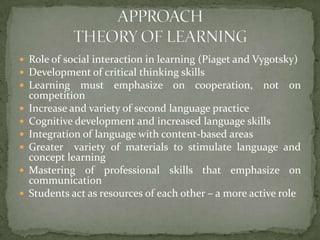
Role of social interaction in learning (Piaget and Vygotsky)Development of critical thinking skillsLearning must emphasize on cooperation, not on competitionIncrease and variety of second language practiceCognitive development and increased language skillsIntegration of language with content-based areasGreater  variety of materials to stimulate language and concept learningMastering of professional skills that emphasize on communicationStudents act as resources of each other – a more active roleAPPROACHTHEORY OF LEARNING
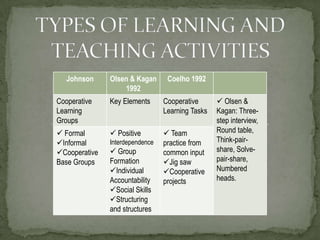
TYPES OF LEARNING AND TEACHING ACTIVITIES
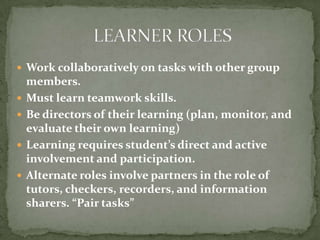
Work collaboratively on tasks with other group members.Must learn teamwork skills.Be directors of their learning (plan, monitor, and evaluate their own learning)Learning requires student’s direct and active involvement and participation.Alternate roles involve partners in the role of tutors, checkers, recorders, and information sharers. “Pair tasks” LEARNER ROLES
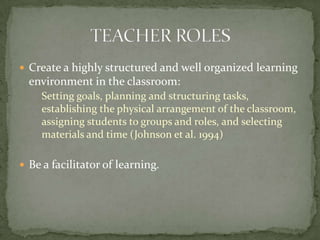
Create a highly structured and well organized learning environment in the classroom:	Setting goals, planning and structuring tasks, establishing the physical arrangement of the classroom, assigning students to groups and roles, and selecting materials and time (Johnson et al. 1994)Be a facilitator of learning.TEACHER ROLES
Move around the class and helping students and groups as needs arise:During this time the teacher interacts, teaches, refocuses, questions, clarifies, supports, expands, celebrates, and empathizes.And facilitators are giving feedback, redirecting the group with questions, encouraging the group to solve its own problems, extending activity, encouraging thinking, managing conflict, observing students, and supplying resources. (Harel 1992: 169)
Teacher speaks less than in teacher fronted class.Provide broad questions to challenge thinking.Prepare students for the task they will carry out.Assist students with the  learning tasks.Give few commands, imposing less disciplinary control (Harel 1992)
Restructuring lessons so that students can work cooperatively.  This involves the following steps (Johnson et al. 1994: 9):Take your existing lessons, curriculum, and sources and structure them cooperatively.Tailor cooperative learning lessons to your unique instructional needs, circumstances, curricula, subject areas, and students.Diagnose the problems some students may have in working together and intervene to increase learning groups’ effectiveness.
Create opportunities for students to work cooperatively.E.g.  If students are working in groups..Each student might have a set of materials.Groups might have different sets of materials.Or, each member might need a copy of a text.Materials can be specially designed for CLL learning, modified from existing materials, or borrowed from other disciplines.THE ROLE OF INSTRUCTIONAL MATERIALS
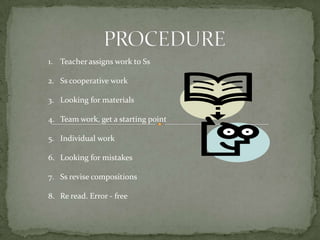
PROCEDURETeacherassignsworktoSsSscooperativeworkLookingformaterialsTeamwork, get a startingpointIndividual workLookingformistakesSs revise compositionsRe read. Error - free
CONCLUSIONS Use of groupdiscussion. Motives participation
Maximizestudent’sinteraction

Cooperative Language Learning

  • 1.
    Wilson Burgos ArocaYohamerErnesto Guevara SalazarJesús Alfonso Hermosa TovarJosé Luis Moreno SolanoCOOPERATIVE LANGUAGE LEARNING
  • 2.
    Cooperative learning isgroup learning activity organized so that learning is dependent on the socially structured exchange of information between learners in groups and in which each learner is held accountable for his or her own learning and is motivated to increase the learning of others. (Olsen and Kagan 1992:8)COOPERATIVE LANGUAGE LEARNING
  • 3.
    Raise of achievementsof all studentsPositive relationships among studentsExperience on healthy social, psychological, and cognitive developmentReplace competition for cooperationReplace teacher-fronted lessons for student-centeredInteractive pair and group activitiesDevelopment of learning and communication strategiesReduce learner stress and create a positive affective classroom climateGENERAL CHARACTERISTICS
  • 4.
    Interactive and cooperativenature of languageCommunication as a primary purpose of languageMost speech is organized as conversationCommunication takes place upon certain agreed-upon set of cooperative rulesWe learn these social rules in conversational interactionAPPROACHTHEORY OF LANGUAGE
  • 5.
    Role of socialinteraction in learning (Piaget and Vygotsky)Development of critical thinking skillsLearning must emphasize on cooperation, not on competitionIncrease and variety of second language practiceCognitive development and increased language skillsIntegration of language with content-based areasGreater variety of materials to stimulate language and concept learningMastering of professional skills that emphasize on communicationStudents act as resources of each other – a more active roleAPPROACHTHEORY OF LEARNING
  • 6.
    TYPES OF LEARNINGAND TEACHING ACTIVITIES
  • 7.
    Work collaboratively ontasks with other group members.Must learn teamwork skills.Be directors of their learning (plan, monitor, and evaluate their own learning)Learning requires student’s direct and active involvement and participation.Alternate roles involve partners in the role of tutors, checkers, recorders, and information sharers. “Pair tasks” LEARNER ROLES
  • 8.
    Create a highlystructured and well organized learning environment in the classroom: Setting goals, planning and structuring tasks, establishing the physical arrangement of the classroom, assigning students to groups and roles, and selecting materials and time (Johnson et al. 1994)Be a facilitator of learning.TEACHER ROLES
  • 9.
    Move around theclass and helping students and groups as needs arise:During this time the teacher interacts, teaches, refocuses, questions, clarifies, supports, expands, celebrates, and empathizes.And facilitators are giving feedback, redirecting the group with questions, encouraging the group to solve its own problems, extending activity, encouraging thinking, managing conflict, observing students, and supplying resources. (Harel 1992: 169)
  • 10.
    Teacher speaks lessthan in teacher fronted class.Provide broad questions to challenge thinking.Prepare students for the task they will carry out.Assist students with the learning tasks.Give few commands, imposing less disciplinary control (Harel 1992)
  • 11.
    Restructuring lessons sothat students can work cooperatively. This involves the following steps (Johnson et al. 1994: 9):Take your existing lessons, curriculum, and sources and structure them cooperatively.Tailor cooperative learning lessons to your unique instructional needs, circumstances, curricula, subject areas, and students.Diagnose the problems some students may have in working together and intervene to increase learning groups’ effectiveness.
  • 12.
    Create opportunities forstudents to work cooperatively.E.g. If students are working in groups..Each student might have a set of materials.Groups might have different sets of materials.Or, each member might need a copy of a text.Materials can be specially designed for CLL learning, modified from existing materials, or borrowed from other disciplines.THE ROLE OF INSTRUCTIONAL MATERIALS
  • 13.
    PROCEDURETeacherassignsworktoSsSscooperativeworkLookingformaterialsTeamwork, get astartingpointIndividual workLookingformistakesSs revise compositionsRe read. Error - free
  • 14.
    CONCLUSIONS Use ofgroupdiscussion. Motives participation
  • 15.