DISCRETE POINT TEST
Presented by:
1. Fairuz Labibah
2. Arrum Puspita Ratna
3. Novi Nur Sofan
4. Intan Lutfiyah
5. Hilmi Mizzi Perdana
6. Lulu Aulia
DEFINITION
Discrete point testing refers to the testing of one element at a
time, item by item. This might involve, for example, a series of
items each testing a particular grammatical structure.
(Taken from Hughes, A (2003) Testing for Language Teachers. Cambridge: Cambridge
University Press).
• Discrete point test respond to the underlying assumption that language can be broken
down into its component parts and those parts tested in turn.
• These components are the four skills (listening, speaking, reading, writing) and the
different linguistic components (morphology, graphology, spelling, grammar,
morphology, syntax and vocabulary), together with subcategories within these units.
Accordingly, test are devised in order to assess just one of these components.
(Taken from RESLA (1996) Testing English As Foreign Language: An Overview and Some Methodological
Consideration. Page 22)
THE EXAMPLES OF DISCRETE POINT
TEST
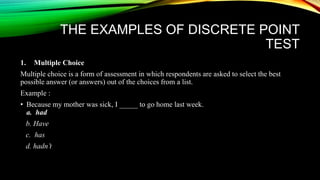
1. Multiple Choice
Multiple choice is a form of assessment in which respondents are asked to select the best
possible answer (or answers) out of the choices from a list.
Example :
• Because my mother was sick, I _____ to go home last week.
a. had
b. Have
c. has
d. hadn’t
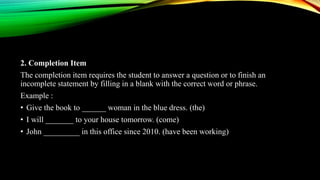
2. Completion Item
The completion item requires the student to answer a question or to finish an
incomplete statement by filling in a blank with the correct word or phrase.
Example :
• Give the book to ______ woman in the blue dress. (the)
• I will _______ to your house tomorrow. (come)
• John _________ in this office since 2010. (have been working)
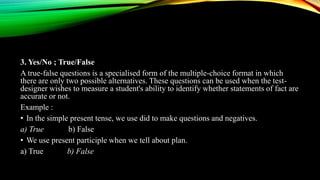
3. Yes/No ; True/False
A true-false questions is a specialised form of the multiple-choice format in which
there are only two possible alternatives. These questions can be used when the test-
designer wishes to measure a student's ability to identify whether statements of fact are
accurate or not.
Example :
• In the simple present tense, we use did to make questions and negatives.
a) True b) False
• We use present participle when we tell about plan.
a) True b) False
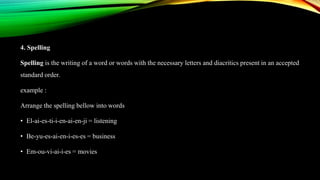
4. Spelling
Spelling is the writing of a word or words with the necessary letters and diacritics present in an accepted
standard order.
example :
Arrange the spelling bellow into words
• El-ai-es-ti-i-en-ai-en-ji = listening
• Be-yu-es-ai-en-i-es-es = business
• Em-ou-vi-ai-i-es = movies
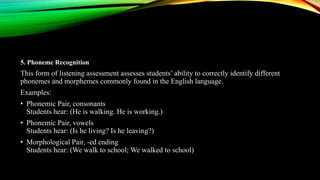
5. Phoneme Recognition
This form of listening assessment assesses students’ ability to correctly identify different
phonemes and morphemes commonly found in the English language.
Examples:
• Phonemic Pair, consonants
Students hear: (He is walking. He is working.)
• Phonemic Pair, vowels
Students hear: (Is he living? Is he leaving?)
• Morphological Pair, -ed ending
Students hear: (We walk to school; We walked to school)
STRENGTH
• The test of this approach can cover a wide range of scope of materials to be put in
the tests.
• The test allows quantification on the students’ responses.
• In the term of scoring, the test is also reliable because of its objectivity; the scoring
is efficient, even it can be perform by machine
WEAKNESSES
• Constructing discrete point test items is potentially energy and time consuming.
• The test do not include social context where verbal communication normally take
place.
• Success in doing the test is not readily inferable to the ability of the test taker to
communicate in real life circumstances.
•

Discrete point test 1

  • 1.
    DISCRETE POINT TEST Presentedby: 1. Fairuz Labibah 2. Arrum Puspita Ratna 3. Novi Nur Sofan 4. Intan Lutfiyah 5. Hilmi Mizzi Perdana 6. Lulu Aulia
  • 2.
    DEFINITION Discrete point testingrefers to the testing of one element at a time, item by item. This might involve, for example, a series of items each testing a particular grammatical structure. (Taken from Hughes, A (2003) Testing for Language Teachers. Cambridge: Cambridge University Press).
  • 3.
    • Discrete pointtest respond to the underlying assumption that language can be broken down into its component parts and those parts tested in turn. • These components are the four skills (listening, speaking, reading, writing) and the different linguistic components (morphology, graphology, spelling, grammar, morphology, syntax and vocabulary), together with subcategories within these units. Accordingly, test are devised in order to assess just one of these components. (Taken from RESLA (1996) Testing English As Foreign Language: An Overview and Some Methodological Consideration. Page 22)
  • 4.
    THE EXAMPLES OFDISCRETE POINT TEST 1. Multiple Choice Multiple choice is a form of assessment in which respondents are asked to select the best possible answer (or answers) out of the choices from a list. Example : • Because my mother was sick, I _____ to go home last week. a. had b. Have c. has d. hadn’t
  • 5.
    2. Completion Item Thecompletion item requires the student to answer a question or to finish an incomplete statement by filling in a blank with the correct word or phrase. Example : • Give the book to ______ woman in the blue dress. (the) • I will _______ to your house tomorrow. (come) • John _________ in this office since 2010. (have been working)
  • 6.
    3. Yes/No ;True/False A true-false questions is a specialised form of the multiple-choice format in which there are only two possible alternatives. These questions can be used when the test- designer wishes to measure a student's ability to identify whether statements of fact are accurate or not. Example : • In the simple present tense, we use did to make questions and negatives. a) True b) False • We use present participle when we tell about plan. a) True b) False
  • 7.
    4. Spelling Spelling isthe writing of a word or words with the necessary letters and diacritics present in an accepted standard order. example : Arrange the spelling bellow into words • El-ai-es-ti-i-en-ai-en-ji = listening • Be-yu-es-ai-en-i-es-es = business • Em-ou-vi-ai-i-es = movies
  • 8.
    5. Phoneme Recognition Thisform of listening assessment assesses students’ ability to correctly identify different phonemes and morphemes commonly found in the English language. Examples: • Phonemic Pair, consonants Students hear: (He is walking. He is working.) • Phonemic Pair, vowels Students hear: (Is he living? Is he leaving?) • Morphological Pair, -ed ending Students hear: (We walk to school; We walked to school)
  • 9.
    STRENGTH • The testof this approach can cover a wide range of scope of materials to be put in the tests. • The test allows quantification on the students’ responses. • In the term of scoring, the test is also reliable because of its objectivity; the scoring is efficient, even it can be perform by machine
  • 10.
    WEAKNESSES • Constructing discretepoint test items is potentially energy and time consuming. • The test do not include social context where verbal communication normally take place. • Success in doing the test is not readily inferable to the ability of the test taker to communicate in real life circumstances. •