
Application of nanotechnology in biosensor Course Current topics in biochemistry Instructors: Dr. I.M. Santha Dr. A. Sachdev Dr. A. Dahuja Presented by: Om Prakash Gupta 9817, Ph.D,
Science of using or producing objects –  that are nanometers in size (nano = 1 billionth) –  the ability to manipulate and control those materials in a useful way –  for industrial applications in the medical, chemical, materials, electronics, sensing and other fields What is Nanotechnology?
 
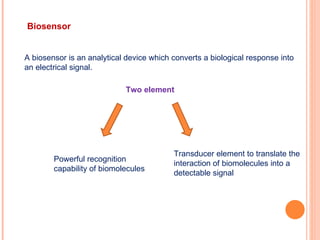
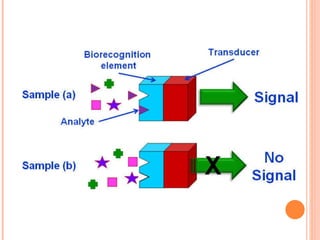
A biosensor is an analytical device which converts a biological response into an electrical signal. Biosensor Two element Powerful recognition capability of biomolecules Transducer element to translate the interaction of biomolecules into a detectable signal
 
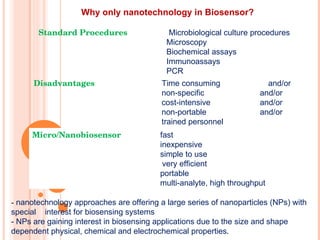
-  nanotechnology approaches are offering a large series of nanoparticles (NPs) with special  interest for biosensing systems - NPs are gaining interest in biosensing applications due to the size and shape dependent physical, chemical and electrochemical properties . Micro/Nanobiosensor   fast inexpensive simple to use very efficient portable multi-analyte, high throughput Why only nanotechnology in Biosensor? Standard Procedures   Microbiological culture procedures Microscopy Biochemical assays Immunoassays PCR Disadvantages   Time consuming   and/or non-specific  and/or cost-intensive  and/or non-portable  and/or trained personnel
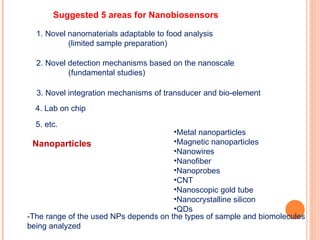
Nanoparticles Metal nanoparticles Magnetic nanoparticles Nanowires Nanofiber Nanoprobes CNT Nanoscopic gold tube Nanocrystalline silicon QDs -The range of the used NPs depends on the types of sample and biomolecules being analyzed Suggested 5 areas for Nanobiosensors 1. Novel nanomaterials adaptable to food analysis (limited sample preparation) 2. Novel detection mechanisms based on the nanoscale (fundamental studies) 3. Novel integration mechanisms of transducer and bio-element 4. Lab on chip 5. etc.
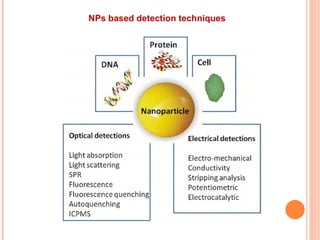
NPs based detection techniques
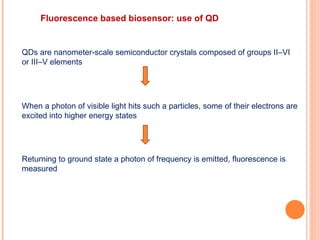
Fluorescence based biosensor: use of QD QDs are nanometer-scale semiconductor crystals composed of groups II–VI or III–V elements When a photon of visible light hits such a particles, some of their electrons are excited into higher energy states Returning to ground state a photon of frequency is emitted, fluorescence is measured
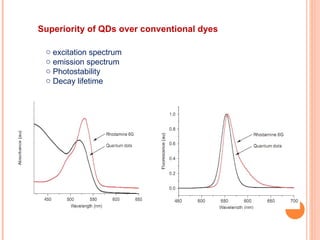
Superiority of QDs over conventional dyes excitation spectrum emission spectrum Photostability Decay lifetime
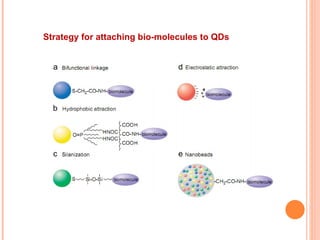
Strategy for attaching bio-molecules to QDs
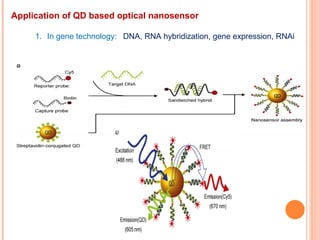
Design of QD based DNA nanosensor Application of QD based optical nanosensor In gene technology: DNA, RNA hybridization, gene expression, RNAi
2. Intracellular protein labeling 3. Cell tracking 4. Pathogen and toxin detection 5. In vivo animal imaging Jamieson T.,  et al .,  Biomaterials ,  28  (2007) 4717–4732
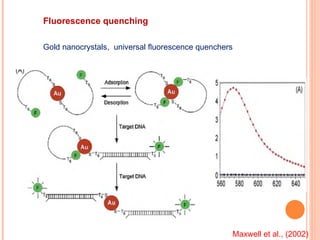
Fluorescence quenching Gold nanocrystals,  universal fluorescence quenchers Maxwell et al., (2002)
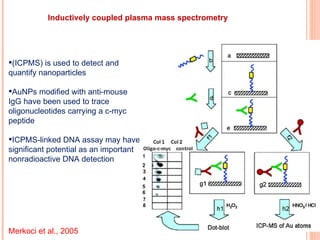
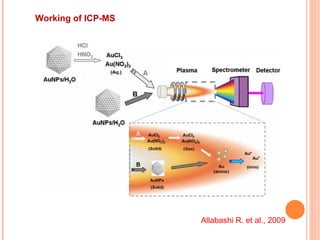
Inductively coupled plasma mass spectrometry (ICPMS) is used to detect and quantify nanoparticles AuNPs modified with anti-mouse IgG have been used to trace oligonucleotides carrying a c-myc peptide ICPMS-linked DNA assay may have significant potential as an important nonradioactive DNA detection Merkoci et al., 2005
Working of ICP-MS Allabashi R. et al., 2009
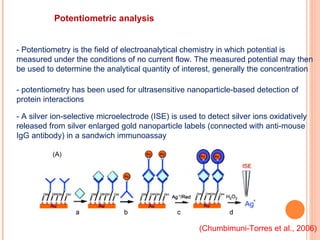
Potentiometric analysis - Potentiometry is the field of electroanalytical chemistry in which potential is measured under the conditions of no current flow. The measured potential may then be used to determine the analytical quantity of interest, generally the concentration - potentiometry has been used for ultrasensitive nanoparticle-based detection of protein interactions - A silver ion-selective microelectrode (ISE) is used to detect silver ions oxidatively released from silver enlarged gold nanoparticle labels (connected with anti-mouse IgG antibody) in a sandwich immunoassay  (Chumbimuni-Torres et al., 2006)
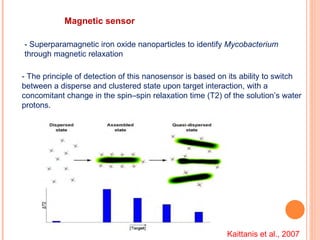
Magnetic sensor - Superparamagnetic iron oxide nanoparticles to identify  Mycobacterium  through magnetic relaxation - The principle of detection of this nanosensor is based on its ability to switch between a disperse and clustered state upon target interaction, with a concomitant change in the spin–spin relaxation time (T2) of the solution’s water protons. Kaittanis et al., 2007
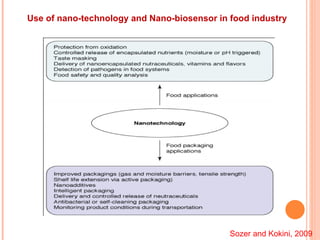
Use of nano-technology and Nano-biosensor in food industry Sozer and Kokini, 2009
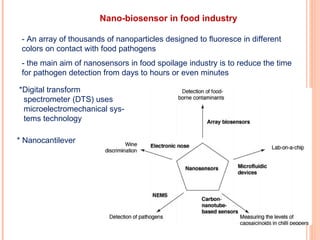
Nano-biosensor in food industry - the main aim of nanosensors in food spoilage industry is to reduce the time for pathogen detection from days to hours or even minutes - An array of thousands of nanoparticles designed to fluoresce in different colors on contact with food pathogens *Digital transform  spectrometer (DTS) uses microelectromechanical sys- tems technology  * Nanocantilever
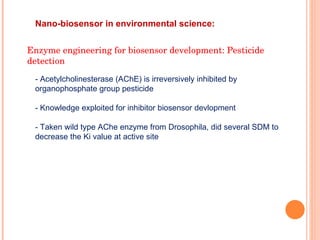
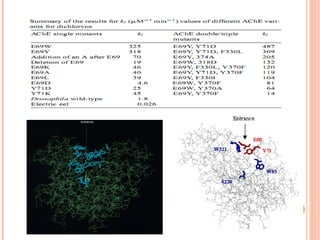
Nano-biosensor in environmental science:  Enzyme engineering for biosensor development: Pesticide detection - Acetylcholinesterase (AChE) is irreversively inhibited by organophosphate group pesticide - Knowledge exploited for inhibitor biosensor devlopment - Taken wild type AChe enzyme from Drosophila, did several SDM to decrease the Ki value at active site
 
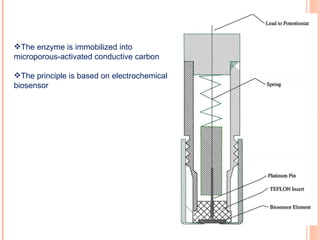
The enzyme is immobilized into microporous-activated conductive carbon The principle is based on electrochemical biosensor
Thank You

Ohm pres

  • 1.
    Application of nanotechnologyin biosensor Course Current topics in biochemistry Instructors: Dr. I.M. Santha Dr. A. Sachdev Dr. A. Dahuja Presented by: Om Prakash Gupta 9817, Ph.D,
  • 2.
    Science of usingor producing objects – that are nanometers in size (nano = 1 billionth) – the ability to manipulate and control those materials in a useful way – for industrial applications in the medical, chemical, materials, electronics, sensing and other fields What is Nanotechnology?
  • 3.
  • 4.
    A biosensor isan analytical device which converts a biological response into an electrical signal. Biosensor Two element Powerful recognition capability of biomolecules Transducer element to translate the interaction of biomolecules into a detectable signal
  • 5.
  • 6.
    - nanotechnologyapproaches are offering a large series of nanoparticles (NPs) with special interest for biosensing systems - NPs are gaining interest in biosensing applications due to the size and shape dependent physical, chemical and electrochemical properties . Micro/Nanobiosensor fast inexpensive simple to use very efficient portable multi-analyte, high throughput Why only nanotechnology in Biosensor? Standard Procedures Microbiological culture procedures Microscopy Biochemical assays Immunoassays PCR Disadvantages Time consuming and/or non-specific and/or cost-intensive and/or non-portable and/or trained personnel
  • 7.
    Nanoparticles Metal nanoparticlesMagnetic nanoparticles Nanowires Nanofiber Nanoprobes CNT Nanoscopic gold tube Nanocrystalline silicon QDs -The range of the used NPs depends on the types of sample and biomolecules being analyzed Suggested 5 areas for Nanobiosensors 1. Novel nanomaterials adaptable to food analysis (limited sample preparation) 2. Novel detection mechanisms based on the nanoscale (fundamental studies) 3. Novel integration mechanisms of transducer and bio-element 4. Lab on chip 5. etc.
  • 8.
  • 9.
    Fluorescence based biosensor:use of QD QDs are nanometer-scale semiconductor crystals composed of groups II–VI or III–V elements When a photon of visible light hits such a particles, some of their electrons are excited into higher energy states Returning to ground state a photon of frequency is emitted, fluorescence is measured
  • 10.
    Superiority of QDsover conventional dyes excitation spectrum emission spectrum Photostability Decay lifetime
  • 11.
    Strategy for attachingbio-molecules to QDs
  • 12.
    Design of QDbased DNA nanosensor Application of QD based optical nanosensor In gene technology: DNA, RNA hybridization, gene expression, RNAi
  • 13.
    2. Intracellular proteinlabeling 3. Cell tracking 4. Pathogen and toxin detection 5. In vivo animal imaging Jamieson T., et al ., Biomaterials , 28 (2007) 4717–4732
  • 14.
    Fluorescence quenching Goldnanocrystals, universal fluorescence quenchers Maxwell et al., (2002)
  • 15.
    Inductively coupled plasmamass spectrometry (ICPMS) is used to detect and quantify nanoparticles AuNPs modified with anti-mouse IgG have been used to trace oligonucleotides carrying a c-myc peptide ICPMS-linked DNA assay may have significant potential as an important nonradioactive DNA detection Merkoci et al., 2005
  • 16.
    Working of ICP-MSAllabashi R. et al., 2009
  • 17.
    Potentiometric analysis -Potentiometry is the field of electroanalytical chemistry in which potential is measured under the conditions of no current flow. The measured potential may then be used to determine the analytical quantity of interest, generally the concentration - potentiometry has been used for ultrasensitive nanoparticle-based detection of protein interactions - A silver ion-selective microelectrode (ISE) is used to detect silver ions oxidatively released from silver enlarged gold nanoparticle labels (connected with anti-mouse IgG antibody) in a sandwich immunoassay (Chumbimuni-Torres et al., 2006)
  • 18.
    Magnetic sensor -Superparamagnetic iron oxide nanoparticles to identify Mycobacterium through magnetic relaxation - The principle of detection of this nanosensor is based on its ability to switch between a disperse and clustered state upon target interaction, with a concomitant change in the spin–spin relaxation time (T2) of the solution’s water protons. Kaittanis et al., 2007
  • 19.
    Use of nano-technologyand Nano-biosensor in food industry Sozer and Kokini, 2009
  • 20.
    Nano-biosensor in foodindustry - the main aim of nanosensors in food spoilage industry is to reduce the time for pathogen detection from days to hours or even minutes - An array of thousands of nanoparticles designed to fluoresce in different colors on contact with food pathogens *Digital transform spectrometer (DTS) uses microelectromechanical sys- tems technology * Nanocantilever
  • 21.
    Nano-biosensor in environmentalscience: Enzyme engineering for biosensor development: Pesticide detection - Acetylcholinesterase (AChE) is irreversively inhibited by organophosphate group pesticide - Knowledge exploited for inhibitor biosensor devlopment - Taken wild type AChe enzyme from Drosophila, did several SDM to decrease the Ki value at active site
  • 22.
  • 23.
    The enzyme isimmobilized into microporous-activated conductive carbon The principle is based on electrochemical biosensor
  • 24.