Nanotechnology in
microbiology
By Dr Mayuri
Nanotechnology
• “Nano ” means very small, and it comes from the
Greek word “nanos”, meaning dwarf
• Nanotechnology by defination is the art and
science of manipulating matter at the nanoscale.
• Thus encompassing nanoscale science and
involves manipulating matter at 1 to 100 nm
length scale.
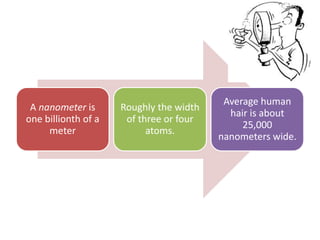
A nanometer is
one billionth of a
meter
Roughly the width
of three or four
atoms.
Average human
hair is about
25,000
nanometers wide.
What happens at the nanoscale?
• At the nanoscale, the physical, chemical, and
biological properties of materials differ in
fundamental and valuable ways from the
properties of individual atoms and molecules
or bulk matter.
• Nanotechnology R&D is directed toward
understanding and creating improved
materials, devices, and systems that exploit
these new properties
Limitation of current technologies
• High cost and short shelve half-life of some
reagents such as enzymes and DNA primers,
limit the application of most conventional
pathogen detection techniques in developing
nations.
• ELISA and PCR, require extensive sample
preparation and have long readout times,
which delay prompt response and disease
containment.
The potential of nanotechnology
• Due to unique electrical, magnetic,
luminescent, and catalytic properties of
nanomaterials
• Faster, sensitive and more economical
diagnostic assays can be developed
• Without any sample preparation, providing
fast and reliable results in simple and user-
friendly formats
• The properties of the nanomaterials used for
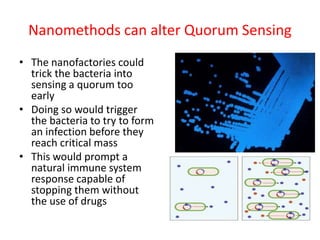
pathogen detection can be tailored by
changing the size, shape, composition and
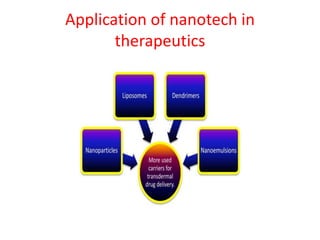
surface modification of the nanomaterial.
• Electronic, spectroscopic (emissive,
absorptive), light scattering and conductive
properties can be modified by engineering the
nanoparticles’ structural parameter: size,
composition and binding properties
Methodology of Nanotechnology
2 Approaches
• Bottom-up approach: Going from molecules to the
next higher levels of biological organization : how
molecular components in cells interact with each other
and how they are organized into functional modules
performing discrete tasks that any single class of
molecules cannot accomplish
• Top down approaches: The top-down controls that
operate in living cells entails studying how regulatory
modules are coupled to one another and to gene
transcription.
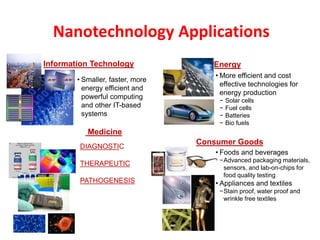
Nanotechnology Applications
Information Technology Energy
Medicine
Consumer Goods
• Smaller, faster, more
energy efficient and
powerful computing
and other IT-based
systems
• More efficient and cost
effective technologies for
energy production
− Solar cells
− Fuel cells
− Batteries
− Bio fuels
• Foods and beverages
−Advanced packaging materials,
sensors, and lab-on-chips for
food quality testing
• Appliances and textiles
−Stain proof, water proof and
wrinkle free textiles
DIAGNOSTIC
THERAPEUTIC
PATHOGENESIS
Nanotechnology tools & their
applications in microbiology
• Qdots
• Nanoparticles
 Gold
 Silver
 Silicone
 Magnetic
 Flourescent polymeric
• Nanopores
• Nanocantilevers
• Nanoemulsion
• Liposomes
• Nanopores
• Nanofibres
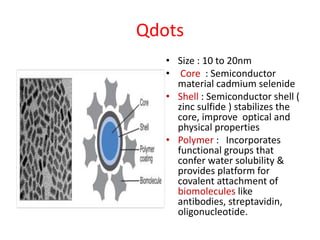
Qdots
• Size : 10 to 20nm
• Core : Semiconductor
material cadmium selenide
• Shell : Semiconductor shell (
zinc sulfide ) stabilizes the
core, improve optical and
physical properties
• Polymer : Incorporates
functional groups that
confer water solubility &
provides platform for
covalent attachment of
biomolecules like
antibodies, streptavidin,
oligonucleotide.
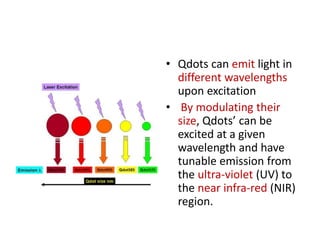
• Qdots can emit light in
different wavelengths
upon excitation
• By modulating their
size, Qdots’ can be
excited at a given
wavelength and have
tunable emission from
the ultra-violet (UV) to
the near infra-red (NIR)
region.
• Advantage –
 Confer targeting specificity for biomolecular
detection.
 Incorporate multiple affinity reagent—(dye-
labeled conjugates in which multiple dyes are
attached to a single affinity reagent)
Highly bright and extremely photostable(no
photobleaching)
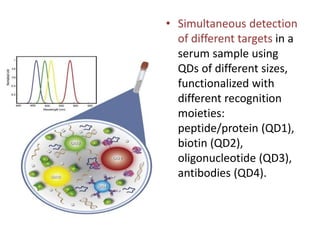
• Simultaneous detection
of different targets in a
serum sample using
QDs of different sizes,
functionalized with
different recognition
moieties:
peptide/protein (QD1),
biotin (QD2),
oligonucleotide (QD3),
antibodies (QD4).
• Uses -
 FRET-Based Quantum Dot Immunoassay for Rapid and Sensitive Detection
of Aspergillus amstelodami
 Confocal nanoscope
 Quantum dot barcodes have been used for the detection of
viruses, such as HIV and Hepatitis, via a sensitive handheld
diagnostic system
 Qdot-based FISH probes have been widely used for the detection of the Y-
chromosome in fixed human sperm cells
 Qdot-FRET-based nanosensors (Qdot act as donor) mediated
ultrasensitive detection of low concentrations of target DNA in the
diagnosis of genetic diseases
FRET-based Qdot immunoassay
 Initial complex formed when a
quencher-labeled analyte bound
the antigen-binding site of QD-
conjugated antibody
 When excited, QD transfer its
energy to the quencher
molecules due to their close
proximity.
 Addition of target analytes,
leads to displacement of
quencher-labeled analytes causes
disruption of FRET, which
translates to increased QD donor
emission signal.
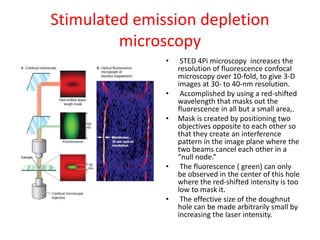
Stimulated emission depletion
microscopy
• STED 4Pi microscopy increases the
resolution of fluorescence confocal
microscopy over 10-fold, to give 3-D
images at 30- to 40-nm resolution.
• Accomplished by using a red-shifted
wavelength that masks out the
fluorescence in all but a small area,.
• Mask is created by positioning two
objectives opposite to each other so
that they create an interference
pattern in the image plane where the
two beams cancel each other in a
“null node.”
• The fluorescence ( green) can only
be observed in the center of this hole
where the red-shifted intensity is too
low to mask it.
• The effective size of the doughnut
hole can be made arbitrarily small by
increasing the laser intensity.
Quantum dot barcodes
A ‘microbead’ acts as a host structure that
contains designed quantities of QDs with
different emission wavelengths. This creates
unique emission spectra varying in colour and
intensity. These microbeads, with different
emission spectra, were used to tag biological
samples
The quantum dot-barcoded microbeads are
sequentially introduced into the chip.
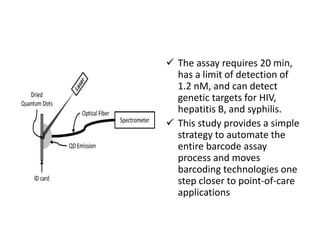
 The assay requires 20 min,
has a limit of detection of
1.2 nM, and can detect
genetic targets for HIV,
hepatitis B, and syphilis.
 This study provides a simple
strategy to automate the
entire barcode assay
process and moves
barcoding technologies one
step closer to point-of-care
applications
Gold and Silver NPs
• The optical absorption and scattering spectra of gold NPs exhibit a
pronounced peak in the the plasmon resonance (the collective
excitation of the free electron gas)
• Surface chemistries of gold NPs can be controlled by grafting thiol
molecules or thiol-containing polymers, as the gold surface exerts
strong affinity towards sulfhydryl groups leading to the formation of
relatively strong covalent bonds.
• Hence, further surface modification can be done simply by using
thiolated functional molecules, facilitating conjugation of various
probes, including antibodies and nucleic acids.
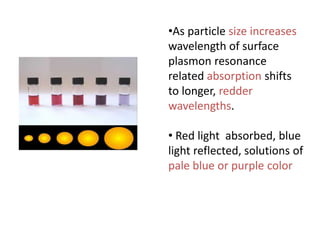
•As particle size increases
wavelength of surface
plasmon resonance
related absorption shifts
to longer, redder
wavelengths.
• Red light absorbed, blue
light reflected, solutions of
pale blue or purple color
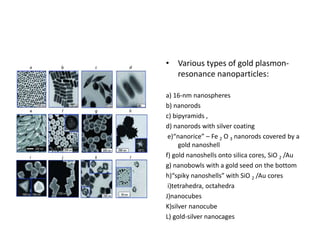
• Various types of gold plasmon-
resonance nanoparticles:
a) 16-nm nanospheres
b) nanorods
c) bipyramids ,
d) nanorods with silver coating
e)“nanorice” – Fe 2 O 3 nanorods covered by a
gold nanoshell
f) gold nanoshells onto silica cores, SiO 2 /Au
g) nanobowls with a gold seed on the bottom
h)“spiky nanoshells” with SiO 2 /Au cores
i)tetrahedra, octahedra
J)nanocubes
K)silver nanocube
L) gold-silver nanocages
• Uses
Sol particle immunoassay (SPIA)
 Surface plasmon resonance biosensors
 Resonance scattering confocal microscopy or
two-photon luminescence confocal microscopy
Nanochips and nanoarrays
Carriers for drugs
Sol particle immunoassay
• a) conjugate aggregation caused
by binding to target molecules
• b) corresponding changes in
color and absorption spectra
when particles approach a
distance that is less than 1/10nth
of their diameter,
• the sol’s red color changes into
purple as the absorption
spectrum broadens and shifts
into red region
• detected either
spectrophotometrically or visually
Immunoassay
 Schistosomes (Ag)
 Rubella viruses (Ag)
Leptospira in urine
 Quantitative determination of
immunoglobulins
Direct detection of cancer cells and
Markers of Alzheimer’s disease
• Modified SPIA method proposed for
colorimetric detection of DNA.
• Use of GNP conjugated with thiol-modified
single-stranded DNA of 10–30 nm size
• Hybridization of targets and probes results in
formation of GNP aggregates, changes in
absorption spectrum of solution and can be
detected visually
Surface plasmon resonance biosensors
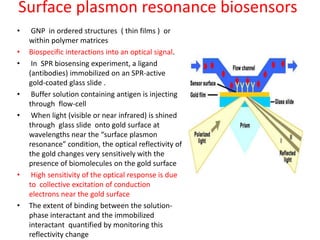
• GNP in ordered structures ( thin films ) or
within polymer matrices
• Biospecific interactions into an optical signal.
• In SPR biosensing experiment, a ligand
(antibodies) immobilized on an SPR-active
gold-coated glass slide .
• Buffer solution containing antigen is injecting
through flow-cell
• When light (visible or near infrared) is shined
through glass slide onto gold surface at
wavelengths near the “surface plasmon
resonance” condition, the optical reflectivity of
the gold changes very sensitively with the
presence of biomolecules on the gold surface
• High sensitivity of the optical response is due
to collective excitation of conduction
electrons near the gold surface
• The extent of binding between the solution-
phase interactant and the immobilized
interactant quantified by monitoring this
reflectivity change
 Advantage of SPR is high sensitivity without any
labeling of interactants.
• Application
 immunodiagnostics
 tick-borne encephalitis
 HPV and HIV
 Alzheimer’s disease
 allergens
 cytokines
 detecting tumor
Two-photon luminescence confocal
microscopy
• Object’s luminescence is excited due to the simultaneous absorption of
two (or more) photons; the energy of each of them being lower than that
required for fluorescence excitation.
• laser scanning confocal microscopy, without pinholes
• Optical sectioning of the sample is instead achieved through the use of a
mode-locked Ti:sapphire laser which operates in the near-infrared
• The laser produces a high photon density that is tuned to a wavelength
about twice that of the intended absorption wavelength of the sample.
• Two or more photons are required at a single point to produce an optical
signal (i.e. excitation) that can be detected.
• The probability of such a two-photon event occurring is limited to the
focal plane where there is an extremely high photon density.
• As a result, excitation occurs only at the plane of focus
• The use of two-photon luminescence of gold nanoparticles allows to
visualize object
 The major advantage of this method is that
the strong decrease in the background signal
results in the contrast being enhanced.
Fluorescent polymeric nanoparticles
• linear or branched polymer coating
• presence of functional groups on the polymer coating
confers attachment of probes
• Encapsulated fluorophore within the nanoparticle’s
cavity
 Advantage
 Photostability
 polymer protects fluorophore
 Detection by fluorescence spectrometer, flow
cytometer, and fluorescence-recording microtiter plate
reader
 Uses
 Antibody-conjugated flourescent silica nanoparticles single
bacterium detection was achieved in less than 20 minutes (
E. coli O157:H7 in processed ground beef samples)
Bacterial species quantified, such as Salmonella and
Bacillus, indicating that this method can be used for both
Gram-negative and Gram-positive microorganisms.
• The nanoparticle assay’s readout time was faster than that
of the plate-counting (gold standard) (16 – 18 h).
• High-throughput capability using a microtiter plate reader,
which can achieve bacterial quantification from 1 to 400
bacterial cells. Thus, its clinical utility is significant,
especially for the detection of highly infectious agents in
low count
 Adenovirus was quantified in nasopharyngeal samples
Magnetic nanoparticles
• Iron oxide core
• Coated with polymers, such as dextran, polyacrylic acid and silica
• Functional groups, such as amino and carboxylic acids, making
subsequent conjugations easy.
• Carry diverse ligands, such as peptides, small molecules, proteins,
antibodies and nucleic acids.
• Uses
• Identification and quantification of mRNA, DNA, viruses, bacteria and
cells
• Monitoring of enzymatic and metabolic activity
• Detection with magnetic nanoparticles achieved with magnetic
relaxation nanosensors, magnetometers or superconducting quantum
interference device (SQUID), which record alterations in the magnetic
properties of the particles upon molecular interactions with a target
Uses
• Antibody-carrying magnetic nanoparticles used
for quatitative detection of food-borne pathogen
L. monocytogenes (SQUID-based detection )
• Immunomagnetic reduction assays (SQUID
based)
Principle - magnetic nanoparticles’ differential
oscillations in the presence or absence of a target
during exposure to magnetic fields
 Presence of the avian flu virus the anti-H5N1
magnetic nanoparticles clustered. This specific
interaction affected the nanoparticles oscillatory
mode, as compared to those of the
corresponding negative controls
• hMRS are composed of a polymer-coated iron oxide
nanoparticle and are chemically modified to specifically bind
to a DNA marker that is unique to a particular pathogen.
• When the hMRS bind to the pathogen's DNA, a magnetic
resonance signal is detected, which is amplified by the water
molecules that surround the nanoparticle
• Change in the magnetic signature can be read on a computer
screen or portable electronic device, such as a smartphone,
and determine whether the sample is infected with a
particular pathogen.
• Mycobacterium avium spp. paratuberculosis (MAP)
• Can detect MAP DNA in blood samples via changes in
magnetic signal in 1 hour
Hybridizing magnetic relaxation
nanosensors (hMRS)
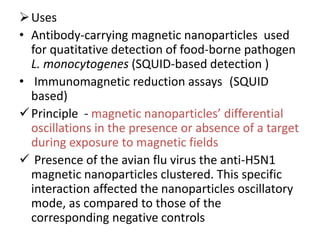
• Magnetic NPs coated with
antibodies for detection of viral
particles. (MAGNETIC
RELAXATION SWITCHES)
• These particles will form
aggregates only in the presence
of target viruses
• Results in detectable changes in
magnetic relaxation times of
protons in the surrounding media
(relaxation describes how fast
spins"forget" the direction in
which they are oriented).
• The rates of this spin relaxation
can be measured by
relaxometers
• Detect as little as 5 viral particles
of Herpes Simplex or Adenovirus
in 10 μL 25 % serum samples.
• 100% serum samples, detection
threshold was 10 virions per 10
μL.
Nanoarrays
• Nanochips can be prepared for the fast identification of
biomolecules, using gold or silica nanoparticles supported
on thin silicon layers
• Due to their small , can screen samples in a high-
throughput format requiring minute sample volumes
• The Nano eNabler System™ (BioForce Nanosciences )
 Advantage
• Nanoarrays utilize approximately 1/10,000th
of the surface area occupied by a conventional microarray
• Over 1,500 Nanoarray spots can be placed in the area
occupied by a single microarray spot
• very small quantities (0.1 micro gram)of individual
proteins can now be effectively screened
 Nanoarrays have been fabricated using
• Inkjet printing
• Electrochemistry
• Microfabricated surface patterning
• Photolithography with either pre-assembled mask or micromirror-based
apparatus.
 Nanoarray can be constructed on diverse surfaces
• silicon, silanes, hydrogels, metallic and polydimethylsiloxane
 Detection of a target can be achieved with
• AFM
• Surface plasmon resonance
• Electrical current detectors.
 The nanoarray can utilize various probes
• Antibody, nucleic acid, deposited in 1 – 30 μm dropletS
• In addition to these entities, Qdots can be further applied leading to the
construction of multiplexed nanoarrays capable of screening minute
samples in large libraries of potential pathogenic agents
 USES
 Detection of HIV 1 in plasma
 METHODOLOGY
 DPN was used to generate nanoscale patterns of antibodies against the
HIV-1 p24 antigen on a gold surface
 Feature sizes were less than 100-nm
 HIV-1 p24 antigen in plasma obtained directly from HIV-1-infected
patients was hybridized to the antibody array in situ, and the bound
protein was hybridized to a gold antibody- nanoparticle probe for signal
enhancement.
 The nanoarray features confirmed by AFM
 Demonstration of measurable amounts of HIV-1 p24 antigen in plasma
having less than 50 copies of RNA per ml (corresponding to 0.025 pg per
ml)
 Nanoarray-based assay can exceed the limit of detection of conventional
ELISA based immunoassays (5 pg per ml of plasma) by more than 1000-
fold.
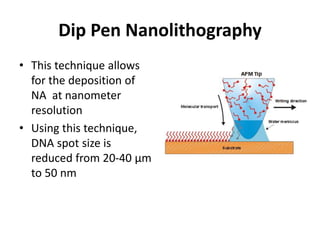
Dip Pen Nanolithography
• This technique allows
for the deposition of
NA at nanometer
resolution
• Using this technique,
DNA spot size is
reduced from 20-40 μm
to 50 nm
Nanocantilevers
• The cantilever is made of silicon with a tip
radius of curvature on the order of nm.
• Advanced sensors.
• Can be conjugated with nucleic acids,
antibodies.
Uses
• Atomic force microscopy
• Cantilever based arrays
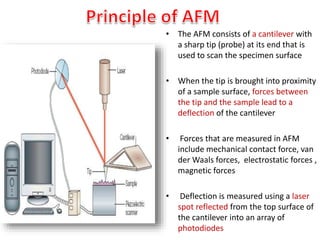
• The AFM consists of a cantilever with
a sharp tip (probe) at its end that is
used to scan the specimen surface
• When the tip is brought into proximity
of a sample surface, forces between
the tip and the sample lead to a
deflection of the cantilever
• Forces that are measured in AFM
include mechanical contact force, van
der Waals forces, electrostatic forces ,
magnetic forces
• Deflection is measured using a laser
spot reflected from the top surface of
the cantilever into an array of
photodiodes
Useful for visualizing: surface of hydrated cells and
membranes on the nanoscale
To probe the nanoscale chemical & physical properties of
cell surfaces
To localize single molecular recognition sites
To locally probe biomolecular forces & physical properties
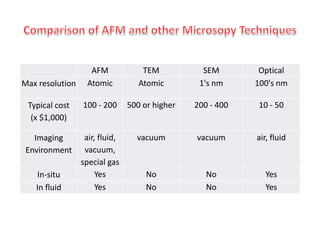
AFM TEM SEM Optical
Max resolution Atomic Atomic 1's nm 100's nm
Typical cost
(x $1,000)
100 - 200 500 or higher 200 - 400 10 - 50
Imaging
Environment
air, fluid,
vacuum,
special gas
vacuum vacuum air, fluid
In-situ Yes No No Yes
In fluid Yes No No Yes
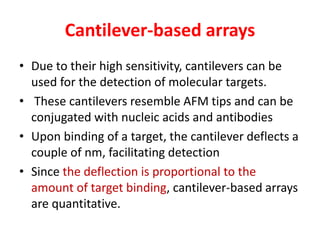
Cantilever-based arrays
• Due to their high sensitivity, cantilevers can be
used for the detection of molecular targets.
• These cantilevers resemble AFM tips and can be
conjugated with nucleic acids and antibodies
• Upon binding of a target, the cantilever deflects a
couple of nm, facilitating detection
• Since the deflection is proportional to the
amount of target binding, cantilever-based arrays
are quantitative.
Nanotechnology in Food Industry
• A microscopic biological
sensor that detects
Salmonella bacteria in
lab tests has been
developed
• The sensor could be
adapted to detect other
food borne pathogens
as well.
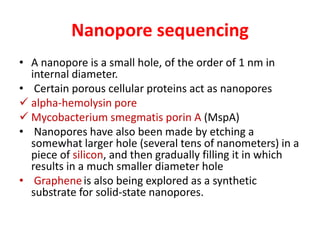
Nanopore sequencing
• A nanopore is a small hole, of the order of 1 nm in
internal diameter.
• Certain porous cellular proteins act as nanopores
 alpha-hemolysin pore
 Mycobacterium smegmatis porin A (MspA)
• Nanopores have also been made by etching a
somewhat larger hole (several tens of nanometers) in a
piece of silicon, and then gradually filling it in which
results in a much smaller diameter hole
• Grapheneis also being explored as a synthetic
substrate for solid-state nanopores.
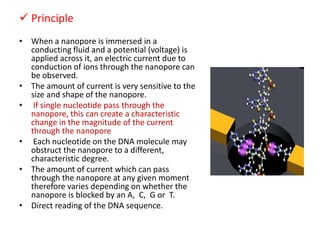
 Principle
• When a nanopore is immersed in a
conducting fluid and a potential (voltage) is
applied across it, an electric current due to
conduction of ions through the nanopore can
be observed.
• The amount of current is very sensitive to the
size and shape of the nanopore.
• If single nucleotide pass through the
nanopore, this can create a characteristic
change in the magnitude of the current
through the nanopore
• Each nucleotide on the DNA molecule may
obstruct the nanopore to a different,
characteristic degree.
• The amount of current which can pass
through the nanopore at any given moment
therefore varies depending on whether the
nanopore is blocked by an A, C, G or T.
• Direct reading of the DNA sequence.
Advantage
• Without PCR amplification step
• Chemical labelling step
• Read genomic DNA at a speed of hundreds to
thousands of bases per second
Nanomethods can alter Quorum Sensing
• The nanofactories could
trick the bacteria into
sensing a quorum too
early
• Doing so would trigger
the bacteria to try to form
an infection before they
reach critical mass
• This would prompt a
natural immune system
response capable of
stopping them without
the use of drugs
• Magnetic nanoparticles (assembled by first co-precipitating
nanoparticles of iron salts and the biopolymer chitosan, E.
coli AI-2 synthases, Pfs and LuxS, are then covalently
tethered onto the chitosan)
• Chitosan serves as a molecular scaffold and provides cell
capture ability; magnetite provides stimuli responsiveness
• These enzymes synthesize autoinducer-2 (AI-2),"universal"
bacterial quorum-sensing signal molecule, from metabolite
S-adenosylhomocysteine
• Nanoparticles synthesise and deliver to the surface of
Escherichia coli.
• These magnetic nanofactories are shown to modulate the
natural progression of quorum-sensing activity.
• New prospects for small molecule delivery, based on
localized synthesis, are envisioned.
Application of nanotech in
therapeutics
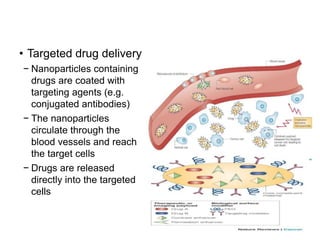
• Targeted drug delivery
− Nanoparticles containing
drugs are coated with
targeting agents (e.g.
conjugated antibodies)
− The nanoparticles
circulate through the
blood vessels and reach
the target cells
− Drugs are released
directly into the targeted
cells
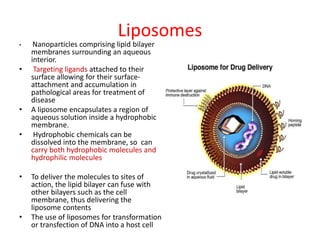
Liposomes
• Nanoparticles comprising lipid bilayer
membranes surrounding an aqueous
interior.
• Targeting ligands attached to their
surface allowing for their surface-
attachment and accumulation in
pathological areas for treatment of
disease
• A liposome encapsulates a region of
aqueous solution inside a hydrophobic
membrane.
• Hydrophobic chemicals can be
dissolved into the membrane, so can
carry both hydrophobic molecules and
hydrophilic molecules
• To deliver the molecules to sites of
action, the lipid bilayer can fuse with
other bilayers such as the cell
membrane, thus delivering the
liposome contents
• The use of liposomes for transformation
or transfection of DNA into a host cell
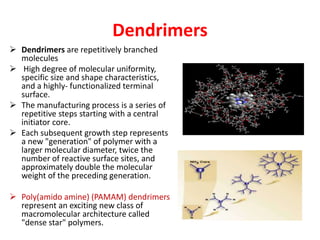
Dendrimers
 Dendrimers are repetitively branched
molecules
 High degree of molecular uniformity,
specific size and shape characteristics,
and a highly- functionalized terminal
surface.
 The manufacturing process is a series of
repetitive steps starting with a central
initiator core.
 Each subsequent growth step represents
a new "generation" of polymer with a
larger molecular diameter, twice the
number of reactive surface sites, and
approximately double the molecular
weight of the preceding generation.
 Poly(amido amine) (PAMAM) dendrimers
represent an exciting new class of
macromolecular architecture called
"dense star" polymers.
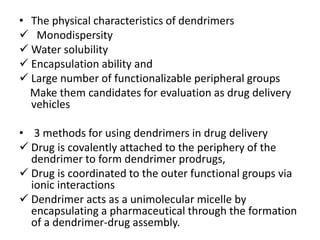
• The physical characteristics of dendrimers
 Monodispersity
 Water solubility
 Encapsulation ability and
 Large number of functionalizable peripheral groups
Make them candidates for evaluation as drug delivery
vehicles
• 3 methods for using dendrimers in drug delivery
 Drug is covalently attached to the periphery of the
dendrimer to form dendrimer prodrugs,
 Drug is coordinated to the outer functional groups via
ionic interactions
 Dendrimer acts as a unimolecular micelle by
encapsulating a pharmaceutical through the formation
of a dendrimer-drug assembly.
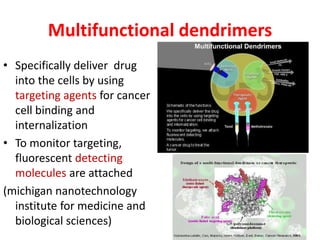
Multifunctional dendrimers
• Specifically deliver drug
into the cells by using
targeting agents for cancer
cell binding and
internalization
• To monitor targeting,
fluorescent detecting
molecules are attached
(michigan nanotechnology
institute for medicine and
biological sciences)
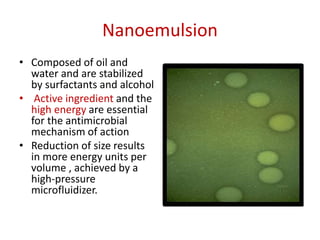
Nanoemulsion
• Composed of oil and
water and are stabilized
by surfactants and alcohol
• Active ingredient and the
high energy are essential
for the antimicrobial
mechanism of action
• Reduction of size results
in more energy units per
volume , achieved by a
high-pressure
microfluidizer.
• The nanoemulsion particles
are driven to fuse with lipid-
containing organisms.
• By the electrostatic attraction
between the cationic charge of
the emulsion and the anionic
charge on the pathogen.
• When enough nanoparticles
fuse with the pathogens, they
release part of the energy
trapped within the emulsion.
• Both the active ingredient and
the energy released destabilize
the pathogen lipid membrane,
resulting in cell lysis and death
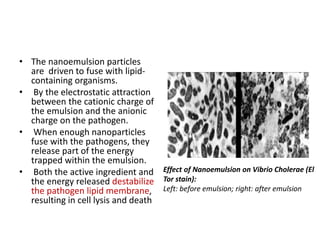
Effect of Nanoemulsion on Vibrio Cholerae (El
Tor stain):
Left: before emulsion; right: after emulsion
• Michigan nanotechnology institute for
medicine and biological sciences has
developed nanoemulsion broad spectrum
activity against bacteria (e.g., E. coli,
Salmonella, S. aureus), enveloped viruses
(e.g., HIV, Herpes simplex), fungi (e.g.,
Candida, Dermatophytes), and spores (e.g.,
anthrax)
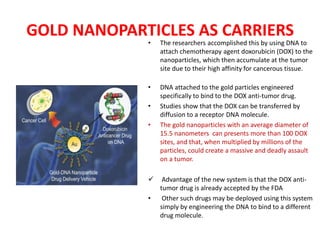
GOLD NANOPARTICLES AS CARRIERS
• The researchers accomplished this by using DNA to
attach chemotherapy agent doxorubicin (DOX) to the
nanoparticles, which then accumulate at the tumor
site due to their high affinity for cancerous tissue.
• DNA attached to the gold particles engineered
specifically to bind to the DOX anti-tumor drug.
• Studies show that the DOX can be transferred by
diffusion to a receptor DNA molecule.
• The gold nanoparticles with an average diameter of
15.5 nanometers can presents more than 100 DOX
sites, and that, when multiplied by millions of the
particles, could create a massive and deadly assault
on a tumor.
 Advantage of the new system is that the DOX anti-
tumor drug is already accepted by the FDA
• Other such drugs may be deployed using this system
simply by engineering the DNA to bind to a different
drug molecule.
• Antibiotics and are also considered as objects that can be delivered by
gold nanoparticles.
• Possibility of producing a stable complex of vancomycin and gold and the
efficacy of such a complex against various enteropathogenic strains of
Escherichia coli , Enterococcus faecium , Enterococcus faecalis (including
vancomycin-resistant strains) have also been demonstrated
• Similar results were obtained in a complex of ciprofloxacin with gold
nanoshells showed high antibacterial activity towards E. coli .
• Gold nanoparticles used as antigen carriers were shown to stimulate the
phagocytic activity of macrophages and affect the functioning of
lymphocytes, (immune-modulating effect)
• Gold nanoparticles and antigen conjugates stimulate the respiratory
activity of the cells of the reticulo-endothelial system and the activity of
the mitochondrial enzymes of macrophages, adjuvant properties of gold
Nanofibers
• Nanofibers are defined as fibers with
diameters on the order of 100 nanometers.
• Researchers around the world are searching
for ways to produce polymer nanofibers.
• There are more than 70 research groups
worldwide investigating polymer nanofibers
produced by electrospinning method.
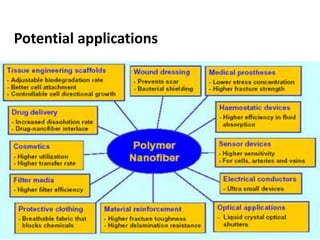
Potential applications
Nanotechnology in microbiology

Nanotechnology in microbiology

  • 1.
  • 2.
    Nanotechnology • “Nano ”means very small, and it comes from the Greek word “nanos”, meaning dwarf • Nanotechnology by defination is the art and science of manipulating matter at the nanoscale. • Thus encompassing nanoscale science and involves manipulating matter at 1 to 100 nm length scale.
  • 3.
    A nanometer is onebillionth of a meter Roughly the width of three or four atoms. Average human hair is about 25,000 nanometers wide.
  • 5.
    What happens atthe nanoscale? • At the nanoscale, the physical, chemical, and biological properties of materials differ in fundamental and valuable ways from the properties of individual atoms and molecules or bulk matter. • Nanotechnology R&D is directed toward understanding and creating improved materials, devices, and systems that exploit these new properties
  • 6.
    Limitation of currenttechnologies • High cost and short shelve half-life of some reagents such as enzymes and DNA primers, limit the application of most conventional pathogen detection techniques in developing nations. • ELISA and PCR, require extensive sample preparation and have long readout times, which delay prompt response and disease containment.
  • 7.
    The potential ofnanotechnology • Due to unique electrical, magnetic, luminescent, and catalytic properties of nanomaterials • Faster, sensitive and more economical diagnostic assays can be developed • Without any sample preparation, providing fast and reliable results in simple and user- friendly formats
  • 8.
    • The propertiesof the nanomaterials used for pathogen detection can be tailored by changing the size, shape, composition and surface modification of the nanomaterial. • Electronic, spectroscopic (emissive, absorptive), light scattering and conductive properties can be modified by engineering the nanoparticles’ structural parameter: size, composition and binding properties
  • 9.
    Methodology of Nanotechnology 2Approaches • Bottom-up approach: Going from molecules to the next higher levels of biological organization : how molecular components in cells interact with each other and how they are organized into functional modules performing discrete tasks that any single class of molecules cannot accomplish • Top down approaches: The top-down controls that operate in living cells entails studying how regulatory modules are coupled to one another and to gene transcription.
  • 10.
    Nanotechnology Applications Information TechnologyEnergy Medicine Consumer Goods • Smaller, faster, more energy efficient and powerful computing and other IT-based systems • More efficient and cost effective technologies for energy production − Solar cells − Fuel cells − Batteries − Bio fuels • Foods and beverages −Advanced packaging materials, sensors, and lab-on-chips for food quality testing • Appliances and textiles −Stain proof, water proof and wrinkle free textiles DIAGNOSTIC THERAPEUTIC PATHOGENESIS
  • 11.
    Nanotechnology tools &their applications in microbiology • Qdots • Nanoparticles  Gold  Silver  Silicone  Magnetic  Flourescent polymeric • Nanopores • Nanocantilevers • Nanoemulsion • Liposomes • Nanopores • Nanofibres
  • 12.
    Qdots • Size :10 to 20nm • Core : Semiconductor material cadmium selenide • Shell : Semiconductor shell ( zinc sulfide ) stabilizes the core, improve optical and physical properties • Polymer : Incorporates functional groups that confer water solubility & provides platform for covalent attachment of biomolecules like antibodies, streptavidin, oligonucleotide.
  • 13.
    • Qdots canemit light in different wavelengths upon excitation • By modulating their size, Qdots’ can be excited at a given wavelength and have tunable emission from the ultra-violet (UV) to the near infra-red (NIR) region.
  • 14.
    • Advantage – Confer targeting specificity for biomolecular detection.  Incorporate multiple affinity reagent—(dye- labeled conjugates in which multiple dyes are attached to a single affinity reagent) Highly bright and extremely photostable(no photobleaching)
  • 15.
    • Simultaneous detection ofdifferent targets in a serum sample using QDs of different sizes, functionalized with different recognition moieties: peptide/protein (QD1), biotin (QD2), oligonucleotide (QD3), antibodies (QD4).
  • 16.
    • Uses - FRET-Based Quantum Dot Immunoassay for Rapid and Sensitive Detection of Aspergillus amstelodami  Confocal nanoscope  Quantum dot barcodes have been used for the detection of viruses, such as HIV and Hepatitis, via a sensitive handheld diagnostic system  Qdot-based FISH probes have been widely used for the detection of the Y- chromosome in fixed human sperm cells  Qdot-FRET-based nanosensors (Qdot act as donor) mediated ultrasensitive detection of low concentrations of target DNA in the diagnosis of genetic diseases
  • 17.
    FRET-based Qdot immunoassay Initial complex formed when a quencher-labeled analyte bound the antigen-binding site of QD- conjugated antibody  When excited, QD transfer its energy to the quencher molecules due to their close proximity.  Addition of target analytes, leads to displacement of quencher-labeled analytes causes disruption of FRET, which translates to increased QD donor emission signal.
  • 18.
    Stimulated emission depletion microscopy •STED 4Pi microscopy increases the resolution of fluorescence confocal microscopy over 10-fold, to give 3-D images at 30- to 40-nm resolution. • Accomplished by using a red-shifted wavelength that masks out the fluorescence in all but a small area,. • Mask is created by positioning two objectives opposite to each other so that they create an interference pattern in the image plane where the two beams cancel each other in a “null node.” • The fluorescence ( green) can only be observed in the center of this hole where the red-shifted intensity is too low to mask it. • The effective size of the doughnut hole can be made arbitrarily small by increasing the laser intensity.
  • 19.
    Quantum dot barcodes A‘microbead’ acts as a host structure that contains designed quantities of QDs with different emission wavelengths. This creates unique emission spectra varying in colour and intensity. These microbeads, with different emission spectra, were used to tag biological samples The quantum dot-barcoded microbeads are sequentially introduced into the chip.
  • 20.
     The assayrequires 20 min, has a limit of detection of 1.2 nM, and can detect genetic targets for HIV, hepatitis B, and syphilis.  This study provides a simple strategy to automate the entire barcode assay process and moves barcoding technologies one step closer to point-of-care applications
  • 21.
    Gold and SilverNPs • The optical absorption and scattering spectra of gold NPs exhibit a pronounced peak in the the plasmon resonance (the collective excitation of the free electron gas) • Surface chemistries of gold NPs can be controlled by grafting thiol molecules or thiol-containing polymers, as the gold surface exerts strong affinity towards sulfhydryl groups leading to the formation of relatively strong covalent bonds. • Hence, further surface modification can be done simply by using thiolated functional molecules, facilitating conjugation of various probes, including antibodies and nucleic acids.
  • 22.
    •As particle sizeincreases wavelength of surface plasmon resonance related absorption shifts to longer, redder wavelengths. • Red light absorbed, blue light reflected, solutions of pale blue or purple color
  • 23.
    • Various typesof gold plasmon- resonance nanoparticles: a) 16-nm nanospheres b) nanorods c) bipyramids , d) nanorods with silver coating e)“nanorice” – Fe 2 O 3 nanorods covered by a gold nanoshell f) gold nanoshells onto silica cores, SiO 2 /Au g) nanobowls with a gold seed on the bottom h)“spiky nanoshells” with SiO 2 /Au cores i)tetrahedra, octahedra J)nanocubes K)silver nanocube L) gold-silver nanocages
  • 24.
    • Uses Sol particleimmunoassay (SPIA)  Surface plasmon resonance biosensors  Resonance scattering confocal microscopy or two-photon luminescence confocal microscopy Nanochips and nanoarrays Carriers for drugs
  • 25.
    Sol particle immunoassay •a) conjugate aggregation caused by binding to target molecules • b) corresponding changes in color and absorption spectra when particles approach a distance that is less than 1/10nth of their diameter, • the sol’s red color changes into purple as the absorption spectrum broadens and shifts into red region • detected either spectrophotometrically or visually
  • 26.
    Immunoassay  Schistosomes (Ag) Rubella viruses (Ag) Leptospira in urine  Quantitative determination of immunoglobulins Direct detection of cancer cells and Markers of Alzheimer’s disease
  • 27.
    • Modified SPIAmethod proposed for colorimetric detection of DNA. • Use of GNP conjugated with thiol-modified single-stranded DNA of 10–30 nm size • Hybridization of targets and probes results in formation of GNP aggregates, changes in absorption spectrum of solution and can be detected visually
  • 28.
    Surface plasmon resonancebiosensors • GNP in ordered structures ( thin films ) or within polymer matrices • Biospecific interactions into an optical signal. • In SPR biosensing experiment, a ligand (antibodies) immobilized on an SPR-active gold-coated glass slide . • Buffer solution containing antigen is injecting through flow-cell • When light (visible or near infrared) is shined through glass slide onto gold surface at wavelengths near the “surface plasmon resonance” condition, the optical reflectivity of the gold changes very sensitively with the presence of biomolecules on the gold surface • High sensitivity of the optical response is due to collective excitation of conduction electrons near the gold surface • The extent of binding between the solution- phase interactant and the immobilized interactant quantified by monitoring this reflectivity change
  • 29.
     Advantage ofSPR is high sensitivity without any labeling of interactants. • Application  immunodiagnostics  tick-borne encephalitis  HPV and HIV  Alzheimer’s disease  allergens  cytokines  detecting tumor
  • 30.
    Two-photon luminescence confocal microscopy •Object’s luminescence is excited due to the simultaneous absorption of two (or more) photons; the energy of each of them being lower than that required for fluorescence excitation. • laser scanning confocal microscopy, without pinholes • Optical sectioning of the sample is instead achieved through the use of a mode-locked Ti:sapphire laser which operates in the near-infrared • The laser produces a high photon density that is tuned to a wavelength about twice that of the intended absorption wavelength of the sample. • Two or more photons are required at a single point to produce an optical signal (i.e. excitation) that can be detected. • The probability of such a two-photon event occurring is limited to the focal plane where there is an extremely high photon density. • As a result, excitation occurs only at the plane of focus • The use of two-photon luminescence of gold nanoparticles allows to visualize object
  • 31.
     The majoradvantage of this method is that the strong decrease in the background signal results in the contrast being enhanced.
  • 32.
    Fluorescent polymeric nanoparticles •linear or branched polymer coating • presence of functional groups on the polymer coating confers attachment of probes • Encapsulated fluorophore within the nanoparticle’s cavity  Advantage  Photostability  polymer protects fluorophore  Detection by fluorescence spectrometer, flow cytometer, and fluorescence-recording microtiter plate reader
  • 33.
     Uses  Antibody-conjugatedflourescent silica nanoparticles single bacterium detection was achieved in less than 20 minutes ( E. coli O157:H7 in processed ground beef samples) Bacterial species quantified, such as Salmonella and Bacillus, indicating that this method can be used for both Gram-negative and Gram-positive microorganisms. • The nanoparticle assay’s readout time was faster than that of the plate-counting (gold standard) (16 – 18 h). • High-throughput capability using a microtiter plate reader, which can achieve bacterial quantification from 1 to 400 bacterial cells. Thus, its clinical utility is significant, especially for the detection of highly infectious agents in low count  Adenovirus was quantified in nasopharyngeal samples
  • 34.
    Magnetic nanoparticles • Ironoxide core • Coated with polymers, such as dextran, polyacrylic acid and silica • Functional groups, such as amino and carboxylic acids, making subsequent conjugations easy. • Carry diverse ligands, such as peptides, small molecules, proteins, antibodies and nucleic acids. • Uses • Identification and quantification of mRNA, DNA, viruses, bacteria and cells • Monitoring of enzymatic and metabolic activity • Detection with magnetic nanoparticles achieved with magnetic relaxation nanosensors, magnetometers or superconducting quantum interference device (SQUID), which record alterations in the magnetic properties of the particles upon molecular interactions with a target
  • 35.
    Uses • Antibody-carrying magneticnanoparticles used for quatitative detection of food-borne pathogen L. monocytogenes (SQUID-based detection ) • Immunomagnetic reduction assays (SQUID based) Principle - magnetic nanoparticles’ differential oscillations in the presence or absence of a target during exposure to magnetic fields  Presence of the avian flu virus the anti-H5N1 magnetic nanoparticles clustered. This specific interaction affected the nanoparticles oscillatory mode, as compared to those of the corresponding negative controls
  • 36.
    • hMRS arecomposed of a polymer-coated iron oxide nanoparticle and are chemically modified to specifically bind to a DNA marker that is unique to a particular pathogen. • When the hMRS bind to the pathogen's DNA, a magnetic resonance signal is detected, which is amplified by the water molecules that surround the nanoparticle • Change in the magnetic signature can be read on a computer screen or portable electronic device, such as a smartphone, and determine whether the sample is infected with a particular pathogen. • Mycobacterium avium spp. paratuberculosis (MAP) • Can detect MAP DNA in blood samples via changes in magnetic signal in 1 hour Hybridizing magnetic relaxation nanosensors (hMRS)
  • 37.
    • Magnetic NPscoated with antibodies for detection of viral particles. (MAGNETIC RELAXATION SWITCHES) • These particles will form aggregates only in the presence of target viruses • Results in detectable changes in magnetic relaxation times of protons in the surrounding media (relaxation describes how fast spins"forget" the direction in which they are oriented). • The rates of this spin relaxation can be measured by relaxometers • Detect as little as 5 viral particles of Herpes Simplex or Adenovirus in 10 μL 25 % serum samples. • 100% serum samples, detection threshold was 10 virions per 10 μL.
  • 38.
    Nanoarrays • Nanochips canbe prepared for the fast identification of biomolecules, using gold or silica nanoparticles supported on thin silicon layers • Due to their small , can screen samples in a high- throughput format requiring minute sample volumes • The Nano eNabler System™ (BioForce Nanosciences )  Advantage • Nanoarrays utilize approximately 1/10,000th of the surface area occupied by a conventional microarray • Over 1,500 Nanoarray spots can be placed in the area occupied by a single microarray spot • very small quantities (0.1 micro gram)of individual proteins can now be effectively screened
  • 39.
     Nanoarrays havebeen fabricated using • Inkjet printing • Electrochemistry • Microfabricated surface patterning • Photolithography with either pre-assembled mask or micromirror-based apparatus.  Nanoarray can be constructed on diverse surfaces • silicon, silanes, hydrogels, metallic and polydimethylsiloxane  Detection of a target can be achieved with • AFM • Surface plasmon resonance • Electrical current detectors.  The nanoarray can utilize various probes • Antibody, nucleic acid, deposited in 1 – 30 μm dropletS • In addition to these entities, Qdots can be further applied leading to the construction of multiplexed nanoarrays capable of screening minute samples in large libraries of potential pathogenic agents
  • 40.
     USES  Detectionof HIV 1 in plasma  METHODOLOGY  DPN was used to generate nanoscale patterns of antibodies against the HIV-1 p24 antigen on a gold surface  Feature sizes were less than 100-nm  HIV-1 p24 antigen in plasma obtained directly from HIV-1-infected patients was hybridized to the antibody array in situ, and the bound protein was hybridized to a gold antibody- nanoparticle probe for signal enhancement.  The nanoarray features confirmed by AFM  Demonstration of measurable amounts of HIV-1 p24 antigen in plasma having less than 50 copies of RNA per ml (corresponding to 0.025 pg per ml)  Nanoarray-based assay can exceed the limit of detection of conventional ELISA based immunoassays (5 pg per ml of plasma) by more than 1000- fold.
  • 41.
    Dip Pen Nanolithography •This technique allows for the deposition of NA at nanometer resolution • Using this technique, DNA spot size is reduced from 20-40 μm to 50 nm
  • 42.
    Nanocantilevers • The cantileveris made of silicon with a tip radius of curvature on the order of nm. • Advanced sensors. • Can be conjugated with nucleic acids, antibodies. Uses • Atomic force microscopy • Cantilever based arrays
  • 43.
    • The AFMconsists of a cantilever with a sharp tip (probe) at its end that is used to scan the specimen surface • When the tip is brought into proximity of a sample surface, forces between the tip and the sample lead to a deflection of the cantilever • Forces that are measured in AFM include mechanical contact force, van der Waals forces, electrostatic forces , magnetic forces • Deflection is measured using a laser spot reflected from the top surface of the cantilever into an array of photodiodes
  • 44.
    Useful for visualizing:surface of hydrated cells and membranes on the nanoscale To probe the nanoscale chemical & physical properties of cell surfaces To localize single molecular recognition sites To locally probe biomolecular forces & physical properties
  • 45.
    AFM TEM SEMOptical Max resolution Atomic Atomic 1's nm 100's nm Typical cost (x $1,000) 100 - 200 500 or higher 200 - 400 10 - 50 Imaging Environment air, fluid, vacuum, special gas vacuum vacuum air, fluid In-situ Yes No No Yes In fluid Yes No No Yes
  • 46.
    Cantilever-based arrays • Dueto their high sensitivity, cantilevers can be used for the detection of molecular targets. • These cantilevers resemble AFM tips and can be conjugated with nucleic acids and antibodies • Upon binding of a target, the cantilever deflects a couple of nm, facilitating detection • Since the deflection is proportional to the amount of target binding, cantilever-based arrays are quantitative.
  • 47.
    Nanotechnology in FoodIndustry • A microscopic biological sensor that detects Salmonella bacteria in lab tests has been developed • The sensor could be adapted to detect other food borne pathogens as well.
  • 48.
    Nanopore sequencing • Ananopore is a small hole, of the order of 1 nm in internal diameter. • Certain porous cellular proteins act as nanopores  alpha-hemolysin pore  Mycobacterium smegmatis porin A (MspA) • Nanopores have also been made by etching a somewhat larger hole (several tens of nanometers) in a piece of silicon, and then gradually filling it in which results in a much smaller diameter hole • Grapheneis also being explored as a synthetic substrate for solid-state nanopores.
  • 49.
     Principle • Whena nanopore is immersed in a conducting fluid and a potential (voltage) is applied across it, an electric current due to conduction of ions through the nanopore can be observed. • The amount of current is very sensitive to the size and shape of the nanopore. • If single nucleotide pass through the nanopore, this can create a characteristic change in the magnitude of the current through the nanopore • Each nucleotide on the DNA molecule may obstruct the nanopore to a different, characteristic degree. • The amount of current which can pass through the nanopore at any given moment therefore varies depending on whether the nanopore is blocked by an A, C, G or T. • Direct reading of the DNA sequence.
  • 50.
    Advantage • Without PCRamplification step • Chemical labelling step • Read genomic DNA at a speed of hundreds to thousands of bases per second
  • 51.
    Nanomethods can alterQuorum Sensing • The nanofactories could trick the bacteria into sensing a quorum too early • Doing so would trigger the bacteria to try to form an infection before they reach critical mass • This would prompt a natural immune system response capable of stopping them without the use of drugs
  • 52.
    • Magnetic nanoparticles(assembled by first co-precipitating nanoparticles of iron salts and the biopolymer chitosan, E. coli AI-2 synthases, Pfs and LuxS, are then covalently tethered onto the chitosan) • Chitosan serves as a molecular scaffold and provides cell capture ability; magnetite provides stimuli responsiveness • These enzymes synthesize autoinducer-2 (AI-2),"universal" bacterial quorum-sensing signal molecule, from metabolite S-adenosylhomocysteine • Nanoparticles synthesise and deliver to the surface of Escherichia coli. • These magnetic nanofactories are shown to modulate the natural progression of quorum-sensing activity. • New prospects for small molecule delivery, based on localized synthesis, are envisioned.
  • 53.
    Application of nanotechin therapeutics
  • 54.
    • Targeted drugdelivery − Nanoparticles containing drugs are coated with targeting agents (e.g. conjugated antibodies) − The nanoparticles circulate through the blood vessels and reach the target cells − Drugs are released directly into the targeted cells
  • 55.
    Liposomes • Nanoparticles comprisinglipid bilayer membranes surrounding an aqueous interior. • Targeting ligands attached to their surface allowing for their surface- attachment and accumulation in pathological areas for treatment of disease • A liposome encapsulates a region of aqueous solution inside a hydrophobic membrane. • Hydrophobic chemicals can be dissolved into the membrane, so can carry both hydrophobic molecules and hydrophilic molecules • To deliver the molecules to sites of action, the lipid bilayer can fuse with other bilayers such as the cell membrane, thus delivering the liposome contents • The use of liposomes for transformation or transfection of DNA into a host cell
  • 56.
    Dendrimers  Dendrimers arerepetitively branched molecules  High degree of molecular uniformity, specific size and shape characteristics, and a highly- functionalized terminal surface.  The manufacturing process is a series of repetitive steps starting with a central initiator core.  Each subsequent growth step represents a new "generation" of polymer with a larger molecular diameter, twice the number of reactive surface sites, and approximately double the molecular weight of the preceding generation.  Poly(amido amine) (PAMAM) dendrimers represent an exciting new class of macromolecular architecture called "dense star" polymers.
  • 57.
    • The physicalcharacteristics of dendrimers  Monodispersity  Water solubility  Encapsulation ability and  Large number of functionalizable peripheral groups Make them candidates for evaluation as drug delivery vehicles • 3 methods for using dendrimers in drug delivery  Drug is covalently attached to the periphery of the dendrimer to form dendrimer prodrugs,  Drug is coordinated to the outer functional groups via ionic interactions  Dendrimer acts as a unimolecular micelle by encapsulating a pharmaceutical through the formation of a dendrimer-drug assembly.
  • 58.
    Multifunctional dendrimers • Specificallydeliver drug into the cells by using targeting agents for cancer cell binding and internalization • To monitor targeting, fluorescent detecting molecules are attached (michigan nanotechnology institute for medicine and biological sciences)
  • 59.
    Nanoemulsion • Composed ofoil and water and are stabilized by surfactants and alcohol • Active ingredient and the high energy are essential for the antimicrobial mechanism of action • Reduction of size results in more energy units per volume , achieved by a high-pressure microfluidizer.
  • 60.
    • The nanoemulsionparticles are driven to fuse with lipid- containing organisms. • By the electrostatic attraction between the cationic charge of the emulsion and the anionic charge on the pathogen. • When enough nanoparticles fuse with the pathogens, they release part of the energy trapped within the emulsion. • Both the active ingredient and the energy released destabilize the pathogen lipid membrane, resulting in cell lysis and death Effect of Nanoemulsion on Vibrio Cholerae (El Tor stain): Left: before emulsion; right: after emulsion
  • 61.
    • Michigan nanotechnologyinstitute for medicine and biological sciences has developed nanoemulsion broad spectrum activity against bacteria (e.g., E. coli, Salmonella, S. aureus), enveloped viruses (e.g., HIV, Herpes simplex), fungi (e.g., Candida, Dermatophytes), and spores (e.g., anthrax)
  • 62.
    GOLD NANOPARTICLES ASCARRIERS • The researchers accomplished this by using DNA to attach chemotherapy agent doxorubicin (DOX) to the nanoparticles, which then accumulate at the tumor site due to their high affinity for cancerous tissue. • DNA attached to the gold particles engineered specifically to bind to the DOX anti-tumor drug. • Studies show that the DOX can be transferred by diffusion to a receptor DNA molecule. • The gold nanoparticles with an average diameter of 15.5 nanometers can presents more than 100 DOX sites, and that, when multiplied by millions of the particles, could create a massive and deadly assault on a tumor.  Advantage of the new system is that the DOX anti- tumor drug is already accepted by the FDA • Other such drugs may be deployed using this system simply by engineering the DNA to bind to a different drug molecule.
  • 63.
    • Antibiotics andare also considered as objects that can be delivered by gold nanoparticles. • Possibility of producing a stable complex of vancomycin and gold and the efficacy of such a complex against various enteropathogenic strains of Escherichia coli , Enterococcus faecium , Enterococcus faecalis (including vancomycin-resistant strains) have also been demonstrated • Similar results were obtained in a complex of ciprofloxacin with gold nanoshells showed high antibacterial activity towards E. coli . • Gold nanoparticles used as antigen carriers were shown to stimulate the phagocytic activity of macrophages and affect the functioning of lymphocytes, (immune-modulating effect) • Gold nanoparticles and antigen conjugates stimulate the respiratory activity of the cells of the reticulo-endothelial system and the activity of the mitochondrial enzymes of macrophages, adjuvant properties of gold
  • 64.
    Nanofibers • Nanofibers aredefined as fibers with diameters on the order of 100 nanometers. • Researchers around the world are searching for ways to produce polymer nanofibers. • There are more than 70 research groups worldwide investigating polymer nanofibers produced by electrospinning method.
  • 65.

Editor's Notes

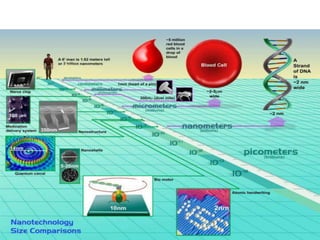
  • #5 Now this is a bit informative 3d chart, providing the size comparisons between different objects raised to the power of 10 meters. Here you can see, a 6 foot man is 1.62 meters or roughly around 2 billion nms tall. While on the other hand, a sample of a DNA molecule, as we have already seen in the previous slide, is approx. 2 nms long.
  • #15 Emerging nanotechnology-based strategies for the identification of microbial pathogenesis Adv Drug Deliv Rev. 2010 March 18; 62(4-5): 408–423.
  • #17  Semiconductor nanocrystals as fluorescent biological labels. Science. 1998;281:2013–2016 FRET-Based Quantum Dot Immunoassay for Rapid and Sensitive Detection of Aspergillus amstelodami. Sensors 2011, 11, 6396-6410
  • #20 Automating Quantum Dot Barcode Assays Using Microfluidics and Magnetism for the Development of a Point-of-Care DeviceACS Appl Mater Interfaces. 2013 Feb 25 Institute of Biomaterials and Biomedical Engineering, Terrence Donnelly Center for Cellular and Biomolecular Research, University of Toronto , 160 College Street, Fourth Floor, Toronto, Ontario M5S 3E1, Canada
  • #25  Gold Nanoparticles in Biology and Medicine: Recent Advances and Prospects Acta Naturae. 2011 Apr-Jun; 3(2): 34–55
  • #37 Nanotechnology used to hunt for hidden pathogens. Science Daily Apr. 9, 2012 — Researchers at the University of Central Florida .
  • #38 In vitro diagnostic prospects of nanoparticles Review Article & Perez JM, Simeone FJ, Saeki Y, Josephson L, Weissleder R. Viral-induced self-assembly of magnetic nanoparticles allows the detection of viral particles in biological media. J. Am. Chem. Soc. 2003;125:10192–10193 Clinica Chimica Acta, Volume 403, Issues 1–2, May 2009, Pages 1-8
  • #41 The Use of Nanoarrays for Highly Sensitive and Selective Detection of Human Immunodeficiency Virus Type 1 in Plasma. Ki-Bum Lee,† Eun-Young Kim,‡ Chad A. Mirkin,*,† and Steven M. Wolinsky*,†,‡ Department of Chemistry and The Institute for Nanotechnology, Northwestern UniVersity, EVanston, Illinois, and DiVision of Infectious Diseases, The Feinberg School of Medicine, Northwestern UniVersity, Chicago, Illinois . NANO LETTERS 2004 Vol. 4, No. 10 1869-1872
  • #53 Metab Eng. 2007 Mar;9(2):228-39. Epub 2006 Dec 15. Magnetic nanofactories: localized synthesis and delivery of quorum-sensing signaling molecule autoinducer-2 to bacterial cell surfaces. Fernandes R, Tsao CY, Hashimoto Y, Wang L, Wood TK, Payne GF, Bentley WE